Archives: Art

  • Not My Circus

    “Not My Circus” by Jason Kotecki. Digital.
    Original is SOLD 🖼️ Shop this art!

    Since 94% of the population suffers from at least a mild form of Adultitis, odds are that anyone with a job has to work with someone infected with this vile disease. Maybe it’s a co-worker, or a client, or – gulp! – the boss. Sometimes, the people I chat with after my speaking programs will confess to being married to someone with a full-blown case of Adultitis.

    So the question, of course, is how do I fix someone who has it?

    Unfortunately, the truth is…you don’t.

    I am a professional speaker. Most speakers I know started their careers with the hope of making a difference and changing lives. I certainly did. If you do it long enough, you’ll likely come across the uplifting statistic that informs you that your audience will probably forget almost everything you said the minute they walk out the door. Eventually, you will realize that you do not have any ability whatsoever to change someone’s life. Entertain, sure. Inspire, maybe. But change? That’s up to them, not you. (Newsflash: this little rule also applies to any husbands, wives, parents, and teachers who may be reading.)

    It’s hard not to feel like you’re a professional exerciser of futility.

    The thing is, the more quickly you accept this reality, the better speaker you become.

    When you are not worried about the guy in the front row crossing his arms, or the lady who ducked out the back, or whether or not you will get a standing ovation, the more you will be able to focus on being your authentic, true self and allow your message to land where it will.

    And THEN you might make some sort of difference for someone.

    You may not make a living from being on stage, but the principle is the same. When dealing with people who have Adultitis, there is only so much you can do. This is it:

    1) Do your best to be a good example. Take yourself lightly. Live your life cheerfully, with humor and joyful anticipation. In the best-case scenario, these people will see and be inspired by your approach to life, and a little will rub off. Maybe they’ll even ask for your secret, and then you can help them on the road to recovery.

    2) If your example alone doesn’t make a dent, you should incorporate their office supplies or car keys into Jell-O molds. (Just kidding.) (Not really.) Maybe you could try sending them flowers or a box of cookies. Maybe they just need someone to notice them and be kind to them.

    3) If you’re still running into a brick wall of Adultitis, your only other option is to ignore them and do your best to limit your exposure to them. You don’t have to be mean about it; you just have to be intentional. Depending on your relationship, you might consider deleting them from your life. Harsh, I know, but life is too short to have the joy sucked out of you by someone with a full-blown case of Adultitis.

    “Whoa, buddy,” you may be thinking. “That’s a little extreme. And it’s not exactly gonna work. This is my spouse you’re talking about,” or “I can’t exactly fire my idiot co-worker.” If extracting yourself from the situation is not an option, you should make it a priority to surround yourself with people who are relatively Adultitis-free. These relationships will help bolster your energy levels and serve as a force field from the Adultitis-ridden zombies in your life. 

    Is it an ideal solution? No, but it’s reality.

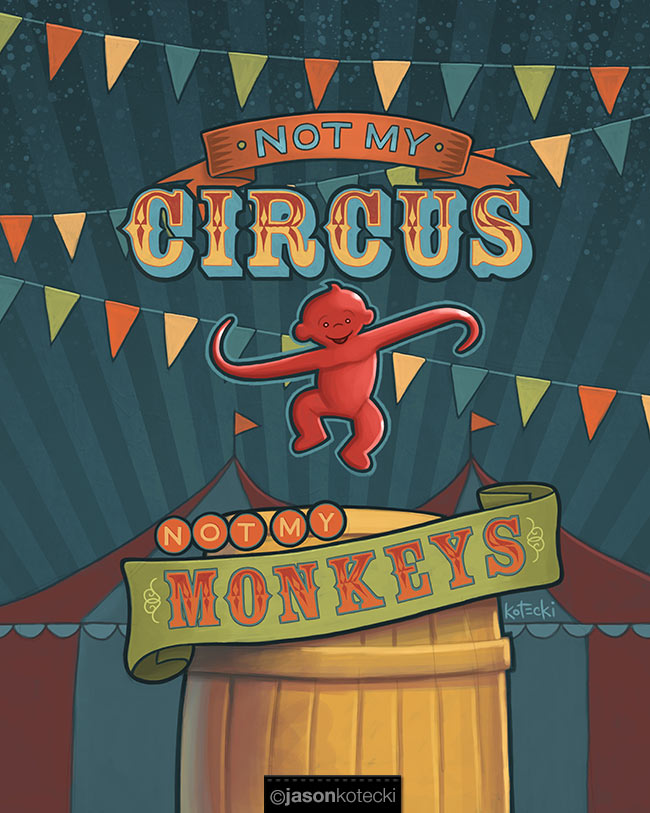
    You are only the ringmaster of your circus and your monkeys. Focus on the things you can control: your attitude, your actions, and the people you choose to spend most of your time with. Let go of the things you can’t.

    Simple, although certainly not easy.

    Striving for an Adultitis-free life will not always yield the results you’d like. You may not be able to make someone change, but it’s always possible to make a difference.

    Don’t be surprised if the difference is in you.

  • Celebrate Everything

    “Celebrate Everything” by Jason Kotecki. Digital.
     Shop this art!

    Too many people treat the calendar as the utmost authority on what constitutes a good reason to celebrate. If a holiday is written in fine print on a particular day in the calendar, we assume it’s safe to throw a party.

    So, if the calendar says it’s Halloween, we dress up in costumes and go bobbing for apples. If the calendar says it’s Independence Day, then we’ll throw meat on the grill and go blow something up. If the calendar says it’s New Year’s Eve, we stay up late, wear funny hats, and use instruments made of paper to make noises that sound like diphtheria-ridden ducks. 

    Contrary to popular belief, your calendar is not the boss of you.

    Making your last mortgage payment is a good reason to throw a party.

    The night before the last day of school is a good reason to throw a party.

    Baby’s first laugh is a good reason to throw a party.

    If a reason seems good enough to you, well then, it’s good enough.

    The calendar as we know it is woefully incomplete. Every single day is a holiday.

    It’s just that most days, what to celebrate is up to you.


  • Open Gate

    “Open Gate” by Jason Kotecki. Digital.
    🖼️ Shop this art!

    There’s always been a danger in naming this brand “Escape Adulthood.”

    You see, it’s easy for people to discount all of us as irresponsible, immature, cotton-headed ninny noggins who are avoiding the responsibilities of adulthood and trying to escape the pressures of the “real world.”

    As a pragmatist, I guess I might be tempted to think the same way if I didn’t know any better. 

    It gives me solace to know that we are not alone. J. R. R. Tolkien, author of those little-known books The Hobbit and The Lord of the Rings, was often accused of writing fairy tales that were nothing more than the escapist’s way out of this so-called real world. His reply was simple and brilliant. He proposed that everything was dependent on that from which one is escaping:

    “We view the flight of the deserter and the escape of a prisoner very differently. Why should a man be scorned if, finding himself in prison, he tries to get out and go home?”

    –J. R. R. Tolkien

    Exactly. 

    Paying bills, upholding responsibility, and making hard decisions; these are important and necessary hallmarks of adult life. But the deep-down person we were when we were kids is much closer to the real us than the stilted version we often present to the world around us.

    Cynicism, common knowledge, and the rules that don’t exist have imprisoned us from being our true selves: passionate, playful, and curious creatures who dream big dreams and are filled with faith, hope, and love.

    So no, we’re not about shirking responsibilities or ignoring reality.

    We’re just trying to get back home.
  • Penguin Possible

    “Penguin Possible” by Jason Kotecki. Digital.
    🖼️ Shop this art!

    “I do have dreams, but I try to keep them realistic.”

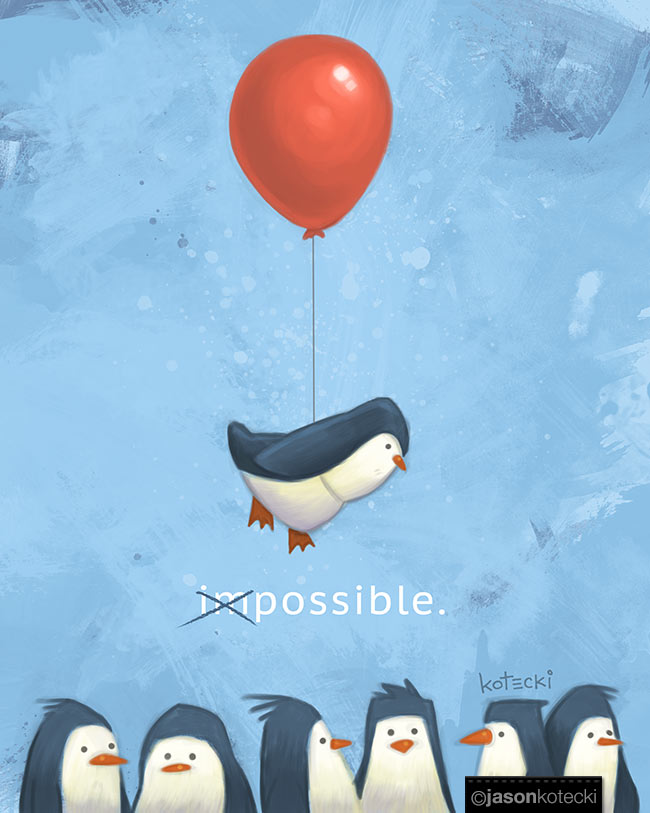
    No one likes to admit they don’t have dreams. But no one likes to be called a fool, either. Or worse yet, a failure. After all, the bigger you dream, the more likely you are to fail. Claiming to have realistic dreams makes you sound smart. It gives the impression that you’re going places, likely to succeed, and are not to be sidetracked chasing any childish, crackpot schemes. But one of those words is terribly problematic.

    The word “realistic.”

    Who’s to say what’s realistic or not?

    Do we really believe that Orville and Wilbur Wright were deemed “realistic” by their fellow townsfolk while they used their bicycle repair shop profits to try and build the world’s first “flying machine”?

    After all, in 1902 (just ONE year before the Wright Brothers’ great success), Lord Kelvin—the otherwise brilliant dude who determined the correct value of absolute zero as approximately –273.15 degrees Celsius—said, “No aeroplane will ever be practically successful.”

    And just fifty-eight years after the Wright Brothers’ breakthrough, was President John F. Kennedy being “realistic” in 1961 when he declared that America would send a man to the Moon by the end of the decade? (By the way, the first handheld pocket calculator would not be invented until five years after Kennedy’s speech.)

    Meanwhile, is it “realistic” today to think that we will ever find a cure for AIDS or autism, or Alzheimer’s disease?

    When it comes to dreams, this world is suffering from a bigness deficiency. I don’t think there’s anybody alive who is dreaming too big. In fact, I’m not even sure it’s possible. I don’t need studies about how much of our brain capacity goes unused to tell me about the potential of mankind. Just look at examples. Whether it’s the invention of the artificial heart, or the guy who climbed Mount Everest blind, or the inspiring examples of Holocaust survivors. We are created to do things that don’t, at first glance, seem very realistic.

    If a dream is realistic, it’s not really a dream. It’s a to-do.

    If you want to be realistic, be realistic about your fears. After all, most of the things you worry about will never happen. But when it comes to your dreams, leave realism at home. At least at the beginning.

    No matter how big you think you’re dreaming, it’s not big enough. A good dream has to be kind of crazy. And improbable.

    “Big dreams create the magic that stir men’s souls to greatness.”

    —Bill McCartney

    If you’re going to dream, you might as well dream big. And if you’re ever accused of dreaming too big, then you can rest assured that you’re on the right track. Just pretend you’re a long-lost member of the Wright clan.

    Don’t worry about being realistic. And be very, very cautious about what you label as “impossible.”

    For as John Andrew Holmes wisely said, “Never tell a young person that something cannot be done. God may have been waiting centuries for somebody ignorant enough of the impossible to do that thing.”

  • Bee Optimistic

    “Bee Optimistic” by Jason Kotecki. 8 x 10. Acrylic on paper.
    Original is SOLD 🔴 Shop this art!

    The phone call came minutes after I walked off stage after a speaking program. It was my wife Kim, alerting me that my dad wanted to arrange an urgent family meeting for the next day. As he has a bit of a history of overhyping things, I couldn’t help but wonder about the true importance of this meeting, especially since the following day was the only day I’d be home in the span of a week.

    A call back to Dad confirmed that the situation was serious, and he was adamant that he didn’t want to tell us the news by phone.

    * Gulp *

    And so began a 24-hour waiting period in which the only thing to do was entertain worst-case scenarios and pray that somehow, things would work out. I spent the rest of the evening trying to get my mind off it, suddenly empathizing with everyone who has ever had to wait for a diagnosis. No matter how dire the news, there is a certain peace in at least knowing what you’re dealing with. But the waiting (and the not knowing) is torture.

    The next day, my brothers and our wives convened at the home of my youngest sibling. While waiting for my parents to arrive, we ate some pumpkin desserts my sister-in-law had whipped up, as if the sweetness would somehow counteract the sour news we all anticipated.

    A million years later, my parent’s car pulled into the driveway. My mom looked like she was wearing a white sweatshirt with the hood pulled over her head. This did not look good, and seemed to confirm our suspicions that this terrible news was centered around her.

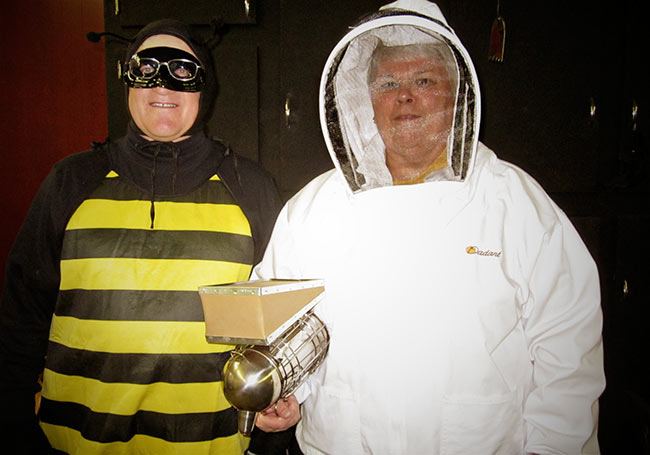
    As they got out of the car, we could see that Mom was in fact wearing a beekeeping costume, and my dad was dressed as a bee!

    What the?!

    We were all confused as could be, but still secretly wished that this ridiculousness was a sign that the news was not as bad as we feared. Maybe this was just “Dad being Dad.”

    Hugs we exchanged and it seemed like my parents were in good spirits. I wanted to exhale, assured that my worst fears were just the by-product of an overactive imagination. I glanced at the uncertain smiles on the faces of my family members and hoped that we’d soon be pleasantly surprised with positive news that we never saw coming.

    Then my dad set up a makeshift cardboard podium in the living room and pulled out a homemade sign made on loose-leaf paper that he taped to the front. It read “Stuff Happens.” Below that was a smiley face next to a frowny face. The frowny face had an “x” through it. Hope quickly evaporated from the room. It felt hard to breathe. We braced for the worst.

    All eyes were fixed on my Dad, who started things off by reminding us of how many tough challenges we’d gotten through as a family over the years. On and on he went, testing the patience of his children and his wife, who was sitting in a chair on the opposite side of the room.

    Finally, this man, my father, the one dressed up like a bee, bravely told us that he had cancer.

    At first, my heart plummeted into my stomach. But as he explained the kind of cancer he had (prostate), shared that they had caught it so early, and told us how high the survival rate was, hope slowly returned. He said that he and Mom had resolved to be positive and optimistic, which is why they decided to lighten the mood by coming dressed in the Halloween costumes they had worn at a party the night before.

    He said, “We hoped it would take a little of the sting out of the news we had to share.”

    I am not even kidding.

    We eventually learned that my parents had worn the costumes for the entire two-hour drive up to Wisconsin, a trip that included a stop to pump gas, as well as a run through the Burger King drive-thru.

    As the mood lightened and we followed my parents’ optimistic lead, all I could think about was, I bet no one in the history of ever has told his family that he had cancer while wearing a bee costume.

    But that’s exactly what my dad did.

    He also served as a shining example of how even though we can’t control what life throws at us, we can control whether or not we’ll go down looking or swing for the fences.

    My dad came though the other side, prostate-free but filled with perspective and gratitude. Since then, my Mom has overcome her own battle with uterine cancer. And both tell me they feel like they won the lottery. In their regular visits to the Cancer Treatment Center of America, they encountered people who were in a much tougher fight, many of whom weren’t likely to make it through. Meanwhile, Kim and I have met a lot of beautiful families through our work with the Make-A-Wish Foundation, all of whom have been dealt hands I wouldn’t wish on my worst enemy. It’s impossible not to want to help.

    But how do you help fight cancer? It’s so big and scary and ugly, and we are so small.

    One of the things my dad does is hand out Bee pins.

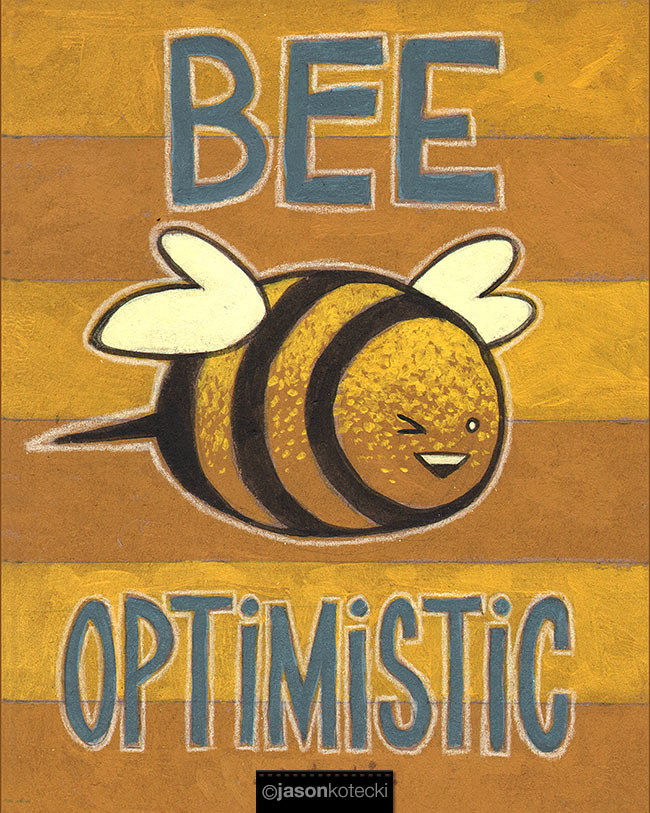
    Shortly after the big meeting with the bee and his keeper, I made a painting for my dad featuring his favorite insect and the message, “Bee Optimistic.” It was equal parts encouragement and tribute to his positivity. He asked if I could make him a “Bee Optimistic” pin that he could wear every day. I did, and he does.

    He’s purchased hundreds of pins, handing them out to anyone he meets who has been touched by the shadow of cancer, like he’s a volunteer at a marathon handing out water to the the runners.

    Because he is.

    Fighting cancer is a hard race. Faith and hope is the water you need to keep going. When my Dad hands out the Bee pins, he is handing out hope. Although the action is small, the impact is huge.

    We can’t control what happens to us in life, but we can control how we react to it. No matter who you are, people are watching, be it your kids, your employees, or your biggest fans.

    Life will throw you curveballs.

    When it does, it always helps to bee optimistic.