Art Series: Food at Play

  • Half Full

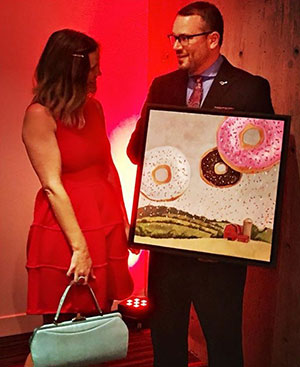
    “Half Full” by Jason Kotecki. 12 x 12. Oil on canvas.
    Original is SOLD 🔴 Shop this art!

    I like to think of myself as an optimistic person. After all, I am a lifelong Cubs fan who always believed in the hope-filled power of next year. Then again, when they lose three games in a row these days, feeling certain that they’ll never win another game again seems pretty pessimistic.

    The truth is, I’m probably a little bit of both. 

    The optimistic side of me believed that Penguins Can’t Fly would be a New York Times best seller. It wasn’t.

    This defeat, along with a number of other epic failures in my career, add up to bolster the popular argument that I should minimize the chance of pain and defeat by keeping my expectations low. 

    This strategy of operating with low expectations is employed by many. The thinking goes that if you don’t get your hopes up about something, then you won’t be as disappointed if it doesn’t work out. And if it turns out well, you’ll get the enjoyment of being pleasantly surprised.

    As it turns out, it’s a flawed strategy.

    According to neuroscientist Tali Sharot, people with high expectations always feel better because how we feel depends on how we interpret the event. 

    When a person with high expectations succeeds, they attribute it to their own traits. When they fail, it wasn’t because they were dumb; it was because the exam happened to be unfair, and next time they’ll do better. When a person with low expectations fails, it was because they were dumb, and if they succeed, it’s because the exam happened to be really easy, and next time reality will catch up with them.

    Secondly, regardless of the outcome, the act of anticipation makes us happy. It’s why people prefer Friday to Sunday, because it brings with it the anticipation of the weekend ahead.

    Finally, optimism acts as a self-fulfilling prophecy. Believing we will be successful makes us more likely to be so, and optimism reduces stress and anxiety, leading to better health.

    When a container is at 50% capacity, it is half full.

    But technically, it’s also half empty.

    Both are absolutely correct assessments of the container in question.

    If the label you give it is completely subjective, go with the one that gives you the best chance of going somewhere beyond what you thought was possible.

    So many of our experiences in life could be seen in the same light. We lose a job. We break a leg. We get dumped by the one we thought was The One. Is that unexpected, unwelcome thing that just happened in your life an obstacle or an opportunity?

    Yes.

    Both are absolutely correct assessments of the event in question.

    Deciding what you call it can make all the difference.

    Was Penguins Can’t Fly a failure?

    Upon further review, believing that it had a chance at being a bestseller led us to put in a lot of effort. It pushed us to think of new and creative ways to promote it, and it got me out of my comfort zone in asking for help. All of these things made a difference. No, it wasn’t a NYT bestseller, but three printings later, and after having outsold my advance (something most published authors never do), it was a success.

    It turns out that optimism is attributed to that success. Without it, I would have always wondered what might have been.

    I don’t know if I’m naturally optimistic or not. These days, even though I still feel fearful about getting my hopes up only to have them dashed, I’m realizing it’s more of a choice than a disposition. 

    We all get to make that choice every single day. To me, there’s really no contest.

    I choose half full.
  • Cupcakes Are Miracles

    “Cupcakes Are Miracles” by Jason Kotecki. 20 x 20. Oil on canvas.
    Original is SOLD 🔴  Shop this art!

    I’ve wanted to be an artist for as long as I can remember. Especially after I found out that the roles of being George Lucas or Superman were already taken.

    Like most artists, I started out making “copies.” I drew Simpsons characters and portraits of athletes and celebrities. It was how I learned my craft. As Elizabeth Gilbert wrote, “Everybody imitates before they can innovate.

    My first real attempt at saying something original was through comics. First, a sports panel cartoon I did in college called Obstructed View, then a comic strip called Kim & Jason. I became inspired by people like Charles Schulz (Peanuts) and Sam Butcher (Precious Moments), and I decided that I wanted to use my art to make a difference.

    I was convinced that Kim & Jason was the way I was destined to do that. I had big dreams, and we worked really hard to make it successful. Undeterred by the scores of syndicate rejections, we tried self-syndication. Craft fairs. Gift shows. Fundraising programs. Some things were moderately successful. Most things failed epically. It never earned enough to live on, and Kim and I had many sleepless nights and tear-filled discussions wondering if we were crazy. 

    Eventually, my experience making a comic strip led me to doing cartooning workshops in schools, which led to speaking at churches, which led to the speaking I now do for associations and companies.

    Speaking became more financially successful than Kim & Jason ever was, and eventually, I became so busy that, after seven years of making a daily comic, I decided to retire the strip.

    Although Kim & Jason inspired many people and generated lots of smiles and laughter, it was hard not to think of my art as a total failure. As my speaking career took off, I put the “art thing” in the closet. I figured my attempt to be an artist had failed, and decided to focus on more “valuable” things. Even though I used my creativity in many ways while growing the business, I pretty much stopped making art. 

    After several years of inactivity — I dramatically call it my “fallow period” — I started to feel the urge to make art again. Little by little, I began to create. I started feeling alive in a way I hadn’t in a long time. So I kept going, eventually sharing it with others. People responded, not just to how it was made, but how it made them feel. And think.

    I got a book deal with a big New York publisher largely because a literary agent saw some art that was shared by a friend of a friend on Facebook. In the design of that book, I marveled at the fact that 90% of the art in the book was created after my “fallow period.” But the book also contained stories, comic strips and paintings from years earlier. It became a love letter to the things in my past that I thought were failures. 

    I finally realized that they weren’t failures; they were the foundation.

    Earlier this month, we hosted Wondernite, a special art collecting event that featured my newest works, all of which were created in the last two years. 

    Ten years ago, when I made the tough decision to retire Kim & Jason, if you’d have told me that new art I’d create would help me land a book deal, and that we’d be able to pull off an event like Wondernite, fill it to capacity, and sell the majority of the original art I brought to sell, I wouldn’t have believed you. I might have punched you in the face for being mean.

    To me, how this journey ultimately unfolded feels very much like a miracle.

    Miracles happen. I’ve seen them, in my own life and in the lives of others. Frustratingly, they are unpredictable and cannot be conjured up on demand.

    I have had my heart broken many times by dreams that didn’t come true and miracles that never materialized. I have been tempted to give up, to quit dreaming and stop waiting for miracles. It seems easier. Less painful, at least.

    But I just can’t.

    I don’t know why sometimes a miracle shows up while other times it doesn’t. Maybe it’s because what we get in return is even better in the long run. Maybe it’s just random luck or something entirely. 

    Whatever it is, I can’t shake the belief that it’s still worth believing in them. 

    It seems like the people who see miracles are the ones who spend more time looking for them.

  • Different is Cool

    “Different Is Cool” by Jason Kotecki. Digital.
    Shop this art!

    Is it possible to be correct when all the experts think you’re nuts?

    Iggy was a doctor who lived in the 1800s and was greatly concerned about the high rate of women dying after childbirth. He knew there had to be a reason for the problem, so he experimented with different solutions. Finally, he figured out a simple practice that was easy to do, and when it was followed, it saved lives.

    His colleagues rejected and ridiculed his idea, branded him a quack, and he was eventually committed to a mental institution, where he died two weeks later. The thing is, his idea worked; he just couldn’t explain why. His solution was too out there, too unorthodox, too different from what the experts were used to.

    What’s so threatening about different?

    Can you imagine turning on your car radio only to hear the same song on every single station?

    What about going to a restaurant that only had one thing on the menu?

    Or firing up Netflix and finding just one show to watch?

    I think we can all agree that a world without options would be very boring indeed. 

    Different is cool.

    Except when it comes to things that challenge our beliefs or question our long-held assumptions.

    The human brain is engineered to be a pattern recognition machine. We are built to notice differences and changes in our environment. It helps us determine a storm is coming that requires us to seek shelter, notice an accident up ahead that suggests we should slow down, or that there is a lion in our camp we might want to avoid. We notice breaks in the pattern and make a prejudgment to feel safe or prepared.

    Lately, we have been struggling with this often helpful but sometimes not-so-helpful feature of noticing differences and making snap judgments. We are taught in after-school specials that prejudice is bad, and if we catch ourselves doing it, we experience feelings of guilt or shame.

    My friend Jessica, a speaker, comedian, and diversity trainer, reminded me that we shouldn’t feel guilty about these judgments and assumptions; after all, they happen automatically and can be useful. What really matters is what we do with them.

    Jessica’s suggestion was this: “When you write that first story, print it as a draft, triple-spaced with extra-wide margins. You do this because you’re anticipating edits.”

    So back to Iggy, formally known as Ignaz Semmelweis. What was his crazeballs idea? Only that doctors should wash their hands before working with patients.

    After his tragic demise, a small group of curious scientists experimented with the procedures he proposed. Eventually, his theories finally gained widespread acceptance years after his death, partly thanks to Louis Pasteur’s scientific confirmation of germ theory.

    He also inspired what is now known as the Semmelweis reflex: a metaphor for a certain type of human behavior characterized by the reflex-like rejection of new knowledge because it contradicts entrenched norms, beliefs, or paradigms.

    Was it a terrible thing for the first reaction from the experts of the day to dismiss Iggy’s idea? No, not necessarily. After all, it went against the pattern of everything they knew to be true at the time. The scientists who originally branded Iggy a crackpot weren’t jerks for thinking that his ideas were weird. They were jerks because they didn’t leave enough room for edits to their original story about him. They should have been open to examining more facts, even if it might lead them away from what they believed to be true. But they weren’t, which is a shame when you think about how many lives could have been saved.

    It’s always a useful exercise to spend time exploring a point of view that is the opposite of what we’re used to. It could be watching a documentary, reading a book, or having a real conversation – not a Facebook fight – with a human being.

    Our brains are pretty great at noticing differences and making assumptions.
    A more constructive alternative to wishing they weren’t so effective at that task might be to figure out whether our assumptions and prejudices are actually serving us, and act accordingly.

    Anticipate edits.

  • Cherry On Top

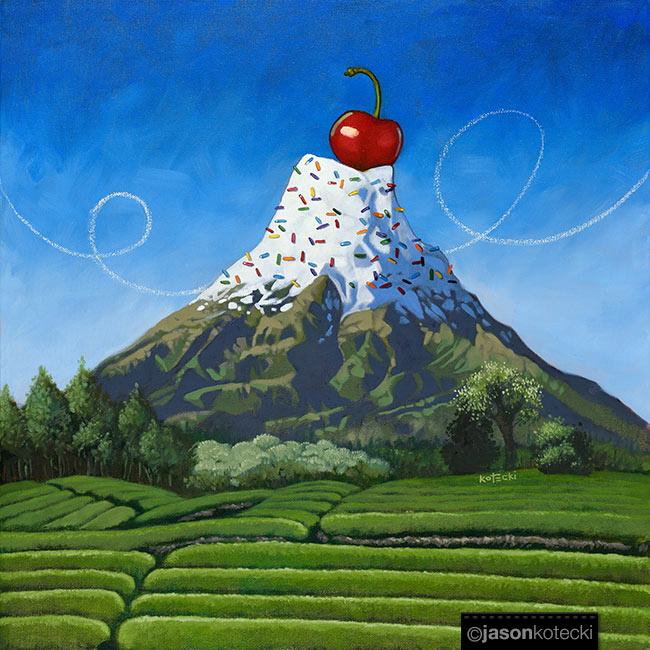
    “Cherry On Top” by Jason Kotecki. 20 x 20. Oil on canvas.
    Original is SOLD 🔴  Shop this art!

    I’m really not a fan of how often I base my happiness on what I haven’t accomplished, or what inconvenience just popped up.

    The truth is, life really is amazing. 

    Unfortunately, Adultitis would have us think differently. 

    Your washing machine goes kaput. You’re in the middle of dinner and realize you don’t have a crucial ingredient. You don’t get the promotion. That nagging cold won’t go away. Your goals are taking longer to achieve than expected.

    It’s easy to get lost in the weeds, focused on what we’re missing or what’s going wrong.

    Sometimes we just need a bit of perspective. The average world income is five thousand dollars. If you make more than that, then you’re in the top 50%. If you make more than $50,000, you’re in the top 0.5%. 

    We live in a time where Oregon Trail is a fun computer game, not a harrowing months-long journey replete with danger and dysentery.

    Are you alive? Do you have a job? Do you have a roof over your head? Do you have something to eat today? Does someone love you? Do you have a dream in your heart? Is today a chance to let go of yesterday and start fresh? Although you may not have said yes to every single one of those questions, I’m betting you can say yes to most. 

    And if that’s true, regardless of what goals remain unattained, or what inconveniences are currently plaguing us, I think we can agree that our lives are pretty dang good. 

    Anything else is a cherry on top.

  • Celebrate Everything

    “Celebrate Everything” by Jason Kotecki. Digital.
     Shop this art!

    Too many people treat the calendar as the utmost authority on what constitutes a good reason to celebrate. If a holiday is written in fine print on a particular day in the calendar, we assume it’s safe to throw a party.

    So, if the calendar says it’s Halloween, we dress up in costumes and go bobbing for apples. If the calendar says it’s Independence Day, then we’ll throw meat on the grill and go blow something up. If the calendar says it’s New Year’s Eve, we stay up late, wear funny hats, and use instruments made of paper to make noises that sound like diphtheria-ridden ducks. 

    Contrary to popular belief, your calendar is not the boss of you.

    Making your last mortgage payment is a good reason to throw a party.

    The night before the last day of school is a good reason to throw a party.

    Baby’s first laugh is a good reason to throw a party.

    If a reason seems good enough to you, well then, it’s good enough.

    The calendar as we know it is woefully incomplete. Every single day is a holiday.

    It’s just that most days, what to celebrate is up to you.