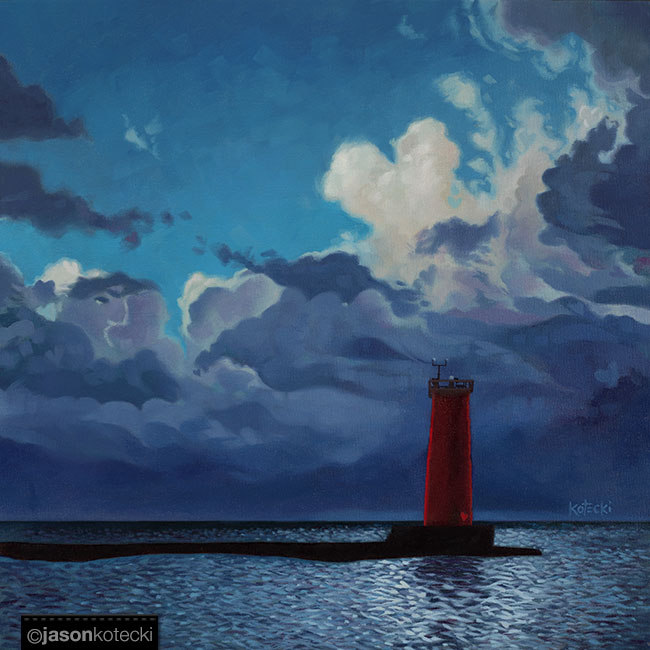
“Seek & Find” by Jason Kotecki. 20 x 20. Oil on canvas. Original is available. 🟢 Shop this art!
My wife has a remarkable superpower for finding hearts in nature, hiding in clouds, flowers, and even her sourdough bread.
One day, we walked along a pier in Lake Michigan. We talked about our business, kids, and future. We lingered at the end of the pier, then walked back, resuming our conversation. Kim casually mentioned seeing fifteen hearts during our walk.
I had seen exactly none.
I marveled at her talent.
But is there such a thing as talent for seeing hearts in nature? I’m not so sure. It’s not like having a beautiful singing voice, exceptional sprinting speed, or a penchant for math.
Kim has a knack for spotting hearts because she spends a lot of time looking for them.
What seems magical to others is often the result of lots of practice.
I once wrote a book about seeing. In it, I talked about storms, the metaphorical kind that blow through our lives. I also wrote about one of our most underrated superpowers: the ability to choose what we look for in the midst of those storms.
Yes, the storms will come. Scary, devastating, faith-shaking storms. They are a given, right up there with death and taxes and missing socks.
But those who see the silver linings are usually the ones looking for them.
It’s not a talent; it’s a practice.
The more you practice, the better you get.
This is true with finding hearts in nature as it is with anything.
So, will this year be worse than last year? Or will it be your best year ever?
Here’s the secret: You don’t have to wait to find out.
The trap is letting external circumstances dictate our answers: the news headlines, the outrage du jour on social media, the ups and downs of life.
It’s hard to view a year of hardship as anything but negative. However, a decade might offer perspective, transforming it into a valuable gift. A little time and practice might turn up a whole host of hidden blessings.
I’m not suggesting you pretend that the tough or terrible moments don’t suck. Being sad, mad, or angry is part of the human experience. We don’t have to bury those emotions under some false blanket of positivity.
Just remember that storms are part of life. The best year isn’t one without failure, conflict, tragedy, or loss.
Kim took the photo that inspired this painting. She saw a heart in the sky near the lighthouse. I enhanced it slightly and added dozens more. I can’t count them all, and you might find some I didn’t add.
That is how it is with cloud watching and wonderhunting and the counting of blessings.
The more you practice, the more you’ll see.
Those who seek shall find.
☕ How would you assess your ability to spot the “hearts” in your life? What’s one way you could practice getting better?
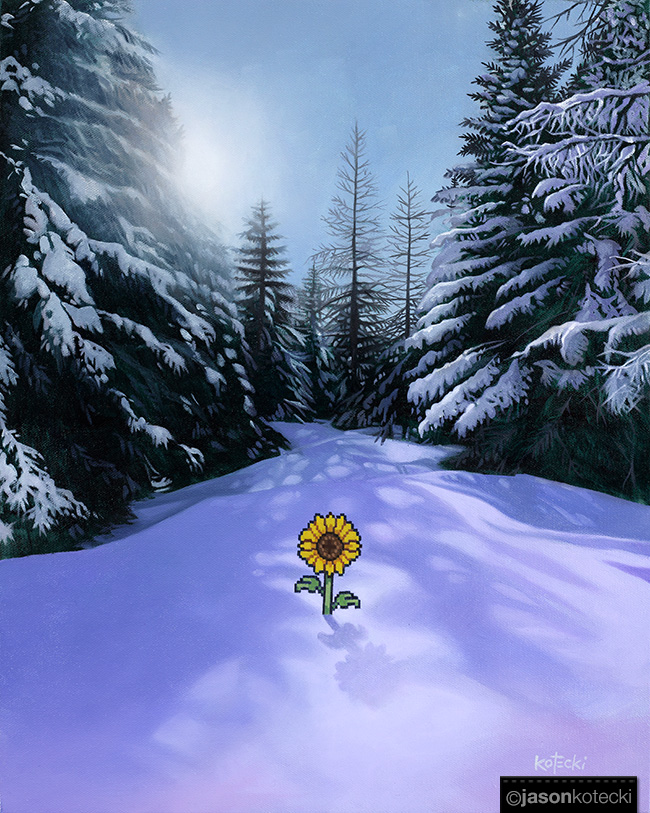
“We Can’t Let Winter Win” by Jason Kotecki. 16 x 20. Oil on canvas. Original is available 🟢 Shop this art!
One thing I love about the Midwest is the seasons. Real ones. Not like those they claim to have elsewhere, so-called “winters” with an occasional snow flurry and temperatures that sometimes flirt below forty.
In Wisconsin, our seasons are pure, not pretenders.
I like that, because it allows me to fully embrace the beauty and lessons of each one. It’s a reflection of life, which has distinct seasons, no matter where we live.
If we’re honest, we’d prefer life to be one long, glorious summer, filled with sunshine and popsicles. But no. There are seasons of autumn, times for slowing down and saying goodbyes. And there are long winters of loneliness, where life feels frozen solid, and hope gets buried under a blanket of snow.
Of course, spring always follows, but sometimes it seems to have overslept.
In Wisconsin, there is always a point when you’re pretty sure winter is over.
Live here long enough, and you realize it’s not.
There’s always one last gasp. One final snowstorm. One more cold snap that steals spring away, just as you were about to elope together on your way to summer.
That might be the most deflating, difficult part of winter: The moment when it appears it will never end, and you don’t know how much more you can take.
Life feels like that sometimes, when it seems like winter’s gonna win.
Winter wins when it convinces us that nothing will ever change.
Winter wins when we let disappointment over unmet expectations turn into resentment.
Winter wins when we allow ourselves to be buried under a blanket of apathy.
Winter wins when we decide to give up and let the hope within us flicker out.
But it doesn’t have to get the final say.
This painting is a reminder that we can’t let winter win.
The 8-bit sunflower is reminiscent of a video game, because I think that’s a good way to think of it. When you’re in the middle of one of life’s winters, everything is heavy. Summer looks so far away. We see all the things that need to change for us to go from where we are to where we want to be, and it feels insurmountable.
Sometimes the answer to the darkness that weighs down on us is a little levity. Making a game out of it is a way to rise above the life-and-death seriousness of our situation. It takes us ever-so-slightly outside ourselves to give us perspective that is a little wider than the restricted, optionless way winter can feel sometimes.
Part of what makes a game engaging and fun is that there is a challenge to it. But the key is for it to be a doable challenge. So instead of focusing on all the ways we are frozen in place and how many more days of winter are ahead, make a game out of finding even one tiny clue that spring is on its way. You don’t need to defeat the Final Boss and save the Princess; you just need to make it past this level.
Today.
The game is this: Figure out how to win today.
It doesn’t have to be big.
It could be one five-minute prayer.
It could be getting dinner on the table.
It could be dumping the bottle of vodka down the drain.
It might just be getting out of bed.
Sometimes the win is just giving it one more day.
I’ve experienced many winters, especially in the early days of building our business. I once got some advice from a business colleague I’ve never forgotten. He, too, was an entrepreneur and knew how discouraging it was to feel like you made one step forward only to take three steps back. He shared a simple policy he lived by. On those really hard days, the days when he didn’t think he could go any further, he promised himself he’d give it one more day. He gave himself permission to abandon ship after that, but not before he gave it one more day.
Sure enough, the next day always brought some glint of hope, a new reason to believe. There was rarely any huge breakthrough that magically happened. Maybe it was a small sale. Maybe it was an encouraging word from a friend. Maybe it was just a good night’s sleep.
Just a baby step forward.
We win when we find evidence that spring is on its way.
We win when hope bursts through a blanket of apathy.
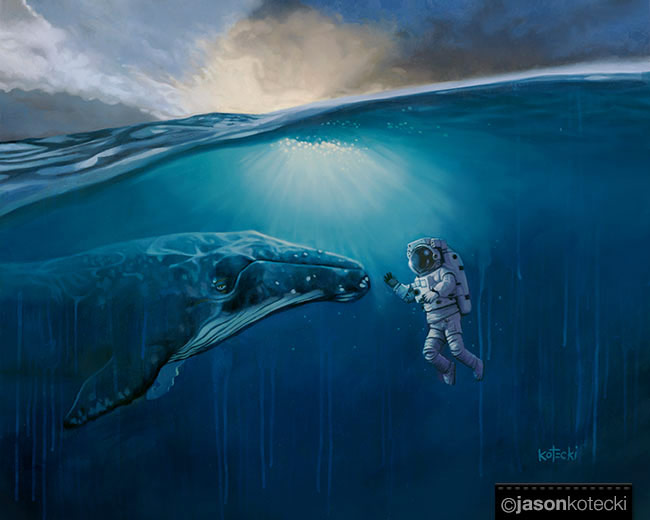
“Great Expectations” by Jason Kotecki. 30 x 24. Oil on canvas. Original is SOLD. 🔴 Shop this art!
I have a confession to make.
I fully expected to marry a brunette. I was pretty vocal about it, even. No blondes for me!
In retrospect, the women who caught my eye when I was young — Princess Leia, Lois Lane, Wonder Woman — were all brunette. Most of the girls I dated in high school were brunettes.
But after I met Kim, who was most definitely not a brunette, I didn’t waste any time wondering if I was making the right choice in spending time with her. I didn’t delay my decision to propose because I was holding out for a brunette to come along. I didn’t miss the opportunity of a lifetime because “this wasn’t the way it was supposed to go.”
I wish I could say I was that flexible with all my expectations.
When I graduated from college with a degree in illustration, I expected I’d make my living as a freelance illustrator. A year into that pursuit led me to realize that I really hated taking orders drawing what other people wanted me to draw.
So I shifted all my attention to a comic strip I had been developing called Kim & Jason. I expected that I’d make my mark in the world by following in the footsteps of Charles Schulz and Bill Watterson.
I put everything into it for six years. Along the way, I fell into speaking, and it started to bring in money. Way more than the comic strip. I eventually made the difficult decision to retire Kim & Jason so I could double down on what was working.
With that decision, it felt that the naysayers were proven right: I really couldn’t make it as an artist. But the only reason they seemed right is that my expectations were wrong.
I once heard a talk by Fr. Mike Schmitz in which he said, “Expectations are a thief of peace.”
I recoiled at the idea at first, because I associate expectations with hope, and hope is good. If expectations are the thief of peace, is the antidote to become a pessimist? Lower the bar? Settle for mediocrity? Slack off? That seemed less than ideal.
Then it occurred to me: An expectation is a prediction.
It’s a prediction about what you think — and maybe even hope — will happen. Sometimes it’s little more than wishful thinking, but it could be a legitimate educated guess with actual data to back it up. And sometimes your prediction is correct and your expectations are met.
But it’s still a prediction.
One you might be making with a wildly insufficient lack of information.
Before I actually started freelancing, I didn’t know how I’d feel creating things that didn’t light me up. When I began my comic strip, I didn’t realize how quickly the internet would decimate newspapers and change the landscape. And back then, I didn’t know anything about the business of professional speaking.
Take a quick review of your life right now. How much current frustration, pain, or sadness is the result of circumstances turning out differently from what you expected?
Is holding on to what didn’t happen keeping you from appreciating all the great things that did and are happening now?
Maybe you can relate to this simple example. Recently, I had a wonderful, tremendously productive day that felt like a failure. One project took waaaay longer than I expected, blowing my to-do list to smithereens. Although some tasks got pushed to another day, I accomplished a few other things I hadn’t planned and took advantage of the unseasonably warm day to enjoy an invigorating walk in the sunshine. It ended with a delicious dinner with my beautiful bride.
By all objective measures, it was a very good day. But it didn’t feel like it.
The thing that soured it?
My expectations.
The day simply didn’t line up according to the timing and order of my expectations. Because some to-dos were left unchecked — even though other great elements were added — somehow it felt like I failed.
This is not a cautionary tale against planning or a list of pro tips to bulletproof your plans. It’s a reminder that it’s hard to appreciate accomplishments when they are in the same room as even one unmet expectation, one missed goal, or one unforeseen event that was out of your control.
In the battle between reality and expectations, reality is undefeated.
Expectations really are a thief of peace. They can ruin a day or derail our dream if we’re not careful.
I believe that God plants dreams in our hearts. The details we imagine in the early stages create enthusiasm that serves as fuel to get moving. But oftentimes, those details reflect immaturity, a lack of imagination, or are limited by the fact that we don’t yet have the relationships, technology, or knowledge that will eventually help us to get there.
Art was my first love; the first talent I discovered, and the one that was most nurtured early in my life. It’s easy to see why I would have the expectation of making it as an artist.
But that was before I took a creative writing class in high school.
It was before I discovered a gift for public speaking in college.
It was before I realized “professional speaker” was an actual job.
And it was before I figured out that my art, writing, and speaking could be combined to create something unique and bigger than the sum of their parts.
Like many people, when I was a young adult, I expected my career to go a certain way. It went a different direction, filled with opportunities and experiences I didn’t even know were possible when I was an 18-year-old kid.
But thirty years ago, if I had been given the choice between my original expectations and a full picture of how my life turned out, I’d choose my current reality.
Every. Single. Time.
And yet, here’s the crazy part: because it doesn’t match up with my original expectation — you know, the one I had when I was a naive, inexperienced teenager — I am sometimes tempted to wonder where I went wrong.
Expectations are a thief of peace.
Holding on to expectations that don’t match reality is a terrific way to go through life frustrated and disappointed.
When we become resentful of missed expectations, we are in danger of also missing other opportunities and blessings we didn’t see coming.
The astronaut in this painting represents a dreamer.
This dreamer has always possessed a spirit of adventure and imagined a life spent exploring the unknown, pushing past the boundaries of human understanding, and experiencing the supernatural enchantment. The dreamer expected this would happen as an astronaut in the context of space.
Instead, the dreamer’s story ended up in the ocean after a visit to Sea World, and now days are spent adventurously exploring the unknown and experiencing enchantment in encounters with sea creatures.
So…did this dreamer’s dream go unfulfilled?
My friend Jessica has some good advice about how we should handle our expectations: “When you write that first story, print it as a draft, triple-spaced with extra wide margins. You do this because you’re anticipating edits.”
Letting go of expectations is not about being pessimistic. One can be optimistic without becoming a slave to expectations. My optimism is grounded in the fact that God has ALL the data, loves me more than I deserve, and tells the best stories. We can make plans and hope for things to go a certain way, while still holding loosely to them, trusting that God may have different (and better!) ones.
If you want more peace in your life, don’t abandon hope.
“You Can Just Do Things” by Jason Kotecki. 30 x 24. Oil on canvas. Original is available. 🔴 Shop this art!
I don’t know who needs to hear this, but you can just do things.
It’s true.
Yet it seems we’re always waiting for something before we can begin.
We are waiting until we get the degree.
We are waiting until the kids leave the nest or until we retire.
We are waiting until we know all the steps.
We are waiting until we finalize the plan.
We are waiting until we feel ready.
We are waiting until we feel courageous.
We are waiting for inspiration.
We are waiting for permission.
We are waiting for the stars to align, the sun to come out, and conditions to be perfect.
We are waiting for just one last thing before the rest of our lives can begin.
Meanwhile, sand slips through the hourglass, turning into minutes, days, and years.
Patience is a virtue, and there are times in life when only patience will do. But more often than not, our waiting is just a form of hiding. Adultitis sabotages us before we even begin.
You can just do things.
Unfortunately, it’s easier to complain. To blame someone else. To wait for instructions, permission, or for the timing to be just right.
But the timing will never seem right.
You don’t have to wait for permission.
You don’t need a hall pass.
You don’t need a note from your parents.
You don’t need a document signed by a notary public.
You can just do things.
As I was working on the manuscript for The Penguin Who Flew, I had the serendipitous opportunity to take a writing retreat to the Outer Banks in North Carolina. It’s the very site where Orville and Wilbur Wright achieved flight for the first time. While I was there, I dove deep into their story. I read “The Wright Brothers” by David McCullough, watched a documentary about their life, and visited the National Monument in Kitty Hawk, standing at the place where they made history.
The Wright Brothers did not wait for permission.
Other people working on achieving sustained flight of an engine-powered, heavier-than-air aircraft were highly educated experts. The Wrights only had high school diplomas. But they didn’t put their dream on pause to get a degree. Instead, they read books on math and physics, studied and observed birds in flight, and collected data from their own experiments. They needed knowledge and experience, not a piece of paper.
They also didn’t wait for funding from investors. Big money went to the more well-known, more highly educated experts in the race. Orville and Wilbur were nobodies, unknown and irrelevant. They didn’t have financial backers, an inheritance from a wealthy father, or a winning lottery ticket in their pocket. They had a mildly successful business that provided just enough profit to self-fund their experiments, bit by bit.
Nor did they wait until they had a full plan in place before taking their first steps. The brothers tinkered, learning as they went. Although the whole point was to figure out how to make a self-powered plane, they didn’t even bother with a motor until they could figure out how to master lift, balance, and control. Their competitors floundered trying to accomplish everything all at once.
Even after the brothers had cracked the nut of manned flight, they were met with doubt and disinterest in their initial attempt to sell their invention to the U.S. government. Instead of giving up, they went to Europe. It was only upon becoming celebrities after successful, public demonstrations in France that the United States finally offered a contract.
You can just do things.
“Whoa, hold up, pal,” you might be saying. “You can’t just be a surgeon without a medical degree.” Well, obviously. Of course. It’s easy to come up with exceptions, but they only prove the rule.
You don’t need permission to change the direction your life is heading, and you don’t need a piece of paper on the wall to start improving your life today.
Real life is not a schoolyard version of kickball, where you wait anxiously for someone to pick you, hoping it’s sooner rather than later.
Adultitis is the king of convincing you that you absolutely need just one more thing before you begin. It’s really just trying to kill time and run out the clock on you.
Yes, you will need some patience, but you don’t need permission to start chasing your dream.
You don’t need to wait for a pink slip to start looking for a better job.
You don’t need to wait until you’re a millionaire before you start being generous.
You don’t need to wait to feel courageous before you can act bravely.
You can just ask for help.
You can just start a side hustle.
You can just ask her on a date.
You can just homeschool your kids.
You can just apply for better jobs, even if you already have one.
You can just stop spending money on stupid things.
You can just end that toxic relationship.
You can just cancel your subscription to Netflix.
You can just offer forgiveness before receiving your apology.
You can just talk to God and ask Him to show you He’s real.
You can just stop waiting for permission.
And you know what else?
You can be afraid and still do all of these things.
Don’t waste your life waiting for the fear to magically disappear.
There will not be a time when you will have all the assurances you need.
You will not earn everyone’s unconditional approval.
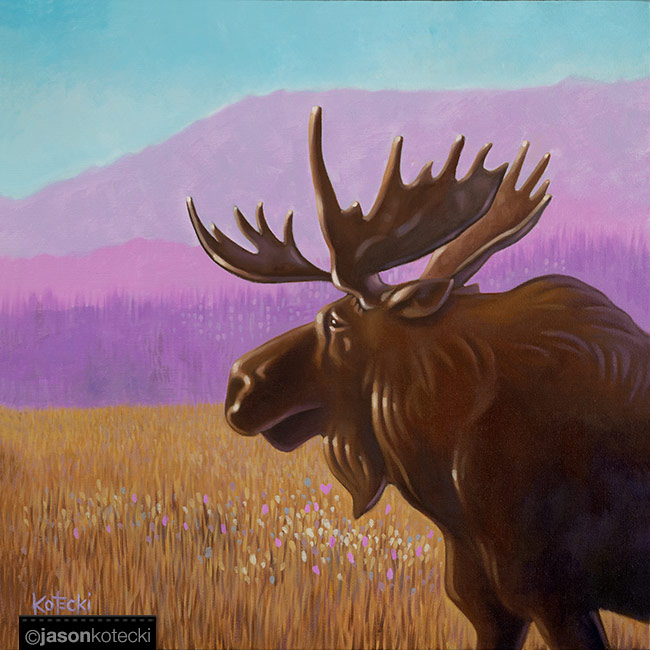
“Chocolate Moose” by Jason Kotecki. 20 x 20. Oil on canvas. Original is SOLD 🔴 Shop this art!
Our family didn’t go to Yellowstone to see moose, specifically. We went for the scenery, and we did want to see as much wildlife as possible.
One afternoon, we settled into a nice spot in the shadow of the Grand Tetons called Schwabacher Landing, and waited for moose. We’d heard the odds of seeing them there were good. Very quietly, we waited, and waited, and waited. It felt like any moment one might emerge from the brush to steal a drink from the pond.
We sat for two hours before admitting defeat and heading back to the hotel, disappointed.
The next day, while in Jackson, we wandered into the gallery of a photographer who told us about a side road to check out if we really wanted to see moose. The sun was about to set, but the spot was only a few miles away. We were skeptical, but two minutes after parking our car, we saw three moose.
It was as if our patience the day before had been rewarded in some strange way. Our persistence earned us a small prize after all, like a sweet dessert at the end of a meal.
In life, there is a lot of waiting. Long periods where nothing seems to go right. Tiresome stretches where we sit with patient expectations to see a dream come true.
This sometimes confounds us, because somewhere along the line, we got the idea that life is supposed to be easy. We chase comfort and good feelings and grow frustrated when we encounter struggle and pain.
But the truth is that a life in which you expect nothing but nummy treats and comforts will leave you disappointed. That’s not what this life is for.
As Pope Benedict XVI implored, “You are not made for comfort, you are made for greatness.”
But to paraphrase Benjamin Franklin, chocolate is proof that God loves us and loves to see us happy. That’s probably why he rewards us with little treats along the way. They are there to reward our efforts, keep us on the right track, and motivate us to keep going in pursuit of true greatness.
And yet, it is not healthy to develop a spiritual sweet tooth. Perhaps heaven will flow with rivers of decadent chocolate, but chocolate is not meant to be our entire diet here on earth. Life is a training ground for relying on faith instead of feelings.
The small desserts we encounter on our journey are only a foretaste of what’s ahead.
Enjoy them. Delight in them. Savor them so that you may persevere during the difficult times.
“Big & Grand” by Jason & Ginny Kotecki. 24 x 24. Oil on canvas. Original is SOLD 🔴 Shop this art!
Everything that exists first started as an idea. A vision. A dream.
The question is, How many people have to see it before it becomes reality?
On a family trip west, we spent time in the foothills of the Grand Tetons hoping to see moose. We didn’t have any luck, but while we were waiting, I snapped a photo of my youngest daughter sitting at the edge of the pond, tossing pebbles into the water. I thought it might be the start of a great painting. The only question in my mind was, “What might she be looking at?”
I imagined painting a moose into the scene, maybe a huge one. I thought Bigfoot would be funny, or perhaps a montage of all sorts of fictional creatures: leprechauns, fairies, unicorns, oh my!
Eventually, the solution became obvious: it needed to be Big.
You see, “Big” is a character Ginny created when she was younger, and he’s made appearances in many of her artworks over the years. He needed to be what she was looking at, and that’s how this painting became my first official collaboration.
Ginny drew and painted Big, and I handled the rest of the painting, including his reflection in the pond. It was a blast, and my heart just about exploded when she signed her name in the corner. (Rose is her middle name.)
I love the origin story of Big. According to Ginny, he is a lovable giant who lives in the clouds and comes down occasionally to give people hugs.
One thing we can all agree on is that the world could definitely use more hugs.
I wish that Big were real.
Part of me wonders if he is.
How many people have to see it before it becomes reality?
You have to imagine something before it can become a physical reality, whether it’s the main character of a book or a life-saving cancer drug. Our dreams are often born from a problem that needs to be solved, like a personal need or a nagging challenge you regularly encounter. Maybe it’s a larger one the world around you is groaning for.
I believe your dreams are planted within you by God. And He wouldn’t have planted them within you if you weren’t the right person to help bring them to fruition.
These dreams start as a faint vision or a passing thought, before slowly coming into focus, eventually becoming clear in your mind’s eye.
There comes a point when you need some affirmation that you’re not hallucinating, that there really is something to this vision that has stirred up a fiery passion within you. Then comes the big and scary moment: You summon up courage and float the idea past a few others, just to check if they can see it too.
Usually, the reactions are mixed.
Many won’t see the vision at all. They may even try to argue you out of it, saying it’s not realistic or practical.
Some will nod and smile, offering words of encouragement, but it feels more like a grandparent whose grandchild just told them about their imaginary friend: “What an active imagination you have!”
But if the dream has merit, you will encounter some true believers. These folks must be taken seriously because you will need them later.
When I had the vision to take an unconventional path, to make a living with my art while making the world a little better by making its people a little more childlike, I experienced all of these reactions.
I encountered many who never saw the vision of what we were trying to build, even though I described it as accurately as I could. They included newspaper syndicates, retailers, publishers, licensing agents, and more.
I also felt the “pat, pat” on my head from those who viewed me as slightly delusional, but relatively harmless and easily redirected once reality hit.
But I was also graced with a few true believers who saw the vision. Some notable ones included my parents, Kim’s parents, and our best friends, Sue and Jenna. Theirs were not just empty words of encouragement. They responded with action by sacrificing their time, money, and prayers. This signaled the proof of their belief.
The certainty from true believers is invaluable. There will come a time when you lose faith in the vision, and you will need them to remind you that it’s real.
Mounting failures and things taking longer than you expected take a toll. That vision, which once seemed so clear, begins to fade. You wonder if all the naysayers were right. After all, so many of them had way more experience than you, and the evidence seems to be piling up in their favor. Maybe I am delusional? Maybe I was mistaken? Maybe the signals got crossed, and I accidentally co-opted a dream that was not meant for me…
I entertained all these thoughts at various times. It was tempting to give up.
But then I remembered my parents. And Kim’s parents. And Sue and Jenna. I remembered that nobody pours money or time into a lost cause. Their sacrifice was tangible proof of their belief in us. It helped assure me that no, this is not a mirage. It’s real. They see it.
Their belief bolstered my own.
It’s easy to feel discouraged and lose hope when people don’t see what you see. Or when it’s taking too long. It might even show up in a time and place you weren’t expecting. The dream might feel long in coming, but it won’t be late.
Disregard the people standing in your way.
Don’t worry about the ones who say, “I just don’t see it.”
That’s ok. Not everyone will catch your vision.
That doesn’t mean it’s not real.
Your idea might just be the hug our world’s been waiting for.
“Reality Check” by Jason Kotecki. 20 x 20. Oil on canvas. Original is SOLD 🔴 Shop this art!
The Grand Prismatic is one of the things I was most looking forward to seeing on our family trip to Yellowstone National Park. It’s like I had to see it to believe it was real.
This is not an uncommon sentiment when it comes to this magical place.
The early explorers who came back with stories from Yellowstone were written off as crazy people. Surely a loose screw, an overindulgence in booze, or insanity caused by being alone for too long was easier to believe than the tall tales that returned. Upside-down waterfalls? Boiling rivers? Bubbling mud? Twenty-foot beasts?
Please.
Well, if you’ve never seen a geyser, hydrothermal activity, or an angry grizzly bear reared up on its hind legs, you’d deem these reports as unbelievable, too.
I have been to Yellowstone, and in the words of Han Solo when speaking to Rey and Finn about the Force, “It’s true. All of it.” (Even the grizzlies, although I didn’t experience an angry one.) The place is filled with the unbelievable.
But of course, now it is believable. Because we’ve seen the pictures and millions of us have visited, having driven through it on roads that weren’t there 150 years ago. And so the amazement has dimmed.
Just like it has with all the wonders of this world.
We are surrounded — besieged! saturated! deluged! — by the unbelievable, but because it’s familiar, we treat it like an afterthought. Every day becomes ho-hum.
But pretend with me for a moment that you’re from Mars, a barren red wasteland, and you’re hearing about Earth for the first time. What if I told you it was a place where…
Food grows right out of the ground.
Water comes from a sky that regularly changes color throughout the day.
Sometimes that water turns into trillions of tiny crystals that cover the ground and shine like diamonds when the sun hits it just right.
Small flying insects use flowers to create a delicious, sweet liquid called honey.
The people living there are created when two microscopic cells meet under just the right conditions.
The majority of the oxygen those people depend on for survival comes from a vast army of invisible sea creatures.
The people can fly across a vast ocean in a matter of hours.
They burn ancient sea creatures to fuel their vehicles.
They can significantly improve their vision by applying small slips of soft plastic to their eyeballs, and they just throw them away at the end of the day.
They have small handheld devices that allow them to listen to any song ever recorded, communicate across continents by video, tell them how to get anywhere on Earth, and share cute photos of cats.
And yes, there really are rainbow pools in this land that once teemed with animals bigger than a house.
Balderdash! you say?
Well, I’ve been there and it’s true. All of it.
Unfortunately, the sad fact is that most of the people who live there take it all for granted. It’s all familiar. Ho-hum.
Now that’s balderdash. Today, my friend is not just another day.
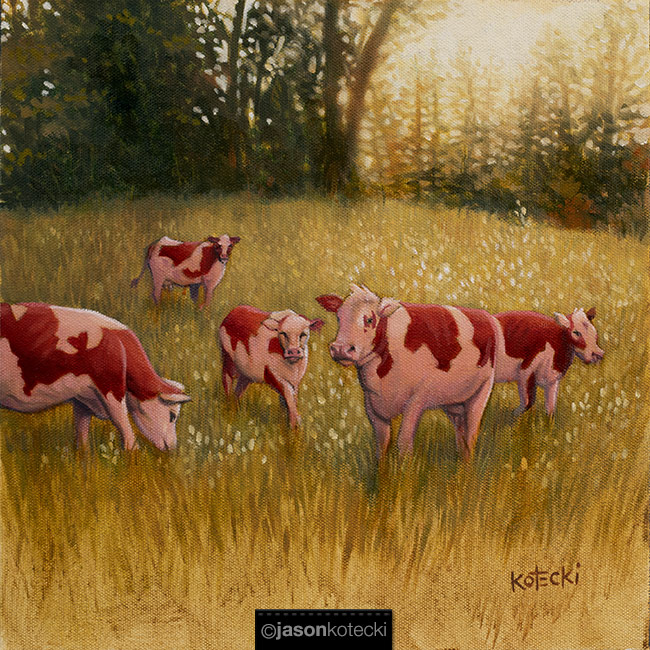
“Strawberry Fields” by Jason Kotecki. 12 x 12. Oil on canvas. Original is SOLD 🔴 Shop this art!
Where does strawberry milk come from? Pink cows, of course.
It’s a silly thing that some children believe; something grandparents tell grandchildren when pulling their leg.
I created this painting for an art fair we exhibited at in Sheboygan, Wisconsin, a land filled with dairy cows. I was pleased that so many people who saw it got the joke, reminiscing nostalgically about the “fact” that strawberry milk comes from pink cows.
Part of the humor comes from considering the silly logic of children, and the outlandish things they are prone to believe.
I, for one, used to believe I was Superman. I wore my Superman shirt under my school uniform in second grade to prove it.
The ridicule of my classmates inspired me to reconsider that belief.
But kids are not alone in their misguided understanding of the world. We grown-ups believe our fair share of ridiculous things, don’t we?
After all, some of us believe that you can’t eat breakfast for dinner and should never eat dessert first.
Some of us believe that Diet Coke is good for us.
Some of us believe it’s bad luck to bring bananas on a fishing boat.
Some of us believe that the first few years of parenting are the hardest.
Some of us believe that it’s possible to do and see everything on vacation, and we should ruin that vacation trying.
Some of us believe the news other people watch is propaganda while the news they watch is always true.
Some of us believe that we don’t need to prioritize spending time with loved ones, as long as the scraps of time we do spend is “quality” time.
Some of us believe that money is the best barometer of success.
Some of us believe that skin color says something about who we are as a person.
Some of us believe that good times will last forever.
Some of us believe that bad times will last forever.
Some of us believe that love is a feeling.
Some of us believe the devil isn’t real.
Some of us believe that they’d finally be happy, if only…
Oh dear. Perhaps we grown-ups are not as grounded in reality as we like to think. Maybe we are all in danger of following a few rules that don’t exist.
I know I believe some of these things some of the time. But it’s probably silly to believe that anyone who reads this will take a moment to re-evaluate their own beliefs.
Maybe even sillier than believing that pink cows are responsible for strawberry milk.
“To Sheboygan with Love” by Jason Kotecki. 16 x 16. Oil on canvas. Original is SOLD 🔴 Shop this art!
On our very first date, Kim and I agreed to live on a lake.
As we began the process of getting to know each other, we got talking about our ideal place to live. For some reason, Idaho was mentioned. (When you grow up in a small town in Illinois surrounded by cornfields, almost everywhere feels more exotic.) We talked of mountains and potatoes (obviously), but pine trees and lakes took precedence.
We both agreed that living on a lake surrounded by tall pine trees would be an ideal place to settle down. (We didn’t necessarily know it would be together.)
The two of us dated for five years before getting married, and that vision of lake living stayed with us. We never lived on any of the four lakes that make up the heart and soul of Madison, Wisconsin, in the twenty years we called it home. We did spend hours and hours walking along those lakes, dreaming and scheming together, trying our best to figure out how to make it happen.
We were also open to other lakes in other locations. We just knew it needed to be bigger than a pond, something large enough to accommodate a pontoon boat. We tried on lots of places, including Idaho, where we finally visited for the first time while celebrating our twentieth wedding anniversary. After all those years, we couldn’t shake the dream of living on a lake.
We never anticipated it would be a Great one.
Sheboygan didn’t hit our radar until one day during the height of the pandemic. A friend of ours knew our dream. He took note of the fact that we often took vacations near the ocean because we loved the sound of the waves, and suggested we check out Lake Michigan (which looks a lot like an ocean when you’re standing on the shore, unable to see the other side).
The idea had never occurred to us. We pulled up a map and surveyed the cities east coast of Wisconsin. What about Sheboygan? I had spoken there once, and remember enjoying a few moments I had to spend sitting by the lake. We googled it, and learned it was known as the Bratwurst Capitol of the World and the Malibu of the Midwest because of its unique geographical qualities that provide ideal surfing conditions.
That kicked off a magical and miraculous journey, a long story made short by saying we now live in Sheboygan. On a lake.
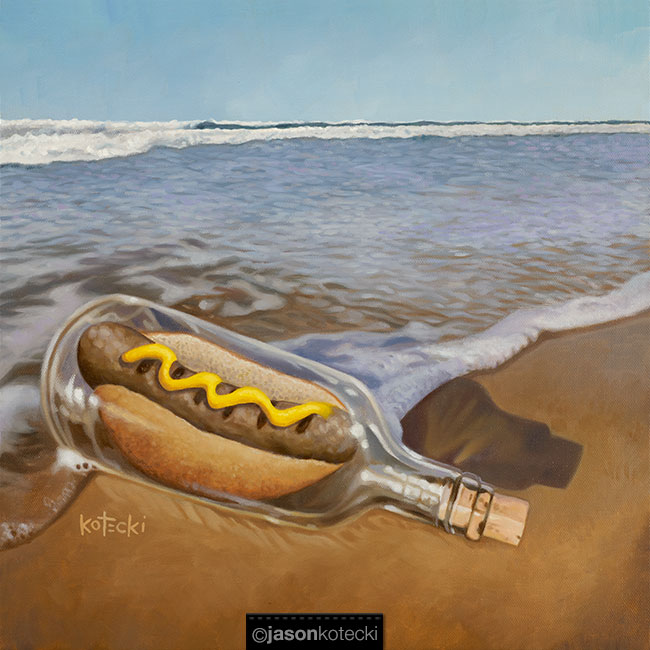
This painting celebrates Sheboygan, the funny-sounding city on the shores of Lake Michigan, known for brats and surfing. But it also represents our prayers.
Saying a prayer is like launching a message in a bottle into the ocean. Once a prayer leaves your heart, you lose all control. You hope it reaches God, but once it floats out of sight, it’s easy for doubt to creep in: Did it get lost? Swallowed by a shark? Did it reach its destination only to be rejected or forgotten? You might be tempted to wonder how you could have been so foolish to trust in such an uncontrollable, unpredictable, mysterious method. Did you think this would actually work?
Our prayer to live on a lake was a message in a bottle. It floated out there for two decades.
The dream felt more and more foolish as the years wore on and our business took longer to grow than we’d expected. There were times I thought the dream was lost at sea. There were moments I wished it really was, because I was so weary from wondering what happened to it. I figured it would be easier, and less painful, to have never dreamed the dream or prayed the prayer at all.
Maybe you have a prayer like that, a message in a bottle that you’re certain is lost. I can’t tell you how your prayer will be answered, but I know for sure it’s not lost. It’s definitely not forgotten.
Somehow, our prayers find our way back, with answers washing up on unexpected shores at unexpected times. But it’s always at exactly the right time and delivers exactly what we need, even if it looks different than we imagined.
God will not let you miss your future.
It takes faith to release a prayer into the great unknown, and that faith is always rewarded.
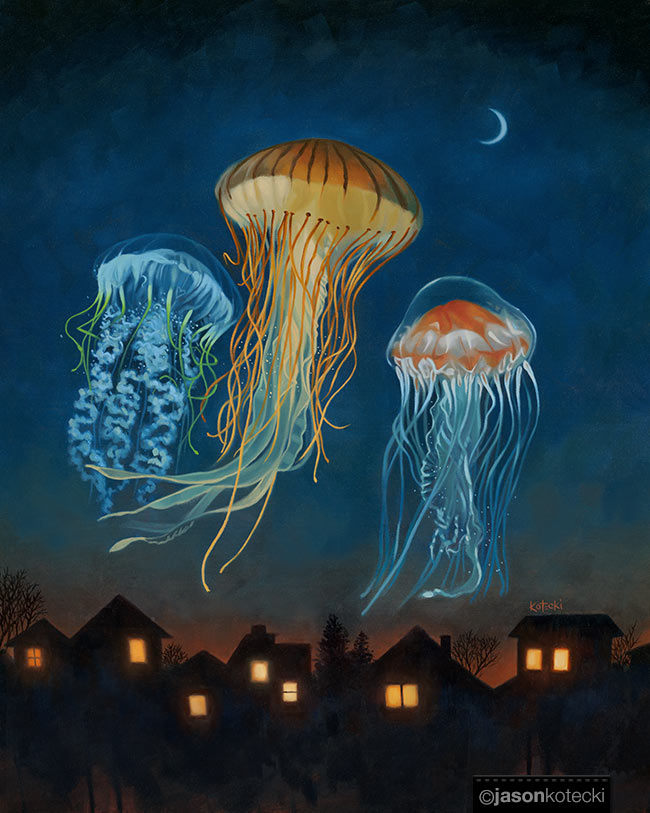
“Evening Show” by Jason Kotecki. 24 x 30. Oil on canvas. Original is SOLD. 🔴 Shop this art!
A clear night sky is a thing of beauty, with millions of stars blinking silently overhead.
It’s a pity we rarely notice them.
In an episode of Curb Your Enthusiasm, Larry David is speaking with a receptionist at a law firm who has a spectacular view of the city behind her. “Beautiful view here! How long did it take you to take it for granted?”
She replies, “Umm, not long I guess.”
He candidly admits, “It would take me about a day. Maybe less. Maybe half an hour. And I would never look out the window again.”
How quickly we take wonder for granted.
This painting was inspired by a passage I read in the book The Sense of Wonder, by conservationist Rachel Carson, who wrote about a summer her grandnephew visited her cottage in Maine, and together they wandered the surrounding woods and tide pools.
She recounted a particular evening when they gazed in awe at one of those breathtaking night skies:
“It occurred to me that if this were a sight that could be seen only once in a century or even once in a human generation, this little headland would be thronged with spectators. But it can be seen many scores of nights in any year, and so the lights burned in the cottages, and the inhabitants probably gave not a thought to the beauty overhead; and because they could see it almost any night perhaps they will never see it.”
Because they could see it almost any night, perhaps they will never see it.
This painting takes its inspiration from those lights burning in the cottages, with the inhabitants giving not a thought of the beauty overhead.
What if a party of giant glowing jellyfish appeared above your town and put on a light show? Surely that would get your attention.
But what if it happened every year? Every week? Every night? How long would it take before everyone stopped caring?
Not as long as you’d think.
Apollo 11 landed on the moon. It was a huge source of national pride. Half a billion people were glued to their television sets watching the historic achievement.
Nine months later—nine months!—flights to the moon had already become boring. By the time Apollo 13 came around, the television networks didn’t even bother covering the launch or broadcasting the live video of the crew from space because they felt there wasn’t enough interest. Nobody wanted their soap operas or game shows interrupted by another group of heroes doing what most people had never done before. Only until Apollo 13 got into trouble did anyone care.
We grow numb to wonder.
Look around you. What are you taking for granted? What are you missing?
Be honest: When was the last time you gazed at the stars?
Stood in awe at a sunrise bursting forth with color on the horizon?
Sat in silence amidst the peace of a placid snowfall?
I don’t know about you, but I am disgusted by this propensity to grow numb to wonder.
But can we do anything about it?
Fortunately, Rachel Carson shows us a way:
“One way to open your eyes to unnoticed beauty is to ask yourself, ‘What if I had never seen this before? What if I knew I would never see it again?”
One painting and two powerful questions remind us to keep our eyes peeled for the wonder all around us.