Art Series: Living Things

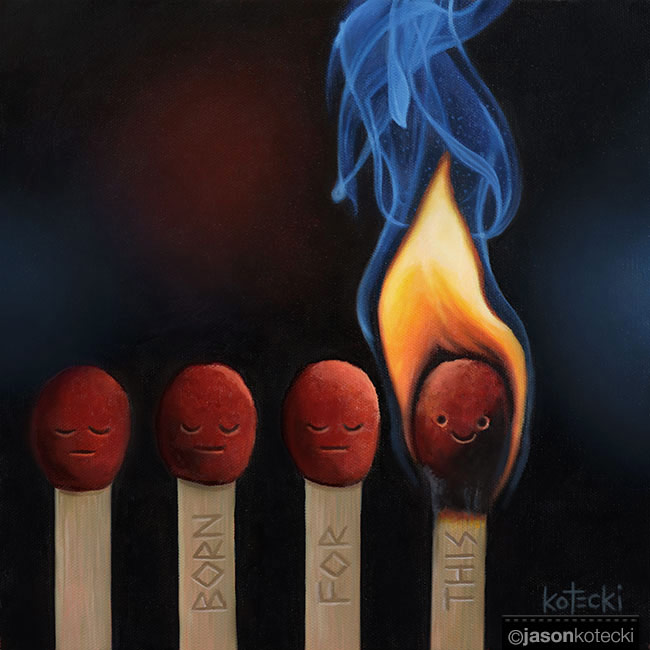
  • Born For This

    “Born For This” by Jason Kotecki. 12 x 12. Oil on canvas.
    Original is SOLD 🔴 Shop this art!

    The Wright Brothers were the first to fly, but they weren’t the first to try.

    Not by a long shot.

    For more than fifty years, humans had been actively working on the problem (after thousands of years of dreaming about it). Many brave people tried for years in vain, often at the cost of their very lives. Most considered it impossible.

    But when the Wright Brothers succeeded, they became a match that lit the way forward.

    They shared the joy of flying with others. In his first public demonstrations in Europe, Wilbur would take a passenger into the air with him. The brothers also eagerly trained new pilots. Soon after their success, countless others followed, and in short order, aviation boomed across the world.

    After fifty years of collective failure, the work and the example of the brothers opened the floodgates. Orville himself lived to see aviation transformed by jet propulsion, the introduction of the rocket, and the breaking of the sound barrier in 1947. On July 20, 1969, when Neil Armstrong, another American born and raised in western Ohio, stepped onto the moon, he carried with him, in tribute to the Wright brothers, a small swatch of the muslin from a wing of their 1903 Flyer.

    It reminds me of another pioneer named Roger Bannister, who was the first to run a mile in less than four minutes. People said it couldn’t be done. Doctors suggested you could die in the process of even attempting it. And yet after Bannister proved it was possible, Australian John Landy did it himself just six weeks later.

    You can just do things.

    But sometimes we need someone to show us a something can be done for us to believe we can do it ourselves.

    One family Kim and I knew before having children was a match that sparked our own belief that we could travel with kids. Our daughter Lucy ended up on 34 flights before her first birthday.

    And all the homeschooling parents we encountered who had raised successful children doing amazing things in the world were matches that gave us the confidence that maybe would could, too.

    What if someone is waiting for you to be the example they need?

    You and me, we’re like matches.

    A match is not made to sit in a box, unlit, forever. It was designed to create a fire, but not one kept to itself.

    You were made with specific talents to achieve a specific purpose. Part of that purpose in life is to make a difference in the lives of others. And just like a match, you get one shot. You have to give it your all.

    Of course, it’s scary!

    You have the option to embrace the status quo, like the other matches in this painting, preferring comfort and protecting themselves. But they are not fulfilling their potential.

    That is not why they were made.

    If God planted a dream in your heart, you have the moral imperative to chase it. Because your example might be exactly what someone else needs to achieve theirs.

    Your spark can enflame and bring life to others.

    As St. Catherine of Siena said, “Be who God meant you to be and you will set the world on fire.”

    You were born for this.
  • The Armada

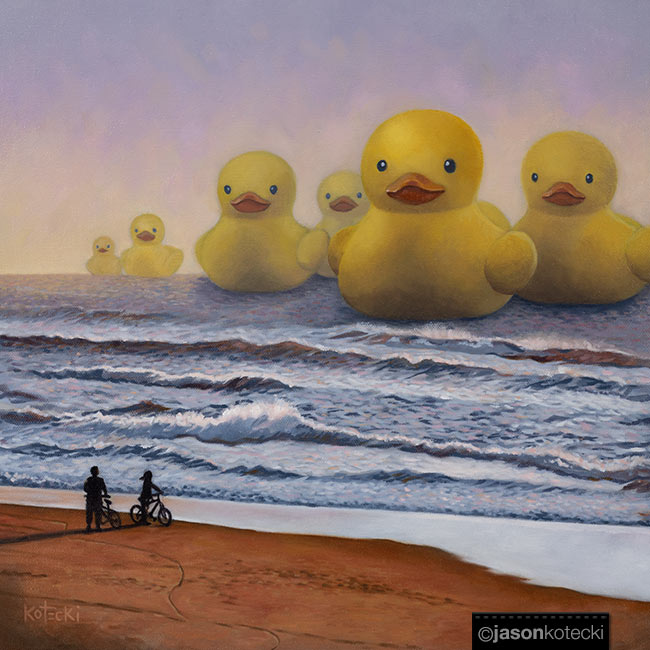
    “The Armada” by Jason Kotecki. 16 x 16. Oil on canvas.
    Original is SOLD 🔴 Shop this art!

    Quick! You’re on the beach with a friend and you spot something approaching on the horizon. To your amazement, you make out an armada of giant rubber ducks coming to shore. What is your reaction?

    Are you excited? Overjoyed? Concerned? Skeptical? Worried? Afraid?

    Are they visitors or invaders?

    Do they bring good tidings or dark intentions?

    Sometimes a painting can just be a fun picture that makes you smile. And sometimes it contains a deeper meaning. I asked people on social media to share their perceptions of this painting, and it may or may not surprise you that their responses varied greatly:

    • “Pure joy. I have a jacket printed with rubber ducks. They always make me smile, as does the ocean, and riding my bike!”
    • “Here comes whimsy!”
    • “Hope is on the horizon.”
    • “I’m a little worried.”
    • “Terrified.”
    • “Invasion from a Trojan Horse.”
    • “Plastic pollution and impending doom from climate change.”

    It turns out that the meaning of this painting, as well as the meaning of almost everything in life, is largely determined by you. 

    Our perceptions impact our actions. For example, whether you’d run for cover or organize a welcoming party would depend on whether you see these rubber ducks as friends or foes. One side sees the other as hopelessly naive. The other side sees the other as paranoid. Both sides have a point.

    If we respond too enthusiastically, we might fall into a trap.

    If we respond with animosity, we may sabotage any chance of something good happening.

    We can assume the best, assume the worst, or…perhaps the best, wisest, most productive thing we can do is keep an open mind and wait and see.

    Now, let’s put the shoe on the other flipper. Imagine if you’re one of those ducks. You’re fun. Lots of people like you. You want to be helpful and bring joy to others. You’re new in town, but you have good intentions. But what are those locals on the shore thinking?

    Do they see you as a visitor or an invader?

    Do they think you bring good tidings or dark intentions?

    We’ve all been the new guy. The new kid in class. The newest employee. Or, most recently for us, the new family in town. I like to think of this painting as a metaphor for our mission to bring wonder and whimsy to distant shores. I unveiled it at the first Wondernite we hosted in Sheboygan, having moved from Madison two years earlier. As relative unknowns, we wondered if anyone would come.

    It turned out to be our biggest and best one yet.

    It’s scary to consider what the natives might think of you. You feel like you stick out like a sore thumb because it seems obvious that everyone can tell you’re not familiar with the local culture, the shorthand, the inside information that everyone else takes for granted. 

    It’s tempting to want to appear big and important. Maybe pretend to be something you’re not. After all, you’ve got a clean slate. None of these new people know all your history and baggage. You never get a second chance to make a first impression, so it’s a chance to put forth something impressive.

    I’ve found it’s easier, more effective, and frankly, less exhausting to just be yourself. People are drawn to authenticity, and we are very good at spotting a fake. Your weird flag may not inspire everyone, but it will attract your people.

    It’s more beneficial to check your expectations.

    If you expect the natives to be hostile, you’re likely to protect yourself by being hesitant and withdrawn, which may make you appear cold and aloof to others. But be warned: if you assume the locals will be hostile and unwelcoming, guess what you’re likely to get.

    You see, there is this thing called confirmation bias. (Perhaps you’ve heard of it.) It’s applicable whether or not you see yourself as the kids on the beach or the newcomers floating to shore. How it works is that we make an initial judgment or tell ourselves a story about a person, group, or situation. Then we reflexively look for evidence that supports our case and confirms our bias. 

    Meanwhile, we subconsciously filter out any information that runs contrary to our story. We interpret new information as being supportive of the opinions we already hold, and it doesn’t matter how poorly it fits. Our dutifully protective brain finds a way without us having much of a say.

    If you think your spouse is ignoring you, you’ll be on the lookout for all the evidence to make your case.

    If you expect to have an awesome day, your antenna will be up and scanning for proof all day long.

    If you think Republicans are the worst, you will notice and remember every example that proves your point.

    If you think Democrats are the enemy, well, you get the point.

    So…what if we paused at the very beginning to realize we don’t yet know the truth and take a wait-and-see approach? Thanks to confirmation bias, if you expect the best in others, the odds are better you’ll find it.

    This might just be a fun, whimsical painting that makes you smile.

    Perhaps something light-hearted to hang in your bathroom.

    It might also be a reminder to always be yourself while giving other people a chance to do the same.

  • How Many Watermelons?

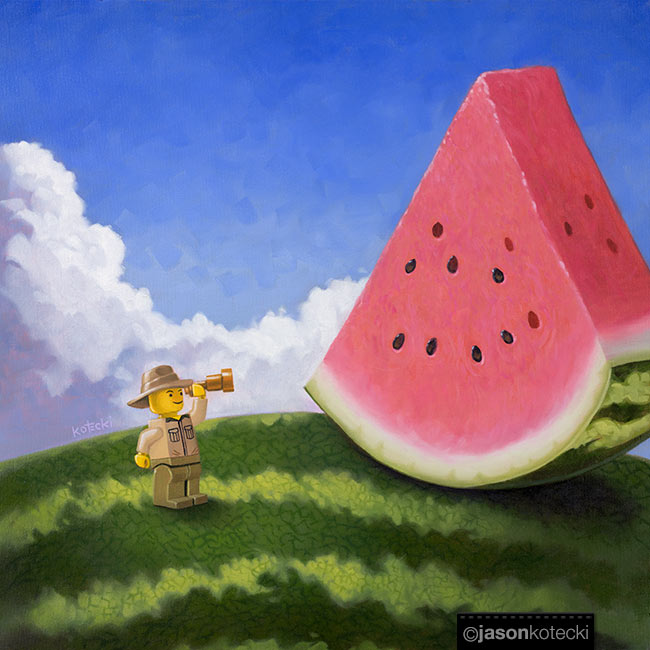
    “How Many Watermelons?” by Jason Kotecki. 20 x 20. Oil on canvas.
    Original is available. 🔴 Shop this art!

    What do motivational posters, charismatic preachers, and embroidered pillows have in common?

    They regularly tell us to count our blessings.

    If we’re in the midst of a good day, we’d probably admit it would take a long time to count all our blessings. Maybe even longer than it would take to count all the seeds in a watermelon. But theoretically, both could be done.

    This painting was inspired by the saying “Anyone can count the number of seeds in a watermelon, but only God can count the number of watermelons in a seed.”

    Today is the second anniversary of the day I needed a chainsaw-wielding neighbor to help me clear trees from my driveway so I could drive to the airport for a speaking engagement. The night before, a storm descended upon our home with a terrible straight-line wind that damaged our home and devastated our property. I had to leave my wife behind in a home with no power to push aside the grief to begin the clean-up and call insurance companies.

    I can assure you, it did not feel like a blessing.

    That storm turned our trees into kindling and destroyed our finances. It wrought great debt and fear, and uncertainty. It brought trauma to our family and nightmares to my kids.

    But it was also a seed.

    A seed that has since produced many blessings…

    • It connected us to some amazing people.
    • It taught us how to receive generosity from others with humility.
    • It provided us with the insurance money to buy a new roof which needed to be replaced.
    • It opened the door to a new space to play ball and badminton and frisbee together.
    • It inspired us to be even more hospitable, ushering in Moonrise Movie Nights and the Wonder & Whimsy Society Family Reunion.
    • It gave us a new view, one that many agree is even more breathtaking than the one we had before.
    • It strengthened our family and bolstered our faith, bringing us even closer to God.

    I suspect that dark forces were pretty happy about the storm, hoping it would destroy us. But I believe God allowed it because even though it brought a great deal of pain, he also knew just how many blessings would spring forth.

    I share this not to minimize the pain any of us has experienced, but to offer a reminder that in life, pain and joy can co-exist.

    Today is also Father’s Day. My experiences have led me to believe that God is a good father. He wants to hold you in his arms and give you a big, all-encompassing hug, especially if you are struggling with some great trauma of your own. I want to let you know that he is bringing forth fruit from the ashes, perhaps some of which you may already be able to perceive.

    I can assure you, the full bounty goes beyond what you can ever imagine.

    I’ve just shared many blessings we’ve identified from the storm we experienced. But the thing is, we’re only two years removed from it. How many more blessings have yet to be revealed?

    • Only God knows how many games of catch I’ll have with my son.
    • Only God knows all the conversations that will be had around our new fire pit.
    • Only God knows how many pies will be baked from the fruit trees we just planted.
    • Only God knows how many photos Kim will take of the wonder that will bloom there.
    • Only God knows how many family dinners will be shared from our deck overlooking the lake.
    • Only God knows how many people will be blessed and healed in some way by their time there.
    • Only God knows what opportunities and relationships will arise from this new space.

    The storm was a seed that produced a multitude of watermelons.

    And those watermelons are filled with seeds that will usher forth even more.

    Only God knows all the things that will be made possible because of a brief moment in time when a hurricane-force wind whooshed through our lives one summer day.

    Only God knows the number of watermelons in a seed.
  • Talent Stack

    “Talent Stack” by Jason Kotecki. 16 x 16. Oil on canvas.
    Original is SOLD 🔴 Shop this art!

    Sometimes people look at successes I’ve had and say, “Must be nice,” as if they happened by magic.

    What they don’t often see is the framework that helped enable that success. Fortunately, it’s a framework anyone can develop.

    We often assume that in order to be successful, we need to be great at one thing. That can work—see LeBron James, for example—but that path is extremely difficult and unlikely. The truth is, you only need to be pretty good at a handful of ordinary skills.

    You just need to build a talent stack.

    Scott Adams, the creator of the comic strip Dilbert, popularized this concept which states that you can ensure success by assembling a “stack” of two or more complementary skills and be in the top 25 percent or so in each. Do that and you’ll be unstoppable. 

    In his case, he readily admits he’s not the best artist, the most skilled writer, or the savviest business expert. But his unique combination of those skill sets has contributed to his success as a cartoonist.

    My own talent stack began with a few crayons. “Artist” was my first and is my longest-lasting identity. I’ve always enjoyed it, and I got praised for it, so I’m sure that made me want to keep doing it.

    In high school, I had a chance to take a creative writing class, which I enjoyed exponentially more than my math classes. I kept honing that skill, which eventually became an indispensable part of my talent stack.

    In college, I gave a talk as a leader on a retreat and received great reviews. Even though I am naturally shy, I enjoyed the process of crafting stories in spoken form. It was like creative writing but delivered out loud. 

    To the surprise of me, my parents, and the high school speech teacher who gave me a “C,” public speaking emerged as the primary driver of our business. I went from giving cartooning workshops in schools to speaking at churches to keynoting conferences for associations and corporations all over the place. 

    Now it took me a few years to realize that these three talents—art, writing, and speaking—were not separate skills that operated independently, but part of a talent stack, that when used in harmony became even more powerful. I am not the best artist in the world, or the best writer or speaker. But I’m pretty good at all three, and that combination has been the secret sauce of my success. Once I was introduced to talent stacking, I eagerly looked for complementary skills to add. By devouring hundreds of marketing books and through the school of trial and error, I’ve achieved the equivalent of an MBA in marketing. Am I the best marketer in the world? No, but I easily fall into the top 25 percent.

    Kim and I went on several organized retreats in college. That background gave us a foundation to build on when we started hosting our own events. After putting on numerous meetups, workshops, book tours, fundraising galas, and Escape Adulthood Summits over the past two decades, we’ve gotten pretty good at managing logistics and creating experiences that move people.

    Most recently, we used the pandemic as an opportunity to get good at livestreaming, which added a whole new dimension to our business.

    Drip by drip, these new skills made the other skills even more valuable and ushered in greater success.

    Of course, your talent stack will look different from mine, but the premise is the same. Start with natural strengths and abilities and work to make them better. Think about how they can work together in unexpected ways, even if they seem unrelated. 

    Everyone in your industry probably competes on many of the same skills. What do you have that’s different? Oftentimes the magic lies in a skill or interest that seems to come out of left field. For instance, many professional speakers are also writers. But my artistic gifts and whimsical, childlike perspective allow me to offer something extraordinary.

    This isn’t just about what you were born with. Look for other skills you can attain that complement and enrich the others. That might involve a traditional degree or certification, but it can also be done by reading books, listening to podcasts, taking courses online or at your local community college, or practicing, in public, every day, as we did with our pandemic project of livestreaming.

    If you’re stuck, here are some evergreen choices that will help:

    • Presentation skills
    • Technology skills
    • Foreign language skills
    • Sales or marketing skills
    • Writing skills
    • Business management skills
    • Nunchuck skills

    Remember, you don’t have to turn yourself into the foremost expert on any of these skills. Just be in the top 25 percent. Said another way, in a world of around eight billion people, you only need to be among the top two billion. If one hundred thousand people live in your city, you just have to be in the top twenty-five thousand. 

    In other words, pretty good is good enough.

    Keep in mind that this is a lifelong project. If you’re doing it right—meaning you stay curious and keep growing—your talent stack will continue to evolve and strengthen throughout your career and life. One last word of warning, however…

    When you have a decent stack of three to five skills going, you can bank on someone, somewhere observing what you’ve been able to accomplish and saying, “Must be nice.”

  • Gummy Bear Doing Sit-Ups

    “Gummy Bear Doing Sit-Ups” by Jason Kotecki. 12 x 12. Oil on canvas.
    Original is SOLD 🔴 Shop this art!

    When I was a teenager, my mom called me a dreamer.

    She didn’t mean it as a compliment, but she wasn’t wrong.

    I’ve always been idealistic, my head regularly inhabiting the clouds. I’d sing along with John Lennon’s Imagine and revel in the fact that we were soul mates. You’re NOT the only one, John. We’re in this together!

    I took pride in that side of myself. But when my mom labeled me a dreamer, and I knew it wasn’t a compliment, it got my attention.

    Of course, my idiot teenage response was, “What does she know?”

    Eventually, I would relate to Mark Twain, who said, “When I was a boy of fourteen, my father was so ignorant I could hardly stand to have the old man around. But when I got to be twenty-one, I was astonished at how much he had learned in seven years.”

    When I graduated from college, I had big dreams. I was going to marry the love of my life. I was going to become a successful artist. And I may or may not have imagined the small town I came from erecting a statue in my honor one day.

    But in order for my dream to work, I needed my parents to let me live with them in the year between graduation and the wedding. That would give me the financial runway to knock on doors, get my name out there, and start making things happen.

    I knew I needed a plan. I put together a multi-page document outlining my detailed strategy and financial projections. I don’t know if my parents let me stay with them for that year rent-free because of the brilliance of my plan, or because that’s what parents do, and there really wasn’t another option. And as most business plans go, big chunks of it fell apart when it got punched in the mouth by reality.

    But it did give me focus, direction, and accountability to do the work that propelled me forward on my journey. It exposed me to an important truth I’ve seen at work again and again in the last twenty-five years:

    The most successful people balance hopes and dreams with practicality and hard work.

    If you spend all your time with your head in the clouds, you may come up with a world-changing idea or two. But if you don’t have the initiative and work ethic to put toward them, they’ll never materialize. 

    World-changing ideas are worthless without execution. 

    On the other hand, a relentless work ethic that lacks vision is wasteful. People in this camp default to letting someone else tell them what to do – which is unlikely to lead to happiness – or they toil without purpose, methodically plodding along in no particular direction. 

    When you keep your head down all the time, you’re blind to the road signs pointing to exciting possibilities.

    A rocket ship requires practical thought, precise calculations, and productive persistence to achieve orbit. But it requires a dreamer to imagine they can reach the stars in the first place.

    It’s a tricky balance, and my experience leads me to believe people are usually stronger in one area than the other. As I shared, I am a dreamer at heart. But getting where I am today required a lot of hustle, sacrifice, experimentation, and experience gained from failure.

    Henry David Thoreau gave us the blueprint when he said, “If you have built castles in the air, your work need not be lost; that is where they should be. Now put foundations under them.”

    My mother’s candid observation was meant to be helpful. And it was. It inspired me to buckle down. Maybe at first just to prove her wrong, but eventually simply because she was right.

    What camp are you in?

    If you are more of a dreamer, maybe you need to spend time putting your ideas into action with a little elbow grease. It’s more comfortable to live in Dreamland, where reality doesn’t rudely poke holes in your grand visions. Don’t be discouraged by the failures you encounter, for they are not arrows piercing the heart of your dream, but merely guideposts pointing you in the direction to go.

    If you are more of a “nose to the grindstone” type of person, perhaps you need to give yourself permission to wonder aimlessly and dream of something better. Sure, it’s more comfortable to stay in work mode than get your hopes up for a future that may never happen. But that only leads to a future you never wanted. Don’t worry about figuring it all out before you begin. Plant your flag on a future summit and use your work ethic and practicality to plot your path there one step at a time.

    Both ways are hard. But great things don’t come easy. 

    This gummy bear knows what’s up.

    Dreaming of six-pack abs is a good start, but it amounts to nothing without any sit-ups.

    But the sit-ups are a waste of time if we never ponder why we wanted the six-pack abs in the first place.

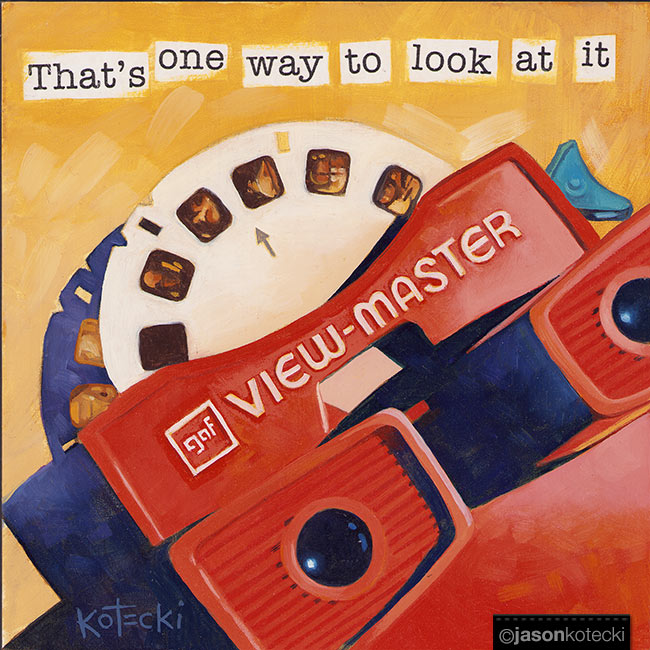
  • One Way To Look At It

    “One Way To Look At It” by Jason Kotecki. 6 x 6. Oil on canvas.
    Original is SOLD 🔴 Shop this art!

    One day Kim wrote a social media post about how ugly our backyard is after having been ravaged by a cataclysmic storm. The harsh, violent, apocalyptic hellscape is heartbreaking.

    And very, very ugly. 

    A well-intentioned commenter felt the need to correct her, “No, it’s beautiful.”

    Of course, the commenter is right. It is beautiful, in many real and metaphorical ways. And the photos Kim has taken of the carnage have captured some of that beauty.

    But you know what? It’s also ugly. Especially in comparison to what it was before.

    It can be both. It is both. And that’s ok.

    As I pointed out in my book, A Chance of Awesome, some people look at dandelions and see weeds. 

    Others – mostly kids – see wishes.

    The thing is, both are true. 

    Or take cars. Automobiles are modern marvels that give us great freedom and save us enormous amounts of time. The industry employs nearly two million people. But about 40,000 people die in motor vehicle traffic crashes each year in the U.S.

    So are cars good or bad?

    Unfortunately, our rotten news media has conditioned us to operate without any nuance whatsoever because there is profit to be made in conflict. We no longer seem to have the capacity for critical thinking; we’ve been reduced to the infantile reflex that things are either “good” or “bad.” Every issue is presented as either black or white, red state or blue state, right or wrong, good or evil.

    Ugly or beautiful.

    When it comes to any story – especially the headline-grabbing issues of the day – we’ve been duped into believing we only have two options: be right or be wrong.  

    But life is more complicated than that. Life is both / and.

    When your kid heads off to college for the first time, it’s natural to feel a sense of pride as they move into a new season of growth and independence. It’s also natural to feel sad that your day-to-day interactions with them are coming to an end. 

    Or when a loved one you have taken care of for years has passed away, you probably feel sad that they are gone. It can also feel nice to believe that they are in a better place. 

    But you can also feel relieved that your burden has been lifted. 

    That doesn’t make you a monster; it makes you human. 

    We live in a complicated world with unlimited shades of grey. (Yes, even more than fifty.) It’s not helpful to force everything into an absolute. We don’t have to walk around wearing rose-colored glasses, deluding ourselves into thinking everything is unicorns and rainbows.

    Nor is it especially healthy to point out every potential storm cloud. 

    Both approaches are childish. 

    A mature perspective is acknowledging that life is filled with contradictions. There is good and evil, joy and pain, hope and fear intermingling in all of it. 

    We do have a choice about where we want our attention to dwell, which is one of our most overlooked and underused superpowers. But it’s important to remember that focusing on one doesn’t disappear the other. 

    Life is painful. It is also joyful. Sometimes on the very same day. 

    And that’s ok.

    Acknowledging the ugliness is what keeps us from taking beauty for granted.
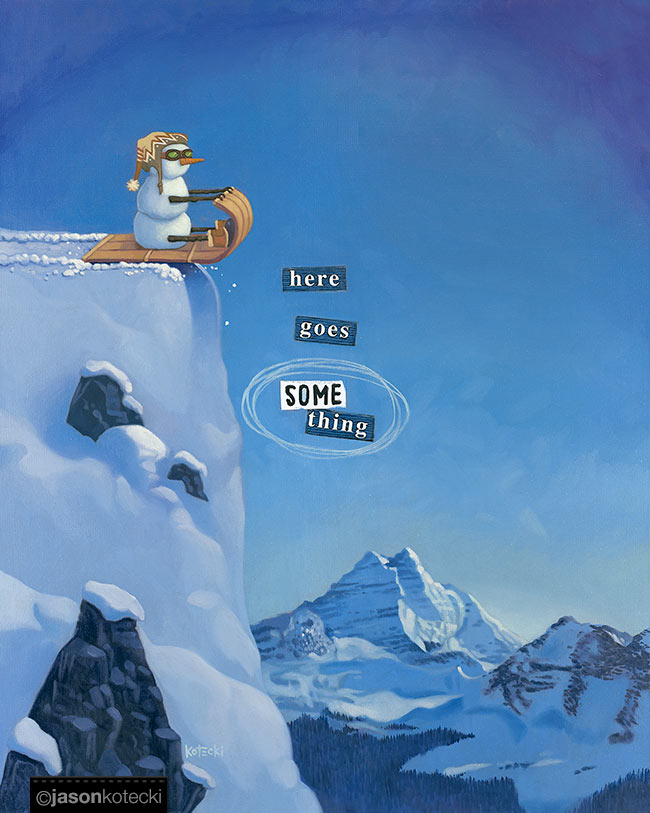
  • Here Goes Something

    “Here Goes Something” by Jason Kotecki. 24 x 30. Oil on canvas.
    Original is SOLD 🔴 Shop this art!

    “Here goes nothing.”

    It’s a phrase we often use when we’re not sure how something will turn out. In fact, since it tends to come from a sense of desperation, we use it to admit that there’s a pretty good chance of it not working. It’s our little way of softening the psychological blow of failing.

    It makes me think of the pass play in football referred to as a “Hail Mary.” The team with the ball is losing, and time has nearly expired. They need a touchdown but they’re so far from the goal line that their only hope is to launch a long pass into a sea of waiting defenders. It’s a pass with a very low chance of success, but at that point, you’re out of options. 

    Here. Goes. Nothing. 

    However.

    This isn’t a football game.

    Trying things that might not work is not nothing.

    It takes tremendous courage, vulnerability, and faith. Dare I say it’s the most important thing we can ever do?

    Doing things that we are sure will work is safe and comfortable. Chasing guarantees is one way to go about our days, but if this is all we ever do, we will have wasted our lives. This is not why we were born.

    When you try something that might not work, it’s true: it might not. But in the end, many other good things will have come of it. At the very least, you will have learned something, and your comfort zone will have inched a little larger.

    And that’s definitely not nothing.

    We recently hosted our third Wondernite. Before our first one, I had no idea if it would work. I didn’t know if anyone would come. I didn’t know if I would even sell one painting. There was a distinct possibility that my brother Doug would go through all twenty items up for auction and not receive one bid and I’d have the exciting opportunity to descend into a catastrophically humiliating shame spiral while sitting in the back of the room. Thankfully for all concerned parties, it turned out well enough that we are currently planning our fourth.

    By the same token, we’ve also invested thousands of dollars into trade shows that did not deliver a good return on investment. They drove us deeper into debt. They bordered on soul-crushing. But the lessons we learned in the process, about marketing, positioning, pricing, and branding, were invaluable, and part of the reason Wondernite turned out to be a success.

    Tinker. Play. Experiment. Try things that might not work. And when you cast off into the unknown, you can be confident in saying to yourself, “Here goes something!!!”

  • Where The Party’s At

    “Where The Party’s At” by Jason Kotecki. 16 x 20. Oil on canvas.
    Original is SOLD 🔴 Shop this art!

    Piñatas are great fun, but only if they actually contain candy. We may be drawn in by the bright colors that promise a good time, but it’s quite a disappointment if, after a few whacks, it’s revealed that there’s actually nothing inside. Whomp whomp.

    The thing that makes a piñata so irresistible is what’s inside.

    The idea behind this painting is that if you’ve got a piñata, you’ve got a party, even if you’re in the middle of a barren wasteland. It was inspired by a song by the Newsboys, called “Wherever We Go.”

    Here are some of the lyrics:

    Wherever we go, the dumb get wise
    And the crime rates drop and the markets rise
    It’s a curious thing
    But it’s just our thing

    Bullies make nice, crooks repent
    And the Ozone layer shows improvement
    It’s a curious thing
    And it’s humbling

    Where we’re led, all the living dead
    Wanna leave their zombie mob
    It’s a touching scene when they all come clean
    God help us, we just love our job

    Hands up, holler back now
    We don’t claim any know-how
    We’re giving God all that
    Wherever we go, that’s where the party’s at

    One of the reasons this song has always resonated with me is that it feels like my life. I am a professional permission granter. I encourage people to make ugly cakes, to draw on their children, and break stupid rules. I make colorful paintings featuring objects with smiley faces on them. When people hire me to speak, they gain permission to have all kinds of fun with the theme and branding. People love it when I bring my family with me to gigs.

    It feels like wherever we go, that’s where the party’s at.

    That being said, I have a confession to make: I have never been the life of a party, and our family is not as fun as you think it is.

    Don’t get me wrong. We do have fun together, we do more than our fair share of kitchen dancing, and Adultitis is not welcome in our home. But I often get the sense that people think that living in our house is like being on an episode of Pee Wee’s Playhouse. Well, if you’re old enough to remember that puppet-fueled gem of a show, today’s secret word is: “letdown.”

    Even as we prepare to leave our beloved neighborhood in Madison for new shenanigans in Sheboygan, our neighbors are flooding us with heartfelt well-wishes. It appears we will be missed. And although I’ve never felt I’ve misrepresented what life is like in our family, I got the sense that people were seeing something more.

    One day, I realized people were resonating with more than our outside appearances and outward actions. Like a piñata, what people are really attracted to is what’s inside us. 

    Our joy.

    In my twenty years of writing and speaking, I haven’t talked that much about my faith, preferring to live by the old St. Francis adage, “Preach the gospel always, and if necessary use words.” But the truth is, our faith is what drives everything.

    It’s where our joy comes from. I know some people don’t have it, but I can’t imagine my life without it. It’s what sustained us in the long periods of darkness when we were in debt and didn’t know if we’d ever make a living with the business. The Holy Spirit is what stirs my imagination and gives me the courage to do things I never could have imagined as a shy, scared little boy.

    In our household, we are celebrating the season of Advent as we prepare our Christmas. My favorite song of this time is O Come Emmanuel. 

    Emmanuel means “God with us.” 

    And that’s the difference between a party and an empty piñata filled with nothing but disappointment. 

    Some consider faith to be a crutch. An opiate for the masses. But I see my faith as a gift. 

    I don’t know how to give it to someone, but I do know this: People are searching for happiness, but what I think they really crave is joy, which is deeper and less fleeting.

    Joy is an inside job.

    If you have it, wherever you go, that’s where the party’s at.

  • The Greatest Showman

    “The Greatest Showman” by Jason Kotecki. 16 x 20. Oil on canvas.
    Original is SOLD 🔴 Shop this art!

    The absence of fear is not bravery.

    The absence of fear is a terrible life.

    If you stay exactly where you are and never try anything new, you may be able to avoid fear. Maybe.

    If you want your life to matter, however, fear comes with the territory. You’re going to have to figure out how to tame it.

    The good news is that our fear is never as ferocious as we make it out to be.

    Most adults don’t consider themselves to have a robust imagination; that’s the realm of children and fairy tales. However, there is one aspect where most adults actually have an overactive imagination, and that’s when it comes to our fears. It doesn’t require any effort at all to picture our portfolio going belly up, our project crashing and burning, or ending up penniless, homeless, and living in a van down by the river while eating Spam out of a can. We can picture all of these things easily, in vibrant, living color, just as easily as a child imagining a personal tour through Willy Wonka’s chocolate factory.

    We easily dismiss any vision of an ideal (but as of yet unrealized) future, but give total credence to even the most far-fetched worst-case scenario. 

    A better strategy is to stop pretending that our imagination has gone missing, realize how powerful it is, and start using it to help us. Whenever I am freaked out about something, I like to do a little activity that only requires three steps, but requires full use of my imagination.

    The first step is to imagine the worst-case scenario in your situation. This is the easy part, because we probably already have a head start. It’s helpful to write it down or say it out loud, because the mere act of shining some light on it helps us to see how ridiculous it is.

    The second step is to imagine the best-case scenario. This might be a little harder, but it’s a lot of fun. Enter Mr. Roger’s Land of Make Believe and visualize the most preposterously positive scenario that you can possibly imagine. The sort of thing that would make you say, “If you wrote this into a movie, no one would believe it.” You will notice that you begin to turn the tables on fear and plant a vision in your head that can have an eerie way of coming to pass.

    The final step is to imagine a likely scenario. This will likely land somewhere in the middle of the first two. Your job is to pretend that you are a Las Vegas oddsmaker and draw up a picture of how things will most likely go down. It’s not ideal, and might be uncomfortable, but it’s surely nowhere near as bad as the worst-case scenario. Meanwhile, ideas will start to surface about some practical things you can do to help your cause.

    This activity helps you use your imagination for good, and also reminds you how it can trick you into seeing your situation as more terrifying than it really is.

    When I was a teenager, I worked at a car dealership. I was a good worker, but I had never received a raise. And I was trying to save up for a car. I decided to ask my boss for a raise. He was the owner, a smart, no-nonsense, sometimes gruff kind of guy. I put it off for weeks. I carefully planned the argument that made my case. I rehearsed my speech, prepared to list my accomplishments and call in lead witnesses if needed. I debated the proper time of day to ask: first thing in the morning? At the end of the workday? On a Saturday when the service department was closed? It went without saying that the beginning of the conversation was crucial. I needed to float a trial balloon to gauge his mood. Any sense of irritability, and the mission would have to be aborted at once. More than once, I considered what to do if he fired me on the spot for being an ingrateful little peon. 

    Eventually, I decided that the day had come. I screwed up my courage and walked up to his office, prepared to handle any possible rebuttal and ready to deliver an impassioned speech about justice and landing on the right side of history. 

    “Excuse me, Ron…can I talk to you for a second?”

    “Yeah, what is it?”

    That must have been when I blacked out. I probably mumbled the word “raise” at some point, but there was nothing close to the memorized inspirational speech I had practiced. 

    He let me flounder for about seventeen seconds before putting me out of my misery and saying, “Yeah, that sounds fine.”

    I walked back to my wash station on cloud nine. I had no idea that conquering the world would be so easy. 

    Sometimes the tiger we’re fighting is nothing more than a house cat.
  • Shine On

    “Shine On” by Jason Kotecki. 30 x 20. Oil on canvas.
    Original is SOLD 🔴 Shop this art!

    After months of anticipation about our family’s first trip to Mexico and an escape from the Wisconsin winter, the weather report turned foreboding. All eight days were calling for rain. Kim and I were crushed. Our family had finally recovered from a three-week battle with the flu over the holidays, and we were looking forward to the time away to recharge in the sun and surf. Kim was especially fretful about the forecast of rain, incessantly checking the weather app on her phone.

    On the plane, I read a section in a devotional about God being a “living God.” That struck me. I grew up thinking of God as some far-off historical figure who did a lot of neat things in olden times, forgetting that He lives in the present tense, active in the here and now. 

    In that moment, I felt totally at peace. Did I expect God to alter a weather system on account of li’l old us? To be honest, I guess I hoped He would, but more than that, I knew that the only way to really ruin the vacation was to spend all our time worried and anxious over the weather report. Even if it rained the whole trip, we would still have an opportunity to be together and to rest, away from the hustle and bustle of our daily lives.

    We did pray for sunshine, but we also prayed for peace to melt away our fears, and for the perspective to make the best of whatever each day would bring.

    No one knows with certainty what next year, next week, or even what tomorrow will bring. (Not me, not you, and certainly not weather forecasters!) But too often in life, we allow doubt and anxiety to dominate our perspective, and we live out our fears in advance. I knew that God knew how big of a deal this trip was to us, and He would give us what we needed from it, even if it didn’t look exactly how we imagined it.

    So here’s what happened. Every single evening, the weather app on our phones indicated storms for the next day. And every single day, we woke up to sunny skies, while the thundercloud icon had vanished. The only rain we experienced was about a half-hour’s worth on our last day, and it came as a welcome relief during a hot walk at the Tulum ruins.

    The abundant sunshine became a symbol to us of God’s goodness. As the trip was coming to an end, we searched for a sunshine-themed souvenir to bring home with us, something to remind ourselves of what felt like a mini-miracle and God’s active presence in our lives. We never did find anything just right.

    We arrived home at about midnight. Our youngest child was asleep as we pulled into our driveway. A few police officers were canvassing the street with flashlights, clearly looking for something. We didn’t think much of it, figuring the neighbor kid was in trouble again.

    As our tired bodies, carrying overfilled suitcases, stumbled into the house, our oldest daughter said, “Hey, what’s that on the ceiling?” I looked up and saw a gash in the drywall. The directional groove led my eye to the window, which had a bullet hole in it.

    A bullet hole. 

    “Kim,” I said, “Hurry and go tell the cops that we have a bullet hole in our window!”

    The rest of the evening was a blur. We found small bits of glass all over the carpet and on the piano across the room. The officers pulled a bullet fragment from the ceiling, but it was too mangled to be of any use. They had very little information for us, except for the reports from neighbors, who had heard multiple gunshots and a speeding car with a bad muffler. At first, I was annoyed that I had to postpone the date with my bed to deal with this after having had an awesome vacation, but eventually, it hit me. “Wait. What if we had been home? This could have hit one of my kids.” 

    The mood quickly turned from annoyance to anger and fear.  

    None of us got much sleep that night. (Except Ginny, who was already asleep and would ask about that taped-up cardboard patch on our window two whole days later.) 

    The next morning, our six-year-old son, Ben, brought a bullet to Kim that he found in the hallway. “Momma, what’s this?” he asked. 

    Another call to the police. 

    The next few weeks were a blur of logistics and emotion. Assurances from the police that our neighborhood was historically among the safest in the city didn’t seem to help. Calls to the insurance company and various vendors about replacing the window and fixing the damaged ceiling were interspersed with the feeling of being violated and wondering if we were still in danger. I’d never seen my wife cry so much in all of our eighteen years of marriage. 

    We heard stories from neighbors who’d been home. Three young girls next door were in the front room watching TV when the shooting happened. An elderly neighbor across the street told us the gunshots were so loud that she thought her house was the one under attack. A young mother in the home next to hers was nursing her two-month-old in her front room. She hit the deck when the shots rang out. Everyone was shaken. For days, we saw cars slow down in front of our house to gawk at the scene of the crime.  

    Eventually, amidst the haze of fear and confusion, we began to notice where God had been working in the situation.

    We realized that our house was the only one on the whole block that was empty when the shooting occurred. We figured out that it wouldn’t have been had we not been held up in Minneapolis so our plane could be de-iced. We felt His presence in the neighborhood meeting that was organized two days after the incident. Over fifty people crammed into a basement owned by a former police officer, bonding together to comfort one another and talk about practical ways to protect our neighborhood. It was neat to see connections get made and friendships deepen.

    Finally, Kim and I got to a place where we could ask, “What does this terrible event make possible?”

    Years earlier, we had stayed in a vacation home in Santa Barbara that featured some stained-glass windows. We’d always been smitten by their charm, so we wondered if we could replace the broken front window in our living room with a stained-glass work of art. The fact that the window in question was a decorative half-circle above the normal windows made it a perfect candidate. Maybe I could even design it. And maybe it would give hope to the rest of the neighborhood. We knew immediately what the design had to be.

    A sun.

    We got connected with Rick Findora, who just so happened to be the guy who did the stained glass windows at our church, and I gave him a sketch.

    We got our sunshine souvenir after all—after we returned home, and in a form we never anticipated. It now serves as a beacon of hope to the entire neighborhood.

    We live in a dark world, where tragedy and pain are all too common. Sometimes vacations do get rained out. Sometimes bullets don’t miss. But I believe this: God is a living God. He gives us small signs—signs that don’t seem like much in the grand scheme of things—just to let us know He is there. I think the reason He does this is so that when the bad things happen, we’ll remember that He is still there, ready to bring good things out of terrible circumstances. He gives us the sunny days to recharge us, to fill our reserves with hope that lights the way during the dark times, reminding us that the sun will shine again.

    It’s worth remembering that even on the darkest, cloudiest days, the sun doesn’t disappear. It’s still there; it’s just hidden. The people who see silver linings are the ones who look for them. If you are in a dark season right now, keep looking for the light. It’s coming.

    Finally, I believe we are called to be a light for others. We do this by sharing our gifts and by being kind. When it comes to people who disagree with us, instead of calling them names, we can call them up for coffee. The smallest things can make the biggest difference. Our happiness increases when we help others, shining our own lights outward.

    In the battle between light and darkness, the darkness doesn’t stand a chance.

    Shine on.