Keyword: animals

  • One of One

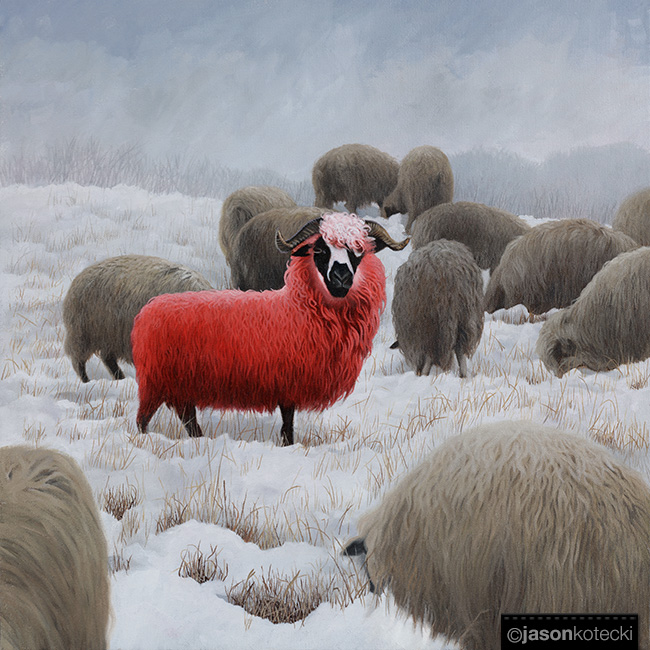
    “One of One” by Jason Kotecki. 20 x 20. Oil on canvas.
    Original is available 🟢 Shop this art!

    When I was in art school in the late nineties, the goth look was in. A significant segment of art kids wore all-black clothing, Doc Martens boots, and fingernails painted with dark colors. I found it fascinating to observe that the ones intent on bucking the system, sticking it to the man, and expressing their individuality all looked…exactly the same.

    It’s scary to stand out.

    We learn this at a young age, when simply being our weird, unique selves can lead to us being shamed and ostracised at recess, on the school bus, or even across the dinner table by a sibling or parent.

    And so, much of life is a careful effort to blend in.

    Just look at the cars we drive, most of which are either black, white, or some combination of the two.

    Or how we take fashion cues from tastemakers and trendsetters because getting caught wearing something out of style is akin to death.

    We must be careful to curate what we say in public for fear of being cancelled.

    In the case of my art school companions, we even blend together in our rebellion.

    Now, some would explain this as an evolutionary feature, not a bug. There’s safety in numbers, after all. We’ve learned to blend in because there’s danger in straying too far from the herd.

    The thing is, we’re not here to sink to our base animal instincts. We were created for a higher purpose. We were made for greatness.

    We are born originals. The problem, as St. Carlo Acutis observed, is that most of us die as photocopies.

    As an artist, I sell prints of my work. Some of them are timed releases, some are limited editions, and some are open editions (available all the time). 

    I sell a lot of them, but they’re all really just fancy photocopies. 

    And none are worth as much as the original. A print sells for less than a hundred dollars. The original can sell for thousands.

    Ask anyone who has purchased one of my original paintings, where you can see the texture of the canvas, feel the brushstrokes with your fingers, and observe the luminosity that emanates from dozens of thin layers of oil paint, and they’ll confirm: Nothing beats an original.

    Sadly, too often we settle for being photocopies.

    It’s been said that imitation is the sincerest form of flattery.

    Maybe if someone else is imitating us. 

    But if it is we who are doing the imitating, then imitation is the sincerest form of boring.

    It is good to learn from those who came before us. It’s possible to find a measure of success by imitating someone else. 

    But the best you’ll ever be is a second-rate version of them.

    This is not a call to stand out for the sake of standing out, or to pretend to be something you’re not. It’s about having the courage to be more of who you are. It’s a reminder that safety should not be our highest virtue. 

    You are free to opt for the safe path. Most people do.

    But you will not be able to escape the gnawing sense of dissatisfaction, the quiet desperation, the ever-present sense in your soul that there’s more to life, and this ain’t it.

    The reason I made the hero in this painting red was because of the lesson I learned from red shoes. After years of wearing safe, plain, predictable shoes, I started pining for red ones. The people I saw wearing red shoes always seemed to be so brave and adventurous, somehow getting more out of life. I wanted that, but I was afraid. I was afraid of standing out too much, but mostly I was afraid that I’d be found out as a fraud.

    Adultitis tried convincing me that I wasn’t one of those “red shoe people.” I wasn’t fun enough, brave enough, or free enough. 

    Eventually, I stood up to Adultitis and got the red shoes. The fears ended up being empty threats. I’ve worn red shoes on stage for every speaking engagement for about two decades now. I love ’em. They make me feel more fun, confident, and free, like a guy who decided it didn’t matter what other people think. 

    Of course, red shoes are not the secret to defeating Adultitis.

    Being brave is.

    What are your red shoes? There is probably something in your life you’ve always (but probably secretly) wanted to own, do, or be, that you’ve talked yourself out of. Maybe Adultitis sold you on the idea that you’re just not “that type of person” and it would be safer to blend in.

    But maybe you actually are that type of person.

    Maybe the fear is a smokescreen keeping you from becoming all God created you to be.

    Maybe twenty seconds of embarrassing bravery will open the door to a new level of confidence and unimaginable opportunities.

    Maybe your example of standing out from the herd will be the spark that lights the way forward for someone else, giving them courage to be brave, too.

    “To be nobody-but-yourself—in a world which is doing its best, night and day, to make you everybody else—means to fight the hardest battle which any human being can fight; and never stop fighting.”

    —E.E. Cummings

    Is any of this safe? Hell no. Of course not.
    But it’s the only way to feel alive.
  • The Prepper

    “The Prepper” by Jason Kotecki. 16 x 16. Oil on canvas.
    Original is SOLD 🔴 Shop this art!

    When my wife told me she was pregnant with our first child, my heart filled with joy.

    Two seconds later, panic arrived at the party.

    All I could think about was how profoundly our lives were about to change and I didn’t have the slightest idea of how to prepare. I immediately began searching Amazon for the latest owner’s manual for babies.

    Kim, on the other hand, seemed to calmly slide into the nesting phase that’s common to many moms in the animal kingdom. In preparation for a new life, they instinctually work to create conditions for that new life to thrive.

    In the years since I’ve seen Kim navigate this phase for all three of our kids, and I’ve realized there are parallels between mothers and artists. While not all of us get to experience motherhood, I believe that every last one of us is an artist.

    Yes, even if you can only draw stick figures.

    In essence, an artist is simply someone who brings something new and beautiful into the world with the potential to improve it in some way. It’s a one-of-a-kind gift that could not be created by anyone else.

    You could have been born at any time in any place, but you were born when and where you were born and you are alive now. You were born for a reason! As long as you’re still breathing, you have something within you the world needs.

    It might be a novel, a non-profit, a painting, or a play. Perhaps it’s a sculpture, a sonnet, or a song. It could also be that a building, a business, or a movement will be your masterpiece.

    We need to take this endeavor as seriously as a mother takes the preparations for her new baby. We need to create conditions that give our undertaking its best chance of success, and that involves three things: supplies, space, and safety.

    A serious mother collects the supplies that will be needed to help her succeed: diapers, bottles, creams, clothes, blankets, and toys. A serious artist needs supplies, too. It might be pens, pencils, paper and paint, or yarn, wood, software, or clay.

    A serious mother considers where the baby will sleep and play and she creates space for that to happen. Likewise, a serious artist also requires a dedicated space, even if it’s just a small folding table in the corner of their bedroom, or a workbench in the back of the garage.

    Finally, a serious mother makes preparations to ensure her youngster is protected and safe to grow and develop. A serious artist also needs a safe space for creativity. New ideas are especially fragile. One must not judge them too harshly at the start, for they need time to blossom into what they are to become.

    The nesting stage is fun, exciting, and imbued with the magic of anticipation, as you envision all the memories (or masterpieces) that will be made. It is a good inclination to want everything you need, and make sure it all has a place. After all, when you are in the whirlwind of caring for a newborn (or in the thick of the creative process), it’s helpful to have what you need, when you need it.

    But don’t be fooled.

    The trap that awaits both mothers and artists is the desire to have all the supplies one could corral, the most ideal space one could hope for, and the highest level of safety and comfort possible.

    All parents eventually come to discover that you are never fully prepared for a baby to arrive in your home. There will always be something you’ve forgotten, something you run out of too quickly.

    It’s ok. Eventually, you learn to make do, and from these constraints come real growth.

    One thing is certain…when it comes to parenting, Mother Nature will not be delayed. The baby is coming, ready or not.

    Alas, this is where the comparisons diverge, for the artist has no such advantage. As such, he or she may be lured into a trap that tricks them into a never-ending nesting phase of collecting all the colors and tools and tricks of the trade.

    It’s an illusion. Under the guise of being serious, the artist is now simply hiding. One must never be fooled into waiting for conditions to be perfect, because they never will be.

    If an artist is not careful, nine months of preparation can slip into nine years of procrastination, justified by not enough time, not enough space, not enough money to begin. Before you know it, nine decades of life are spent and the art your soul desired to make, the gift the world so desperately needed from you, never gets to emerge.

    Serious artists don’t let preparation turn into procrastination.

    We don’t need perfection. But we do need your art.

    That’s why we need you to take it seriously.
  • Strawberry Fields

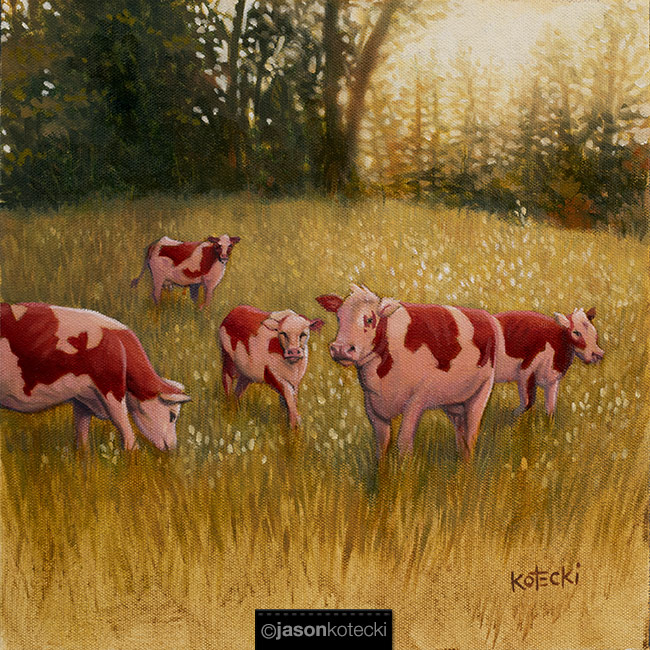
    “Strawberry Fields” by Jason Kotecki. 12 x 12. Oil on canvas.
    Original is SOLD 🔴 Shop this art!

    Where does strawberry milk come from? Pink cows, of course.

    It’s a silly thing that some children believe; something grandparents tell grandchildren when pulling their leg.

    I created this painting for an art fair we exhibited at in Sheboygan, Wisconsin, a land filled with dairy cows. I was pleased that so many people who saw it got the joke, reminiscing nostalgically about the “fact” that strawberry milk comes from pink cows.

    Part of the humor comes from considering the silly logic of children, and the outlandish things they are prone to believe.

    I, for one, used to believe I was Superman. I wore my Superman shirt under my school uniform in second grade to prove it. 

    The ridicule of my classmates inspired me to reconsider that belief.

    But kids are not alone in their misguided understanding of the world. We grown-ups believe our fair share of ridiculous things, don’t we?

    After all, some of us believe that you can’t eat breakfast for dinner and should never eat dessert first.

    Some of us believe that Diet Coke is good for us.

    Some of us believe it’s bad luck to bring bananas on a fishing boat.

    Some of us believe that the first few years of parenting are the hardest.

    Some of us believe that it’s possible to do and see everything on vacation, and we should ruin that vacation trying.

    Some of us believe the news other people watch is propaganda while the news they watch is always true.

    Some of us believe that we don’t need to prioritize spending time with loved ones, as long as the scraps of time we do spend is “quality” time.

    Some of us believe that money is the best barometer of success.

    Some of us believe that skin color says something about who we are as a person.

    Some of us believe that good times will last forever.

    Some of us believe that bad times will last forever.

    Some of us believe that love is a feeling.

    Some of us believe the devil isn’t real.

    Some of us believe that they’d finally be happy, if only…

    Oh dear. Perhaps we grown-ups are not as grounded in reality as we like to think. Maybe we are all in danger of following a few rules that don’t exist.

    I know I believe some of these things some of the time. But it’s probably silly to believe that anyone who reads this will take a moment to re-evaluate their own beliefs.

    Maybe even sillier than believing that pink cows are responsible for strawberry milk.

  • What Does The Fox Say?

    “What Does The Fox Say?” by Jason Kotecki. 24 x 30. Oil on canvas.
    Original is SOLD 🔴 Shop this art!

    Have you ever texted someone a question and then those three little dots pop up as they formulate their reply? 

    You know the three dots.

    Depending on how consequential their response is, that delay can feel like an eternity, right?

    We want answers now, but sometimes they take a while to come.

    From the very beginning of our relationship, Kim and I talked about living in a lake home one day, surrounded by tall pine trees. It took over twenty years to come true, which was approximately nineteen more than I expected.

    Over that prolongated waiting period, I asked God what was taking so long many times. I never got a concrete answer. (At least not one that kept me from asking it again, three months later.)

    When we grow impatient waiting for an answer, we are prone to make up our own.

    I figured maybe God didn’t hear me. Maybe He was hard of hearing. Maybe He was waiting for me to pray harder. Maybe I wasn’t good enough. Maybe He didn’t think I deserved it.

    The thing is, I never got the sense that God was saying no. Sometimes I wished he would, because the waiting was so difficult, as He wasn’t exactly responding with an obvious yes. Just twenty years of three dots.

    After the dream home materialized, in the middle of a global pandemic, when we thought we might lose everything, so did the answer. It became clear that He was doing important work in me that mattered more to Him than the dream home, and that kind of work takes time.

    Eighteen months after moving in, a storm rolled into Sheboygan, and a terrible straight-line wind ripped through our backyard. It destroyed 150 trees, uprooting our forest oasis and plunging us into debilitating debt.

    Again, I came to God with a question: Why?

    This time, my faith was stronger than the roots of the pine trees that couldn’t stand up to the storm. I knew something good would come from the nightmare, but the three dots lingered for longer than I would have liked. I leaned on a question that got us through the pandemic, and one I share almost every time I’m on stage: 

    “Now that this has happened, what does this make possible?”

    A week after the storm, I took my family to breakfast. After we ordered, I turned to a blank page in a journal and asked my wife and kids to dream with me. What was possible now that the storm had taken all our trees? One by one, we built our list as we envisioned a bright future.

    It took a few months for the professional lumberjacks to clear the trees, level our property, and for the new grass to take root. But now we have a stunning, unobstructed view of Lake Michigan and a vast stretch of green to play baseball and bocce, and frisbee. We’ve hosted several Moonrise Movie Nights with friends and family. We installed a fire pit, a bird bath, and other whimsical touches that make our hearts sing. We recently planted fruit trees that we hope will yield ingredients for homemade pies, and we hope to add some legacy trees that will look gorgeous in the fall.

    When people who knew our old backyard see our new one, they often lower their voices to a whisper and say, “I hate to say it, but I think it’s even better now!”

    And you know what? They are right. We do miss the trees, but we like this version of our backyard even better. And never in a million years would we have had the gall to cut down 150 perfectly good trees to get it.

    Meanwhile, even though insurance didn’t pay for any of the backyard cleanup or restoration, it did give us a new roof, which was due to be replaced. And the debt, which is steadily being paid down, has drawn me even closer to God, which is right where He wants me.

    So what about you?

    Are you in a spot where you are waiting for answers, and all you’ve received so far are the three dots? 

    I can’t tell you when the answers will come, but they will. Maybe not till the next life, but maybe sooner than you think.

    As you wait for answers, don’t be so quick to make up your own.

  • The Wingman

    “The Wingman” by Jason Kotecki. 60 x 40. Oil on canvas.
    Original is SOLD 🔴 Shop this art!

    Life is amazing. It is also hard.

    The war against Adultitis is a grueling one that will last your lifetime. But that shouldn’t keep you from trying to soak it with water balloons.

    Your happiness depends on it.

    Now, you’ll need two things in the fight against Adultitis: water balloons and a wingman.

    A Water Balloon is anything joyful that induces playfulness, laughter, merriment, or wonder. The most powerful ones appear frivolous, done for no particular reason other than fun.

    My late father-in-law Gary had a long fight with chronic pain. His faith sustained him, along with a diverse array of water balloons to help him fight, such as Chuck Norris jokes, air shows, Ernest movies, and April Fools pranks.

    My water balloons include: Dad jokes. My Funko Pop collection. Pajama runs. Dance parties. Photobombing my family’s photos. Watching Parks and Rec reruns.

    A Wingman is someone who encourages you to throw water balloons at Adultitis, and when you do, is at the ready with another one. It’s someone you can be goofy with and have fun with, who doesn’t roll their eyes at your silliness or denigrate the things that light you up.

    My wingman is my wife. And my kids. And the members of the Wonder & Whimsy Society.

    Sometimes a wingman is hard to come by. One of my favorite things about our tribe of Adultitis Fighters is that it provides a place for people on an island, without a wingman in their immediate vicinity. The Escape Adulthood League is an army of wingmen (and women) with water balloons at the ready.

    Not only do we each need a wingman, but we are also called to be a wingman for others. That’s what this movement we’re building together is about. Every single one of us can encourage others to embrace their inner child. To embrace their guilty pleasures and to celebrate the things that make them weird.

    So collect as many water balloons as you can. Summon your wingman.

    This is war.

    And Adultitis is about to get wet.

  • Hallelujah Chorus

    “Hallelujah Chorus” by Jason Kotecki. 24x 24. Oil on canvas.
    Original is SOLD 🔴 Shop this art!

    What makes life worth living?

    When we look back on a given year, it’s easy to identify the massive oak trees and tall pines that stand as signposts: the weddings and the funerals, the epic vacations, and the major accomplishments. 

    But we often overlook the small blessings – the birds within the trees, if you will.

    Our minds can only hold so much information, and in my experience, our hard drive space seems to dwindle with each passing year. The brain prioritizes the stuff it determines is important, discarding the rest. Those giant oaks and majestic pines take precedence.

    I’ve been rescuing things from the discard pile through a simple practice that makes it easier to spot those aforementioned birds.

    Once a day, I write down one happy moment from the day before. That’s it. One moment. One line. No paragraph or story or context. Most aren’t even full sentences. It’s like a verbal Polaroid, a snapshot in time that describes a simple moment of happiness. 

    But in the same way that a picture is worth a thousand words, that simple snapshot composed of a handful of words contains within it a treasure trove of details, emotions, and story.

    I do this in a Bullet Journal, with each Happy Moment taking up no more than one line on a page. One could adapt it by writing each Happy Moment on a Post-It note and dropping it into a jar with the intent of reading them when you need a pick-me-up.

    The practice takes me less than thirty seconds a day. The payoff comes at the end of the month or the year, when I re-read them all. 

    Kim and I recently spent time reviewing the previous year. The publication of Wonderhunt stood out, as did our Escape Adulthood Summit in Utah and family trips to Key West and Washington, D.C. But my favorite part was reading all 365 of my Happy Moments for the year.

    Here are a few highlights:

    Playing catch with Ben amidst the kites at Leland Park.
    The scallop dish with leeks and apple risotto at the Black Pig.
    Ginny rolling a strike on frame 10 with no bumpers.
    Staff dinner at the supper club.
    Seeing the walls finally up in the studio.
    Watching Lucy ride Chester with confidence.
    Family time on the front porch, eating push-ups.

    As you can see, none of these rise to the level of “major milestone.” Frankly, they’d probably be forgotten had I not taken the time to write them down at the time.

    But these happy moments become souvenirs of a wonderful journey. Perhaps even more than the achievements and milestones, they give me a feeling of aliveness and a sense that my year was spent well. They are reminders of what makes life worth living, and that I have been blessed in myriad ways, despite the defeats and sorrows that also populated the previous year.

    It’s easy to overlook the small songbirds hidden in the forest of our lives. But when we invest a few seconds to jot down one happy moment a day, reading them at the end of the month or year is magical. It’s like experiencing a sublime symphony, with each note harmoniously contributing its voice to a melody that slowly builds to a soaring crescendo of gratitude.

    It becomes a hallelujah chorus, exulting in the glorious gift of being alive.
  • Shocked Chicken

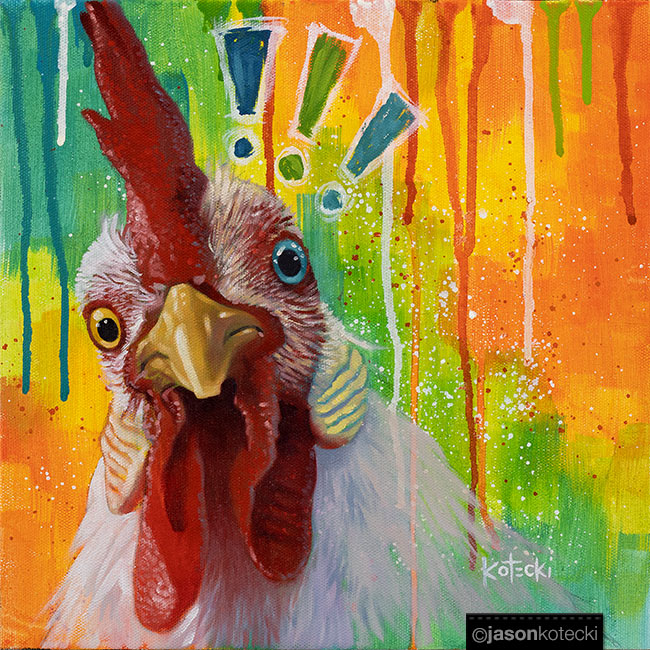
    “Shocked Chicken” by Jason Kotecki. 12 x 12. Oil on canvas.
    Original is SOLD 🔴 Shop this art!

    Thomas Edison has been attributed with saying, “If we did all the things we are capable of, we would literally astound ourselves.” 

    This is true. The potential within each one of us is enormous. 

    But I’ll go one step further. I say that we’d be astounded if we knew how good we already are. Maybe the marketing messages we’ve been bombarded with over the years have convinced us that we really aren’t good enough. Maybe we haven’t received enough positive compliments. Maybe we think the people who do compliment us are just being nice, or don’t know the real us. 

    Please…stop.

    My confidence does not rest in your resume, your highlight reel, or your dashing good looks. It rests in the divine Spirit of your Creator, which dwells within you. 

    You matter. 

    This may come as a shock to you, but you have a special brand of awesome that no one else has. 

    And this world needs it!

  • The Sherpa

    “The Sherpa” by Jason Kotecki. 24 x 30. Oil on canvas.
    Original is SOLD 🔴 Shop this art!

    Do you ever feel lost?

    It seems like an absurd question when we all have smartphones offering turn-by-turn directions to anywhere we want to go.

    But having access to all the paths isn’t the same as knowing which one to take.

    What happens when none of the paths you’ve tried have led to where you want to go? What do you do when you know where you are now isn’t where you want to be, but none of the roads before you seem quite right? What then?

    Perhaps the best place to begin is with those little bits of colored whimsy people sprinkle on ice cream sundaes. Indeed, it’s as good a starting place as any.

    According to an Internet search, the ball-shaped versions of hardened sugar are called “sprinkles,” while the rod-shaped variety is known as “jimmies.” My family isn’t particular; we just call them awesome. My youngest daughter drew a picture of a “Jimmy Machine,” illustrating how they are made. 

    According to her, “Jimmy goes into a machine and it prints out Jimmys onto a conveyor belt. When it goes upside down, they fall, drop onto a series of four trampolines, and then into a butt cheek pit where they emerge as butterflies. Finally, they go in lava and then turn into jimmies.”

    I like to think of myself as creative, but this is PhD-level stuff.

    Some might say it’s merely the absurd ramblings of an eight-year-old with an overactive imagination.

    Yet, is it that much different than Walt Disney’s preposterous vision of Disneyland, a vision that investors, his brother, and even his own wife considered a disastrous waste of time and money? The success of Walt’s idea seems obvious in retrospect, but at the time, it was anything but. The same goes for “Snow White,” history’s first feature-length animated film, which was derisively dubbed “Disney’s Folly.” To those who didn’t get the vision, Walt’s ideas probably looked a lot like the blueprint of my daughter’s “Jimmy Machine.”

    Overactive imagination, indeed. 

    If you look closely, most of the best advancements of humankind started out looking like delusions of ridiculousness. Walt Disney knew that sometimes the best path forward isn’t on the map at all, and the only way to see it is through childlike eyes.

    Reminding people of the power of the childlike spirit is my mission in life. In a world overwhelmed by Adultitis, it’s been an uphill battle. 

    You see, the danger in branding your company “Escape Adulthood” is that it’s easy for people to discount you as irresponsible, immature, cotton-headed ninny noggins who are avoiding the responsibilities of adulthood and trying to escape the pressures of the “real world.”

    As a pragmatist, I’d be tempted to think the same way if I didn’t know any better. 

    It gives me solace to know we are not alone. J. R. R. Tolkien, the author of those little-known books The Hobbit and The Lord of the Rings, was often accused of writing fairy tales that were nothing more than the escapist’s way out of this so-called real world. His reply was simple and brilliant. He proposed that everything was dependent on that from which one is escaping. “We view the flight of the deserter and the escape of a prisoner very differently. Why should a man be scorned if, finding himself in prison, he tries to get out and go home?”

    Exactly. 

    Paying bills, upholding responsibility, and making hard decisions are important and necessary hallmarks of adult life. But the deep-down person we were when we were kids is much closer to the real us than the stilted, joyless version we often present to the world around us. Cynicism, common knowledge, and the rules that don’t exist have imprisoned us from being our true selves: passionate, playful, and curious creatures who dream big dreams and are filled with faith, hope, and love.

    So no, we’re not about shirking responsibilities or ignoring reality.

    We’re just trying to get back home.

    That’s why Kim and I often refer to children as sherpas. Like those experienced, wise guides who escort climbers up the face of a mountain, children have a pure wisdom that can help us traverse this adventure called life. 

    A GPS will not get us where we want to go. 

    Like any good adventure, life is difficult. We need all the tools we can carry, including the ones we tossed away so carelessly in our hurry to grow up. So yes, bring your logic, your experience, and self-control. (Walt needed all of them to make Disneyland real.) But don’t forget to pack your curiosity, playfulness, and passion, for they, too, have their usefulness. 

    They help us to identify hidden paths missing from our map. They open our eyes to help us see what can be, which is the first step required in making it so.

    And leave room in your pack for one more important but overlooked tool: whimsy.

    Although Whimsy is often viewed as superfluous, it is a spark of delight with the supernatural power to uplift the human spirit. Whimsy can fill a heart with happiness and a head with new ideas. Whimsy brings a playful unpredictability to our days. It puts the heavy things we carry in perspective. The delicious ridiculousness of whimsy helps lighten our loads and brings joy to others.

    Sometimes in life, we get stuck circling the same path, repeating our mistakes because we keep trying to use the wrong tools for the job, expecting a different result. The tried and true tools of adulthood are useful, but like using a screwdriver to shovel your driveway, insufficient for the task at hand. 

    If you are sad, stuck, discouraged, or overwhelmed…try whimsy.

    It’s a small thing that can have outsized results, the same way a sprinkling of jimmies can transform an ice cream sundae.

    A good sherpa knows the power of whimsy. Don’t bother looking for it on a map, but it might be the best path to take right now to get where you want to go. 

    In a dark world where the terrible stuff weighs so heavily upon us, we need whimsy more than ever. Whimsy lifts the soul, loosens up the mind, gladdens the heart, and opens the eyes to what can be. 

    This is the way.
  • Smack Daddy

    “Smack Daddy” by Jason Kotecki. 12 x 12. Oil on canvas.
    Original in Private Collection. 🔴 Shop this art!

    Have you kissed a frog lately?

    This painting was inspired by Dig ‘Em, the cartoon mascot of Honey Smacks. But it represents something deeper than a favorite Saturday morning breakfast cereal from my youth. Whether it’s a beautiful princess or a handsome prince disguised as a slimy wart-ridden amphibian, frogs often find themselves in fairy tales as hidden forms of something else.

    Fairy tales aren’t real, but sometimes real life does mimic them.

    For example, do you know someone in your life you weren’t very fond of when you first met? When I was in Little League, Scott D. was the best player on the best team (which sadly, wasn’t mine). I was certain he was part-cyborg – no human was that good – who drank plutonium for breakfast. I pitched against him a few times.

    It never went well.

    I tried hitting against him, too (with “tried” being the operative word). He was the only kid in the league who threw a real curveball, and you couldn’t actually see his fastball, only hear it zip by you as you stood Jello-legged in the batter’s box. He fielded every ground ball that came his way and hit home runs over buildings, always with an air of ease and an ever-present smile plastered on his face.

    I hated him and that stupid, smug smile.

    Fast forward a few years, and we ended up on the same high school baseball team together. He was still a great player, but I discovered that he wasn’t part-cyborg. He was actually a super nice guy, and we became friends. Scott was the kind of person who made you feel better than you actually were. He was ten times the ballplayer I was, but he made me feel like we were equals. I was a second baseman, and we developed a sneaky pickoff maneuver when he was pitching. With nothing more than a knowing glance, we claimed many a baserunner with our clever trap. After the umpire called the out and our opponent slinked shamefully off the field, we always shared a smile.

    Some may have even considered it smug.

    Like a frog in a fable, we regularly encounter situations in which things aren’t as they appear and surprise us when their true identities are revealed. Enemies transform into friends. Setbacks turn into steps forward. Challenges become unexpected gifts.

    Over the course of the pandemic, stories of pain, loss, and anger have been plentiful. We know those stories well; they’re the ones trumpeted by the media and passed along on social media like a dirty crack pipe. But I love asking people to share good reports from the ordeal. In my virtual and in-person speaking programs, I can always count on receiving a stream of replies from attendees; stories of happy moments, unanticipated opportunities, and surprising blessings.

    Sometimes life feels more like a horror movie than a fairy tale, with our happy ending having gone missing.

    But pay attention; it might be hiding right around the corner.
     
    It can be hard to find hope in present circumstances. That’s why it’s helpful to look back on the surprise twists we’ve already encountered, to remind us of their presence and give us hope.
     
    The interesting twist in my story about Scott is that he didn’t change; only my perception of him did. And that’s the big difference between fairy tales and real life. In real life, it’s usually not the frog that transforms, it’s us.

    Might be worth keeping that in mind the next time you find yourself in a swamp, face-to-face with a frog.

  • If There Was a Problem

    “If There Was A Problem” by Jason Kotecki. 16 x 20. Oil on canvas.
    Original is SOLD 🔴 Shop this art!

    What if your biggest problem isn’t a problem at all?

    I love watching otters do meal prep.

    They float on their back as they work to open an oyster for lunch. They put off a nonchalant vibe, like they’re nursing a margarita on an inflatable raft in a pool at an all-inclusive resort. They have the cool confidence of Vanilla Ice, who famously rapped, “If there was a problem yo, I’ll solve it.”

    The situation is actually a matter of life and death because if they don’t eat, they don’t last long. But of course, they are well-suited for the task, so their body language gives away the fact that there’s not much drama involved.

    I wonder how our lives would look if we went about our challenges the same way, looking at our problems more like…brain teasers. What if we saw them as fun puzzles to solve, like oysters that just take a bit of patience and persistence to crack open? Too often, we (and when I say we, I mean me, but perhaps you can relate), run around in a frenzied state, lamenting the sorry state of our affairs and worried that we’ve already eaten our last meal. 

    I, for one, have perfected the craft of rejoicing over all the times God has blessed me and provided for me, while feeling absolutely certain that He’s forgotten about me this time. Sure, there was that time I never thought I’d be brave enough to make it through freshman year. That time we had less than $100 in the checking account. That time, the mechanic left a rag in the engine that prevented us from decelerating on the highway. And the time we came home from vacation to find bullet holes and glass in our living room. 

    Sure, those all worked out ok. But this time…?

    Sometimes I look back at old journal entries and come across my account of a five-alarm dumpster fire written as if it were the sign of the pending apocalypse. With a few years of hindsight, I often have to work to even remember the event.

    Like just today, I stumbled across an old photo of a car that had been in an accident. The hood was crumpled like a Shar-Pei, and it reminded me a lot of a silver Grand Am we used to have. Upon further inspection, it was our Grand Am, and memories flooded back of a fender-bender that happened after a family outing at the zoo. That, too, seemed like a disaster at the time. It was apparently so disruptive to my life that I’d forgotten all about it until I saw the photo in my photostream.

    We encountered a problem, we solved it, and life went on.

    Most problems in life are like that.

    I’m not suggesting we ignore our problems or pretend they don’t exist, but merely to reframe them as cosmic crossword puzzles to decipher, a Rubik’s cube to solve.

    It’s realizing that problems are a part of life, and the only people without them are taking up residence in those extended stay resorts called cemeteries.
    It’s about acknowledging that most problems are not as catastrophic as they feel.
    It’s about maintaining an attitude that problems are solvable while refusing to underestimate our ability to solve them.

    And it’s about accepting that even if you don’t solve the problem right away, even if you’re still trying to crack that baby open, that’s ok, too.

    What if we adopted the frame that these problems are not sent to destroy us, but to keep our minds sharp? Novelist and poet Wendell Berry reminds us that, “The mind that is not baffled is not employed. The impeded stream is the one that sings.”

    Perhaps the next time we encounter a problem – especially the kind that leaves us hysterical – we can try a little harder to adopt the posture of an otter with an oyster. Yes, it’s important. But it’s figureoutable and nothing to panic over. Maybe the calm would give us the clarity we need. Maybe an air of nonchalance would invite the playful spirit we need to crack the case.

    We are more creative than we give ourselves credit for. We are stronger than we feel. And we are loved by a God who is stronger still.

    Like the otter, we are well-suited to overcome any problem we encounter.

    Yo, we got this.