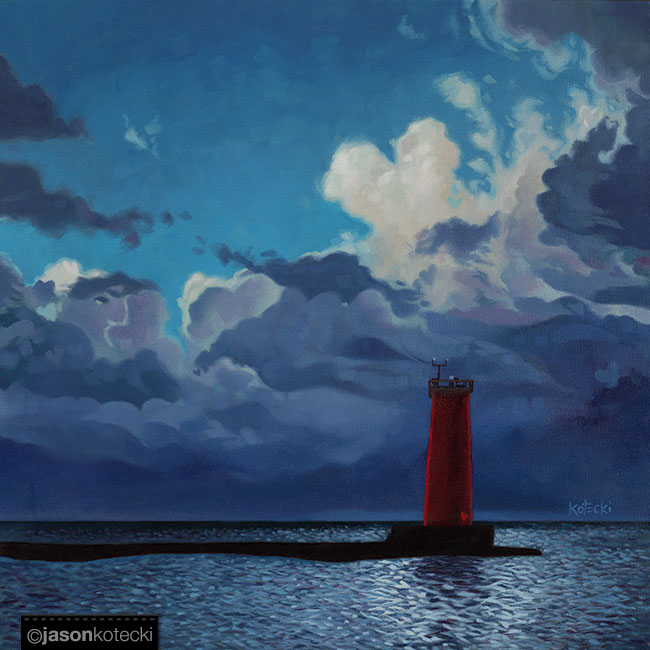
“Seek & Find” by Jason Kotecki. 20 x 20. Oil on canvas. Original is available. 🟢 Shop this art!
My wife has a remarkable superpower for finding hearts in nature, hiding in clouds, flowers, and even her sourdough bread.
One day, we walked along a pier in Lake Michigan. We talked about our business, kids, and future. We lingered at the end of the pier, then walked back, resuming our conversation. Kim casually mentioned seeing fifteen hearts during our walk.
I had seen exactly none.
I marveled at her talent.
But is there such a thing as talent for seeing hearts in nature? I’m not so sure. It’s not like having a beautiful singing voice, exceptional sprinting speed, or a penchant for math.
Kim has a knack for spotting hearts because she spends a lot of time looking for them.
What seems magical to others is often the result of lots of practice.
I once wrote a book about seeing. In it, I talked about storms, the metaphorical kind that blow through our lives. I also wrote about one of our most underrated superpowers: the ability to choose what we look for in the midst of those storms.
Yes, the storms will come. Scary, devastating, faith-shaking storms. They are a given, right up there with death and taxes and missing socks.
But those who see the silver linings are usually the ones looking for them.
It’s not a talent; it’s a practice.
The more you practice, the better you get.
This is true with finding hearts in nature as it is with anything.
So, will this year be worse than last year? Or will it be your best year ever?
Here’s the secret: You don’t have to wait to find out.
The trap is letting external circumstances dictate our answers: the news headlines, the outrage du jour on social media, the ups and downs of life.
It’s hard to view a year of hardship as anything but negative. However, a decade might offer perspective, transforming it into a valuable gift. A little time and practice might turn up a whole host of hidden blessings.
I’m not suggesting you pretend that the tough or terrible moments don’t suck. Being sad, mad, or angry is part of the human experience. We don’t have to bury those emotions under some false blanket of positivity.
Just remember that storms are part of life. The best year isn’t one without failure, conflict, tragedy, or loss.
Kim took the photo that inspired this painting. She saw a heart in the sky near the lighthouse. I enhanced it slightly and added dozens more. I can’t count them all, and you might find some I didn’t add.
That is how it is with cloud watching and wonderhunting and the counting of blessings.
The more you practice, the more you’ll see.
Those who seek shall find.
☕ How would you assess your ability to spot the “hearts” in your life? What’s one way you could practice getting better?
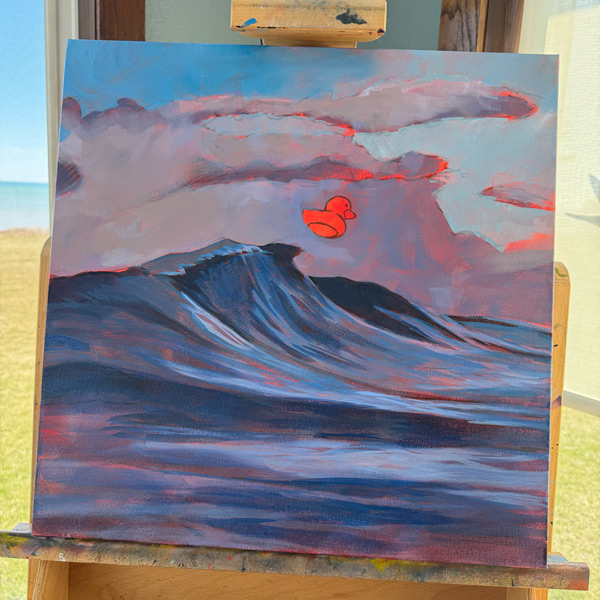
“Beyond the Bathtub” by Jason Kotecki. 20 x 20. Oil on canvas. Original is available 🟢 Shop this art!
I could have stayed in the bathtub.
Way back when, after completing my schooling and earning a degree, the safe path was waiting for me. A decent job in my hometown. It wasn’t particularly exciting, but it was close enough to what I went to school for that I could rationalize it as making sense. I could have taken the job, gotten married, bought a house, and started collecting benefits.
It was tempting, and by most standards, the smart thing to do. The only problem is that I knew exactly what life in the bathtub would look like for the rest of my life.
I may have been shy and quiet, but I grew up observing people who decided to stay in the bathtub. Whether they rationalized it as a smart choice or insisted they didn’t have any others, I could always sense a certain sadness, simmering just below the surface.
Life outside the bathtub is fraught.
The ocean is vast. The edges disappear as the shoreline fades from view. The waves toss us around until we’re seasick. At times it feels like we’ll drown—or be swallowed by something much bigger than ourselves. The current carries us in directions we never would have chosen. It’s disorienting. Terrifying. Unpredictable.
Of course we prefer to remain in an environment we can control!
The problem is that it’s not much of a life.
The bathtub is safe, controlled, and predictable. But it’s also small. Constricting. Eventually the what-ifs become impossible to ignore. What’s outside these walls? What am I truly capable of? Where might I go if I ventured beyond the edge of what I can see?
I was the kid my relatives called a scaredy-cat. Honestly, not much has changed. I’ve never become especially brave or outgoing.
I just knew there was life beyond the bathtub.
Although I’m just a tiny rubber duck, I sensed I was made for a bigger shore, farther away than I could get to on my own.
So I put my trust in the One who made the water, the waves, and the wind.
That choice came with no certainty, no safety, and no benefits package. There were seasons when I felt lost at sea. Driftless. Doubtful. Overwhelmed. Afraid.
You know what? I still feel that way sometimes. There are always temptations to pull into a safe harbor somewhere and settle down. To quit while I’m ahead.
But I can’t go back now.
Since giving my life to the Creator of the ocean, I’ve seen things, accomplished things, and experienced things I never would have known had I stayed in the bathtub. I’ve been swept up in an adventure that’s been wonderful, beautiful, and breathtaking.
The decision isn’t to become adventurous.
The decision is to leave the bathtub.
Everything else follows.
We’re destined for a life beyond the bathtub.
Of course it isn’t safe. But it is good.
Is it time for you to experience what lifeis like beyond the bathtub?
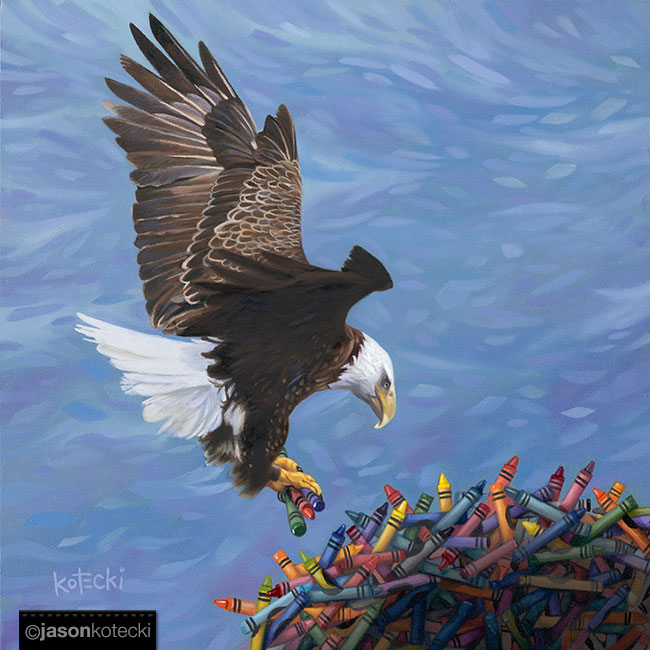
“Jailbreak” by Jason Kotecki. 16 x16. Oil on canvas. Original is available 🔴 Shop this art!
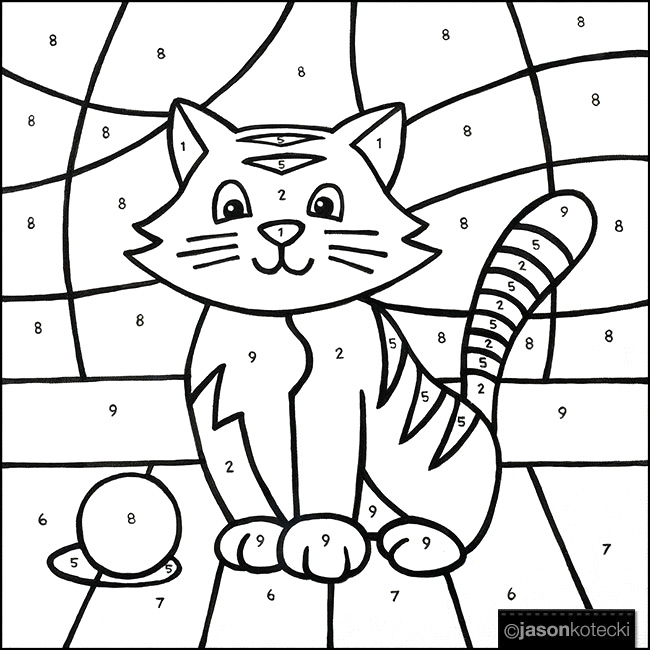
Remember paint-by-numbers?
You know, the beloved craft project in which an image is broken down into sections, each labeled with a number. Fill in each section with the color that corresponds to the ascribed number, and you achieve something that sort of resembles a work of art.
Kinda, but not really.
It might look pretty, but it’s not art.
It’s a plan. It’s a system. It’s one way of doing things.
But it’s definitely not art.
There’s no risk involved. No creativity. There’s none of YOU in the work.
When you finish building a desk from IKEA, do you stand back and proclaim that you have just created a work of art?
No. You were merely following instructions.
A paint-by-number can be a fun, relaxing way to spend an afternoon.
Unfortunately, too many of us settle for a paint-by-number life.
We believe that if we follow the rules, do what we’re told, and stay within the lines, we’ll end up with something that sort of resembles a successful life.
Kinda, but not really.
Oh, it may get you a nice job with a nice benefits package and a nice house in a nice neighborhood with a nice car and 2.5 very nice kids, but I’m not sure that I’d call that a masterpiece.
Just as a paint-by-number gives you the illusion of having made art, this path gives you the illusion of a well-lived life.
We didn’t come up with this on our own, of course. Society and governments would very much prefer us to adopt the paint-by-number route. We’ve been conditioned this way, beginning in school.
The prospect of a paint-by-number life is not all that different from those standardized tests we were given, the kind that can be graded by a machine, where the objective is to fill in each section correctly. The only difference is that instead of using a number 2 pencil, you get to use color.
Just not all of them.
We’re not unwilling participants, however. Part of us craves the comfort and security that comes from embracing a paint-by-number method: “Just tell me what to do to have a safe, comfortable, successful life.”
Unfortunately, our best life is not achieved via the safe, predictable, step-by-step path.
Safety is an illusion, and doing things the way everyone else is doing them is not the path to happiness. Too many people figure this out in midlife, when the paint-by-number method fails to satisfy.
We’re not here to live paint-by-number lives.
Earlier in my career, I searched for a paint-by-number approach. I joined the National Speakers’ Association and got to know many successful people. I tried to copy them, but while they had specific talents and interests and values that contributed to their success, I discovered I had different ones. I searched for a speaker who was also an artist to show me the way. But the few artists I did find weren’t artists in the same way I was an artist, so it didn’t translate.
I thought maybe I was looking in the wrong place. I looked to other artists I admired for a roadmap. That also proved fruitless; it turns out that not many artists are all that eager to stand on a stage and speak to a thousand people.
Lots of experts were happy to sell me their program: “Paint this red and this blue and this green, and you’ll be as happy and successful as I am!”
That fell short, too. It was as if I had red and blue crayons, but lacked a green one that seemed important. Meanwhile, I also had purple and periwinkle, but I couldn’t find a paint-by-number that also included them.
I spent many years frustrated and discouraged, unable to find a prescribed path to success that fit my unique talents, interests, and values.
Finally, I had an epiphany. I didn’t need to wish for or wait until I had the colors someone else had before I could be successful. And those extra colors that didn’t seem to fit were actually an advantage.
I resonated with this realization from Fred Rogers: “I’ll never forget the sense of wholeness I felt when I finally realized what in fact I really was: not just a writer or a language buff or a student of human development or a telecommunicator, but I was someone who could use every talent that had ever been given to me in the service of children and their families.”
I, too, realized that the magic was in combining my seemingly disparate talents. If I took all the crayons I had — even the ones that seemed extra or out of place — I’d be able to create something wholly original.
That’s when everything changed, and my career exploded.
“Escape competition through authenticity.”
–Naval Ravikant
I have original paintings for sale. I also sell prints, which are copies of the original.
They look similar.
But one is worth exponentially more.
“All people are born originals, but many die a photocopy.”
–St. Carlo Acutis
It’s easier and feels safer to copy what other people are doing by living a paint-by-number life. Fit in. Follow the rules. Keep on doing what you’ve always done. Keep telling yourself you’re not creative.
Adultitis would like nothing more for you.
But here’s the thing: they don’t hang paint by numbers in the Louvre.
This doesn’t mean we shouldn’t listen to advice, learn from others, or ever follow best practices. I’m not saying you should strive to be original for the sake of originality.
I’m saying you already are an original.
Or, as Dr. Seuss said, “There is no one alive that is youer than you.”
You were made to be a masterpiece.
You are in the process of building a portfolio. Fill it with adventures. Take chances. Try new things. Do things that don’t make sense once in a while.
Use all the colors you’ve got.
When you get to the end of your life, and you’re looking back at what you’ve created, please don’t let it be filled with paint-by-numbers.
Don’t limit your potential by trying to squeeze yourself into someone else’s tame, safe, predictable prescription for success.
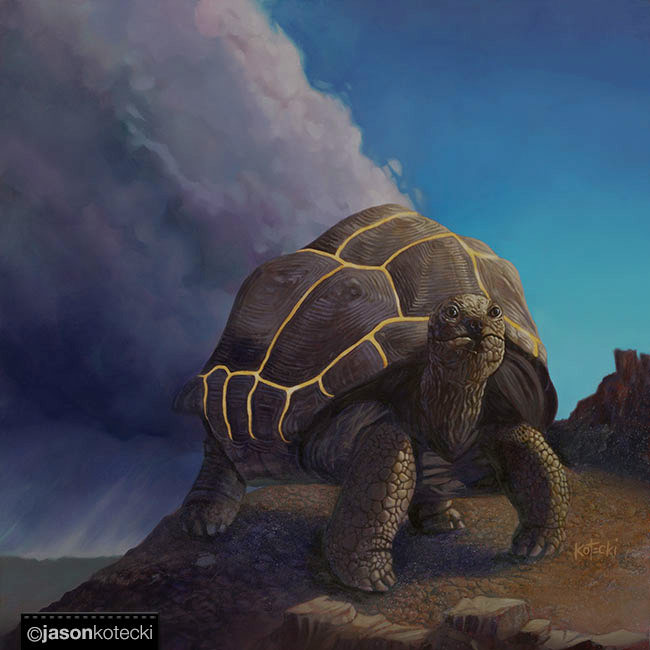
“Kintsugi Tortoise” by Jason Kotecki. 30 x 30. Oil on canvas. Original is SOLD. 🔴 Shop this art!
All dreamers start out delusional.
But perhaps that’s an essential ingredient.
The feeling that their idea is “genius” and the perception of their inevitability of success provide the enthusiasm and energy to get started. After all, no one found the fuel to begin chasing a dream by focusing on all the reasons it could never work.
The critical moment is how the dreamer responds when he or she first encounters adversity.
Or as philosopher Mike Tyson put it, “Everyone has a plan until they get punched in the mouth.”
If a dream is big enough and you pursue it long enough, it will break you.
Your confidence will be shattered. Doubt will creep in. Hope will be lost.
Then what?
I’m sad to say that’s often where it ends. The dream dissolves into an emaciated wish, a thin, pale shadow of its former glorious self.
For twenty-five years, Kim and I dreamed of having a lake home. We talked about it on our first date. We spent hundreds and hundreds of hours talking about it, trying to figure out the most efficient way to make it happen while still doing the work we love and feel called to. We tried on dozens of scenarios in our minds, calculating what was possible and what sacrifices might be required.
In the early days, it seemed like just a matter of time before we made it happen. We had pure motives, a little bit of talent, and a desire to work hard. I could see it, clear as day. On the hard days, the steadfast belief that it would come true kept me going. In my naiveté, I figured it would take a year, maybe three at most. (Ha!)
As months turned to years, and our kids got older, doubts crept in. I wondered if I was wasting my time. I wondered if I was only holding on in desperation, and that my death grip on my dream life was keeping me from living my real one.
It was exhausting and soul-crushing at times. While on a family vacation in Florida, and with the kids asleep in bed, I was sitting on the balcony of our rental. Although it was too dark to see them, I could hear the Gulf’s waves pound the shoreline. My heart was broken, and I wished that I’d never had the dream at all. I was overcome by the desire to throw it back into the sea.
I considered that maybe giving it up would give me relief and freedom. I yearned for someone from a Harry Potter book to cast a Memory Charm upon me, to obliviate the dream from my memory.
That night on the balcony in Florida was February 3, 2020. A little over a month later, a pandemic began, and all hell broke loose in our lives.
Yet somehow, just eleven months later, our family moved into our dream home on Lake Michigan. (Never in a million years did I think it would be one of the Great ones!)
Kintsugi is the Japanese art of repairing broken pottery with gold (or other precious metals). Instead of disguising the damage, kintsugi highlights the repairs, transforming the broken object into a unique and beautiful piece. It’s a philosophy that embraces imperfections and impermanence, finding beauty in flaws and celebrating the history of an object.
It’s true that if a vessel breaks, it can never be made to look new again.
But kintsugi makes it better than new, because it’s even more beautiful than it was before.
Our brokenness makes us humble. Humility is the most beautiful virtue because it allows our other good qualities to shine fully and be most helpful to ourselves and the world.
These broken places within us are not defects. They are the places where light can shine through. Those golden scars embody a soul that is stronger and a story that’s more beautiful because of the trial.
This painting represents the slow patience that’s required of a person trying to achieve something great. It’s a reminder that we will experience the storms of struggle and brokenness. But it’s also a beacon of hope for brighter days ahead waiting for us if we persist.
The journey may be harder than you expected, but the you that emerges will be better for it.
“The Prepper” by Jason Kotecki. 16 x 16. Oil on canvas. Original is SOLD 🔴 Shop this art!
When my wife told me she was pregnant with our first child, my heart filled with joy.
Two seconds later, panic arrived at the party.
All I could think about was how profoundly our lives were about to change and I didn’t have the slightest idea of how to prepare. I immediately began searching Amazon for the latest owner’s manual for babies.
Kim, on the other hand, seemed to calmly slide into the nesting phase that’s common to many moms in the animal kingdom. In preparation for a new life, they instinctually work to create conditions for that new life to thrive.
In the years since I’ve seen Kim navigate this phase for all three of our kids, and I’ve realized there are parallels between mothers and artists. While not all of us get to experience motherhood, I believe that every last one of us is an artist.
Yes, even if you can only draw stick figures.
In essence, an artist is simply someone who brings something new and beautiful into the world with the potential to improve it in some way. It’s a one-of-a-kind gift that could not be created by anyone else.
You could have been born at any time in any place, but you were born when and where you were born and you are alive now. You were born for a reason! As long as you’re still breathing, you have something within you the world needs.
It might be a novel, a non-profit, a painting, or a play. Perhaps it’s a sculpture, a sonnet, or a song. It could also be that a building, a business, or a movement will be your masterpiece.
We need to take this endeavor as seriously as a mother takes the preparations for her new baby. We need to create conditions that give our undertaking its best chance of success, and that involves three things: supplies, space, and safety.
A serious mother collects the supplies that will be needed to help her succeed: diapers, bottles, creams, clothes, blankets, and toys. A serious artist needs supplies, too. It might be pens, pencils, paper and paint, or yarn, wood, software, or clay.
A serious mother considers where the baby will sleep and play and she creates space for that to happen. Likewise, a serious artist also requires a dedicated space, even if it’s just a small folding table in the corner of their bedroom, or a workbench in the back of the garage.
Finally, a serious mother makes preparations to ensure her youngster is protected and safe to grow and develop. A serious artist also needs a safe space for creativity. New ideas are especially fragile. One must not judge them too harshly at the start, for they need time to blossom into what they are to become.
The nesting stage is fun, exciting, and imbued with the magic of anticipation, as you envision all the memories (or masterpieces) that will be made. It is a good inclination to want everything you need, and make sure it all has a place. After all, when you are in the whirlwind of caring for a newborn (or in the thick of the creative process), it’s helpful to have what you need, when you need it.
But don’t be fooled.
The trap that awaits both mothers and artists is the desire to have all the supplies one could corral, the most ideal space one could hope for, and the highest level of safety and comfort possible.
All parents eventually come to discover that you are never fully prepared for a baby to arrive in your home. There will always be something you’ve forgotten, something you run out of too quickly.
It’s ok. Eventually, you learn to make do, and from these constraints come real growth.
One thing is certain…when it comes to parenting, Mother Nature will not be delayed. The baby is coming, ready or not.
Alas, this is where the comparisons diverge, for the artist has no such advantage. As such, he or she may be lured into a trap that tricks them into a never-ending nesting phase of collecting all the colors and tools and tricks of the trade.
It’s an illusion. Under the guise of being serious, the artist is now simply hiding. One must never be fooled into waiting for conditions to be perfect, because they never will be.
If an artist is not careful, nine months of preparation can slip into nine years of procrastination, justified by not enough time, not enough space, not enough money to begin. Before you know it, nine decades of life are spent and the art your soul desired to make, the gift the world so desperately needed from you, never gets to emerge.
Serious artists don’t let preparation turn into procrastination.
We don’t need perfection. But we do need your art.
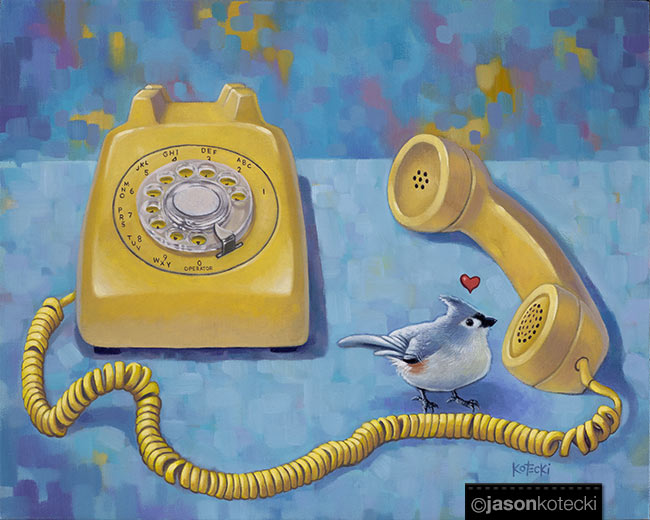
“I Just Called to Say I Loe You” by Jason Kotecki. 20 x 16. Oil on canvas. Original is SOLD 🔴 Shop this art!
“I Just Called to Say I Love You” is a famous Stevie Wonder song. It’s also the title of this painting.
One word in that title might be more important than all the others. We’ll get to that in a sec.
When my wife Kim and I were dating, we’d spend hours and hours on the phone, talking late into the night, racking up phone bills that if bound together, would make the longest Harry Potter book look like a pamphlet. This was in the days when phones were attached to walls and the “call waiting” feature was a source of civil war for any siblings also angling for phone rights.
My personal phone habits with Kim were the exception, not the rule. To this day, I hate being on the phone, for reasons both justified and irrational, but too numerous to bore you with. I let almost everything go straight to voicemail. I am certain the quality of my life would increase exponentially if I never had to talk on the phone ever again.
Of course, the phone is a handy tool for maintaining relationships, which is another weakness of mine. Fortunately, my wife helps with that, as she does the little things that help keep relationships alive for both of us. I am an introvert, a Type 5w4 on the Enneagram (if you know, you know), and as previously mentioned, hate the phone. A generous assessment is that I spend a lot of time in my own head and it’s easy to get lost in there. Which is good for allowing me to create wonderful things, but not so good for maintaining friendships.
Either way, it’s a perfect storm for a scenario in which if Kim dies before me, I’ll end up living alone in a home that neighborhood kids will describe as haunted and invent all sorts of urban legends about the old guy who supposedly lives there.
Part of my problem is that I overthink relationships. In our own ways, maybe we all do.
Friendships can stall if we make them too complicated or set expectations too high. Failing to meet them finds us buried in an ever-mounting pile of “shoulds.” The more time that passes, the more time we assume is required for catching up. And of course, life rarely drops oceans of uninterrupted time into our laps, so… the relationship slowly grows stale and eventually dies.
A recent conversation convinced me of that being a flawed approach.
Andy Gullahorn is a songwriter in Nashville who started an interesting routine with his friend Gabe several years ago. Every week, Andy goes for a walk. Gabe, who lives a mile and a half away, does the same thing at the same time. They walk toward each other, and when they meet, they give each other a high five. Sometimes they stop to play badminton. Oftentimes, no words are exchanged, and they simply head back home.
Kim and I had a chance to interview Andy, and he shared another routine he has with a friend who lives in Houston. Since an in-person high-five is out of the question, every Monday for six years, they simply exchange fist bump emojis. That’s it. And yet the connection has deepened to such an extent that Andy says he trusts that friend with his life.
Andy’s advice is to start small. And ridiculous. “It doesn’t have to be dead serious to make a deep connection,” he says. “In fact, if that’s where it starts, it’s hard to maintain that. The high five is just a stupid foundation to hold real relationship.”
Of course, not every relationship needs to be maintained for all time. Some people come into our lives for a reason or a season. But Andy’s right. Maybe we should focus on uncomplicating the friendships we want to fertilize.
In the interview, he challenged viewers to just commit to not having a deep conversation but to just exchange winks or honk at each other as they pass one another on the road, even without saying another word.
That’s why maybe the most important word in Stevie’s classic song is…”just.”
I JUST called to say I love you. That’s it. No fanfare. No guilt trips. No phone bills weighty enough to kill a small mammal.
We don’t always need to have an hour-long conversation for our relationships to thrive.
A high five or a fist bump emoji might just do the trick. 👊
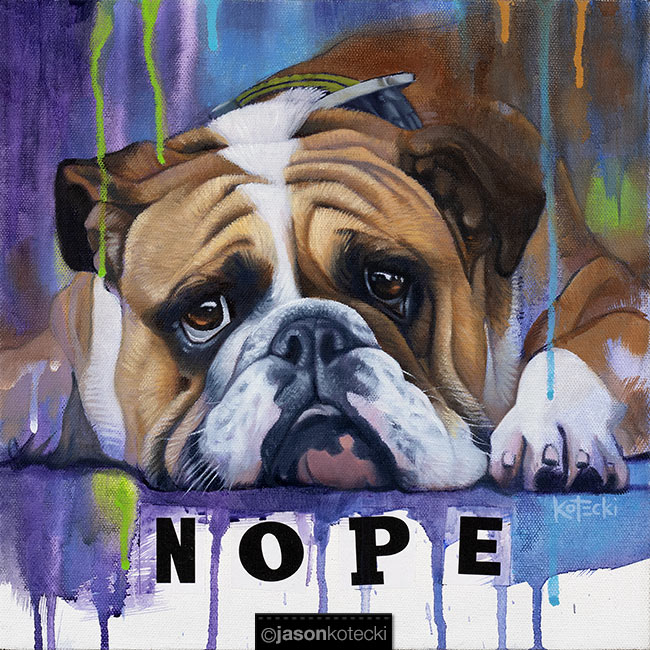
“Nope” by Jason Kotecki. 12 x 12. Oil on canvas. Original is SOLD 🔴 Shop this art!
Mama said there’d be days like this.
Sometimes when we’re feeling overwhelmed, exhausted, or sad, we simply need a time out.
Or pizza.
That was the prescription our midwife gave us after Lucy was born. Kim and I had come into the delivery day mentally depleted, our first child already a few weeks overdue. Then the labor itself was a marathon. After the birth, Kim almost fainted because of a drop in blood pressure. As she recovered, it was on me to put on Lucy’s first diaper and figure out out to dress a four-hour-old (it’s like trying to gift-wrap Jell-O) before clearing an inch of ice from our car so we could drive home from the birth center.
The prospect of going home to attend to the 24/7 needs of a newborn was overwhelming, to say the least. Aware of our exhaustion and sensing our uncertainty, our midwife said, “You know what I want you to do? When you get home, I want you to order in the biggest, cheesiest, gooiest deep-dish pizza ever, and savor it.”
And we did. It was glorious.
It was just the little treat we needed to keep going. We still rely on the magical properties of pizza from time to time.
Sometimes we require something stronger, like a “sick of it” day. In most workplaces, if you have the flu, a persistent cough, or you’re going through more Kleenex than me watching the opening scenes of “Up,” you get to take a sick day and stay home from work. But what if you have a case of the Mondays (or a case of November)?
Kim and I recommend taking a “sick of it” day. (You can still tell your boss it’s a “sick day.”) It’s kind of like playing hooky, but it’s really a chance to shift momentum and throw life a curveball for a change. You can do anything you want, but no work and no chores. Treat yo self.
But what happens when those days mama warned us about turn into weeks, or months, or years?
Our body will tell us if we’re paying attention. I like to think of our negative emotions as a check engine light for our body and soul. You know, the light that illuminates our vehicle’s dashboard to tell us that something’s off. Most people handle it like my father-in-law handled the check engine light on his old Chevrolet Celebrity – with a thick black piece of electrical tape, hiding the light from view.
Problem solved!
Or not. Ignoring a problem rarely works. If you’re in a funk right now or enduring a hard season, it might be time to call a time-out and see what the inner check engine light is trying to tell you.
I preach the power of optimism. But it’s unrealistic to expect we can go through life on a positive high all the time (and I’m leery about people who seem to do so).
Maybe you’re experiencing caregiver fatigue. Maybe it feels like everything you touch turns to shitake. Or maybe you’re burned out from the last three years of pandemic, politics, and pivoting.
It’s ok. Welcome to the Human Club. You’re normal!
We don’t have to be afraid of feeling the feels and examining what they have to teach us.
Uncomfortability can be useful. We need to pay attention to our inner check engine light, not ignore it with a never-ending Netflix marathon, a bottle of wine, or any of the countless ways we self-medicate to numb ourselves to escape our pain.
It’s giving us a heads-up that something may need to be addressed. For me, it’s usually a warning that I need to ease up on adding new commitments to my calendar, a reminder to spend more time in my secret hideout, or an invitation to get a little more rest. (Often it’s a combo of all three.)
This approach from Steve Jobs is a good guide. He said, “For the past 33 years, I have looked in the mirror every morning and asked myself: ‘If today were the last day of my life, would I want to do what I am about to do today?’ And whenever the answer has been no for too many days in a row, I know I need to change something.”
Are you in need of a change? It might be time to talk to someone, like a counselor, pastor, or medical professional. Maybe you need to take that difficult first step toward healing a relationship. Or maybe it’s time to finally embark on that new career path.
Remember, for now doesn’t mean forever. It may feel like there’s no end in sight to the malaise you’re experiencing, but it only seems that way.
Don’t be afraid to peel back the tape on your check engine light and see what it has to tell you.
Maybe a gooey, cheesy pizza and a night on the couch is exactly what you need. Maybe a “sick of it” day will do the trick. Or maybe it’s time for a baby step toward a bigger change.
“The Sherpa” by Jason Kotecki. 24 x 30. Oil on canvas. Original is SOLD 🔴 Shop this art!
Do you ever feel lost?
It seems like an absurd question when we all have smartphones offering turn-by-turn directions to anywhere we want to go.
But having access to all the paths isn’t the same as knowing which one to take.
What happens when none of the paths you’ve tried have led to where you want to go? What do you do when you know where you are now isn’t where you want to be, but none of the roads before you seem quite right? What then?
Perhaps the best place to begin is with those little bits of colored whimsy people sprinkle on ice cream sundaes. Indeed, it’s as good a starting place as any.
According to an Internet search, the ball-shaped versions of hardened sugar are called “sprinkles,” while the rod-shaped variety is known as “jimmies.” My family isn’t particular; we just call them awesome. My youngest daughter drew a picture of a “Jimmy Machine,” illustrating how they are made.
According to her, “Jimmy goes into a machine and it prints out Jimmys onto a conveyor belt. When it goes upside down, they fall, drop onto a series of four trampolines, and then into a butt cheek pit where they emerge as butterflies. Finally, they go in lava and then turn into jimmies.”
I like to think of myself as creative, but this is PhD-level stuff.
Some might say it’s merely the absurd ramblings of an eight-year-old with an overactive imagination.
Yet, is it that much different than Walt Disney’s preposterous vision of Disneyland, a vision that investors, his brother, and even his own wife considered a disastrous waste of time and money? The success of Walt’s idea seems obvious in retrospect, but at the time, it was anything but. The same goes for “Snow White,” history’s first feature-length animated film, which was derisively dubbed “Disney’s Folly.” To those who didn’t get the vision, Walt’s ideas probably looked a lot like the blueprint of my daughter’s “Jimmy Machine.”
Overactive imagination, indeed.
If you look closely, most of the best advancements of humankind started out looking like delusions of ridiculousness. Walt Disney knew that sometimes the best path forward isn’t on the map at all, and the only way to see it is through childlike eyes.
Reminding people of the power of the childlike spirit is my mission in life. In a world overwhelmed by Adultitis, it’s been an uphill battle.
You see, the danger in branding your company “Escape Adulthood” is that it’s easy for people to discount you as irresponsible, immature, cotton-headed ninny noggins who are avoiding the responsibilities of adulthood and trying to escape the pressures of the “real world.”
As a pragmatist, I’d be tempted to think the same way if I didn’t know any better.
It gives me solace to know we are not alone. J. R. R. Tolkien, the author of those little-known books The Hobbit and The Lord of the Rings, was often accused of writing fairy tales that were nothing more than the escapist’s way out of this so-called real world. His reply was simple and brilliant. He proposed that everything was dependent on that from which one is escaping. “We view the flight of the deserter and the escape of a prisoner very differently. Why should a man be scorned if, finding himself in prison, he tries to get out and go home?”
Exactly.
Paying bills, upholding responsibility, and making hard decisions are important and necessary hallmarks of adult life. But the deep-down person we were when we were kids is much closer to the real us than the stilted, joyless version we often present to the world around us. Cynicism, common knowledge, and the rules that don’t exist have imprisoned us from being our true selves: passionate, playful, and curious creatures who dream big dreams and are filled with faith, hope, and love.
So no, we’re not about shirking responsibilities or ignoring reality.
We’re just trying to get back home.
That’s why Kim and I often refer to children as sherpas. Like those experienced, wise guides who escort climbers up the face of a mountain, children have a pure wisdom that can help us traverse this adventure called life.
A GPS will not get us where we want to go.
Like any good adventure, life is difficult. We need all the tools we can carry, including the ones we tossed away so carelessly in our hurry to grow up. So yes, bring your logic, your experience, and self-control. (Walt needed all of them to make Disneyland real.) But don’t forget to pack your curiosity, playfulness, and passion, for they, too, have their usefulness.
They help us to identify hidden paths missing from our map. They open our eyes to help us see what can be, which is the first step required in making it so.
And leave room in your pack for one more important but overlooked tool: whimsy.
Although Whimsyis often viewed as superfluous, it is a spark of delight with the supernatural power to uplift the human spirit. Whimsy can fill a heart with happiness and a head with new ideas. Whimsy brings a playful unpredictability to our days. It puts the heavy things we carry in perspective. The delicious ridiculousness of whimsy helps lighten our loads and brings joy to others.
Sometimes in life, we get stuck circling the same path, repeating our mistakes because we keep trying to use the wrong tools for the job, expecting a different result. The tried and true tools of adulthood are useful, but like using a screwdriver to shovel your driveway, insufficient for the task at hand.
If you are sad, stuck, discouraged, or overwhelmed…try whimsy.
It’s a small thing that can have outsized results, the same way a sprinkling of jimmies can transform an ice cream sundae.
A good sherpa knows the power of whimsy. Don’t bother looking for it on a map, but it might be the best path to take right now to get where you want to go.
In a dark world where the terrible stuff weighs so heavily upon us, we need whimsy more than ever. Whimsy lifts the soul, loosens up the mind, gladdens the heart, and opens the eyes to what can be.
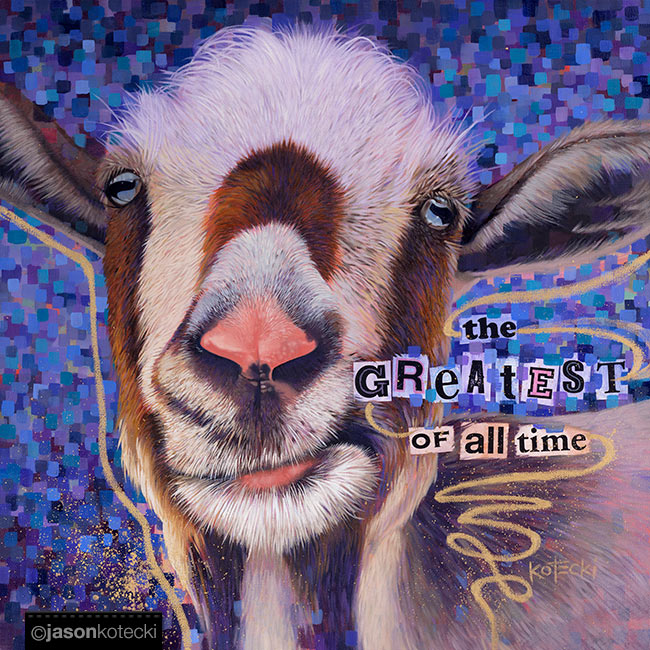
“Greatest Of All Time” by Jason Kotecki. 24 x 24. Oil on canvas. Original is SOLD. 🔴 Shop this art!
How many Super Bowl rings does it take to become a goat?
I am not referring to those four-legged cheese-making mammals with a taste for tin cans.
I’m talking about the label of “GOAT” – the Greatest Of All Time.
As I write this, Tom Brady recently retired after twenty-two seasons in the NFL. He was the 199th pick in the draft, yet ended up with seven Super Bowl rings and threw more touchdown passes than anyone in history. He never played on a losing team. He is widely regarded as the GOAT, at least when it comes to quarterbacks.
Frankly, I’m still getting used to being labeled a “goat” as a good thing. In 1986, Bill Buckner was called a goat for letting an easy ground ball roll past him in a World Series game, and it definitely wasn’t meant as a compliment. (Ah, the ever-present thin line between hero and villain.)
Debating the greatest of all time is a juicy topic for sports talk radio, but what makes the discussion so compelling? Why such an obsession with greatness?
Besides the fact that we like comparing things (and arguing!), greatness stirs something within us. We are inspired when we see it manifested, be it in the long and decorated career of Tom Brady or in the gold medal performance of figure skater Nathan Chen.
But greatness stretches far beyond the sports world:
🥘We see it in a delicious dish prepared with ease by Gordon Ramsay. ✈️We saw it in the remarkable daring and bravery of Amelia Earhart. 🐯We saw it in the spellbinding gentleness and kindness of Fred Rogers. 🙏We saw it in the compelling selflessness and compassion of Mother Teresa.
The greatness of these individuals is so profound and self-evident, it’s easy to assume they are rare geniuses who possess mystical talents. Their level of excellence appears unattainable for us mere mortals. Their talent is unmistakable, but the individuals we place on the pedestal of greatness are merely human beings whose extraordinary results came from the consistent practice of ordinary things.
Our preoccupation with debating the greatest of all time is a trap that prevents us from striving for greatness ourselves.
It’s easier to argue about the top five saints of all time than to aim to become one.
Am I suggesting you are GOAT material?
Actually, yes.
Hear me out. Usually, the title of GOAT is bestowed on someone famous, known for their professional accomplishments, and often in a domain conducive to measurable outcomes…
But what about people who aren’t famous? Isn’t it possible that some Incan woman possessed unmatched skill as a potter, with her only flaw being born at a time when she couldn’t have her own YouTube channel?
And what if your skill is not as esteemed or public as that of a professional athlete or celebrity chef? Could an unknown Amish grandmother technically be the greatest bread maker of all time? And tell me, who is the greatest school custodian of all time? The greatest dental hygienist of all time? The greatest administrative assistant of all time?
What about domains lacking metrics that are easy to quantify? When it comes to football, we can compare wins, passing yards, touchdowns, longevity, playoff appearances, awards, and Super Bowl rings, all while debating the relative importance of each. But how would one go about naming the Greatest Mother of All Time? The Greatest Father of All Time? The Greatest Wife or Husband or Friend or Next Door Neighbor of All Time?
Most of us don’t have trading cards with our pictures on them, and if we did, they wouldn’t have stats on the back totaling Boo-Boos Kissed, Lunches Prepared, Loads of Laundry Completed, Encouraging Words Spoken, or Hugs Delivered.
Without these metrics a Google search away, what would it take for you to become the GOAT?
If you’re normal, you might be thinking, slow your roll, buddy. I already feel like I’m falling short, day after day. I barely qualify as a good parent, let alone the greatest of all time.
I hear you. Sometimes I feel like I’m leading the league in dropped balls.
The good news is that the seeds of greatness are in our DNA because we each have a spark of the divine within us.
Simply put, you were born for greatness.
Don’t let my famous examples fool you. The dictionary defines great as “remarkable in magnitude, quality, skill, or effectiveness.” The steps to achieve greatness are accessible to everyone. Including me. And you. The steps are simple, but not easy.
🔎 Identify Your Gifts. What talents have you been given? If they don’t immediately come to mind, settle into a quiet place. Take stock of the things you do well. Where do you shine? What comes easily to you? What do you love doing? What do people compliment you for? These are your gifts. Remember, “better than everyone else in the world” at anything is not a requirement for greatness.
🎁 Honor Your Gifts. If you treasure a gift, you don’t take it for granted or throw it in a corner. To give your gifts the respect they deserve, use them, share them, and work to improve them. Shoring up weaknesses can be helpful, but keep in mind that Mister Rogers wasn’t as bold and gregarious as Gordon Ramsay, who was not as gentle or vulnerable as Mister Rogers. Greatness lies in maximizing your strengths.
🔒 Be Committed. Greatness requires the willingness to do what no one else will. Not many are willing to stick to the diet and workout routine that helped Tom Brady stay so productive for so long. Even fewer are clamoring to comfort the sick and clean the sores of people living in the slums of Calcutta, as Mother Teresa did. Amelia Earhart was willing to attempt things no one else had ever done, consequences be damned. Greatness requires immense courage and bravery. You have to be willing to challenge conventional wisdom, buck the status quo, and take a stand without any guarantee that anyone will follow you.
🧗 Keep Going. Nathan Chen’s debut Olympic performance was a disaster, riddled with falls. Gordon Ramsay didn’t make a perfect omelet on his first try. Tom Brady didn’t win every playoff game he was in. The great ones aren’t people who never get knocked down. They’re the ones who keep getting up when they do. Anybody can have a good day, a good week, or even a good year. The greats show up year after year. They are persistent, consistent, and stand the test of time.
🚀 Empower Others. Through his example alone, Fred Rogers inspired millions of people, most of whom never met him, to treat others with more respect and kindness than they might have otherwise. Tom Brady’s drive, high standards, and work ethic empowered his teammates to be better. Mother Teresa built a community of sisters who followed her lead and carried on her work after she was gone. Your own humble journey toward greatness may be your most enduring legacy.
We can’t count on being considered the greatest. But that doesn’t mean we shouldn’t strive to be great.
It’s unlikely that you or I will ever be publicly regarded as the “GOAT” of anything. Unless you’re Muhammad Ali – “I am the greatest!” – the title is bestowed on you by others. We can’t control it. Who cares?
When it comes to greatness, everyone else is irrelevant. I agree with Hemingway, who said, “There is nothing noble to being superior to your fellow man; true nobility is being superior to your former self.”
There is one category you can be assured of being the GOAT, and that’s the category of YOU.
Your job is to be the Greatest You of All Time.
If you learned a new thing today or did something to improve your craft or make yourself better than you were yesterday, congrats. You are officially the greatest YOU of all time.
If you got up today after being knocked down yesterday, your legend just gained a new comeback story, and you’re officially the greatest YOU of all time.
If you used one of your gifts to make someone’s day or lessen the burden of another soul, your scoreboard of contributions to the world just increased by one, officially making you the greatest YOU of all time.
Instead of wasting our time arguing over who is the GOAT, may we use their example as inspiration to cultivate our own greatness within us.
Identify your gifts. Honor them by honing them and sharing them with others. Be committed. Keep going. And empower others along the way.
Regardless of whether or not you play in the NFL or make soufflés on TV, those principles are controllable. If you practice them, I can’t guarantee you’ll ever be deemed the GOAT by pundits, historians, or late-night callers on talk radio.
But I will guarantee that people will be inspired by the greatness they see within you.
“If There Was A Problem” by Jason Kotecki. 16 x 20. Oil on canvas. Original is SOLD 🔴 Shop this art!
What if your biggest problem isn’t a problem at all?
I love watching otters do meal prep.
They float on their back as they work to open an oyster for lunch. They put off a nonchalant vibe, like they’re nursing a margarita on an inflatable raft in a pool at an all-inclusive resort. They have the cool confidence of Vanilla Ice, who famously rapped, “If there was a problem yo, I’ll solve it.”
The situation is actually a matter of life and death because if they don’t eat, they don’t last long. But of course, they are well-suited for the task, so their body language gives away the fact that there’s not much drama involved.
I wonder how our lives would look if we went about our challenges the same way, looking at our problems more like…brain teasers. What if we saw them as fun puzzles to solve, like oysters that just take a bit of patience and persistence to crack open? Too often, we (and when I say we, I mean me, but perhaps you can relate), run around in a frenzied state, lamenting the sorry state of our affairs and worried that we’ve already eaten our last meal.
I, for one, have perfected the craft of rejoicing over all the times God has blessed me and provided for me, while feeling absolutely certain that He’s forgotten about me this time. Sure, there was that time I never thought I’d be brave enough to make it through freshman year. That time we had less than $100 in the checking account. That time, the mechanic left a rag in the engine that prevented us from decelerating on the highway. And the time we came home from vacation to find bullet holes and glass in our living room.
Sure, those all worked out ok. But this time…?
Sometimes I look back at old journal entries and come across my account of a five-alarm dumpster fire written as if it were the sign of the pending apocalypse. With a few years of hindsight, I often have to work to even remember the event.
Like just today, I stumbled across an old photo of a car that had been in an accident. The hood was crumpled like a Shar-Pei, and it reminded me a lot of a silver Grand Am we used to have. Upon further inspection, it was our Grand Am, and memories flooded back of a fender-bender that happened after a family outing at the zoo. That, too, seemed like a disaster at the time. It was apparently so disruptive to my life that I’d forgotten all about it until I saw the photo in my photostream.
We encountered a problem, we solved it, and life went on.
Most problems in life are like that.
I’m not suggesting we ignore our problems or pretend they don’t exist, but merely to reframe them as cosmic crossword puzzles to decipher, a Rubik’s cube to solve.
It’s realizing that problems are a part of life, and the only people without them are taking up residence in those extended stay resorts called cemeteries. It’s about acknowledging that most problems are not as catastrophic as they feel. It’s about maintaining an attitude that problems are solvable while refusing to underestimate our ability to solve them.
And it’s about accepting that even if you don’t solve the problem right away, even if you’re still trying to crack that baby open, that’s ok, too.
What if we adopted the frame that these problems are not sent to destroy us, but to keep our minds sharp? Novelist and poet Wendell Berry reminds us that, “The mind that is not baffled is not employed. The impeded stream is the one that sings.”
Perhaps the next time we encounter a problem – especially the kind that leaves us hysterical – we can try a little harder to adopt the posture of an otter with an oyster. Yes, it’s important. But it’s figureoutable and nothing to panic over. Maybe the calm would give us the clarity we need. Maybe an air of nonchalance would invite the playful spirit we need to crack the case.
We are more creative than we give ourselves credit for. We are stronger than we feel. And we are loved by a God who is stronger still.
Like the otter, we are well-suited to overcome any problem we encounter.