“The Joyful Elf” by Jason Kotecki. 20 x 20. Oil on canvas. Original is SOLD 🔴 Shop this art!
This is part of “Adultitis Fighters,” a series of paintings by Jason Kotecki featuring real and fictional characters who serve as role models in the fight against Adultitis.
Buddy the Elf, played by Will Ferrell in the movie Elf, shows us how to embrace life with joy, creativity, and unrelenting optimism. Buddy is unapologetically himself and marvels at the simplest pleasures. He has a knack for breaking the monotony of adult life, improvising solutions and injecting fun into routine tasks. He regularly spreads joy through acts of kindness. Despite being surrounded by skeptical adults, Buddy doesn’t let their negativity diminish his joy or mission. He models resilience in preserving one’s childlike spirit.
“Does somebody need a hug?”
“There’s room for everyone on the Nice List.”
“We elves try to stick to the four main food groups: candy, candy canes, candy corns, and syrup.”
“The best way to spread Christmas cheer is singing loud for all to hear.”
“The Redheaded Pioneer” by Jason Kotecki. 20 x 20. Oil on canvas. Original is SOLD 🔴 Shop this art!
This is part of “Adultitis Fighters,” a series of paintings by Jason Kotecki featuring real and fictional characters who serve as role models in the fight against Adultitis.
Actor and comedian Lucille Ball was a great breaker of rules that don’t exist, becoming one of the first women to own a major television production company and addressed issues like marriage, pregnancy, and women in the workforce at a time when such topics were rarely discussed on television. Through her iconic character Lucy Ricardo on the television show “I Love Lucy,” she was a comedic trailblazer, portraying a strong, independent woman who wasn’t afraid to be funny, clumsy, or ambitious.
“The secret of staying young is to live honestly, eat slowly, and lie about your age.”
“In life, all good things come hard, but wisdom is the hardest to come by.”
“One of the things I learned the hard way was that it doesn’t pay to get discouraged. Keeping busy and making optimism a way of life can restore faith in yourself.”
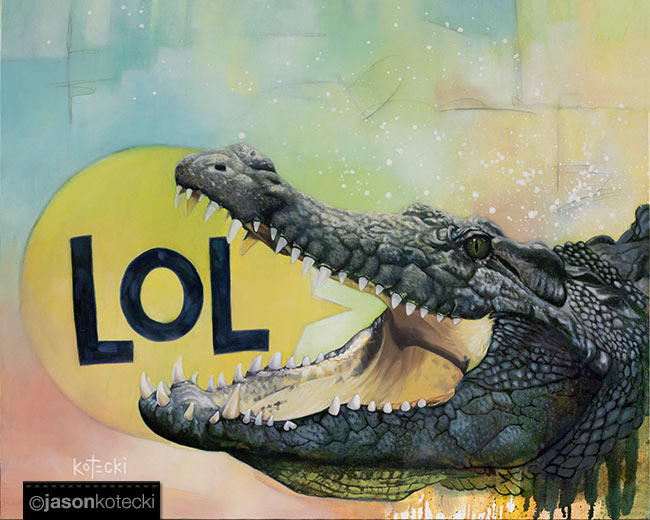
“LOLigator” by Jason Kotecki. 30 x 24. Oil on canvas. Original is SOLD 🔴 Shop this art!
An alligator can live up to 100 years…
which is why there’s an increased chance they will see you later.
One of the midwives who helped Kim on her journey into motherhood had experience working with the Navajo people. She told us about a custom of theirs in which the first person to make a newborn laugh is obligated to throw the family a huge party to celebrate the occasion. According to their tradition, it’s considered the moment in which the baby is fully present and “in the world.”
I think that’s pretty cool.
You often see people rejoicing over a baby’s first words, first steps, and first day of school, but never have I heard a big deal made out of a baby’s first laugh. At least not enough to warrant a party to be thrown because of it.
It’s a striking example of how little we value laughter in our society.
What’s weird is that laughter is a universally loved activity, and yet, adulthood often finds us treating it as a non-renewable resource, something to be reserved for when our work is done. We leave it out of serious and challenging situations, and grow suspicious of people who do too much of it.
Which brings me to alligators.
I don’t know about you, but when I see an alligator, I don’t think, “Here’s a guy who must be the life of every party.” He’s not on my Top 10 list of Animals Who Don’t Take Themselves Too Seriously.
And yet, when he opens his mouth, it looks like he just heard a good joke.
Which gives me hope, because I encounter a lot of people walking around with the sunny disposition of an alligator these days.
We can all agree that laughter is beneficial. It boosts the immune system (why they say laughter is the best medicine), brings you more energy, lowers levels of pain, and protects you from the dreaded Adultitis. Of course, as we get older and are inundated with Adultitis, laughs can be hard to come by.
The good news is that you can literally fake it till you make it.
Believe it or not, fake laughter offers the same benefits as real the kind. Certified life coach Katie West says, “Pretending to laugh (or practicing laughter) can alter our body chemistry since our brains can not tell the difference between real and fake laughter.”
I have experienced a group of people fake laughing, and I can tell you, the vibe shift is real. And when people are practicing fake laughs, real ones bubble up like clockwork.
Likewise, we can generate more laughter by being intentional about injecting some fun into our routine:
Read or watch something funny before bed. (At the very least, stop watching the Crisis News Network!)
Stress continues to be a contributing factor to every single thing that kills us, from heart disease to suicide. Yet the standard operating procedure these days is to trudge through life with furrowed brows and steely determination. But now, more than ever, we should take a cue from the Navajo people and celebrate laughter.
Every single laugh is a dollar in the economy of the human spirit.
I get that we live in serious and challenging times, but that doesn’t require us to take ourselves seriously.
St. Teresa of Ávila, a Spanish mystic and great reformer, once said, “May God protect me from gloomy saints.”
One of the greatest things ever is hearing my kids laugh. Whether it’s a silly little giggle or an unbridled belly laugh, there’s no better sound in the world.
I imagine that God probably feels the same way about his children.
When we laugh, we are happy and free. During that moment of laughter, we are not worried, anxious, or stressed. And so it must give God great joy to see his children buckled over in laughter, just as it does me with my kids.
And reminds me just how much Adultitis must hate it.
All the more reason to make laughter a priority.
As Charlie Chaplin, one of the world’s greatest Adultitis fighters and a patron saint of comedy, once said, “A day without laughter is a day wasted.”
“The Coach” by Jason Kotecki. 20 x 20. Oil on canvas. Original is SOLD 🔴 Shop this art!
This is part of “Adultitis Fighters,” a series of paintings by Jason Kotecki featuring real and fictional characters who serve as role models in the fight against Adultitis.
Ted Lasso, the titular character of the TV series “Ted Lasso,” is a model of blue sky optimism and positivity. His humor and lightheartedness diffuse tension and bring joy, but he’s far from a naive pollyanna. Even though he had plenty of reasons to despair, from his failing marriage to his losing team, he didn’t succumb to pessimism and remained filled with hope. His sunny disposition and can-do attitude inspire us to maintain a positive outlook and approach challenges with resilience and determination.
“Taking on a challenge is a lot like riding a horse, isn’t it? If you’re comfortable while you’re doing it, you’re probably doing it wrong.”
“You say impossible, but all I hear is ‘I’m possible.’”
“You beating yourself up is like Woody Allen playing the clarinet. I don’t wanna hear it.”
“So I’ve been hearing this phrase y’all got over here that I ain’t too crazy about. ‘It’s the hope that kills you.’ Y’all know that? I disagree, you know? I think it’s the lack of hope that comes and gets you.”
“The Candymaker” by Jason Kotecki. 20 x 20. Oil on canvas. Original is SOLD 🔴 Shop this art!
This is part of “Adultitis Fighters,” a series of paintings by Jason Kotecki featuring real and fictional characters who serve as role models in the fight against Adultitis.
Willy Wonka, the enigmatic chocolatier from Roald Dahl’s “Charlie and the Chocolate Factory,” is an iconic symbol of the wonder and magic of childhood. His eccentric behavior, refusal to conform, and unexpected twists challenge conventional expectations, encouraging us find delight in surprises. Willy’s whimsical inventions and fantastical creations teach everyone that anything is possible with a little imagination and ingenuity. His witty remarks and mischievous antics remind us not to take life too seriously.
“You should never, never doubt what nobody is sure about.”
“We are the music makers, and we are the dreamers of dreams.”
“If the good lord intended us to walk, he never would’ve invented roller skates.”
“The suspense is terrible! I hope it’ll last.”
“A little nonsense now and then is relished by the wisest of men.”