Keyword: forest

  • We Can’t Let Winter Win

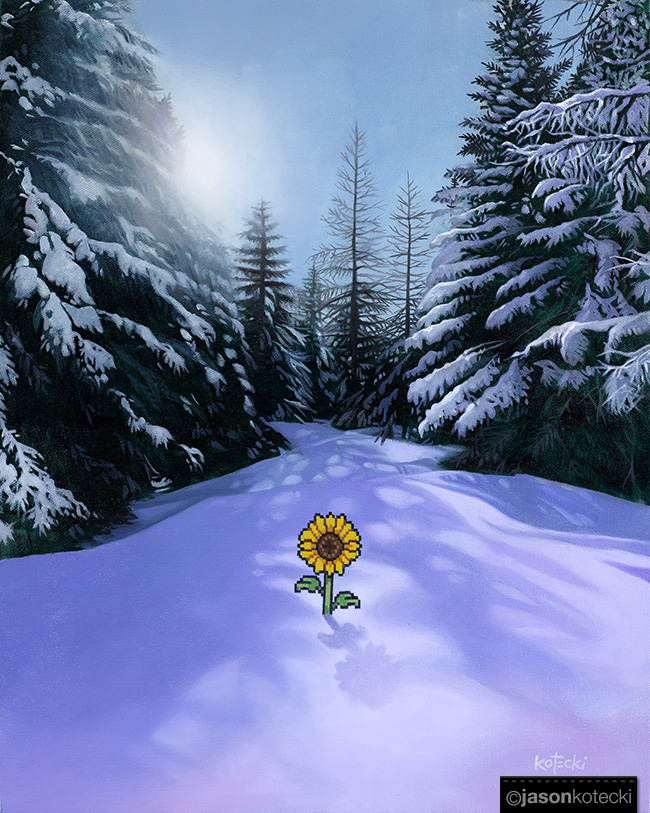
    “We Can’t Let Winter Win” by Jason Kotecki. 16 x 20. Oil on canvas.
    Original is available 🟢 Shop this art!

    One thing I love about the Midwest is the seasons. Real ones. Not like those they claim to have elsewhere, so-called “winters” with an occasional snow flurry and temperatures that sometimes flirt below forty.

    In Wisconsin, our seasons are pure, not pretenders. 

    I like that, because it allows me to fully embrace the beauty and lessons of each one. It’s a reflection of life, which has distinct seasons, no matter where we live.  

    If we’re honest, we’d prefer life to be one long, glorious summer, filled with sunshine and popsicles. But no. There are seasons of autumn, times for slowing down and saying goodbyes. And there are long winters of loneliness, where life feels frozen solid, and hope gets buried under a blanket of snow. 

    Of course, spring always follows, but sometimes it seems to have overslept.

    In Wisconsin, there is always a point when you’re pretty sure winter is over. 

    Live here long enough, and you realize it’s not. 

    There’s always one last gasp. One final snowstorm. One more cold snap that steals spring away, just as you were about to elope together on your way to summer.

    That might be the most deflating, difficult part of winter: The moment when it appears it will never end, and you don’t know how much more you can take.

    Life feels like that sometimes, when it seems like winter’s gonna win. 

    Winter wins when it convinces us that nothing will ever change.

    Winter wins when we let disappointment over unmet expectations turn into resentment.

    Winter wins when we allow ourselves to be buried under a blanket of apathy.

    Winter wins when we decide to give up and let the hope within us flicker out.

    But it doesn’t have to get the final say.

    This painting is a reminder that we can’t let winter win.

    The 8-bit sunflower is reminiscent of a video game, because I think that’s a good way to think of it. When you’re in the middle of one of life’s winters, everything is heavy. Summer looks so far away. We see all the things that need to change for us to go from where we are to where we want to be, and it feels insurmountable. 

    Sometimes the answer to the darkness that weighs down on us is a little levity. Making a game out of it is a way to rise above the life-and-death seriousness of our situation. It takes us ever-so-slightly outside ourselves to give us perspective that is a little wider than the restricted, optionless way winter can feel sometimes.

    Part of what makes a game engaging and fun is that there is a challenge to it. But the key is for it to be a doable challenge. So instead of focusing on all the ways we are frozen in place and how many more days of winter are ahead, make a game out of finding even one tiny clue that spring is on its way. You don’t need to defeat the Final Boss and save the Princess; you just need to make it past this level. 

    Today.

    The game is this: Figure out how to win today.

    It doesn’t have to be big.

    It could be one five-minute prayer.

    It could be getting dinner on the table.

    It could be dumping the bottle of vodka down the drain.

    It might just be getting out of bed.

    Sometimes the win is just giving it one more day.

    I’ve experienced many winters, especially in the early days of building our business. I once got some advice from a business colleague I’ve never forgotten. He, too, was an entrepreneur and knew how discouraging it was to feel like you made one step forward only to take three steps back. He shared a simple policy he lived by. On those really hard days, the days when he didn’t think he could go any further, he promised himself he’d give it one more day. He gave himself permission to abandon ship after that, but not before he gave it one more day.

    Sure enough, the next day always brought some glint of hope, a new reason to believe. There was rarely any huge breakthrough that magically happened. Maybe it was a small sale. Maybe it was an encouraging word from a friend. Maybe it was just a good night’s sleep.  

    Just a baby step forward.

    We win when we find evidence that spring is on its way.

    We win when hope bursts through a blanket of apathy.

    We win when our resentment melts into acceptance.

    We win when our panic gives way to patience.

    We win when we bring light to someone else.

    We win when we give it one more day.

    Don’t let winter win.

    Keep holding on for spring.
  • Doing Nothing

    “Doing Nothing” by Jason Kotecki. 20 x 20. Oil on canvas.
    Original is available. 🔴 Shop this art!

    Doing nothing isn’t really doing nothing.

    New parents (and parents-to-be) get lots of advice. Among the wellspring of wisdom are tips on getting your kids to eat or sleep, and keeping them alive while maintaining your sanity. 

    Perhaps the truest and most common exhortation is: Cherish every moment; it all goes so fast.

    We don’t need anyone to tell us this, of course. It’s so obvious that we discard it out of hand with a smile, a nod, and a quip like, “I know; the days are long, but the years are short, amiright?”

    The problem is that the entire world seems to conspire against us. 

    It doesn’t want us cherishing anything. That would require us to slow down for a hot minute. Cherishing, pondering, reflecting…these don’t feel very productive. In fact, they feel a lot like doing nothing.

    I remember when my oldest daughter was a newborn. One afternoon, after completing the important work-related items on my to-do list, I relieved Kim by assuming caregiving duties. Lucy and I nestled into the rocking chair, where she promptly downed several ounces and drifted off to sleep. I sat for a few moments, soaking in the silence before the siren song of productivity resurfaced. Now that she had fallen asleep so quickly, I could tackle my email! As I was about to set her on the couch and grab my laptop, it hit me:

    Oh my gosh. I’m doing it. I’m missing out on the best stuff.

    Sometimes, a sleeping baby is a gift God gives us to help us manage other responsibilities. But I’d already accomplished my important tasks for the day. In that moment, I received a gift: the realization that there will always be e-mail to check, but my opportunities to hold that little sleeping angel were numbered. I became acutely aware that years from now, when I’m walking Lucy down the aisle on her wedding day, I will not remember any of the “productive” things I did that day. But the memory of her button nose, bald head, and peaceful slumber will remain with me forever.

    On that rapidly approaching day, I don’t want to find myself wishing I’d spent more time doing “nothing.”

    We live in a culture that worships at the altar of productivity. Adultitis is a sinister foe after all of us. It has tricked us into believing that we should always be busy, always “doing” something. If it’s not shared on social media, it didn’t happen. If it can’t be measured, it doesn’t matter. 

    A book called How Will You Measure Your Life? by Clayton Christensen sheds light on this. He points out that it is our nature to unconsciously choose the things that give us an immediate, tangible accomplishment over something for which we aren’t likely to see a return for decades. 

    We can cut the grass, close a sale, finish a week’s worth of lesson plans, deliver a presentation, publish a paper, or redesign our website in less time than it takes to raise great kids or build an awesome marriage.

    So we default to efforts that provide an immediate payoff and a satisfying feeling of accomplishment.

    In chasing this dopamine hit of achievement — even one that isn’t all that consequential — we confuse the urgent with the important. We unwittingly turn irrelevant tasks into priorities simply because they can be checked off some list. And checking off five things is better than one, even if the undone item was the most important. 

    Like a junkie craving another high, we feel anxious spending too much time doing nothing.

    But doing nothing isn’t really doing nothing. Sure, holding my sleeping baby and soaking in a quiet moment didn’t decrease the messages in my inbox. But it certainly wasn’t “nothing.” Quite the contrary. 

    Taking the time to do nothing once in a while – especially with the people we love – might be the single most important thing we do all day.

    When you carve out time to be with someone you care about, “What are we going to do?” becomes a question that demands an answer. The longer it goes without one, the higher the anxiety levels rise.

    Unfortunately, without a specific activity on which to focus our attention, we turn to those little dopamine-delivering slot machines always by our side. Time and again, I see friends or couples together, at the beach, on the train, out to dinner, and their attention is on their phones. 

    Their bodies are near each other, but their hearts and minds are miles apart.

    Together, but not really.

    All because we can’t escape the lure to do…something.

    Let’s refuse to let the almighty algorithm dictate how we spend our time. What if the answer to “What are we going to do?” was simply, “Nothing. Doesn’t matter. Let’s just be together.” There doesn’t need to be a mission accomplished, a box to be checked, or an objective to be measured.

    This painting is inspired by a favorite quote from Winnie the Pooh, who said, “People say nothing is impossible, but I do nothing every day.” 

    Doing nothing, it seems, takes more effort than doing something.

    When Lucy was a baby, and I was savoring a quiet moment alone with her doing nothing, the pull of productivity tried to poison it. Even if I left my laptop closed, I wondered if I should be engaging her more, teaching her more, or coming up with something more “Instagram worthy” to do with her. Was I a bad dad for not wanting to do more than just sit with her? 

    But the doing nothing was actually…nice.

    And it filled me with peace that is oh so hard to come by these days.

    Having a little honey, wishing on a dandelion, and enjoying a fine day together might feel a lot like nothing.

    Sometimes doing nothing is the very best something you can do.
  • True Believer

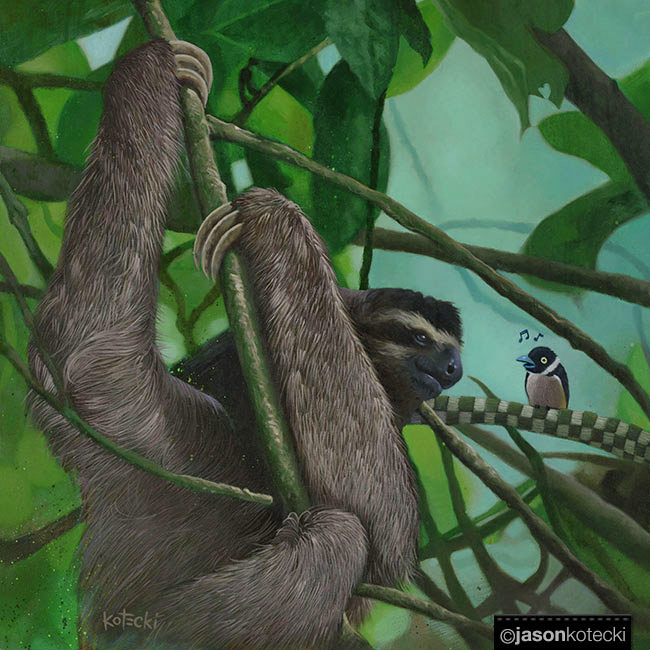
    “True Believer” by Jason Kotecki. 24 x 24. Oil on canvas.
    Original is available. 🟢 Shop this art!

    Dreams always take longer than we think.

    There may be such a thing as overnight successes, but if so, they don’t stay successful for very long.

    More often than not, so-called “overnight successes” are anything but.

    One time, Kim and I spent a couple of hundred dollars on a two-day craft show. That was a big chunk of change for us at the time — about two months’ worth of groceries. We were next to a booth where a guy was selling knockoff Garfield tchotchkes. Meanwhile, we moved a grand total of $7.92 worth of greeting cards. It was rough. Then we drowned our sorrows in sirloin steaks at Outback, which made our negative profit margin even worse.

    I have a lot of stories like that from the early days. Happy times.

    Over the years, I have often felt like the sloth in this painting. Very little progress to show for a heck of a lot of effort.

    But then I think of things like that craft show, and I’m impressed and even a little surprised by how far we’ve come. There is a great sense of satisfaction in what we’ve built and the things we’ve accomplished, regardless of how much distance there is left to cover.

    Anything worth building takes time.

    More time than you think it should.

    Like way more.

    We need to hear that reminder often, because it goes for everything from dream businesses and amazing relationships to paying off Bank of America and mastering the clarinet. Thanks to the proliferation of microwave ovens and high-speed internet, progress always seems to be taking longer than it should. Then the media peddles their stories of overnight success. They catapulted to fame and fortune in one fell swoop; why can’t you?

    When the early buzz of enthusiasm wanes, discouragement is quick to settle in. It is during those seasons that we need to look for and listen to our true believers.

    I’ve been fortunate to have quite a few in my life.

    My Grandma K. made me feel like I was special, just as I was.

    My third-grade teacher, Mrs. Smith, encouraged me to take my artistic talent seriously.

    My Little League coach, Mr. Dawson, helped me believe that I was a winner.

    My high school art teacher, Mrs. Garrett, made me believe I had the talent to do this for a living.

    When I was an uncertain teenager, Deacon Vince saw me as a grown-up with valuable contributions to make.

    When Kim and I got married and launched our business, we were graced with a few true believers who saw the vision, including our parents and our best friends, Sue and Jenna. Theirs were not just empty words of encouragement. They responded with action by offering their time, money, and prayers. This signaled the proof of their belief.

    The certainty from true believers is invaluable. There will come a time when you lose faith in the vision, and you will need them to remind you that it’s real.

    Mounting failures and things taking longer than you expected take a toll. That vision, which once seemed so clear, begins to fade. You wonder if all the naysayers were right. After all, so many of them have way more experience than you, and the evidence seems to be piling up in their favor. Maybe I AM delusional? Maybe I was mistaken? Maybe the signals got crossed and I accidentally co-opted a dream that was not meant for me…

    I entertained all these thoughts at various times. It was tempting to give up.

    But then I remembered my parents. And Kim’s parents. And Sue and Jenna. I remembered that nobody pours money or time into a lost cause. Their sacrifice was tangible proof of their belief in us. It helped assure me that no, this is not a mirage. It’s real. They see it.

    Their belief bolstered my own.

    We need cheerleaders to succeed. They give us the boost we need when our dream seems late in coming.

    There are a few reasons dreams take longer than we think they should.

    One is partly for us to prove how much we want it.

    But it’s also because the most important part of a dream is who we become in the process of chasing it. That’s the real reward.

    When success doesn’t materialize as quickly as you thought it would and you’re discouraged by your dream taking too long, don’t despair. Heed the true believer cheering you on.

    Take it from the sloth. Achieving anything worthwhile is a marathon, not a sprint.

  • What Does The Fox Say?

    “What Does The Fox Say?” by Jason Kotecki. 24 x 30. Oil on canvas.
    Original is SOLD 🔴 Shop this art!

    Have you ever texted someone a question and then those three little dots pop up as they formulate their reply? 

    You know the three dots.

    Depending on how consequential their response is, that delay can feel like an eternity, right?

    We want answers now, but sometimes they take a while to come.

    From the very beginning of our relationship, Kim and I talked about living in a lake home one day, surrounded by tall pine trees. It took over twenty years to come true, which was approximately nineteen more than I expected.

    Over that prolongated waiting period, I asked God what was taking so long many times. I never got a concrete answer. (At least not one that kept me from asking it again, three months later.)

    When we grow impatient waiting for an answer, we are prone to make up our own.

    I figured maybe God didn’t hear me. Maybe He was hard of hearing. Maybe He was waiting for me to pray harder. Maybe I wasn’t good enough. Maybe He didn’t think I deserved it.

    The thing is, I never got the sense that God was saying no. Sometimes I wished he would, because the waiting was so difficult, as He wasn’t exactly responding with an obvious yes. Just twenty years of three dots.

    After the dream home materialized, in the middle of a global pandemic, when we thought we might lose everything, so did the answer. It became clear that He was doing important work in me that mattered more to Him than the dream home, and that kind of work takes time.

    Eighteen months after moving in, a storm rolled into Sheboygan, and a terrible straight-line wind ripped through our backyard. It destroyed 150 trees, uprooting our forest oasis and plunging us into debilitating debt.

    Again, I came to God with a question: Why?

    This time, my faith was stronger than the roots of the pine trees that couldn’t stand up to the storm. I knew something good would come from the nightmare, but the three dots lingered for longer than I would have liked. I leaned on a question that got us through the pandemic, and one I share almost every time I’m on stage: 

    “Now that this has happened, what does this make possible?”

    A week after the storm, I took my family to breakfast. After we ordered, I turned to a blank page in a journal and asked my wife and kids to dream with me. What was possible now that the storm had taken all our trees? One by one, we built our list as we envisioned a bright future.

    It took a few months for the professional lumberjacks to clear the trees, level our property, and for the new grass to take root. But now we have a stunning, unobstructed view of Lake Michigan and a vast stretch of green to play baseball and bocce, and frisbee. We’ve hosted several Moonrise Movie Nights with friends and family. We installed a fire pit, a bird bath, and other whimsical touches that make our hearts sing. We recently planted fruit trees that we hope will yield ingredients for homemade pies, and we hope to add some legacy trees that will look gorgeous in the fall.

    When people who knew our old backyard see our new one, they often lower their voices to a whisper and say, “I hate to say it, but I think it’s even better now!”

    And you know what? They are right. We do miss the trees, but we like this version of our backyard even better. And never in a million years would we have had the gall to cut down 150 perfectly good trees to get it.

    Meanwhile, even though insurance didn’t pay for any of the backyard cleanup or restoration, it did give us a new roof, which was due to be replaced. And the debt, which is steadily being paid down, has drawn me even closer to God, which is right where He wants me.

    So what about you?

    Are you in a spot where you are waiting for answers, and all you’ve received so far are the three dots? 

    I can’t tell you when the answers will come, but they will. Maybe not till the next life, but maybe sooner than you think.

    As you wait for answers, don’t be so quick to make up your own.

  • The Wingman

    “The Wingman” by Jason Kotecki. 60 x 40. Oil on canvas.
    Original is SOLD 🔴 Shop this art!

    Life is amazing. It is also hard.

    The war against Adultitis is a grueling one that will last your lifetime. But that shouldn’t keep you from trying to soak it with water balloons.

    Your happiness depends on it.

    Now, you’ll need two things in the fight against Adultitis: water balloons and a wingman.

    A Water Balloon is anything joyful that induces playfulness, laughter, merriment, or wonder. The most powerful ones appear frivolous, done for no particular reason other than fun.

    My late father-in-law Gary had a long fight with chronic pain. His faith sustained him, along with a diverse array of water balloons to help him fight, such as Chuck Norris jokes, air shows, Ernest movies, and April Fools pranks.

    My water balloons include: Dad jokes. My Funko Pop collection. Pajama runs. Dance parties. Photobombing my family’s photos. Watching Parks and Rec reruns.

    A Wingman is someone who encourages you to throw water balloons at Adultitis, and when you do, is at the ready with another one. It’s someone you can be goofy with and have fun with, who doesn’t roll their eyes at your silliness or denigrate the things that light you up.

    My wingman is my wife. And my kids. And the members of the Wonder & Whimsy Society.

    Sometimes a wingman is hard to come by. One of my favorite things about our tribe of Adultitis Fighters is that it provides a place for people on an island, without a wingman in their immediate vicinity. The Escape Adulthood League is an army of wingmen (and women) with water balloons at the ready.

    Not only do we each need a wingman, but we are also called to be a wingman for others. That’s what this movement we’re building together is about. Every single one of us can encourage others to embrace their inner child. To embrace their guilty pleasures and to celebrate the things that make them weird.

    So collect as many water balloons as you can. Summon your wingman.

    This is war.

    And Adultitis is about to get wet.

  • Not a Morning Person

    “Not a Morning Person” by Jason Kotecki. 24 x 24. Oil on canvas.
    Original is SOLD 🔴 Shop this art!

    Do elk have the choice of being a morning person?

    Are there some elk, hidden away in the woods, “sleeping in?” Some who stayed up late contemplating the universe, or were up all night partying with other woodland creatures?

    Alas, I assume that elk are wired the way they are wired, and they don’t have the choice of whether they are a night elk or a morning elk.

    No, but we do.

    I used to be a night person. I rolled my eyes at the people who annoyingly championed the virtue of early rising. I loved staying up to work on art when the world was quiet. I’d go to bed way past midnight and somehow only need a few hours to tackle the next day with a full supply of energy.

    That, of course, was before kids. Nowadays, when nine o’clock rolls around I am dragging like a wet, rolled-up area rug. If I do summon the energy to stay up a smidge past midnight, my next few days are completely wrecked.

    A few years back, I read the book “Miracle Morning” and developed a new habit. Nowadays, I am up before 6 am (unthinkable back in my youth).

    I guess that makes me a morning person.

    The war rages on between the pious morning people and the obstinate night owls. Although typically vehemently opposed to one another, both sides seem to talk about liking the quiet, which is, of course, present both very early in the morning and very late at night.

    Our souls crave solitude from the noise that dominates our daily lives.

    We all need to carve out some quiet time. The when probably isn’t as important as what we do with it.

    My life transformed when I became a morning person, and not because I decided to get up early in the morning, but because of what I did with that time.

    Back in the day, I used the silence to work, read, or endlessly scurry down internet rabbit holes.

    These days, my routine looks different.

    I pour a fresh cup of coffee, light a candle, and plant myself in my prayer chair, which once served as the place where I rocked all three of my kids. I read the Bible. I journal. I pray. Sometimes I listen to music or read from a devotional. Other times, I just sit there, in the quiet, before the kids are up and the world turns on for the day, listening for the still, small voice of God. It is bliss. I never thought I’d ever actually enjoy getting up this early, but now I wouldn’t miss it.

    It’s a little oasis in a desert filled with an endless parade of noisy marching bands and riled-up slot machines blinking and begging us to pull their lever. The marching bands are all the outside forces trying to distract us. The slot machines are the illuminated rectangles in our purses and pockets that we constantly refresh, lured in by the promise of that oh-so-gratifying hit of dopamine when we see something that surprises us, delights us, entertains us, or enrages us.

    This is a challenge to examine our habits.

    Do we get up early merely to have a longer treadmill on which to sprint, attacking a to-do list that never ends?

    Do we stay up late bingeing content that temporarily satisfies but does nothing to uplift our souls or make us better humans?

    Do we subconsciously avoid silence because it makes us feel anxious in the immediate gratification era in which we live?

    Silence feels weird.

    Silence feels unproductive.

    Silence feels boring.

    And yet, maybe the elk are up early to bask in silence.

    I’ve always been a believer. I’ve not always been a morning person.

    But spending an hour a day in silence with God changed everything.

  • Hope in the Darkness

    “Hope In The Darkness” by Jason Kotecki. 20 x 20. Oil on canvas.
    Original is SOLD 🔴 Shop this art!

    It was a dark and stormy night…

    …that lasted for months. 😳

    That’s the season we found ourselves in, when a pandemic descended and darkness filled the entire world, and months felt like centuries.

    As I think about darkness, I can’t help but think of a strange quality we humans have. Whether it’s a handful of birthday candles in a darkened room, the glowing embers from a campfire in the woods, or the flickering stars in a night sky, we can’t help but be drawn to the light.

    Throughout this pandemic, a particular phrase resurfaced again and again during my morning quiet times: fix my eyes.

    I encountered it so often, in songs, books, and videos, that I was curious to look it up and see if I might glean some deeper understanding. According to one dictionary definition, this version of “fix” means to direct one’s eyes, mind, or attention steadily or unwaveringly towards something.

    I immediately thought of a story in the Bible in which Peter, one of Jesus’ most lovable and bone-headed followers, gets to walk on water. The thing is, when he’s focused on Jesus, all is well and he is able to do the impossible. But when he shifts his attention to the raging waves, he’s swallowed by fear and begins to sink.

    The only difference is where Peter has chosen to fix his eyes.

    Back to this peculiarity that human beings are born with an innate attraction to light. Spend any time at sunset on any beach in the world, and you will find every single person staring at the sun. No one is facing the opposite direction.

    It’s not that we don’t notice the darkness. There were times during the pandemic when I was sucked in by it. It’s a scary place to dwell. During those times, my anxiety levels increase. Fear grows.

    But then I notice it.

    My attention is pulled away by something else…a tiny firefly, glowing amidst the expansive backdrop of black. Before long, I see another, and then another.

    These fireflies are the helpers. The people who have decided to help where they can. It’s the same light, but expressed by individuals in different ways.

    The high school principal who visited over 600 graduating seniors. 

    The woman delivering donuts to her staff who are working from home. 

    The DJ leading dance parties in the street. 

    It may be just as dark at one in the morning as it is at three, but only one of them is two hours closer to dawn. For most of us, it’s still night. But sunrise is closer than it was a month ago.

    The fireflies are hope in the darkness that we will see the light.

    Until morning comes –  which it will – may we continue to fix our eyes on the humble lights pulsing with hope all around us. 

    And may we flash our own light for others. 

    Process Video