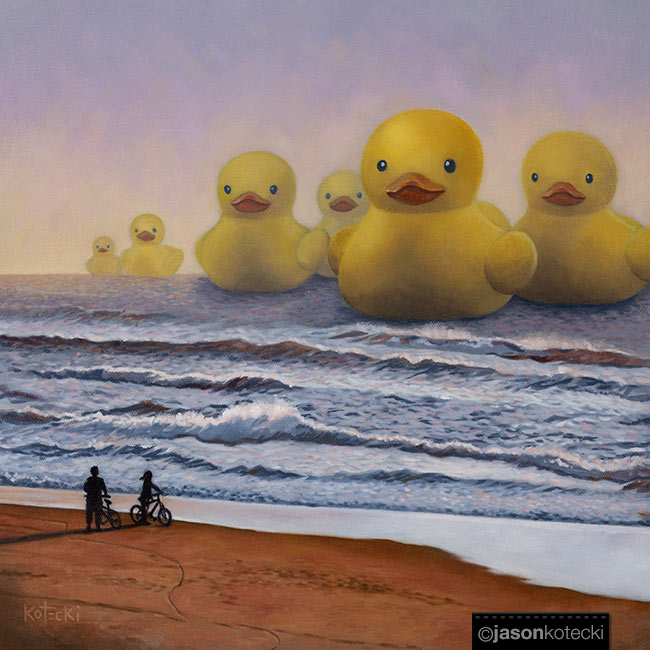
“The Armada” by Jason Kotecki. 16 x 16. Oil on canvas.
Original is SOLD 🔴 Shop this art!
Quick! You’re on the beach with a friend and you spot something approaching on the horizon. To your amazement, you make out an armada of giant rubber ducks coming to shore. What is your reaction?
Are you excited? Overjoyed? Concerned? Skeptical? Worried? Afraid?
Are they visitors or invaders?
Do they bring good tidings or dark intentions?
Sometimes a painting can just be a fun picture that makes you smile. And sometimes it contains a deeper meaning. I asked people on social media to share their perceptions of this painting, and it may or may not surprise you that their responses varied greatly:
- “Pure joy. I have a jacket printed with rubber ducks. They always make me smile, as does the ocean, and riding my bike!”
- “Here comes whimsy!”
- “Hope is on the horizon.”
- “I’m a little worried.”
- “Terrified.”
- “Invasion from a Trojan Horse.”
- “Plastic pollution and impending doom from climate change.”
It turns out that the meaning of this painting, as well as the meaning of almost everything in life, is largely determined by you.
Our perceptions impact our actions. For example, whether you’d run for cover or organize a welcoming party would depend on whether you see these rubber ducks as friends or foes. One side sees the other as hopelessly naive. The other side sees the other as paranoid. Both sides have a point.
If we respond too enthusiastically, we might fall into a trap.
If we respond with animosity, we may sabotage any chance of something good happening.
We can assume the best, assume the worst, or…perhaps the best, wisest, most productive thing we can do is keep an open mind and wait and see.
Now, let’s put the shoe on the other flipper. Imagine if you’re one of those ducks. You’re fun. Lots of people like you. You want to be helpful and bring joy to others. You’re new in town, but you have good intentions. But what are those locals on the shore thinking?
Do they see you as a visitor or an invader?
Do they think you bring good tidings or dark intentions?
We’ve all been the new guy. The new kid in class. The newest employee. Or, most recently for us, the new family in town. I like to think of this painting as a metaphor for our mission to bring wonder and whimsy to distant shores. I unveiled it at the first Wondernite we hosted in Sheboygan, having moved from Madison two years earlier. As relative unknowns, we wondered if anyone would come.
It turned out to be our biggest and best one yet.
It’s scary to consider what the natives might think of you. You feel like you stick out like a sore thumb because it seems obvious that everyone can tell you’re not familiar with the local culture, the shorthand, the inside information that everyone else takes for granted.
It’s tempting to want to appear big and important. Maybe pretend to be something you’re not. After all, you’ve got a clean slate. None of these new people know all your history and baggage. You never get a second chance to make a first impression, so it’s a chance to put forth something impressive.
I’ve found it’s easier, more effective, and frankly, less exhausting to just be yourself. People are drawn to authenticity, and we are very good at spotting a fake. Your weird flag may not inspire everyone, but it will attract your people.
It’s more beneficial to check your expectations.
If you expect the natives to be hostile, you’re likely to protect yourself by being hesitant and withdrawn, which may make you appear cold and aloof to others. But be warned: if you assume the locals will be hostile and unwelcoming, guess what you’re likely to get.
You see, there is this thing called confirmation bias. (Perhaps you’ve heard of it.) It’s applicable whether or not you see yourself as the kids on the beach or the newcomers floating to shore. How it works is that we make an initial judgment or tell ourselves a story about a person, group, or situation. Then we reflexively look for evidence that supports our case and confirms our bias.
Meanwhile, we subconsciously filter out any information that runs contrary to our story. We interpret new information as being supportive of the opinions we already hold, and it doesn’t matter how poorly it fits. Our dutifully protective brain finds a way without us having much of a say.
If you think your spouse is ignoring you, you’ll be on the lookout for all the evidence to make your case.
If you expect to have an awesome day, your antenna will be up and scanning for proof all day long.
If you think Republicans are the worst, you will notice and remember every example that proves your point.
If you think Democrats are the enemy, well, you get the point.
So…what if we paused at the very beginning to realize we don’t yet know the truth and take a wait-and-see approach? Thanks to confirmation bias, if you expect the best in others, the odds are better you’ll find it.
This might just be a fun, whimsical painting that makes you smile.
Perhaps something light-hearted to hang in your bathroom.
It might also be a reminder to always be yourself while giving other people a chance to do the same.