
Keyword: lego

  • How Many Watermelons?

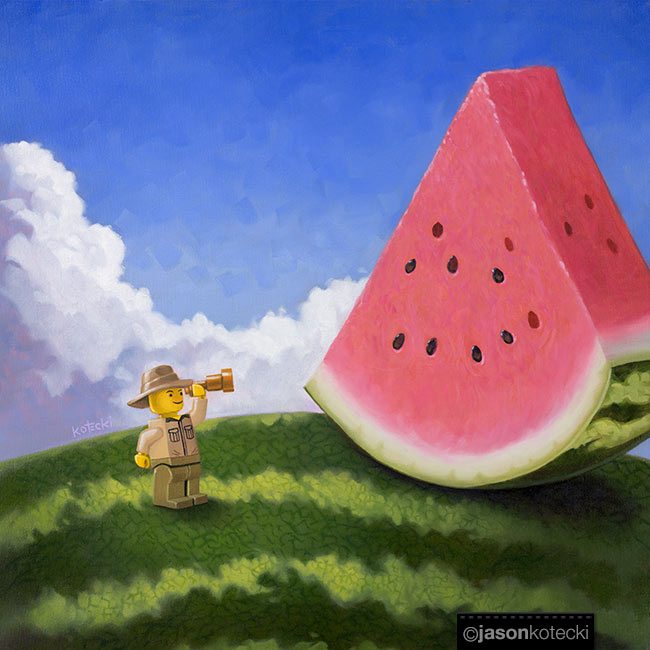
    “How Many Watermelons?” by Jason Kotecki. 20 x 20. Oil on canvas.
    Original is available. 🔴 Shop this art!

    What do motivational posters, charismatic preachers, and embroidered pillows have in common?

    They regularly tell us to count our blessings.

    If we’re in the midst of a good day, we’d probably admit it would take a long time to count all our blessings. Maybe even longer than it would take to count all the seeds in a watermelon. But theoretically, both could be done.

    This painting was inspired by the saying “Anyone can count the number of seeds in a watermelon, but only God can count the number of watermelons in a seed.”

    Today is the second anniversary of the day I needed a chainsaw-wielding neighbor to help me clear trees from my driveway so I could drive to the airport for a speaking engagement. The night before, a storm descended upon our home with a terrible straight-line wind that damaged our home and devastated our property. I had to leave my wife behind in a home with no power to push aside the grief to begin the clean-up and call insurance companies.

    I can assure you, it did not feel like a blessing.

    That storm turned our trees into kindling and destroyed our finances. It wrought great debt and fear, and uncertainty. It brought trauma to our family and nightmares to my kids.

    But it was also a seed.

    A seed that has since produced many blessings…

    • It connected us to some amazing people.
    • It taught us how to receive generosity from others with humility.
    • It provided us with the insurance money to buy a new roof which needed to be replaced.
    • It opened the door to a new space to play ball and badminton and frisbee together.
    • It inspired us to be even more hospitable, ushering in Moonrise Movie Nights and the Wonder & Whimsy Society Family Reunion.
    • It gave us a new view, one that many agree is even more breathtaking than the one we had before.
    • It strengthened our family and bolstered our faith, bringing us even closer to God.

    I suspect that dark forces were pretty happy about the storm, hoping it would destroy us. But I believe God allowed it because even though it brought a great deal of pain, he also knew just how many blessings would spring forth.

    I share this not to minimize the pain any of us has experienced, but to offer a reminder that in life, pain and joy can co-exist.

    Today is also Father’s Day. My experiences have led me to believe that God is a good father. He wants to hold you in his arms and give you a big, all-encompassing hug, especially if you are struggling with some great trauma of your own. I want to let you know that he is bringing forth fruit from the ashes, perhaps some of which you may already be able to perceive.

    I can assure you, the full bounty goes beyond what you can ever imagine.

    I’ve just shared many blessings we’ve identified from the storm we experienced. But the thing is, we’re only two years removed from it. How many more blessings have yet to be revealed?

    • Only God knows how many games of catch I’ll have with my son.
    • Only God knows all the conversations that will be had around our new fire pit.
    • Only God knows how many pies will be baked from the fruit trees we just planted.
    • Only God knows how many photos Kim will take of the wonder that will bloom there.
    • Only God knows how many family dinners will be shared from our deck overlooking the lake.
    • Only God knows how many people will be blessed and healed in some way by their time there.
    • Only God knows what opportunities and relationships will arise from this new space.

    The storm was a seed that produced a multitude of watermelons.

    And those watermelons are filled with seeds that will usher forth even more.

    Only God knows all the things that will be made possible because of a brief moment in time when a hurricane-force wind whooshed through our lives one summer day.
    Only God knows the number of watermelons in a seed.
  • Talent Stack

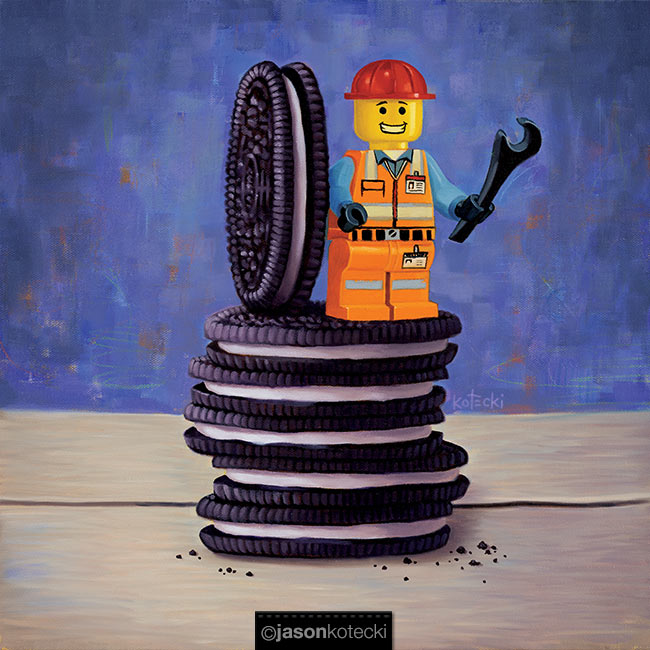
    “Talent Stack” by Jason Kotecki. 16 x 16. Oil on canvas.
    Original is SOLD 🔴 Shop this art!

    Sometimes people look at successes I’ve had and say, “Must be nice,” as if they happened by magic.

    What they don’t often see is the framework that helped enable that success. Fortunately, it’s a framework anyone can develop.

    We often assume that in order to be successful, we need to be great at one thing. That can work—see LeBron James, for example—but that path is extremely difficult and unlikely. The truth is, you only need to be pretty good at a handful of ordinary skills.

    You just need to build a talent stack.

    Scott Adams, the creator of the comic strip Dilbert, popularized this concept which states that you can ensure success by assembling a “stack” of two or more complementary skills and be in the top 25 percent or so in each. Do that and you’ll be unstoppable. 

    In his case, he readily admits he’s not the best artist, the most skilled writer, or the savviest business expert. But his unique combination of those skill sets has contributed to his success as a cartoonist.

    My own talent stack began with a few crayons. “Artist” was my first and is my longest-lasting identity. I’ve always enjoyed it, and I got praised for it, so I’m sure that made me want to keep doing it.

    In high school, I had a chance to take a creative writing class, which I enjoyed exponentially more than my math classes. I kept honing that skill, which eventually became an indispensable part of my talent stack.

    In college, I gave a talk as a leader on a retreat and received great reviews. Even though I am naturally shy, I enjoyed the process of crafting stories in spoken form. It was like creative writing but delivered out loud. 

    To the surprise of me, my parents, and the high school speech teacher who gave me a “C,” public speaking emerged as the primary driver of our business. I went from giving cartooning workshops in schools to speaking at churches to keynoting conferences for associations and corporations all over the place. 

    Now it took me a few years to realize that these three talents—art, writing, and speaking—were not separate skills that operated independently, but part of a talent stack, that when used in harmony became even more powerful. I am not the best artist in the world, or the best writer or speaker. But I’m pretty good at all three, and that combination has been the secret sauce of my success. Once I was introduced to talent stacking, I eagerly looked for complementary skills to add. By devouring hundreds of marketing books and through the school of trial and error, I’ve achieved the equivalent of an MBA in marketing. Am I the best marketer in the world? No, but I easily fall into the top 25 percent.

    Kim and I went on several organized retreats in college. That background gave us a foundation to build on when we started hosting our own events. After putting on numerous meetups, workshops, book tours, fundraising galas, and Escape Adulthood Summits over the past two decades, we’ve gotten pretty good at managing logistics and creating experiences that move people.

    Most recently, we used the pandemic as an opportunity to get good at livestreaming, which added a whole new dimension to our business.

    Drip by drip, these new skills made the other skills even more valuable and ushered in greater success.

    Of course, your talent stack will look different from mine, but the premise is the same. Start with natural strengths and abilities and work to make them better. Think about how they can work together in unexpected ways, even if they seem unrelated. 

    Everyone in your industry probably competes on many of the same skills. What do you have that’s different? Oftentimes the magic lies in a skill or interest that seems to come out of left field. For instance, many professional speakers are also writers. But my artistic gifts and whimsical, childlike perspective allow me to offer something extraordinary.

    This isn’t just about what you were born with. Look for other skills you can attain that complement and enrich the others. That might involve a traditional degree or certification, but it can also be done by reading books, listening to podcasts, taking courses online or at your local community college, or practicing, in public, every day, as we did with our pandemic project of livestreaming.

    If you’re stuck, here are some evergreen choices that will help:

    • Presentation skills
    • Technology skills
    • Foreign language skills
    • Sales or marketing skills
    • Writing skills
    • Business management skills
    • Nunchuck skills

    Remember, you don’t have to turn yourself into the foremost expert on any of these skills. Just be in the top 25 percent. Said another way, in a world of around eight billion people, you only need to be among the top two billion. If one hundred thousand people live in your city, you just have to be in the top twenty-five thousand. 

    In other words, pretty good is good enough.

    Keep in mind that this is a lifelong project. If you’re doing it right—meaning you stay curious and keep growing—your talent stack will continue to evolve and strengthen throughout your career and life. One last word of warning, however…

    When you have a decent stack of three to five skills going, you can bank on someone, somewhere observing what you’ve been able to accomplish and saying, “Must be nice.”

  • The Greatest Showman

    “The Greatest Showman” by Jason Kotecki. 16 x 20. Oil on canvas.
    Original is SOLD 🔴 Shop this art!

    The absence of fear is not bravery.

    The absence of fear is a terrible life.

    If you stay exactly where you are and never try anything new, you may be able to avoid fear. Maybe.

    If you want your life to matter, however, fear comes with the territory. You’re going to have to figure out how to tame it.

    The good news is that our fear is never as ferocious as we make it out to be.

    Most adults don’t consider themselves to have a robust imagination; that’s the realm of children and fairy tales. However, there is one aspect where most adults actually have an overactive imagination, and that’s when it comes to our fears. It doesn’t require any effort at all to picture our portfolio going belly up, our project crashing and burning, or ending up penniless, homeless, and living in a van down by the river while eating Spam out of a can. We can picture all of these things easily, in vibrant, living color, just as easily as a child imagining a personal tour through Willy Wonka’s chocolate factory.

    We easily dismiss any vision of an ideal (but as of yet unrealized) future, but give total credence to even the most far-fetched worst-case scenario. 

    A better strategy is to stop pretending that our imagination has gone missing, realize how powerful it is, and start using it to help us. Whenever I am freaked out about something, I like to do a little activity that only requires three steps, but requires full use of my imagination.

    The first step is to imagine the worst-case scenario in your situation. This is the easy part, because we probably already have a head start. It’s helpful to write it down or say it out loud, because the mere act of shining some light on it helps us to see how ridiculous it is.

    The second step is to imagine the best-case scenario. This might be a little harder, but it’s a lot of fun. Enter Mr. Roger’s Land of Make Believe and visualize the most preposterously positive scenario that you can possibly imagine. The sort of thing that would make you say, “If you wrote this into a movie, no one would believe it.” You will notice that you begin to turn the tables on fear and plant a vision in your head that can have an eerie way of coming to pass.

    The final step is to imagine a likely scenario. This will likely land somewhere in the middle of the first two. Your job is to pretend that you are a Las Vegas oddsmaker and draw up a picture of how things will most likely go down. It’s not ideal, and might be uncomfortable, but it’s surely nowhere near as bad as the worst-case scenario. Meanwhile, ideas will start to surface about some practical things you can do to help your cause.

    This activity helps you use your imagination for good, and also reminds you how it can trick you into seeing your situation as more terrifying than it really is.

    When I was a teenager, I worked at a car dealership. I was a good worker, but I had never received a raise. And I was trying to save up for a car. I decided to ask my boss for a raise. He was the owner, a smart, no-nonsense, sometimes gruff kind of guy. I put it off for weeks. I carefully planned the argument that made my case. I rehearsed my speech, prepared to list my accomplishments and call in lead witnesses if needed. I debated the proper time of day to ask: first thing in the morning? At the end of the workday? On a Saturday when the service department was closed? It went without saying that the beginning of the conversation was crucial. I needed to float a trial balloon to gauge his mood. Any sense of irritability, and the mission would have to be aborted at once. More than once, I considered what to do if he fired me on the spot for being an ingrateful little peon. 

    Eventually, I decided that the day had come. I screwed up my courage and walked up to his office, prepared to handle any possible rebuttal and ready to deliver an impassioned speech about justice and landing on the right side of history. 

    “Excuse me, Ron…can I talk to you for a second?”

    “Yeah, what is it?”

    That must have been when I blacked out. I probably mumbled the word “raise” at some point, but there was nothing close to the memorized inspirational speech I had practiced. 

    He let me flounder for about seventeen seconds before putting me out of my misery and saying, “Yeah, that sounds fine.”

    I walked back to my wash station on cloud nine. I had no idea that conquering the world would be so easy. 

    Sometimes the tiger we’re fighting is nothing more than a house cat.