
Keyword: night

  • Evening Show

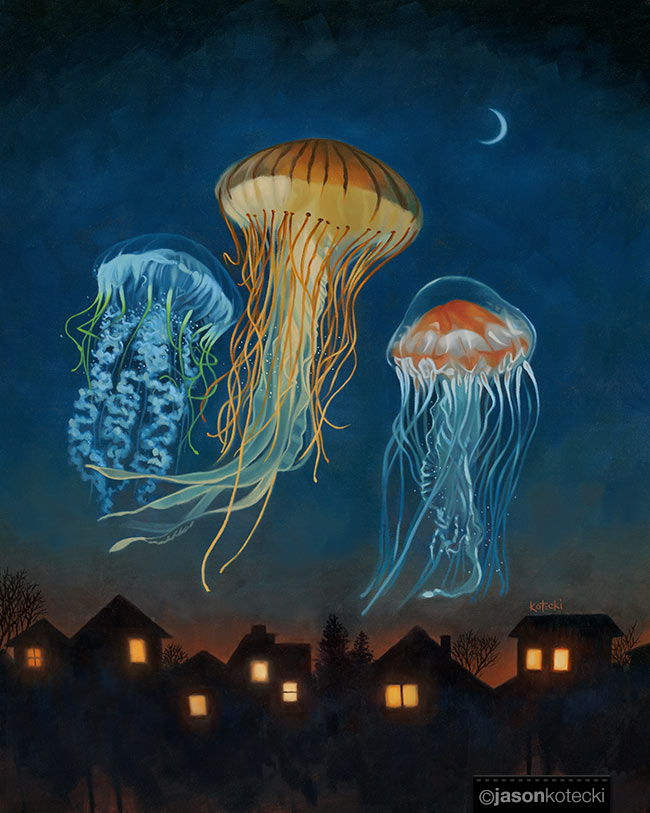
    “Evening Show” by Jason Kotecki. 24 x 30. Oil on canvas.
    Original is SOLD. 🔴 Shop this art!

    A clear night sky is a thing of beauty, with millions of stars blinking silently overhead.

    It’s a pity we rarely notice them.

    In an episode of Curb Your Enthusiasm, Larry David is speaking with a receptionist at a law firm who has a spectacular view of the city behind her. “Beautiful view here! How long did it take you to take it for granted?”

    She replies, “Umm, not long I guess.”

    He candidly admits, “It would take me about a day. Maybe less. Maybe half an hour. And I would never look out the window again.”

    How quickly we take wonder for granted.

    This painting was inspired by a passage I read in the book The Sense of Wonder, by conservationist Rachel Carson, who wrote about a summer her grandnephew visited her cottage in Maine, and together they wandered the surrounding woods and tide pools.

    She recounted a particular evening when they gazed in awe at one of those breathtaking night skies: 

    “It occurred to me that if this were a sight that could be seen only once in a century or even once in a human generation, this little headland would be thronged with spectators. But it can be seen many scores of nights in any year, and so the lights burned in the cottages, and the inhabitants probably gave not a thought to the beauty overhead; and because they could see it almost any night perhaps they will never see it.”

    Because they could see it almost any night, perhaps they will never see it.

    This painting takes its inspiration from those lights burning in the cottages, with the inhabitants giving not a thought of the beauty overhead.

    What if a party of giant glowing jellyfish appeared above your town and put on a light show? Surely that would get your attention.

    But what if it happened every year? Every week? Every night? How long would it take before everyone stopped caring?

    Not as long as you’d think.

    Apollo 11 landed on the moon. It was a huge source of national pride. Half a billion people were glued to their television sets watching the historic achievement.

    Nine months later—nine months!—flights to the moon had already become boring. By the time Apollo 13 came around, the television networks didn’t even bother covering the launch or broadcasting the live video of the crew from space because they felt there wasn’t enough interest. Nobody wanted their soap operas or game shows interrupted by another group of heroes doing what most people had never done before. Only until Apollo 13 got into trouble did anyone care.

    We grow numb to wonder.

    Look around you. What are you taking for granted? What are you missing?

    Be honest: When was the last time you gazed at the stars?

    Stood in awe at a sunrise bursting forth with color on the horizon?

    Sat in silence amidst the peace of a placid snowfall?

    I don’t know about you, but I am disgusted by this propensity to grow numb to wonder.

    But can we do anything about it?

    Fortunately, Rachel Carson shows us a way:

    “One way to open your eyes to unnoticed beauty is to ask yourself, ‘What if I had never seen this before? What if I knew I would never see it again?”


    One painting and two powerful questions remind us to keep our eyes peeled for the wonder all around us.
  • Hope in the Darkness

    “Hope In The Darkness” by Jason Kotecki. 20 x 20. Oil on canvas.
    Original is SOLD 🔴 Shop this art!

    It was a dark and stormy night…

    …that lasted for months. 😳

    That’s the season we found ourselves in, when a pandemic descended and darkness filled the entire world, and months felt like centuries.

    As I think about darkness, I can’t help but think of a strange quality we humans have. Whether it’s a handful of birthday candles in a darkened room, the glowing embers from a campfire in the woods, or the flickering stars in a night sky, we can’t help but be drawn to the light.

    Throughout this pandemic, a particular phrase resurfaced again and again during my morning quiet times: fix my eyes.

    I encountered it so often, in songs, books, and videos, that I was curious to look it up and see if I might glean some deeper understanding. According to one dictionary definition, this version of “fix” means to direct one’s eyes, mind, or attention steadily or unwaveringly towards something.

    I immediately thought of a story in the Bible in which Peter, one of Jesus’ most lovable and bone-headed followers, gets to walk on water. The thing is, when he’s focused on Jesus, all is well and he is able to do the impossible. But when he shifts his attention to the raging waves, he’s swallowed by fear and begins to sink.

    The only difference is where Peter has chosen to fix his eyes.

    Back to this peculiarity that human beings are born with an innate attraction to light. Spend any time at sunset on any beach in the world, and you will find every single person staring at the sun. No one is facing the opposite direction.

    It’s not that we don’t notice the darkness. There were times during the pandemic when I was sucked in by it. It’s a scary place to dwell. During those times, my anxiety levels increase. Fear grows.

    But then I notice it.

    My attention is pulled away by something else…a tiny firefly, glowing amidst the expansive backdrop of black. Before long, I see another, and then another.

    These fireflies are the helpers. The people who have decided to help where they can. It’s the same light, but expressed by individuals in different ways.

    The high school principal who visited over 600 graduating seniors. 

    The woman delivering donuts to her staff who are working from home. 

    The DJ leading dance parties in the street. 

    It may be just as dark at one in the morning as it is at three, but only one of them is two hours closer to dawn. For most of us, it’s still night. But sunrise is closer than it was a month ago.

    The fireflies are hope in the darkness that we will see the light.

    Until morning comes –  which it will – may we continue to fix our eyes on the humble lights pulsing with hope all around us. 

    And may we flash our own light for others. 

    Process Video

  • Not My Circus

    “Not My Circus” by Jason Kotecki. Digital.
    Original is SOLD 🖼️ Shop this art!

    Since 94% of the population suffers from at least a mild form of Adultitis, odds are that anyone with a job has to work with someone infected with this vile disease. Maybe it’s a co-worker, or a client, or – gulp! – the boss. Sometimes, the people I chat with after my speaking programs will confess to being married to someone with a full-blown case of Adultitis.

    So the question, of course, is how do I fix someone who has it?

    Unfortunately, the truth is…you don’t.

    I am a professional speaker. Most speakers I know started their careers with the hope of making a difference and changing lives. I certainly did. If you do it long enough, you’ll likely come across the uplifting statistic that informs you that your audience will probably forget almost everything you said the minute they walk out the door. Eventually, you will realize that you do not have any ability whatsoever to change someone’s life. Entertain, sure. Inspire, maybe. But change? That’s up to them, not you. (Newsflash: this little rule also applies to any husbands, wives, parents, and teachers who may be reading.)

    It’s hard not to feel like you’re a professional exerciser of futility.

    The thing is, the more quickly you accept this reality, the better speaker you become.

    When you are not worried about the guy in the front row crossing his arms, or the lady who ducked out the back, or whether or not you will get a standing ovation, the more you will be able to focus on being your authentic, true self and allow your message to land where it will.

    And THEN you might make some sort of difference for someone.

    You may not make a living from being on stage, but the principle is the same. When dealing with people who have Adultitis, there is only so much you can do. This is it:

    1) Do your best to be a good example. Take yourself lightly. Live your life cheerfully, with humor and joyful anticipation. In the best-case scenario, these people will see and be inspired by your approach to life, and a little will rub off. Maybe they’ll even ask for your secret, and then you can help them on the road to recovery.

    2) If your example alone doesn’t make a dent, you should incorporate their office supplies or car keys into Jell-O molds. (Just kidding.) (Not really.) Maybe you could try sending them flowers or a box of cookies. Maybe they just need someone to notice them and be kind to them.

    3) If you’re still running into a brick wall of Adultitis, your only other option is to ignore them and do your best to limit your exposure to them. You don’t have to be mean about it; you just have to be intentional. Depending on your relationship, you might consider deleting them from your life. Harsh, I know, but life is too short to have the joy sucked out of you by someone with a full-blown case of Adultitis.

    “Whoa, buddy,” you may be thinking. “That’s a little extreme. And it’s not exactly gonna work. This is my spouse you’re talking about,” or “I can’t exactly fire my idiot co-worker.” If extracting yourself from the situation is not an option, you should make it a priority to surround yourself with people who are relatively Adultitis-free. These relationships will help bolster your energy levels and serve as a force field from the Adultitis-ridden zombies in your life. 

    Is it an ideal solution? No, but it’s reality.

    You are only the ringmaster of your circus and your monkeys. Focus on the things you can control: your attitude, your actions, and the people you choose to spend most of your time with. Let go of the things you can’t.

    Simple, although certainly not easy.

    Striving for an Adultitis-free life will not always yield the results you’d like. You may not be able to make someone change, but it’s always possible to make a difference.

    Don’t be surprised if the difference is in you.