Keyword: optimism

  • We Can’t Let Winter Win

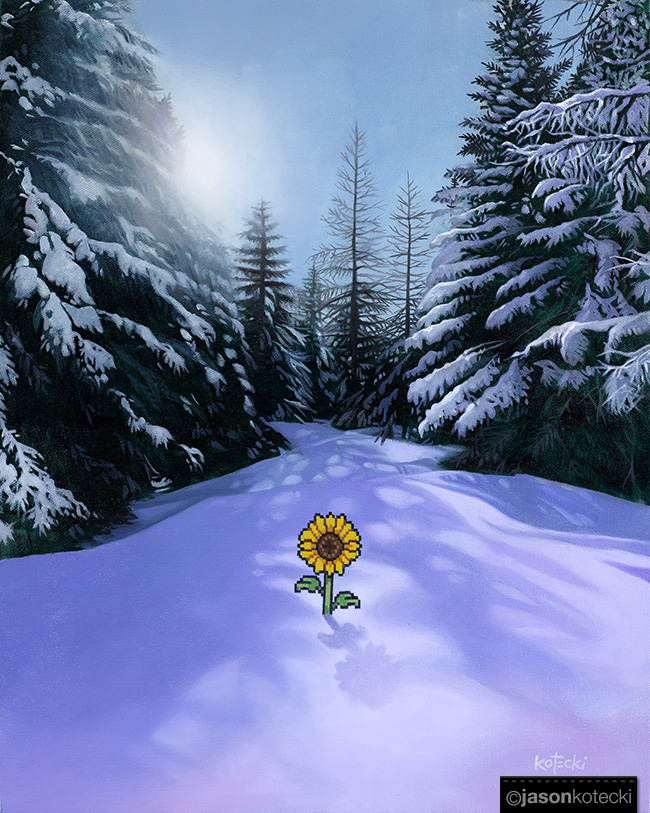
    “We Can’t Let Winter Win” by Jason Kotecki. 16 x 20. Oil on canvas.
    Original is available 🟢 Shop this art!

    One thing I love about the Midwest is the seasons. Real ones. Not like those they claim to have elsewhere, so-called “winters” with an occasional snow flurry and temperatures that sometimes flirt below forty.

    In Wisconsin, our seasons are pure, not pretenders. 

    I like that, because it allows me to fully embrace the beauty and lessons of each one. It’s a reflection of life, which has distinct seasons, no matter where we live.  

    If we’re honest, we’d prefer life to be one long, glorious summer, filled with sunshine and popsicles. But no. There are seasons of autumn, times for slowing down and saying goodbyes. And there are long winters of loneliness, where life feels frozen solid, and hope gets buried under a blanket of snow. 

    Of course, spring always follows, but sometimes it seems to have overslept.

    In Wisconsin, there is always a point when you’re pretty sure winter is over. 

    Live here long enough, and you realize it’s not. 

    There’s always one last gasp. One final snowstorm. One more cold snap that steals spring away, just as you were about to elope together on your way to summer.

    That might be the most deflating, difficult part of winter: The moment when it appears it will never end, and you don’t know how much more you can take.

    Life feels like that sometimes, when it seems like winter’s gonna win. 

    Winter wins when it convinces us that nothing will ever change.

    Winter wins when we let disappointment over unmet expectations turn into resentment.

    Winter wins when we allow ourselves to be buried under a blanket of apathy.

    Winter wins when we decide to give up and let the hope within us flicker out.

    But it doesn’t have to get the final say.

    This painting is a reminder that we can’t let winter win.

    The 8-bit sunflower is reminiscent of a video game, because I think that’s a good way to think of it. When you’re in the middle of one of life’s winters, everything is heavy. Summer looks so far away. We see all the things that need to change for us to go from where we are to where we want to be, and it feels insurmountable. 

    Sometimes the answer to the darkness that weighs down on us is a little levity. Making a game out of it is a way to rise above the life-and-death seriousness of our situation. It takes us ever-so-slightly outside ourselves to give us perspective that is a little wider than the restricted, optionless way winter can feel sometimes.

    Part of what makes a game engaging and fun is that there is a challenge to it. But the key is for it to be a doable challenge. So instead of focusing on all the ways we are frozen in place and how many more days of winter are ahead, make a game out of finding even one tiny clue that spring is on its way. You don’t need to defeat the Final Boss and save the Princess; you just need to make it past this level. 

    Today.

    The game is this: Figure out how to win today.

    It doesn’t have to be big.

    It could be one five-minute prayer.

    It could be getting dinner on the table.

    It could be dumping the bottle of vodka down the drain.

    It might just be getting out of bed.

    Sometimes the win is just giving it one more day.

    I’ve experienced many winters, especially in the early days of building our business. I once got some advice from a business colleague I’ve never forgotten. He, too, was an entrepreneur and knew how discouraging it was to feel like you made one step forward only to take three steps back. He shared a simple policy he lived by. On those really hard days, the days when he didn’t think he could go any further, he promised himself he’d give it one more day. He gave himself permission to abandon ship after that, but not before he gave it one more day.

    Sure enough, the next day always brought some glint of hope, a new reason to believe. There was rarely any huge breakthrough that magically happened. Maybe it was a small sale. Maybe it was an encouraging word from a friend. Maybe it was just a good night’s sleep.  

    Just a baby step forward.

    We win when we find evidence that spring is on its way.

    We win when hope bursts through a blanket of apathy.

    We win when our resentment melts into acceptance.

    We win when our panic gives way to patience.

    We win when we bring light to someone else.

    We win when we give it one more day.

    Don’t let winter win.
    Keep holding on for spring.
  • Kintsugi Tortoise

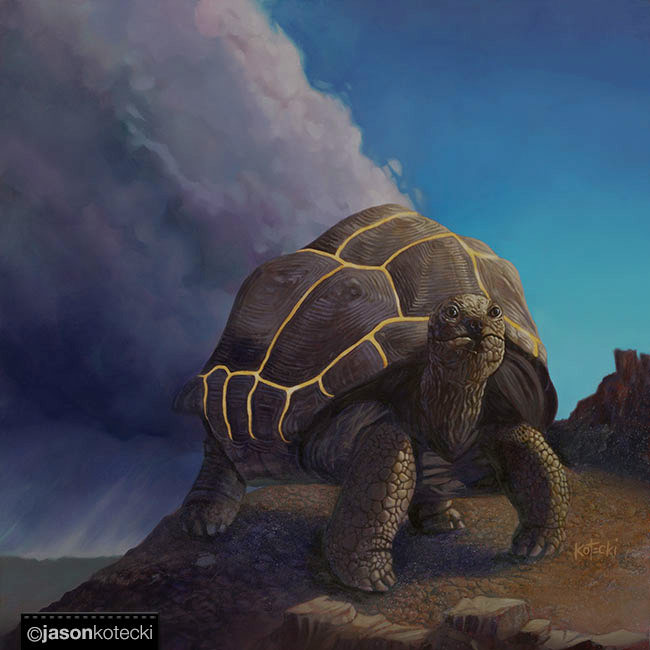
    “Kintsugi Tortoise” by Jason Kotecki. 30 x 30. Oil on canvas.
    Original is SOLD. 🔴 Shop this art!

    All dreamers start out delusional.

    But perhaps that’s an essential ingredient.

    The feeling that their idea is “genius” and the perception of their inevitability of success provide the enthusiasm and energy to get started. After all, no one found the fuel to begin chasing a dream by focusing on all the reasons it could never work.

    The critical moment is how the dreamer responds when he or she first encounters adversity.

    Or as philosopher Mike Tyson put it, “Everyone has a plan until they get punched in the mouth.”

    If a dream is big enough and you pursue it long enough, it will break you.

    Your confidence will be shattered. Doubt will creep in. Hope will be lost.

    Then what?

    I’m sad to say that’s often where it ends. The dream dissolves into an emaciated wish, a thin, pale shadow of its former glorious self.

    For twenty-five years, Kim and I dreamed of having a lake home. We talked about it on our first date. We spent hundreds and hundreds of hours talking about it, trying to figure out the most efficient way to make it happen while still doing the work we love and feel called to. We tried on dozens of scenarios in our minds, calculating what was possible and what sacrifices might be required.

    In the early days, it seemed like just a matter of time before we made it happen. We had pure motives, a little bit of talent, and a desire to work hard. I could see it, clear as day. On the hard days, the steadfast belief that it would come true kept me going. In my naiveté, I figured it would take a year, maybe three at most. (Ha!) 

    As months turned to years, and our kids got older, doubts crept in. I wondered if I was wasting my time. I wondered if I was only holding on in desperation, and that my death grip on my dream life was keeping me from living my real one.

    It was exhausting and soul-crushing at times. While on a family vacation in Florida, and with the kids asleep in bed, I was sitting on the balcony of our rental. Although it was too dark to see them, I could hear the Gulf’s waves pound the shoreline. My heart was broken, and I wished that I’d never had the dream at all. I was overcome by the desire to throw it back into the sea.

    I considered that maybe giving it up would give me relief and freedom. I yearned for someone from a Harry Potter book to cast a Memory Charm upon me, to obliviate the dream from my memory.

    That night on the balcony in Florida was February 3, 2020. A little over a month later, a pandemic began, and all hell broke loose in our lives.

    Yet somehow, just eleven months later, our family moved into our dream home on Lake Michigan. (Never in a million years did I think it would be one of the Great ones!)

    Kintsugi is the Japanese art of repairing broken pottery with gold (or other precious metals). Instead of disguising the damage, kintsugi highlights the repairs, transforming the broken object into a unique and beautiful piece. It’s a philosophy that embraces imperfections and impermanence, finding beauty in flaws and celebrating the history of an object. 

    It’s true that if a vessel breaks, it can never be made to look new again.

    But kintsugi makes it better than new, because it’s even more beautiful than it was before.

    Our brokenness makes us humble. Humility is the most beautiful virtue because it allows our other good qualities to shine fully and be most helpful to ourselves and the world.

    These broken places within us are not defects. They are the places where light can shine through. Those golden scars embody a soul that is stronger and a story that’s more beautiful because of the trial.

    This painting represents the slow patience that’s required of a person trying to achieve something great. It’s a reminder that we will experience the storms of struggle and brokenness. But it’s also a beacon of hope for brighter days ahead waiting for us if we persist.

    The journey may be harder than you expected, but the you that emerges will be better for it.
  • Great Expectations

    “Great Expectations” by Jason Kotecki. 30 x 24. Oil on canvas.
    Original is SOLD. 🔴 Shop this art!

    I have a confession to make.

    I fully expected to marry a brunette. I was pretty vocal about it, even. No blondes for me!

    In retrospect, the women who caught my eye when I was young — Princess Leia, Lois Lane, Wonder Woman — were all brunette. Most of the girls I dated in high school were brunettes.

    But after I met Kim, who was most definitely not a brunette, I didn’t waste any time wondering if I was making the right choice in spending time with her. I didn’t delay my decision to propose because I was holding out for a brunette to come along. I didn’t miss the opportunity of a lifetime because “this wasn’t the way it was supposed to go.”

    I wish I could say I was that flexible with all my expectations.

    When I graduated from college with a degree in illustration, I expected I’d make my living as a freelance illustrator. A year into that pursuit led me to realize that I really hated taking orders drawing what other people wanted me to draw.

    So I shifted all my attention to a comic strip I had been developing called Kim & Jason. I expected that I’d make my mark in the world by following in the footsteps of Charles Schulz and Bill Watterson.

    I put everything into it for six years. Along the way, I fell into speaking, and it started to bring in money. Way more than the comic strip. I eventually made the difficult decision to retire Kim & Jason so I could double down on what was working.

    With that decision, it felt that the naysayers were proven right: I really couldn’t make it as an artist. But the only reason they seemed right is that my expectations were wrong.

    I once heard a talk by Fr. Mike Schmitz in which he said, “Expectations are a thief of peace.”

    I recoiled at the idea at first, because I associate expectations with hope, and hope is good. If expectations are the thief of peace, is the antidote to become a pessimist? Lower the bar? Settle for mediocrity? Slack off? That seemed less than ideal.

    Then it occurred to me: An expectation is a prediction.

    It’s a prediction about what you think — and maybe even hope — will happen. Sometimes it’s little more than wishful thinking, but it could be a legitimate educated guess with actual data to back it up. And sometimes your prediction is correct and your expectations are met. 

    But it’s still a prediction. 

    One you might be making with a wildly insufficient lack of information.

    Before I actually started freelancing, I didn’t know how I’d feel creating things that didn’t light me up. When I began my comic strip, I didn’t realize how quickly the internet would decimate newspapers and change the landscape. And back then, I didn’t know anything about the business of professional speaking.

    Take a quick review of your life right now. How much current frustration, pain, or sadness is the result of circumstances turning out differently from what you expected?

    Is holding on to what didn’t happen keeping you from appreciating all the great things that did and are happening now?

    Maybe you can relate to this simple example. Recently, I had a wonderful, tremendously productive day that felt like a failure. One project took waaaay longer than I expected, blowing my to-do list to smithereens. Although some tasks got pushed to another day, I accomplished a few other things I hadn’t planned and took advantage of the unseasonably warm day to enjoy an invigorating walk in the sunshine. It ended with a delicious dinner with my beautiful bride.

    By all objective measures, it was a very good day. But it didn’t feel like it.

    The thing that soured it? 

    My expectations. 

    The day simply didn’t line up according to the timing and order of my expectations. Because some to-dos were left unchecked — even though other great elements were added — somehow it felt like I failed. 

    This is not a cautionary tale against planning or a list of pro tips to bulletproof your plans. It’s a reminder that it’s hard to appreciate accomplishments when they are in the same room as even one unmet expectation, one missed goal, or one unforeseen event that was out of your control. 

    In the battle between reality and expectations, reality is undefeated. 

    Expectations really are a thief of peace. They can ruin a day or derail our dream if we’re not careful.

    I believe that God plants dreams in our hearts. The details we imagine in the early stages create enthusiasm that serves as fuel to get moving. But oftentimes, those details reflect immaturity, a lack of imagination, or are limited by the fact that we don’t yet have the relationships, technology, or knowledge that will eventually help us to get there.

    Art was my first love; the first talent I discovered, and the one that was most nurtured early in my life. It’s easy to see why I would have the expectation of making it as an artist.

    But that was before I took a creative writing class in high school.

    It was before I discovered a gift for public speaking in college.

    It was before I realized “professional speaker” was an actual job.

    And it was before I figured out that my art, writing, and speaking could be combined to create something unique and bigger than the sum of their parts.

    Like many people, when I was a young adult, I expected my career to go a certain way. It went a different direction, filled with opportunities and experiences I didn’t even know were possible when I was an 18-year-old kid.

    But thirty years ago, if I had been given the choice between my original expectations and a full picture of how my life turned out, I’d choose my current reality. 

    Every. Single. Time.

    And yet, here’s the crazy part: because it doesn’t match up with my original expectation — you know, the one I had when I was a naive, inexperienced teenager — I am sometimes tempted to wonder where I went wrong.

    Expectations are a thief of peace.

    Holding on to expectations that don’t match reality is a terrific way to go through life frustrated and disappointed.

    When we become resentful of missed expectations, we are in danger of also missing other opportunities and blessings we didn’t see coming.  

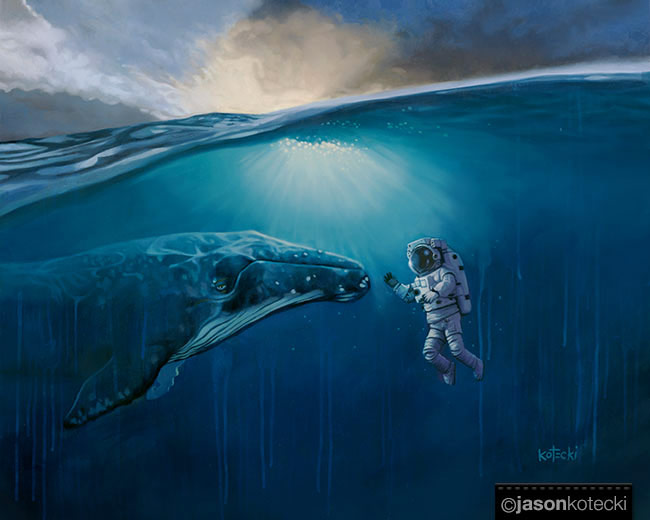
    The astronaut in this painting represents a dreamer.

    This dreamer has always possessed a spirit of adventure and imagined a life spent exploring the unknown, pushing past the boundaries of human understanding, and experiencing the supernatural enchantment. The dreamer expected this would happen as an astronaut in the context of space.

    Instead, the dreamer’s story ended up in the ocean after a visit to Sea World, and now days are spent adventurously exploring the unknown and experiencing enchantment in encounters with sea creatures.

    So…did this dreamer’s dream go unfulfilled?

    My friend Jessica has some good advice about how we should handle our expectations: “When you write that first story, print it as a draft, triple-spaced with extra wide margins. You do this because you’re anticipating edits.”

    Letting go of expectations is not about being pessimistic. One can be optimistic without becoming a slave to expectations. My optimism is grounded in the fact that God has ALL the data, loves me more than I deserve, and tells the best stories. We can make plans and hope for things to go a certain way, while still holding loosely to them, trusting that God may have different (and better!) ones. 

    If you want more peace in your life, don’t abandon hope. 

    Don’t stop striving for greatness. 

    Just stop putting faith in your predictions.
  • The Coach

    “The Coach” by Jason Kotecki. 20 x 20. Oil on canvas.
    Original is SOLD 🔴 Shop this art!

    This is part of “Adultitis Fighters,” a series of paintings by Jason Kotecki featuring real and fictional characters who serve as role models in the fight against Adultitis.

    Ted Lasso, the titular character of the TV series “Ted Lasso,” is a model of blue sky optimism and positivity. His humor and lightheartedness diffuse tension and bring joy, but he’s far from a naive pollyanna. Even though he had plenty of reasons to despair, from his failing marriage to his losing team, he didn’t succumb to pessimism and remained filled with hope. His sunny disposition and can-do attitude inspire us to maintain a positive outlook and approach challenges with resilience and determination.

    “Taking on a challenge is a lot like riding a horse, isn’t it? If you’re comfortable while you’re doing it, you’re probably doing it wrong.”

    “You say impossible, but all I hear is ‘I’m possible.’”

    “You beating yourself up is like Woody Allen playing the clarinet. I don’t wanna hear it.”

    “So I’ve been hearing this phrase y’all got over here that I ain’t too crazy about. ‘It’s the hope that kills you.’ Y’all know that? I disagree, you know? I think it’s the lack of hope that comes and gets you.”

  • Shine On

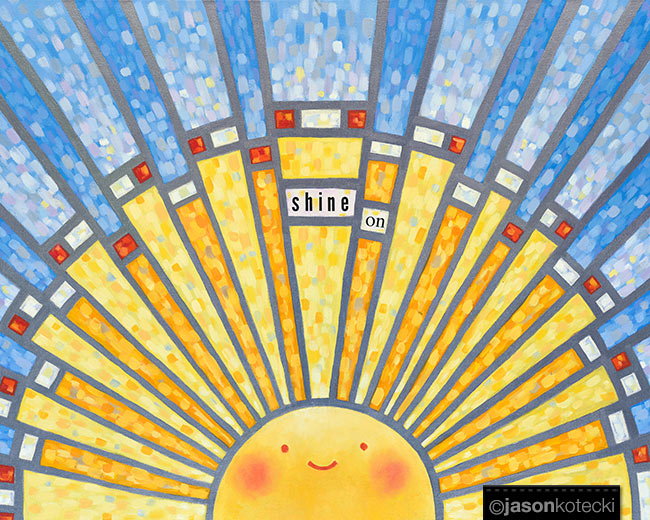
    “Shine On” by Jason Kotecki. 30 x 20. Oil on canvas.
    Original is SOLD 🔴 Shop this art!

    After months of anticipation about our family’s first trip to Mexico and an escape from the Wisconsin winter, the weather report turned foreboding. All eight days were calling for rain. Kim and I were crushed. Our family had finally recovered from a three-week battle with the flu over the holidays, and we were looking forward to the time away to recharge in the sun and surf. Kim was especially fretful about the forecast of rain, incessantly checking the weather app on her phone.

    On the plane, I read a section in a devotional about God being a “living God.” That struck me. I grew up thinking of God as some far-off historical figure who did a lot of neat things in olden times, forgetting that He lives in the present tense, active in the here and now. 

    In that moment, I felt totally at peace. Did I expect God to alter a weather system on account of li’l old us? To be honest, I guess I hoped He would, but more than that, I knew that the only way to really ruin the vacation was to spend all our time worried and anxious over the weather report. Even if it rained the whole trip, we would still have an opportunity to be together and to rest, away from the hustle and bustle of our daily lives.

    We did pray for sunshine, but we also prayed for peace to melt away our fears, and for the perspective to make the best of whatever each day would bring.

    No one knows with certainty what next year, next week, or even what tomorrow will bring. (Not me, not you, and certainly not weather forecasters!) But too often in life, we allow doubt and anxiety to dominate our perspective, and we live out our fears in advance. I knew that God knew how big of a deal this trip was to us, and He would give us what we needed from it, even if it didn’t look exactly how we imagined it.

    So here’s what happened. Every single evening, the weather app on our phones indicated storms for the next day. And every single day, we woke up to sunny skies, while the thundercloud icon had vanished. The only rain we experienced was about a half-hour’s worth on our last day, and it came as a welcome relief during a hot walk at the Tulum ruins.

    The abundant sunshine became a symbol to us of God’s goodness. As the trip was coming to an end, we searched for a sunshine-themed souvenir to bring home with us, something to remind ourselves of what felt like a mini-miracle and God’s active presence in our lives. We never did find anything just right.

    We arrived home at about midnight. Our youngest child was asleep as we pulled into our driveway. A few police officers were canvassing the street with flashlights, clearly looking for something. We didn’t think much of it, figuring the neighbor kid was in trouble again.

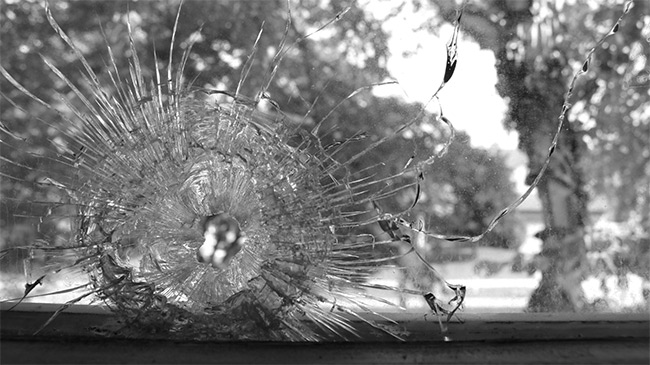
    As our tired bodies, carrying overfilled suitcases, stumbled into the house, our oldest daughter said, “Hey, what’s that on the ceiling?” I looked up and saw a gash in the drywall. The directional groove led my eye to the window, which had a bullet hole in it.

    A bullet hole. 

    “Kim,” I said, “Hurry and go tell the cops that we have a bullet hole in our window!”

    The rest of the evening was a blur. We found small bits of glass all over the carpet and on the piano across the room. The officers pulled a bullet fragment from the ceiling, but it was too mangled to be of any use. They had very little information for us, except for the reports from neighbors, who had heard multiple gunshots and a speeding car with a bad muffler. At first, I was annoyed that I had to postpone the date with my bed to deal with this after having had an awesome vacation, but eventually, it hit me. “Wait. What if we had been home? This could have hit one of my kids.” 

    The mood quickly turned from annoyance to anger and fear.  

    None of us got much sleep that night. (Except Ginny, who was already asleep and would ask about that taped-up cardboard patch on our window two whole days later.) 

    The next morning, our six-year-old son, Ben, brought a bullet to Kim that he found in the hallway. “Momma, what’s this?” he asked. 

    Another call to the police. 

    The next few weeks were a blur of logistics and emotion. Assurances from the police that our neighborhood was historically among the safest in the city didn’t seem to help. Calls to the insurance company and various vendors about replacing the window and fixing the damaged ceiling were interspersed with the feeling of being violated and wondering if we were still in danger. I’d never seen my wife cry so much in all of our eighteen years of marriage. 

    We heard stories from neighbors who’d been home. Three young girls next door were in the front room watching TV when the shooting happened. An elderly neighbor across the street told us the gunshots were so loud that she thought her house was the one under attack. A young mother in the home next to hers was nursing her two-month-old in her front room. She hit the deck when the shots rang out. Everyone was shaken. For days, we saw cars slow down in front of our house to gawk at the scene of the crime.  

    Eventually, amidst the haze of fear and confusion, we began to notice where God had been working in the situation.

    We realized that our house was the only one on the whole block that was empty when the shooting occurred. We figured out that it wouldn’t have been had we not been held up in Minneapolis so our plane could be de-iced. We felt His presence in the neighborhood meeting that was organized two days after the incident. Over fifty people crammed into a basement owned by a former police officer, bonding together to comfort one another and talk about practical ways to protect our neighborhood. It was neat to see connections get made and friendships deepen.

    Finally, Kim and I got to a place where we could ask, “What does this terrible event make possible?”

    Years earlier, we had stayed in a vacation home in Santa Barbara that featured some stained-glass windows. We’d always been smitten by their charm, so we wondered if we could replace the broken front window in our living room with a stained-glass work of art. The fact that the window in question was a decorative half-circle above the normal windows made it a perfect candidate. Maybe I could even design it. And maybe it would give hope to the rest of the neighborhood. We knew immediately what the design had to be.

    A sun.

    We got connected with Rick Findora, who just so happened to be the guy who did the stained glass windows at our church, and I gave him a sketch.

    We got our sunshine souvenir after all—after we returned home, and in a form we never anticipated. It now serves as a beacon of hope to the entire neighborhood.

    We live in a dark world, where tragedy and pain are all too common. Sometimes vacations do get rained out. Sometimes bullets don’t miss. But I believe this: God is a living God. He gives us small signs—signs that don’t seem like much in the grand scheme of things—just to let us know He is there. I think the reason He does this is so that when the bad things happen, we’ll remember that He is still there, ready to bring good things out of terrible circumstances. He gives us the sunny days to recharge us, to fill our reserves with hope that lights the way during the dark times, reminding us that the sun will shine again.

    It’s worth remembering that even on the darkest, cloudiest days, the sun doesn’t disappear. It’s still there; it’s just hidden. The people who see silver linings are the ones who look for them. If you are in a dark season right now, keep looking for the light. It’s coming.

    Finally, I believe we are called to be a light for others. We do this by sharing our gifts and by being kind. When it comes to people who disagree with us, instead of calling them names, we can call them up for coffee. The smallest things can make the biggest difference. Our happiness increases when we help others, shining our own lights outward.

    In the battle between light and darkness, the darkness doesn’t stand a chance.

    Shine on.
  • Half Full

    “Half Full” by Jason Kotecki. 12 x 12. Oil on canvas.
    Original is SOLD 🔴 Shop this art!

    I like to think of myself as an optimistic person. After all, I am a lifelong Cubs fan who always believed in the hope-filled power of next year. Then again, when they lose three games in a row these days, feeling certain that they’ll never win another game again seems pretty pessimistic.

    The truth is, I’m probably a little bit of both. 

    The optimistic side of me believed that Penguins Can’t Fly would be a New York Times bestseller. It wasn’t.

    This defeat, along with a number of other epic failures in my career, bolsters the popular argument that I should minimize the risk of pain and defeat by keeping my expectations low. 

    This strategy of operating with low expectations is employed by many. The thinking goes that if you don’t get your hopes up about something, then you won’t be as disappointed if it doesn’t work out. And if it turns out well, you’ll get the enjoyment of being pleasantly surprised.

    As it turns out, it’s a flawed strategy.

    According to neuroscientist Tali Sharot, people with high expectations always feel better because how we feel depends on how we interpret the event. 

    When a person with high expectations succeeds, they attribute it to their own traits. When they fail, it wasn’t because they were dumb; it was because the exam was unfair, and next time they’ll do better. When a person with low expectations fails, it was because they were dumb, and if they succeed, it’s because the exam happened to be really easy, and next time reality will catch up with them.

    Secondly, regardless of the outcome, anticipation makes us happy. It’s why people prefer Friday to Sunday: it brings the anticipation of the weekend ahead.

    Finally, optimism acts as a self-fulfilling prophecy. Believing we will be successful makes us more likely to be so, and optimism reduces stress and anxiety, leading to better health.

    When a container is at 50% capacity, it is half full.

    But technically, it’s also half empty.

    Both are absolutely correct assessments of the container in question.

    If the label you give it is completely subjective, go with the one that gives you the best chance of going somewhere beyond what you thought was possible.

    So many of our life experiences could be seen in the same light. We lose a job. We break a leg. We get dumped by the one we thought was The One. Is that unexpected, unwelcome thing that just happened in your life an obstacle or an opportunity?

    Yes.

    Both are absolutely correct assessments of the event in question.

    Deciding what you call it can make all the difference.

    Was Penguins Can’t Fly a failure?

    Upon further review, believing that it had a chance of becoming a bestseller led me to put in a lot of effort. It pushed me to think of new and creative ways to promote it, and it got me out of my comfort zone by asking for help. All of these things made a difference. No, it wasn’t a NYT bestseller, but three printings later, and after having outsold my advance (something most published authors never do), it was a success.

    It turns out that optimism is attributed to that success. Without it, I would have always wondered what might have been.

    I don’t know if I’m naturally optimistic or not. These days, even though I still feel fearful about getting my hopes up only to have them dashed, I’m realizing it’s more of a choice than a disposition. 

    We all get to make that choice every single day. To me, there’s really no contest.

    I choose half full.
  • Rocket Yeah

    “Rocket Yeah” by Jason Kotecki. 24 x 30. Oil on canvas.
    Original is SOLD 🔴 Shop this art!

    We’ve been launching ourselves into space for decades now, and there’s still an element of risk every time we do it. Although very smart people do their best to minimize it, there is always the prospect of danger, disaster, and the possibility that it might not work. With all that humankind has gained from these amazing missions, I’m thankful we’ve had so many brave people willing to go for the ride.

    It’s good to remember that every worthwhile endeavor comes with an element of risk and requires at least some small measure of bravery. It comes with the territory and is a necessary consideration as we make our plans.

    However, I made this painting to also remind us not to focus too much on the danger. I know I can get sucked into spending too much time thinking about the risk, what I might lose, and what people will think of me if I fail (especially if in some spectacular fashion).

    Determining that an endeavor carries some risk shouldn’t automatically keep us from moving forward.

    The whimsy incorporated into this piece in the form of a bomb pop blasting off into space is a reminder to focus at least as much on the excitement of what’s possible and the potential gains to be made in the process of trying. This recalibration can give us the fuel we need to launch off into an adventure in which the outcome is unknown.

    Do you have an opportunity in front of you that’s freaking you out a little bit?

    Instead of worrying so much about what might happen if it doesn’t work, get excited by asking yourself the question, “What if it does?!”

    * * *

    [ Below is a video with a behind-the-scenes look at the making of this painting – enjoy! ]