Keyword: purple

  • Beyond the Bathtub

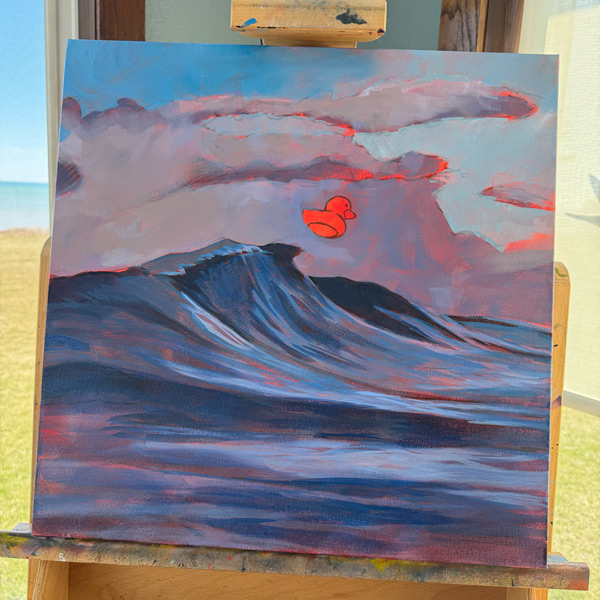
    “Beyond the Bathtub” by Jason Kotecki. 20 x 20. Oil on canvas.
    Original is available 🟢 Shop this art!

    I could have stayed in the bathtub.

    Way back when, after completing my schooling and earning a degree, the safe path was waiting for me. A decent job in my hometown. It wasn’t particularly exciting, but it was close enough to what I went to school for that I could rationalize it as making sense. I could have taken the job, gotten married, bought a house, and started collecting benefits.

    It was tempting, and by most standards, the smart thing to do. The only problem is that I knew exactly what life in the bathtub would look like for the rest of my life.

    I may have been shy and quiet, but I grew up observing people who decided to stay in the bathtub. Whether they rationalized it as a smart choice or insisted they didn’t have any others, I could always sense a certain sadness, simmering just below the surface. 

    Life outside the bathtub is fraught.

    The ocean is vast. The edges disappear as the shoreline fades from view. The waves toss us around until we’re seasick. At times it feels like we’ll drown—or be swallowed by something much bigger than ourselves. The current carries us in directions we never would have chosen. It’s disorienting. Terrifying. Unpredictable.

    Of course we prefer to remain in an environment we can control! 

    The problem is that it’s not much of a life. 

    The bathtub is safe, controlled, and predictable. But it’s also small. Constricting. Eventually the what-ifs become impossible to ignore. What’s outside these walls? What am I truly capable of? Where might I go if I ventured beyond the edge of what I can see?

    I was the kid my relatives called a scaredy-cat. Honestly, not much has changed. I’ve never become especially brave or outgoing.

    I just knew there was life beyond the bathtub.

    Although I’m just a tiny rubber duck, I sensed I was made for a bigger shore, farther away than I could get to on my own.

    So I put my trust in the One who made the water, the waves, and the wind.

    That choice came with no certainty, no safety, and no benefits package. There were seasons when I felt lost at sea. Driftless. Doubtful. Overwhelmed. Afraid.

    You know what? I still feel that way sometimes. There are always temptations to pull into a safe harbor somewhere and settle down. To quit while I’m ahead.

    But I can’t go back now.

    Since giving my life to the Creator of the ocean, I’ve seen things, accomplished things, and experienced things I never would have known had I stayed in the bathtub. I’ve been swept up in an adventure that’s been wonderful, beautiful, and breathtaking.

    The decision isn’t to become adventurous.

    The decision is to leave the bathtub.

    Everything else follows.

    We’re destined for a life beyond the bathtub. 

    Of course it isn’t safe. But it is good.

    Is it time for you to experience what life is like beyond the bathtub?


    process

  • We Can’t Let Winter Win

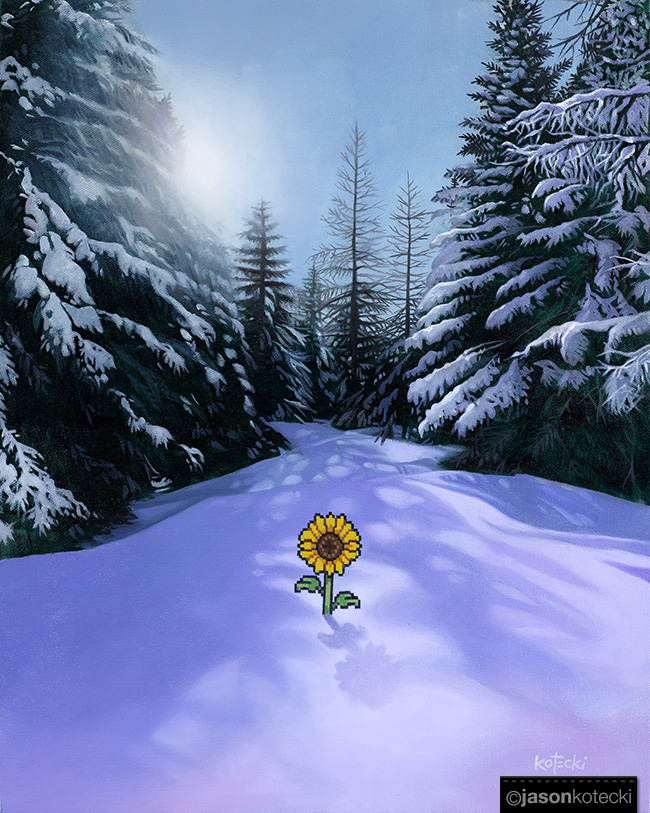
    “We Can’t Let Winter Win” by Jason Kotecki. 16 x 20. Oil on canvas.
    Original is available 🟢 Shop this art!

    One thing I love about the Midwest is the seasons. Real ones. Not like those they claim to have elsewhere, so-called “winters” with an occasional snow flurry and temperatures that sometimes flirt below forty.

    In Wisconsin, our seasons are pure, not pretenders. 

    I like that, because it allows me to fully embrace the beauty and lessons of each one. It’s a reflection of life, which has distinct seasons, no matter where we live.  

    If we’re honest, we’d prefer life to be one long, glorious summer, filled with sunshine and popsicles. But no. There are seasons of autumn, times for slowing down and saying goodbyes. And there are long winters of loneliness, where life feels frozen solid, and hope gets buried under a blanket of snow. 

    Of course, spring always follows, but sometimes it seems to have overslept.

    In Wisconsin, there is always a point when you’re pretty sure winter is over. 

    Live here long enough, and you realize it’s not. 

    There’s always one last gasp. One final snowstorm. One more cold snap that steals spring away, just as you were about to elope together on your way to summer.

    That might be the most deflating, difficult part of winter: The moment when it appears it will never end, and you don’t know how much more you can take.

    Life feels like that sometimes, when it seems like winter’s gonna win. 

    Winter wins when it convinces us that nothing will ever change.

    Winter wins when we let disappointment over unmet expectations turn into resentment.

    Winter wins when we allow ourselves to be buried under a blanket of apathy.

    Winter wins when we decide to give up and let the hope within us flicker out.

    But it doesn’t have to get the final say.

    This painting is a reminder that we can’t let winter win.

    The 8-bit sunflower is reminiscent of a video game, because I think that’s a good way to think of it. When you’re in the middle of one of life’s winters, everything is heavy. Summer looks so far away. We see all the things that need to change for us to go from where we are to where we want to be, and it feels insurmountable. 

    Sometimes the answer to the darkness that weighs down on us is a little levity. Making a game out of it is a way to rise above the life-and-death seriousness of our situation. It takes us ever-so-slightly outside ourselves to give us perspective that is a little wider than the restricted, optionless way winter can feel sometimes.

    Part of what makes a game engaging and fun is that there is a challenge to it. But the key is for it to be a doable challenge. So instead of focusing on all the ways we are frozen in place and how many more days of winter are ahead, make a game out of finding even one tiny clue that spring is on its way. You don’t need to defeat the Final Boss and save the Princess; you just need to make it past this level. 

    Today.

    The game is this: Figure out how to win today.

    It doesn’t have to be big.

    It could be one five-minute prayer.

    It could be getting dinner on the table.

    It could be dumping the bottle of vodka down the drain.

    It might just be getting out of bed.

    Sometimes the win is just giving it one more day.

    I’ve experienced many winters, especially in the early days of building our business. I once got some advice from a business colleague I’ve never forgotten. He, too, was an entrepreneur and knew how discouraging it was to feel like you made one step forward only to take three steps back. He shared a simple policy he lived by. On those really hard days, the days when he didn’t think he could go any further, he promised himself he’d give it one more day. He gave himself permission to abandon ship after that, but not before he gave it one more day.

    Sure enough, the next day always brought some glint of hope, a new reason to believe. There was rarely any huge breakthrough that magically happened. Maybe it was a small sale. Maybe it was an encouraging word from a friend. Maybe it was just a good night’s sleep.  

    Just a baby step forward.

    We win when we find evidence that spring is on its way.

    We win when hope bursts through a blanket of apathy.

    We win when our resentment melts into acceptance.

    We win when our panic gives way to patience.

    We win when we bring light to someone else.

    We win when we give it one more day.

    Don’t let winter win.

    Keep holding on for spring.
  • Don’t Fight Fire With Fire

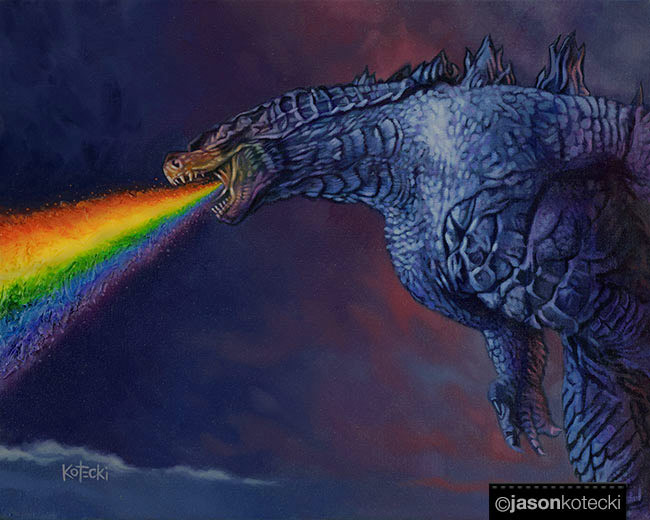
    “Don’t Fight Fight with Fire” by Jason Kotecki. 20 x 16. Oil on canvas.
    Original is SOLD 🔴 Shop this art!

    If you try to do anything worthwhile, you’ll likely suffer skeptics and critics.

    When you encounter naysayers, you have a few options. You can allow them to stop you. This is generally not advised, especially if they are little more than bullies. Or you can use their doubts as fuel. 

    This is what I recommend, but with caution.

    You see, that fuel burns hot. If you rely too much on it, you can end up consumed with anger and rage. If it becomes all about proving someone else wrong, rather than pursuing something worthwhile that brings you joy, you will be the loser in the end.

    When I was younger, I idolized Michael Jordan. Besides his athletic prowess, I also admired his work ethic, determination, and persistence. But I also remember the speech he gave when he was inducted into the NBA Hall of Fame. Despite having accomplished everything a player could possibly achieve and being widely regarded as the greatest of all time, he was still holding on to grudges from decades gone by. Perceived slights from his high school basketball coach, teammates, reporters, and fellow competitors. He was still trying to torch them all to prove his dominance, spitting out petty barbs to people he perceived as having wronged him. He came across as bitter, shallow, and small.

    Those slights he used to fuel his competitive drive seemed to have consumed him, leaving him charred.

    It’s natural to want to right perceived wrongs. But as many wise people have said, “Withholding forgiveness is like drinking poison and expecting the other person to die.”

    Our culture today seems more combative than ever. Trash-talking is considered an art form. We are urged to use the haters to fuel our rise, and then, when our success is undeniable, use it to torch them. When we win, it’s open season on our opponent. We must reign fiery retorts and comebacks down upon them, shaming them into submission. The more clever the comeback, the more street cred we receive.

    But there’s a better way, and the Wright Brothers are a great example.

    As you might imagine, the race to be the first to fly was heated. The two were fiercely competitive, but they never badmouthed their competitors, choosing instead to compliment their good qualities.

    One of their biggest rivals was a man by the name of Samuel Langley. He was the head of the Smithsonian, one of the most respected scientists of the day, and by far the most well-funded individual pursuing the problem of flight. He portrayed a haughty pride over his self-perceived inevitability of success. Ultimately, he experienced a very public, very humiliating failure.

    One that opened the door for the Wright Brothers to gloat.

    As I read David McCullough’s book about them, I found myself rooting for Orville and Wilbur to do some sort of well-deserved verbal victory dance.

    They never did.

    McCullough writes:

    “Neither brother was ever to make critical or belittling comments about Langley. Rather, they expressed respect and gratitude for the part he had played in their efforts. Just knowing that the head of the Smithsonian, the most prominent scientific institution in America, believed in the possibility of human flight was one of the influences that led them to proceed with their work.

    Wilbur told Octave Chanute in a letter written some years later: ‘He possessed mental and moral qualities of the kind that influence history. When scientists in general considered it discreditable to work in the field of aeronautics, he possessed both the discernment to discover possibilities there and the moral courage to subject himself to the ridicule of the public and the apologies of his friends. He deserves more credit for this than he has yet received.’”

    How kind. How gracious. And frankly, how epically badass.

    Taking the high road and responding with kindness possesses an underrated level of effectiveness. For the Bible tells us that when you treat your enemies with kindness, “you heap burning coals upon their head.”

    Don’t let the naysayers stop you. You can turn them into motivation, but be careful about using them for fuel.

    Fighting fire with fire leaves both of you as a pile of ash.

  • Kintsugi Tortoise

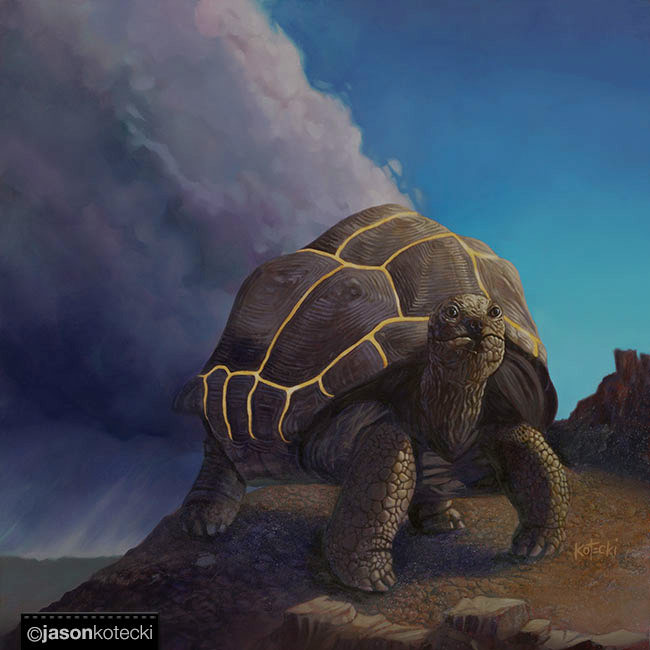
    “Kintsugi Tortoise” by Jason Kotecki. 30 x 30. Oil on canvas.
    Original is SOLD. 🔴 Shop this art!

    All dreamers start out delusional.

    But perhaps that’s an essential ingredient.

    The feeling that their idea is “genius” and the perception of their inevitability of success provide the enthusiasm and energy to get started. After all, no one found the fuel to begin chasing a dream by focusing on all the reasons it could never work.

    The critical moment is how the dreamer responds when he or she first encounters adversity.

    Or as philosopher Mike Tyson put it, “Everyone has a plan until they get punched in the mouth.”

    If a dream is big enough and you pursue it long enough, it will break you.

    Your confidence will be shattered. Doubt will creep in. Hope will be lost.

    Then what?

    I’m sad to say that’s often where it ends. The dream dissolves into an emaciated wish, a thin, pale shadow of its former glorious self.

    For twenty-five years, Kim and I dreamed of having a lake home. We talked about it on our first date. We spent hundreds and hundreds of hours talking about it, trying to figure out the most efficient way to make it happen while still doing the work we love and feel called to. We tried on dozens of scenarios in our minds, calculating what was possible and what sacrifices might be required.

    In the early days, it seemed like just a matter of time before we made it happen. We had pure motives, a little bit of talent, and a desire to work hard. I could see it, clear as day. On the hard days, the steadfast belief that it would come true kept me going. In my naiveté, I figured it would take a year, maybe three at most. (Ha!) 

    As months turned to years, and our kids got older, doubts crept in. I wondered if I was wasting my time. I wondered if I was only holding on in desperation, and that my death grip on my dream life was keeping me from living my real one.

    It was exhausting and soul-crushing at times. While on a family vacation in Florida, and with the kids asleep in bed, I was sitting on the balcony of our rental. Although it was too dark to see them, I could hear the Gulf’s waves pound the shoreline. My heart was broken, and I wished that I’d never had the dream at all. I was overcome by the desire to throw it back into the sea.

    I considered that maybe giving it up would give me relief and freedom. I yearned for someone from a Harry Potter book to cast a Memory Charm upon me, to obliviate the dream from my memory.

    That night on the balcony in Florida was February 3, 2020. A little over a month later, a pandemic began, and all hell broke loose in our lives.

    Yet somehow, just eleven months later, our family moved into our dream home on Lake Michigan. (Never in a million years did I think it would be one of the Great ones!)

    Kintsugi is the Japanese art of repairing broken pottery with gold (or other precious metals). Instead of disguising the damage, kintsugi highlights the repairs, transforming the broken object into a unique and beautiful piece. It’s a philosophy that embraces imperfections and impermanence, finding beauty in flaws and celebrating the history of an object. 

    It’s true that if a vessel breaks, it can never be made to look new again.

    But kintsugi makes it better than new, because it’s even more beautiful than it was before.

    Our brokenness makes us humble. Humility is the most beautiful virtue because it allows our other good qualities to shine fully and be most helpful to ourselves and the world.

    These broken places within us are not defects. They are the places where light can shine through. Those golden scars embody a soul that is stronger and a story that’s more beautiful because of the trial.

    This painting represents the slow patience that’s required of a person trying to achieve something great. It’s a reminder that we will experience the storms of struggle and brokenness. But it’s also a beacon of hope for brighter days ahead waiting for us if we persist.

    The journey may be harder than you expected, but the you that emerges will be better for it.
  • Sunshine In My Soul

    “Sunshine In My Soul” by Jason Kotecki. 12 x 12. Oil on canvas.
    Original is SOLD 🔴 Shop this art!

    I do not know how people survive without faith in this dark world. 

    Perhaps it’s why our rates of depression, anxiety, and suicide are at all-time highs. My faith is like having sunshine in my soul. No matter how heavy the storm or dark the night, there is a joy that never dissipates, giving me hope. 

    I did not always have this faith. Like many, my perception of God came from the reflection of Him I saw in others. Often, it was a pretty distorted version. 

    But there were people I encountered who were in alignment with the merciful, mighty, and loving Father I have come to know and love. 

    This is the God whose light I pray shines forth from my work, so that others may see, believe, and experience this sunshine in their soul. 

  • The Armada

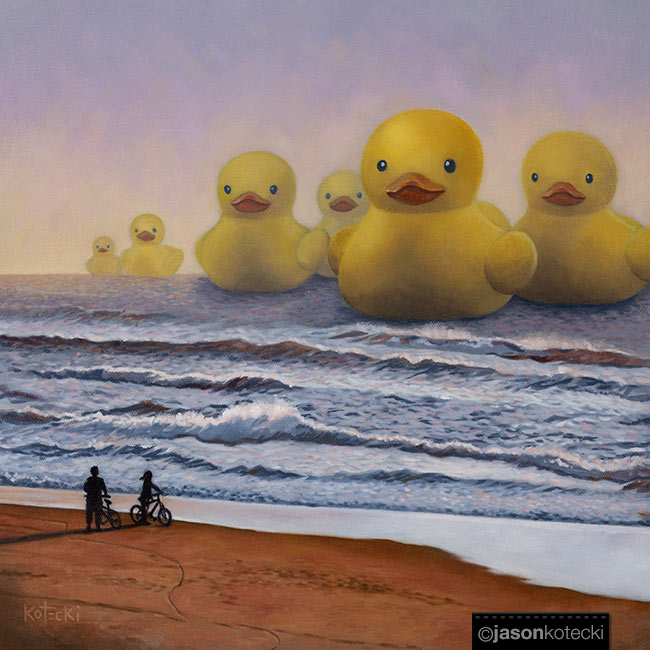
    “The Armada” by Jason Kotecki. 16 x 16. Oil on canvas.
    Original is SOLD 🔴 Shop this art!

    Quick! You’re on the beach with a friend and you spot something approaching on the horizon. To your amazement, you make out an armada of giant rubber ducks coming to shore. What is your reaction?

    Are you excited? Overjoyed? Concerned? Skeptical? Worried? Afraid?

    Are they visitors or invaders?

    Do they bring good tidings or dark intentions?

    Sometimes a painting can just be a fun picture that makes you smile. And sometimes it contains a deeper meaning. I asked people on social media to share their perceptions of this painting, and it may or may not surprise you that their responses varied greatly:

    • “Pure joy. I have a jacket printed with rubber ducks. They always make me smile, as does the ocean, and riding my bike!”
    • “Here comes whimsy!”
    • “Hope is on the horizon.”
    • “I’m a little worried.”
    • “Terrified.”
    • “Invasion from a Trojan Horse.”
    • “Plastic pollution and impending doom from climate change.”

    It turns out that the meaning of this painting, as well as the meaning of almost everything in life, is largely determined by you. 

    Our perceptions impact our actions. For example, whether you’d run for cover or organize a welcoming party would depend on whether you see these rubber ducks as friends or foes. One side sees the other as hopelessly naive. The other side sees the other as paranoid. Both sides have a point.

    If we respond too enthusiastically, we might fall into a trap.

    If we respond with animosity, we may sabotage any chance of something good happening.

    We can assume the best, assume the worst, or…perhaps the best, wisest, most productive thing we can do is keep an open mind and wait and see.

    Now, let’s put the shoe on the other flipper. Imagine if you’re one of those ducks. You’re fun. Lots of people like you. You want to be helpful and bring joy to others. You’re new in town, but you have good intentions. But what are those locals on the shore thinking?

    Do they see you as a visitor or an invader?

    Do they think you bring good tidings or dark intentions?

    We’ve all been the new guy. The new kid in class. The newest employee. Or, most recently for us, the new family in town. I like to think of this painting as a metaphor for our mission to bring wonder and whimsy to distant shores. I unveiled it at the first Wondernite we hosted in Sheboygan, having moved from Madison two years earlier. As relative unknowns, we wondered if anyone would come.

    It turned out to be our biggest and best one yet.

    It’s scary to consider what the natives might think of you. You feel like you stick out like a sore thumb because it seems obvious that everyone can tell you’re not familiar with the local culture, the shorthand, the inside information that everyone else takes for granted. 

    It’s tempting to want to appear big and important. Maybe pretend to be something you’re not. After all, you’ve got a clean slate. None of these new people know all your history and baggage. You never get a second chance to make a first impression, so it’s a chance to put forth something impressive.

    I’ve found it’s easier, more effective, and frankly, less exhausting to just be yourself. People are drawn to authenticity, and we are very good at spotting a fake. Your weird flag may not inspire everyone, but it will attract your people.

    It’s more beneficial to check your expectations.

    If you expect the natives to be hostile, you’re likely to protect yourself by being hesitant and withdrawn, which may make you appear cold and aloof to others. But be warned: if you assume the locals will be hostile and unwelcoming, guess what you’re likely to get.

    You see, there is this thing called confirmation bias. (Perhaps you’ve heard of it.) It’s applicable whether or not you see yourself as the kids on the beach or the newcomers floating to shore. How it works is that we make an initial judgment or tell ourselves a story about a person, group, or situation. Then we reflexively look for evidence that supports our case and confirms our bias. 

    Meanwhile, we subconsciously filter out any information that runs contrary to our story. We interpret new information as being supportive of the opinions we already hold, and it doesn’t matter how poorly it fits. Our dutifully protective brain finds a way without us having much of a say.

    If you think your spouse is ignoring you, you’ll be on the lookout for all the evidence to make your case.

    If you expect to have an awesome day, your antenna will be up and scanning for proof all day long.

    If you think Republicans are the worst, you will notice and remember every example that proves your point.

    If you think Democrats are the enemy, well, you get the point.

    So…what if we paused at the very beginning to realize we don’t yet know the truth and take a wait-and-see approach? Thanks to confirmation bias, if you expect the best in others, the odds are better you’ll find it.

    This might just be a fun, whimsical painting that makes you smile.

    Perhaps something light-hearted to hang in your bathroom.

    It might also be a reminder to always be yourself while giving other people a chance to do the same.

  • Talent Stack

    “Talent Stack” by Jason Kotecki. 16 x 16. Oil on canvas.
    Original is SOLD 🔴 Shop this art!

    Sometimes people look at successes I’ve had and say, “Must be nice,” as if they happened by magic.

    What they don’t often see is the framework that helped enable that success. Fortunately, it’s a framework anyone can develop.

    We often assume that in order to be successful, we need to be great at one thing. That can work—see LeBron James, for example—but that path is extremely difficult and unlikely. The truth is, you only need to be pretty good at a handful of ordinary skills.

    You just need to build a talent stack.

    Scott Adams, the creator of the comic strip Dilbert, popularized this concept which states that you can ensure success by assembling a “stack” of two or more complementary skills and be in the top 25 percent or so in each. Do that and you’ll be unstoppable. 

    In his case, he readily admits he’s not the best artist, the most skilled writer, or the savviest business expert. But his unique combination of those skill sets has contributed to his success as a cartoonist.

    My own talent stack began with a few crayons. “Artist” was my first and is my longest-lasting identity. I’ve always enjoyed it, and I got praised for it, so I’m sure that made me want to keep doing it.

    In high school, I had a chance to take a creative writing class, which I enjoyed exponentially more than my math classes. I kept honing that skill, which eventually became an indispensable part of my talent stack.

    In college, I gave a talk as a leader on a retreat and received great reviews. Even though I am naturally shy, I enjoyed the process of crafting stories in spoken form. It was like creative writing but delivered out loud. 

    To the surprise of me, my parents, and the high school speech teacher who gave me a “C,” public speaking emerged as the primary driver of our business. I went from giving cartooning workshops in schools to speaking at churches to keynoting conferences for associations and corporations all over the place. 

    Now it took me a few years to realize that these three talents—art, writing, and speaking—were not separate skills that operated independently, but part of a talent stack, that when used in harmony became even more powerful. I am not the best artist in the world, or the best writer or speaker. But I’m pretty good at all three, and that combination has been the secret sauce of my success. Once I was introduced to talent stacking, I eagerly looked for complementary skills to add. By devouring hundreds of marketing books and through the school of trial and error, I’ve achieved the equivalent of an MBA in marketing. Am I the best marketer in the world? No, but I easily fall into the top 25 percent.

    Kim and I went on several organized retreats in college. That background gave us a foundation to build on when we started hosting our own events. After putting on numerous meetups, workshops, book tours, fundraising galas, and Escape Adulthood Summits over the past two decades, we’ve gotten pretty good at managing logistics and creating experiences that move people.

    Most recently, we used the pandemic as an opportunity to get good at livestreaming, which added a whole new dimension to our business.

    Drip by drip, these new skills made the other skills even more valuable and ushered in greater success.

    Of course, your talent stack will look different from mine, but the premise is the same. Start with natural strengths and abilities and work to make them better. Think about how they can work together in unexpected ways, even if they seem unrelated. 

    Everyone in your industry probably competes on many of the same skills. What do you have that’s different? Oftentimes the magic lies in a skill or interest that seems to come out of left field. For instance, many professional speakers are also writers. But my artistic gifts and whimsical, childlike perspective allow me to offer something extraordinary.

    This isn’t just about what you were born with. Look for other skills you can attain that complement and enrich the others. That might involve a traditional degree or certification, but it can also be done by reading books, listening to podcasts, taking courses online or at your local community college, or practicing, in public, every day, as we did with our pandemic project of livestreaming.

    If you’re stuck, here are some evergreen choices that will help:

    • Presentation skills
    • Technology skills
    • Foreign language skills
    • Sales or marketing skills
    • Writing skills
    • Business management skills
    • Nunchuck skills

    Remember, you don’t have to turn yourself into the foremost expert on any of these skills. Just be in the top 25 percent. Said another way, in a world of around eight billion people, you only need to be among the top two billion. If one hundred thousand people live in your city, you just have to be in the top twenty-five thousand. 

    In other words, pretty good is good enough.

    Keep in mind that this is a lifelong project. If you’re doing it right—meaning you stay curious and keep growing—your talent stack will continue to evolve and strengthen throughout your career and life. One last word of warning, however…

    When you have a decent stack of three to five skills going, you can bank on someone, somewhere observing what you’ve been able to accomplish and saying, “Must be nice.”

  • Nope

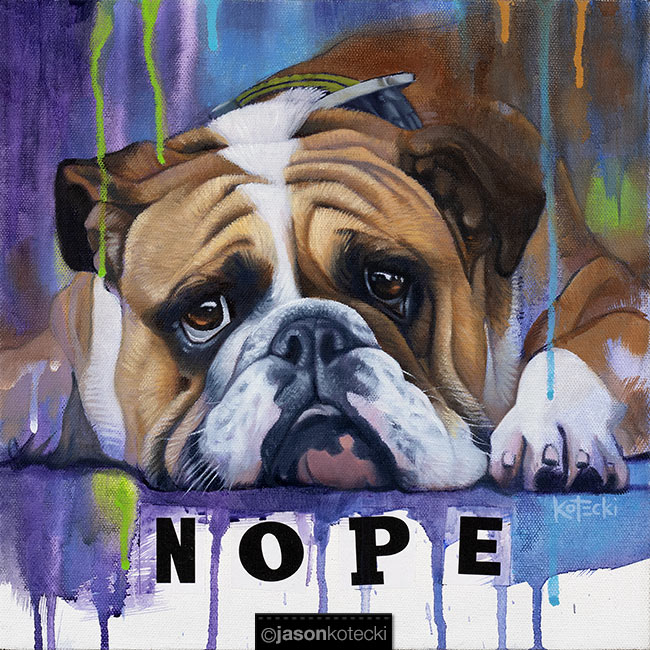
    “Nope” by Jason Kotecki. 12 x 12. Oil on canvas.
    Original is SOLD 🔴 Shop this art!

    Mama said there’d be days like this.

    Sometimes when we’re feeling overwhelmed, exhausted, or sad, we simply need a time out. 

    Or pizza. 

    That was the prescription our midwife gave us after Lucy was born. Kim and I had come into the delivery day mentally depleted, our first child already a few weeks overdue. Then the labor itself was a marathon. After the birth, Kim almost fainted because of a drop in blood pressure. As she recovered, it was on me to put on Lucy’s first diaper and figure out out to dress a four-hour-old (it’s like trying to gift-wrap Jell-O) before clearing an inch of ice from our car so we could drive home from the birth center. 

    The prospect of going home to attend to the 24/7 needs of a newborn was overwhelming, to say the least.  Aware of our exhaustion and sensing our uncertainty, our midwife said, “You know what I want you to do? When you get home, I want you to order in the biggest, cheesiest, gooiest deep-dish pizza ever, and savor it.”

    And we did. It was glorious.

    It was just the little treat we needed to keep going. We still rely on the magical properties of pizza from time to time. 

    Sometimes we require something stronger, like a “sick of it” day. In most workplaces, if you have the flu, a persistent cough, or you’re going through more Kleenex than me watching the opening scenes of “Up,” you get to take a sick day and stay home from work. But what if you have a case of the Mondays (or a case of November)? 

    Kim and I recommend taking a “sick of it” day. (You can still tell your boss it’s a “sick day.”) It’s kind of like playing hooky, but it’s really a chance to shift momentum and throw life a curveball for a change. You can do anything you want, but no work and no chores. Treat yo self. 

    But what happens when those days mama warned us about turn into weeks, or months, or years?

    Our body will tell us if we’re paying attention. I like to think of our negative emotions as a check engine light for our body and soul. You know, the light that illuminates our vehicle’s dashboard to tell us that something’s off. Most people handle it like my father-in-law handled the check engine light on his old Chevrolet Celebrity – with a thick black piece of electrical tape, hiding the light from view. 

    Problem solved!

    Or not. Ignoring a problem rarely works. If you’re in a funk right now or enduring a hard season, it might be time to call a time-out and see what the inner check engine light is trying to tell you.

    I preach the power of optimism. But it’s unrealistic to expect we can go through life on a positive high all the time (and I’m leery about people who seem to do so). 

    Maybe you’re experiencing caregiver fatigue. Maybe it feels like everything you touch turns to shitake. Or maybe you’re burned out from the last three years of pandemic, politics, and pivoting. 

    It’s ok. Welcome to the Human Club. You’re normal!

    We don’t have to be afraid of feeling the feels and examining what they have to teach us.

    Uncomfortability can be useful. We need to pay attention to our inner check engine light, not ignore it with a never-ending Netflix marathon, a bottle of wine, or any of the countless ways we self-medicate to numb ourselves to escape our pain.

    It’s giving us a heads-up that something may need to be addressed. For me, it’s usually a warning that I need to ease up on adding new commitments to my calendar, a reminder to spend more time in my secret hideout, or an invitation to get a little more rest. (Often it’s a combo of all three.)

    This approach from Steve Jobs is a good guide. He said, “For the past 33 years, I have looked in the mirror every morning and asked myself: ‘If today were the last day of my life, would I want to do what I am about to do today?’ And whenever the answer has been no for too many days in a row, I know I need to change something.”

    Are you in need of a change? It might be time to talk to someone, like a counselor, pastor, or medical professional. Maybe you need to take that difficult first step toward healing a relationship. Or maybe it’s time to finally embark on that new career path.

    Remember, for now doesn’t mean forever. It may feel like there’s no end in sight to the malaise you’re experiencing, but it only seems that way.

    Don’t be afraid to peel back the tape on your check engine light and see what it has to tell you.

    Maybe a gooey, cheesy pizza and a night on the couch is exactly what you need. Maybe a “sick of it” day will do the trick. Or maybe it’s time for a baby step toward a bigger change.

    Let your inner check engine light lead the way.

  • The Monarch

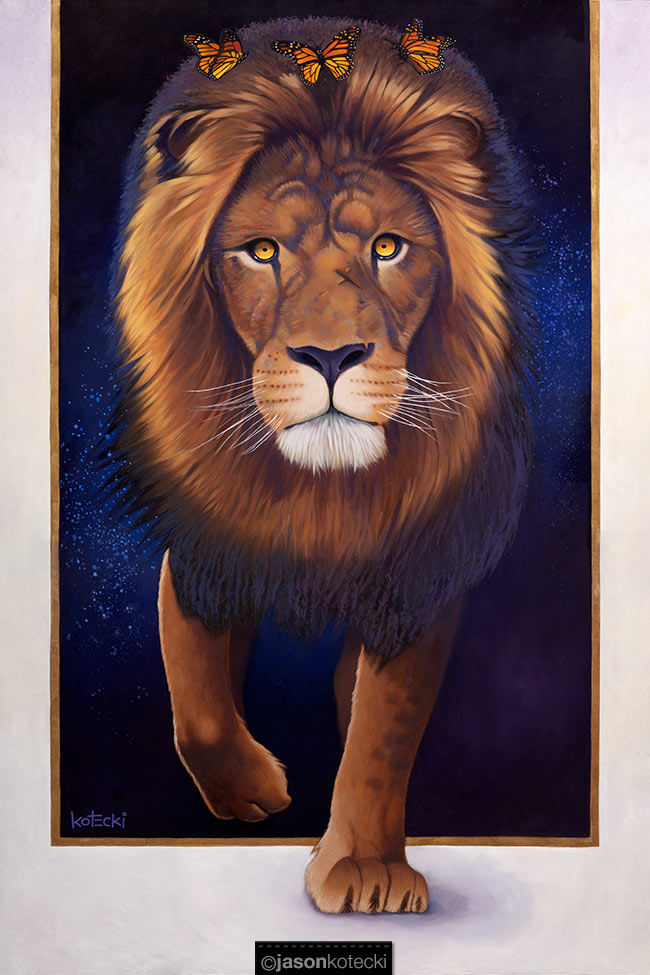
    “The Monarch” by Jason Kotecki. 40 x 60. Oil on canvas.
    Original is SOLD 🔴 Shop this art!

    His name was Joel, but I called him Mr. Dawson. He was one of the best leaders I’ve ever known.

    On the surface, Mr. Dawson was just a regular guy who coached youth baseball. But he was kind, humble, and strong, albeit not in the “benchpress dump trucks” sort of way. A rare autoimmune disease took several fingers on one hand. But he was able to balance a baseball with it while holding a bat with his other hand. During practice, he’d carefully toss the ball upwards and whack it with the bat in the direction of a fielder.

    When I played Little League, he managed an opposing team, but his vote helped me land on the all-star team. He became my coach after drafting me when I turned thirteen and moved up to Junior League. I was an occasional pitcher. My fastball wasn’t very fast, and I didn’t have a curveball, but I kept the ball over the plate. The good news is I rarely walked anyone, but the bad news is batters usually salivate at the prospect of facing someone who throws slow and straight. 

    The back of my baseball card was not impressive.

    Perhaps not surprisingly, I’d never been the winning pitcher of a game. I could claim it was because the teams I pitched for were never that good, but then again, neither was I. For some unknown reason, Mr. Dawson decided to make it his mission that season to get me a win. It took a while, but somehow, his persistent belief in me sank in. I actually started believing it was possible. I don’t even remember the score of the game when it finally happened, but I do remember the feeling. I remember his proud smile. 
    And I remember being happier for him than I was for myself.

    That’s what the best leaders do: believe in people. 

    Oftentimes, those people don’t believe in themselves. Sometimes it’s for a good reason, and sometimes it’s the natural result of not having anyone in your life who does. But the good leaders see a spark. Heck, maybe the spark doesn’t even exist, but their belief that it does is so convincing, it’s as if they are somehow able to will it into existence. 

    This painting was inspired by C.S. Lewis’s character, Aslan, the Christ-like figure in The Chronicles of Narnia. It’s a great image of the best kind of leader: brave but vulnerable. He’s confident in knowing what he’s about, but kind enough to welcome the lowliest creatures into his friendship and protection. Malcolm Forbes said, “You can easily judge the character of a man by how he treats those who can do nothing for him.” 

    People are fragile beings, like the butterflies in this painting. I sure was when I was thirteen, a shy, skinny kid with oversized glasses playing on a team stocked with much better athletes, trying to figure out who he was and what he had to offer. 

    The best leaders walk with us out of our past and into our future, accompanying us from who we’ve been to who we can be. We all need people like that in our lives. If someone believes in you, consider yourself lucky. And take them at their word, even if you can’t yet see what they see.

    Mr. Dawson died too soon from cancer shortly after I moved on to high school, more complications of his condition. By then a close friend of the family, I saw him face his final battle and the unknown of the next life with bravery and good humor. 

    Sometimes in life, we are the butterflies. We are fragile and need to believe the people who care about us are right when they tell us they see greatness within us.

    Sometimes in life, we are the lion.

    We are called to be leaders who seek out the lost, the young, the weak, and the forgotten. Our job is to look for the good in them, believing in them as long as it takes until they can see it for themselves. 

    Thanks, Mr. Dawson.

  • The Candymaker

    “The Candymaker” by Jason Kotecki. 20 x 20. Oil on canvas.
    Original is SOLD 🔴 Shop this art!

    This is part of “Adultitis Fighters,” a series of paintings by Jason Kotecki featuring real and fictional characters who serve as role models in the fight against Adultitis.

    Willy Wonka, the enigmatic chocolatier from Roald Dahl’s “Charlie and the Chocolate Factory,” is an iconic symbol of the wonder and magic of childhood. His eccentric behavior, refusal to conform, and unexpected twists challenge conventional expectations, encouraging us find delight in surprises. Willy’s whimsical inventions and fantastical creations teach everyone that anything is possible with a little imagination and ingenuity. His witty remarks and mischievous antics remind us not to take life too seriously.

    “You should never, never doubt what nobody is sure about.”

    “We are the music makers, and we are the dreamers of dreams.”

    “If the good lord intended us to walk, he never would’ve invented roller skates.”

    “The suspense is terrible! I hope it’ll last.”

    “A little nonsense now and then is relished by the wisest of men.”