
Keyword: sail

  • The Armada

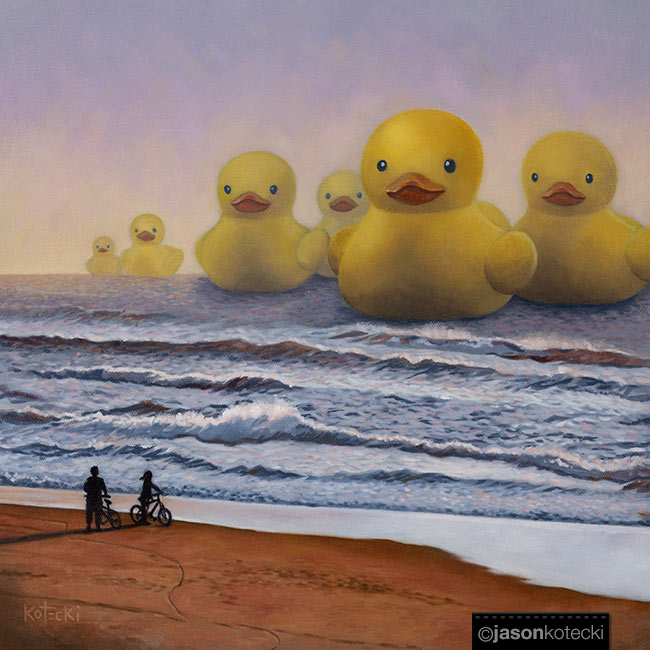
    “The Armada” by Jason Kotecki. 16 x 16. Oil on canvas.
    Original is SOLD 🔴 Shop this art!

    Quick! You’re on the beach with a friend and you spot something approaching on the horizon. To your amazement, you make out an armada of giant rubber ducks coming to shore. What is your reaction?

    Are you excited? Overjoyed? Concerned? Skeptical? Worried? Afraid?

    Are they visitors or invaders?

    Do they bring good tidings or dark intentions?

    Sometimes a painting can just be a fun picture that makes you smile. And sometimes it contains a deeper meaning. I asked people on social media to share their perceptions of this painting, and it may or may not surprise you that their responses varied greatly:

    • “Pure joy. I have a jacket printed with rubber ducks. They always make me smile, as does the ocean, and riding my bike!”
    • “Here comes whimsy!”
    • “Hope is on the horizon.”
    • “I’m a little worried.”
    • “Terrified.”
    • “Invasion from a Trojan Horse.”
    • “Plastic pollution and impending doom from climate change.”

    It turns out that the meaning of this painting, as well as the meaning of almost everything in life, is largely determined by you. 

    Our perceptions impact our actions. For example, whether you’d run for cover or organize a welcoming party would depend on whether you see these rubber ducks as friends or foes. One side sees the other as hopelessly naive. The other side sees the other as paranoid. Both sides have a point.

    If we respond too enthusiastically, we might fall into a trap.

    If we respond with animosity, we may sabotage any chance of something good happening.

    We can assume the best, assume the worst, or…perhaps the best, wisest, most productive thing we can do is keep an open mind and wait and see.

    Now, let’s put the shoe on the other flipper. Imagine if you’re one of those ducks. You’re fun. Lots of people like you. You want to be helpful and bring joy to others. You’re new in town, but you have good intentions. But what are those locals on the shore thinking?

    Do they see you as a visitor or an invader?

    Do they think you bring good tidings or dark intentions?

    We’ve all been the new guy. The new kid in class. The newest employee. Or, most recently for us, the new family in town. I like to think of this painting as a metaphor for our mission to bring wonder and whimsy to distant shores. I unveiled it at the first Wondernite we hosted in Sheboygan, having moved from Madison two years earlier. As relative unknowns, we wondered if anyone would come.

    It turned out to be our biggest and best one yet.

    It’s scary to consider what the natives might think of you. You feel like you stick out like a sore thumb because it seems obvious that everyone can tell you’re not familiar with the local culture, the shorthand, the inside information that everyone else takes for granted. 

    It’s tempting to want to appear big and important. Maybe pretend to be something you’re not. After all, you’ve got a clean slate. None of these new people know all your history and baggage. You never get a second chance to make a first impression, so it’s a chance to put forth something impressive.

    I’ve found it’s easier, more effective, and frankly, less exhausting to just be yourself. People are drawn to authenticity, and we are very good at spotting a fake. Your weird flag may not inspire everyone, but it will attract your people.

    It’s more beneficial to check your expectations.

    If you expect the natives to be hostile, you’re likely to protect yourself by being hesitant and withdrawn, which may make you appear cold and aloof to others. But be warned: if you assume the locals will be hostile and unwelcoming, guess what you’re likely to get.

    You see, there is this thing called confirmation bias. (Perhaps you’ve heard of it.) It’s applicable whether or not you see yourself as the kids on the beach or the newcomers floating to shore. How it works is that we make an initial judgment or tell ourselves a story about a person, group, or situation. Then we reflexively look for evidence that supports our case and confirms our bias. 

    Meanwhile, we subconsciously filter out any information that runs contrary to our story. We interpret new information as being supportive of the opinions we already hold, and it doesn’t matter how poorly it fits. Our dutifully protective brain finds a way without us having much of a say.

    If you think your spouse is ignoring you, you’ll be on the lookout for all the evidence to make your case.

    If you expect to have an awesome day, your antenna will be up and scanning for proof all day long.

    If you think Republicans are the worst, you will notice and remember every example that proves your point.

    If you think Democrats are the enemy, well, you get the point.

    So…what if we paused at the very beginning to realize we don’t yet know the truth and take a wait-and-see approach? Thanks to confirmation bias, if you expect the best in others, the odds are better you’ll find it.

    This might just be a fun, whimsical painting that makes you smile.

    Perhaps something light-hearted to hang in your bathroom.

    It might also be a reminder to always be yourself while giving other people a chance to do the same.
  • Wind In Our Sails

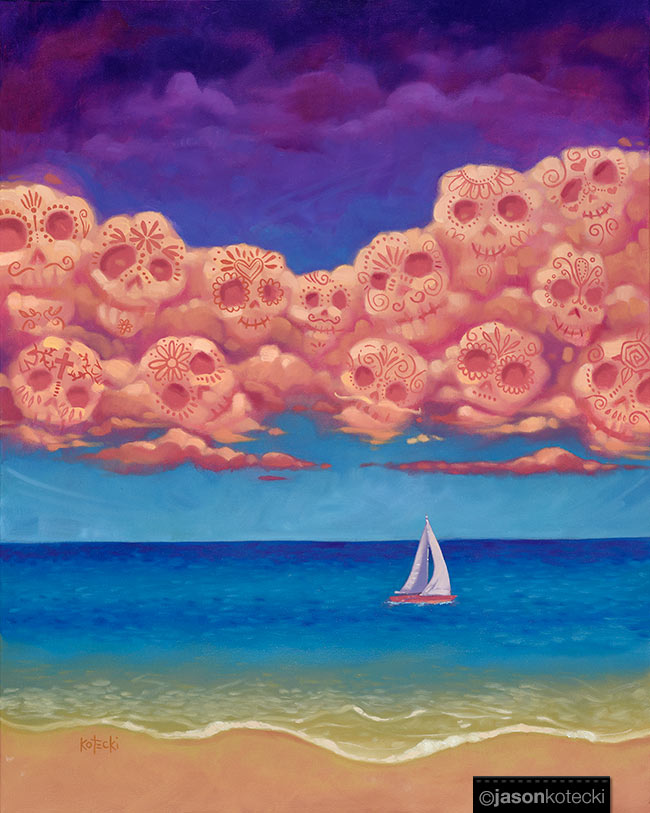
    “Wind In Our Sails” by Jason Kotecki. 20 x 20. Oil on canvas.
    Original is SOLD 🔴 Shop this art!

    This painting was inspired by a family vacation to Mexico. One thing that was abundantly clear in the week we were there is that the Mexican people love their color. When you’re accustomed to everything being Pottery Barn beige and gray, it really stands out. 

    I wanted to incorporate that vibrant, whimsical color, along with one of the culture’s great traditions, Dia de Muertos, or Day of the Dead. I think it is a beautiful way to look at the afterlife and the ancestors who went before us. I appreciated the idea of seeing death as a part of the life process, rather than an end in itself.

    I also liked the focus on how much we owe to the people who came before us. In American culture, the independent spirit of the individual is celebrated. That’s fine, as far as it goes. Except that there is no such thing as a self-made man or woman. No one becomes successful by themselves. Yes, your unique talents and a fiery self-determination are key ingredients for success. 

    But life is a group effort. 

    I was thinking about the people in my own life who have passed away. Not just family members, but teachers and coaches who served as mentors, too. Every one of them taught me something that I carry with me to this day. 

    My Grandma K. made me feel like I was special, just as I was.

    My third-grade teacher, Mrs. Smith, encouraged me to take my artistic talent seriously.

    My Little League coach, Mr. Dawson, helped me believe that I was a winner.

    When I was an uncertain teenager, Deacon Vince saw me as a grown-up with valuable contributions to make.

    Each of us is like that tiny sailboat. At times, it can feel like we are drifting, alone, on a vast and overwhelming sea. 

    But we are not alone. 

    We have the wisdom, given to us by the people in our lives who have gone before us, charting our course. They have touched our lives, and their examples live on, showing us the way.

    And their words live on as the wind in our sails, guiding us into a bright and colorful future.

  • The Captain

    “The Captain” by Jason Kotecki. 20 x 20. Oil on canvas.
    Original is SOLD 🔴 Shop this art!

    I present to you a painting I made of a pirate ship sailing in an ocean of milk amidst floating Cap’n Crunch cereal.

    I thought long and hard about conjuring up some deep meaning on this one. Something that would make you shake your head in amazement and say, “Wow. He is a truly brilliant artist and thinker.”

    But you know what? There isn’t any deep meaning. The truth is, I was thinking about Cap’n Crunch cereal, which I love, and thought about a tiny pirate ship sailing in a bowl of it, which would be neat. But then I thought, what if the ship was normal-sized and the whole ocean was milk and it had giant pieces of Cap’n Crunch floating in it? That would be weirder, and possibly neater. 

    So that’s what I did: gave myself over to pure whimsy.

    As we get older, Adultitis takes over and kills our whimsy. We grow increasingly skilled in the art of taking ourselves too seriously. And all that seems to bring us is anxiety, stress, and a life totally devoid of fun. 

    We’ve mastered the ability to make the trivial monumental. We fret about all sorts of things, from gas prices and elections to how we’re going to kill those weeds in the yard and what we should wear to next Friday’s function.

    Becoming more responsible is one thing. But losing our sense of whimsy and taking ourselves too seriously is another. 

    I have long admired people like Dr. Seuss and Roald Dahl because they created magical characters and worlds that are so rich with whimsy. Their art depicts preposterous, physics-bending, imagination-stirring images and scenarios that exhibit a ridiculousness that is wholly original and entertaining. Meanwhile, within the context of their art, all of it comes across as completely normal. How did they do that? 

    It can be hard for me to give myself over to this pure, unadulterated nonsense, which I consider to be the unfiltered essence of the spirit of childhood. As someone who often errs on the side of practicality and reason, I have always wished I could be more like Dr. Seuss and Roald Dahl. After discovering Adultitis and its evil tricks early in my adult life, I have spent my life trying to get back to that level of creative abandon. Back to normal.

    And yet here I am, having created a painting that exists at least within the same universe as those two greats, frustrated because I cannot come up with words to explain the meaning of this painting. 

    Because there isn’t one. 

    And thankfully, I think to myself, “Well, finally. Some progress.”

    It took a while to become an expert at taking yourself seriously; it will take a while to get back to normal. Give yourself permission to start.