It was the mid-90s. Jason and I had only been in the same room together four times with mutual friends, and yet somehow we found ourselves in a deep conversation, just the two of us, about our dreams for the future.
“Where would you like to live?” became the question that inspired passion within each of us and at the end of it all, we agreed wholeheartedly that Idaho would be an awesome spot, what with all of the tall pine trees and lakes and all.
Yes, with stars in our eyes, at ages 17 and 19, Idaho seemed pretty perfect to both of us.
Fast forward to our 20th wedding anniversary, after years of collectively dreaming of living on a lake surrounded by tall pine trees, and we both knew where we had to go to celebrate our two decades of married life, to one of the only states we had not yet visited together: Idaho!
Amazingly, we ended up in a little town in the northern panhandle called, “Hope” and found ourselves dreaming B!G again, dreams of the next 20 years, dreams of our someday lake home surrounded by tall pines, and dreams of the work we would do together as a couple, business partners and parents.
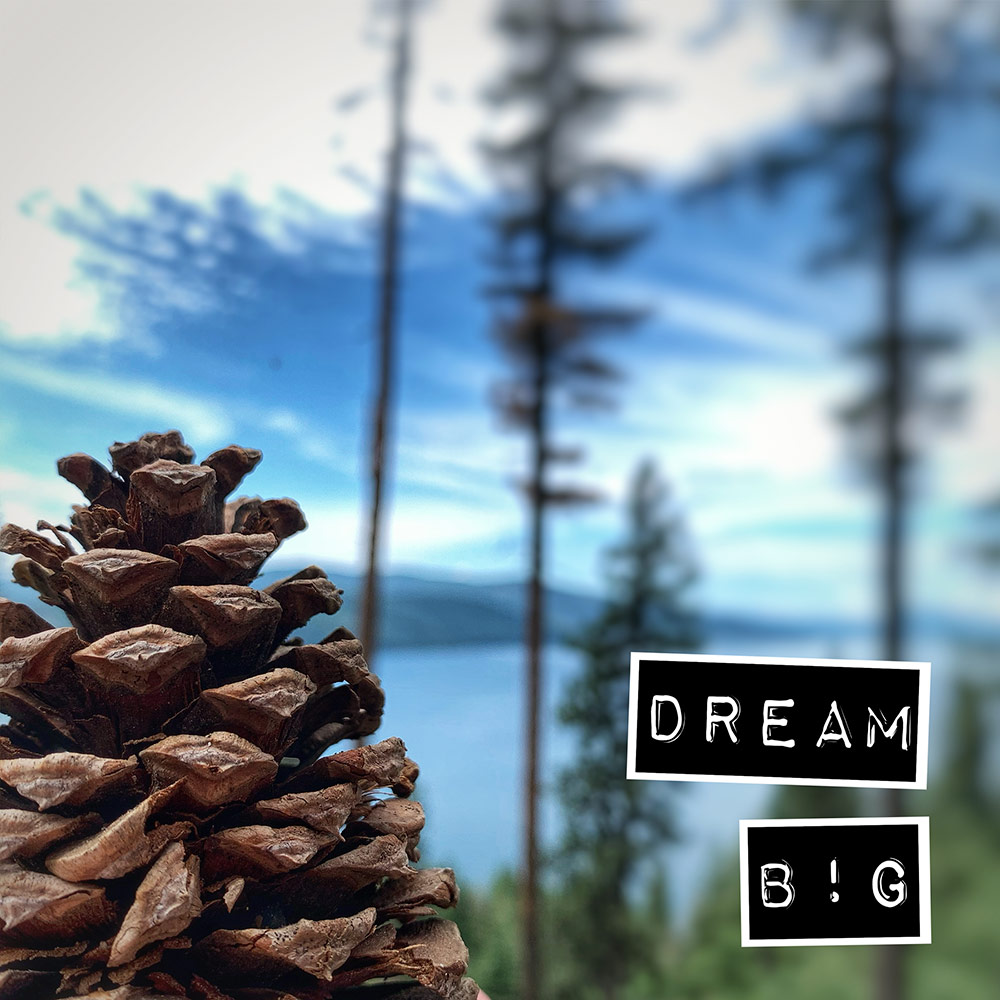
We tend to do our best dreaming while walking and talking, and while on one of our many hikes during that trip, I picked up this pine cone for a picture.
I noticed the true meaning only later when I connected the aspirations of this pine cone to be a full-fledged pine tree someday. So much hope, found in Hope, Idaho.
Dreaming big dreams is a powerful process, one fueled by faith, purpose, and passion.
This picture reminds me to keep asking the B!G questions with my partner-in-crime. My dreams will not only stay alive decades later, they may even quite possibly come true!
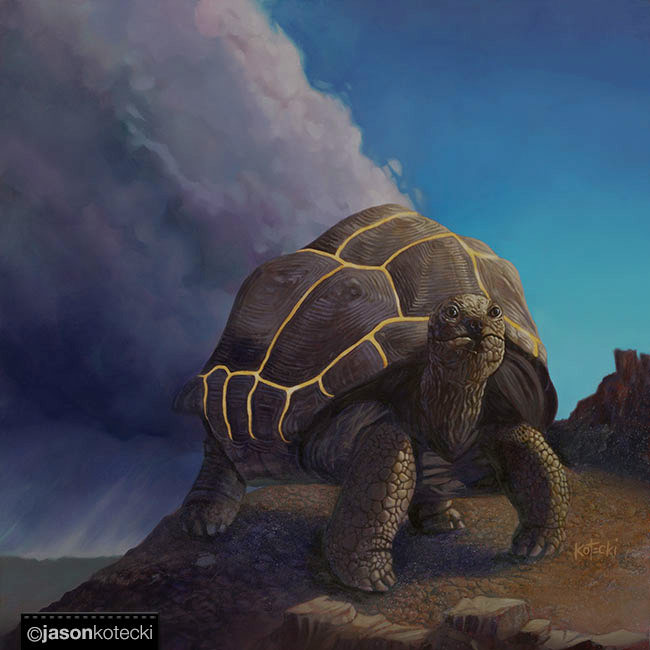
“Kintsugi Tortoise” by Jason Kotecki. 30 x 30. Oil on canvas. Original is SOLD. 🔴 Shop this art!
All dreamers start out delusional.
But perhaps that’s an essential ingredient.
The feeling that their idea is “genius” and the perception of their inevitability of success provide the enthusiasm and energy to get started. After all, no one found the fuel to begin chasing a dream by focusing on all the reasons it could never work.
The critical moment is how the dreamer responds when he or she first encounters adversity.
Or as philosopher Mike Tyson put it, “Everyone has a plan until they get punched in the mouth.”
If a dream is big enough and you pursue it long enough, it will break you.
Your confidence will be shattered. Doubt will creep in. Hope will be lost.
Then what?
I’m sad to say that’s often where it ends. The dream dissolves into an emaciated wish, a thin, pale shadow of its former glorious self.
For twenty-five years, Kim and I dreamed of having a lake home. We talked about it on our first date. We spent hundreds and hundreds of hours talking about it, trying to figure out the most efficient way to make it happen while still doing the work we love and feel called to. We tried on dozens of scenarios in our minds, calculating what was possible and what sacrifices might be required.
In the early days, it seemed like just a matter of time before we made it happen. We had pure motives, a little bit of talent, and a desire to work hard. I could see it, clear as day. On the hard days, the steadfast belief that it would come true kept me going. In my naiveté, I figured it would take a year, maybe three at most. (Ha!)
As months turned to years, and our kids got older, doubts crept in. I wondered if I was wasting my time. I wondered if I was only holding on in desperation, and that my death grip on my dream life was keeping me from living my real one.
It was exhausting and soul-crushing at times. While on a family vacation in Florida, and with the kids asleep in bed, I was sitting on the balcony of our rental. Although it was too dark to see them, I could hear the Gulf’s waves pound the shoreline. My heart was broken, and I wished that I’d never had the dream at all. I was overcome by the desire to throw it back into the sea.
I considered that maybe giving it up would give me relief and freedom. I yearned for someone from a Harry Potter book to cast a Memory Charm upon me, to obliviate the dream from my memory.
That night on the balcony in Florida was February 3, 2020. A little over a month later, a pandemic began, and all hell broke loose in our lives.
Yet somehow, just eleven months later, our family moved into our dream home on Lake Michigan. (Never in a million years did I think it would be one of the Great ones!)
Kintsugi is the Japanese art of repairing broken pottery with gold (or other precious metals). Instead of disguising the damage, kintsugi highlights the repairs, transforming the broken object into a unique and beautiful piece. It’s a philosophy that embraces imperfections and impermanence, finding beauty in flaws and celebrating the history of an object.
It’s true that if a vessel breaks, it can never be made to look new again.
But kintsugi makes it better than new, because it’s even more beautiful than it was before.
Our brokenness makes us humble. Humility is the most beautiful virtue because it allows our other good qualities to shine fully and be most helpful to ourselves and the world.
These broken places within us are not defects. They are the places where light can shine through. Those golden scars embody a soul that is stronger and a story that’s more beautiful because of the trial.
This painting represents the slow patience that’s required of a person trying to achieve something great. It’s a reminder that we will experience the storms of struggle and brokenness. But it’s also a beacon of hope for brighter days ahead waiting for us if we persist.
The journey may be harder than you expected, but the you that emerges will be better for it.
“Great Expectations” by Jason Kotecki. 30 x 24. Oil on canvas. Original is SOLD. 🔴 Shop this art!
I have a confession to make.
I fully expected to marry a brunette. I was pretty vocal about it, even. No blondes for me!
In retrospect, the women who caught my eye when I was young — Princess Leia, Lois Lane, Wonder Woman — were all brunette. Most of the girls I dated in high school were brunettes.
But after I met Kim, who was most definitely not a brunette, I didn’t waste any time wondering if I was making the right choice in spending time with her. I didn’t delay my decision to propose because I was holding out for a brunette to come along. I didn’t miss the opportunity of a lifetime because “this wasn’t the way it was supposed to go.”
I wish I could say I was that flexible with all my expectations.
When I graduated from college with a degree in illustration, I expected I’d make my living as a freelance illustrator. A year into that pursuit led me to realize that I really hated taking orders drawing what other people wanted me to draw.
So I shifted all my attention to a comic strip I had been developing called Kim & Jason. I expected that I’d make my mark in the world by following in the footsteps of Charles Schulz and Bill Watterson.
I put everything into it for six years. Along the way, I fell into speaking, and it started to bring in money. Way more than the comic strip. I eventually made the difficult decision to retire Kim & Jason so I could double down on what was working.
With that decision, it felt that the naysayers were proven right: I really couldn’t make it as an artist. But the only reason they seemed right is that my expectations were wrong.
I once heard a talk by Fr. Mike Schmitz in which he said, “Expectations are a thief of peace.”
I recoiled at the idea at first, because I associate expectations with hope, and hope is good. If expectations are the thief of peace, is the antidote to become a pessimist? Lower the bar? Settle for mediocrity? Slack off? That seemed less than ideal.
Then it occurred to me: An expectation is a prediction.
It’s a prediction about what you think — and maybe even hope — will happen. Sometimes it’s little more than wishful thinking, but it could be a legitimate educated guess with actual data to back it up. And sometimes your prediction is correct and your expectations are met.
But it’s still a prediction.
One you might be making with a wildly insufficient lack of information.
Before I actually started freelancing, I didn’t know how I’d feel creating things that didn’t light me up. When I began my comic strip, I didn’t realize how quickly the internet would decimate newspapers and change the landscape. And back then, I didn’t know anything about the business of professional speaking.
Take a quick review of your life right now. How much current frustration, pain, or sadness is the result of circumstances turning out differently from what you expected?
Is holding on to what didn’t happen keeping you from appreciating all the great things that did and are happening now?
Maybe you can relate to this simple example. Recently, I had a wonderful, tremendously productive day that felt like a failure. One project took waaaay longer than I expected, blowing my to-do list to smithereens. Although some tasks got pushed to another day, I accomplished a few other things I hadn’t planned and took advantage of the unseasonably warm day to enjoy an invigorating walk in the sunshine. It ended with a delicious dinner with my beautiful bride.
By all objective measures, it was a very good day. But it didn’t feel like it.
The thing that soured it?
My expectations.
The day simply didn’t line up according to the timing and order of my expectations. Because some to-dos were left unchecked — even though other great elements were added — somehow it felt like I failed.
This is not a cautionary tale against planning or a list of pro tips to bulletproof your plans. It’s a reminder that it’s hard to appreciate accomplishments when they are in the same room as even one unmet expectation, one missed goal, or one unforeseen event that was out of your control.
In the battle between reality and expectations, reality is undefeated.
Expectations really are a thief of peace. They can ruin a day or derail our dream if we’re not careful.
I believe that God plants dreams in our hearts. The details we imagine in the early stages create enthusiasm that serves as fuel to get moving. But oftentimes, those details reflect immaturity, a lack of imagination, or are limited by the fact that we don’t yet have the relationships, technology, or knowledge that will eventually help us to get there.
Art was my first love; the first talent I discovered, and the one that was most nurtured early in my life. It’s easy to see why I would have the expectation of making it as an artist.
But that was before I took a creative writing class in high school.
It was before I discovered a gift for public speaking in college.
It was before I realized “professional speaker” was an actual job.
And it was before I figured out that my art, writing, and speaking could be combined to create something unique and bigger than the sum of their parts.
Like many people, when I was a young adult, I expected my career to go a certain way. It went a different direction, filled with opportunities and experiences I didn’t even know were possible when I was an 18-year-old kid.
But thirty years ago, if I had been given the choice between my original expectations and a full picture of how my life turned out, I’d choose my current reality.
Every. Single. Time.
And yet, here’s the crazy part: because it doesn’t match up with my original expectation — you know, the one I had when I was a naive, inexperienced teenager — I am sometimes tempted to wonder where I went wrong.
Expectations are a thief of peace.
Holding on to expectations that don’t match reality is a terrific way to go through life frustrated and disappointed.
When we become resentful of missed expectations, we are in danger of also missing other opportunities and blessings we didn’t see coming.
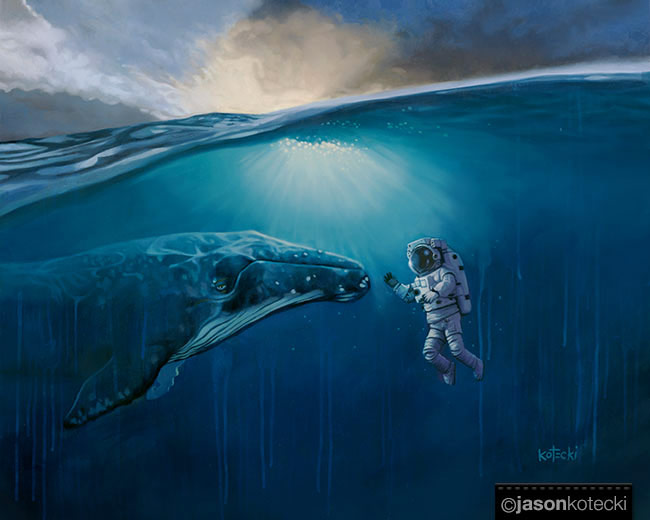
The astronaut in this painting represents a dreamer.
This dreamer has always possessed a spirit of adventure and imagined a life spent exploring the unknown, pushing past the boundaries of human understanding, and experiencing the supernatural enchantment. The dreamer expected this would happen as an astronaut in the context of space.
Instead, the dreamer’s story ended up in the ocean after a visit to Sea World, and now days are spent adventurously exploring the unknown and experiencing enchantment in encounters with sea creatures.
So…did this dreamer’s dream go unfulfilled?
My friend Jessica has some good advice about how we should handle our expectations: “When you write that first story, print it as a draft, triple-spaced with extra wide margins. You do this because you’re anticipating edits.”
Letting go of expectations is not about being pessimistic. One can be optimistic without becoming a slave to expectations. My optimism is grounded in the fact that God has ALL the data, loves me more than I deserve, and tells the best stories. We can make plans and hope for things to go a certain way, while still holding loosely to them, trusting that God may have different (and better!) ones.
If you want more peace in your life, don’t abandon hope.
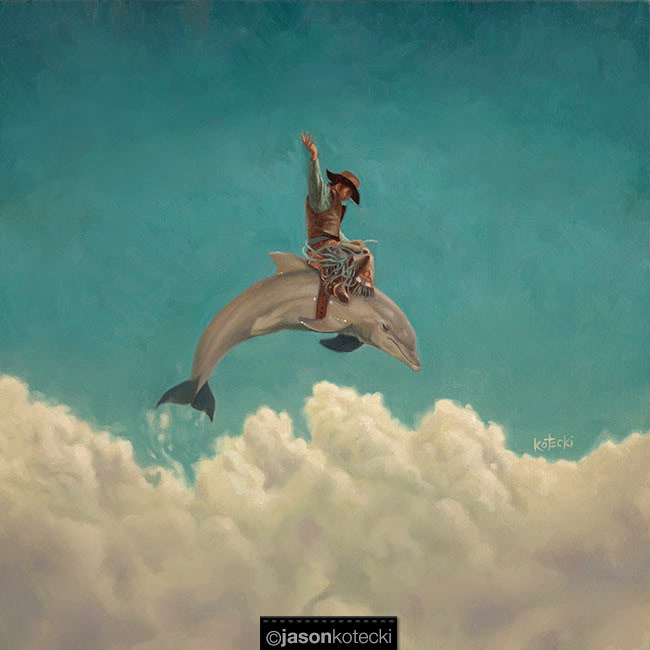
“Rodeo Dolphin” by Jason Kotecki. 20 x 20. Oil on canvas. Original is available. 🔴 Shop this art!
This painting is a little bit crazy.
Some people will be quick to point out that cowboys don’t ride dolphins. They’ll scoff that dolphins don’t belong in the sky. They’ll demand an explanation about the meaning of it all.
Those were the same kind of people who scoffed at the Wright Brothers for having the audacity of thinking they could build a flying machine. Humans can’t fly, they said. They don’t belong in the sky, they scoffed. They demanded an explanation for why these two, with no college education, no formal technical training, no experience working with anyone other than themselves, no friends in high places, no financial backers, no government subsidies, and little money of their own, would ever think they could achieve such an absurdity?
To be fair, for more than fifty years, many others before them served as a source of comic relief, mocked and ridiculed in the press for their delusions of grandeur and “childish” flying machines.
Somehow, and to our benefit, this did not deter Wilbur and Orville Wright.
History is filled with people criticized for being crazy.
But, as it’s been said, monuments are not built for critics and statues are not dedicated to fault-finders.
Very often, our dreams appear absurd, especially to others. And especially the big ones.
A horseless carriage?
A self-powered flying machine?
A pocket-sized device you can use to communicate with anyone in the world?
What will they think of next? A flying car? A colony on Mars? A cure for cancer?
This reminder is not reserved for the select few who change world history and have statues erected in their honor. I make a living doing what I love from my studio on the shores of Lake Michigan. Trust me, in the early days of our business, when Kim and I were living on a diet largely dependent on Hamburger Helper and couldn’t afford to run our air conditioning during the hot summer, every bit of my current life seemed far-fetched, to say the least.
Of course, you can’t count on every dream coming true.
But you can count on somebody calling you crazy for dreaming it.
“The Prepper” by Jason Kotecki. 16 x 16. Oil on canvas. Original is SOLD 🔴 Shop this art!
When my wife told me she was pregnant with our first child, my heart filled with joy.
Two seconds later, panic arrived at the party.
All I could think about was how profoundly our lives were about to change and I didn’t have the slightest idea of how to prepare. I immediately began searching Amazon for the latest owner’s manual for babies.
Kim, on the other hand, seemed to calmly slide into the nesting phase that’s common to many moms in the animal kingdom. In preparation for a new life, they instinctually work to create conditions for that new life to thrive.
In the years since I’ve seen Kim navigate this phase for all three of our kids, and I’ve realized there are parallels between mothers and artists. While not all of us get to experience motherhood, I believe that every last one of us is an artist.
Yes, even if you can only draw stick figures.
In essence, an artist is simply someone who brings something new and beautiful into the world with the potential to improve it in some way. It’s a one-of-a-kind gift that could not be created by anyone else.
You could have been born at any time in any place, but you were born when and where you were born and you are alive now. You were born for a reason! As long as you’re still breathing, you have something within you the world needs.
It might be a novel, a non-profit, a painting, or a play. Perhaps it’s a sculpture, a sonnet, or a song. It could also be that a building, a business, or a movement will be your masterpiece.
We need to take this endeavor as seriously as a mother takes the preparations for her new baby. We need to create conditions that give our undertaking its best chance of success, and that involves three things: supplies, space, and safety.
A serious mother collects the supplies that will be needed to help her succeed: diapers, bottles, creams, clothes, blankets, and toys. A serious artist needs supplies, too. It might be pens, pencils, paper and paint, or yarn, wood, software, or clay.
A serious mother considers where the baby will sleep and play and she creates space for that to happen. Likewise, a serious artist also requires a dedicated space, even if it’s just a small folding table in the corner of their bedroom, or a workbench in the back of the garage.
Finally, a serious mother makes preparations to ensure her youngster is protected and safe to grow and develop. A serious artist also needs a safe space for creativity. New ideas are especially fragile. One must not judge them too harshly at the start, for they need time to blossom into what they are to become.
The nesting stage is fun, exciting, and imbued with the magic of anticipation, as you envision all the memories (or masterpieces) that will be made. It is a good inclination to want everything you need, and make sure it all has a place. After all, when you are in the whirlwind of caring for a newborn (or in the thick of the creative process), it’s helpful to have what you need, when you need it.
But don’t be fooled.
The trap that awaits both mothers and artists is the desire to have all the supplies one could corral, the most ideal space one could hope for, and the highest level of safety and comfort possible.
All parents eventually come to discover that you are never fully prepared for a baby to arrive in your home. There will always be something you’ve forgotten, something you run out of too quickly.
It’s ok. Eventually, you learn to make do, and from these constraints come real growth.
One thing is certain…when it comes to parenting, Mother Nature will not be delayed. The baby is coming, ready or not.
Alas, this is where the comparisons diverge, for the artist has no such advantage. As such, he or she may be lured into a trap that tricks them into a never-ending nesting phase of collecting all the colors and tools and tricks of the trade.
It’s an illusion. Under the guise of being serious, the artist is now simply hiding. One must never be fooled into waiting for conditions to be perfect, because they never will be.
If an artist is not careful, nine months of preparation can slip into nine years of procrastination, justified by not enough time, not enough space, not enough money to begin. Before you know it, nine decades of life are spent and the art your soul desired to make, the gift the world so desperately needed from you, never gets to emerge.
Serious artists don’t let preparation turn into procrastination.
We don’t need perfection. But we do need your art.
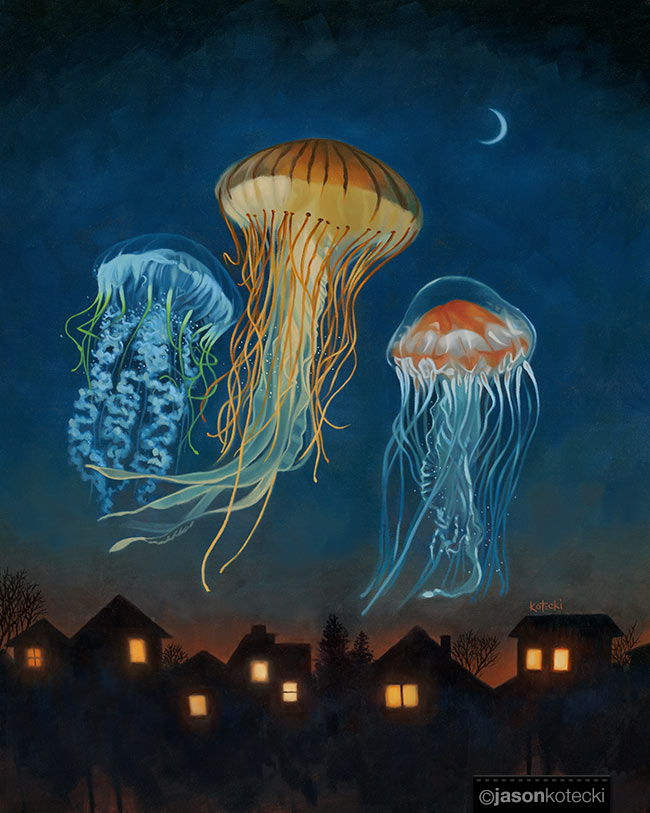
“Evening Show” by Jason Kotecki. 24 x 30. Oil on canvas. Original is SOLD. 🔴 Shop this art!
A clear night sky is a thing of beauty, with millions of stars blinking silently overhead.
It’s a pity we rarely notice them.
In an episode of Curb Your Enthusiasm, Larry David is speaking with a receptionist at a law firm who has a spectacular view of the city behind her. “Beautiful view here! How long did it take you to take it for granted?”
She replies, “Umm, not long I guess.”
He candidly admits, “It would take me about a day. Maybe less. Maybe half an hour. And I would never look out the window again.”
How quickly we take wonder for granted.
This painting was inspired by a passage I read in the book The Sense of Wonder, by conservationist Rachel Carson, who wrote about a summer her grandnephew visited her cottage in Maine, and together they wandered the surrounding woods and tide pools.
She recounted a particular evening when they gazed in awe at one of those breathtaking night skies:
“It occurred to me that if this were a sight that could be seen only once in a century or even once in a human generation, this little headland would be thronged with spectators. But it can be seen many scores of nights in any year, and so the lights burned in the cottages, and the inhabitants probably gave not a thought to the beauty overhead; and because they could see it almost any night perhaps they will never see it.”
Because they could see it almost any night, perhaps they will never see it.
This painting takes its inspiration from those lights burning in the cottages, with the inhabitants giving not a thought of the beauty overhead.
What if a party of giant glowing jellyfish appeared above your town and put on a light show? Surely that would get your attention.
But what if it happened every year? Every week? Every night? How long would it take before everyone stopped caring?
Not as long as you’d think.
Apollo 11 landed on the moon. It was a huge source of national pride. Half a billion people were glued to their television sets watching the historic achievement.
Nine months later—nine months!—flights to the moon had already become boring. By the time Apollo 13 came around, the television networks didn’t even bother covering the launch or broadcasting the live video of the crew from space because they felt there wasn’t enough interest. Nobody wanted their soap operas or game shows interrupted by another group of heroes doing what most people had never done before. Only until Apollo 13 got into trouble did anyone care.
We grow numb to wonder.
Look around you. What are you taking for granted? What are you missing?
Be honest: When was the last time you gazed at the stars?
Stood in awe at a sunrise bursting forth with color on the horizon?
Sat in silence amidst the peace of a placid snowfall?
I don’t know about you, but I am disgusted by this propensity to grow numb to wonder.
But can we do anything about it?
Fortunately, Rachel Carson shows us a way:
“One way to open your eyes to unnoticed beauty is to ask yourself, ‘What if I had never seen this before? What if I knew I would never see it again?”
One painting and two powerful questions remind us to keep our eyes peeled for the wonder all around us.
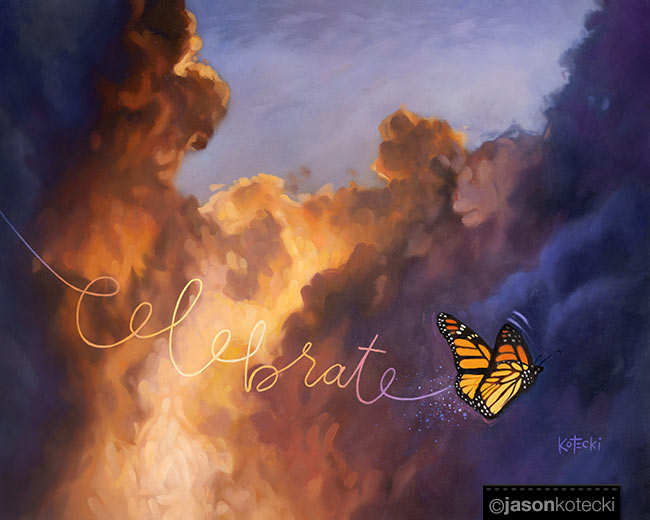
“Celebrate Life” by Jason Kotecki. 24 x 30. Oil on canvas. Original is SOLD 🔴 Shop this art!
My daughter has raised monarch butterflies for the past few years. They undertake a migratory journey from southern Canada to Mexico (up to 3,000 miles!), making them beacons of strength, hope, and resilience as well as symbols of change and transformation.
Take a good, hard look at any caterpillar. If we’re honest, they’re kind of ugly. There’s nothing about a caterpillar to convince an unbeliever that it would ever be able to fly, let alone transform into something so stunningly beautiful.
Is it an ugly worm that crawls on the ground or a majestic creature that flies on the wind?
Both.
Storms are a part of life. Sometimes they come in the form of a diagnosis we don’t want to hear. Sometimes they come in the form of a global pandemic. They are out of our control. The only thing we can control is how we react to them.
The truth is, there is more to any situation than meets the eye.
Life is neither perfect nor pretty. But if you look close enough, you will find blessings in disguise and reasons to celebrate.
“Stonehenge” by Jason Kotecki. 30 x 24. Oil on canvas. Original is SOLD 🔴 Shop this art!
I remember the painting critiques back in art school. After spending several weeks working on our masterpieces, we’d all sit in a circle and explain what our paintings were about. Someone would inevitably say their piece was a postmodern reaction to the psychological impact of the industrial revolution that caused existential dread. To me, it looked like a canvas with some paint sloppily applied. It did seem like the students who were better at making “serious” art got better grades. (Or perhaps they were just better at explaining why their art was serious.)
Perhaps this is why, after making this painting of Stonehenge, constructed with ice cream sandwiches, I feel obliged to explain why.
There are many theories about what Stonehenge is, who built it, when it was built, and what purpose it served. Many theories, but nobody knows for sure.
Of course, someone put them there. Someone had a reason for it.
Most theories assume it served some sort of “serious” purpose concerning astrological events or burial rituals. But maybe it was simply a good challenge that helped pass the time because nobody had invented cable yet. Maybe it was a primitive tourist attraction. Maybe it was just for fun.
People flock to Stonehenge not because they know what purpose it served, but because of the mystery. And mystery is fun. Plus, it looks cool. Which is also fun.
Whimsy and fun are often seen as extra, nonessential. But fun is its own reason for being.
Imagine having the opportunity to jump into a pool of noodles. No child would ever wait until they could answer the question, “But what purpose does this serve?”
People with Adultitis need data and statistics before they justify why having fun is important. They can be found, but if you ask me, most of them are common sense.
Employees who are having fun are happier and do better work.
Customers who are having fun spend more money.
Leaders who are having fun attract more followers.
These are theories that explain why we should take having fun seriously. Why not have fun simply because… it’s fun?
We are constantly in the pursuit of happiness. I don’t know about you, but I’ve never seen someone having fun who is unhappy. Do we really need data to prove that a life filled with fun is better than one that isn’t?
Why did those ancient people build Stonehenge? I don’t know.
Why did I paint Stonehenge made out of ice cream sandwiches? Because I thought it would be fun.
“Teenage Mutant Ninja Sea Turtle” by Jason Kotecki. 40 x 40. Oil on canvas. Original is SOLD 🔴 Shop this art!
If the movies taught me anything, it’s that superheroes wear spandex.
We’ve been led to believe that superheroes are special. They come from another planet. They are blessed with superhuman abilities. They are super smart, or rich, or got involved in some sort of dangerous science experiment that turned out ok. They typically wear cool outfits while traveling in cool vehicles and wielding cool accessories.
Also, their muscles have muscles.
This painting is an homage to the Teenage Mutant Ninja Turtles, who, when they first emerged from the sewer in 1984, clearly challenged the notion of what heroes are supposed to look like.
The truth is, real heroes hardly ever look like they do in the movies.
Oftentimes, they look a lot like you.
The turtle in this painting has emerged from its comfortable ocean surroundings and is wearing a mask that symbolizes two important concepts.
The first is that it’s not all about us.
Superheroes often hide their identity, giving them a sense of anonymity. Real heroes don’t do it for the glory, and they don’t demand credit. They serve a cause greater than themselves, and their chief motivation is doing the right thing and helping others. The mask can serve as a physical reminder that it’s not about us.
Secondly, the mask gives us permission to act “as if.”
Part of the reason children and adults alike enjoy wearing Halloween costumes is that it gives us permission to be someone different. The mask can be an opportunity to wander outside our comfort zone and try on a new way of acting, to be someone better than perhaps we believe we are. I like the advice from Joe Rogan, who suggested that if you’re unsure about what action to take in a particular situation, ask what the hero in the movie would do. In the beginning, it might feel a lot like acting, but that way of acting might just stick, and before you know it, you’ll end up doing something that once seemed superheroic.
Ultimately, being a hero is not about how you look, what you wear, or where you come from.
This painting challenges the notion of what superheroes look like and reminds us that in order to become one, we might need to leave our comfort zone in order to take action.
It might be serving a cause greater than ourselves, standing up for what’s right, regardless of how unpopular it makes us.
It might be standing up to the bully at work (or the one in our head).
It’s often as simple as staying under the radar and just helping someone who needs help, whether it’s a child, an elderly neighbor, or a random guy struggling to load something into his car.
We are all called to be heroes.
This calling may require sacrifice, a bit of discomfort, and a new way of acting, but it doesn’t require spandex.
“Insert Coin” by Jason Kotecki. 30 x 24. Oil on canvas. Original is available. 🟢 Shop this art!
My Grandpa and uncle used to own a tavern. Once in a while, they’d close it to host family parties. I remember the dimly lit atmosphere and the ghosts of spent cigarettes that hung in the air, but my favorite feature was the row of arcade games lined up against the wall. They were blinking, bright doorways to amazing worlds and grand adventures.
I don’t remember ever being given any money from my parents to play them. But no matter. Each game had a preview segment, showing a minute or so of the gameplay to entice you to feed it some coins. I just delighted in going from machine to machine, maneuvering the joystick and mashing buttons while pretending I was the one controlling the game.
Eventually, the novelty wore off, as the preview always ended the same way. I could pretend for hours, living in a fantasy world, which was fun for a while. But if I wanted to experience the game for real, I had to insert some coins.
Sometimes we live “preview” lives in our own heads. Imagining what it would be like if we made the decision to ask her out. Or put the house up for sale and embark on that quest. Or ask for that raise. Or quit that godforsaken job once and for all. Sometimes those visions in our heads have amazing endings, others have disastrous results, but either way, it’s all fake.
No matter how certain you are of the likely result (good or bad), you don’t know what will really happen until you actually go for it. Knowing for sure? That costs something.
You have to be willing to insert the coin.
It might be a financial investment, of course, but that’s not usually what holds us back. Not really. More often, it’s the fear of the unknown, of not measuring up, or the risk of failure (and the embarrassment that might come from it). Sometimes we shy away from the pain and discomfort it will require. We’re just not willing to put in the work or serve the time to get where we want to be.
A few years after my grandfather closed the tavern for good, I had a friend who was great at video games. My brothers and I would sit and watch him play Super Mario Bros., delighted to see how far he’d get, fingers crossed over whether he’d be able to defeat Bowser and win the game. It too was fun, for a while. But the joy was always fleeting because his success was not ours. It was always more fulfilling to solve a level on my own, even if I never did make it as far in the game as he did.
This painting is inspired by that original Nintendo classic. I’m intrigued by the idea of coming across one of the game’s iconic green pipes in the middle of a wide-open field. What’s it doing there? Where does it lead? And most importantly, would I have the courage to find out?
Life is a lot like a video game. It’s filled with challenges, obstacles, and opportunities to level up. But unlike most video games in which you have a few “lives” to get it right, real life only gives you one.
What a pity to waste it watching someone else’s game or settling for an imaginary version of your own.
What a shame to let fear keep you from fully owning your story and who you are meant to become.