
Keyword: spring

  • Doing Nothing

    “Doing Nothing” by Jason Kotecki. 20 x 20. Oil on canvas.
    Original is available. 🔴 Shop this art!

    Doing nothing isn’t really doing nothing.

    New parents (and parents-to-be) get lots of advice. Among the wellspring of wisdom are tips on getting your kids to eat or sleep, and keeping them alive while maintaining your sanity. 

    Perhaps the truest and most common exhortation is: Cherish every moment; it all goes so fast.

    We don’t need anyone to tell us this, of course. It’s so obvious that we discard it out of hand with a smile, a nod, and a quip like, “I know; the days are long, but the years are short, amiright?”

    The problem is that the entire world seems to conspire against us. 

    It doesn’t want us cherishing anything. That would require us to slow down for a hot minute. Cherishing, pondering, reflecting…these don’t feel very productive. In fact, they feel a lot like doing nothing.

    I remember when my oldest daughter was a newborn. One afternoon, after completing the important work-related items on my to-do list, I relieved Kim by assuming caregiving duties. Lucy and I nestled into the rocking chair, where she promptly downed several ounces and drifted off to sleep. I sat for a few moments, soaking in the silence before the siren song of productivity resurfaced. Now that she had fallen asleep so quickly, I could tackle my email! As I was about to set her on the couch and grab my laptop, it hit me:

    Oh my gosh. I’m doing it. I’m missing out on the best stuff.

    Sometimes, a sleeping baby is a gift God gives us to help us manage other responsibilities. But I’d already accomplished my important tasks for the day. In that moment, I received a gift: the realization that there will always be e-mail to check, but my opportunities to hold that little sleeping angel were numbered. I became acutely aware that years from now, when I’m walking Lucy down the aisle on her wedding day, I will not remember any of the “productive” things I did that day. But the memory of her button nose, bald head, and peaceful slumber will remain with me forever.

    On that rapidly approaching day, I don’t want to find myself wishing I’d spent more time doing “nothing.”

    We live in a culture that worships at the altar of productivity. Adultitis is a sinister foe after all of us. It has tricked us into believing that we should always be busy, always “doing” something. If it’s not shared on social media, it didn’t happen. If it can’t be measured, it doesn’t matter. 

    A book called How Will You Measure Your Life? by Clayton Christensen sheds light on this. He points out that it is our nature to unconsciously choose the things that give us an immediate, tangible accomplishment over something for which we aren’t likely to see a return for decades. 

    We can cut the grass, close a sale, finish a week’s worth of lesson plans, deliver a presentation, publish a paper, or redesign our website in less time than it takes to raise great kids or build an awesome marriage.

    So we default to efforts that provide an immediate payoff and a satisfying feeling of accomplishment.

    In chasing this dopamine hit of achievement — even one that isn’t all that consequential — we confuse the urgent with the important. We unwittingly turn irrelevant tasks into priorities simply because they can be checked off some list. And checking off five things is better than one, even if the undone item was the most important. 

    Like a junkie craving another high, we feel anxious spending too much time doing nothing.

    But doing nothing isn’t really doing nothing. Sure, holding my sleeping baby and soaking in a quiet moment didn’t decrease the messages in my inbox. But it certainly wasn’t “nothing.” Quite the contrary. 

    Taking the time to do nothing once in a while – especially with the people we love – might be the single most important thing we do all day.

    When you carve out time to be with someone you care about, “What are we going to do?” becomes a question that demands an answer. The longer it goes without one, the higher the anxiety levels rise.

    Unfortunately, without a specific activity on which to focus our attention, we turn to those little dopamine-delivering slot machines always by our side. Time and again, I see friends or couples together, at the beach, on the train, out to dinner, and their attention is on their phones. 

    Their bodies are near each other, but their hearts and minds are miles apart.

    Together, but not really.

    All because we can’t escape the lure to do…something.

    Let’s refuse to let the almighty algorithm dictate how we spend our time. What if the answer to “What are we going to do?” was simply, “Nothing. Doesn’t matter. Let’s just be together.” There doesn’t need to be a mission accomplished, a box to be checked, or an objective to be measured.

    This painting is inspired by a favorite quote from Winnie the Pooh, who said, “People say nothing is impossible, but I do nothing every day.” 

    Doing nothing, it seems, takes more effort than doing something.

    When Lucy was a baby, and I was savoring a quiet moment alone with her doing nothing, the pull of productivity tried to poison it. Even if I left my laptop closed, I wondered if I should be engaging her more, teaching her more, or coming up with something more “Instagram worthy” to do with her. Was I a bad dad for not wanting to do more than just sit with her? 

    But the doing nothing was actually…nice.

    And it filled me with peace that is oh so hard to come by these days.

    Having a little honey, wishing on a dandelion, and enjoying a fine day together might feel a lot like nothing.
    Sometimes doing nothing is the very best something you can do.
  • Spring Break

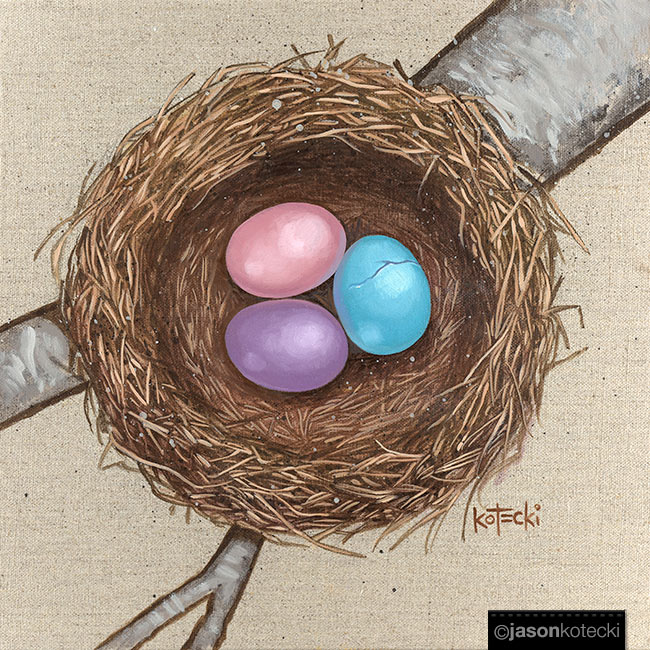
    “Spring Break” by Jason Kotecki. 12 x 12. Oil on canvas.
    Original is SOLD 🔴 Shop this art!

    “All the King’s horses and all the King’s men couldn’t put Humpty Dumpty back together again.”

    iPhone screens. Windows. Windshields. Bones. Baseball bats. Helmets. Even Humpty Dumpty.

    When something is cracked, we often think of it as ruined, useless, irredeemably broken.

    But when a bird’s egg cracks while in the confines of its nest, it is a sign of new life, a fresh beginning. Only moments before the first crack, the egg is pure, smooth, unbroken. Then the crack happens, disrupting the calm surface of the egg. 

    But what emerges next is something new and beautiful.

    Our business had its best year ever in 2019. Speaking in person, on live stages, was the biggest driver of revenue. Who would have predicted that such a business model could vanish so quickly? But of course, it did, thanks to the arrival of a tiny, unwelcome virus.

    Almost overnight, as speaking engagements went up in smoke, our business model cracked. Our future looked bleak. But we clung more fervently to our faith and were bolstered by the support of past clients and the merry band of Adultitis Fighters who had assembled behind us over the previous twenty years.

    We pivoted to a virtual world, developed a super secret membership community, and developed new skills that ushered in new opportunities. Not only did we survive, but we thrived, and ended up buying our dream home on the edge of Lake Michigan amidst the turmoil.

    It was an imaginable outcome twelve months earlier, but made possible thanks to an unwelcome disruption.

    A year and a half after we moved in, we countered another bad “break.” A 112-mph straight-line wind tore through our neighborhood and decimated our backyard, leaving a mess of uprooted trees and an enormous pile of debt in its wake.

    It was rough. We were safe, and it could have been worse, but we were broken. Fast forward another year and a half, and I am only now fully realizing the full scope of blessings that came forth from that challenging chapter.

    Sometimes our life cracks.

    Plans go south. Failures mount. Tragedy strikes.

    We lose the game, our health, or someone we love.

    We feel irredeemably broken.

    But that doesn’t have to be the end of the story. In fact, it might just be the start of a new and better one.

    This painting is a reminder of that first Easter morning, when something that undoubtedly felt like the end of the line miraculously turned into a glorious new beginning.

    Maybe something in your life has cracked recently.

    Is it broken, or the start of a new opportunity?

  • Weeds or Wishes

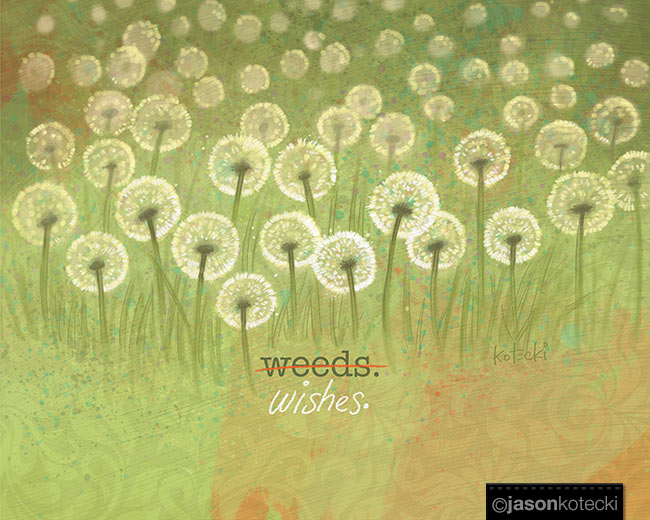
    “Weeds or Wishes” by Jason Kotecki. Digital art.
    Shop this art!

    “Dagnabbit! An army of weeds has taken over the yard. Better call the weed guy.”

    That’s how most people assess a backyard overrun with dandelions. But not children.

    They see a thousand wishes. Thousands of flowers to give to mom.

    It’s true: a backyard flush with dandelions can inspire an hour of exciting adventure for a five-year-old. The same backyard can also inspire an hour of expletive-laden adjectives for a fifty-year-old.

    It’s the exact same scene. But an entirely different perspective.

    A person came up to me after one of my presentations, and under her breath, sheepishly admitted, “I’m sorry, but they’re still weeds to me.”

    I thought that was interesting, especially because I never actually said they weren’t. Dandelions are, at least horticulturally speaking, weeds. But they are also, according to most four-year-olds, wishes. (And flowers for Mom.)

    The thing is, challenges are like weeds. Once a challenge has sprung up in your life, pretending that it doesn’t exist doesn’t make it true.

    A field of dandelions may very well represent a million weeds, but it can also represent a million wishes. It’s both. The power comes in deciding which viewpoint you choose to adopt.

    They are weeds. They are also wishes. The cool thing? You get to choose which one you spend more time focused on. And your choice can change everything. It’s the most important factor that determines the likelihood of your happiness and success.

    For example, let’s say you lose your job. Waking up tomorrow and going back to your previous place of employment is not going to change that fact (but may merit you a restraining order). Likewise, while grieving is normal and healthy, spending every day from here on out wishing you still had that job, being angry about being let go from that job, and telling yourself over and over again that no job could ever measure up to that one is only ensuring one thing: that you’ll never find the next (potentially better!) job.

    Challenges are real. They’re hard, uncomfortable, and often very much unwanted. If we spend our time and energy complaining about a challenge, we miss out on the fact that it’s also an opportunity. 

    So. What frustrating, terrible, no-good thing has sprung up in your life recently?

    Let’s not pretend that it’s not frustrating, terrible, or (seemingly) no good.

    But let’s remember that it could also be an opportunity – a chance – for something awesome.

    Believe it or not, most of the things we don’t like about life are changeable. The tricky part is that in order to get the result we desire, the first thing that needs to change is…us.

    Is it really that simple? Actually, yes.

    A change in perspective can change everything.