Keyword: sunset

  • Big & Grand

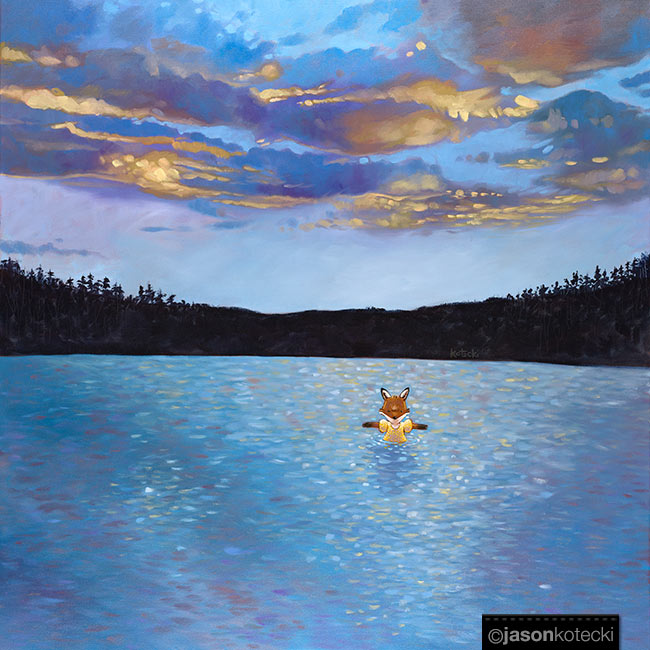
    “Big & Grand” by Jason & Ginny Kotecki. 24 x 24. Oil on canvas.
    Original is SOLD 🔴 Shop this art!

    Everything that exists first started as an idea. A vision. A dream.

    The question is, How many people have to see it before it becomes reality?

    On a family trip west, we spent time in the foothills of the Grand Tetons hoping to see moose. We didn’t have any luck, but while we were waiting, I snapped a photo of my youngest daughter sitting at the edge of the pond, tossing pebbles into the water. I thought it might be the start of a great painting. The only question in my mind was, “What might she be looking at?”

    I imagined painting a moose into the scene, maybe a huge one. I thought Bigfoot would be funny, or perhaps a montage of all sorts of fictional creatures: leprechauns, fairies, unicorns, oh my!

    Eventually, the solution became obvious: it needed to be Big.

    You see, “Big” is a character Ginny created when she was younger, and he’s made appearances in many of her artworks over the years. He needed to be what she was looking at, and that’s how this painting became my first official collaboration.

    Ginny drew and painted Big, and I handled the rest of the painting, including his reflection in the pond. It was a blast, and my heart just about exploded when she signed her name in the corner. (Rose is her middle name.)

    I love the origin story of Big. According to Ginny, he is a lovable giant who lives in the clouds and comes down occasionally to give people hugs.

    One thing we can all agree on is that the world could definitely use more hugs.

    I wish that Big were real.

    Part of me wonders if he is.

    How many people have to see it before it becomes reality?

    You have to imagine something before it can become a physical reality, whether it’s the main character of a book or a life-saving cancer drug. Our dreams are often born from a problem that needs to be solved, like a personal need or a nagging challenge you regularly encounter. Maybe it’s a larger one the world around you is groaning for.

    I believe your dreams are planted within you by God. And He wouldn’t have planted them within you if you weren’t the right person to help bring them to fruition.

    These dreams start as a faint vision or a passing thought, before slowly coming into focus, eventually becoming clear in your mind’s eye.

    There comes a point when you need some affirmation that you’re not hallucinating, that there really is something to this vision that has stirred up a fiery passion within you. Then comes the big and scary moment: You summon up courage and float the idea past a few others, just to check if they can see it too. 

    Usually, the reactions are mixed.

    Many won’t see the vision at all. They may even try to argue you out of it, saying it’s not realistic or practical.

    Some will nod and smile, offering words of encouragement, but it feels more like a grandparent whose grandchild just told them about their imaginary friend: “What an active imagination you have!”

    But if the dream has merit, you will encounter some true believers. These folks must be taken seriously because you will need them later.

    When I had the vision to take an unconventional path, to make a living with my art while making the world a little better by making its people a little more childlike, I experienced all of these reactions.

    I encountered many who never saw the vision of what we were trying to build, even though I described it as accurately as I could. They included newspaper syndicates, retailers, publishers, licensing agents, and more.

    I also felt the “pat, pat” on my head from those who viewed me as slightly delusional, but relatively harmless and easily redirected once reality hit.

    But I was also graced with a few true believers who saw the vision. Some notable ones included my parents, Kim’s parents, and our best friends, Sue and Jenna. Theirs were not just empty words of encouragement. They responded with action by sacrificing their time, money, and prayers. This signaled the proof of their belief.

    The certainty from true believers is invaluable. There will come a time when you lose faith in the vision, and you will need them to remind you that it’s real.

    Mounting failures and things taking longer than you expected take a toll. That vision, which once seemed so clear, begins to fade. You wonder if all the naysayers were right. After all, so many of them had way more experience than you, and the evidence seems to be piling up in their favor. Maybe I am delusional? Maybe I was mistaken? Maybe the signals got crossed, and I accidentally co-opted a dream that was not meant for me…

    I entertained all these thoughts at various times. It was tempting to give up.

    But then I remembered my parents. And Kim’s parents. And Sue and Jenna. I remembered that nobody pours money or time into a lost cause. Their sacrifice was tangible proof of their belief in us. It helped assure me that no, this is not a mirage. It’s real. They see it.

    Their belief bolstered my own.

    It’s easy to feel discouraged and lose hope when people don’t see what you see. Or when it’s taking too long. It might even show up in a time and place you weren’t expecting. The dream might feel long in coming, but it won’t be late. 

    Disregard the people standing in your way.

    Don’t worry about the ones who say, “I just don’t see it.”

    That’s ok. Not everyone will catch your vision.

    That doesn’t mean it’s not real.
    Your idea might just be the hug our world’s been waiting for.
  • The Armada

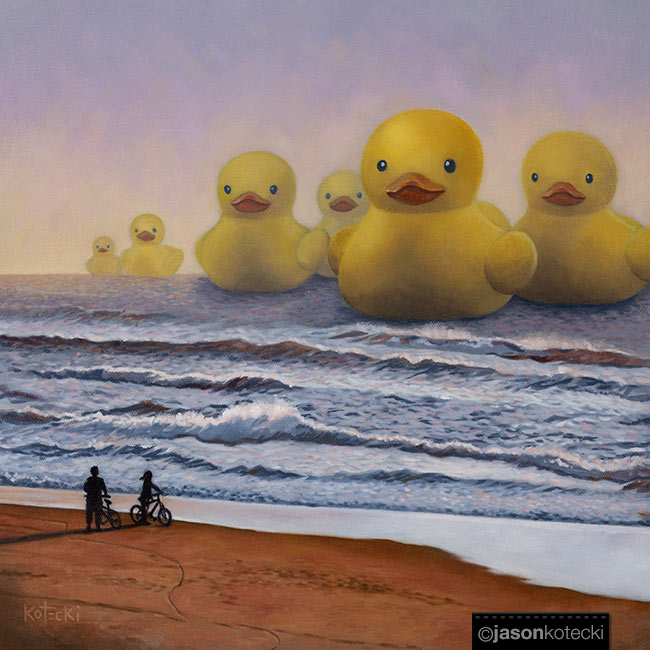
    “The Armada” by Jason Kotecki. 16 x 16. Oil on canvas.
    Original is SOLD 🔴 Shop this art!

    Quick! You’re on the beach with a friend and you spot something approaching on the horizon. To your amazement, you make out an armada of giant rubber ducks coming to shore. What is your reaction?

    Are you excited? Overjoyed? Concerned? Skeptical? Worried? Afraid?

    Are they visitors or invaders?

    Do they bring good tidings or dark intentions?

    Sometimes a painting can just be a fun picture that makes you smile. And sometimes it contains a deeper meaning. I asked people on social media to share their perceptions of this painting, and it may or may not surprise you that their responses varied greatly:

    • “Pure joy. I have a jacket printed with rubber ducks. They always make me smile, as does the ocean, and riding my bike!”
    • “Here comes whimsy!”
    • “Hope is on the horizon.”
    • “I’m a little worried.”
    • “Terrified.”
    • “Invasion from a Trojan Horse.”
    • “Plastic pollution and impending doom from climate change.”

    It turns out that the meaning of this painting, as well as the meaning of almost everything in life, is largely determined by you. 

    Our perceptions impact our actions. For example, whether you’d run for cover or organize a welcoming party would depend on whether you see these rubber ducks as friends or foes. One side sees the other as hopelessly naive. The other side sees the other as paranoid. Both sides have a point.

    If we respond too enthusiastically, we might fall into a trap.

    If we respond with animosity, we may sabotage any chance of something good happening.

    We can assume the best, assume the worst, or…perhaps the best, wisest, most productive thing we can do is keep an open mind and wait and see.

    Now, let’s put the shoe on the other flipper. Imagine if you’re one of those ducks. You’re fun. Lots of people like you. You want to be helpful and bring joy to others. You’re new in town, but you have good intentions. But what are those locals on the shore thinking?

    Do they see you as a visitor or an invader?

    Do they think you bring good tidings or dark intentions?

    We’ve all been the new guy. The new kid in class. The newest employee. Or, most recently for us, the new family in town. I like to think of this painting as a metaphor for our mission to bring wonder and whimsy to distant shores. I unveiled it at the first Wondernite we hosted in Sheboygan, having moved from Madison two years earlier. As relative unknowns, we wondered if anyone would come.

    It turned out to be our biggest and best one yet.

    It’s scary to consider what the natives might think of you. You feel like you stick out like a sore thumb because it seems obvious that everyone can tell you’re not familiar with the local culture, the shorthand, the inside information that everyone else takes for granted. 

    It’s tempting to want to appear big and important. Maybe pretend to be something you’re not. After all, you’ve got a clean slate. None of these new people know all your history and baggage. You never get a second chance to make a first impression, so it’s a chance to put forth something impressive.

    I’ve found it’s easier, more effective, and frankly, less exhausting to just be yourself. People are drawn to authenticity, and we are very good at spotting a fake. Your weird flag may not inspire everyone, but it will attract your people.

    It’s more beneficial to check your expectations.

    If you expect the natives to be hostile, you’re likely to protect yourself by being hesitant and withdrawn, which may make you appear cold and aloof to others. But be warned: if you assume the locals will be hostile and unwelcoming, guess what you’re likely to get.

    You see, there is this thing called confirmation bias. (Perhaps you’ve heard of it.) It’s applicable whether or not you see yourself as the kids on the beach or the newcomers floating to shore. How it works is that we make an initial judgment or tell ourselves a story about a person, group, or situation. Then we reflexively look for evidence that supports our case and confirms our bias. 

    Meanwhile, we subconsciously filter out any information that runs contrary to our story. We interpret new information as being supportive of the opinions we already hold, and it doesn’t matter how poorly it fits. Our dutifully protective brain finds a way without us having much of a say.

    If you think your spouse is ignoring you, you’ll be on the lookout for all the evidence to make your case.

    If you expect to have an awesome day, your antenna will be up and scanning for proof all day long.

    If you think Republicans are the worst, you will notice and remember every example that proves your point.

    If you think Democrats are the enemy, well, you get the point.

    So…what if we paused at the very beginning to realize we don’t yet know the truth and take a wait-and-see approach? Thanks to confirmation bias, if you expect the best in others, the odds are better you’ll find it.

    This might just be a fun, whimsical painting that makes you smile.

    Perhaps something light-hearted to hang in your bathroom.

    It might also be a reminder to always be yourself while giving other people a chance to do the same.

  • Teenage Mutant Ninja Sea Turtle

    “Teenage Mutant Ninja Sea Turtle” by Jason Kotecki. 40 x 40. Oil on canvas.
    Original is SOLD 🔴 Shop this art!

    If the movies taught me anything, it’s that superheroes wear spandex.

    We’ve been led to believe that superheroes are special. They come from another planet. They are blessed with superhuman abilities. They are super smart, or rich, or got involved in some sort of dangerous science experiment that turned out ok. They typically wear cool outfits while traveling in cool vehicles and wielding cool accessories.
     
    Also, their muscles have muscles.

    This painting is an homage to the Teenage Mutant Ninja Turtles, who, when they first emerged from the sewer in 1984, clearly challenged the notion of what heroes are supposed to look like.

    The truth is, real heroes hardly ever look like they do in the movies.

    Oftentimes, they look a lot like you.

    The turtle in this painting has emerged from its comfortable ocean surroundings and is wearing a mask that symbolizes two important concepts.

    The first is that it’s not all about us.

    Superheroes often hide their identity, giving them a sense of anonymity. Real heroes don’t do it for the glory, and they don’t demand credit. They serve a cause greater than themselves, and their chief motivation is doing the right thing and helping others. The mask can serve as a physical reminder that it’s not about us.

    Secondly, the mask gives us permission to act “as if.”

    Part of the reason children and adults alike enjoy wearing Halloween costumes is that it gives us permission to be someone different. The mask can be an opportunity to wander outside our comfort zone and try on a new way of acting, to be someone better than perhaps we believe we are. I like the advice from Joe Rogan, who suggested that if you’re unsure about what action to take in a particular situation, ask what the hero in the movie would do. In the beginning, it might feel a lot like acting,  but that way of acting might just stick, and before you know it, you’ll end up doing something that once seemed superheroic.

    Ultimately, being a hero is not about how you look, what you wear, or where you come from. 

    This painting challenges the notion of what superheroes look like and reminds us that in order to become one, we might need to leave our comfort zone in order to take action.

    It might be serving a cause greater than ourselves, standing up for what’s right, regardless of how unpopular it makes us.

    It might be standing up to the bully at work (or the one in our head).

    It’s often as simple as staying under the radar and just helping someone who needs help, whether it’s a child, an elderly neighbor, or a random guy struggling to load something into his car.

    We are all called to be heroes.

    This calling may require sacrifice, a bit of discomfort, and a new way of acting, but it doesn’t require spandex.

  • How Many Licks?

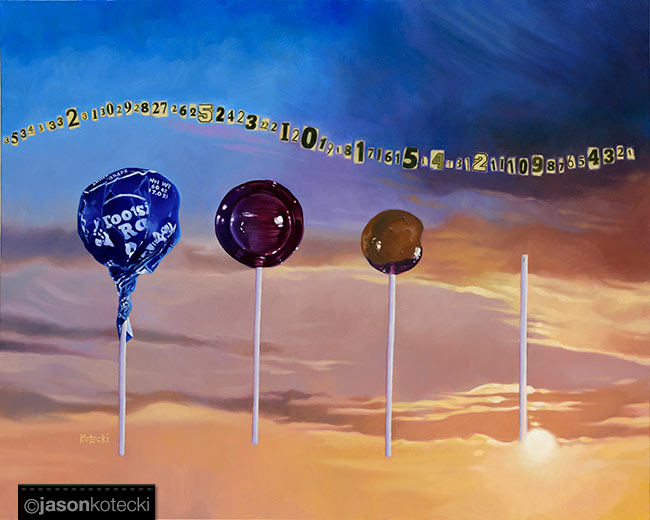
    “How Many Licks?” by Jason Kotecki. 30 x 24. Oil on canvas.
    Original is SOLD 🔴 Shop this art!

    How many licks does it take to get to the Tootsie Roll center of a Tootsie Pop?

    A commercial that appeared on TV when I was a child asked that very question. It turns out that a number of folks have tried to get to the bottom of this.

    A group of engineering students from Purdue University built a licking machine, modeled after a human tongue, and determined that it took an average of 364 licks to get to the center of a Tootsie Pop.

    A chemical engineering student from the University of Michigan built his own licking machine and recorded that it required 411 licks.

    And a group of junior high school students ditched machines in favor of human lickers, and reported an average of 144 licks.

    Apparently, the world really may never know how many licks it takes to get to the Tootsie Roll center of a Tootsie Pop.

    I remember the first time I took my kids to Wrigley Field. It was the year after the Cubs won the World Series, and the kids were excited to see their favorite players in person. It was a beautiful day, the Cubbies won, and we relished singing “Go, Cubs, Go” with 40,000 fellow Cub fans.

    We looked forward to that game for months. As we do for many of the firsts in our lives. Your first baseball game. Your first kiss. The first time you get to drive by yourself. The first place of your own. Your first child.

    We anticipate the first times and do our best to savor them.

    But the last times are different. They have a habit of sneaking up on us. Undoubtedly, there was a last time that I held my youngest daughter in the middle of the night, in a grouchy sleep-deprived state, comforting her – begging her — back to sleep. But I don’t remember it, because I didn’t realize it was the last time when it happened.

    The first times come with a lot of fanfare. But the last times come and go without a whisper.

    How many dinners do you have left with your parents?

    How many anniversaries do you have left with your spouse?

    How many bedtime stories do you have left to read to your kids?

    How many fishing trips do you have left with your grandchildren?

    How many licks?

    There is no machine we can build that will tell us. Not exactly.

    We can guess, we can estimate, we can hope for the best.

    But I bet that number is a lot smaller than we think it is.

    Live accordingly.
  • The Princess Dress

    “The Princess Dress” by Jason Kotecki. 36 x 36. Oil on canvas.
    Original is SOLD 🔴 Shop this art!

    This painting was inspired by my daughter.

    Our family loves going on walks. A half mile from our house, there is a row of lakefront homes. A small sliver of land between two of them serves as a public access point to the lake. A few years ago, an hour before the sun tucked itself in for the night, we pushed our strollers through the skinny green passageway to enjoy the pint-sized plot of beach that was ours.

    It wasn’t long before my oldest began wading in the water, delighted by the sand squishing between her toes. Lucy was wearing last year’s Halloween costume — a sparkly pink and yellow princess dress — because, well…just because. The gentle waves kissed the bottom of her gown. I considered telling her to be careful not to ruin it, but reasoned that a little water never hurt anyone.

    Meanwhile, Ben was outfitted in his Incredible Hulk costume — you know, just because — and for some reason, was lying face-down in the sand. Motionless. He looked like a big green sea turtle who had come in with the tide to build a nest. We’d be finding sand on him days later.

    By the time I turned my attention back to Lucy, she was in lake water up to her armpits, princess dress and all! I stood there, in stunned silence, as the supercomputer in my brain whizzed through its vast database in search of some rule frowning upon the intermingling of lakes and princess dresses. (Old Halloween costume or not, that dress wasn’t cheap, and I didn’t want it ruined.) But the warm smile that beamed widely across her face suggested that perhaps this was yet another rule that doesn’t exist.

    In that moment, with the sun setting behind her, I realized that Lucy was living life as well as it could possibly be lived. Too often, we fall far short of this ideal. Why? 

    Because we’re afraid of getting our princess dress wet.

    And we all have one. Our “princess dress” is the carefully curated version of ourselves that we show off to others. It’s the way we look, speak, and act. It’s our degree and our job title, our home and hairstyle, our cars, clothes, and 401ks, all wrapped into one pretty package and tied with a bow that signifies that we are responsible, sophisticated, and successful.

    In order to keep this princess dress looking good, we must live a life of restraint. No full-out running, no sitting on the ground, no eating messy things, and certainly no swimming in lakes.

    We are given countless opportunities to dive headfirst into the experience of life, but we are too afraid to mess up our hair, our clothes, or our reputation. Because running through puddles, making a mess, or doing something silly for the sheer sake of fun sullies the dress we’ve worked so hard to preserve. And besides, people like “us” don’t do things like “that.”

    While settling for good enough, we miss the insanely great.

    Guess what? After the dip in the lake, Lucy’s princess dress went into the washing machine and came out… good as new.

    Fear does a pretty good job of keeping us from living an amazing life. But it’s a horrible predictor of the future.

    Don’t settle for dipping your toes into this adventure called life. For best results, spend more of your time up to your armpits in awesome. 

    Don’t be afraid to get your princess dress wet.
  • The Captain

    “The Captain” by Jason Kotecki. 20 x 20. Oil on canvas.
    Original is SOLD 🔴 Shop this art!

    I present to you a painting I made of a pirate ship sailing in an ocean of milk amidst floating Cap’n Crunch cereal.

    I thought long and hard about conjuring up some deep meaning on this one. Something that would make you shake your head in amazement and say, “Wow. He is a truly brilliant artist and thinker.”

    But you know what? There isn’t any deep meaning. The truth is, I was thinking about Cap’n Crunch cereal, which I love, and thought about a tiny pirate ship sailing in a bowl of it, which would be neat. But then I thought, what if the ship was normal-sized and the whole ocean was milk and it had giant pieces of Cap’n Crunch floating in it? That would be weirder, and possibly neater. 

    So that’s what I did: gave myself over to pure whimsy.

    As we get older, Adultitis takes over and kills our whimsy. We grow increasingly skilled in the art of taking ourselves too seriously. And all that seems to bring us is anxiety, stress, and a life totally devoid of fun. 

    We’ve mastered the ability to make the trivial monumental. We fret about all sorts of things, from gas prices and elections to how we’re going to kill those weeds in the yard and what we should wear to next Friday’s function.

    Becoming more responsible is one thing. But losing our sense of whimsy and taking ourselves too seriously is another. 

    I have long admired people like Dr. Seuss and Roald Dahl because they created magical characters and worlds that are so rich with whimsy. Their art depicts preposterous, physics-bending, imagination-stirring images and scenarios that exhibit a ridiculousness that is wholly original and entertaining. Meanwhile, within the context of their art, all of it comes across as completely normal. How did they do that? 

    It can be hard for me to give myself over to this pure, unadulterated nonsense, which I consider to be the unfiltered essence of the spirit of childhood. As someone who often errs on the side of practicality and reason, I have always wished I could be more like Dr. Seuss and Roald Dahl. After discovering Adultitis and its evil tricks early in my adult life, I have spent my life trying to get back to that level of creative abandon. Back to normal.

    And yet here I am, having created a painting that exists at least within the same universe as those two greats, frustrated because I cannot come up with words to explain the meaning of this painting. 

    Because there isn’t one. 

    And thankfully, I think to myself, “Well, finally. Some progress.”

    It took a while to become an expert at taking yourself seriously; it will take a while to get back to normal. Give yourself permission to start.

  • Invasion

    “Invasion” by Jason Kotecki. 20 x 20. Oil on canvas.
    Original is SOLD 🔴 Shop this art!

    I love macarons. I only had my first one a few years ago, but it was love at first bite.

    Not only am I always on the lookout for ways to get them in my belly, but I decided it was time to get them into some paintings. They’re so cute and colorful, after all, and perhaps keeping myself busy painting them would help distract me enough to keep me from eating them.

    I like the whimsy that comes from playing with scale, making something smaller or bigger than it would be in real life. Perhaps this reflects my early fascination with dollhouses, dioramas, and Micro Machine cars.

    One day, as I was doodling in my sketchbook, it occurred to me that a macaron looked a little bit like a flying saucer, and that was all she wrote. My imagination concocted a great scene in which an army of macaron UFOs descended upon a field of grazing cows. Naturally, one would have to be taken as a specimen for further experimentation, sucked up by some powerful tractor beam.

    I like the idea that a painting like this begs the viewer to ponder some questions. What kind of planet did these strange, sweet ships come from? What will become of the cow? And where will the farmer imagine it went when he awakes in the morning to find one missing?

    Yes, it’s all nonsense. But that doesn’t make it useless.

    “I like nonsense; it wakes up the brain cells.”

    –Dr. Seuss

    Perhaps these nonsensical questions will wake up our brain cells so they will be firing on all cylinders when it comes to tackling more vexing challenges in our life. Answers tend to be found by people asking the most questions. And sometimes the answer to a problem is hiding in something that looks a lot like nonsense.

    Maybe someday soon, one or more of Earth’s most pressing problems will be solved thanks to a discovery on some faraway planet.

    After all, it wasn’t that long ago that space travel was nothing more than science fiction.