Keyword: toys

  • Reality Check

    “Reality Check” by Jason Kotecki. 20 x 20. Oil on canvas.
    Original is SOLD 🔴 Shop this art!

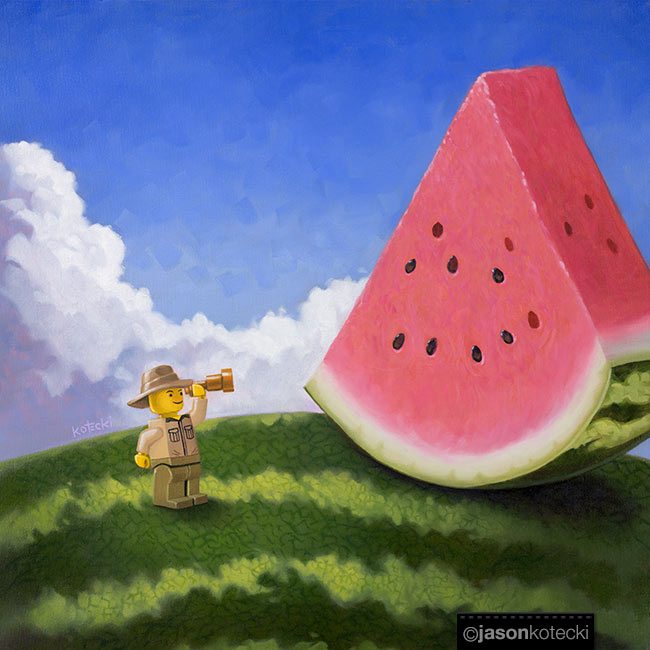
    The Grand Prismatic is one of the things I was most looking forward to seeing on our family trip to Yellowstone National Park. It’s like I had to see it to believe it was real.

    This is not an uncommon sentiment when it comes to this magical place.

    The early explorers who came back with stories from Yellowstone were written off as crazy people. Surely a loose screw, an overindulgence in booze, or insanity caused by being alone for too long was easier to believe than the tall tales that returned. Upside-down waterfalls? Boiling rivers? Bubbling mud? Twenty-foot beasts?

    Please.

    Well, if you’ve never seen a geyser, hydrothermal activity, or an angry grizzly bear reared up on its hind legs, you’d deem these reports as unbelievable, too.

    I have been to Yellowstone, and in the words of Han Solo when speaking to Rey and Finn about the Force, “It’s true. All of it.” (Even the grizzlies, although I didn’t experience an angry one.) The place is filled with the unbelievable.

    But of course, now it is believable. Because we’ve seen the pictures and millions of us have visited, having driven through it on roads that weren’t there 150 years ago. And so the amazement has dimmed.

    Just like it has with all the wonders of this world.

    We are surrounded — besieged! saturated! deluged! — by the unbelievable, but because it’s familiar, we treat it like an afterthought. Every day becomes ho-hum.

    But pretend with me for a moment that you’re from Mars, a barren red wasteland, and you’re hearing about Earth for the first time. What if I told you it was a place where…

    Food grows right out of the ground.

    Water comes from a sky that regularly changes color throughout the day.

    Sometimes that water turns into trillions of tiny crystals that cover the ground and shine like diamonds when the sun hits it just right.

    Small flying insects use flowers to create a delicious, sweet liquid called honey.

    The people living there are created when two microscopic cells meet under just the right conditions.

    The majority of the oxygen those people depend on for survival comes from a vast army of invisible sea creatures.

    The people can fly across a vast ocean in a matter of hours.

    They burn ancient sea creatures to fuel their vehicles.

    They can significantly improve their vision by applying small slips of soft plastic to their eyeballs, and they just throw them away at the end of the day.

    They have small handheld devices that allow them to listen to any song ever recorded, communicate across continents by video, tell them how to get anywhere on Earth, and share cute photos of cats.

    And yes, there really are rainbow pools in this land that once teemed with animals bigger than a house.

    Balderdash! you say?

    Well, I’ve been there and it’s true. All of it.

    Unfortunately, the sad fact is that most of the people who live there take it all for granted. It’s all familiar. Ho-hum.

    Now that’s balderdash. Today, my friend is not just another day.

    Keep your eyes peeled. Don’t miss it.

    The unbelievable is everywhere.
  • The Armada

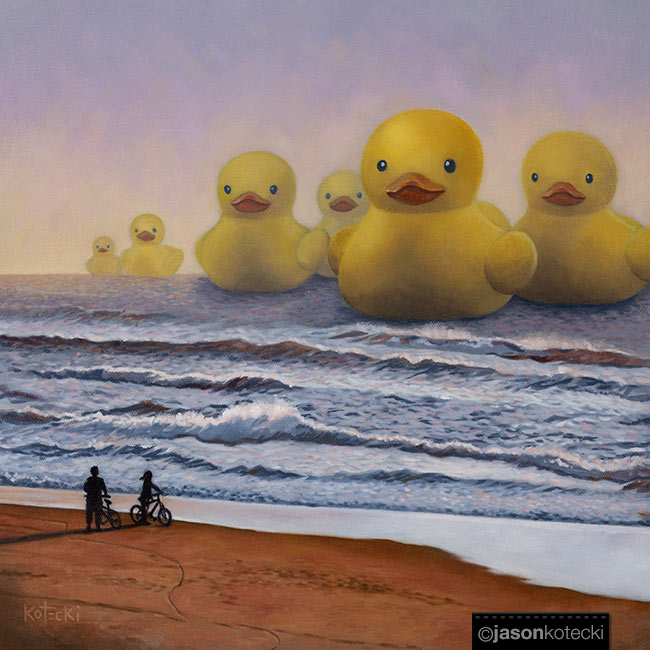
    “The Armada” by Jason Kotecki. 16 x 16. Oil on canvas.
    Original is SOLD 🔴 Shop this art!

    Quick! You’re on the beach with a friend and you spot something approaching on the horizon. To your amazement, you make out an armada of giant rubber ducks coming to shore. What is your reaction?

    Are you excited? Overjoyed? Concerned? Skeptical? Worried? Afraid?

    Are they visitors or invaders?

    Do they bring good tidings or dark intentions?

    Sometimes a painting can just be a fun picture that makes you smile. And sometimes it contains a deeper meaning. I asked people on social media to share their perceptions of this painting, and it may or may not surprise you that their responses varied greatly:

    • “Pure joy. I have a jacket printed with rubber ducks. They always make me smile, as does the ocean, and riding my bike!”
    • “Here comes whimsy!”
    • “Hope is on the horizon.”
    • “I’m a little worried.”
    • “Terrified.”
    • “Invasion from a Trojan Horse.”
    • “Plastic pollution and impending doom from climate change.”

    It turns out that the meaning of this painting, as well as the meaning of almost everything in life, is largely determined by you. 

    Our perceptions impact our actions. For example, whether you’d run for cover or organize a welcoming party would depend on whether you see these rubber ducks as friends or foes. One side sees the other as hopelessly naive. The other side sees the other as paranoid. Both sides have a point.

    If we respond too enthusiastically, we might fall into a trap.

    If we respond with animosity, we may sabotage any chance of something good happening.

    We can assume the best, assume the worst, or…perhaps the best, wisest, most productive thing we can do is keep an open mind and wait and see.

    Now, let’s put the shoe on the other flipper. Imagine if you’re one of those ducks. You’re fun. Lots of people like you. You want to be helpful and bring joy to others. You’re new in town, but you have good intentions. But what are those locals on the shore thinking?

    Do they see you as a visitor or an invader?

    Do they think you bring good tidings or dark intentions?

    We’ve all been the new guy. The new kid in class. The newest employee. Or, most recently for us, the new family in town. I like to think of this painting as a metaphor for our mission to bring wonder and whimsy to distant shores. I unveiled it at the first Wondernite we hosted in Sheboygan, having moved from Madison two years earlier. As relative unknowns, we wondered if anyone would come.

    It turned out to be our biggest and best one yet.

    It’s scary to consider what the natives might think of you. You feel like you stick out like a sore thumb because it seems obvious that everyone can tell you’re not familiar with the local culture, the shorthand, the inside information that everyone else takes for granted. 

    It’s tempting to want to appear big and important. Maybe pretend to be something you’re not. After all, you’ve got a clean slate. None of these new people know all your history and baggage. You never get a second chance to make a first impression, so it’s a chance to put forth something impressive.

    I’ve found it’s easier, more effective, and frankly, less exhausting to just be yourself. People are drawn to authenticity, and we are very good at spotting a fake. Your weird flag may not inspire everyone, but it will attract your people.

    It’s more beneficial to check your expectations.

    If you expect the natives to be hostile, you’re likely to protect yourself by being hesitant and withdrawn, which may make you appear cold and aloof to others. But be warned: if you assume the locals will be hostile and unwelcoming, guess what you’re likely to get.

    You see, there is this thing called confirmation bias. (Perhaps you’ve heard of it.) It’s applicable whether or not you see yourself as the kids on the beach or the newcomers floating to shore. How it works is that we make an initial judgment or tell ourselves a story about a person, group, or situation. Then we reflexively look for evidence that supports our case and confirms our bias. 

    Meanwhile, we subconsciously filter out any information that runs contrary to our story. We interpret new information as being supportive of the opinions we already hold, and it doesn’t matter how poorly it fits. Our dutifully protective brain finds a way without us having much of a say.

    If you think your spouse is ignoring you, you’ll be on the lookout for all the evidence to make your case.

    If you expect to have an awesome day, your antenna will be up and scanning for proof all day long.

    If you think Republicans are the worst, you will notice and remember every example that proves your point.

    If you think Democrats are the enemy, well, you get the point.

    So…what if we paused at the very beginning to realize we don’t yet know the truth and take a wait-and-see approach? Thanks to confirmation bias, if you expect the best in others, the odds are better you’ll find it.

    This might just be a fun, whimsical painting that makes you smile.

    Perhaps something light-hearted to hang in your bathroom.

    It might also be a reminder to always be yourself while giving other people a chance to do the same.

  • How Many Watermelons?

    “How Many Watermelons?” by Jason Kotecki. 20 x 20. Oil on canvas.
    Original is available. 🔴 Shop this art!

    What do motivational posters, charismatic preachers, and embroidered pillows have in common?

    They regularly tell us to count our blessings.

    If we’re in the midst of a good day, we’d probably admit it would take a long time to count all our blessings. Maybe even longer than it would take to count all the seeds in a watermelon. But theoretically, both could be done.

    This painting was inspired by the saying “Anyone can count the number of seeds in a watermelon, but only God can count the number of watermelons in a seed.”

    Today is the second anniversary of the day I needed a chainsaw-wielding neighbor to help me clear trees from my driveway so I could drive to the airport for a speaking engagement. The night before, a storm descended upon our home with a terrible straight-line wind that damaged our home and devastated our property. I had to leave my wife behind in a home with no power to push aside the grief to begin the clean-up and call insurance companies.

    I can assure you, it did not feel like a blessing.

    That storm turned our trees into kindling and destroyed our finances. It wrought great debt and fear, and uncertainty. It brought trauma to our family and nightmares to my kids.

    But it was also a seed.

    A seed that has since produced many blessings…

    • It connected us to some amazing people.
    • It taught us how to receive generosity from others with humility.
    • It provided us with the insurance money to buy a new roof which needed to be replaced.
    • It opened the door to a new space to play ball and badminton and frisbee together.
    • It inspired us to be even more hospitable, ushering in Moonrise Movie Nights and the Wonder & Whimsy Society Family Reunion.
    • It gave us a new view, one that many agree is even more breathtaking than the one we had before.
    • It strengthened our family and bolstered our faith, bringing us even closer to God.

    I suspect that dark forces were pretty happy about the storm, hoping it would destroy us. But I believe God allowed it because even though it brought a great deal of pain, he also knew just how many blessings would spring forth.

    I share this not to minimize the pain any of us has experienced, but to offer a reminder that in life, pain and joy can co-exist.

    Today is also Father’s Day. My experiences have led me to believe that God is a good father. He wants to hold you in his arms and give you a big, all-encompassing hug, especially if you are struggling with some great trauma of your own. I want to let you know that he is bringing forth fruit from the ashes, perhaps some of which you may already be able to perceive.

    I can assure you, the full bounty goes beyond what you can ever imagine.

    I’ve just shared many blessings we’ve identified from the storm we experienced. But the thing is, we’re only two years removed from it. How many more blessings have yet to be revealed?

    • Only God knows how many games of catch I’ll have with my son.
    • Only God knows all the conversations that will be had around our new fire pit.
    • Only God knows how many pies will be baked from the fruit trees we just planted.
    • Only God knows how many photos Kim will take of the wonder that will bloom there.
    • Only God knows how many family dinners will be shared from our deck overlooking the lake.
    • Only God knows how many people will be blessed and healed in some way by their time there.
    • Only God knows what opportunities and relationships will arise from this new space.

    The storm was a seed that produced a multitude of watermelons.

    And those watermelons are filled with seeds that will usher forth even more.

    Only God knows all the things that will be made possible because of a brief moment in time when a hurricane-force wind whooshed through our lives one summer day.

    Only God knows the number of watermelons in a seed.
  • Talent Stack

    “Talent Stack” by Jason Kotecki. 16 x 16. Oil on canvas.
    Original is SOLD 🔴 Shop this art!

    Sometimes people look at successes I’ve had and say, “Must be nice,” as if they happened by magic.

    What they don’t often see is the framework that helped enable that success. Fortunately, it’s a framework anyone can develop.

    We often assume that in order to be successful, we need to be great at one thing. That can work—see LeBron James, for example—but that path is extremely difficult and unlikely. The truth is, you only need to be pretty good at a handful of ordinary skills.

    You just need to build a talent stack.

    Scott Adams, the creator of the comic strip Dilbert, popularized this concept which states that you can ensure success by assembling a “stack” of two or more complementary skills and be in the top 25 percent or so in each. Do that and you’ll be unstoppable. 

    In his case, he readily admits he’s not the best artist, the most skilled writer, or the savviest business expert. But his unique combination of those skill sets has contributed to his success as a cartoonist.

    My own talent stack began with a few crayons. “Artist” was my first and is my longest-lasting identity. I’ve always enjoyed it, and I got praised for it, so I’m sure that made me want to keep doing it.

    In high school, I had a chance to take a creative writing class, which I enjoyed exponentially more than my math classes. I kept honing that skill, which eventually became an indispensable part of my talent stack.

    In college, I gave a talk as a leader on a retreat and received great reviews. Even though I am naturally shy, I enjoyed the process of crafting stories in spoken form. It was like creative writing but delivered out loud. 

    To the surprise of me, my parents, and the high school speech teacher who gave me a “C,” public speaking emerged as the primary driver of our business. I went from giving cartooning workshops in schools to speaking at churches to keynoting conferences for associations and corporations all over the place. 

    Now it took me a few years to realize that these three talents—art, writing, and speaking—were not separate skills that operated independently, but part of a talent stack, that when used in harmony became even more powerful. I am not the best artist in the world, or the best writer or speaker. But I’m pretty good at all three, and that combination has been the secret sauce of my success. Once I was introduced to talent stacking, I eagerly looked for complementary skills to add. By devouring hundreds of marketing books and through the school of trial and error, I’ve achieved the equivalent of an MBA in marketing. Am I the best marketer in the world? No, but I easily fall into the top 25 percent.

    Kim and I went on several organized retreats in college. That background gave us a foundation to build on when we started hosting our own events. After putting on numerous meetups, workshops, book tours, fundraising galas, and Escape Adulthood Summits over the past two decades, we’ve gotten pretty good at managing logistics and creating experiences that move people.

    Most recently, we used the pandemic as an opportunity to get good at livestreaming, which added a whole new dimension to our business.

    Drip by drip, these new skills made the other skills even more valuable and ushered in greater success.

    Of course, your talent stack will look different from mine, but the premise is the same. Start with natural strengths and abilities and work to make them better. Think about how they can work together in unexpected ways, even if they seem unrelated. 

    Everyone in your industry probably competes on many of the same skills. What do you have that’s different? Oftentimes the magic lies in a skill or interest that seems to come out of left field. For instance, many professional speakers are also writers. But my artistic gifts and whimsical, childlike perspective allow me to offer something extraordinary.

    This isn’t just about what you were born with. Look for other skills you can attain that complement and enrich the others. That might involve a traditional degree or certification, but it can also be done by reading books, listening to podcasts, taking courses online or at your local community college, or practicing, in public, every day, as we did with our pandemic project of livestreaming.

    If you’re stuck, here are some evergreen choices that will help:

    • Presentation skills
    • Technology skills
    • Foreign language skills
    • Sales or marketing skills
    • Writing skills
    • Business management skills
    • Nunchuck skills

    Remember, you don’t have to turn yourself into the foremost expert on any of these skills. Just be in the top 25 percent. Said another way, in a world of around eight billion people, you only need to be among the top two billion. If one hundred thousand people live in your city, you just have to be in the top twenty-five thousand. 

    In other words, pretty good is good enough.

    Keep in mind that this is a lifelong project. If you’re doing it right—meaning you stay curious and keep growing—your talent stack will continue to evolve and strengthen throughout your career and life. One last word of warning, however…

    When you have a decent stack of three to five skills going, you can bank on someone, somewhere observing what you’ve been able to accomplish and saying, “Must be nice.”

  • Teenage Mutant Ninja Sea Turtle

    “Teenage Mutant Ninja Sea Turtle” by Jason Kotecki. 40 x 40. Oil on canvas.
    Original is SOLD 🔴 Shop this art!

    If the movies taught me anything, it’s that superheroes wear spandex.

    We’ve been led to believe that superheroes are special. They come from another planet. They are blessed with superhuman abilities. They are super smart, or rich, or got involved in some sort of dangerous science experiment that turned out ok. They typically wear cool outfits while traveling in cool vehicles and wielding cool accessories.
     
    Also, their muscles have muscles.

    This painting is an homage to the Teenage Mutant Ninja Turtles, who, when they first emerged from the sewer in 1984, clearly challenged the notion of what heroes are supposed to look like.

    The truth is, real heroes hardly ever look like they do in the movies.

    Oftentimes, they look a lot like you.

    The turtle in this painting has emerged from its comfortable ocean surroundings and is wearing a mask that symbolizes two important concepts.

    The first is that it’s not all about us.

    Superheroes often hide their identity, giving them a sense of anonymity. Real heroes don’t do it for the glory, and they don’t demand credit. They serve a cause greater than themselves, and their chief motivation is doing the right thing and helping others. The mask can serve as a physical reminder that it’s not about us.

    Secondly, the mask gives us permission to act “as if.”

    Part of the reason children and adults alike enjoy wearing Halloween costumes is that it gives us permission to be someone different. The mask can be an opportunity to wander outside our comfort zone and try on a new way of acting, to be someone better than perhaps we believe we are. I like the advice from Joe Rogan, who suggested that if you’re unsure about what action to take in a particular situation, ask what the hero in the movie would do. In the beginning, it might feel a lot like acting,  but that way of acting might just stick, and before you know it, you’ll end up doing something that once seemed superheroic.

    Ultimately, being a hero is not about how you look, what you wear, or where you come from. 

    This painting challenges the notion of what superheroes look like and reminds us that in order to become one, we might need to leave our comfort zone in order to take action.

    It might be serving a cause greater than ourselves, standing up for what’s right, regardless of how unpopular it makes us.

    It might be standing up to the bully at work (or the one in our head).

    It’s often as simple as staying under the radar and just helping someone who needs help, whether it’s a child, an elderly neighbor, or a random guy struggling to load something into his car.

    We are all called to be heroes.

    This calling may require sacrifice, a bit of discomfort, and a new way of acting, but it doesn’t require spandex.

  • Jump Around

    “Jump Around” by Jason Kotecki. 16 x 20. Oil on canvas.
    Original is SOLD 🔴 Shop this art!

    This painting was inspired by a tradition that Badger fans have at University of Wisconsin football games. Between the third and fourth quarters, the song “Jump Around” is booming through the loudspeakers, and all of the red-clad fans do exactly that.

    It reminded me of those old electronic football games in which tiny plastic athletes buzzed around on a green metal field. Readers of a certain age will know exactly what I’m talking about, and this painting will bring back all sorts of memories.

    For those of you who don’t know what I’m talking about, well, I guess you had to be there.

    With football season now upon us, I am reminded of a cool idea the leader of an insurance agency shared with me at one of my speaking programs. During pigskin season, he allows his employees to wear jeans and the jersey of their favorite college or pro team. (He even buys the jersey as a welcome aboard present!) Then, if their team wins over the weekend, they can wear it again on Monday. He reports that those days are always the most light-hearted and energized.

    Even if you work in an environment where jerseys wouldn’t be appropriate, perhaps everyone could represent their favorite team with a necktie, lapel pin, socks, or coffee mug.

    I think it’s worth figuring something out, because this sounds like a pretty good way to keep a team buzzing to me.

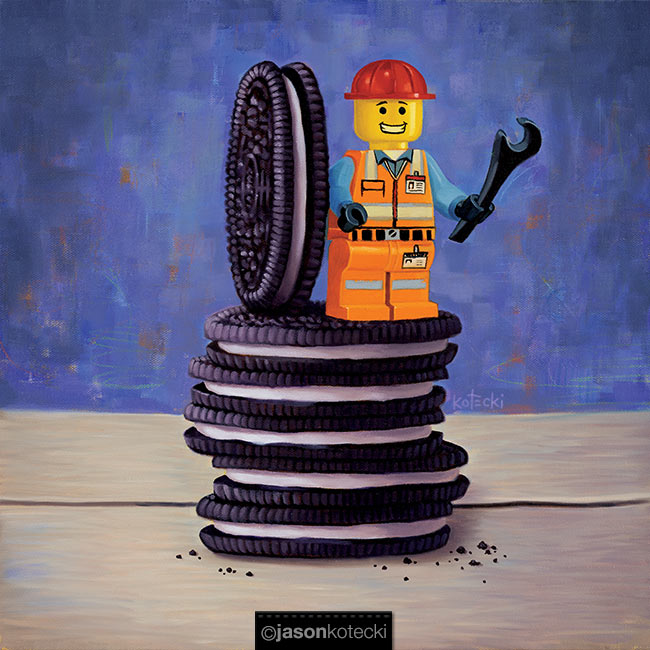
  • Monkey Business

    “Monkey Business” by Jason Kotecki. 16 x 20. Oil on canvas.
    Original is SOLD 🔴 Shop this art!

    “He’s all business.”

    “Let’s get down to business.”

    “It’s not personal, it’s just business.”

    Business is usually regarded as serious stuff. Too bad, because it doesn’t have to be.

    Some people seem to think that when it comes to business, you can’t have fun and be successful at the same time. Which is the dumbest thing ever. Leaders who see the power in bringing fun to the workplace are smart enough to understand that having a little fun in no way diminishes the seriousness in which one takes his or her responsibility.

    The cool thing is that fun can be a competitive advantage. The old saw is true: People like doing business with people they like. If two real estate agents or financial advisors or home child care providors are equally proficient in what they do, but one is way more fun to work with, which one will make more money?

    The truth is, there is no reason you can’t have more fun at work, even though Adultitis likes feeding you plenty of excuses:

    “But my work is really serious.”

    If your job is super serious, you’d better make sure you have some sort of humor outlet somewhere or you can plan to burn out in short order. Being a 9-1-1 operator is a high-stress operation, but the ones I’ve talked to who last have a top flight sense of humor that keeps them sane.

    “But my work is really boring.”

    Sometimes the actual work you might be inherently fun. (A Lego Master Builder or teaching at a clown school comes to mind.) But even if you’re not in that camp, there’s still hope. Have a job that requires you to perform the same boring task over and over? Online videos abound proving that some flight attendants have figured out how to make their safety instruction speech fun while others drone on in the same way, day after day.

    “But my workplace is so bleak.”

    You can always make your work environment more fun in some small way. There are famous examples that feature foosball tables and indoor slides, but you can easily turn your workspace into a whimsical art gallery or give your office supplies faces.

    “But my co-workers are riddled with Adultitis.”

    Even if you work with Adultitis-ridden colleagues (or mostly alone), you’re still not off the hook. You can bring an attitude of fun. First, quit hiding behind corporate speak and excuses about policy. Have a personality. Add a little fun to your wardrobe. And don’t take yourself too seriously. Our family doctor is very good at what he does. And he is really, really funny. In fact, I’m not sure I can describe my first ever prostate exam as fun or enjoyable, but somehow, by telling jokes and stories and keeping things light, he made it not the worst experience ever. Which is saying something. Oh, and never, ever underestimate the power of a red clown nose.

    Yes, it’s technically possible to be successful in business without having any fun.

    But where’s the fun in that?

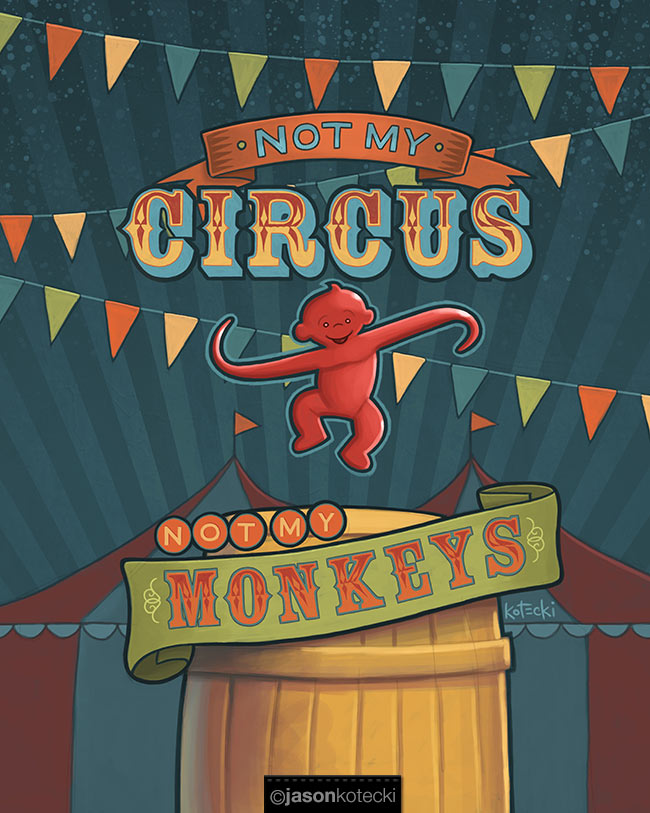
  • Not My Circus

    “Not My Circus” by Jason Kotecki. Digital.
    Original is SOLD 🖼️ Shop this art!

    Since 94% of the population suffers from at least a mild form of Adultitis, odds are that anyone with a job has to work with someone infected with this vile disease. Maybe it’s a co-worker, or a client, or – gulp! – the boss. Sometimes, the people I chat with after my speaking programs will confess to being married to someone with a full-blown case of Adultitis.

    So the question, of course, is how do I fix someone who has it?

    Unfortunately, the truth is…you don’t.

    I am a professional speaker. Most speakers I know started their careers with the hope of making a difference and changing lives. I certainly did. If you do it long enough, you’ll likely come across the uplifting statistic that informs you that your audience will probably forget almost everything you said the minute they walk out the door. Eventually, you will realize that you do not have any ability whatsoever to change someone’s life. Entertain, sure. Inspire, maybe. But change? That’s up to them, not you. (Newsflash: this little rule also applies to any husbands, wives, parents, and teachers who may be reading.)

    It’s hard not to feel like you’re a professional exerciser of futility.

    The thing is, the more quickly you accept this reality, the better speaker you become.

    When you are not worried about the guy in the front row crossing his arms, or the lady who ducked out the back, or whether or not you will get a standing ovation, the more you will be able to focus on being your authentic, true self and allow your message to land where it will.

    And THEN you might make some sort of difference for someone.

    You may not make a living from being on stage, but the principle is the same. When dealing with people who have Adultitis, there is only so much you can do. This is it:

    1) Do your best to be a good example. Take yourself lightly. Live your life cheerfully, with humor and joyful anticipation. In the best-case scenario, these people will see and be inspired by your approach to life, and a little will rub off. Maybe they’ll even ask for your secret, and then you can help them on the road to recovery.

    2) If your example alone doesn’t make a dent, you should incorporate their office supplies or car keys into Jell-O molds. (Just kidding.) (Not really.) Maybe you could try sending them flowers or a box of cookies. Maybe they just need someone to notice them and be kind to them.

    3) If you’re still running into a brick wall of Adultitis, your only other option is to ignore them and do your best to limit your exposure to them. You don’t have to be mean about it; you just have to be intentional. Depending on your relationship, you might consider deleting them from your life. Harsh, I know, but life is too short to have the joy sucked out of you by someone with a full-blown case of Adultitis.

    “Whoa, buddy,” you may be thinking. “That’s a little extreme. And it’s not exactly gonna work. This is my spouse you’re talking about,” or “I can’t exactly fire my idiot co-worker.” If extracting yourself from the situation is not an option, you should make it a priority to surround yourself with people who are relatively Adultitis-free. These relationships will help bolster your energy levels and serve as a force field from the Adultitis-ridden zombies in your life. 

    Is it an ideal solution? No, but it’s reality.

    You are only the ringmaster of your circus and your monkeys. Focus on the things you can control: your attitude, your actions, and the people you choose to spend most of your time with. Let go of the things you can’t.

    Simple, although certainly not easy.

    Striving for an Adultitis-free life will not always yield the results you’d like. You may not be able to make someone change, but it’s always possible to make a difference.

    Don’t be surprised if the difference is in you.