Keyword: vintage

  • I Just Called to Say I Love You

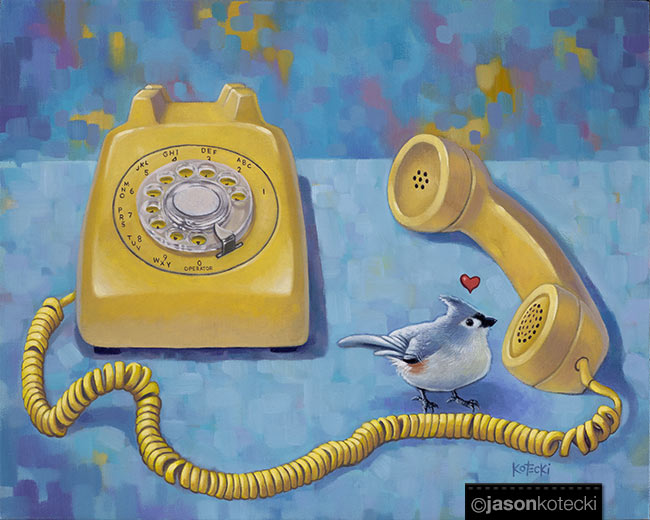
    “I Just Called to Say I Loe You” by Jason Kotecki. 20 x 16. Oil on canvas.
    Original is SOLD 🔴 Shop this art!

    “I Just Called to Say I Love You” is a famous Stevie Wonder song. It’s also the title of this painting.

    One word in that title might be more important than all the others. We’ll get to that in a sec.

    When my wife Kim and I were dating, we’d spend hours and hours on the phone, talking late into the night, racking up phone bills that if bound together, would make the longest Harry Potter book look like a pamphlet. This was in the days when phones were attached to walls and the “call waiting” feature was a source of civil war for any siblings also angling for phone rights.

    My personal phone habits with Kim were the exception, not the rule. To this day, I hate being on the phone, for reasons both justified and irrational, but too numerous to bore you with. I let almost everything go straight to voicemail. I am certain the quality of my life would increase exponentially if I never had to talk on the phone ever again. 

    Of course, the phone is a handy tool for maintaining relationships, which is another weakness of mine. Fortunately, my wife helps with that, as she does the little things that help keep relationships alive for both of us. I am an introvert, a Type 5w4 on the Enneagram (if you know, you know), and as previously mentioned, hate the phone. A generous assessment is that I spend a lot of time in my own head and it’s easy to get lost in there. Which is good for allowing me to create wonderful things, but not so good for maintaining friendships.

    Either way, it’s a perfect storm for a scenario in which if Kim dies before me, I’ll end up living alone in a home that neighborhood kids will describe as haunted and invent all sorts of urban legends about the old guy who supposedly lives there.

    Part of my problem is that I overthink relationships. In our own ways, maybe we all do.

    Friendships can stall if we make them too complicated or set expectations too high. Failing to meet them finds us buried in an ever-mounting pile of “shoulds.” The more time that passes, the more time we assume is required for catching up. And of course, life rarely drops oceans of uninterrupted time into our laps, so… the relationship slowly grows stale and eventually dies.

    A recent conversation convinced me of that being a flawed approach.

    Andy Gullahorn is a songwriter in Nashville who started an interesting routine with his friend Gabe several years ago. Every week, Andy goes for a walk. Gabe, who lives a mile and a half away, does the same thing at the same time. They walk toward each other, and when they meet, they give each other a high five. Sometimes they stop to play badminton. Oftentimes, no words are exchanged, and they simply head back home.

    Kim and I had a chance to interview Andy, and he shared another routine he has with a friend who lives in Houston. Since an in-person high-five is out of the question, every Monday for six years, they simply exchange fist bump emojis. That’s it. And yet the connection has deepened to such an extent that Andy says he trusts that friend with his life.

    Andy’s advice is to start small. And ridiculous. “It doesn’t have to be dead serious to make a deep connection,” he says. “In fact, if that’s where it starts, it’s hard to maintain that. The high five is just a stupid foundation to hold real relationship.”

    Of course, not every relationship needs to be maintained for all time. Some people come into our lives for a reason or a season. But Andy’s right. Maybe we should focus on uncomplicating the friendships we want to fertilize.

    In the interview, he challenged viewers to just commit to not having a deep conversation but to just exchange winks or honk at each other as they pass one another on the road, even without saying another word. 

    That’s why maybe the most important word in Stevie’s classic song is…”just.”

    I JUST called to say I love you. That’s it. No fanfare. No guilt trips. No phone bills weighty enough to kill a small mammal.

    We don’t always need to have an hour-long conversation for our relationships to thrive. 
    A high five or a fist bump emoji might just do the trick. 👊
  • One Way To Look At It

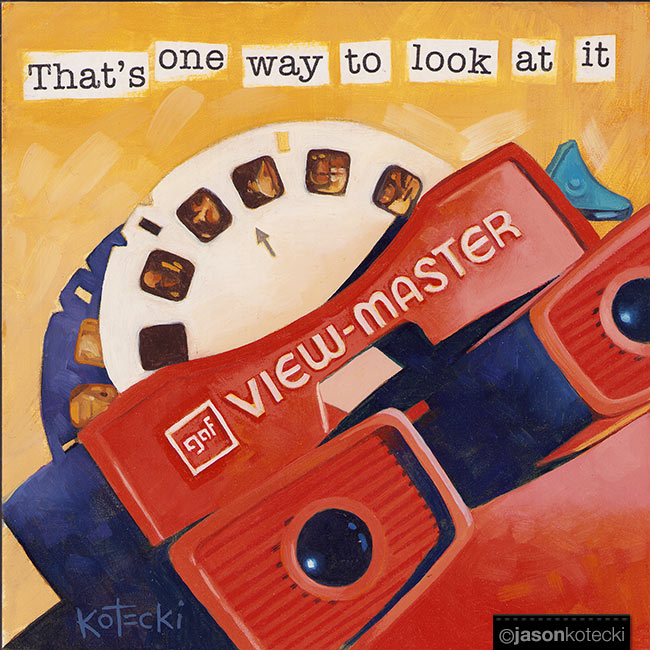
    “One Way To Look At It” by Jason Kotecki. 6 x 6. Oil on canvas.
    Original is SOLD 🔴 Shop this art!

    One day Kim wrote a social media post about how ugly our backyard is after having been ravaged by a cataclysmic storm. The harsh, violent, apocalyptic hellscape is heartbreaking.

    And very, very ugly. 

    A well-intentioned commenter felt the need to correct her, “No, it’s beautiful.”

    Of course, the commenter is right. It is beautiful, in many real and metaphorical ways. And the photos Kim has taken of the carnage have captured some of that beauty.

    But you know what? It’s also ugly. Especially in comparison to what it was before.

    It can be both. It is both. And that’s ok.

    As I pointed out in my book, A Chance of Awesome, some people look at dandelions and see weeds. 

    Others – mostly kids – see wishes.

    The thing is, both are true. 

    Or take cars. Automobiles are modern marvels that give us great freedom and save us enormous amounts of time. The industry employs nearly two million people. But about 40,000 people die in motor vehicle traffic crashes each year in the U.S.

    So are cars good or bad?

    Unfortunately, our rotten news media has conditioned us to operate without any nuance whatsoever because there is profit to be made in conflict. We no longer seem to have the capacity for critical thinking; we’ve been reduced to the infantile reflex that things are either “good” or “bad.” Every issue is presented as either black or white, red state or blue state, right or wrong, good or evil.

    Ugly or beautiful.

    When it comes to any story – especially the headline-grabbing issues of the day – we’ve been duped into believing we only have two options: be right or be wrong.  

    But life is more complicated than that. Life is both / and.

    When your kid heads off to college for the first time, it’s natural to feel a sense of pride as they move into a new season of growth and independence. It’s also natural to feel sad that your day-to-day interactions with them are coming to an end. 

    Or when a loved one you have taken care of for years has passed away, you probably feel sad that they are gone. It can also feel nice to believe that they are in a better place. 

    But you can also feel relieved that your burden has been lifted. 

    That doesn’t make you a monster; it makes you human. 

    We live in a complicated world with unlimited shades of grey. (Yes, even more than fifty.) It’s not helpful to force everything into an absolute. We don’t have to walk around wearing rose-colored glasses, deluding ourselves into thinking everything is unicorns and rainbows.

    Nor is it especially healthy to point out every potential storm cloud. 

    Both approaches are childish. 

    A mature perspective is acknowledging that life is filled with contradictions. There is good and evil, joy and pain, hope and fear intermingling in all of it. 

    We do have a choice about where we want our attention to dwell, which is one of our most overlooked and underused superpowers. But it’s important to remember that focusing on one doesn’t disappear the other. 

    Life is painful. It is also joyful. Sometimes on the very same day. 

    And that’s ok.

    Acknowledging the ugliness is what keeps us from taking beauty for granted.
  • Not My Circus

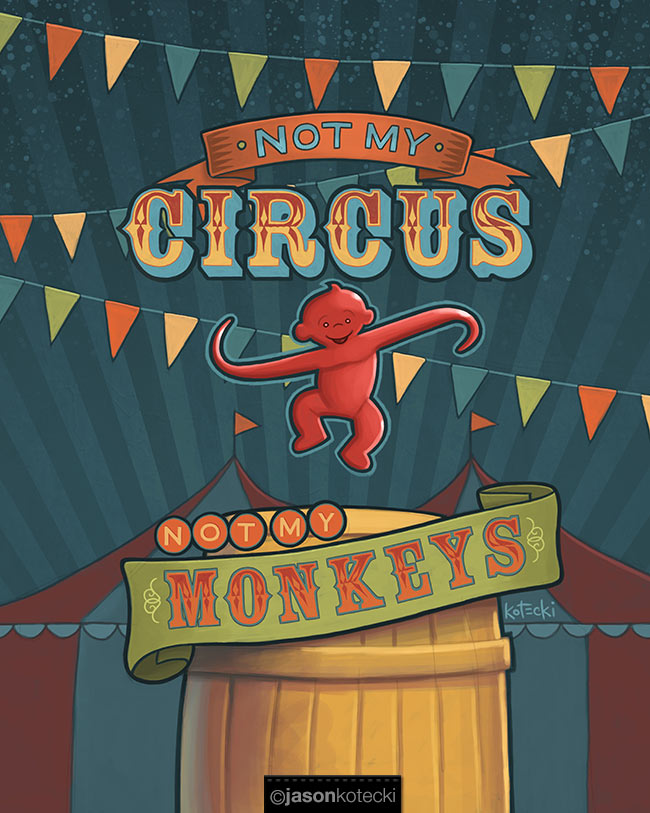
    “Not My Circus” by Jason Kotecki. Digital.
    Original is SOLD 🖼️ Shop this art!

    Since 94% of the population suffers from at least a mild form of Adultitis, odds are that anyone with a job has to work with someone infected with this vile disease. Maybe it’s a co-worker, or a client, or – gulp! – the boss. Sometimes, the people I chat with after my speaking programs will confess to being married to someone with a full-blown case of Adultitis.

    So the question, of course, is how do I fix someone who has it?

    Unfortunately, the truth is…you don’t.

    I am a professional speaker. Most speakers I know started their careers with the hope of making a difference and changing lives. I certainly did. If you do it long enough, you’ll likely come across the uplifting statistic that informs you that your audience will probably forget almost everything you said the minute they walk out the door. Eventually, you will realize that you do not have any ability whatsoever to change someone’s life. Entertain, sure. Inspire, maybe. But change? That’s up to them, not you. (Newsflash: this little rule also applies to any husbands, wives, parents, and teachers who may be reading.)

    It’s hard not to feel like you’re a professional exerciser of futility.

    The thing is, the more quickly you accept this reality, the better speaker you become.

    When you are not worried about the guy in the front row crossing his arms, or the lady who ducked out the back, or whether or not you will get a standing ovation, the more you will be able to focus on being your authentic, true self and allow your message to land where it will.

    And THEN you might make some sort of difference for someone.

    You may not make a living from being on stage, but the principle is the same. When dealing with people who have Adultitis, there is only so much you can do. This is it:

    1) Do your best to be a good example. Take yourself lightly. Live your life cheerfully, with humor and joyful anticipation. In the best-case scenario, these people will see and be inspired by your approach to life, and a little will rub off. Maybe they’ll even ask for your secret, and then you can help them on the road to recovery.

    2) If your example alone doesn’t make a dent, you should incorporate their office supplies or car keys into Jell-O molds. (Just kidding.) (Not really.) Maybe you could try sending them flowers or a box of cookies. Maybe they just need someone to notice them and be kind to them.

    3) If you’re still running into a brick wall of Adultitis, your only other option is to ignore them and do your best to limit your exposure to them. You don’t have to be mean about it; you just have to be intentional. Depending on your relationship, you might consider deleting them from your life. Harsh, I know, but life is too short to have the joy sucked out of you by someone with a full-blown case of Adultitis.

    “Whoa, buddy,” you may be thinking. “That’s a little extreme. And it’s not exactly gonna work. This is my spouse you’re talking about,” or “I can’t exactly fire my idiot co-worker.” If extracting yourself from the situation is not an option, you should make it a priority to surround yourself with people who are relatively Adultitis-free. These relationships will help bolster your energy levels and serve as a force field from the Adultitis-ridden zombies in your life. 

    Is it an ideal solution? No, but it’s reality.

    You are only the ringmaster of your circus and your monkeys. Focus on the things you can control: your attitude, your actions, and the people you choose to spend most of your time with. Let go of the things you can’t.

    Simple, although certainly not easy.

    Striving for an Adultitis-free life will not always yield the results you’d like. You may not be able to make someone change, but it’s always possible to make a difference.

    Don’t be surprised if the difference is in you.