Keyword: winter

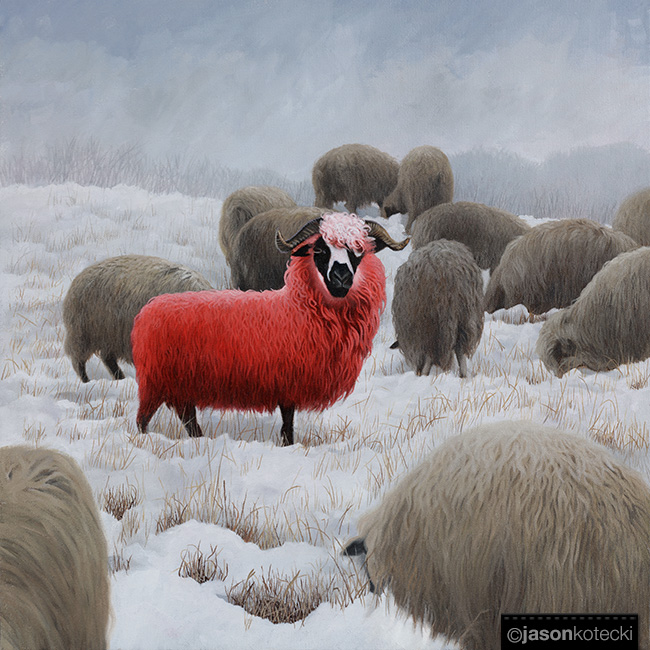
  • One of One

    “One of One” by Jason Kotecki. 20 x 20. Oil on canvas.
    Original is available 🟢 Shop this art!

    When I was in art school in the late nineties, the goth look was in. A significant segment of art kids wore all-black clothing, Doc Martens boots, and fingernails painted with dark colors. I found it fascinating to observe that the ones intent on bucking the system, sticking it to the man, and expressing their individuality all looked…exactly the same.

    It’s scary to stand out.

    We learn this at a young age, when simply being our weird, unique selves can lead to us being shamed and ostracised at recess, on the school bus, or even across the dinner table by a sibling or parent.

    And so, much of life is a careful effort to blend in.

    Just look at the cars we drive, most of which are either black, white, or some combination of the two.

    Or how we take fashion cues from tastemakers and trendsetters because getting caught wearing something out of style is akin to death.

    We must be careful to curate what we say in public for fear of being cancelled.

    In the case of my art school companions, we even blend together in our rebellion.

    Now, some would explain this as an evolutionary feature, not a bug. There’s safety in numbers, after all. We’ve learned to blend in because there’s danger in straying too far from the herd.

    The thing is, we’re not here to sink to our base animal instincts. We were created for a higher purpose. We were made for greatness.

    We are born originals. The problem, as St. Carlo Acutis observed, is that most of us die as photocopies.

    As an artist, I sell prints of my work. Some of them are timed releases, some are limited editions, and some are open editions (available all the time). 

    I sell a lot of them, but they’re all really just fancy photocopies. 

    And none are worth as much as the original. A print sells for less than a hundred dollars. The original can sell for thousands.

    Ask anyone who has purchased one of my original paintings, where you can see the texture of the canvas, feel the brushstrokes with your fingers, and observe the luminosity that emanates from dozens of thin layers of oil paint, and they’ll confirm: Nothing beats an original.

    Sadly, too often we settle for being photocopies.

    It’s been said that imitation is the sincerest form of flattery.

    Maybe if someone else is imitating us. 

    But if it is we who are doing the imitating, then imitation is the sincerest form of boring.

    It is good to learn from those who came before us. It’s possible to find a measure of success by imitating someone else. 

    But the best you’ll ever be is a second-rate version of them.

    This is not a call to stand out for the sake of standing out, or to pretend to be something you’re not. It’s about having the courage to be more of who you are. It’s a reminder that safety should not be our highest virtue. 

    You are free to opt for the safe path. Most people do.

    But you will not be able to escape the gnawing sense of dissatisfaction, the quiet desperation, the ever-present sense in your soul that there’s more to life, and this ain’t it.

    The reason I made the hero in this painting red was because of the lesson I learned from red shoes. After years of wearing safe, plain, predictable shoes, I started pining for red ones. The people I saw wearing red shoes always seemed to be so brave and adventurous, somehow getting more out of life. I wanted that, but I was afraid. I was afraid of standing out too much, but mostly I was afraid that I’d be found out as a fraud.

    Adultitis tried convincing me that I wasn’t one of those “red shoe people.” I wasn’t fun enough, brave enough, or free enough. 

    Eventually, I stood up to Adultitis and got the red shoes. The fears ended up being empty threats. I’ve worn red shoes on stage for every speaking engagement for about two decades now. I love ’em. They make me feel more fun, confident, and free, like a guy who decided it didn’t matter what other people think. 

    Of course, red shoes are not the secret to defeating Adultitis.

    Being brave is.

    What are your red shoes? There is probably something in your life you’ve always (but probably secretly) wanted to own, do, or be, that you’ve talked yourself out of. Maybe Adultitis sold you on the idea that you’re just not “that type of person” and it would be safer to blend in.

    But maybe you actually are that type of person.

    Maybe the fear is a smokescreen keeping you from becoming all God created you to be.

    Maybe twenty seconds of embarrassing bravery will open the door to a new level of confidence and unimaginable opportunities.

    Maybe your example of standing out from the herd will be the spark that lights the way forward for someone else, giving them courage to be brave, too.

    “To be nobody-but-yourself—in a world which is doing its best, night and day, to make you everybody else—means to fight the hardest battle which any human being can fight; and never stop fighting.”

    —E.E. Cummings

    Is any of this safe? Hell no. Of course not.
    But it’s the only way to feel alive.
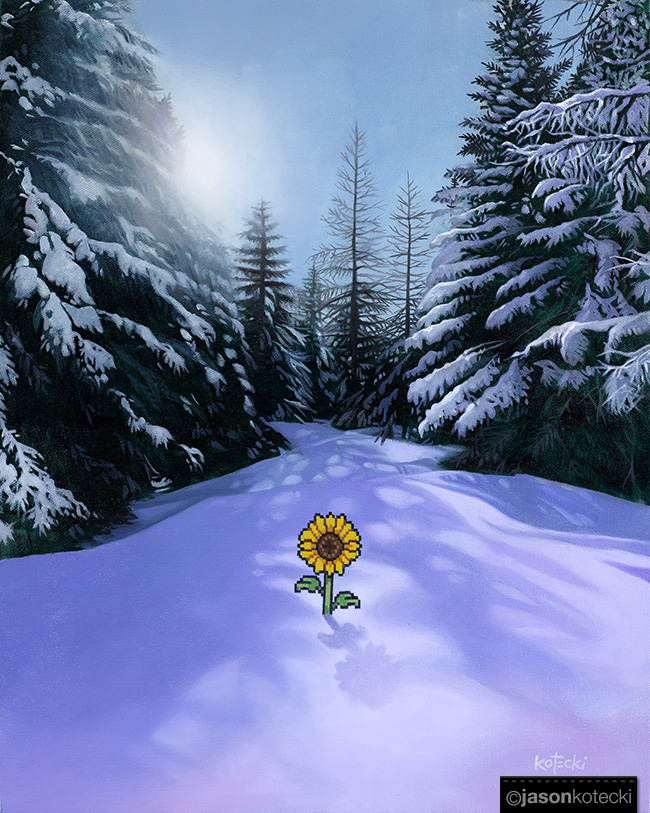
  • We Can’t Let Winter Win

    “We Can’t Let Winter Win” by Jason Kotecki. 16 x 20. Oil on canvas.
    Original is available 🟢 Shop this art!

    One thing I love about the Midwest is the seasons. Real ones. Not like those they claim to have elsewhere, so-called “winters” with an occasional snow flurry and temperatures that sometimes flirt below forty.

    In Wisconsin, our seasons are pure, not pretenders. 

    I like that, because it allows me to fully embrace the beauty and lessons of each one. It’s a reflection of life, which has distinct seasons, no matter where we live.  

    If we’re honest, we’d prefer life to be one long, glorious summer, filled with sunshine and popsicles. But no. There are seasons of autumn, times for slowing down and saying goodbyes. And there are long winters of loneliness, where life feels frozen solid, and hope gets buried under a blanket of snow. 

    Of course, spring always follows, but sometimes it seems to have overslept.

    In Wisconsin, there is always a point when you’re pretty sure winter is over. 

    Live here long enough, and you realize it’s not. 

    There’s always one last gasp. One final snowstorm. One more cold snap that steals spring away, just as you were about to elope together on your way to summer.

    That might be the most deflating, difficult part of winter: The moment when it appears it will never end, and you don’t know how much more you can take.

    Life feels like that sometimes, when it seems like winter’s gonna win. 

    Winter wins when it convinces us that nothing will ever change.

    Winter wins when we let disappointment over unmet expectations turn into resentment.

    Winter wins when we allow ourselves to be buried under a blanket of apathy.

    Winter wins when we decide to give up and let the hope within us flicker out.

    But it doesn’t have to get the final say.

    This painting is a reminder that we can’t let winter win.

    The 8-bit sunflower is reminiscent of a video game, because I think that’s a good way to think of it. When you’re in the middle of one of life’s winters, everything is heavy. Summer looks so far away. We see all the things that need to change for us to go from where we are to where we want to be, and it feels insurmountable. 

    Sometimes the answer to the darkness that weighs down on us is a little levity. Making a game out of it is a way to rise above the life-and-death seriousness of our situation. It takes us ever-so-slightly outside ourselves to give us perspective that is a little wider than the restricted, optionless way winter can feel sometimes.

    Part of what makes a game engaging and fun is that there is a challenge to it. But the key is for it to be a doable challenge. So instead of focusing on all the ways we are frozen in place and how many more days of winter are ahead, make a game out of finding even one tiny clue that spring is on its way. You don’t need to defeat the Final Boss and save the Princess; you just need to make it past this level. 

    Today.

    The game is this: Figure out how to win today.

    It doesn’t have to be big.

    It could be one five-minute prayer.

    It could be getting dinner on the table.

    It could be dumping the bottle of vodka down the drain.

    It might just be getting out of bed.

    Sometimes the win is just giving it one more day.

    I’ve experienced many winters, especially in the early days of building our business. I once got some advice from a business colleague I’ve never forgotten. He, too, was an entrepreneur and knew how discouraging it was to feel like you made one step forward only to take three steps back. He shared a simple policy he lived by. On those really hard days, the days when he didn’t think he could go any further, he promised himself he’d give it one more day. He gave himself permission to abandon ship after that, but not before he gave it one more day.

    Sure enough, the next day always brought some glint of hope, a new reason to believe. There was rarely any huge breakthrough that magically happened. Maybe it was a small sale. Maybe it was an encouraging word from a friend. Maybe it was just a good night’s sleep.  

    Just a baby step forward.

    We win when we find evidence that spring is on its way.

    We win when hope bursts through a blanket of apathy.

    We win when our resentment melts into acceptance.

    We win when our panic gives way to patience.

    We win when we bring light to someone else.

    We win when we give it one more day.

    Don’t let winter win.

    Keep holding on for spring.
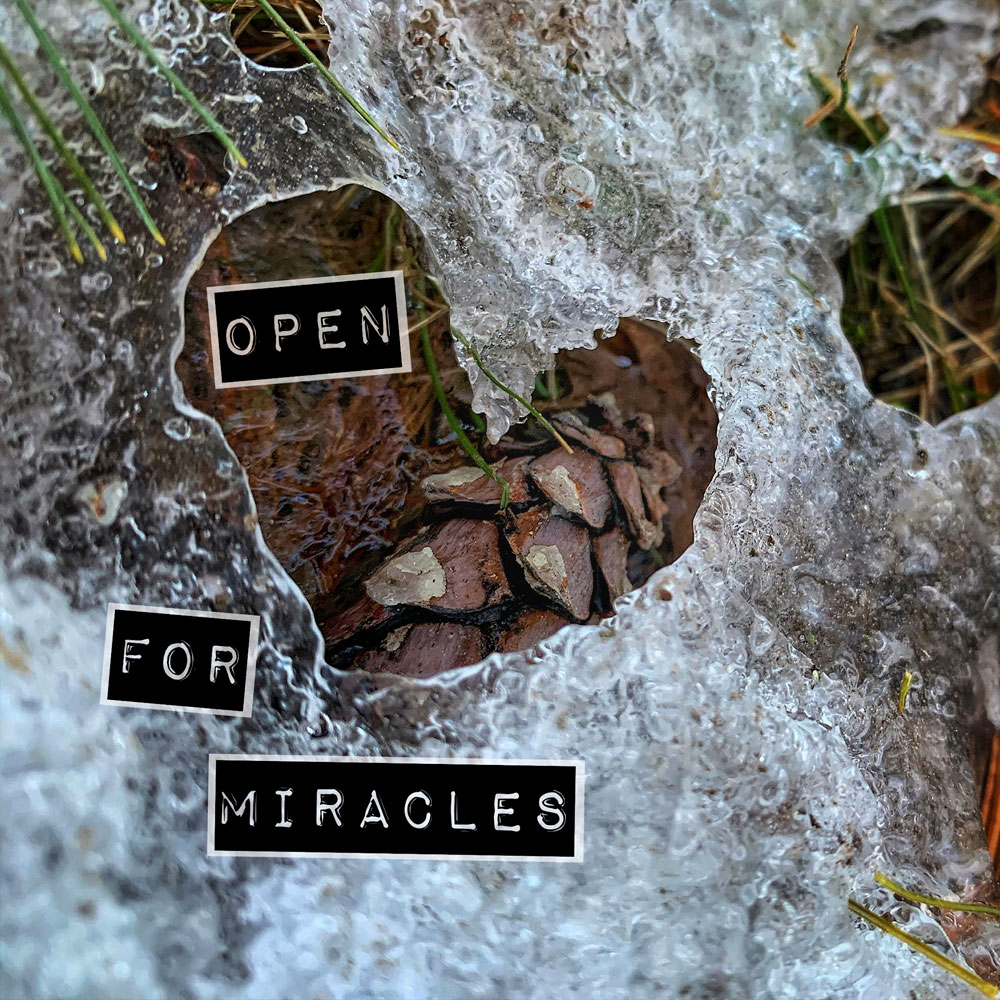
  • Open For Miracles

    Photo by Kim Kotecki

    When my Dad was in his final days here on earth we made some significant promises to each other. I promised to take good care of Mom, assuring him that she would be supported. I asked him to pray for us; some specific prayers and other private intentions he didn’t know about before. He assured me he would do his best to help from the other side.

    At his funeral, a dear friend and neighbor of ours for many years shared something that meant a lot. He said lovingly, “I know your Dad told us that he and your mom were moving to be closer to you guys and would be helping you with the kids. But, I think he realized he could help more where he’s at now than he could before on earth.”

    I couldn’t agree more. I’m open for miracles, Dad. Pray for them on our behalf as needed.  

    Hearty doses of faith, hope, and love create a winning combination to open your heart to the miracles that await you.

    Stay open for miracles.

  • The Sherpa

    “The Sherpa” by Jason Kotecki. 24 x 30. Oil on canvas.
    Original is SOLD 🔴 Shop this art!

    Do you ever feel lost?

    It seems like an absurd question when we all have smartphones offering turn-by-turn directions to anywhere we want to go.

    But having access to all the paths isn’t the same as knowing which one to take.

    What happens when none of the paths you’ve tried have led to where you want to go? What do you do when you know where you are now isn’t where you want to be, but none of the roads before you seem quite right? What then?

    Perhaps the best place to begin is with those little bits of colored whimsy people sprinkle on ice cream sundaes. Indeed, it’s as good a starting place as any.

    According to an Internet search, the ball-shaped versions of hardened sugar are called “sprinkles,” while the rod-shaped variety is known as “jimmies.” My family isn’t particular; we just call them awesome. My youngest daughter drew a picture of a “Jimmy Machine,” illustrating how they are made. 

    According to her, “Jimmy goes into a machine and it prints out Jimmys onto a conveyor belt. When it goes upside down, they fall, drop onto a series of four trampolines, and then into a butt cheek pit where they emerge as butterflies. Finally, they go in lava and then turn into jimmies.”

    I like to think of myself as creative, but this is PhD-level stuff.

    Some might say it’s merely the absurd ramblings of an eight-year-old with an overactive imagination.

    Yet, is it that much different than Walt Disney’s preposterous vision of Disneyland, a vision that investors, his brother, and even his own wife considered a disastrous waste of time and money? The success of Walt’s idea seems obvious in retrospect, but at the time, it was anything but. The same goes for “Snow White,” history’s first feature-length animated film, which was derisively dubbed “Disney’s Folly.” To those who didn’t get the vision, Walt’s ideas probably looked a lot like the blueprint of my daughter’s “Jimmy Machine.”

    Overactive imagination, indeed. 

    If you look closely, most of the best advancements of humankind started out looking like delusions of ridiculousness. Walt Disney knew that sometimes the best path forward isn’t on the map at all, and the only way to see it is through childlike eyes.

    Reminding people of the power of the childlike spirit is my mission in life. In a world overwhelmed by Adultitis, it’s been an uphill battle. 

    You see, the danger in branding your company “Escape Adulthood” is that it’s easy for people to discount you as irresponsible, immature, cotton-headed ninny noggins who are avoiding the responsibilities of adulthood and trying to escape the pressures of the “real world.”

    As a pragmatist, I’d be tempted to think the same way if I didn’t know any better. 

    It gives me solace to know we are not alone. J. R. R. Tolkien, the author of those little-known books The Hobbit and The Lord of the Rings, was often accused of writing fairy tales that were nothing more than the escapist’s way out of this so-called real world. His reply was simple and brilliant. He proposed that everything was dependent on that from which one is escaping. “We view the flight of the deserter and the escape of a prisoner very differently. Why should a man be scorned if, finding himself in prison, he tries to get out and go home?”

    Exactly. 

    Paying bills, upholding responsibility, and making hard decisions are important and necessary hallmarks of adult life. But the deep-down person we were when we were kids is much closer to the real us than the stilted, joyless version we often present to the world around us. Cynicism, common knowledge, and the rules that don’t exist have imprisoned us from being our true selves: passionate, playful, and curious creatures who dream big dreams and are filled with faith, hope, and love.

    So no, we’re not about shirking responsibilities or ignoring reality.

    We’re just trying to get back home.

    That’s why Kim and I often refer to children as sherpas. Like those experienced, wise guides who escort climbers up the face of a mountain, children have a pure wisdom that can help us traverse this adventure called life. 

    A GPS will not get us where we want to go. 

    Like any good adventure, life is difficult. We need all the tools we can carry, including the ones we tossed away so carelessly in our hurry to grow up. So yes, bring your logic, your experience, and self-control. (Walt needed all of them to make Disneyland real.) But don’t forget to pack your curiosity, playfulness, and passion, for they, too, have their usefulness. 

    They help us to identify hidden paths missing from our map. They open our eyes to help us see what can be, which is the first step required in making it so.

    And leave room in your pack for one more important but overlooked tool: whimsy.

    Although Whimsy is often viewed as superfluous, it is a spark of delight with the supernatural power to uplift the human spirit. Whimsy can fill a heart with happiness and a head with new ideas. Whimsy brings a playful unpredictability to our days. It puts the heavy things we carry in perspective. The delicious ridiculousness of whimsy helps lighten our loads and brings joy to others.

    Sometimes in life, we get stuck circling the same path, repeating our mistakes because we keep trying to use the wrong tools for the job, expecting a different result. The tried and true tools of adulthood are useful, but like using a screwdriver to shovel your driveway, insufficient for the task at hand. 

    If you are sad, stuck, discouraged, or overwhelmed…try whimsy.

    It’s a small thing that can have outsized results, the same way a sprinkling of jimmies can transform an ice cream sundae.

    A good sherpa knows the power of whimsy. Don’t bother looking for it on a map, but it might be the best path to take right now to get where you want to go. 

    In a dark world where the terrible stuff weighs so heavily upon us, we need whimsy more than ever. Whimsy lifts the soul, loosens up the mind, gladdens the heart, and opens the eyes to what can be. 

    This is the way.
  • Years Since It’s Been Here

    “Years Since It’s Been Here” by Jason Kotecki. 12 x 12. Oil on canvas.
    Original is SOLD 🔴 Shop this art!

    This piece is part of a series of nine paintings inspired by the Beatles’ song “Here Comes The Sun.” Watch a short film I created about the powerful story behind the series:

  • That Ice Is Slowly Melting

    “That Ice Is Slowly Melting” by Jason Kotecki. 12 x 12. Oil on canvas.
    Original is SOLD 🔴 Shop this art!

    This piece is part of a series of nine paintings inspired by the Beatles’ song “Here Comes The Sun.” Watch a short film I created about the powerful story behind the series:

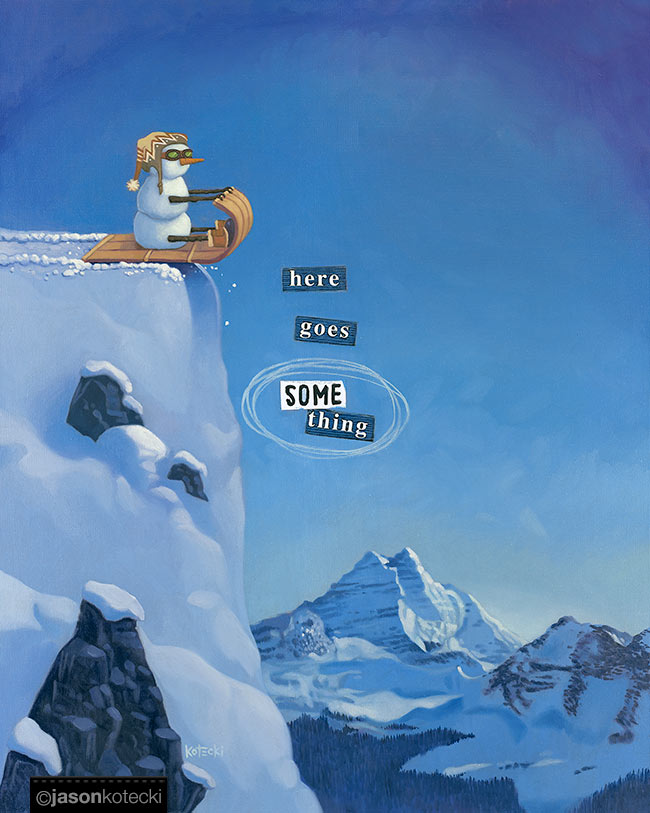
  • Here Goes Something

    “Here Goes Something” by Jason Kotecki. 24 x 30. Oil on canvas.
    Original is SOLD 🔴 Shop this art!

    “Here goes nothing.”

    It’s a phrase we often use when we’re not sure how something will turn out. In fact, since it tends to come from a sense of desperation, we use it to admit that there’s a pretty good chance of it not working. It’s our little way of softening the psychological blow of failing.

    It makes me think of the pass play in football referred to as a “Hail Mary.” The team with the ball is losing, and time has nearly expired. They need a touchdown but they’re so far from the goal line that their only hope is to launch a long pass into a sea of waiting defenders. It’s a pass with a very low chance of success, but at that point, you’re out of options. 

    Here. Goes. Nothing. 

    However.

    This isn’t a football game.

    Trying things that might not work is not nothing.

    It takes tremendous courage, vulnerability, and faith. Dare I say it’s the most important thing we can ever do?

    Doing things that we are sure will work is safe and comfortable. Chasing guarantees is one way to go about our days, but if this is all we ever do, we will have wasted our lives. This is not why we were born.

    When you try something that might not work, it’s true: it might not. But in the end, many other good things will have come of it. At the very least, you will have learned something, and your comfort zone will have inched a little larger.

    And that’s definitely not nothing.

    We recently hosted our third Wondernite. Before our first one, I had no idea if it would work. I didn’t know if anyone would come. I didn’t know if I would even sell one painting. There was a distinct possibility that my brother Doug would go through all twenty items up for auction and not receive one bid and I’d have the exciting opportunity to descend into a catastrophically humiliating shame spiral while sitting in the back of the room. Thankfully for all concerned parties, it turned out well enough that we are currently planning our fourth.

    By the same token, we’ve also invested thousands of dollars into trade shows that did not deliver a good return on investment. They drove us deeper into debt. They bordered on soul-crushing. But the lessons we learned in the process, about marketing, positioning, pricing, and branding, were invaluable, and part of the reason Wondernite turned out to be a success.

    Tinker. Play. Experiment. Try things that might not work. And when you cast off into the unknown, you can be confident in saying to yourself, “Here goes something!!!”

  • Enjoy the Climb

    “Enjoy the Climb” by Jason Kotecki. 16 x 20. Oil on canvas.
    Original is SOLD 🔴 Shop this art!

    If you were to place your nose really close to this canvas and focus only on one of the goats, what would you see? A mountain goat on a snowy mountain. The environment around them is boring, plain, cold, and possibly treacherous.

    I was reading some old journals the other day. I was struck by how concerned I was about details of projects and initiatives that are no longer relevant to our current business model. Problems that needed to be solved, or else! Pitfalls that seemed like backbreakers. At first, I felt disappointment that I had wasted so much time on things that, in the end, didn’t matter at all. But then I realized that’s how life works. You struggle through, doing the best you can with the information you have. Hopefully, you learn from your mistakes, grow, and move forward. I realized that in ten years, a review of the journal I wrote this morning will probably feel the same way; only the details will have changed.

    Back to the painting now. Look at the big picture.

    Holy cow, those goats are surrounded by ice cream! 

    Sometimes we miss the cool things happening in our lives, because we’re too focused on the struggles right in front of us.

    A few years ago, I was enjoying a wonderful dinner with some speaker friends. We started a table discussion about the best place you’ve ever been that you’d like to go back to. While others shared amazing stories of Tuscany, Brazil, and Ireland, I felt silly because all I could think of was the Quality Inn in Clearwater, Florida.

    I’m pretty sure the year was 2007. Kim and I didn’t have kids yet, and we were in the early stages of my speaking career. We’d recently been to a speakers’ convention where a guy named Randy Gage talked about these exotic bungalows in Tahiti. He noted that some are perched over the water, featuring cool glass-bottomed floors, and wondered why anyone would invest the considerable expense to vacation in Tahiti and then settle for the slightly cheaper but extremely less exotic wood-bottomed accommodations a few hundred feet inland.

    So as we checked into the Quality Inn, the host offered us the option of upgrading from our “Garden View” room (which savvy travelers know as code for “Ugly Roof and Air Conditioning Unit View”) to an “Ocean View” room.

    “How much extra would that cost?” we asked.

    “$20 a night,” was the reply.

    We huddled to talk it over. Twenty bucks was a big deal for us, which should not come as a surprise because, as I mentioned, we were checking into a QUALITY INN.

    With Randy’s rallying cry still ringing in our ears, we threw caution to the wind and said YES.

    Isn’t it funny how often it takes far less than a million dollars to feel like a millionaire? That’s definitely how we felt as we triumphantly surveyed our ocean view.

    Photographers often refer to the hour before sunset as “magic hour,” because the light from the sun casts a beautiful golden hue on everything it touches. I remember lying on our bed, watching the sun sink into the Gulf. And I still remember how beautiful Kim looked. I’m so glad we snapped this selfie before selfies were a thing.

    I also remember that back then, we spent a lot of our time dreaming of “making it” and looking forward to the days when we’d be checking into much fancier hotels, you know, like Quality Inns in Tuscany.

    I spent a lot of time striving, worrying, and wishing I were somewhere else. Somewhere better. But I look back now and realize what an exciting, fun time that really was.

    Sometimes we get so caught up chasing the next moment that we forget to savor the one we’re in.

    Wherever you are on the mountain right now, enjoy the climb.
  • Willing To Relocate

    “Willing To Relocate” by Jason Kotecki. 24 x 24. Oil on canvas.
    Original is SOLD 🔴 Shop this art!

    When Kim and I decided to move to Madison after we got married, neither of us had jobs or job prospects for that matter. I’m sure some people thought we were crazy.

    Kim and I didn’t have to leave home. It was fine, and it offered an opportunity. But we wanted an adventure to call our own, and suspected that the life we wanted to live would require a change of scenery. 

    And so we were willing to relocate.

    We had to leave behind that which was familiar in order to grow into who we were meant to become. We picked Madison, but in our case, the need to move away from our comfort zone was more important than the actual location itself.

    Sometimes we have to be willing to relocate to make our dreams come true. Of course, that might mean moving across town or across the country.

    But it might mean moving into a different group of friends.

    It might mean moving from where our customers are today to where they will be tomorrow.

    It might mean moving into a new way of seeing ourselves, perhaps from the role of victim to that of victor.

    When I was a brand new speaker, Kim and I helped form a mastermind group with a few of our peers, talented people at a similar stage as us. We had the harebrained idea to invite Robert into our group. Robert was a true pro that we all looked up to. He’d been speaking for years and had a thriving business. We never thought he’d actually say yes. 

    He did. 

    The thing that impressed me most about Robert was his openness to new ideas. He shared hard-earned lessons, but never paraded the fact that he was further along than any of us. He looked at us as true peers. He was always curious and open to our ideas. He regularly asked us for our opinions and was eager to try out our suggestions. 

    I remember thinking that when I grew up and got really successful, I wanted to be like Robert. 

    Here’s the thing. I now see that he wasn’t patronizing us; he was smart. He knew that in order to grow his business and get better as a speaker, he couldn’t stay where he was. He had to be willing to relocate. 

    Sadly, the reason he stood out is that his attitude is rare. I’ve seen many speakers – and businesses for that matter – slowly fade into oblivion and irrelevance because pride held them back. They already knew it all. They weren’t open to a new path.

    Robert was successful. But he wasn’t about to settle.

    If you are not satisfied with your life as it is now, you have to be willing to relocate from where you are now to where you want to be.

    If you want to experience the summit, you have to say goodbye to sea level.