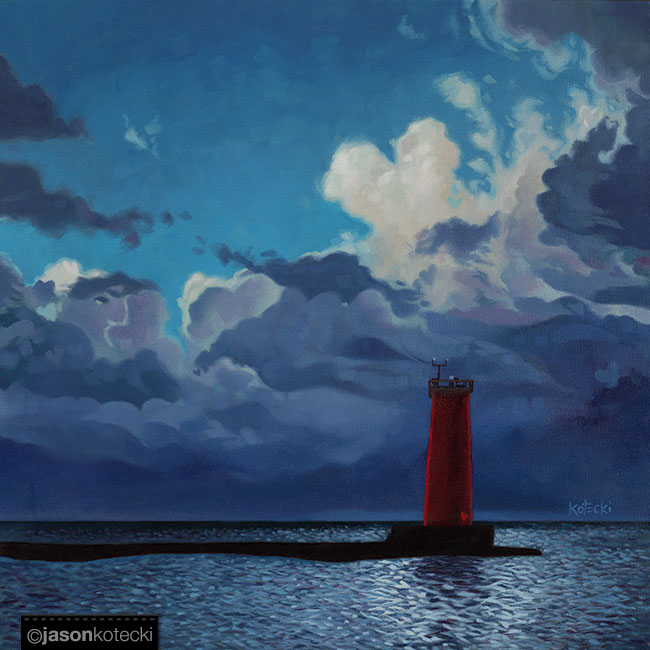
“Seek & Find” by Jason Kotecki. 20 x 20. Oil on canvas. Original is available. 🟢 Shop this art!
My wife has a remarkable superpower for finding hearts in nature, hiding in clouds, flowers, and even her sourdough bread.
One day, we walked along a pier in Lake Michigan. We talked about our business, kids, and future. We lingered at the end of the pier, then walked back, resuming our conversation. Kim casually mentioned seeing fifteen hearts during our walk.
I had seen exactly none.
I marveled at her talent.
But is there such a thing as talent for seeing hearts in nature? I’m not so sure. It’s not like having a beautiful singing voice, exceptional sprinting speed, or a penchant for math.
Kim has a knack for spotting hearts because she spends a lot of time looking for them.
What seems magical to others is often the result of lots of practice.
I once wrote a book about seeing. In it, I talked about storms, the metaphorical kind that blow through our lives. I also wrote about one of our most underrated superpowers: the ability to choose what we look for in the midst of those storms.
Yes, the storms will come. Scary, devastating, faith-shaking storms. They are a given, right up there with death and taxes and missing socks.
But those who see the silver linings are usually the ones looking for them.
It’s not a talent; it’s a practice.
The more you practice, the better you get.
This is true with finding hearts in nature as it is with anything.
So, will this year be worse than last year? Or will it be your best year ever?
Here’s the secret: You don’t have to wait to find out.
The trap is letting external circumstances dictate our answers: the news headlines, the outrage du jour on social media, the ups and downs of life.
It’s hard to view a year of hardship as anything but negative. However, a decade might offer perspective, transforming it into a valuable gift. A little time and practice might turn up a whole host of hidden blessings.
I’m not suggesting you pretend that the tough or terrible moments don’t suck. Being sad, mad, or angry is part of the human experience. We don’t have to bury those emotions under some false blanket of positivity.
Just remember that storms are part of life. The best year isn’t one without failure, conflict, tragedy, or loss.
Kim took the photo that inspired this painting. She saw a heart in the sky near the lighthouse. I enhanced it slightly and added dozens more. I can’t count them all, and you might find some I didn’t add.
That is how it is with cloud watching and wonderhunting and the counting of blessings.
The more you practice, the more you’ll see.
Those who seek shall find.
☕ How would you assess your ability to spot the “hearts” in your life? What’s one way you could practice getting better?
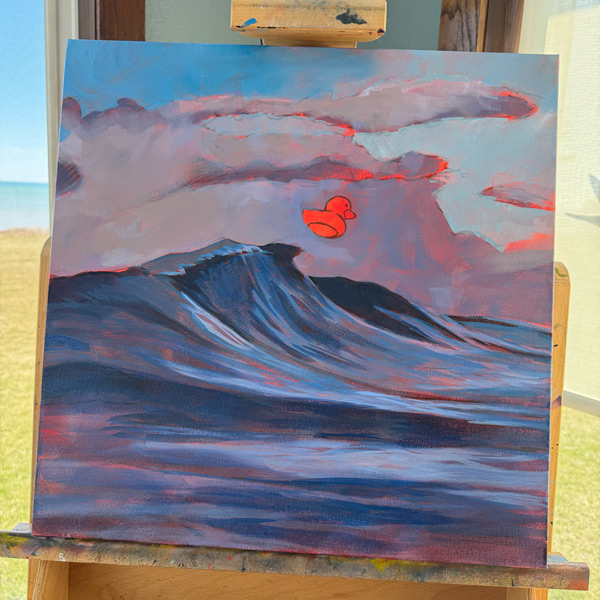
“Beyond the Bathtub” by Jason Kotecki. 20 x 20. Oil on canvas. Original is available 🟢 Shop this art!
I could have stayed in the bathtub.
Way back when, after completing my schooling and earning a degree, the safe path was waiting for me. A decent job in my hometown. It wasn’t particularly exciting, but it was close enough to what I went to school for that I could rationalize it as making sense. I could have taken the job, gotten married, bought a house, and started collecting benefits.
It was tempting, and by most standards, the smart thing to do. The only problem is that I knew exactly what life in the bathtub would look like for the rest of my life.
I may have been shy and quiet, but I grew up observing people who decided to stay in the bathtub. Whether they rationalized it as a smart choice or insisted they didn’t have any others, I could always sense a certain sadness, simmering just below the surface.
Life outside the bathtub is fraught.
The ocean is vast. The edges disappear as the shoreline fades from view. The waves toss us around until we’re seasick. At times it feels like we’ll drown—or be swallowed by something much bigger than ourselves. The current carries us in directions we never would have chosen. It’s disorienting. Terrifying. Unpredictable.
Of course we prefer to remain in an environment we can control!
The problem is that it’s not much of a life.
The bathtub is safe, controlled, and predictable. But it’s also small. Constricting. Eventually the what-ifs become impossible to ignore. What’s outside these walls? What am I truly capable of? Where might I go if I ventured beyond the edge of what I can see?
I was the kid my relatives called a scaredy-cat. Honestly, not much has changed. I’ve never become especially brave or outgoing.
I just knew there was life beyond the bathtub.
Although I’m just a tiny rubber duck, I sensed I was made for a bigger shore, farther away than I could get to on my own.
So I put my trust in the One who made the water, the waves, and the wind.
That choice came with no certainty, no safety, and no benefits package. There were seasons when I felt lost at sea. Driftless. Doubtful. Overwhelmed. Afraid.
You know what? I still feel that way sometimes. There are always temptations to pull into a safe harbor somewhere and settle down. To quit while I’m ahead.
But I can’t go back now.
Since giving my life to the Creator of the ocean, I’ve seen things, accomplished things, and experienced things I never would have known had I stayed in the bathtub. I’ve been swept up in an adventure that’s been wonderful, beautiful, and breathtaking.
The decision isn’t to become adventurous.
The decision is to leave the bathtub.
Everything else follows.
We’re destined for a life beyond the bathtub.
Of course it isn’t safe. But it is good.
Is it time for you to experience what lifeis like beyond the bathtub?
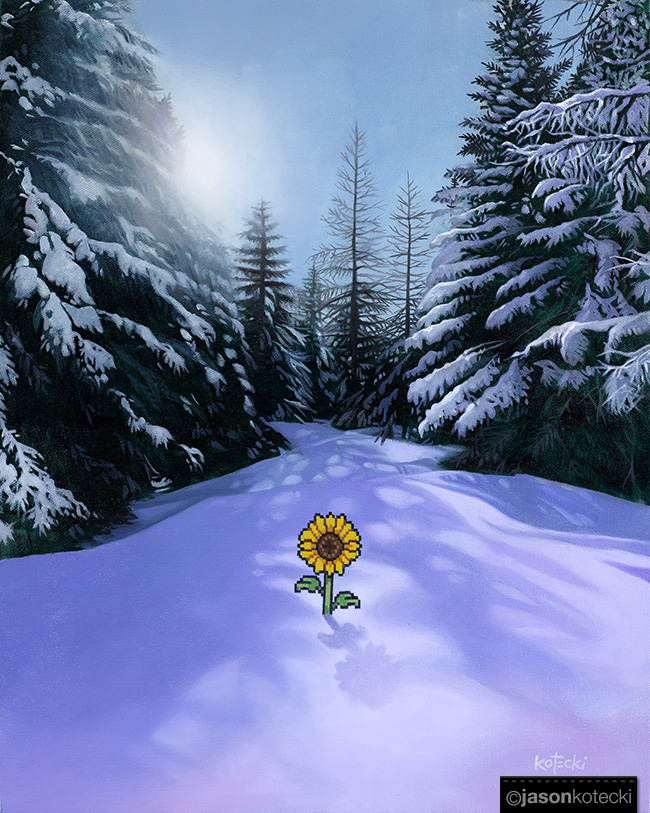
“We Can’t Let Winter Win” by Jason Kotecki. 16 x 20. Oil on canvas. Original is available 🟢 Shop this art!
One thing I love about the Midwest is the seasons. Real ones. Not like those they claim to have elsewhere, so-called “winters” with an occasional snow flurry and temperatures that sometimes flirt below forty.
In Wisconsin, our seasons are pure, not pretenders.
I like that, because it allows me to fully embrace the beauty and lessons of each one. It’s a reflection of life, which has distinct seasons, no matter where we live.
If we’re honest, we’d prefer life to be one long, glorious summer, filled with sunshine and popsicles. But no. There are seasons of autumn, times for slowing down and saying goodbyes. And there are long winters of loneliness, where life feels frozen solid, and hope gets buried under a blanket of snow.
Of course, spring always follows, but sometimes it seems to have overslept.
In Wisconsin, there is always a point when you’re pretty sure winter is over.
Live here long enough, and you realize it’s not.
There’s always one last gasp. One final snowstorm. One more cold snap that steals spring away, just as you were about to elope together on your way to summer.
That might be the most deflating, difficult part of winter: The moment when it appears it will never end, and you don’t know how much more you can take.
Life feels like that sometimes, when it seems like winter’s gonna win.
Winter wins when it convinces us that nothing will ever change.
Winter wins when we let disappointment over unmet expectations turn into resentment.
Winter wins when we allow ourselves to be buried under a blanket of apathy.
Winter wins when we decide to give up and let the hope within us flicker out.
But it doesn’t have to get the final say.
This painting is a reminder that we can’t let winter win.
The 8-bit sunflower is reminiscent of a video game, because I think that’s a good way to think of it. When you’re in the middle of one of life’s winters, everything is heavy. Summer looks so far away. We see all the things that need to change for us to go from where we are to where we want to be, and it feels insurmountable.
Sometimes the answer to the darkness that weighs down on us is a little levity. Making a game out of it is a way to rise above the life-and-death seriousness of our situation. It takes us ever-so-slightly outside ourselves to give us perspective that is a little wider than the restricted, optionless way winter can feel sometimes.
Part of what makes a game engaging and fun is that there is a challenge to it. But the key is for it to be a doable challenge. So instead of focusing on all the ways we are frozen in place and how many more days of winter are ahead, make a game out of finding even one tiny clue that spring is on its way. You don’t need to defeat the Final Boss and save the Princess; you just need to make it past this level.
Today.
The game is this: Figure out how to win today.
It doesn’t have to be big.
It could be one five-minute prayer.
It could be getting dinner on the table.
It could be dumping the bottle of vodka down the drain.
It might just be getting out of bed.
Sometimes the win is just giving it one more day.
I’ve experienced many winters, especially in the early days of building our business. I once got some advice from a business colleague I’ve never forgotten. He, too, was an entrepreneur and knew how discouraging it was to feel like you made one step forward only to take three steps back. He shared a simple policy he lived by. On those really hard days, the days when he didn’t think he could go any further, he promised himself he’d give it one more day. He gave himself permission to abandon ship after that, but not before he gave it one more day.
Sure enough, the next day always brought some glint of hope, a new reason to believe. There was rarely any huge breakthrough that magically happened. Maybe it was a small sale. Maybe it was an encouraging word from a friend. Maybe it was just a good night’s sleep.
Just a baby step forward.
We win when we find evidence that spring is on its way.
We win when hope bursts through a blanket of apathy.
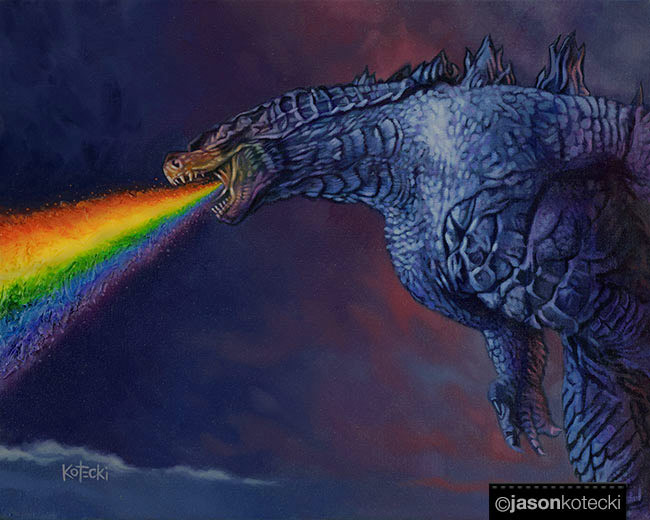
“Don’t Fight Fight with Fire” by Jason Kotecki. 20 x 16. Oil on canvas. Original is SOLD 🔴 Shop this art!
If you try to do anything worthwhile, you’ll likely suffer skeptics and critics.
When you encounter naysayers, you have a few options. You can allow them to stop you. This is generally not advised, especially if they are little more than bullies. Or you can use their doubts as fuel.
This is what I recommend, but with caution.
You see, that fuel burns hot. If you rely too much on it, you can end up consumed with anger and rage. If it becomes all about proving someone else wrong, rather than pursuing something worthwhile that brings you joy, you will be the loser in the end.
When I was younger, I idolized Michael Jordan. Besides his athletic prowess, I also admired his work ethic, determination, and persistence. But I also remember the speech he gave when he was inducted into the NBA Hall of Fame. Despite having accomplished everything a player could possibly achieve and being widely regarded as the greatest of all time, he was still holding on to grudges from decades gone by. Perceived slights from his high school basketball coach, teammates, reporters, and fellow competitors. He was still trying to torch them all to prove his dominance, spitting out petty barbs to people he perceived as having wronged him. He came across as bitter, shallow, and small.
Those slights he used to fuel his competitive drive seemed to have consumed him, leaving him charred.
It’s natural to want to right perceived wrongs. But as many wise people have said, “Withholding forgiveness is like drinking poison and expecting the other person to die.”
Our culture today seems more combative than ever. Trash-talking is considered an art form. We are urged to use the haters to fuel our rise, and then, when our success is undeniable, use it to torch them. When we win, it’s open season on our opponent. We must reign fiery retorts and comebacks down upon them, shaming them into submission. The more clever the comeback, the more street cred we receive.
But there’s a better way, and the Wright Brothers are a great example.
As you might imagine, the race to be the first to fly was heated. The two were fiercely competitive, but they never badmouthed their competitors, choosing instead to compliment their good qualities.
One of their biggest rivals was a man by the name of Samuel Langley. He was the head of the Smithsonian, one of the most respected scientists of the day, and by far the most well-funded individual pursuing the problem of flight. He portrayed a haughty pride over his self-perceived inevitability of success. Ultimately, he experienced a very public, very humiliating failure.
One that opened the door for the Wright Brothers to gloat.
As I read David McCullough’s book about them, I found myself rooting for Orville and Wilbur to do some sort of well-deserved verbal victory dance.
They never did.
McCullough writes:
“Neither brother was ever to make critical or belittling comments about Langley. Rather, they expressed respect and gratitude for the part he had played in their efforts. Just knowing that the head of the Smithsonian, the most prominent scientific institution in America, believed in the possibility of human flight was one of the influences that led them to proceed with their work.
Wilbur told Octave Chanute in a letter written some years later: ‘He possessed mental and moral qualities of the kind that influence history. When scientists in general considered it discreditable to work in the field of aeronautics, he possessed both the discernment to discover possibilities there and the moral courage to subject himself to the ridicule of the public and the apologies of his friends. He deserves more credit for this than he has yet received.’”
How kind. How gracious. And frankly, how epically badass.
Taking the high road and responding with kindness possesses an underrated level of effectiveness. For the Bible tells us that when you treat your enemies with kindness, “you heap burning coals upon their head.”
Don’t let the naysayers stop you. You can turn them into motivation, but be careful about using them for fuel.
Fighting fire with fire leaves both of you as a pile of ash.
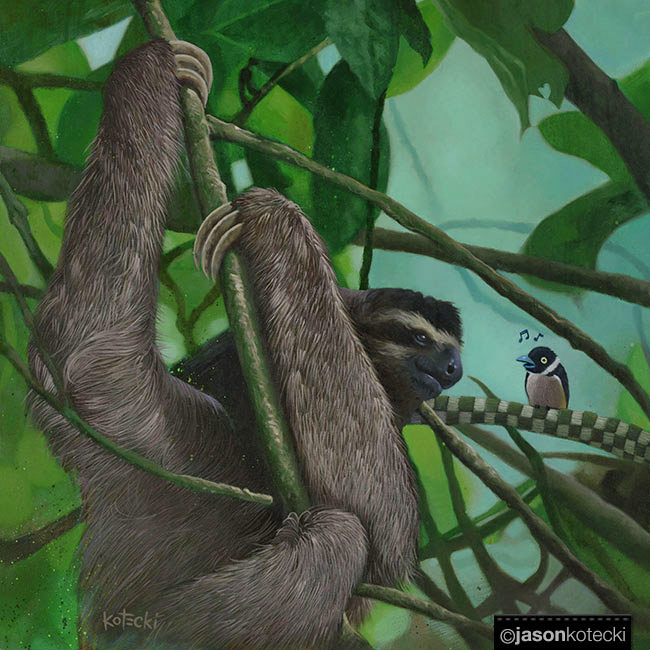
“True Believer” by Jason Kotecki. 24 x 24. Oil on canvas. Original is available. 🟢 Shop this art!
Dreams always take longer than we think.
There may be such a thing as overnight successes, but if so, they don’t stay successful for very long.
More often than not, so-called “overnight successes” are anything but.
One time, Kim and I spent a couple of hundred dollars on a two-day craft show. That was a big chunk of change for us at the time — about two months’ worth of groceries. We were next to a booth where a guy was selling knockoff Garfield tchotchkes. Meanwhile, we moved a grand total of $7.92 worth of greeting cards. It was rough. Then we drowned our sorrows in sirloin steaks at Outback, which made our negative profit margin even worse.
I have a lot of stories like that from the early days. Happy times.
Over the years, I have often felt like the sloth in this painting. Very little progress to show for a heck of a lot of effort.
But then I think of things like that craft show, and I’m impressed and even a little surprised by how far we’ve come. There is a great sense of satisfaction in what we’ve built and the things we’ve accomplished, regardless of how much distance there is left to cover.
Anything worth building takes time.
More time than you think it should.
Like way more.
We need to hear that reminder often, because it goes for everything from dream businesses and amazing relationships to paying off Bank of America and mastering the clarinet. Thanks to the proliferation of microwave ovens and high-speed internet, progress always seems to be taking longer than it should. Then the media peddles their stories of overnight success. They catapulted to fame and fortune in one fell swoop; why can’t you?
When the early buzz of enthusiasm wanes, discouragement is quick to settle in. It is during those seasons that we need to look for and listen to our true believers.
I’ve been fortunate to have quite a few in my life.
My Grandma K. made me feel like I was special, just as I was.
My third-grade teacher, Mrs. Smith, encouraged me to take my artistic talent seriously.
My Little League coach, Mr. Dawson, helped me believe that I was a winner.
My high school art teacher, Mrs. Garrett, made me believe I had the talent to do this for a living.
When I was an uncertain teenager, Deacon Vince saw me as a grown-up with valuable contributions to make.
When Kim and I got married and launched our business, we were graced with a few true believers who saw the vision, including our parents and our best friends, Sue and Jenna. Theirs were not just empty words of encouragement. They responded with action by offering their time, money, and prayers. This signaled the proof of their belief.
The certainty from true believers is invaluable. There will come a time when you lose faith in the vision, and you will need them to remind you that it’s real.
Mounting failures and things taking longer than you expected take a toll. That vision, which once seemed so clear, begins to fade. You wonder if all the naysayers were right. After all, so many of them have way more experience than you, and the evidence seems to be piling up in their favor. Maybe I AM delusional? Maybe I was mistaken? Maybe the signals got crossed and I accidentally co-opted a dream that was not meant for me…
I entertained all these thoughts at various times. It was tempting to give up.
But then I remembered my parents. And Kim’s parents. And Sue and Jenna. I remembered that nobody pours money or time into a lost cause. Their sacrifice was tangible proof of their belief in us. It helped assure me that no, this is not a mirage. It’s real. They see it.
Their belief bolstered my own.
We need cheerleaders to succeed. They give us the boost we need when our dream seems late in coming.
There are a few reasons dreams take longer than we think they should.
One is partly for us to prove how much we want it.
But it’s also because the most important part of a dream is who we become in the process of chasing it. That’s the real reward.
When success doesn’t materialize as quickly as you thought it would and you’re discouraged by your dream taking too long, don’t despair. Heed the true believer cheering you on.
Take it from the sloth. Achieving anything worthwhile is a marathon, not a sprint.
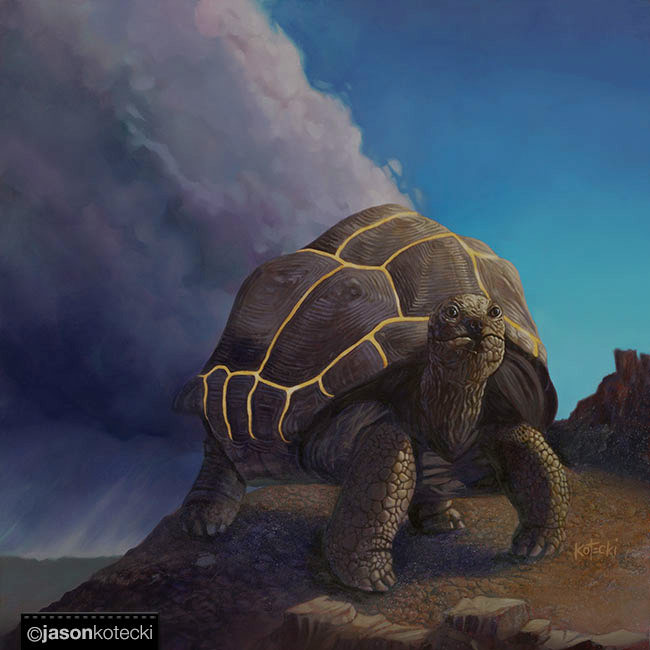
“Kintsugi Tortoise” by Jason Kotecki. 30 x 30. Oil on canvas. Original is SOLD. 🔴 Shop this art!
All dreamers start out delusional.
But perhaps that’s an essential ingredient.
The feeling that their idea is “genius” and the perception of their inevitability of success provide the enthusiasm and energy to get started. After all, no one found the fuel to begin chasing a dream by focusing on all the reasons it could never work.
The critical moment is how the dreamer responds when he or she first encounters adversity.
Or as philosopher Mike Tyson put it, “Everyone has a plan until they get punched in the mouth.”
If a dream is big enough and you pursue it long enough, it will break you.
Your confidence will be shattered. Doubt will creep in. Hope will be lost.
Then what?
I’m sad to say that’s often where it ends. The dream dissolves into an emaciated wish, a thin, pale shadow of its former glorious self.
For twenty-five years, Kim and I dreamed of having a lake home. We talked about it on our first date. We spent hundreds and hundreds of hours talking about it, trying to figure out the most efficient way to make it happen while still doing the work we love and feel called to. We tried on dozens of scenarios in our minds, calculating what was possible and what sacrifices might be required.
In the early days, it seemed like just a matter of time before we made it happen. We had pure motives, a little bit of talent, and a desire to work hard. I could see it, clear as day. On the hard days, the steadfast belief that it would come true kept me going. In my naiveté, I figured it would take a year, maybe three at most. (Ha!)
As months turned to years, and our kids got older, doubts crept in. I wondered if I was wasting my time. I wondered if I was only holding on in desperation, and that my death grip on my dream life was keeping me from living my real one.
It was exhausting and soul-crushing at times. While on a family vacation in Florida, and with the kids asleep in bed, I was sitting on the balcony of our rental. Although it was too dark to see them, I could hear the Gulf’s waves pound the shoreline. My heart was broken, and I wished that I’d never had the dream at all. I was overcome by the desire to throw it back into the sea.
I considered that maybe giving it up would give me relief and freedom. I yearned for someone from a Harry Potter book to cast a Memory Charm upon me, to obliviate the dream from my memory.
That night on the balcony in Florida was February 3, 2020. A little over a month later, a pandemic began, and all hell broke loose in our lives.
Yet somehow, just eleven months later, our family moved into our dream home on Lake Michigan. (Never in a million years did I think it would be one of the Great ones!)
Kintsugi is the Japanese art of repairing broken pottery with gold (or other precious metals). Instead of disguising the damage, kintsugi highlights the repairs, transforming the broken object into a unique and beautiful piece. It’s a philosophy that embraces imperfections and impermanence, finding beauty in flaws and celebrating the history of an object.
It’s true that if a vessel breaks, it can never be made to look new again.
But kintsugi makes it better than new, because it’s even more beautiful than it was before.
Our brokenness makes us humble. Humility is the most beautiful virtue because it allows our other good qualities to shine fully and be most helpful to ourselves and the world.
These broken places within us are not defects. They are the places where light can shine through. Those golden scars embody a soul that is stronger and a story that’s more beautiful because of the trial.
This painting represents the slow patience that’s required of a person trying to achieve something great. It’s a reminder that we will experience the storms of struggle and brokenness. But it’s also a beacon of hope for brighter days ahead waiting for us if we persist.
The journey may be harder than you expected, but the you that emerges will be better for it.
“You Can Just Do Things” by Jason Kotecki. 30 x 24. Oil on canvas. Original is available. 🔴 Shop this art!
I don’t know who needs to hear this, but you can just do things.
It’s true.
Yet it seems we’re always waiting for something before we can begin.
We are waiting until we get the degree.
We are waiting until the kids leave the nest or until we retire.
We are waiting until we know all the steps.
We are waiting until we finalize the plan.
We are waiting until we feel ready.
We are waiting until we feel courageous.
We are waiting for inspiration.
We are waiting for permission.
We are waiting for the stars to align, the sun to come out, and conditions to be perfect.
We are waiting for just one last thing before the rest of our lives can begin.
Meanwhile, sand slips through the hourglass, turning into minutes, days, and years.
Patience is a virtue, and there are times in life when only patience will do. But more often than not, our waiting is just a form of hiding. Adultitis sabotages us before we even begin.
You can just do things.
Unfortunately, it’s easier to complain. To blame someone else. To wait for instructions, permission, or for the timing to be just right.
But the timing will never seem right.
You don’t have to wait for permission.
You don’t need a hall pass.
You don’t need a note from your parents.
You don’t need a document signed by a notary public.
You can just do things.
As I was working on the manuscript for The Penguin Who Flew, I had the serendipitous opportunity to take a writing retreat to the Outer Banks in North Carolina. It’s the very site where Orville and Wilbur Wright achieved flight for the first time. While I was there, I dove deep into their story. I read “The Wright Brothers” by David McCullough, watched a documentary about their life, and visited the National Monument in Kitty Hawk, standing at the place where they made history.
The Wright Brothers did not wait for permission.
Other people working on achieving sustained flight of an engine-powered, heavier-than-air aircraft were highly educated experts. The Wrights only had high school diplomas. But they didn’t put their dream on pause to get a degree. Instead, they read books on math and physics, studied and observed birds in flight, and collected data from their own experiments. They needed knowledge and experience, not a piece of paper.
They also didn’t wait for funding from investors. Big money went to the more well-known, more highly educated experts in the race. Orville and Wilbur were nobodies, unknown and irrelevant. They didn’t have financial backers, an inheritance from a wealthy father, or a winning lottery ticket in their pocket. They had a mildly successful business that provided just enough profit to self-fund their experiments, bit by bit.
Nor did they wait until they had a full plan in place before taking their first steps. The brothers tinkered, learning as they went. Although the whole point was to figure out how to make a self-powered plane, they didn’t even bother with a motor until they could figure out how to master lift, balance, and control. Their competitors floundered trying to accomplish everything all at once.
Even after the brothers had cracked the nut of manned flight, they were met with doubt and disinterest in their initial attempt to sell their invention to the U.S. government. Instead of giving up, they went to Europe. It was only upon becoming celebrities after successful, public demonstrations in France that the United States finally offered a contract.
You can just do things.
“Whoa, hold up, pal,” you might be saying. “You can’t just be a surgeon without a medical degree.” Well, obviously. Of course. It’s easy to come up with exceptions, but they only prove the rule.
You don’t need permission to change the direction your life is heading, and you don’t need a piece of paper on the wall to start improving your life today.
Real life is not a schoolyard version of kickball, where you wait anxiously for someone to pick you, hoping it’s sooner rather than later.
Adultitis is the king of convincing you that you absolutely need just one more thing before you begin. It’s really just trying to kill time and run out the clock on you.
Yes, you will need some patience, but you don’t need permission to start chasing your dream.
You don’t need to wait for a pink slip to start looking for a better job.
You don’t need to wait until you’re a millionaire before you start being generous.
You don’t need to wait to feel courageous before you can act bravely.
You can just ask for help.
You can just start a side hustle.
You can just ask her on a date.
You can just homeschool your kids.
You can just apply for better jobs, even if you already have one.
You can just stop spending money on stupid things.
You can just end that toxic relationship.
You can just cancel your subscription to Netflix.
You can just offer forgiveness before receiving your apology.
You can just talk to God and ask Him to show you He’s real.
You can just stop waiting for permission.
And you know what else?
You can be afraid and still do all of these things.
Don’t waste your life waiting for the fear to magically disappear.
There will not be a time when you will have all the assurances you need.
You will not earn everyone’s unconditional approval.
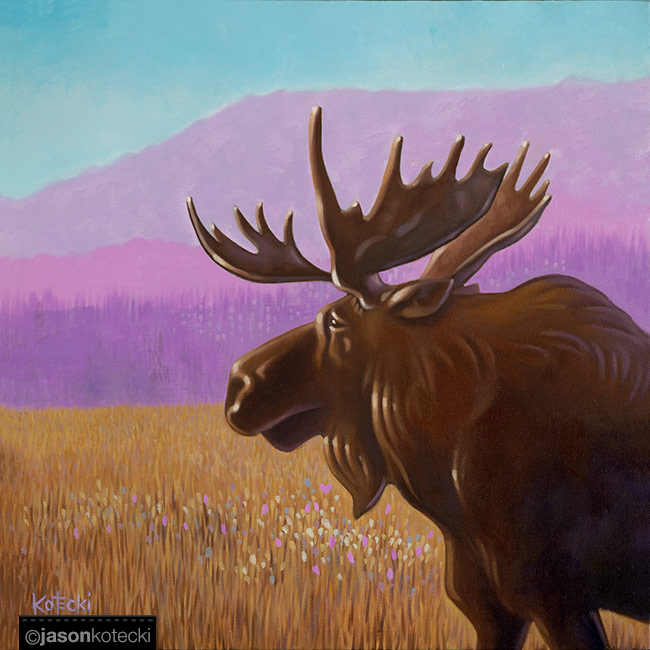
“Chocolate Moose” by Jason Kotecki. 20 x 20. Oil on canvas. Original is SOLD 🔴 Shop this art!
Our family didn’t go to Yellowstone to see moose, specifically. We went for the scenery, and we did want to see as much wildlife as possible.
One afternoon, we settled into a nice spot in the shadow of the Grand Tetons called Schwabacher Landing, and waited for moose. We’d heard the odds of seeing them there were good. Very quietly, we waited, and waited, and waited. It felt like any moment one might emerge from the brush to steal a drink from the pond.
We sat for two hours before admitting defeat and heading back to the hotel, disappointed.
The next day, while in Jackson, we wandered into the gallery of a photographer who told us about a side road to check out if we really wanted to see moose. The sun was about to set, but the spot was only a few miles away. We were skeptical, but two minutes after parking our car, we saw three moose.
It was as if our patience the day before had been rewarded in some strange way. Our persistence earned us a small prize after all, like a sweet dessert at the end of a meal.
In life, there is a lot of waiting. Long periods where nothing seems to go right. Tiresome stretches where we sit with patient expectations to see a dream come true.
This sometimes confounds us, because somewhere along the line, we got the idea that life is supposed to be easy. We chase comfort and good feelings and grow frustrated when we encounter struggle and pain.
But the truth is that a life in which you expect nothing but nummy treats and comforts will leave you disappointed. That’s not what this life is for.
As Pope Benedict XVI implored, “You are not made for comfort, you are made for greatness.”
But to paraphrase Benjamin Franklin, chocolate is proof that God loves us and loves to see us happy. That’s probably why he rewards us with little treats along the way. They are there to reward our efforts, keep us on the right track, and motivate us to keep going in pursuit of true greatness.
And yet, it is not healthy to develop a spiritual sweet tooth. Perhaps heaven will flow with rivers of decadent chocolate, but chocolate is not meant to be our entire diet here on earth. Life is a training ground for relying on faith instead of feelings.
The small desserts we encounter on our journey are only a foretaste of what’s ahead.
Enjoy them. Delight in them. Savor them so that you may persevere during the difficult times.
“Big & Grand” by Jason & Ginny Kotecki. 24 x 24. Oil on canvas. Original is SOLD 🔴 Shop this art!
Everything that exists first started as an idea. A vision. A dream.
The question is, How many people have to see it before it becomes reality?
On a family trip west, we spent time in the foothills of the Grand Tetons hoping to see moose. We didn’t have any luck, but while we were waiting, I snapped a photo of my youngest daughter sitting at the edge of the pond, tossing pebbles into the water. I thought it might be the start of a great painting. The only question in my mind was, “What might she be looking at?”
I imagined painting a moose into the scene, maybe a huge one. I thought Bigfoot would be funny, or perhaps a montage of all sorts of fictional creatures: leprechauns, fairies, unicorns, oh my!
Eventually, the solution became obvious: it needed to be Big.
You see, “Big” is a character Ginny created when she was younger, and he’s made appearances in many of her artworks over the years. He needed to be what she was looking at, and that’s how this painting became my first official collaboration.
Ginny drew and painted Big, and I handled the rest of the painting, including his reflection in the pond. It was a blast, and my heart just about exploded when she signed her name in the corner. (Rose is her middle name.)
I love the origin story of Big. According to Ginny, he is a lovable giant who lives in the clouds and comes down occasionally to give people hugs.
One thing we can all agree on is that the world could definitely use more hugs.
I wish that Big were real.
Part of me wonders if he is.
How many people have to see it before it becomes reality?
You have to imagine something before it can become a physical reality, whether it’s the main character of a book or a life-saving cancer drug. Our dreams are often born from a problem that needs to be solved, like a personal need or a nagging challenge you regularly encounter. Maybe it’s a larger one the world around you is groaning for.
I believe your dreams are planted within you by God. And He wouldn’t have planted them within you if you weren’t the right person to help bring them to fruition.
These dreams start as a faint vision or a passing thought, before slowly coming into focus, eventually becoming clear in your mind’s eye.
There comes a point when you need some affirmation that you’re not hallucinating, that there really is something to this vision that has stirred up a fiery passion within you. Then comes the big and scary moment: You summon up courage and float the idea past a few others, just to check if they can see it too.
Usually, the reactions are mixed.
Many won’t see the vision at all. They may even try to argue you out of it, saying it’s not realistic or practical.
Some will nod and smile, offering words of encouragement, but it feels more like a grandparent whose grandchild just told them about their imaginary friend: “What an active imagination you have!”
But if the dream has merit, you will encounter some true believers. These folks must be taken seriously because you will need them later.
When I had the vision to take an unconventional path, to make a living with my art while making the world a little better by making its people a little more childlike, I experienced all of these reactions.
I encountered many who never saw the vision of what we were trying to build, even though I described it as accurately as I could. They included newspaper syndicates, retailers, publishers, licensing agents, and more.
I also felt the “pat, pat” on my head from those who viewed me as slightly delusional, but relatively harmless and easily redirected once reality hit.
But I was also graced with a few true believers who saw the vision. Some notable ones included my parents, Kim’s parents, and our best friends, Sue and Jenna. Theirs were not just empty words of encouragement. They responded with action by sacrificing their time, money, and prayers. This signaled the proof of their belief.
The certainty from true believers is invaluable. There will come a time when you lose faith in the vision, and you will need them to remind you that it’s real.
Mounting failures and things taking longer than you expected take a toll. That vision, which once seemed so clear, begins to fade. You wonder if all the naysayers were right. After all, so many of them had way more experience than you, and the evidence seems to be piling up in their favor. Maybe I am delusional? Maybe I was mistaken? Maybe the signals got crossed, and I accidentally co-opted a dream that was not meant for me…
I entertained all these thoughts at various times. It was tempting to give up.
But then I remembered my parents. And Kim’s parents. And Sue and Jenna. I remembered that nobody pours money or time into a lost cause. Their sacrifice was tangible proof of their belief in us. It helped assure me that no, this is not a mirage. It’s real. They see it.
Their belief bolstered my own.
It’s easy to feel discouraged and lose hope when people don’t see what you see. Or when it’s taking too long. It might even show up in a time and place you weren’t expecting. The dream might feel long in coming, but it won’t be late.
Disregard the people standing in your way.
Don’t worry about the ones who say, “I just don’t see it.”
That’s ok. Not everyone will catch your vision.
That doesn’t mean it’s not real.
Your idea might just be the hug our world’s been waiting for.
“The Rebel Princess” by Jason Kotecki. 20 x 20. Oil on canvas. Original is SOLD 🔴 Shop this art!
This is part of “Adultitis Fighters,” a series of paintings by Jason Kotecki featuring real and fictional characters who serve as role models in the fight against Adultitis.
Princess Leia, from the “Star Wars” franchise, is a role model because fighting Adultitis is a fight. (And Darth Vader is a pretty good example of someone with a full-blown case.) Far from a traditional “damsel in distress,” Leia showed great strength as a leader, rising up in rebellion against oppression and tyranny, facing the battle with courage and resilience while preserving a compassionate and empathetic heart. Her example encourages us to embrace our own strength, stand up for what is right, and never lose hope in the face of adversity.
“I don’t know who you are or where you came from, but from now on you’ll do as I tell you, okay?”
“Someone has to save our skins. Into the garbage chute, flyboy.”
“Never be afraid of who you are.”
“Hope is like the sun. If you only believe it when you see it you’ll never make it through the night.”