Topic: Personal Development

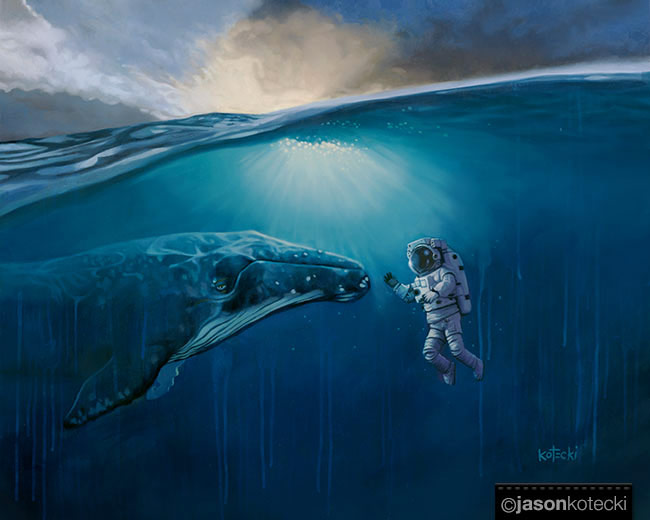
  • Great Expectations

    “Great Expectations” by Jason Kotecki. 30 x 24. Oil on canvas.
    Original is SOLD. 🔴 Shop this art!

    I have a confession to make.

    I fully expected to marry a brunette. I was pretty vocal about it, even. No blondes for me!

    In retrospect, the women who caught my eye when I was young — Princess Leia, Lois Lane, Wonder Woman — were all brunette. Most of the girls I dated in high school were brunettes.

    But after I met Kim, who was most definitely not a brunette, I didn’t waste any time wondering if I was making the right choice in spending time with her. I didn’t delay my decision to propose because I was holding out for a brunette to come along. I didn’t miss the opportunity of a lifetime because “this wasn’t the way it was supposed to go.”

    I wish I could say I was that flexible with all my expectations.

    When I graduated from college with a degree in illustration, I expected I’d make my living as a freelance illustrator. A year into that pursuit led me to realize that I really hated taking orders drawing what other people wanted me to draw.

    So I shifted all my attention to a comic strip I had been developing called Kim & Jason. I expected that I’d make my mark in the world by following in the footsteps of Charles Schulz and Bill Watterson.

    I put everything into it for six years. Along the way, I fell into speaking, and it started to bring in money. Way more than the comic strip. I eventually made the difficult decision to retire Kim & Jason so I could double down on what was working.

    With that decision, it felt that the naysayers were proven right: I really couldn’t make it as an artist. But the only reason they seemed right is that my expectations were wrong.

    I once heard a talk by Fr. Mike Schmitz in which he said, “Expectations are a thief of peace.”

    I recoiled at the idea at first, because I associate expectations with hope, and hope is good. If expectations are the thief of peace, is the antidote to become a pessimist? Lower the bar? Settle for mediocrity? Slack off? That seemed less than ideal.

    Then it occurred to me: An expectation is a prediction.

    It’s a prediction about what you think — and maybe even hope — will happen. Sometimes it’s little more than wishful thinking, but it could be a legitimate educated guess with actual data to back it up. And sometimes your prediction is correct and your expectations are met. 

    But it’s still a prediction. 

    One you might be making with a wildly insufficient lack of information.

    Before I actually started freelancing, I didn’t know how I’d feel creating things that didn’t light me up. When I began my comic strip, I didn’t realize how quickly the internet would decimate newspapers and change the landscape. And back then, I didn’t know anything about the business of professional speaking.

    Take a quick review of your life right now. How much current frustration, pain, or sadness is the result of circumstances turning out differently from what you expected?

    Is holding on to what didn’t happen keeping you from appreciating all the great things that did and are happening now?

    Maybe you can relate to this simple example. Recently, I had a wonderful, tremendously productive day that felt like a failure. One project took waaaay longer than I expected, blowing my to-do list to smithereens. Although some tasks got pushed to another day, I accomplished a few other things I hadn’t planned and took advantage of the unseasonably warm day to enjoy an invigorating walk in the sunshine. It ended with a delicious dinner with my beautiful bride.

    By all objective measures, it was a very good day. But it didn’t feel like it.

    The thing that soured it? 

    My expectations. 

    The day simply didn’t line up according to the timing and order of my expectations. Because some to-dos were left unchecked — even though other great elements were added — somehow it felt like I failed. 

    This is not a cautionary tale against planning or a list of pro tips to bulletproof your plans. It’s a reminder that it’s hard to appreciate accomplishments when they are in the same room as even one unmet expectation, one missed goal, or one unforeseen event that was out of your control. 

    In the battle between reality and expectations, reality is undefeated. 

    Expectations really are a thief of peace. They can ruin a day or derail our dream if we’re not careful.

    I believe that God plants dreams in our hearts. The details we imagine in the early stages create enthusiasm that serves as fuel to get moving. But oftentimes, those details reflect immaturity, a lack of imagination, or are limited by the fact that we don’t yet have the relationships, technology, or knowledge that will eventually help us to get there.

    Art was my first love; the first talent I discovered, and the one that was most nurtured early in my life. It’s easy to see why I would have the expectation of making it as an artist.

    But that was before I took a creative writing class in high school.

    It was before I discovered a gift for public speaking in college.

    It was before I realized “professional speaker” was an actual job.

    And it was before I figured out that my art, writing, and speaking could be combined to create something unique and bigger than the sum of their parts.

    Like many people, when I was a young adult, I expected my career to go a certain way. It went a different direction, filled with opportunities and experiences I didn’t even know were possible when I was an 18-year-old kid.

    But thirty years ago, if I had been given the choice between my original expectations and a full picture of how my life turned out, I’d choose my current reality. 

    Every. Single. Time.

    And yet, here’s the crazy part: because it doesn’t match up with my original expectation — you know, the one I had when I was a naive, inexperienced teenager — I am sometimes tempted to wonder where I went wrong.

    Expectations are a thief of peace.

    Holding on to expectations that don’t match reality is a terrific way to go through life frustrated and disappointed.

    When we become resentful of missed expectations, we are in danger of also missing other opportunities and blessings we didn’t see coming.  

    The astronaut in this painting represents a dreamer.

    This dreamer has always possessed a spirit of adventure and imagined a life spent exploring the unknown, pushing past the boundaries of human understanding, and experiencing the supernatural enchantment. The dreamer expected this would happen as an astronaut in the context of space.

    Instead, the dreamer’s story ended up in the ocean after a visit to Sea World, and now days are spent adventurously exploring the unknown and experiencing enchantment in encounters with sea creatures.

    So…did this dreamer’s dream go unfulfilled?

    My friend Jessica has some good advice about how we should handle our expectations: “When you write that first story, print it as a draft, triple-spaced with extra wide margins. You do this because you’re anticipating edits.”

    Letting go of expectations is not about being pessimistic. One can be optimistic without becoming a slave to expectations. My optimism is grounded in the fact that God has ALL the data, loves me more than I deserve, and tells the best stories. We can make plans and hope for things to go a certain way, while still holding loosely to them, trusting that God may have different (and better!) ones. 

    If you want more peace in your life, don’t abandon hope. 

    Don’t stop striving for greatness. 
    Just stop putting faith in your predictions.
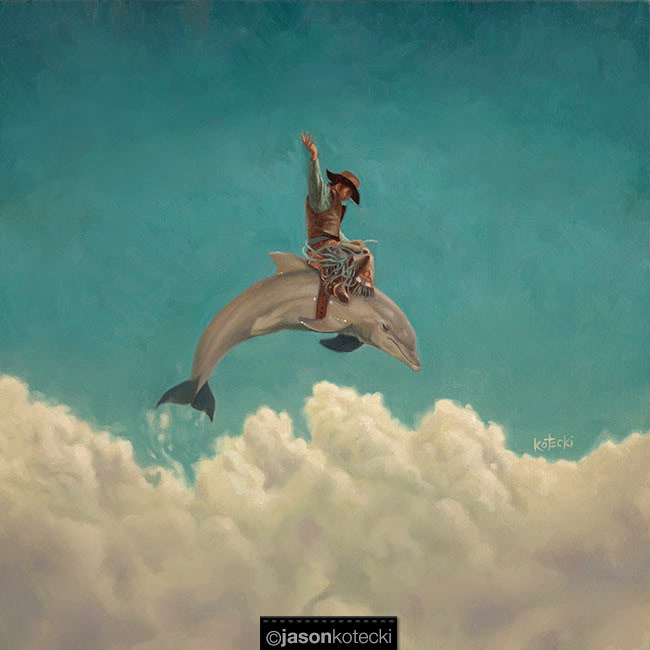
  • Rodeo Dolphin

    “Rodeo Dolphin” by Jason Kotecki. 20 x 20. Oil on canvas.
    Original is available. 🔴 Shop this art!

    This painting is a little bit crazy.

    Some people will be quick to point out that cowboys don’t ride dolphins. They’ll scoff that dolphins don’t belong in the sky. They’ll demand an explanation about the meaning of it all.

    Those were the same kind of people who scoffed at the Wright Brothers for having the audacity of thinking they could build a flying machine. Humans can’t fly, they said. They don’t belong in the sky, they scoffed. They demanded an explanation for why these two, with no college education, no formal technical training, no experience working with anyone other than themselves, no friends in high places, no financial backers, no government subsidies, and little money of their own, would ever think they could achieve such an absurdity?

    To be fair, for more than fifty years, many others before them served as a source of comic relief, mocked and ridiculed in the press for their delusions of grandeur and “childish” flying machines.

    Somehow, and to our benefit, this did not deter Wilbur and Orville Wright.

    History is filled with people criticized for being crazy.

    But, as it’s been said, monuments are not built for critics and statues are not dedicated to fault-finders.

    Very often, our dreams appear absurd, especially to others. And especially the big ones.

    A horseless carriage?

    A self-powered flying machine?

    A pocket-sized device you can use to communicate with anyone in the world?

    What will they think of next? A flying car? A colony on Mars? A cure for cancer?

    This reminder is not reserved for the select few who change world history and have statues erected in their honor. I make a living doing what I love from my studio on the shores of Lake Michigan. Trust me, in the early days of our business, when Kim and I were living on a diet largely dependent on Hamburger Helper and couldn’t afford to run our air conditioning during the hot summer, every bit of my current life seemed far-fetched, to say the least.

    Of course, you can’t count on every dream coming true.

    But you can count on somebody calling you crazy for dreaming it.

    That’s ok.

    Keep dreaming anyway.

    The best dreams start out a little crazy.
  • You Can Just Do Things

    “You Can Just Do Things” by Jason Kotecki. 30 x 24. Oil on canvas.
    Original is available. 🔴 Shop this art!

    I don’t know who needs to hear this, but you can just do things.

    It’s true.

    Yet it seems we’re always waiting for something before we can begin.

    We are waiting until we get the degree.

    We are waiting until the kids leave the nest or until we retire.

    We are waiting until we know all the steps.

    We are waiting until we finalize the plan.

    We are waiting until we feel ready.

    We are waiting until we feel courageous.

    We are waiting for inspiration.

    We are waiting for permission.

    We are waiting for the stars to align, the sun to come out, and conditions to be perfect.

    We are waiting for just one last thing before the rest of our lives can begin.

    Meanwhile, sand slips through the hourglass, turning into minutes, days, and years.

    Patience is a virtue, and there are times in life when only patience will do. But more often than not, our waiting is just a form of hiding. Adultitis sabotages us before we even begin.

    You can just do things.

    Unfortunately, it’s easier to complain. To blame someone else. To wait for instructions, permission, or for the timing to be just right.

    But the timing will never seem right.

    You don’t have to wait for permission.

    You don’t need a hall pass.

    You don’t need a note from your parents.

    You don’t need a document signed by a notary public.

    You can just do things.

    As I was working on the manuscript for The Penguin Who Flew, I had the serendipitous opportunity to take a writing retreat to the Outer Banks in North Carolina. It’s the very site where Orville and Wilbur Wright achieved flight for the first time. While I was there, I dove deep into their story. I read “The Wright Brothers” by David McCullough, watched a documentary about their life, and visited the National Monument in Kitty Hawk, standing at the place where they made history.

    The Wright Brothers did not wait for permission.

    Other people working on achieving sustained flight of an engine-powered, heavier-than-air aircraft were highly educated experts. The Wrights only had high school diplomas. But they didn’t put their dream on pause to get a degree. Instead, they read books on math and physics, studied and observed birds in flight, and collected data from their own experiments. They needed knowledge and experience, not a piece of paper.

    They also didn’t wait for funding from investors. Big money went to the more well-known, more highly educated experts in the race. Orville and Wilbur were nobodies, unknown and irrelevant. They didn’t have financial backers, an inheritance from a wealthy father, or a winning lottery ticket in their pocket. They had a mildly successful business that provided just enough profit to self-fund their experiments, bit by bit.

    Nor did they wait until they had a full plan in place before taking their first steps. The brothers tinkered, learning as they went. Although the whole point was to figure out how to make a self-powered plane, they didn’t even bother with a motor until they could figure out how to master lift, balance, and control. Their competitors floundered trying to accomplish everything all at once.

    Even after the brothers had cracked the nut of manned flight, they were met with doubt and disinterest in their initial attempt to sell their invention to the U.S. government. Instead of giving up, they went to Europe. It was only upon becoming celebrities after successful, public demonstrations in France that the United States finally offered a contract.

    You can just do things.

    “Whoa, hold up, pal,” you might be saying. “You can’t just be a surgeon without a medical degree.” Well, obviously. Of course. It’s easy to come up with exceptions, but they only prove the rule.

    You don’t need permission to change the direction your life is heading, and you don’t need a piece of paper on the wall to start improving your life today.

    Real life is not a schoolyard version of kickball, where you wait anxiously for someone to pick you, hoping it’s sooner rather than later.

    Adultitis is the king of convincing you that you absolutely need just one more thing before you begin. It’s really just trying to kill time and run out the clock on you.

    Yes, you will need some patience, but you don’t need permission to start chasing your dream.

    You don’t need to wait for a pink slip to start looking for a better job.

    You don’t need to wait until you’re a millionaire before you start being generous.

    You don’t need to wait to feel courageous before you can act bravely. 

    You can just ask for help.

    You can just start a side hustle.

    You can just ask her on a date.

    You can just homeschool your kids.

    You can just apply for better jobs, even if you already have one.

    You can just stop spending money on stupid things.

    You can just end that toxic relationship.

    You can just cancel your subscription to Netflix.

    You can just offer forgiveness before receiving your apology.

    You can just talk to God and ask Him to show you He’s real.

    You can just stop waiting for permission.

    And you know what else?

    You can be afraid and still do all of these things.

    Don’t waste your life waiting for the fear to magically disappear.

    There will not be a time when you will have all the assurances you need.

    You will not earn everyone’s unconditional approval.

    You will not be able to eliminate every risk.

    You will not receive a guarantee of success.

    And yet, one truth remains.

    You can just do things.
  • The Prepper

    “The Prepper” by Jason Kotecki. 16 x 16. Oil on canvas.
    Original is SOLD 🔴 Shop this art!

    When my wife told me she was pregnant with our first child, my heart filled with joy.

    Two seconds later, panic arrived at the party.

    All I could think about was how profoundly our lives were about to change and I didn’t have the slightest idea of how to prepare. I immediately began searching Amazon for the latest owner’s manual for babies.

    Kim, on the other hand, seemed to calmly slide into the nesting phase that’s common to many moms in the animal kingdom. In preparation for a new life, they instinctually work to create conditions for that new life to thrive.

    In the years since I’ve seen Kim navigate this phase for all three of our kids, and I’ve realized there are parallels between mothers and artists. While not all of us get to experience motherhood, I believe that every last one of us is an artist.

    Yes, even if you can only draw stick figures.

    In essence, an artist is simply someone who brings something new and beautiful into the world with the potential to improve it in some way. It’s a one-of-a-kind gift that could not be created by anyone else.

    You could have been born at any time in any place, but you were born when and where you were born and you are alive now. You were born for a reason! As long as you’re still breathing, you have something within you the world needs.

    It might be a novel, a non-profit, a painting, or a play. Perhaps it’s a sculpture, a sonnet, or a song. It could also be that a building, a business, or a movement will be your masterpiece.

    We need to take this endeavor as seriously as a mother takes the preparations for her new baby. We need to create conditions that give our undertaking its best chance of success, and that involves three things: supplies, space, and safety.

    A serious mother collects the supplies that will be needed to help her succeed: diapers, bottles, creams, clothes, blankets, and toys. A serious artist needs supplies, too. It might be pens, pencils, paper and paint, or yarn, wood, software, or clay.

    A serious mother considers where the baby will sleep and play and she creates space for that to happen. Likewise, a serious artist also requires a dedicated space, even if it’s just a small folding table in the corner of their bedroom, or a workbench in the back of the garage.

    Finally, a serious mother makes preparations to ensure her youngster is protected and safe to grow and develop. A serious artist also needs a safe space for creativity. New ideas are especially fragile. One must not judge them too harshly at the start, for they need time to blossom into what they are to become.

    The nesting stage is fun, exciting, and imbued with the magic of anticipation, as you envision all the memories (or masterpieces) that will be made. It is a good inclination to want everything you need, and make sure it all has a place. After all, when you are in the whirlwind of caring for a newborn (or in the thick of the creative process), it’s helpful to have what you need, when you need it.

    But don’t be fooled.

    The trap that awaits both mothers and artists is the desire to have all the supplies one could corral, the most ideal space one could hope for, and the highest level of safety and comfort possible.

    All parents eventually come to discover that you are never fully prepared for a baby to arrive in your home. There will always be something you’ve forgotten, something you run out of too quickly.

    It’s ok. Eventually, you learn to make do, and from these constraints come real growth.

    One thing is certain…when it comes to parenting, Mother Nature will not be delayed. The baby is coming, ready or not.

    Alas, this is where the comparisons diverge, for the artist has no such advantage. As such, he or she may be lured into a trap that tricks them into a never-ending nesting phase of collecting all the colors and tools and tricks of the trade.

    It’s an illusion. Under the guise of being serious, the artist is now simply hiding. One must never be fooled into waiting for conditions to be perfect, because they never will be.

    If an artist is not careful, nine months of preparation can slip into nine years of procrastination, justified by not enough time, not enough space, not enough money to begin. Before you know it, nine decades of life are spent and the art your soul desired to make, the gift the world so desperately needed from you, never gets to emerge.

    Serious artists don’t let preparation turn into procrastination.

    We don’t need perfection. But we do need your art.

    That’s why we need you to take it seriously.
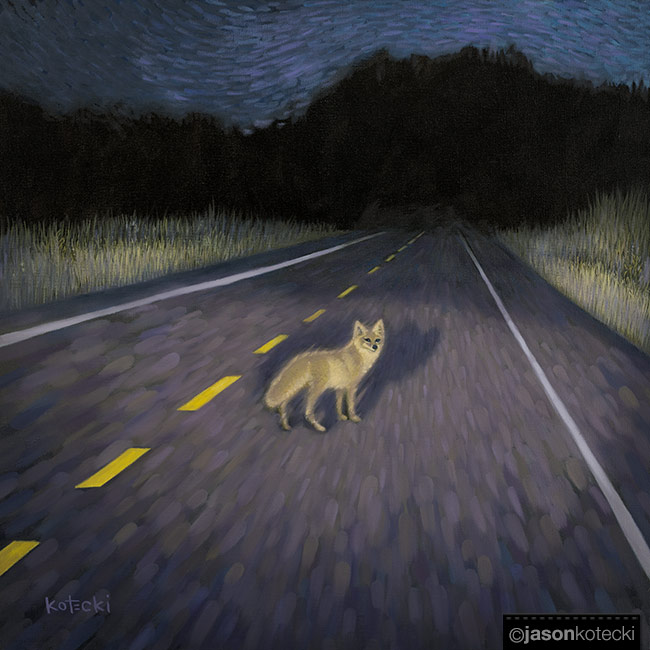
  • Ghost in the Road

    “Ghost in the Road” by Jason Kotecki. 20 x 20. Oil on canvas.
    Original is SOLD 🔴 Shop this art!

    It was like driving through a sea of black ink.

    The trip back to our hotel from the Lamar Valley was harrowing. It being Yellowstone, the specter of animals hanging out on the road is always a possibility. We’d reveled in the wildlife of the North American Serengeti, but now the sun was gone and darkness blanketed the winding way home. My knuckles were white on the steering wheel and Kim’s clear anxiety was less than helpful.

    We snaked around curve after curve, my eyes peeled for any signs of movement. Then we saw it: a small coyote trotting down the middle of the road. As we came upon him, I slowed to a stop. He turned his head and stood frozen in the bright beam of our headlights. Time stood still. He looked at us, and we looked at him, and for a brief moment, we connected.

    Kim snuck a quick photo before he turned away and disappeared into the darkness.

    It felt like we encountered a ghost in the road.

    Sometimes we encounter people in a similar way. Their life intersects with ours and we make a brief connection. They show up to guide us through difficulty, supporting us emotionally, physically, or spiritually. When the time to move on comes, they disappear from our lives, like a ghost in the road

    Have you had encounters like that, a limited interaction with someone that greatly impacted your life?

    Years ago, I had lunch with Phil Vischer, the co-creator of Veggie Tales. I was trying to get my Kim & Jason comic strip off the ground. He gave me a lot of great advice, but one of the most notable things he said was, “Assume that your life two years from now will be nothing like you imagine it will be. Be open to where God is leading. If God calls you or Kim to a different role or a different job, be open.”

    His advice left me unsettled, but it stuck with me.

    Around that same time, Kim and I encountered a woman named Mary Jo who worked for a local Catholic Church. She told us about a growing movement within the Church to educate children and adults together and assured us that if I could create a program that held the attention and spoke to both groups, I’d definitely be in demand as a speaker. She was right, and that’s how my now twenty-year career as a professional speaker began.

    It required me to retire the comic strip, but Phil Vischer’s prophetic words helped give me an open heart and comfort when I saw God lead us in a new direction.

    It’s been said that people are in our lives for a reason, a season, or a lifetime. Phil and Mary Jo are people who came into my life for a reason. They were fellow travelers who crossed my path, and for a brief moment in time, our souls connected. In their own way, they illuminated my path, let me know that I was seen, that what I was doing mattered, and to keep going.

    We are called to do that for others.

    I’ll never forget a time I was a ghost in someone else’s road.

    Waiting for everyone else to leave, she appeared at my product table at the back of the room after my second and final presentation of the day. She seemed hesitant, engaged in an internal debate on whether to approach or retreat. I noticed from her badge that her name was Jennifer. I assumed she was trying to decide if she wanted to buy something. Instead, she hesitantly exclaimed, “I want to trade you something, but I don’t want you to think I’m crazy.”

    “I won’t think you’re crazy,” I promised, not knowing what I was in for.

    Apparently I was convincing enough, as she began digging around in her purse. She pulled out a small black velvet box and placed it on the table between us. She said not a word. Perplexed, I determined that it looked like a ring box and deduced that her silence meant that I was supposed to pick it up. I opened it. I was right there were two simple rings inside, one band was rimmed across the top with a row of tiny diamonds; the other was shiny and plain.

    They were wedding rings.

    “Ok…” I stumbled. “It looks like there is a story here…”

    She began, “Six months ago today, my husband left me while I was at work.”

    Tears welled in her eyes. She offered no further details, but it was clear that it was as surprising as it was devastating. She continued, “After he left, on a whim, I decided to apply for my dream job, the one I never went for while we were together. And I got it. And it was amazing.”

    She began sobbing, and it suddenly felt that the table between us was two miles wide. She apologized for breaking down, while I debated jumping across the table to hug her right then and there.

    She regained her composure and said, “Sitting in your two sessions today…you just said so many things that hit me. For a long time, I had given up on love. I had given up on me. I told myself that this job — my career — was my new love now and that this would be the focus of my life. But you helped me to see that I can’t give up on love.”

    She motioned to the rings, and, looking at the last Adultitis First Aid Kit I had left, said, “If you’d be willing, I’d like to trade these for a new beginning. I don’t need them anymore.”

    I gave her a Kit and a big hug and mumbled something that I don’t remember, but was probably stupid.

    I don’t remember what I said that struck a chord. I don’t know whatever came of her, although it’s possible she’s still following our stuff all these years later.

    I was a ghost in the road of her story, and she was a ghost in the road of mine.

    Something I said to her on that day helped her to see with new eyes and gave her the confidence to bravely move forward. Meanwhile, Jennifer’s courage and her gift serve as an everlasting reminder of the privilege of what I get to do. When I get discouraged that the crowd I’m speaking to is too small, or not engaged enough, or that I am too tired, I think of Jennifer, a ghost in the road who crossed my path so many years ago, and I am reminded that every single day is an opportunity to change someone’s world.

    Never underestimate your role in helping to heal our world. As it has been said many times, “Helping one person might not change the world, but it could change the world for one person.”

    I hope this reflection opens your eyes and gives you an appreciation for the ghosts in your own road.

    And I hope it will inspire you to be a fellow traveler who crosses someone else’s, taking the time to look them in the eye and say, “I see you. You matter. You’re doing great. Keep going.”

  • Love is in the Air

    “Love Is In The Air” by Jason Kotecki. 16 x 16. Oil on canvas.
    Original is SOLD 🔴 Shop this art!

    This painting is called “Love is in the Air.”

    Our eyes draw us to the billowing steam from the geyser, forming the shape of a heart.

    Indeed, it is a fitting representation of the way most of our society views love. Like the steam, it is a little mysterious, always changing, and dependent on which way the wind is blowing. Love is regarded as a fleeting feeling evident on a wedding day, but which vanishes at some point in the ensuing years when life gets hard.

    I would like to invite us to look for a different, better metaphor for true love in this painting.

    Like the bison.

    The bison is rock solid. Grounded. Immovable in winds of change.

    My friend, contrary to popular belief, true love is not a feeling that ebbs and flows with the wind. It’s not caught up with transitory qualities like looks, circumstances, and emotions. Looks fade, circumstances change, and emotions are unreliable, often clouding reality.

    I’m no relationship expert, but I have been married for well over two decades now. If you want a relationship that outlasts the average, you cannot depend on feelings to save you. On any given day, your partner may not look or act anything like the person you first fell in love with. You may find yourselves in a circumstance you didn’t anticipate or plan for when everything was going well.

    True love isn’t a feeling; it’s a choice. 

    This points to another important difference between these two metaphors: The steam cloud has no control over itself. The bison, on the other hand, can take action.

    Here’s a real-world example of the difference:

    A few years ago, I instituted a new personal policy: Always stop at the lemonade stand.

    You see, I am a bit of an over-thinker. My old pattern of behavior went like this: I’d see some kids running a lemonade stand and think about stopping, only to drive past it while overthinking it to death. Did I have cash on me? Did I have the time? Was there even a convenient place to park? I’ve already driven six blocks past it; it would be stupid to turn around now. Ultimately, I’d miss the moment and feel bad for the rest of the day.

    So I decided to take the thinking (and overthinking) out of it. I decided to establish a new rule: ALWAYS STOP AT THE LEMONADE STAND. Of course, for this personal policy to work, it has to be ironclad. The only way to avoid overthinking was that there could be no exceptions. No excuses. I permitted myself to be late wherever I was going. Even if I was late to my own father’s funeral, “I had to stop at the lemonade stand.”

    The key is that when it comes to any sort of goal, habit, or resolution you establish, it’s a lot easier if you don’t give yourself any outs. Commit 100%. If you allow yourself even one exception, then it’s always a fight from then on. You’ll always give yourself a reason why it’s ok to ignore the rule “this one time.” 

    Even though it’s sometimes inconvenient, I love this policy. I like that it allows me to be more generous, which is in line with the type of person I want to be. I always ask the kids what they’re raising money for. I always try to encourage them in some small way. And I always over-tip.

    The thought of stopping at a lemonade stand is like the steam; it comes and goes, and stopping is dependent on how I’m feeling at the time. But this personal policy is a stubborn bison, blocking the rest of my day until I act.

    Thinking about complimenting someone, writing a note of encouragement, or helping someone in a bind is not the same as actually doing any of those things.

    If you are in a relationship where the love feels like it’s fading, are you like the steam cloud, waiting for something to happen? Are you waiting for a feeling to return or for your partner to change, to do something that rekindles that loving feeling you once had?

    The better strategy is to be more like the bison and make the first move.

    As psychologists have found time and again, behavior shapes emotion. If I am angry or upset when I see a lemonade stand, I always feel 100 percent better after I stop, even if I’m only walking away with a watered-down lukewarm cup of lemonade.

    So even if you don’t feel like it, try doing something loving for the other person. Surprise them with an unexpected gift. Do one of their household chores for them. Praise them in front of someone else.

    It’s amazing how often our loving actions can transform into loving feelings.

    Before you throw in the towel on a relationship that has lost its loving feeling, act lovingly toward your partner. Decide that you’re not going anywhere, like a bison standing in the middle of the road at Yellowstone. Don’t give up.

    Change may not be immediate, but if you are persistent and continue acting in love, don’t be surprised if, before long, a new feeling of love is in the air.

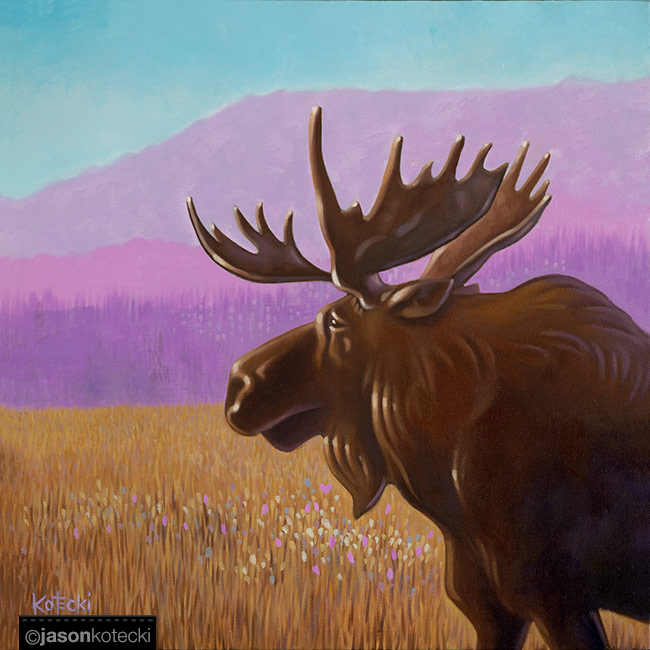
  • Chocolate Moose

    “Chocolate Moose” by Jason Kotecki. 20 x 20. Oil on canvas.
    Original is SOLD 🔴 Shop this art!

    Our family didn’t go to Yellowstone to see moose, specifically. We went for the scenery, and we did want to see as much wildlife as possible.

    One afternoon, we settled into a nice spot in the shadow of the Grand Tetons called Schwabacher Landing, and waited for moose. We’d heard the odds of seeing them there were good. Very quietly, we waited, and waited, and waited. It felt like any moment one might emerge from the brush to steal a drink from the pond.

    We sat for two hours before admitting defeat and heading back to the hotel, disappointed.

    The next day, while in Jackson, we wandered into the gallery of a photographer who told us about a side road to check out if we really wanted to see moose. The sun was about to set, but the spot was only a few miles away. We were skeptical, but two minutes after parking our car, we saw three moose.

    It was as if our patience the day before had been rewarded in some strange way. Our persistence earned us a small prize after all, like a sweet dessert at the end of a meal.

    In life, there is a lot of waiting. Long periods where nothing seems to go right. Tiresome stretches where we sit with patient expectations to see a dream come true.

    This sometimes confounds us, because somewhere along the line, we got the idea that life is supposed to be easy. We chase comfort and good feelings and grow frustrated when we encounter struggle and pain.

    But the truth is that a life in which you expect nothing but nummy treats and comforts will leave you disappointed. That’s not what this life is for.

    As Pope Benedict XVI implored, “You are not made for comfort, you are made for greatness.”

    But to paraphrase Benjamin Franklin, chocolate is proof that God loves us and loves to see us happy. That’s probably why he rewards us with little treats along the way. They are there to reward our efforts, keep us on the right track, and motivate us to keep going in pursuit of true greatness.

    And yet, it is not healthy to develop a spiritual sweet tooth. Perhaps heaven will flow with rivers of decadent chocolate, but chocolate is not meant to be our entire diet here on earth. Life is a training ground for relying on faith instead of feelings.

    The small desserts we encounter on our journey are only a foretaste of what’s ahead.

    Enjoy them. Delight in them. Savor them so that you may persevere during the difficult times.

    But remember that the true reward is yet to come.
  • Big & Grand

    “Big & Grand” by Jason & Ginny Kotecki. 24 x 24. Oil on canvas.
    Original is SOLD 🔴 Shop this art!

    Everything that exists first started as an idea. A vision. A dream.

    The question is, How many people have to see it before it becomes reality?

    On a family trip west, we spent time in the foothills of the Grand Tetons hoping to see moose. We didn’t have any luck, but while we were waiting, I snapped a photo of my youngest daughter sitting at the edge of the pond, tossing pebbles into the water. I thought it might be the start of a great painting. The only question in my mind was, “What might she be looking at?”

    I imagined painting a moose into the scene, maybe a huge one. I thought Bigfoot would be funny, or perhaps a montage of all sorts of fictional creatures: leprechauns, fairies, unicorns, oh my!

    Eventually, the solution became obvious: it needed to be Big.

    You see, “Big” is a character Ginny created when she was younger, and he’s made appearances in many of her artworks over the years. He needed to be what she was looking at, and that’s how this painting became my first official collaboration.

    Ginny drew and painted Big, and I handled the rest of the painting, including his reflection in the pond. It was a blast, and my heart just about exploded when she signed her name in the corner. (Rose is her middle name.)

    I love the origin story of Big. According to Ginny, he is a lovable giant who lives in the clouds and comes down occasionally to give people hugs.

    One thing we can all agree on is that the world could definitely use more hugs.

    I wish that Big were real.

    Part of me wonders if he is.

    How many people have to see it before it becomes reality?

    You have to imagine something before it can become a physical reality, whether it’s the main character of a book or a life-saving cancer drug. Our dreams are often born from a problem that needs to be solved, like a personal need or a nagging challenge you regularly encounter. Maybe it’s a larger one the world around you is groaning for.

    I believe your dreams are planted within you by God. And He wouldn’t have planted them within you if you weren’t the right person to help bring them to fruition.

    These dreams start as a faint vision or a passing thought, before slowly coming into focus, eventually becoming clear in your mind’s eye.

    There comes a point when you need some affirmation that you’re not hallucinating, that there really is something to this vision that has stirred up a fiery passion within you. Then comes the big and scary moment: You summon up courage and float the idea past a few others, just to check if they can see it too. 

    Usually, the reactions are mixed.

    Many won’t see the vision at all. They may even try to argue you out of it, saying it’s not realistic or practical.

    Some will nod and smile, offering words of encouragement, but it feels more like a grandparent whose grandchild just told them about their imaginary friend: “What an active imagination you have!”

    But if the dream has merit, you will encounter some true believers. These folks must be taken seriously because you will need them later.

    When I had the vision to take an unconventional path, to make a living with my art while making the world a little better by making its people a little more childlike, I experienced all of these reactions.

    I encountered many who never saw the vision of what we were trying to build, even though I described it as accurately as I could. They included newspaper syndicates, retailers, publishers, licensing agents, and more.

    I also felt the “pat, pat” on my head from those who viewed me as slightly delusional, but relatively harmless and easily redirected once reality hit.

    But I was also graced with a few true believers who saw the vision. Some notable ones included my parents, Kim’s parents, and our best friends, Sue and Jenna. Theirs were not just empty words of encouragement. They responded with action by sacrificing their time, money, and prayers. This signaled the proof of their belief.

    The certainty from true believers is invaluable. There will come a time when you lose faith in the vision, and you will need them to remind you that it’s real.

    Mounting failures and things taking longer than you expected take a toll. That vision, which once seemed so clear, begins to fade. You wonder if all the naysayers were right. After all, so many of them had way more experience than you, and the evidence seems to be piling up in their favor. Maybe I am delusional? Maybe I was mistaken? Maybe the signals got crossed, and I accidentally co-opted a dream that was not meant for me…

    I entertained all these thoughts at various times. It was tempting to give up.

    But then I remembered my parents. And Kim’s parents. And Sue and Jenna. I remembered that nobody pours money or time into a lost cause. Their sacrifice was tangible proof of their belief in us. It helped assure me that no, this is not a mirage. It’s real. They see it.

    Their belief bolstered my own.

    It’s easy to feel discouraged and lose hope when people don’t see what you see. Or when it’s taking too long. It might even show up in a time and place you weren’t expecting. The dream might feel long in coming, but it won’t be late. 

    Disregard the people standing in your way.

    Don’t worry about the ones who say, “I just don’t see it.”

    That’s ok. Not everyone will catch your vision.

    That doesn’t mean it’s not real.

    Your idea might just be the hug our world’s been waiting for.
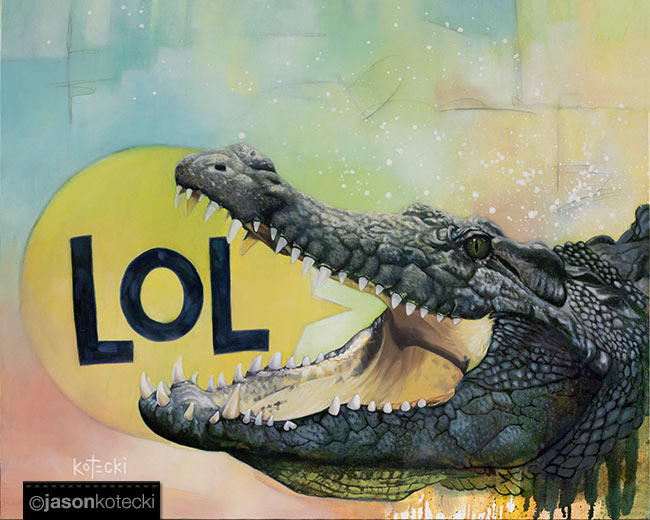
  • LOLigator

    “LOLigator” by Jason Kotecki. 30 x 24. Oil on canvas.
    Original is SOLD 🔴 Shop this art!

    An alligator can live up to 100 years…

    which is why there’s an increased chance they will see you later.

    One of the midwives who helped Kim on her journey into motherhood had experience working with the Navajo people. She told us about a custom of theirs in which the first person to make a newborn laugh is obligated to throw the family a huge party to celebrate the occasion. According to their tradition, it’s considered the moment in which the baby is fully present and “in the world.”

    I think that’s pretty cool.

    You often see people rejoicing over a baby’s first words, first steps, and first day of school, but never have I heard a big deal made out of a baby’s first laugh. At least not enough to warrant a party to be thrown because of it.

    It’s a striking example of how little we value laughter in our society.

    What’s weird is that laughter is a universally loved activity, and yet, adulthood often finds us treating it as a non-renewable resource, something to be reserved for when our work is done. We leave it out of serious and challenging situations, and grow suspicious of people who do too much of it.

    Which brings me to alligators.

    I don’t know about you, but when I see an alligator, I don’t think, “Here’s a guy who must be the life of every party.” He’s not on my Top 10 list of Animals Who Don’t Take Themselves Too Seriously.

    And yet, when he opens his mouth, it looks like he just heard a good joke.

    Which gives me hope, because I encounter a lot of people walking around with the sunny disposition of an alligator these days. 

    We can all agree that laughter is beneficial. It boosts the immune system (why they say laughter is the best medicine), brings you more energy, lowers levels of pain, and protects you from the dreaded Adultitis. Of course, as we get older and are inundated with Adultitis, laughs can be hard to come by. 

    The good news is that you can literally fake it till you make it. 

    Believe it or not, fake laughter offers the same benefits as real the kind. Certified life coach Katie West says, “Pretending to laugh (or practicing laughter) can alter our body chemistry since our brains can not tell the difference between real and fake laughter.”

    I have experienced a group of people fake laughing, and I can tell you, the vibe shift is real. And when people are practicing fake laughs, real ones bubble up like clockwork.

    Likewise, we can generate more laughter by being intentional about injecting some fun into our routine:

    • Read the funny pages over breakfast.
    • Listen to comedy podcasts on your commute.
    • Get a joke-a-day calendar for your desk.
    • Turn your inanimate objects into Adultitis Booby Traps.
    • Hang out with funny people.
    • Attend an improv show.
    • Read or watch something funny before bed. (At the very least, stop watching the Crisis News Network!)

    Stress continues to be a contributing factor to every single thing that kills us, from heart disease to suicide. Yet the standard operating procedure these days is to trudge through life with furrowed brows and steely determination. But now, more than ever, we should take a cue from the Navajo people and celebrate laughter.

    Every single laugh is a dollar in the economy of the human spirit.

    I get that we live in serious and challenging times, but that doesn’t require us to take ourselves seriously.

    St. Teresa of Ávila, a Spanish mystic and great reformer, once said, “May God protect me from gloomy saints.” 

    One of the greatest things ever is hearing my kids laugh. Whether it’s a silly little giggle or an unbridled belly laugh, there’s no better sound in the world.

    I imagine that God probably feels the same way about his children.

    When we laugh, we are happy and free. During that moment of laughter, we are not worried, anxious, or stressed. And so it must give God great joy to see his children buckled over in laughter, just as it does me with my kids.

    And reminds me just how much Adultitis must hate it.

    All the more reason to make laughter a priority.

    As Charlie Chaplin, one of the world’s greatest Adultitis fighters and a patron saint of comedy, once said, “A day without laughter is a day wasted.”

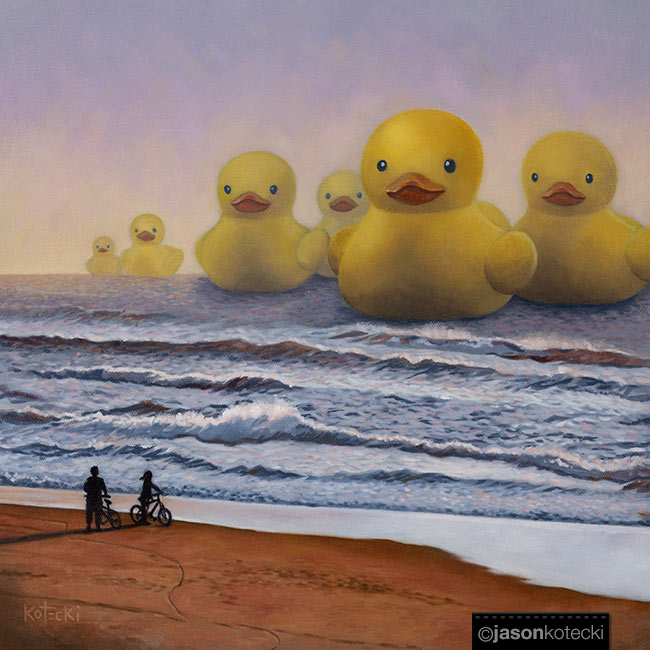
  • The Armada

    “The Armada” by Jason Kotecki. 16 x 16. Oil on canvas.
    Original is SOLD 🔴 Shop this art!

    Quick! You’re on the beach with a friend and you spot something approaching on the horizon. To your amazement, you make out an armada of giant rubber ducks coming to shore. What is your reaction?

    Are you excited? Overjoyed? Concerned? Skeptical? Worried? Afraid?

    Are they visitors or invaders?

    Do they bring good tidings or dark intentions?

    Sometimes a painting can just be a fun picture that makes you smile. And sometimes it contains a deeper meaning. I asked people on social media to share their perceptions of this painting, and it may or may not surprise you that their responses varied greatly:

    • “Pure joy. I have a jacket printed with rubber ducks. They always make me smile, as does the ocean, and riding my bike!”
    • “Here comes whimsy!”
    • “Hope is on the horizon.”
    • “I’m a little worried.”
    • “Terrified.”
    • “Invasion from a Trojan Horse.”
    • “Plastic pollution and impending doom from climate change.”

    It turns out that the meaning of this painting, as well as the meaning of almost everything in life, is largely determined by you. 

    Our perceptions impact our actions. For example, whether you’d run for cover or organize a welcoming party would depend on whether you see these rubber ducks as friends or foes. One side sees the other as hopelessly naive. The other side sees the other as paranoid. Both sides have a point.

    If we respond too enthusiastically, we might fall into a trap.

    If we respond with animosity, we may sabotage any chance of something good happening.

    We can assume the best, assume the worst, or…perhaps the best, wisest, most productive thing we can do is keep an open mind and wait and see.

    Now, let’s put the shoe on the other flipper. Imagine if you’re one of those ducks. You’re fun. Lots of people like you. You want to be helpful and bring joy to others. You’re new in town, but you have good intentions. But what are those locals on the shore thinking?

    Do they see you as a visitor or an invader?

    Do they think you bring good tidings or dark intentions?

    We’ve all been the new guy. The new kid in class. The newest employee. Or, most recently for us, the new family in town. I like to think of this painting as a metaphor for our mission to bring wonder and whimsy to distant shores. I unveiled it at the first Wondernite we hosted in Sheboygan, having moved from Madison two years earlier. As relative unknowns, we wondered if anyone would come.

    It turned out to be our biggest and best one yet.

    It’s scary to consider what the natives might think of you. You feel like you stick out like a sore thumb because it seems obvious that everyone can tell you’re not familiar with the local culture, the shorthand, the inside information that everyone else takes for granted. 

    It’s tempting to want to appear big and important. Maybe pretend to be something you’re not. After all, you’ve got a clean slate. None of these new people know all your history and baggage. You never get a second chance to make a first impression, so it’s a chance to put forth something impressive.

    I’ve found it’s easier, more effective, and frankly, less exhausting to just be yourself. People are drawn to authenticity, and we are very good at spotting a fake. Your weird flag may not inspire everyone, but it will attract your people.

    It’s more beneficial to check your expectations.

    If you expect the natives to be hostile, you’re likely to protect yourself by being hesitant and withdrawn, which may make you appear cold and aloof to others. But be warned: if you assume the locals will be hostile and unwelcoming, guess what you’re likely to get.

    You see, there is this thing called confirmation bias. (Perhaps you’ve heard of it.) It’s applicable whether or not you see yourself as the kids on the beach or the newcomers floating to shore. How it works is that we make an initial judgment or tell ourselves a story about a person, group, or situation. Then we reflexively look for evidence that supports our case and confirms our bias. 

    Meanwhile, we subconsciously filter out any information that runs contrary to our story. We interpret new information as being supportive of the opinions we already hold, and it doesn’t matter how poorly it fits. Our dutifully protective brain finds a way without us having much of a say.

    If you think your spouse is ignoring you, you’ll be on the lookout for all the evidence to make your case.

    If you expect to have an awesome day, your antenna will be up and scanning for proof all day long.

    If you think Republicans are the worst, you will notice and remember every example that proves your point.

    If you think Democrats are the enemy, well, you get the point.

    So…what if we paused at the very beginning to realize we don’t yet know the truth and take a wait-and-see approach? Thanks to confirmation bias, if you expect the best in others, the odds are better you’ll find it.

    This might just be a fun, whimsical painting that makes you smile.

    Perhaps something light-hearted to hang in your bathroom.

    It might also be a reminder to always be yourself while giving other people a chance to do the same.