Topic: Personal Development

  • The Captain

    “The Captain” by Jason Kotecki. 20 x 20. Oil on canvas.
    Original is SOLD 🔴 Shop this art!

    I present to you a painting I made of a pirate ship sailing in an ocean of milk amidst floating Cap’n Crunch cereal.

    I thought long and hard about conjuring up some deep meaning on this one. Something that would make you shake your head in amazement and say, “Wow. He is a truly brilliant artist and thinker.”

    But you know what? There isn’t any deep meaning. The truth is, I was thinking about Cap’n Crunch cereal, which I love, and thought about a tiny pirate ship sailing in a bowl of it, which would be neat. But then I thought, what if the ship was normal-sized and the whole ocean was milk and it had giant pieces of Cap’n Crunch floating in it? That would be weirder, and possibly neater. 

    So that’s what I did: gave myself over to pure whimsy.

    As we get older, Adultitis takes over and kills our whimsy. We grow increasingly skilled in the art of taking ourselves too seriously. And all that seems to bring us is anxiety, stress, and a life totally devoid of fun. 

    We’ve mastered the ability to make the trivial monumental. We fret about all sorts of things, from gas prices and elections to how we’re going to kill those weeds in the yard and what we should wear to next Friday’s function.

    Becoming more responsible is one thing. But losing our sense of whimsy and taking ourselves too seriously is another. 

    I have long admired people like Dr. Seuss and Roald Dahl because they created magical characters and worlds that are so rich with whimsy. Their art depicts preposterous, physics-bending, imagination-stirring images and scenarios that exhibit a ridiculousness that is wholly original and entertaining. Meanwhile, within the context of their art, all of it comes across as completely normal. How did they do that? 

    It can be hard for me to give myself over to this pure, unadulterated nonsense, which I consider to be the unfiltered essence of the spirit of childhood. As someone who often errs on the side of practicality and reason, I have always wished I could be more like Dr. Seuss and Roald Dahl. After discovering Adultitis and its evil tricks early in my adult life, I have spent my life trying to get back to that level of creative abandon. Back to normal.

    And yet here I am, having created a painting that exists at least within the same universe as those two greats, frustrated because I cannot come up with words to explain the meaning of this painting. 

    Because there isn’t one. 

    And thankfully, I think to myself, “Well, finally. Some progress.”

    It took a while to become an expert at taking yourself seriously; it will take a while to get back to normal. Give yourself permission to start.

  • Roam

    “Roam” by Jason Kotecki. 30 x 24. Oil on canvas.
    Original is SOLD 🔴 Shop this art!

    Starting at younger and younger ages, kids are expected to begin thinking about what they want to do with their lives. I feel bad for them, because between increasing homework loads and more demanding extracurricular commitments, they are given less and less free time to figure out who they are and what lights them up.

    No matter how old you are, a little space to roam can make a big difference.

    After three grueling years producing his show, Sam and Friends, Jim Henson was burned out and ready to give up on puppetry. Then he left for a yearlong walkabout in Europe. He took in puppet performances throughout the continent, impressed by how appreciated the art form was outside the United States. “Until then, I hadn’t taken puppetry all that seriously,” Henson said. “It just didn’t seem to be the sort of thing a grown man works at for a living.” But Henson returned from Europe energized and inspired, and would eventually create The Muppet Show and Sesame Street.

    I like the idea of a gap year, which is typically a period of time taken between high school and college to deepen practical, professional, and personal awareness. I’ve also heard of people taking them mid-career, or married couples who take them when they become empty nesters, to re-establish their relationship as it enters a new phase.

    Every once in a while, we all need a bit of time and space to wander, wonder, and think about what’s next.

    I love this definition of roam: To go to different places without having a particular purpose or plan.

    Here’s another good one: To move about or travel aimlessly or unsystematically, especially over a wide area.

    The next step in our life journey is not always evident. Perhaps you are in a season that calls for some aimless travel, even if it’s just spending a few days outside of your normal routine. 

    Sometimes we need to break free from the day-to-day. 

    Sometimes we have to roam a bit to find ourselves.

  • Space Invaders

    “Space Invaders” by Jason Kotecki. 12 x 12. Oil on canvas.
    Original is SOLD 🔴 Shop this art!

    Some of you are old enough to remember the Atari video game system. A far cry from the advanced graphics we see in games today. And only one button!

    One of the most popular games was called Space Invaders, which I have featured prominently in this painting. It was a simple concept: you try to shoot as many aliens as you can as they descend down your screen. As the game continues, the aliens descend at an ever-increasing speed. If they reach the bottom, the alien invasion is successful, and the game ends.

    To me, this is a great metaphor for Adultitis, a disease that Kim and I have committed our lives to help defeat. All of you are familiar with this enemy, even if you’re hearing the name for the first time. It’s what happens when you lose your sense of wonder, your curiosity, and your childlike zest for life.

    Quite literally, Adultitis means “swelling of the adult.” And when you’re walking around with too much adult, your life is more stressful and less fun.

    Although I wish there were a magic potion or miracle cure that ended Adultitis once and for all, there just isn’t. Adultitis is always coming after us, just like those aliens. You can blast down a whole screen by going to Disney World, but on your first day back to work, another wave is ready to strike.

    The key, I think, is to look at fighting Adultitis as a game. It’s most deadly when it hides in the shadows, convincing you to take yourself too seriously and getting you to focus on the negative.

    But if you notice where it tries to sabotage you and laugh at its advances, you can diffuse its power.

    Our family has had great fun in acknowledging when Adultitis has gained the upper hand, and we encourage one another to fight back. Extreme cases call for a pajama run or a spontaneous dance party in the kitchen.

    My Dad always says, “Everything happens for a reason.”

    I make it a game to try to figure out the reason. Anytime something bad happens, I start thinking about what good could come from it. What if you looked at the challenges you face like any other game?

    • Instead of looking at making payroll as a life-or-death situation, make it into a game.
    • Instead of worrying about not getting everything done today, make it into a game.
    • Instead of stressing out over how you’ll ever be able to conform to the new regulations in your industry, make it into a game.

    Instead of acting like your current challenge is something found in the bad-tasting medicine aisle, mentally repackage it in primary colors and take it from the toy section. Breathe. Smile. Have some fun with it. By looking at it as a game and clearing your mind of the useless worst-case scenarios, you’ll actually be MORE likely to notice the people, opportunities, and ideas you’ll need to win.

    You may believe that the stakes are much higher now compared to a silly game of Space Invaders. But are they really? With VERY few exceptions, the truth is that our fear of failure is worse than the consequences that come from actually failing. Sure, the project very well might flop, your efforts might go to waste, or someone may laugh at you. You could get rejected, dejected, or fired.

    Sometimes, like the aliens, Adultitis advances past your defenses and wins the day.

    But you know what? The good news is that you can hit reset and start again. Life WILL go on. It’ll be ok. You’ll be able to pick yourself up, dust yourself off, and get ready for the new — even better! — opportunity right around the corner.

    Are you game?
  • Life’s a Wave

    “Life’s A Wave” by Jason Kotecki. 30 x 24. Oil on canvas.
    Original is SOLD 🔴 Shop this art!

    The familiar pit formed at the bottom of my stomach like a butterfly battle royal on pay-per-view. It developed after my mom answered the phone and told me it was for me.

    When I was younger, I was afraid of just about everything. New situations always brought an enormous level of anxiety, and phone calls delivered a special level of dread.

    It was a classmate on the other end, asking if I wanted to come over to play.

    For most people, this would be great news, not a situation worth getting nauseous over. But I was not most people. I’ve never been keen on having my plans changed at the last minute. I had a whole day planned of doing nothing ahead of me. Not to mention, I’d never been to Chris’s house before. Talk about a new situation! It was clearly a sensory overload too treacherous for a lazy Saturday.

    I quickly mumbled some excuse about how my mom wouldn’t let me today and hung up. “Whew! That was close,” I thought to myself, eager to return to my regularly scheduled day of surprise-free comfort.

    Only one problem: my mom heard.

    She ordered me to call my friend back up to tell him I could go. Gulp. That wasn’t at all embarrassing! “Hey Chris…hehe…good news…”

    The thing is, I ended up having a great time. There were many similar situations in my childhood in which my mom shoved me out of the nest, and I almost always enjoyed it. Eventually, I started to make little leaps on my own. At some point, I decided I didn’t want to be an 80-year-old guy looking back on my life, wondering, “What if?”

    The fear of regret became worse than the fear of the unknown.

    Life can be a spectator sport if you want it to be. You can watch the action standing safely on the shore. It’s the best way to minimize risk, avoid failure, and stay comfortable.

    The only problem is that it’s not much of a life.

    The real action happens out in the surf. To ride the wave of an amazing life, you have to be willing to leave the shore.

    Sometimes you have to take the plunge into parenthood even though you don’t think you’re ready.

    Sometimes you have to cash in your rainy day fund for a venture that might not work.

    Sometimes you have to book that trip today, because you never know how many tomorrows you have left.

    I cannot guarantee that you won’t wipe out now and again. But the bumps and bruises that accompany a wipeout are more tolerable than the deep ache of wondering “what if?”

    What wave is it time for you to catch?

  • Cupcakes Are Miracles

    “Cupcakes Are Miracles” by Jason Kotecki. 20 x 20. Oil on canvas.
    Original is SOLD 🔴  Shop this art!

    I’ve wanted to be an artist for as long as I can remember. Especially after I found out that the roles of being George Lucas or Superman were already taken.

    Like most artists, I started out making “copies.” I drew Simpsons characters and portraits of athletes and celebrities. It was how I learned my craft. As Elizabeth Gilbert wrote, “Everybody imitates before they can innovate.

    My first real attempt at saying something original was through comics. First, a sports panel cartoon I did in college called Obstructed View, then a comic strip called Kim & Jason. I became inspired by people like Charles Schulz (Peanuts) and Sam Butcher (Precious Moments), and I decided that I wanted to use my art to make a difference.

    I was convinced that Kim & Jason was the way I was destined to do that. I had big dreams, and we worked really hard to make it successful. Undeterred by the scores of syndicate rejections, we tried self-syndication. Craft fairs. Gift shows. Fundraising programs. Some things were moderately successful. Most things failed epically. It never earned enough to live on, and Kim and I had many sleepless nights and tear-filled discussions wondering if we were crazy. 

    Eventually, my experience making a comic strip led me to doing cartooning workshops in schools, which led to speaking at churches, which led to the speaking I now do for associations and companies.

    Speaking became more financially successful than Kim & Jason ever was, and eventually, I became so busy that, after seven years of making a daily comic, I decided to retire the strip.

    Although Kim & Jason inspired many people and generated lots of smiles and laughter, it was hard not to think of my art as a total failure. As my speaking career took off, I put the “art thing” in the closet. I figured my attempt to be an artist had failed, and decided to focus on more “valuable” things. Even though I used my creativity in many ways while growing the business, I pretty much stopped making art. 

    After several years of inactivity — I dramatically call it my “fallow period” — I started to feel the urge to make art again. Little by little, I began to create. I started feeling alive in a way I hadn’t in a long time. So I kept going, eventually sharing it with others. People responded, not just to how it was made, but how it made them feel. And think.

    I got a book deal with a big New York publisher largely because a literary agent saw some art that was shared by a friend of a friend on Facebook. In the design of that book, I marveled at the fact that 90% of the art in the book was created after my “fallow period.” But the book also contained stories, comic strips and paintings from years earlier. It became a love letter to the things in my past that I thought were failures. 

    I finally realized that they weren’t failures; they were the foundation.

    Earlier this month, we hosted Wondernite, a special art collecting event that featured my newest works, all of which were created in the last two years. 

    Ten years ago, when I made the tough decision to retire Kim & Jason, if you’d have told me that new art I’d create would help me land a book deal, and that we’d be able to pull off an event like Wondernite, fill it to capacity, and sell the majority of the original art I brought to sell, I wouldn’t have believed you. I might have punched you in the face for being mean.

    To me, how this journey ultimately unfolded feels very much like a miracle.

    Miracles happen. I’ve seen them, in my own life and in the lives of others. Frustratingly, they are unpredictable and cannot be conjured up on demand.

    I have had my heart broken many times by dreams that didn’t come true and miracles that never materialized. I have been tempted to give up, to quit dreaming and stop waiting for miracles. It seems easier. Less painful, at least.

    But I just can’t.

    I don’t know why sometimes a miracle shows up while other times it doesn’t. Maybe it’s because what we get in return is even better in the long run. Maybe it’s just random luck or something entirely. 

    Whatever it is, I can’t shake the belief that it’s still worth believing in them. 

    It seems like the people who see miracles are the ones who spend more time looking for them.

  • Build Something Wonderful

    “Build Something Wonderfull” by Jason Kotecki. 16 x 20. Oil on canvas.
    Original is SOLD 🔴 Shop this art!

    We went to the funeral of a friend’s mom recently. She died suddenly of a heart attack while at home with her husband, who was only into his second week of retirement. When my father-in-law Gary heard the news and learned that they were both in the same age range, he reflected, “Wow. I guess I’m really on borrowed time.”

    He’s right. But not just because he was diagnosed with severe rheumatoid arthritis in his twenties and probably hasn’t had a pain-free day since then. And not just because he continues to amaze his doctors with how long he’s been able to keep on going. He’s right because we are ALL on borrowed time.

    That becomes obvious when we hear of sudden heart attacks and car accidents. When we are faced with stories of tornadoes that drop out of the sky, ending lives at random, or see the aftermath of troubled souls who decided children are suitable targets for acts of terrorism.

    Life expectancy may be 78, but that doesn’t mean we can expect to make it there.

    Gary is on borrowed time. I’m on borrowed time. And so are you. The real question is, how are we investing this time we are borrowing?

    By watching more TV? Keeping busy with activities that don’t really matter? Staying put on a career path we don’t really like?

    Or are we building something wonderful by living with a sense of urgency and making hard choices that lead to a better story and a lasting legacy? 

    The choice is yours. But hurry, the clock is ticking.

  • Pie in the Sky

    “Pie in the Sky” by Jason Kotecki. 20 x 20. Oil on canvas.
    Original is SOLD 🔴 Shop this art!

    In December of 2016, I wrote the biggest check of my life. Not in size, but in importance. It was the final check to close out a business debt that totaled $100,000 back in 2008. We paid it off seven months early, and for the first time since we launched in 2000, the business was completely debt-free.

    That felt really, really good.

    Deep down, I always knew we’d pay it off, but it seemed like it would take forever. In 2008, the year 2017 seemed a million years away. And before that, as we racked up said debt staying afloat while we tested business models, and funded small successes (and a few big defeats), surviving — let alone thriving — seemed pie in the sky.

    At least it did when we spent two whole days at a craft show in Milwaukee and only sold $7.94 in greeting cards.

    Or when my hometown newspaper, which ran my comic strip free for a whole year, decided to drop it when I asked for $10 a week.

    Or when we were down to the last $100 in our bank account more times than I care to remember.

    Pie in the sky.

    Coined in a song written in 1911 by a Swedish-born American named Joe Hill, we understand “pie in the sky” as something good and pleasant to contemplate, but very unlikely to be realized.

    I don’t know what the odds were of us actually building a real business with no experience, no proven business model, and no money. Were they as long as the Cubs rallying from a 3-1 series deficit to win the World Series? Or as unlikely as the Patriots coming back from 25 down with a little over a quarter to play to win the Super Bowl?

    The real question is this: How great does the deck have to be stacked against you before you give up, labeling your dream as pie in the sky?

    Only you can answer that, and every person has a different one. But we are often too quick to chalk something up as pie in the sky when it really isn’t. It can keep us from even starting. It lets us off the hook, thinking our dream was impossible anyway, because sacrifice and hard work and hope — yes, even hope — hurts sometimes.

    I don’t write this to place myself on a pedestal. If I have done anything well, it has been to persist. But my persistence was fueled by a belief that God placed this dream deep in my heart, and that he would see it through. Every day I woke up thinking, this could be the day — the day that we got our big break and everything would turn around. Some of the things that seemed to be big breaks turned out to be pathetic spurts and epic fails. Mostly, we got a lot of small breaks that added up to something pretty great. It certainly tested every bit of my patience and nerve and good sense, and made me question my sanity on more than thirty-seven occasions, but here we are.

    Not everything is worth seeing through till the end. As we grow, our dreams and desires, and priorities can change. But don’t be tricked into stopping just because the odds seem long. Everything is impossible until it isn’t.

    Yes, the odds may be long. Your stamina may be depleted. Your hope may be dim.

    But if the cause is great enough and your soul is on board and your motive is pure, keep going.

    You may just be able to grab that pie and eat it, too.
  • 100% Chance of Awesome

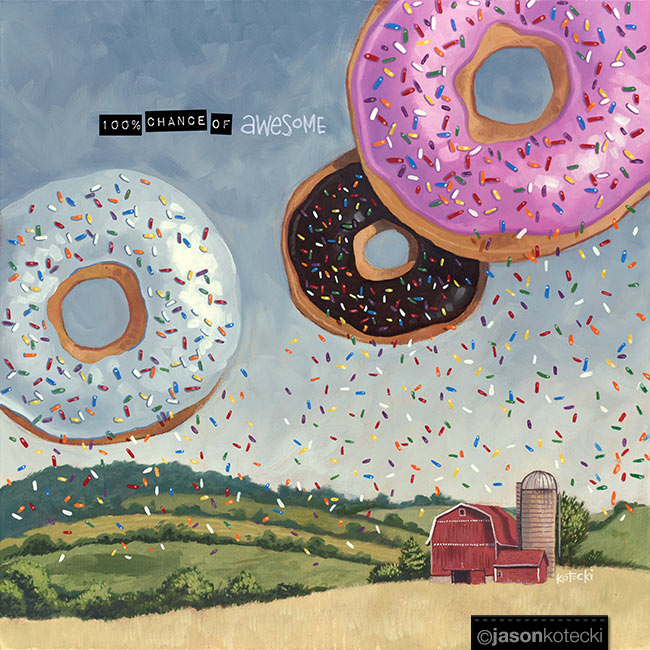
    “100% Chance of Awesome” by Jason Kotecki. 20 x 20. Oil on canvas.
    Original is SOLD 🔴 Shop this art!

    Awesome opportunities are everywhere in life. Sometimes they come disguised as monsoons.

    A few years ago, our basement sprung a leak and we were left with a mess. After months of moping, we asked, “What does this make possible?” We ended up transforming it into a studio for me, an office for my wife, and a play area for the kids. A previously little-used space is now our favorite room in the house.

    When something unexpected turns up, you have a choice: Dwell on the negative and listen to the fear, or open yourself to the possibility that something good is just around the corner.

    Becoming unexpectedly unemployed could be the spark that gets you to start that business.

    Becoming unexpectedly single could be the open door to a relationship beyond your wildest dreams.

    Becoming unexpectedly ill could be an opportunity to get closer to the most important people in your life.

    Life doesn’t always go as planned, but the next time a storm blows through yours, practice looking for what good thing it now makes possible. Do that, and you can expect a 100% chance of awesome.

  • Not My Circus

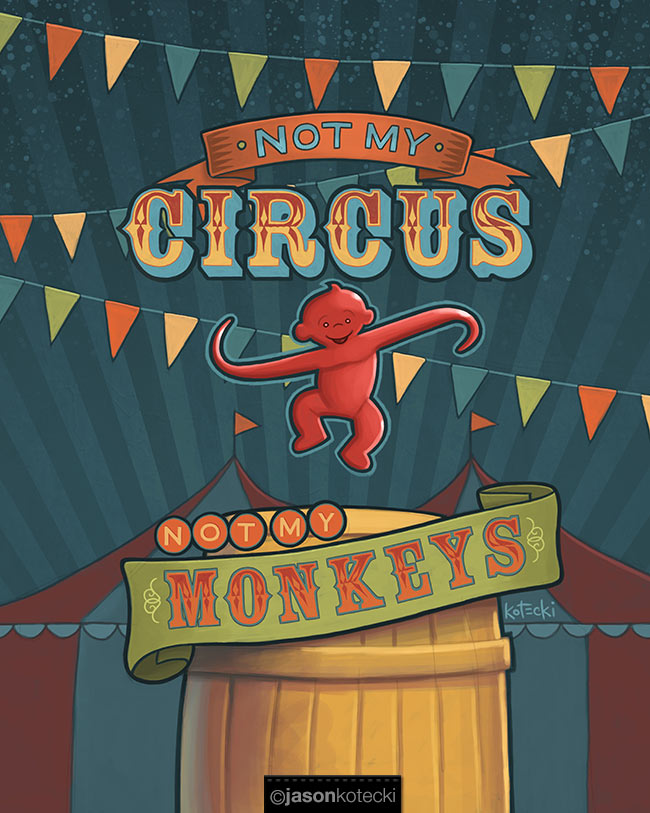
    “Not My Circus” by Jason Kotecki. Digital.
    Original is SOLD 🖼️ Shop this art!

    Since 94% of the population suffers from at least a mild form of Adultitis, odds are that anyone with a job has to work with someone infected with this vile disease. Maybe it’s a co-worker, or a client, or – gulp! – the boss. Sometimes, the people I chat with after my speaking programs will confess to being married to someone with a full-blown case of Adultitis.

    So the question, of course, is how do I fix someone who has it?

    Unfortunately, the truth is…you don’t.

    I am a professional speaker. Most speakers I know started their careers with the hope of making a difference and changing lives. I certainly did. If you do it long enough, you’ll likely come across the uplifting statistic that informs you that your audience will probably forget almost everything you said the minute they walk out the door. Eventually, you will realize that you do not have any ability whatsoever to change someone’s life. Entertain, sure. Inspire, maybe. But change? That’s up to them, not you. (Newsflash: this little rule also applies to any husbands, wives, parents, and teachers who may be reading.)

    It’s hard not to feel like you’re a professional exerciser of futility.

    The thing is, the more quickly you accept this reality, the better speaker you become.

    When you are not worried about the guy in the front row crossing his arms, or the lady who ducked out the back, or whether or not you will get a standing ovation, the more you will be able to focus on being your authentic, true self and allow your message to land where it will.

    And THEN you might make some sort of difference for someone.

    You may not make a living from being on stage, but the principle is the same. When dealing with people who have Adultitis, there is only so much you can do. This is it:

    1) Do your best to be a good example. Take yourself lightly. Live your life cheerfully, with humor and joyful anticipation. In the best-case scenario, these people will see and be inspired by your approach to life, and a little will rub off. Maybe they’ll even ask for your secret, and then you can help them on the road to recovery.

    2) If your example alone doesn’t make a dent, you should incorporate their office supplies or car keys into Jell-O molds. (Just kidding.) (Not really.) Maybe you could try sending them flowers or a box of cookies. Maybe they just need someone to notice them and be kind to them.

    3) If you’re still running into a brick wall of Adultitis, your only other option is to ignore them and do your best to limit your exposure to them. You don’t have to be mean about it; you just have to be intentional. Depending on your relationship, you might consider deleting them from your life. Harsh, I know, but life is too short to have the joy sucked out of you by someone with a full-blown case of Adultitis.

    “Whoa, buddy,” you may be thinking. “That’s a little extreme. And it’s not exactly gonna work. This is my spouse you’re talking about,” or “I can’t exactly fire my idiot co-worker.” If extracting yourself from the situation is not an option, you should make it a priority to surround yourself with people who are relatively Adultitis-free. These relationships will help bolster your energy levels and serve as a force field from the Adultitis-ridden zombies in your life. 

    Is it an ideal solution? No, but it’s reality.

    You are only the ringmaster of your circus and your monkeys. Focus on the things you can control: your attitude, your actions, and the people you choose to spend most of your time with. Let go of the things you can’t.

    Simple, although certainly not easy.

    Striving for an Adultitis-free life will not always yield the results you’d like. You may not be able to make someone change, but it’s always possible to make a difference.

    Don’t be surprised if the difference is in you.

  • Penguin Possible

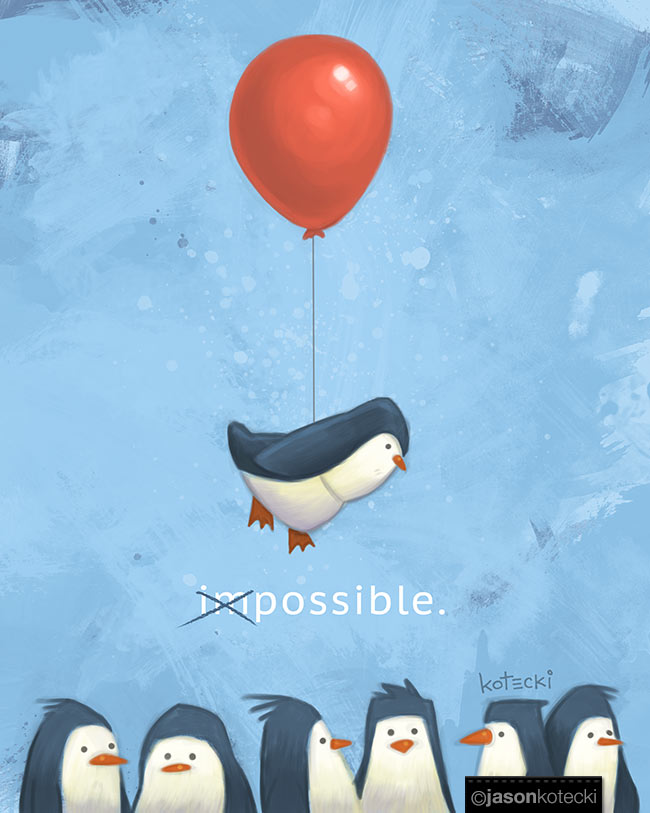
    “Penguin Possible” by Jason Kotecki. Digital.
    🖼️ Shop this art!

    “I do have dreams, but I try to keep them realistic.”

    No one likes to admit they don’t have dreams. But no one likes to be called a fool, either. Or worse yet, a failure. After all, the bigger you dream, the more likely you are to fail. Claiming to have realistic dreams makes you sound smart. It gives the impression that you’re going places, likely to succeed, and are not to be sidetracked chasing any childish, crackpot schemes. But one of those words is terribly problematic.

    The word “realistic.”

    Who’s to say what’s realistic or not?

    Do we really believe that Orville and Wilbur Wright were deemed “realistic” by their fellow townsfolk while they used their bicycle repair shop profits to try and build the world’s first “flying machine”?

    After all, in 1902 (just ONE year before the Wright Brothers’ great success), Lord Kelvin—the otherwise brilliant dude who determined the correct value of absolute zero as approximately –273.15 degrees Celsius—said, “No aeroplane will ever be practically successful.”

    And just fifty-eight years after the Wright Brothers’ breakthrough, was President John F. Kennedy being “realistic” in 1961 when he declared that America would send a man to the Moon by the end of the decade? (By the way, the first handheld pocket calculator would not be invented until five years after Kennedy’s speech.)

    Meanwhile, is it “realistic” today to think that we will ever find a cure for AIDS or autism, or Alzheimer’s disease?

    When it comes to dreams, this world is suffering from a bigness deficiency. I don’t think there’s anybody alive who is dreaming too big. In fact, I’m not even sure it’s possible. I don’t need studies about how much of our brain capacity goes unused to tell me about the potential of mankind. Just look at examples. Whether it’s the invention of the artificial heart, or the guy who climbed Mount Everest blind, or the inspiring examples of Holocaust survivors. We are created to do things that don’t, at first glance, seem very realistic.

    If a dream is realistic, it’s not really a dream. It’s a to-do.

    If you want to be realistic, be realistic about your fears. After all, most of the things you worry about will never happen. But when it comes to your dreams, leave realism at home. At least at the beginning.

    No matter how big you think you’re dreaming, it’s not big enough. A good dream has to be kind of crazy. And improbable.

    “Big dreams create the magic that stir men’s souls to greatness.”

    —Bill McCartney

    If you’re going to dream, you might as well dream big. And if you’re ever accused of dreaming too big, then you can rest assured that you’re on the right track. Just pretend you’re a long-lost member of the Wright clan.

    Don’t worry about being realistic. And be very, very cautious about what you label as “impossible.”

    For as John Andrew Holmes wisely said, “Never tell a young person that something cannot be done. God may have been waiting centuries for somebody ignorant enough of the impossible to do that thing.”