Topic: Fun & Whimsy

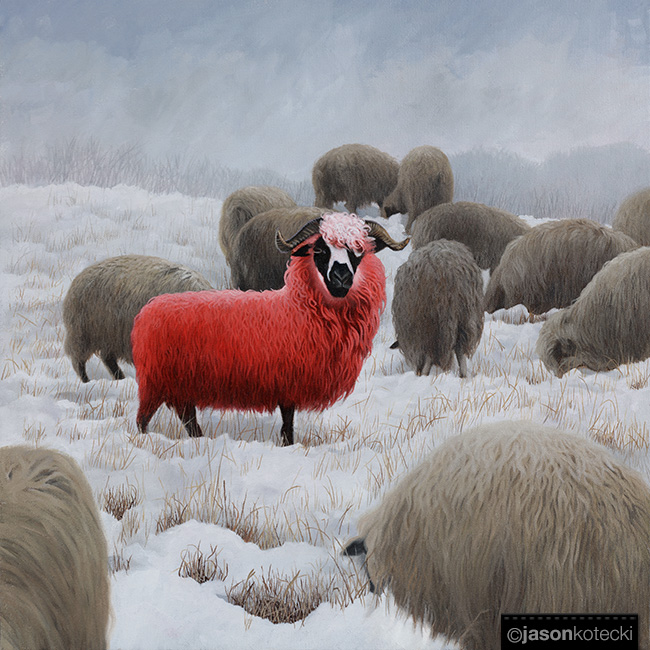
  • One of One

    “One of One” by Jason Kotecki. 20 x 20. Oil on canvas.
    Original is available 🟢 Shop this art!

    When I was in art school in the late nineties, the goth look was in. A significant segment of art kids wore all-black clothing, Doc Martens boots, and fingernails painted with dark colors. I found it fascinating to observe that the ones intent on bucking the system, sticking it to the man, and expressing their individuality all looked…exactly the same.

    It’s scary to stand out.

    We learn this at a young age, when simply being our weird, unique selves can lead to us being shamed and ostracised at recess, on the school bus, or even across the dinner table by a sibling or parent.

    And so, much of life is a careful effort to blend in.

    Just look at the cars we drive, most of which are either black, white, or some combination of the two.

    Or how we take fashion cues from tastemakers and trendsetters because getting caught wearing something out of style is akin to death.

    We must be careful to curate what we say in public for fear of being cancelled.

    In the case of my art school companions, we even blend together in our rebellion.

    Now, some would explain this as an evolutionary feature, not a bug. There’s safety in numbers, after all. We’ve learned to blend in because there’s danger in straying too far from the herd.

    The thing is, we’re not here to sink to our base animal instincts. We were created for a higher purpose. We were made for greatness.

    We are born originals. The problem, as St. Carlo Acutis observed, is that most of us die as photocopies.

    As an artist, I sell prints of my work. Some of them are timed releases, some are limited editions, and some are open editions (available all the time). 

    I sell a lot of them, but they’re all really just fancy photocopies. 

    And none are worth as much as the original. A print sells for less than a hundred dollars. The original can sell for thousands.

    Ask anyone who has purchased one of my original paintings, where you can see the texture of the canvas, feel the brushstrokes with your fingers, and observe the luminosity that emanates from dozens of thin layers of oil paint, and they’ll confirm: Nothing beats an original.

    Sadly, too often we settle for being photocopies.

    It’s been said that imitation is the sincerest form of flattery.

    Maybe if someone else is imitating us. 

    But if it is we who are doing the imitating, then imitation is the sincerest form of boring.

    It is good to learn from those who came before us. It’s possible to find a measure of success by imitating someone else. 

    But the best you’ll ever be is a second-rate version of them.

    This is not a call to stand out for the sake of standing out, or to pretend to be something you’re not. It’s about having the courage to be more of who you are. It’s a reminder that safety should not be our highest virtue. 

    You are free to opt for the safe path. Most people do.

    But you will not be able to escape the gnawing sense of dissatisfaction, the quiet desperation, the ever-present sense in your soul that there’s more to life, and this ain’t it.

    The reason I made the hero in this painting red was because of the lesson I learned from red shoes. After years of wearing safe, plain, predictable shoes, I started pining for red ones. The people I saw wearing red shoes always seemed to be so brave and adventurous, somehow getting more out of life. I wanted that, but I was afraid. I was afraid of standing out too much, but mostly I was afraid that I’d be found out as a fraud.

    Adultitis tried convincing me that I wasn’t one of those “red shoe people.” I wasn’t fun enough, brave enough, or free enough. 

    Eventually, I stood up to Adultitis and got the red shoes. The fears ended up being empty threats. I’ve worn red shoes on stage for every speaking engagement for about two decades now. I love ’em. They make me feel more fun, confident, and free, like a guy who decided it didn’t matter what other people think. 

    Of course, red shoes are not the secret to defeating Adultitis.

    Being brave is.

    What are your red shoes? There is probably something in your life you’ve always (but probably secretly) wanted to own, do, or be, that you’ve talked yourself out of. Maybe Adultitis sold you on the idea that you’re just not “that type of person” and it would be safer to blend in.

    But maybe you actually are that type of person.

    Maybe the fear is a smokescreen keeping you from becoming all God created you to be.

    Maybe twenty seconds of embarrassing bravery will open the door to a new level of confidence and unimaginable opportunities.

    Maybe your example of standing out from the herd will be the spark that lights the way forward for someone else, giving them courage to be brave, too.

    “To be nobody-but-yourself—in a world which is doing its best, night and day, to make you everybody else—means to fight the hardest battle which any human being can fight; and never stop fighting.”

    —E.E. Cummings

    Is any of this safe? Hell no. Of course not.

    But it’s the only way to feel alive.
  • The Joyful Elf

    “The Joyful Elf” by Jason Kotecki. 20 x 20. Oil on canvas.
    Original is SOLD 🔴 Shop this art!

    This is part of “Adultitis Fighters,” a series of paintings by Jason Kotecki featuring real and fictional characters who serve as role models in the fight against Adultitis.

    Buddy the Elf, played by Will Ferrell in the movie Elf, shows us how to embrace life with joy, creativity, and unrelenting optimism. Buddy is unapologetically himself and marvels at the simplest pleasures. He has a knack for breaking the monotony of adult life, improvising solutions and injecting fun into routine tasks. He regularly spreads joy through acts of kindness. Despite being surrounded by skeptical adults, Buddy doesn’t let their negativity diminish his joy or mission. He models resilience in preserving one’s childlike spirit.

    “Does somebody need a hug?”

    “There’s room for everyone on the Nice List.”

    “We elves try to stick to the four main food groups: candy, candy canes, candy corns, and syrup.”

    “The best way to spread Christmas cheer is singing loud for all to hear.”

    “I just like to smile. Smiling’s my favorite.”

    “Treat every day like Christmas.”

  • The Redheaded Pioneer

    “The Redheaded Pioneer” by Jason Kotecki. 20 x 20. Oil on canvas.
    Original is SOLD 🔴 Shop this art!

    This is part of “Adultitis Fighters,” a series of paintings by Jason Kotecki featuring real and fictional characters who serve as role models in the fight against Adultitis.

    Actor and comedian Lucille Ball was a great breaker of rules that don’t exist, becoming one of the first women to own a major television production company and addressed issues like marriage, pregnancy, and women in the workforce at a time when such topics were rarely discussed on television. Through her iconic character Lucy Ricardo on the television show “I Love Lucy,” she was a comedic trailblazer, portraying a strong, independent woman who wasn’t afraid to be funny, clumsy, or ambitious.

    “The secret of staying young is to live honestly, eat slowly, and lie about your age.” 

    “In life, all good things come hard, but wisdom is the hardest to come by.”

    “One of the things I learned the hard way was that it doesn’t pay to get discouraged. Keeping busy and making optimism a way of life can restore faith in yourself.”

    “I’m not funny. What I am is brave.”

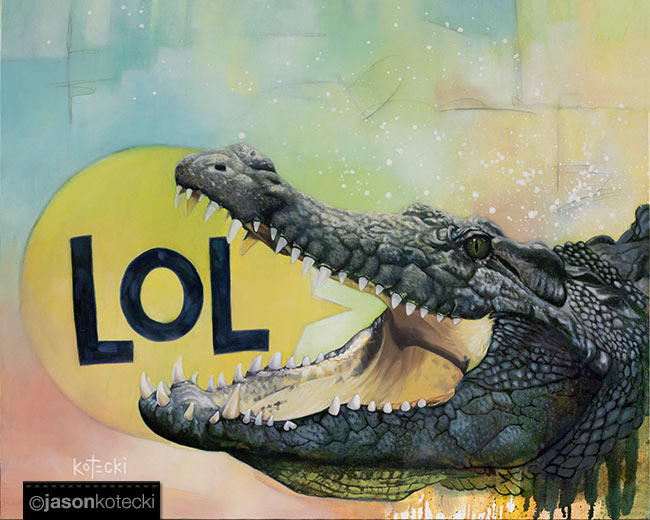
  • LOLigator

    “LOLigator” by Jason Kotecki. 30 x 24. Oil on canvas.
    Original is SOLD 🔴 Shop this art!

    An alligator can live up to 100 years…

    which is why there’s an increased chance they will see you later.

    One of the midwives who helped Kim on her journey into motherhood had experience working with the Navajo people. She told us about a custom of theirs in which the first person to make a newborn laugh is obligated to throw the family a huge party to celebrate the occasion. According to their tradition, it’s considered the moment in which the baby is fully present and “in the world.”

    I think that’s pretty cool.

    You often see people rejoicing over a baby’s first words, first steps, and first day of school, but never have I heard a big deal made out of a baby’s first laugh. At least not enough to warrant a party to be thrown because of it.

    It’s a striking example of how little we value laughter in our society.

    What’s weird is that laughter is a universally loved activity, and yet, adulthood often finds us treating it as a non-renewable resource, something to be reserved for when our work is done. We leave it out of serious and challenging situations, and grow suspicious of people who do too much of it.

    Which brings me to alligators.

    I don’t know about you, but when I see an alligator, I don’t think, “Here’s a guy who must be the life of every party.” He’s not on my Top 10 list of Animals Who Don’t Take Themselves Too Seriously.

    And yet, when he opens his mouth, it looks like he just heard a good joke.

    Which gives me hope, because I encounter a lot of people walking around with the sunny disposition of an alligator these days. 

    We can all agree that laughter is beneficial. It boosts the immune system (why they say laughter is the best medicine), brings you more energy, lowers levels of pain, and protects you from the dreaded Adultitis. Of course, as we get older and are inundated with Adultitis, laughs can be hard to come by. 

    The good news is that you can literally fake it till you make it. 

    Believe it or not, fake laughter offers the same benefits as real the kind. Certified life coach Katie West says, “Pretending to laugh (or practicing laughter) can alter our body chemistry since our brains can not tell the difference between real and fake laughter.”

    I have experienced a group of people fake laughing, and I can tell you, the vibe shift is real. And when people are practicing fake laughs, real ones bubble up like clockwork.

    Likewise, we can generate more laughter by being intentional about injecting some fun into our routine:

    • Read the funny pages over breakfast.
    • Listen to comedy podcasts on your commute.
    • Get a joke-a-day calendar for your desk.
    • Turn your inanimate objects into Adultitis Booby Traps.
    • Hang out with funny people.
    • Attend an improv show.
    • Read or watch something funny before bed. (At the very least, stop watching the Crisis News Network!)

    Stress continues to be a contributing factor to every single thing that kills us, from heart disease to suicide. Yet the standard operating procedure these days is to trudge through life with furrowed brows and steely determination. But now, more than ever, we should take a cue from the Navajo people and celebrate laughter.

    Every single laugh is a dollar in the economy of the human spirit.

    I get that we live in serious and challenging times, but that doesn’t require us to take ourselves seriously.

    St. Teresa of Ávila, a Spanish mystic and great reformer, once said, “May God protect me from gloomy saints.” 

    One of the greatest things ever is hearing my kids laugh. Whether it’s a silly little giggle or an unbridled belly laugh, there’s no better sound in the world.

    I imagine that God probably feels the same way about his children.

    When we laugh, we are happy and free. During that moment of laughter, we are not worried, anxious, or stressed. And so it must give God great joy to see his children buckled over in laughter, just as it does me with my kids.

    And reminds me just how much Adultitis must hate it.

    All the more reason to make laughter a priority.

    As Charlie Chaplin, one of the world’s greatest Adultitis fighters and a patron saint of comedy, once said, “A day without laughter is a day wasted.”

  • The Wingman

    “The Wingman” by Jason Kotecki. 60 x 40. Oil on canvas.
    Original is SOLD 🔴 Shop this art!

    Life is amazing. It is also hard.

    The war against Adultitis is a grueling one that will last your lifetime. But that shouldn’t keep you from trying to soak it with water balloons.

    Your happiness depends on it.

    Now, you’ll need two things in the fight against Adultitis: water balloons and a wingman.

    A Water Balloon is anything joyful that induces playfulness, laughter, merriment, or wonder. The most powerful ones appear frivolous, done for no particular reason other than fun.

    My late father-in-law Gary had a long fight with chronic pain. His faith sustained him, along with a diverse array of water balloons to help him fight, such as Chuck Norris jokes, air shows, Ernest movies, and April Fools pranks.

    My water balloons include: Dad jokes. My Funko Pop collection. Pajama runs. Dance parties. Photobombing my family’s photos. Watching Parks and Rec reruns.

    A Wingman is someone who encourages you to throw water balloons at Adultitis, and when you do, is at the ready with another one. It’s someone you can be goofy with and have fun with, who doesn’t roll their eyes at your silliness or denigrate the things that light you up.

    My wingman is my wife. And my kids. And the members of the Wonder & Whimsy Society.

    Sometimes a wingman is hard to come by. One of my favorite things about our tribe of Adultitis Fighters is that it provides a place for people on an island, without a wingman in their immediate vicinity. The Escape Adulthood League is an army of wingmen (and women) with water balloons at the ready.

    Not only do we each need a wingman, but we are also called to be a wingman for others. That’s what this movement we’re building together is about. Every single one of us can encourage others to embrace their inner child. To embrace their guilty pleasures and to celebrate the things that make them weird.

    So collect as many water balloons as you can. Summon your wingman.

    This is war.

    And Adultitis is about to get wet.

  • The Coach

    “The Coach” by Jason Kotecki. 20 x 20. Oil on canvas.
    Original is SOLD 🔴 Shop this art!

    This is part of “Adultitis Fighters,” a series of paintings by Jason Kotecki featuring real and fictional characters who serve as role models in the fight against Adultitis.

    Ted Lasso, the titular character of the TV series “Ted Lasso,” is a model of blue sky optimism and positivity. His humor and lightheartedness diffuse tension and bring joy, but he’s far from a naive pollyanna. Even though he had plenty of reasons to despair, from his failing marriage to his losing team, he didn’t succumb to pessimism and remained filled with hope. His sunny disposition and can-do attitude inspire us to maintain a positive outlook and approach challenges with resilience and determination.

    “Taking on a challenge is a lot like riding a horse, isn’t it? If you’re comfortable while you’re doing it, you’re probably doing it wrong.”

    “You say impossible, but all I hear is ‘I’m possible.’”

    “You beating yourself up is like Woody Allen playing the clarinet. I don’t wanna hear it.”

    “So I’ve been hearing this phrase y’all got over here that I ain’t too crazy about. ‘It’s the hope that kills you.’ Y’all know that? I disagree, you know? I think it’s the lack of hope that comes and gets you.”

  • The Big Kid

    “The Big Kid” by Jason Kotecki. 20 x 20. Oil on canvas.
    Original is SOLD 🔴 Shop this art!

    This is part of “Adultitis Fighters,” a series of paintings by Jason Kotecki featuring real and fictional characters who serve as role models in the fight against Adultitis.

    Paul Reubens embodied Pee-wee Herman with unparalleled dedication, seamlessly merging character and performer on and off-camera. His meticulous attention to detail, from wardrobe to mannerisms, and innovative comedic techniques, including breaking the fourth wall and surreal humor, contributed to Pee-wee’s iconic persona. Reubens’ commitment to silliness addressed universal themes with humor, resonating with millions and cementing his place as a comedic icon.

    “Why don’t you take a picture, it’ll last longer.“ 

    “That’s my name, don’t wear it out!”

    “I’ve always felt like a kid, and I still feel like a kid, and I’ve never had any problem tapping into my childhood, and my kid side.”

    “Shhh! I’m listening to reason!”

    “I’m just trying to illustrate that it’s okay to be different — not that it’s good, not that it’s bad, but it’s all right. I’m trying to tell kids to have a good time and to encourage them to be creative and to question things.”

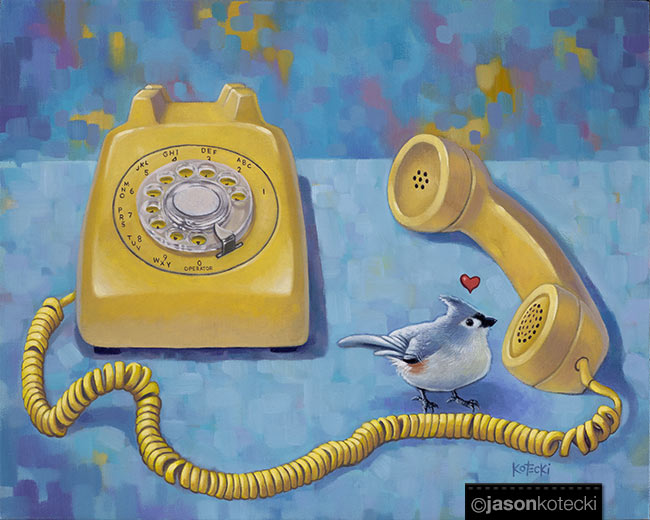
  • I Just Called to Say I Love You

    “I Just Called to Say I Loe You” by Jason Kotecki. 20 x 16. Oil on canvas.
    Original is SOLD 🔴 Shop this art!

    “I Just Called to Say I Love You” is a famous Stevie Wonder song. It’s also the title of this painting.

    One word in that title might be more important than all the others. We’ll get to that in a sec.

    When my wife Kim and I were dating, we’d spend hours and hours on the phone, talking late into the night, racking up phone bills that if bound together, would make the longest Harry Potter book look like a pamphlet. This was in the days when phones were attached to walls and the “call waiting” feature was a source of civil war for any siblings also angling for phone rights.

    My personal phone habits with Kim were the exception, not the rule. To this day, I hate being on the phone, for reasons both justified and irrational, but too numerous to bore you with. I let almost everything go straight to voicemail. I am certain the quality of my life would increase exponentially if I never had to talk on the phone ever again. 

    Of course, the phone is a handy tool for maintaining relationships, which is another weakness of mine. Fortunately, my wife helps with that, as she does the little things that help keep relationships alive for both of us. I am an introvert, a Type 5w4 on the Enneagram (if you know, you know), and as previously mentioned, hate the phone. A generous assessment is that I spend a lot of time in my own head and it’s easy to get lost in there. Which is good for allowing me to create wonderful things, but not so good for maintaining friendships.

    Either way, it’s a perfect storm for a scenario in which if Kim dies before me, I’ll end up living alone in a home that neighborhood kids will describe as haunted and invent all sorts of urban legends about the old guy who supposedly lives there.

    Part of my problem is that I overthink relationships. In our own ways, maybe we all do.

    Friendships can stall if we make them too complicated or set expectations too high. Failing to meet them finds us buried in an ever-mounting pile of “shoulds.” The more time that passes, the more time we assume is required for catching up. And of course, life rarely drops oceans of uninterrupted time into our laps, so… the relationship slowly grows stale and eventually dies.

    A recent conversation convinced me of that being a flawed approach.

    Andy Gullahorn is a songwriter in Nashville who started an interesting routine with his friend Gabe several years ago. Every week, Andy goes for a walk. Gabe, who lives a mile and a half away, does the same thing at the same time. They walk toward each other, and when they meet, they give each other a high five. Sometimes they stop to play badminton. Oftentimes, no words are exchanged, and they simply head back home.

    Kim and I had a chance to interview Andy, and he shared another routine he has with a friend who lives in Houston. Since an in-person high-five is out of the question, every Monday for six years, they simply exchange fist bump emojis. That’s it. And yet the connection has deepened to such an extent that Andy says he trusts that friend with his life.

    Andy’s advice is to start small. And ridiculous. “It doesn’t have to be dead serious to make a deep connection,” he says. “In fact, if that’s where it starts, it’s hard to maintain that. The high five is just a stupid foundation to hold real relationship.”

    Of course, not every relationship needs to be maintained for all time. Some people come into our lives for a reason or a season. But Andy’s right. Maybe we should focus on uncomplicating the friendships we want to fertilize.

    In the interview, he challenged viewers to just commit to not having a deep conversation but to just exchange winks or honk at each other as they pass one another on the road, even without saying another word. 

    That’s why maybe the most important word in Stevie’s classic song is…”just.”

    I JUST called to say I love you. That’s it. No fanfare. No guilt trips. No phone bills weighty enough to kill a small mammal.

    We don’t always need to have an hour-long conversation for our relationships to thrive. 

    A high five or a fist bump emoji might just do the trick. 👊
  • The Candymaker

    “The Candymaker” by Jason Kotecki. 20 x 20. Oil on canvas.
    Original is SOLD 🔴 Shop this art!

    This is part of “Adultitis Fighters,” a series of paintings by Jason Kotecki featuring real and fictional characters who serve as role models in the fight against Adultitis.

    Willy Wonka, the enigmatic chocolatier from Roald Dahl’s “Charlie and the Chocolate Factory,” is an iconic symbol of the wonder and magic of childhood. His eccentric behavior, refusal to conform, and unexpected twists challenge conventional expectations, encouraging us find delight in surprises. Willy’s whimsical inventions and fantastical creations teach everyone that anything is possible with a little imagination and ingenuity. His witty remarks and mischievous antics remind us not to take life too seriously.

    “You should never, never doubt what nobody is sure about.”

    “We are the music makers, and we are the dreamers of dreams.”

    “If the good lord intended us to walk, he never would’ve invented roller skates.”

    “The suspense is terrible! I hope it’ll last.”

    “A little nonsense now and then is relished by the wisest of men.”

  • The Sherpa

    “The Sherpa” by Jason Kotecki. 24 x 30. Oil on canvas.
    Original is SOLD 🔴 Shop this art!

    Do you ever feel lost?

    It seems like an absurd question when we all have smartphones offering turn-by-turn directions to anywhere we want to go.

    But having access to all the paths isn’t the same as knowing which one to take.

    What happens when none of the paths you’ve tried have led to where you want to go? What do you do when you know where you are now isn’t where you want to be, but none of the roads before you seem quite right? What then?

    Perhaps the best place to begin is with those little bits of colored whimsy people sprinkle on ice cream sundaes. Indeed, it’s as good a starting place as any.

    According to an Internet search, the ball-shaped versions of hardened sugar are called “sprinkles,” while the rod-shaped variety is known as “jimmies.” My family isn’t particular; we just call them awesome. My youngest daughter drew a picture of a “Jimmy Machine,” illustrating how they are made. 

    According to her, “Jimmy goes into a machine and it prints out Jimmys onto a conveyor belt. When it goes upside down, they fall, drop onto a series of four trampolines, and then into a butt cheek pit where they emerge as butterflies. Finally, they go in lava and then turn into jimmies.”

    I like to think of myself as creative, but this is PhD-level stuff.

    Some might say it’s merely the absurd ramblings of an eight-year-old with an overactive imagination.

    Yet, is it that much different than Walt Disney’s preposterous vision of Disneyland, a vision that investors, his brother, and even his own wife considered a disastrous waste of time and money? The success of Walt’s idea seems obvious in retrospect, but at the time, it was anything but. The same goes for “Snow White,” history’s first feature-length animated film, which was derisively dubbed “Disney’s Folly.” To those who didn’t get the vision, Walt’s ideas probably looked a lot like the blueprint of my daughter’s “Jimmy Machine.”

    Overactive imagination, indeed. 

    If you look closely, most of the best advancements of humankind started out looking like delusions of ridiculousness. Walt Disney knew that sometimes the best path forward isn’t on the map at all, and the only way to see it is through childlike eyes.

    Reminding people of the power of the childlike spirit is my mission in life. In a world overwhelmed by Adultitis, it’s been an uphill battle. 

    You see, the danger in branding your company “Escape Adulthood” is that it’s easy for people to discount you as irresponsible, immature, cotton-headed ninny noggins who are avoiding the responsibilities of adulthood and trying to escape the pressures of the “real world.”

    As a pragmatist, I’d be tempted to think the same way if I didn’t know any better. 

    It gives me solace to know we are not alone. J. R. R. Tolkien, the author of those little-known books The Hobbit and The Lord of the Rings, was often accused of writing fairy tales that were nothing more than the escapist’s way out of this so-called real world. His reply was simple and brilliant. He proposed that everything was dependent on that from which one is escaping. “We view the flight of the deserter and the escape of a prisoner very differently. Why should a man be scorned if, finding himself in prison, he tries to get out and go home?”

    Exactly. 

    Paying bills, upholding responsibility, and making hard decisions are important and necessary hallmarks of adult life. But the deep-down person we were when we were kids is much closer to the real us than the stilted, joyless version we often present to the world around us. Cynicism, common knowledge, and the rules that don’t exist have imprisoned us from being our true selves: passionate, playful, and curious creatures who dream big dreams and are filled with faith, hope, and love.

    So no, we’re not about shirking responsibilities or ignoring reality.

    We’re just trying to get back home.

    That’s why Kim and I often refer to children as sherpas. Like those experienced, wise guides who escort climbers up the face of a mountain, children have a pure wisdom that can help us traverse this adventure called life. 

    A GPS will not get us where we want to go. 

    Like any good adventure, life is difficult. We need all the tools we can carry, including the ones we tossed away so carelessly in our hurry to grow up. So yes, bring your logic, your experience, and self-control. (Walt needed all of them to make Disneyland real.) But don’t forget to pack your curiosity, playfulness, and passion, for they, too, have their usefulness. 

    They help us to identify hidden paths missing from our map. They open our eyes to help us see what can be, which is the first step required in making it so.

    And leave room in your pack for one more important but overlooked tool: whimsy.

    Although Whimsy is often viewed as superfluous, it is a spark of delight with the supernatural power to uplift the human spirit. Whimsy can fill a heart with happiness and a head with new ideas. Whimsy brings a playful unpredictability to our days. It puts the heavy things we carry in perspective. The delicious ridiculousness of whimsy helps lighten our loads and brings joy to others.

    Sometimes in life, we get stuck circling the same path, repeating our mistakes because we keep trying to use the wrong tools for the job, expecting a different result. The tried and true tools of adulthood are useful, but like using a screwdriver to shovel your driveway, insufficient for the task at hand. 

    If you are sad, stuck, discouraged, or overwhelmed…try whimsy.

    It’s a small thing that can have outsized results, the same way a sprinkling of jimmies can transform an ice cream sundae.

    A good sherpa knows the power of whimsy. Don’t bother looking for it on a map, but it might be the best path to take right now to get where you want to go. 

    In a dark world where the terrible stuff weighs so heavily upon us, we need whimsy more than ever. Whimsy lifts the soul, loosens up the mind, gladdens the heart, and opens the eyes to what can be. 

    This is the way.