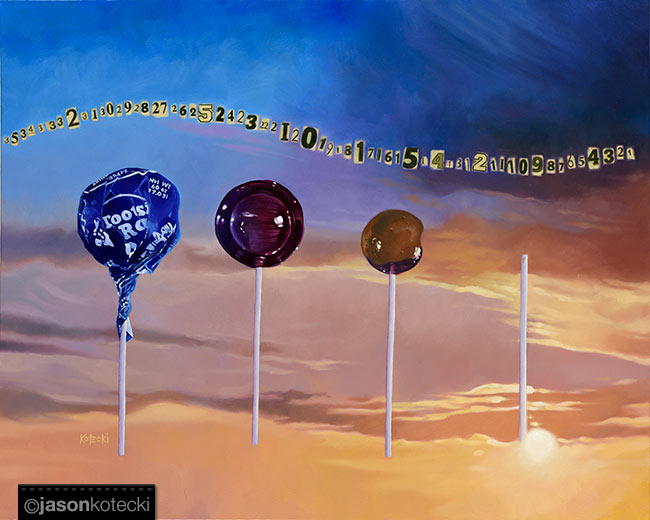
“How Many Licks?” by Jason Kotecki. 30 x 24. Oil on canvas. Original is SOLD 🔴 Shop this art!
How many licks does it take to get to the Tootsie Roll center of a Tootsie Pop?
A commercial that appeared on TV when I was a child asked that very question. It turns out that a number of folks have tried to get to the bottom of this.
A group of engineering students from Purdue University built a licking machine, modeled after a human tongue, and determined that it took an average of 364 licks to get to the center of a Tootsie Pop.
A chemical engineering student from the University of Michigan built his own licking machine and recorded that it required 411 licks.
And a group of junior high school students ditched machines in favor of human lickers, and reported an average of 144 licks.
Apparently, the world really may never know how many licks it takes to get to the Tootsie Roll center of a Tootsie Pop.
I remember the first time I took my kids to Wrigley Field. It was the year after the Cubs won the World Series, and the kids were excited to see their favorite players in person. It was a beautiful day, the Cubbies won, and we relished singing “Go, Cubs, Go” with 40,000 fellow Cub fans.
We looked forward to that game for months. As we do for many of the firsts in our lives. Your first baseball game. Your first kiss. The first time you get to drive by yourself. The first place of your own. Your first child.
We anticipate the first times and do our best to savor them.
But the last times are different. They have a habit of sneaking up on us. Undoubtedly, there was a last time that I held my youngest daughter in the middle of the night, in a grouchy sleep-deprived state, comforting her – begging her — back to sleep. But I don’t remember it, because I didn’t realize it was the last time when it happened.
The first times come with a lot of fanfare. But the last times come and go without a whisper.
How many dinners do you have left with your parents?
How many anniversaries do you have left with your spouse?
How many bedtime stories do you have left to read to your kids?
How many fishing trips do you have left with your grandchildren?
How many licks?
There is no machine we can build that will tell us. Not exactly.
We can guess, we can estimate, we can hope for the best.
But I bet that number is a lot smaller than we think it is.
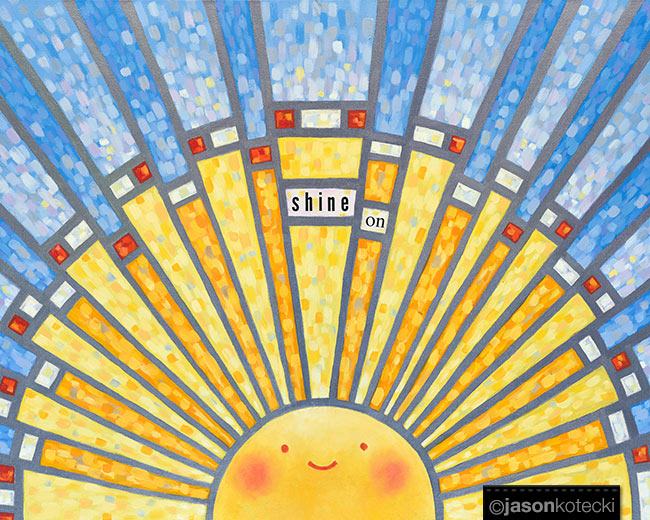
“Shine On” by Jason Kotecki. 30 x 20. Oil on canvas. Original is SOLD 🔴 Shop this art!
After months of anticipation about our family’s first trip to Mexico and an escape from the Wisconsin winter, the weather report turned foreboding. All eight days were calling for rain. Kim and I were crushed. Our family had finally recovered from a three-week battle with the flu over the holidays, and we were looking forward to the time away to recharge in the sun and surf. Kim was especially fretful about the forecast of rain, incessantly checking the weather app on her phone.
On the plane, I read a section in a devotional about God being a “living God.” That struck me. I grew up thinking of God as some far-off historical figure who did a lot of neat things in olden times, forgetting that He lives in the present tense, active in the here and now.
In that moment, I felt totally at peace. Did I expect God to alter a weather system on account of li’l old us? To be honest, I guess I hoped He would, but more than that, I knew that the only way to really ruin the vacation was to spend all our time worried and anxious over the weather report. Even if it rained the whole trip, we would still have an opportunity to be together and to rest, away from the hustle and bustle of our daily lives.
We did pray for sunshine, but we also prayed for peace to melt away our fears, and for the perspective to make the best of whatever each day would bring.
No one knows with certainty what next year, next week, or even what tomorrow will bring. (Not me, not you, and certainly not weather forecasters!) But too often in life, we allow doubt and anxiety to dominate our perspective, and we live out our fears in advance. I knew that God knew how big of a deal this trip was to us, and He would give us what we needed from it, even if it didn’t look exactly how we imagined it.
So here’s what happened. Every single evening, the weather app on our phones indicated storms for the next day. And every single day, we woke up to sunny skies, while the thundercloud icon had vanished. The only rain we experienced was about a half-hour’s worth on our last day, and it came as a welcome relief during a hot walk at the Tulum ruins.
The abundant sunshine became a symbol to us of God’s goodness. As the trip was coming to an end, we searched for a sunshine-themed souvenir to bring home with us, something to remind ourselves of what felt like a mini-miracle and God’s active presence in our lives. We never did find anything just right.
We arrived home at about midnight. Our youngest child was asleep as we pulled into our driveway. A few police officers were canvassing the street with flashlights, clearly looking for something. We didn’t think much of it, figuring the neighbor kid was in trouble again.
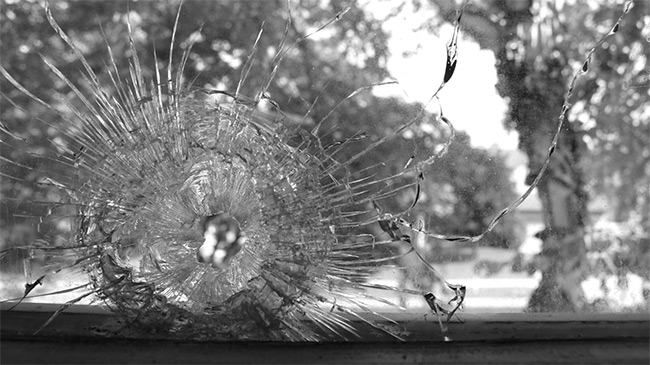
As our tired bodies, carrying overfilled suitcases, stumbled into the house, our oldest daughter said, “Hey, what’s that on the ceiling?” I looked up and saw a gash in the drywall. The directional groove led my eye to the window, which had a bullet hole in it.
A bullet hole.
“Kim,” I said, “Hurry and go tell the cops that we have a bullet hole in our window!”
The rest of the evening was a blur. We found small bits of glass all over the carpet and on the piano across the room. The officers pulled a bullet fragment from the ceiling, but it was too mangled to be of any use. They had very little information for us, except for the reports from neighbors, who had heard multiple gunshots and a speeding car with a bad muffler. At first, I was annoyed that I had to postpone the date with my bed to deal with this after having had an awesome vacation, but eventually, it hit me. “Wait. What if we had been home? This could have hit one of my kids.”
The mood quickly turned from annoyance to anger and fear.
None of us got much sleep that night. (Except Ginny, who was already asleep and would ask about that taped-up cardboard patch on our window two whole days later.)
The next morning, our six-year-old son, Ben, brought a bullet to Kim that he found in the hallway. “Momma, what’s this?” he asked.
Another call to the police.
The next few weeks were a blur of logistics and emotion. Assurances from the police that our neighborhood was historically among the safest in the city didn’t seem to help. Calls to the insurance company and various vendors about replacing the window and fixing the damaged ceiling were interspersed with the feeling of being violated and wondering if we were still in danger. I’d never seen my wife cry so much in all of our eighteen years of marriage.
We heard stories from neighbors who’d been home. Three young girls next door were in the front room watching TV when the shooting happened. An elderly neighbor across the street told us the gunshots were so loud that she thought her house was the one under attack. A young mother in the home next to hers was nursing her two-month-old in her front room. She hit the deck when the shots rang out. Everyone was shaken. For days, we saw cars slow down in front of our house to gawk at the scene of the crime.
Eventually, amidst the haze of fear and confusion, we began to notice where God had been working in the situation.
We realized that our house was the only one on the whole block that was empty when the shooting occurred. We figured out that it wouldn’t have been had we not been held up in Minneapolis so our plane could be de-iced. We felt His presence in the neighborhood meeting that was organized two days after the incident. Over fifty people crammed into a basement owned by a former police officer, bonding together to comfort one another and talk about practical ways to protect our neighborhood. It was neat to see connections get made and friendships deepen.
Finally, Kim and I got to a place where we could ask, “What does this terrible event make possible?”
Years earlier, we had stayed in a vacation home in Santa Barbara that featured some stained-glass windows. We’d always been smitten by their charm, so we wondered if we could replace the broken front window in our living room with a stained-glass work of art. The fact that the window in question was a decorative half-circle above the normal windows made it a perfect candidate. Maybe I could even design it. And maybe it would give hope to the rest of the neighborhood. We knew immediately what the design had to be.
A sun.
We got connected with Rick Findora, who just so happened to be the guy who did the stained glass windows at our church, and I gave him a sketch.
We got our sunshine souvenir after all—after we returned home, and in a form we never anticipated. It now serves as a beacon of hope to the entire neighborhood.
We live in a dark world, where tragedy and pain are all too common. Sometimes vacations do get rained out. Sometimes bullets don’t miss. But I believe this: God is a living God. He gives us small signs—signs that don’t seem like much in the grand scheme of things—just to let us know He is there. I think the reason He does this is so that when the bad things happen, we’ll remember that He is still there, ready to bring good things out of terrible circumstances. He gives us the sunny days to recharge us, to fill our reserves with hope that lights the way during the dark times, reminding us that the sun will shine again.
It’s worth remembering that even on the darkest, cloudiest days, the sun doesn’t disappear. It’s still there; it’s just hidden. The people who see silver linings are the ones who look for them. If you are in a dark season right now, keep looking for the light. It’s coming.
Finally, I believe we are called to be a light for others. We do this by sharing our gifts and by being kind. When it comes to people who disagree with us, instead of calling them names, we can call them up for coffee. The smallest things can make the biggest difference. Our happiness increases when we help others, shining our own lights outward.
In the battle between light and darkness, the darkness doesn’t stand a chance.
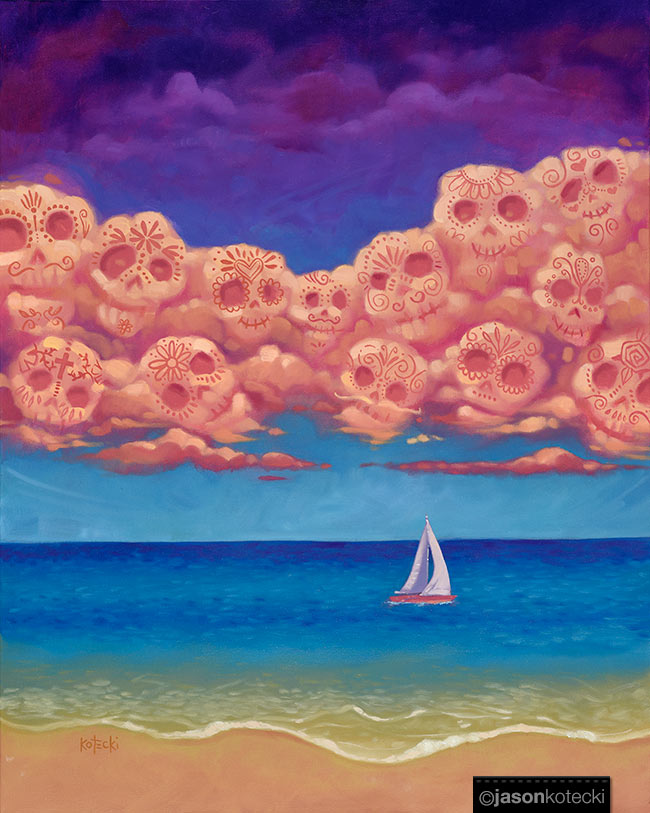
“Wind In Our Sails” by Jason Kotecki. 20 x 20. Oil on canvas. Original is SOLD 🔴 Shop this art!
This painting was inspired by a family vacation to Mexico. One thing that was abundantly clear in the week we were there is that the Mexican people love their color. When you’re accustomed to everything being Pottery Barn beige and gray, it really stands out.
I wanted to incorporate that vibrant, whimsical color, along with one of the culture’s great traditions, Dia de Muertos, or Day of the Dead. I think it is a beautiful way to look at the afterlife and the ancestors who went before us. I appreciated the idea of seeing death as a part of the life process, rather than an end in itself.
I also liked the focus on how much we owe to the people who came before us. In American culture, the independent spirit of the individual is celebrated. That’s fine, as far as it goes. Except that there is no such thing as a self-made man or woman. No one becomes successful by themselves. Yes, your unique talents and a fiery self-determination are key ingredients for success.
But life is a group effort.
I was thinking about the people in my own life who have passed away. Not just family members, but teachers and coaches who served as mentors, too. Every one of them taught me something that I carry with me to this day.
My Grandma K. made me feel like I was special, just as I was.
My third-grade teacher, Mrs. Smith, encouraged me to take my artistic talent seriously.
My Little League coach, Mr. Dawson, helped me believe that I was a winner.
When I was an uncertain teenager, Deacon Vince saw me as a grown-up with valuable contributions to make.
Each of us is like that tiny sailboat. At times, it can feel like we are drifting, alone, on a vast and overwhelming sea.
But we are not alone.
We have the wisdom, given to us by the people in our lives who have gone before us, charting our course. They have touched our lives, and their examples live on, showing us the way.
And their words live on as the wind in our sails, guiding us into a bright and colorful future.
“Good Fortune” by Jason Kotecki. 12 x 12. Oil on canvas. Original is SOLD 🔴 Shop this art!
Lucky is winning a game of Candyland against my daughter.
Most things in life that seem lucky are often anything but.
I don’t like how chalking up someone’s success to a lucky break strips away credit. Not only from the person who worked hard, but also from God, who (often anonymously) orchestrated so many of the events and circumstances along the way.
Undoubtedly, where you are born, who your parents are, the color of your skin, and whether or not you grow up to be 6-foot-8 with the ability to jump over a school bus are completely out of your control and could all be considered “luck.” And yet, having any of these so-called advantages is no guarantee for success, while not having them does not condemn one to certain failure. Every NBA draft class is filled with dudes who won the genetic lottery but won’t last long in the league.
I could be all bent out of shape because my gifts are not advantageous to playing professional basketball. But we are all given different gifts that become our advantages. True joy and fulfillment are the result of fashioning a life that utilizes those gifts to the best of our ability in the service of others.
The Roman philosopher Seneca said, “Luck is what happens when preparation meets opportunity.”
Luck is out of your control. But you know what isn’t? Finding the courage, discipline, and persistence to try something that might not work. See also: Putting in the hours, perfecting your craft, and getting back up after you fail. Sometimes the hardest work is keeping your faith when everyone else paints you a fool.
You have the good fortune to be alive, right now, with an abundance of realized and untapped gifts and talents. What you do with them next has nothing to do with luck.
Want some good fortune? Be good at what you do, and be a good person.
Spend your life working on that, and the luck part has a way of taking care of itself.
“In This Kitchen We Dance” by Jason Kotecki. 20 x 20. Oil on canvas. Original is SOLD 🔴 Shop this art!
I painted this for my wife’s 40th birthday. It’s one of her favorite quotes, and it perfectly captures the spirit that fills our kitchen.
As kids, we danced all the time. We danced when we were excited. We danced when we were happy. We even danced when we were bored. Why did we ever stop?
Maybe we started worrying about looking foolish.
Maybe we’ve discovered that the world isn’t as carefree as we thought it was.
Maybe we are afraid of pulling something.
The kitchen often serves as the primary gathering place in a home. From time to time, our kitchen hosts spontaneous dance parties. If a favorite song comes on, we crank the volume, and our family of five casts our cares to the wind and shakes our booties to the music. Mind you, these dance parties are mostly devoid of any talent (although my son Ben has some sweet moves), but they are always bursting with joy and enthusiasm.
You see, kitchen dancing doesn’t require sweet moves.
It does require you to move, however. Even a little booty shake can make your body feel better.
It also requires the willingness to be vulnerable by looking a little silly, which is one of the most intimate ways to bond with another person.
And it requires the ability to take oneself lightly, which helps lighten the heavy loads that weigh us down.
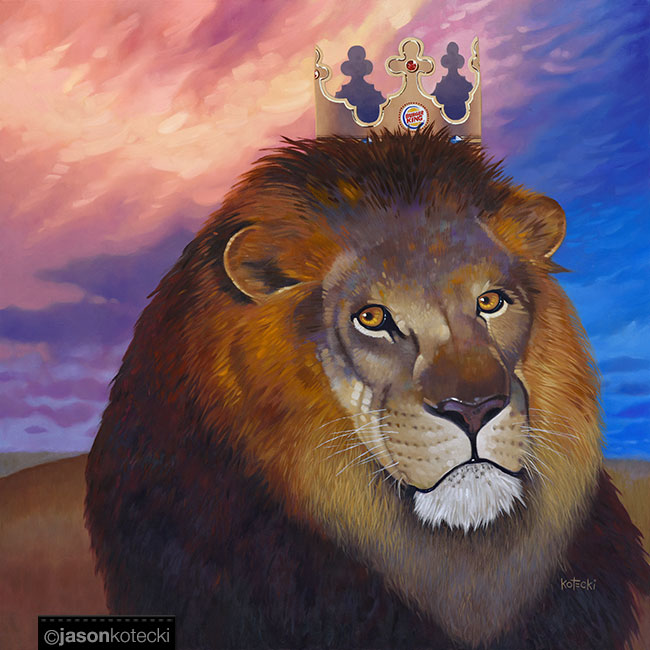
“The Burger King” by Jason Kotecki. 40 x 40. Oil on canvas. Original is SOLD 🔴 Shop this art!
When Kim and I are goofing off, either alone or with the kids, one of us will often challenge the other to “own it.” What this means is that we have to push away any iota of self-consciousness and fully commit to 100% concentrated silliness.
When you see someone trying to act like a funny character or dance ridiculously, you can tell if they are not “owning it.” You can tell they feel awkward, and that awkwardness makes you feel a little awkward, too.
But if you’ve ever seen someone “own it,” it’s like they’re the only person in the room. They look patently ridiculous — way more so than the person who feels awkward being just a little silly — and they positively don’t care.
That is powerful.
Each of us has a line that marks how far we are willing to go in looking silly in front of others. For most of us, that line is not very far away. Some people will do anything to avoid looking the least bit silly in public. We don’t dance in public, wear anything that might draw a sideways glance, or even raise our hands to ask a question if we think everyone else already knows the answer.
Elite comedians are willing to go shockingly beyond that line. They go so over-the-top in their commitment to the bit, owning it in a way that clearly shows that they simply don’t care how silly they look.
Amy Poehler rightly said, “There’s power in looking silly and not caring that you do.”
We often assume that if we are too silly, people won’t take us seriously. But the irony is that the less we care about how silly we look, the more confidence we project. And confidence is power. We are more attracted to people with confidence. People follow confident leaders. We say yes to requests made with confidence.
I considered making this painting 12 x 12 inches. What a stupid choice that would have been. The original painting is almost four feet square, and thank goodness. This painting is about the power of not caring about looking silly. It’s important that this lion, one of the most powerful creatures on earth, is life-size. Being face-to-face with him gives you a real sense of his power.
The fact that this lion, one of the most powerful creatures on Earth, is wearing a silly little paper crown from a fast-food joint does nothing to minimize that power.
Are you going to be the one to tell him he looks like an idiot?
Even if you did, it’s pretty clear that he wouldn’t care one whit about your opinion.
We can’t control the opinions of others or what they think of us. But that doesn’t matter, because you are enough. You don’t need anyone else’s permission or validation to feel valuable. Own the power that comes from being you–your wonderful, weird, and wacky you, and not caring about what other people think.
When you can own that? Well, that’s as powerful as you can be.
“Half Full” by Jason Kotecki. 12 x 12. Oil on canvas. Original is SOLD 🔴 Shop this art!
I like to think of myself as an optimistic person. After all, I am a lifelong Cubs fan who always believed in the hope-filled power of next year. Then again, when they lose three games in a row these days, feeling certain that they’ll never win another game again seems pretty pessimistic.
The truth is, I’m probably a little bit of both.
The optimistic side of me believed that Penguins Can’t Fly would be a New York Times best seller. It wasn’t.
This defeat, along with a number of other epic failures in my career, add up to bolster the popular argument that I should minimize the chance of pain and defeat by keeping my expectations low.
This strategy of operating with low expectations is employed by many. The thinking goes that if you don’t get your hopes up about something, then you won’t be as disappointed if it doesn’t work out. And if it turns out well, you’ll get the enjoyment of being pleasantly surprised.
As it turns out, it’s a flawed strategy.
According to neuroscientist Tali Sharot, people with high expectations always feel better because how we feel depends on how we interpret the event.
When a person with high expectations succeeds, they attribute it to their own traits. When they fail, it wasn’t because they were dumb; it was because the exam happened to be unfair, and next time they’ll do better. When a person with low expectations fails, it was because they were dumb, and if they succeed, it’s because the exam happened to be really easy, and next time reality will catch up with them.
Secondly, regardless of the outcome, the act of anticipation makes us happy. It’s why people prefer Friday to Sunday, because it brings with it the anticipation of the weekend ahead.
Finally, optimism acts as a self-fulfilling prophecy. Believing we will be successful makes us more likely to be so, and optimism reduces stress and anxiety, leading to better health.
When a container is at 50% capacity, it is half full.
But technically, it’s also half empty.
Both are absolutely correct assessments of the container in question.
If the label you give it is completely subjective, go with the one that gives you the best chance of going somewhere beyond what you thought was possible.
So many of our experiences in life could be seen in the same light. We lose a job. We break a leg. We get dumped by the one we thought was The One. Is that unexpected, unwelcome thing that just happened in your life an obstacle or an opportunity?
Yes.
Both are absolutely correct assessments of the event in question.
Deciding what you call it can make all the difference.
Was Penguins Can’t Fly a failure?
Upon further review, believing that it had a chance at being a bestseller led us to put in a lot of effort. It pushed us to think of new and creative ways to promote it, and it got me out of my comfort zone in asking for help. All of these things made a difference. No, it wasn’t a NYT bestseller, but three printings later, and after having outsold my advance (something most published authors never do), it was a success.
It turns out that optimism is attributed to that success. Without it, I would have always wondered what might have been.
I don’t know if I’m naturally optimistic or not. These days, even though I still feel fearful about getting my hopes up only to have them dashed, I’m realizing it’s more of a choice than a disposition.
We all get to make that choice every single day. To me, there’s really no contest.
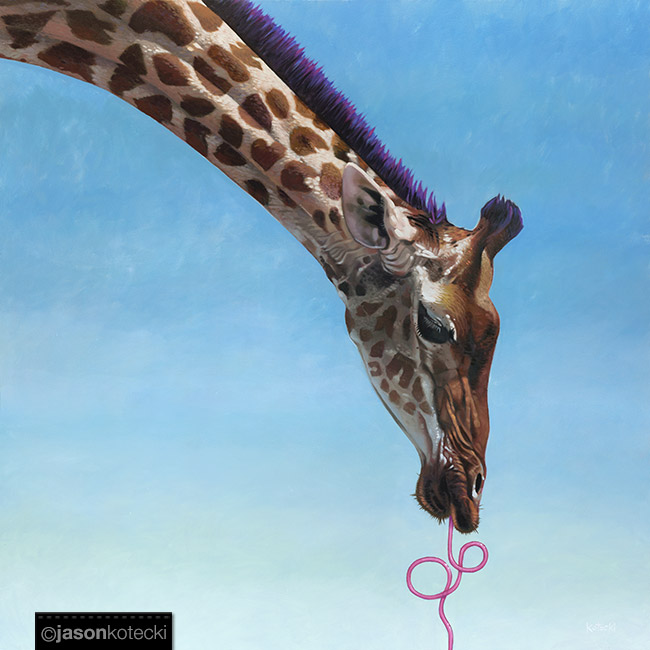
“A Little Whimsy” by Jason Kotecki. 40 x 40. Oil on canvas. Original is SOLD 🔴 Shop this art!
The moment we have fully succumbed to Adultitis is the moment we turn down a twisty straw for a regular one.
The mane on this giraffe is pink and purple. In the early stage of this painting, the spots were different colors, too.
But as it developed, I decided to go with more natural colors. Except for the mane, of course.
And that whimsical twisty straw.
The moment we have fully succumbed to Adultitis is the moment we turn down a twisty straw for a regular one.
Would you like to generate a little bit more positive word of mouth for your business? Maybe improve employee morale and engagement? See your customer satisfaction ratings rise? Attract more people to your association or cause? Would you be interested in making life feel a little bit more magical? Here’s the secret: Add a little whimsy.
Please note! I said “a little.” Like a single drop of food coloring in a pitcher of water, a little whimsy is enough to transform everything.
For me, the giraffe in this painting represents this concept:
Too much whimsy and no one takes you seriously. Just the right amount and the world takes notice.
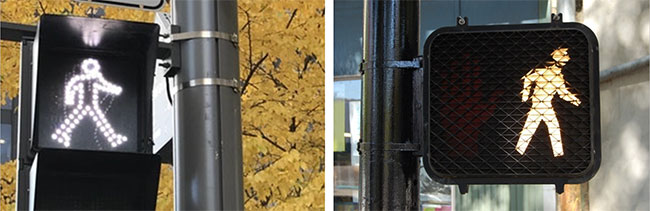
Let me give you an example. One of my favorite things about Canada are the walk signs. I’ve been trying to figure out why. I think it’s because he has cute little feet and seems a bit more laid back in posture compared to his U.S. cousin, who is in a more forward-leaning position (giving the feeling of being in a hurry). Plus, he has no feet. (Maybe he’s hunched over in pain?)
See what I mean? I think the U.S. walk signs have Adultitis. It’s a subtle difference, almost imperceptible, but I’d much rather be the fellow on the left, wouldn’t you?
Just a little bit of whimsy is enough to remind you of the child that still lives inside. The one secretly sticking its tongue out at your idiot boss. The one that knows that even though you have to fill out that tax form doesn’t mean you have to like it. The one who believes in having fun simply for the joy of it.
Something like wearing colorful socks, dying a pink streak in your hair, or adding some stickers to your laptop lets Adultitis know there’s a new sheriff in town.
It adds a little color and zest to a life that may have veered too far into the gray.
On the whole, it’s tempting to see these little touches as frivolous, superfluous, and insignificant. But they actually do something quite important: They have the power to uplift the human spirit.
Something we need now more than ever.
Whenever you can add a little gladness and gaiety to a person’s day, do it. P.T. Barnum once said, “The noblest art is that of making others happy.”
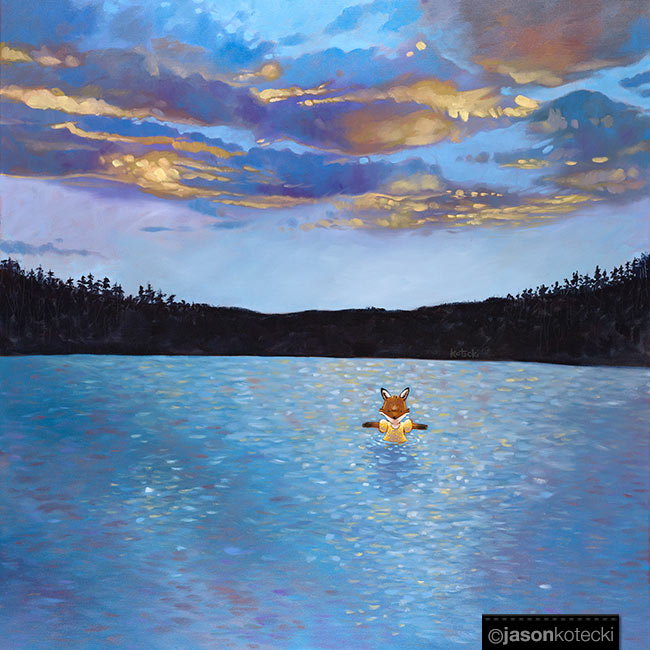
“The Princess Dress” by Jason Kotecki. 36 x 36. Oil on canvas. Original is SOLD 🔴 Shop this art!
This painting was inspired by my daughter.
Our family loves going on walks. A half mile from our house, there is a row of lakefront homes. A small sliver of land between two of them serves as a public access point to the lake. A few years ago, an hour before the sun tucked itself in for the night, we pushed our strollers through the skinny green passageway to enjoy the pint-sized plot of beach that was ours.
It wasn’t long before my oldest began wading in the water, delighted by the sand squishing between her toes. Lucy was wearing last year’s Halloween costume — a sparkly pink and yellow princess dress — because, well…just because. The gentle waves kissed the bottom of her gown. I considered telling her to be careful not to ruin it, but reasoned that a little water never hurt anyone.
Meanwhile, Ben was outfitted in his Incredible Hulk costume — you know, just because — and for some reason, was lying face-down in the sand. Motionless. He looked like a big green sea turtle who had come in with the tide to build a nest. We’d be finding sand on him days later.
By the time I turned my attention back to Lucy, she was in lake water up to her armpits, princess dress and all! I stood there, in stunned silence, as the supercomputer in my brain whizzed through its vast database in search of some rule frowning upon the intermingling of lakes and princess dresses. (Old Halloween costume or not, that dress wasn’t cheap, and I didn’t want it ruined.) But the warm smile that beamed widely across her face suggested that perhaps this was yet another rule that doesn’t exist.
In that moment, with the sun setting behind her, I realized that Lucy was living life as well as it could possibly be lived. Too often, we fall far short of this ideal. Why?
Because we’re afraid of getting our princess dress wet.
And we all have one. Our “princess dress” is the carefully curated version of ourselves that we show off to others. It’s the way we look, speak, and act. It’s our degree and our job title, our home and hairstyle, our cars, clothes, and 401ks, all wrapped into one pretty package and tied with a bow that signifies that we are responsible, sophisticated, and successful.
In order to keep this princess dress looking good, we must live a life of restraint. No full-out running, no sitting on the ground, no eating messy things, and certainly no swimming in lakes.
We are given countless opportunities to dive headfirst into the experience of life, but we are too afraid to mess up our hair, our clothes, or our reputation. Because running through puddles, making a mess, or doing something silly for the sheer sake of fun sullies the dress we’ve worked so hard to preserve. And besides, people like “us” don’t do things like “that.”
While settling for good enough, we miss the insanely great.
Guess what? After the dip in the lake, Lucy’s princess dress went into the washing machine and came out… good as new.
Fear does a pretty good job of keeping us from living an amazing life. But it’s a horrible predictor of the future.
Don’t settle for dipping your toes into this adventure called life. For best results, spend more of your time up to your armpits in awesome.
“The Captain” by Jason Kotecki. 20 x 20. Oil on canvas. Original is SOLD 🔴 Shop this art!
I present to you a painting I made of a pirate ship sailing in an ocean of milk amidst floating Cap’n Crunch cereal.
I thought long and hard about conjuring up some deep meaning on this one. Something that would make you shake your head in amazement and say, “Wow. He is a truly brilliant artist and thinker.”
But you know what? There isn’t any deep meaning. The truth is, I was thinking about Cap’n Crunch cereal, which I love, and thought about a tiny pirate ship sailing in a bowl of it, which would be neat. But then I thought, what if the ship was normal-sized and the whole ocean was milk and it had giant pieces of Cap’n Crunch floating in it? That would be weirder, and possibly neater.
So that’s what I did: gave myself over to pure whimsy.
As we get older, Adultitis takes over and kills our whimsy. We grow increasingly skilled in the art of taking ourselves too seriously. And all that seems to bring us is anxiety, stress, and a life totally devoid of fun.
We’ve mastered the ability to make the trivial monumental. We fret about all sorts of things, from gas prices and elections to how we’re going to kill those weeds in the yard and what we should wear to next Friday’s function.
Becoming more responsible is one thing. But losing our sense of whimsy and taking ourselves too seriously is another.
I have long admired people like Dr. Seuss and Roald Dahl because they created magical characters and worlds that are so rich with whimsy. Their art depicts preposterous, physics-bending, imagination-stirring images and scenarios that exhibit a ridiculousness that is wholly original and entertaining. Meanwhile, within the context of their art, all of it comes across as completely normal. How did they do that?
It can be hard for me to give myself over to this pure, unadulterated nonsense, which I consider to be the unfiltered essence of the spirit of childhood. As someone who often errs on the side of practicality and reason, I have always wished I could be more like Dr. Seuss and Roald Dahl. After discovering Adultitis and its evil tricks early in my adult life, I have spent my life trying to get back to that level of creative abandon. Back to normal.
And yet here I am, having created a painting that exists at least within the same universe as those two greats, frustrated because I cannot come up with words to explain the meaning of this painting.
Because there isn’t one.
And thankfully, I think to myself, “Well, finally. Some progress.”
It took a while to become an expert at taking yourself seriously; it will take a while to get back to normal. Give yourself permission to start.