Art Series: Life’s a Zoo

  • Jailbreak

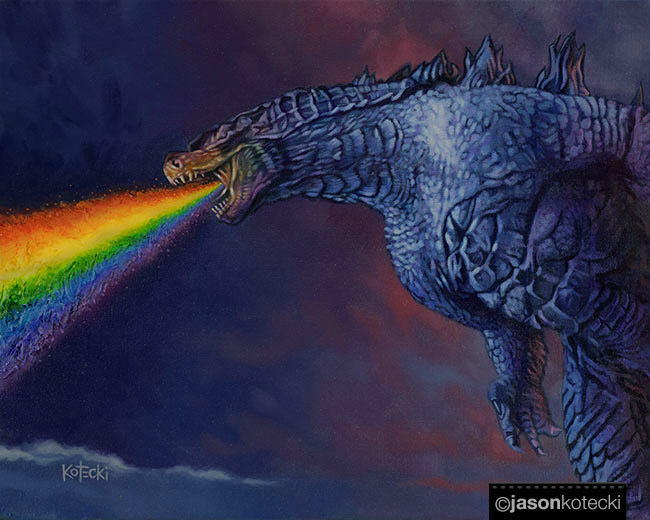
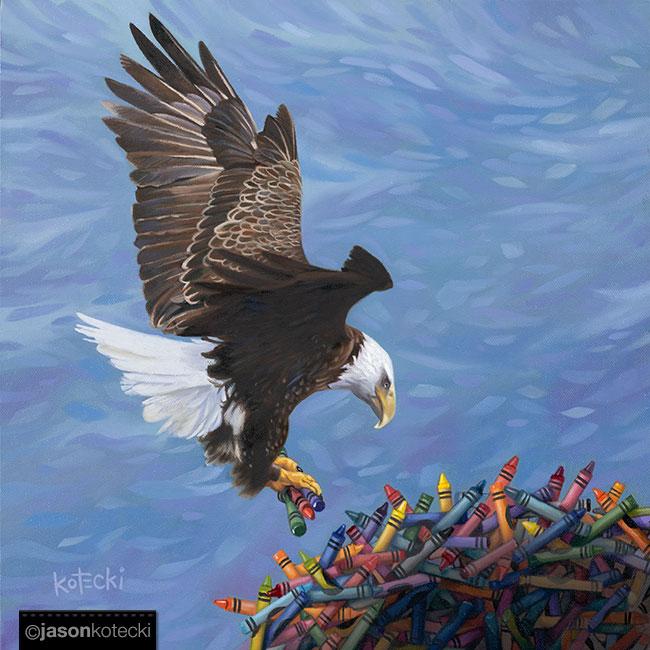
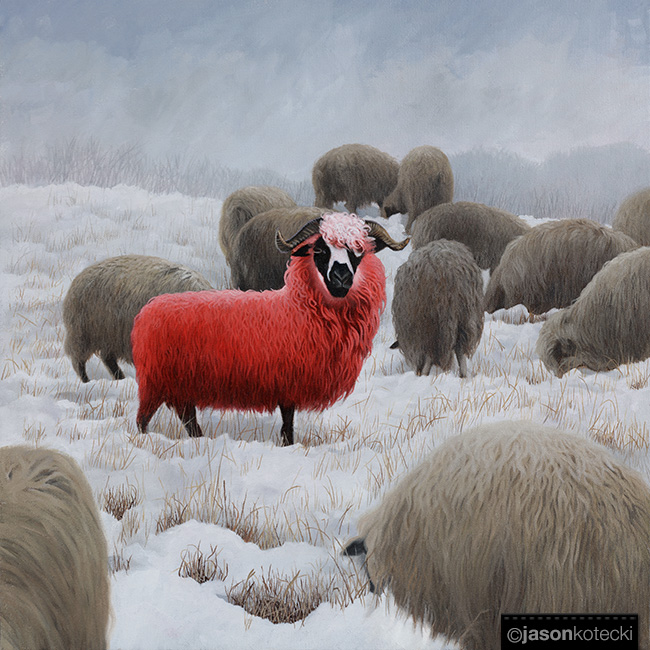
    “Jailbreak” by Jason Kotecki. 16 x16. Oil on canvas.
    Original is available 🔴 Shop this art!

    Remember paint-by-numbers? 

    You know, the beloved craft project in which an image is broken down into sections, each labeled with a number. Fill in each section with the color that corresponds to the ascribed number, and you achieve something that sort of resembles a work of art.

    Kinda, but not really. 

    It might look pretty, but it’s not art.

    It’s a plan. It’s a system. It’s one way of doing things.

    But it’s definitely not art.

    There’s no risk involved. No creativity. There’s none of YOU in the work.

    When you finish building a desk from IKEA, do you stand back and proclaim that you have just created a work of art? 

    No. You were merely following instructions.

    A paint-by-number can be a fun, relaxing way to spend an afternoon.

    Unfortunately, too many of us settle for a paint-by-number life.

    We believe that if we follow the rules, do what we’re told, and stay within the lines, we’ll end up with something that sort of resembles a successful life.

    Kinda, but not really. 

    Oh, it may get you a nice job with a nice benefits package and a nice house in a nice neighborhood with a nice car and 2.5 very nice kids, but I’m not sure that I’d call that a masterpiece.

    Just as a paint-by-number gives you the illusion of having made art, this path gives you the illusion of a well-lived life.

    We didn’t come up with this on our own, of course. Society and governments would very much prefer us to adopt the paint-by-number route. We’ve been conditioned this way, beginning in school.

    The prospect of a paint-by-number life is not all that different from those standardized tests we were given, the kind that can be graded by a machine, where the objective is to fill in each section correctly.  The only difference is that instead of using a number 2 pencil, you get to use color.

    Just not all of them.

    We’re not unwilling participants, however. Part of us craves the comfort and security that comes from embracing a paint-by-number method: “Just tell me what to do to have a safe, comfortable, successful life.” 

    Unfortunately, our best life is not achieved via the safe, predictable, step-by-step path.  

    Safety is an illusion, and doing things the way everyone else is doing them is not the path to happiness. Too many people figure this out in midlife, when the paint-by-number method fails to satisfy.

    We’re not here to live paint-by-number lives.

    Earlier in my career, I searched for a paint-by-number approach. I joined the National Speakers’ Association and got to know many successful people. I tried to copy them, but while they had specific talents and interests and values that contributed to their success, I discovered I had different ones. I searched for a speaker who was also an artist to show me the way. But the few artists I did find weren’t artists in the same way I was an artist, so it didn’t translate. 

    I thought maybe I was looking in the wrong place. I looked to other artists I admired for a roadmap. That also proved fruitless; it turns out that not many artists are all that eager to stand on a stage and speak to a thousand people.

    Lots of experts were happy to sell me their program: “Paint this red and this blue and this green, and you’ll be as happy and successful as I am!”

    That fell short, too. It was as if I had red and blue crayons, but lacked a green one that seemed important. Meanwhile, I also had purple and periwinkle, but I couldn’t find a paint-by-number that also included them.

    I spent many years frustrated and discouraged, unable to find a prescribed path to success that fit my unique talents, interests, and values.

    Finally, I had an epiphany. I didn’t need to wish for or wait until I had the colors someone else had before I could be successful. And those extra colors that didn’t seem to fit were actually an advantage.

    I resonated with this realization from Fred Rogers: “I’ll never forget the sense of wholeness I felt when I finally realized what in fact I really was: not just a writer or a language buff or a student of human development or a telecommunicator, but I was someone who could use every talent that had ever been given to me in the service of children and their families.” 

    I, too, realized that the magic was in combining my seemingly disparate talents. If I took all the crayons I had — even the ones that seemed extra or out of place — I’d be able to create something wholly original. 

    That’s when everything changed, and my career exploded.

    “Escape competition through authenticity.”

    –Naval Ravikant

    I have original paintings for sale. I also sell prints, which are copies of the original. 

    They look similar.

    But one is worth exponentially more.

    “All people are born originals, but many die a photocopy.”

    –St. Carlo Acutis

    It’s easier and feels safer to copy what other people are doing by living a paint-by-number life. Fit in. Follow the rules. Keep on doing what you’ve always done. Keep telling yourself you’re not creative.

    Adultitis would like nothing more for you.

    But here’s the thing: they don’t hang paint by numbers in the Louvre. 

    This doesn’t mean we shouldn’t listen to advice, learn from others, or ever follow best practices. I’m not saying you should strive to be original for the sake of originality. 

    I’m saying you already are an original.

    Or, as Dr. Seuss said, “There is no one alive that is youer than you.”

    You were made to be a masterpiece.

    You are in the process of building a portfolio. Fill it with adventures. Take chances. Try new things. Do things that don’t make sense once in a while.

    Use all the colors you’ve got.

    When you get to the end of your life, and you’re looking back at what you’ve created, please don’t let it be filled with paint-by-numbers.

    Don’t limit your potential by trying to squeeze yourself into someone else’s tame, safe, predictable prescription for success. 

    Confidently be your awesome, wild, original self.

    And make Adultitis go running for the hills.
  • Doing Nothing

    “Doing Nothing” by Jason Kotecki. 20 x 20. Oil on canvas.
    Original is available. 🔴 Shop this art!

    Doing nothing isn’t really doing nothing.

    New parents (and parents-to-be) get lots of advice. Among the wellspring of wisdom are tips on getting your kids to eat or sleep, and keeping them alive while maintaining your sanity. 

    Perhaps the truest and most common exhortation is: Cherish every moment; it all goes so fast.

    We don’t need anyone to tell us this, of course. It’s so obvious that we discard it out of hand with a smile, a nod, and a quip like, “I know; the days are long, but the years are short, amiright?”

    The problem is that the entire world seems to conspire against us. 

    It doesn’t want us cherishing anything. That would require us to slow down for a hot minute. Cherishing, pondering, reflecting…these don’t feel very productive. In fact, they feel a lot like doing nothing.

    I remember when my oldest daughter was a newborn. One afternoon, after completing the important work-related items on my to-do list, I relieved Kim by assuming caregiving duties. Lucy and I nestled into the rocking chair, where she promptly downed several ounces and drifted off to sleep. I sat for a few moments, soaking in the silence before the siren song of productivity resurfaced. Now that she had fallen asleep so quickly, I could tackle my email! As I was about to set her on the couch and grab my laptop, it hit me:

    Oh my gosh. I’m doing it. I’m missing out on the best stuff.

    Sometimes, a sleeping baby is a gift God gives us to help us manage other responsibilities. But I’d already accomplished my important tasks for the day. In that moment, I received a gift: the realization that there will always be e-mail to check, but my opportunities to hold that little sleeping angel were numbered. I became acutely aware that years from now, when I’m walking Lucy down the aisle on her wedding day, I will not remember any of the “productive” things I did that day. But the memory of her button nose, bald head, and peaceful slumber will remain with me forever.

    On that rapidly approaching day, I don’t want to find myself wishing I’d spent more time doing “nothing.”

    We live in a culture that worships at the altar of productivity. Adultitis is a sinister foe after all of us. It has tricked us into believing that we should always be busy, always “doing” something. If it’s not shared on social media, it didn’t happen. If it can’t be measured, it doesn’t matter. 

    A book called How Will You Measure Your Life? by Clayton Christensen sheds light on this. He points out that it is our nature to unconsciously choose the things that give us an immediate, tangible accomplishment over something for which we aren’t likely to see a return for decades. 

    We can cut the grass, close a sale, finish a week’s worth of lesson plans, deliver a presentation, publish a paper, or redesign our website in less time than it takes to raise great kids or build an awesome marriage.

    So we default to efforts that provide an immediate payoff and a satisfying feeling of accomplishment.

    In chasing this dopamine hit of achievement — even one that isn’t all that consequential — we confuse the urgent with the important. We unwittingly turn irrelevant tasks into priorities simply because they can be checked off some list. And checking off five things is better than one, even if the undone item was the most important. 

    Like a junkie craving another high, we feel anxious spending too much time doing nothing.

    But doing nothing isn’t really doing nothing. Sure, holding my sleeping baby and soaking in a quiet moment didn’t decrease the messages in my inbox. But it certainly wasn’t “nothing.” Quite the contrary. 

    Taking the time to do nothing once in a while – especially with the people we love – might be the single most important thing we do all day.

    When you carve out time to be with someone you care about, “What are we going to do?” becomes a question that demands an answer. The longer it goes without one, the higher the anxiety levels rise.

    Unfortunately, without a specific activity on which to focus our attention, we turn to those little dopamine-delivering slot machines always by our side. Time and again, I see friends or couples together, at the beach, on the train, out to dinner, and their attention is on their phones. 

    Their bodies are near each other, but their hearts and minds are miles apart.

    Together, but not really.

    All because we can’t escape the lure to do…something.

    Let’s refuse to let the almighty algorithm dictate how we spend our time. What if the answer to “What are we going to do?” was simply, “Nothing. Doesn’t matter. Let’s just be together.” There doesn’t need to be a mission accomplished, a box to be checked, or an objective to be measured.

    This painting is inspired by a favorite quote from Winnie the Pooh, who said, “People say nothing is impossible, but I do nothing every day.” 

    Doing nothing, it seems, takes more effort than doing something.

    When Lucy was a baby, and I was savoring a quiet moment alone with her doing nothing, the pull of productivity tried to poison it. Even if I left my laptop closed, I wondered if I should be engaging her more, teaching her more, or coming up with something more “Instagram worthy” to do with her. Was I a bad dad for not wanting to do more than just sit with her? 

    But the doing nothing was actually…nice.

    And it filled me with peace that is oh so hard to come by these days.

    Having a little honey, wishing on a dandelion, and enjoying a fine day together might feel a lot like nothing.

    Sometimes doing nothing is the very best something you can do.
  • Don’t Fight Fire With Fire

    “Don’t Fight Fight with Fire” by Jason Kotecki. 20 x 16. Oil on canvas.
    Original is SOLD 🔴 Shop this art!

    If you try to do anything worthwhile, you’ll likely suffer skeptics and critics.

    When you encounter naysayers, you have a few options. You can allow them to stop you. This is generally not advised, especially if they are little more than bullies. Or you can use their doubts as fuel. 

    This is what I recommend, but with caution.

    You see, that fuel burns hot. If you rely too much on it, you can end up consumed with anger and rage. If it becomes all about proving someone else wrong, rather than pursuing something worthwhile that brings you joy, you will be the loser in the end.

    When I was younger, I idolized Michael Jordan. Besides his athletic prowess, I also admired his work ethic, determination, and persistence. But I also remember the speech he gave when he was inducted into the NBA Hall of Fame. Despite having accomplished everything a player could possibly achieve and being widely regarded as the greatest of all time, he was still holding on to grudges from decades gone by. Perceived slights from his high school basketball coach, teammates, reporters, and fellow competitors. He was still trying to torch them all to prove his dominance, spitting out petty barbs to people he perceived as having wronged him. He came across as bitter, shallow, and small.

    Those slights he used to fuel his competitive drive seemed to have consumed him, leaving him charred.

    It’s natural to want to right perceived wrongs. But as many wise people have said, “Withholding forgiveness is like drinking poison and expecting the other person to die.”

    Our culture today seems more combative than ever. Trash-talking is considered an art form. We are urged to use the haters to fuel our rise, and then, when our success is undeniable, use it to torch them. When we win, it’s open season on our opponent. We must reign fiery retorts and comebacks down upon them, shaming them into submission. The more clever the comeback, the more street cred we receive.

    But there’s a better way, and the Wright Brothers are a great example.

    As you might imagine, the race to be the first to fly was heated. The two were fiercely competitive, but they never badmouthed their competitors, choosing instead to compliment their good qualities.

    One of their biggest rivals was a man by the name of Samuel Langley. He was the head of the Smithsonian, one of the most respected scientists of the day, and by far the most well-funded individual pursuing the problem of flight. He portrayed a haughty pride over his self-perceived inevitability of success. Ultimately, he experienced a very public, very humiliating failure.

    One that opened the door for the Wright Brothers to gloat.

    As I read David McCullough’s book about them, I found myself rooting for Orville and Wilbur to do some sort of well-deserved verbal victory dance.

    They never did.

    McCullough writes:

    “Neither brother was ever to make critical or belittling comments about Langley. Rather, they expressed respect and gratitude for the part he had played in their efforts. Just knowing that the head of the Smithsonian, the most prominent scientific institution in America, believed in the possibility of human flight was one of the influences that led them to proceed with their work.

    Wilbur told Octave Chanute in a letter written some years later: ‘He possessed mental and moral qualities of the kind that influence history. When scientists in general considered it discreditable to work in the field of aeronautics, he possessed both the discernment to discover possibilities there and the moral courage to subject himself to the ridicule of the public and the apologies of his friends. He deserves more credit for this than he has yet received.’”

    How kind. How gracious. And frankly, how epically badass.

    Taking the high road and responding with kindness possesses an underrated level of effectiveness. For the Bible tells us that when you treat your enemies with kindness, “you heap burning coals upon their head.”

    Don’t let the naysayers stop you. You can turn them into motivation, but be careful about using them for fuel.

    Fighting fire with fire leaves both of you as a pile of ash.

  • True Believer

    “True Believer” by Jason Kotecki. 24 x 24. Oil on canvas.
    Original is available. 🟢 Shop this art!

    Dreams always take longer than we think.

    There may be such a thing as overnight successes, but if so, they don’t stay successful for very long.

    More often than not, so-called “overnight successes” are anything but.

    One time, Kim and I spent a couple of hundred dollars on a two-day craft show. That was a big chunk of change for us at the time — about two months’ worth of groceries. We were next to a booth where a guy was selling knockoff Garfield tchotchkes. Meanwhile, we moved a grand total of $7.92 worth of greeting cards. It was rough. Then we drowned our sorrows in sirloin steaks at Outback, which made our negative profit margin even worse.

    I have a lot of stories like that from the early days. Happy times.

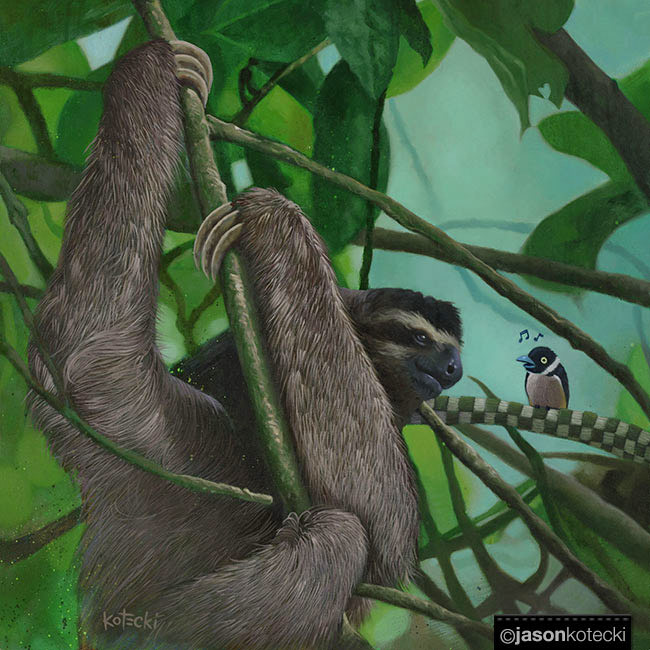
    Over the years, I have often felt like the sloth in this painting. Very little progress to show for a heck of a lot of effort.

    But then I think of things like that craft show, and I’m impressed and even a little surprised by how far we’ve come. There is a great sense of satisfaction in what we’ve built and the things we’ve accomplished, regardless of how much distance there is left to cover.

    Anything worth building takes time.

    More time than you think it should.

    Like way more.

    We need to hear that reminder often, because it goes for everything from dream businesses and amazing relationships to paying off Bank of America and mastering the clarinet. Thanks to the proliferation of microwave ovens and high-speed internet, progress always seems to be taking longer than it should. Then the media peddles their stories of overnight success. They catapulted to fame and fortune in one fell swoop; why can’t you?

    When the early buzz of enthusiasm wanes, discouragement is quick to settle in. It is during those seasons that we need to look for and listen to our true believers.

    I’ve been fortunate to have quite a few in my life.

    My Grandma K. made me feel like I was special, just as I was.

    My third-grade teacher, Mrs. Smith, encouraged me to take my artistic talent seriously.

    My Little League coach, Mr. Dawson, helped me believe that I was a winner.

    My high school art teacher, Mrs. Garrett, made me believe I had the talent to do this for a living.

    When I was an uncertain teenager, Deacon Vince saw me as a grown-up with valuable contributions to make.

    When Kim and I got married and launched our business, we were graced with a few true believers who saw the vision, including our parents and our best friends, Sue and Jenna. Theirs were not just empty words of encouragement. They responded with action by offering their time, money, and prayers. This signaled the proof of their belief.

    The certainty from true believers is invaluable. There will come a time when you lose faith in the vision, and you will need them to remind you that it’s real.

    Mounting failures and things taking longer than you expected take a toll. That vision, which once seemed so clear, begins to fade. You wonder if all the naysayers were right. After all, so many of them have way more experience than you, and the evidence seems to be piling up in their favor. Maybe I AM delusional? Maybe I was mistaken? Maybe the signals got crossed and I accidentally co-opted a dream that was not meant for me…

    I entertained all these thoughts at various times. It was tempting to give up.

    But then I remembered my parents. And Kim’s parents. And Sue and Jenna. I remembered that nobody pours money or time into a lost cause. Their sacrifice was tangible proof of their belief in us. It helped assure me that no, this is not a mirage. It’s real. They see it.

    Their belief bolstered my own.

    We need cheerleaders to succeed. They give us the boost we need when our dream seems late in coming.

    There are a few reasons dreams take longer than we think they should.

    One is partly for us to prove how much we want it.

    But it’s also because the most important part of a dream is who we become in the process of chasing it. That’s the real reward.

    When success doesn’t materialize as quickly as you thought it would and you’re discouraged by your dream taking too long, don’t despair. Heed the true believer cheering you on.

    Take it from the sloth. Achieving anything worthwhile is a marathon, not a sprint.

  • Kintsugi Tortoise

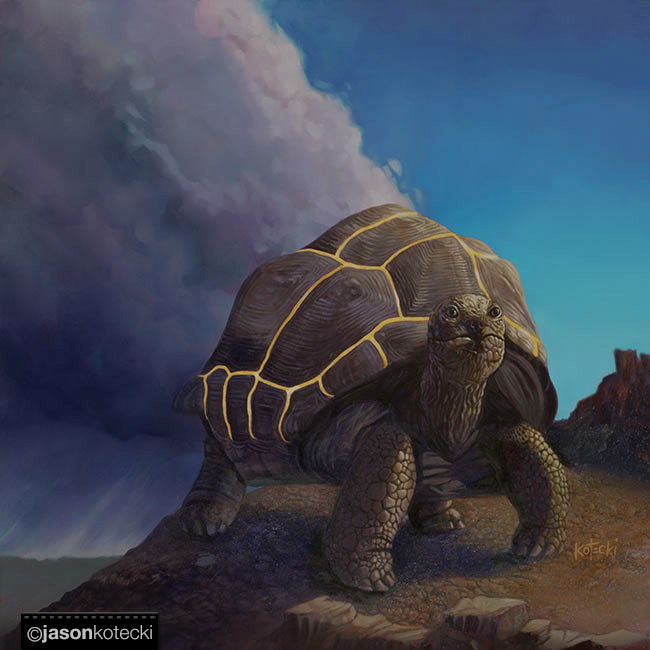
    “Kintsugi Tortoise” by Jason Kotecki. 30 x 30. Oil on canvas.
    Original is SOLD. 🔴 Shop this art!

    All dreamers start out delusional.

    But perhaps that’s an essential ingredient.

    The feeling that their idea is “genius” and the perception of their inevitability of success provide the enthusiasm and energy to get started. After all, no one found the fuel to begin chasing a dream by focusing on all the reasons it could never work.

    The critical moment is how the dreamer responds when he or she first encounters adversity.

    Or as philosopher Mike Tyson put it, “Everyone has a plan until they get punched in the mouth.”

    If a dream is big enough and you pursue it long enough, it will break you.

    Your confidence will be shattered. Doubt will creep in. Hope will be lost.

    Then what?

    I’m sad to say that’s often where it ends. The dream dissolves into an emaciated wish, a thin, pale shadow of its former glorious self.

    For twenty-five years, Kim and I dreamed of having a lake home. We talked about it on our first date. We spent hundreds and hundreds of hours talking about it, trying to figure out the most efficient way to make it happen while still doing the work we love and feel called to. We tried on dozens of scenarios in our minds, calculating what was possible and what sacrifices might be required.

    In the early days, it seemed like just a matter of time before we made it happen. We had pure motives, a little bit of talent, and a desire to work hard. I could see it, clear as day. On the hard days, the steadfast belief that it would come true kept me going. In my naiveté, I figured it would take a year, maybe three at most. (Ha!) 

    As months turned to years, and our kids got older, doubts crept in. I wondered if I was wasting my time. I wondered if I was only holding on in desperation, and that my death grip on my dream life was keeping me from living my real one.

    It was exhausting and soul-crushing at times. While on a family vacation in Florida, and with the kids asleep in bed, I was sitting on the balcony of our rental. Although it was too dark to see them, I could hear the Gulf’s waves pound the shoreline. My heart was broken, and I wished that I’d never had the dream at all. I was overcome by the desire to throw it back into the sea.

    I considered that maybe giving it up would give me relief and freedom. I yearned for someone from a Harry Potter book to cast a Memory Charm upon me, to obliviate the dream from my memory.

    That night on the balcony in Florida was February 3, 2020. A little over a month later, a pandemic began, and all hell broke loose in our lives.

    Yet somehow, just eleven months later, our family moved into our dream home on Lake Michigan. (Never in a million years did I think it would be one of the Great ones!)

    Kintsugi is the Japanese art of repairing broken pottery with gold (or other precious metals). Instead of disguising the damage, kintsugi highlights the repairs, transforming the broken object into a unique and beautiful piece. It’s a philosophy that embraces imperfections and impermanence, finding beauty in flaws and celebrating the history of an object. 

    It’s true that if a vessel breaks, it can never be made to look new again.

    But kintsugi makes it better than new, because it’s even more beautiful than it was before.

    Our brokenness makes us humble. Humility is the most beautiful virtue because it allows our other good qualities to shine fully and be most helpful to ourselves and the world.

    These broken places within us are not defects. They are the places where light can shine through. Those golden scars embody a soul that is stronger and a story that’s more beautiful because of the trial.

    This painting represents the slow patience that’s required of a person trying to achieve something great. It’s a reminder that we will experience the storms of struggle and brokenness. But it’s also a beacon of hope for brighter days ahead waiting for us if we persist.

    The journey may be harder than you expected, but the you that emerges will be better for it.
  • Great Expectations

    “Great Expectations” by Jason Kotecki. 30 x 24. Oil on canvas.
    Original is SOLD. 🔴 Shop this art!

    I have a confession to make.

    I fully expected to marry a brunette. I was pretty vocal about it, even. No blondes for me!

    In retrospect, the women who caught my eye when I was young — Princess Leia, Lois Lane, Wonder Woman — were all brunette. Most of the girls I dated in high school were brunettes.

    But after I met Kim, who was most definitely not a brunette, I didn’t waste any time wondering if I was making the right choice in spending time with her. I didn’t delay my decision to propose because I was holding out for a brunette to come along. I didn’t miss the opportunity of a lifetime because “this wasn’t the way it was supposed to go.”

    I wish I could say I was that flexible with all my expectations.

    When I graduated from college with a degree in illustration, I expected I’d make my living as a freelance illustrator. A year into that pursuit led me to realize that I really hated taking orders drawing what other people wanted me to draw.

    So I shifted all my attention to a comic strip I had been developing called Kim & Jason. I expected that I’d make my mark in the world by following in the footsteps of Charles Schulz and Bill Watterson.

    I put everything into it for six years. Along the way, I fell into speaking, and it started to bring in money. Way more than the comic strip. I eventually made the difficult decision to retire Kim & Jason so I could double down on what was working.

    With that decision, it felt that the naysayers were proven right: I really couldn’t make it as an artist. But the only reason they seemed right is that my expectations were wrong.

    I once heard a talk by Fr. Mike Schmitz in which he said, “Expectations are a thief of peace.”

    I recoiled at the idea at first, because I associate expectations with hope, and hope is good. If expectations are the thief of peace, is the antidote to become a pessimist? Lower the bar? Settle for mediocrity? Slack off? That seemed less than ideal.

    Then it occurred to me: An expectation is a prediction.

    It’s a prediction about what you think — and maybe even hope — will happen. Sometimes it’s little more than wishful thinking, but it could be a legitimate educated guess with actual data to back it up. And sometimes your prediction is correct and your expectations are met. 

    But it’s still a prediction. 

    One you might be making with a wildly insufficient lack of information.

    Before I actually started freelancing, I didn’t know how I’d feel creating things that didn’t light me up. When I began my comic strip, I didn’t realize how quickly the internet would decimate newspapers and change the landscape. And back then, I didn’t know anything about the business of professional speaking.

    Take a quick review of your life right now. How much current frustration, pain, or sadness is the result of circumstances turning out differently from what you expected?

    Is holding on to what didn’t happen keeping you from appreciating all the great things that did and are happening now?

    Maybe you can relate to this simple example. Recently, I had a wonderful, tremendously productive day that felt like a failure. One project took waaaay longer than I expected, blowing my to-do list to smithereens. Although some tasks got pushed to another day, I accomplished a few other things I hadn’t planned and took advantage of the unseasonably warm day to enjoy an invigorating walk in the sunshine. It ended with a delicious dinner with my beautiful bride.

    By all objective measures, it was a very good day. But it didn’t feel like it.

    The thing that soured it? 

    My expectations. 

    The day simply didn’t line up according to the timing and order of my expectations. Because some to-dos were left unchecked — even though other great elements were added — somehow it felt like I failed. 

    This is not a cautionary tale against planning or a list of pro tips to bulletproof your plans. It’s a reminder that it’s hard to appreciate accomplishments when they are in the same room as even one unmet expectation, one missed goal, or one unforeseen event that was out of your control. 

    In the battle between reality and expectations, reality is undefeated. 

    Expectations really are a thief of peace. They can ruin a day or derail our dream if we’re not careful.

    I believe that God plants dreams in our hearts. The details we imagine in the early stages create enthusiasm that serves as fuel to get moving. But oftentimes, those details reflect immaturity, a lack of imagination, or are limited by the fact that we don’t yet have the relationships, technology, or knowledge that will eventually help us to get there.

    Art was my first love; the first talent I discovered, and the one that was most nurtured early in my life. It’s easy to see why I would have the expectation of making it as an artist.

    But that was before I took a creative writing class in high school.

    It was before I discovered a gift for public speaking in college.

    It was before I realized “professional speaker” was an actual job.

    And it was before I figured out that my art, writing, and speaking could be combined to create something unique and bigger than the sum of their parts.

    Like many people, when I was a young adult, I expected my career to go a certain way. It went a different direction, filled with opportunities and experiences I didn’t even know were possible when I was an 18-year-old kid.

    But thirty years ago, if I had been given the choice between my original expectations and a full picture of how my life turned out, I’d choose my current reality. 

    Every. Single. Time.

    And yet, here’s the crazy part: because it doesn’t match up with my original expectation — you know, the one I had when I was a naive, inexperienced teenager — I am sometimes tempted to wonder where I went wrong.

    Expectations are a thief of peace.

    Holding on to expectations that don’t match reality is a terrific way to go through life frustrated and disappointed.

    When we become resentful of missed expectations, we are in danger of also missing other opportunities and blessings we didn’t see coming.  

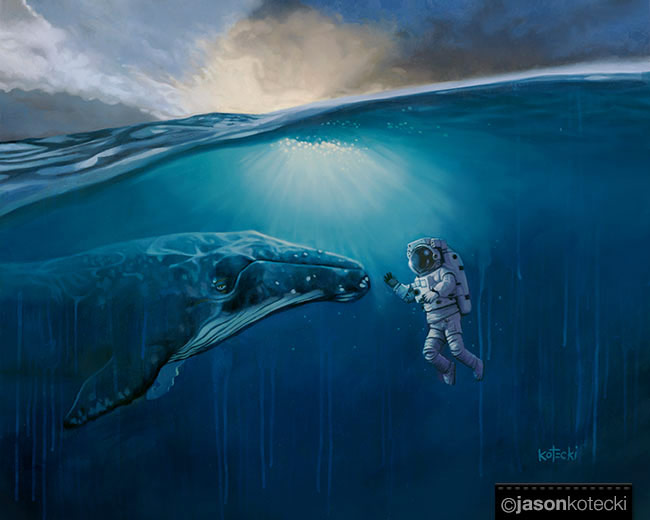
    The astronaut in this painting represents a dreamer.

    This dreamer has always possessed a spirit of adventure and imagined a life spent exploring the unknown, pushing past the boundaries of human understanding, and experiencing the supernatural enchantment. The dreamer expected this would happen as an astronaut in the context of space.

    Instead, the dreamer’s story ended up in the ocean after a visit to Sea World, and now days are spent adventurously exploring the unknown and experiencing enchantment in encounters with sea creatures.

    So…did this dreamer’s dream go unfulfilled?

    My friend Jessica has some good advice about how we should handle our expectations: “When you write that first story, print it as a draft, triple-spaced with extra wide margins. You do this because you’re anticipating edits.”

    Letting go of expectations is not about being pessimistic. One can be optimistic without becoming a slave to expectations. My optimism is grounded in the fact that God has ALL the data, loves me more than I deserve, and tells the best stories. We can make plans and hope for things to go a certain way, while still holding loosely to them, trusting that God may have different (and better!) ones. 

    If you want more peace in your life, don’t abandon hope. 

    Don’t stop striving for greatness. 

    Just stop putting faith in your predictions.
  • Rodeo Dolphin

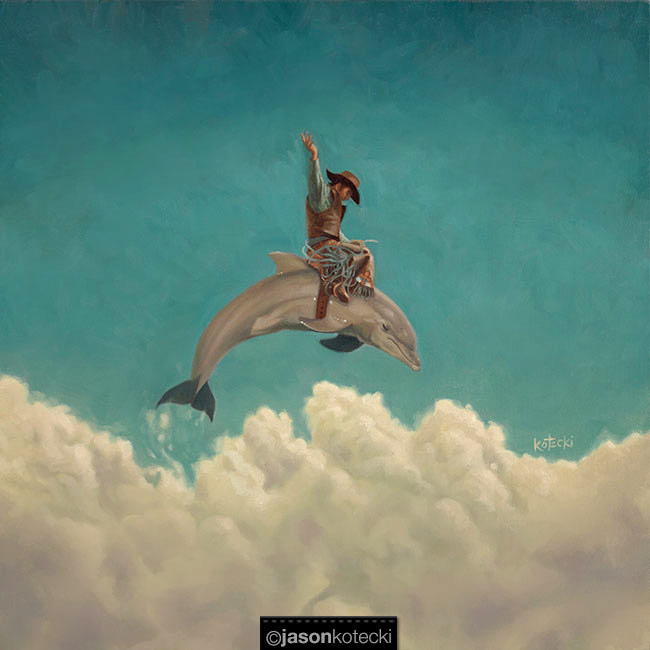
    “Rodeo Dolphin” by Jason Kotecki. 20 x 20. Oil on canvas.
    Original is available. 🔴 Shop this art!

    This painting is a little bit crazy.

    Some people will be quick to point out that cowboys don’t ride dolphins. They’ll scoff that dolphins don’t belong in the sky. They’ll demand an explanation about the meaning of it all.

    Those were the same kind of people who scoffed at the Wright Brothers for having the audacity of thinking they could build a flying machine. Humans can’t fly, they said. They don’t belong in the sky, they scoffed. They demanded an explanation for why these two, with no college education, no formal technical training, no experience working with anyone other than themselves, no friends in high places, no financial backers, no government subsidies, and little money of their own, would ever think they could achieve such an absurdity?

    To be fair, for more than fifty years, many others before them served as a source of comic relief, mocked and ridiculed in the press for their delusions of grandeur and “childish” flying machines.

    Somehow, and to our benefit, this did not deter Wilbur and Orville Wright.

    History is filled with people criticized for being crazy.

    But, as it’s been said, monuments are not built for critics and statues are not dedicated to fault-finders.

    Very often, our dreams appear absurd, especially to others. And especially the big ones.

    A horseless carriage?

    A self-powered flying machine?

    A pocket-sized device you can use to communicate with anyone in the world?

    What will they think of next? A flying car? A colony on Mars? A cure for cancer?

    This reminder is not reserved for the select few who change world history and have statues erected in their honor. I make a living doing what I love from my studio on the shores of Lake Michigan. Trust me, in the early days of our business, when Kim and I were living on a diet largely dependent on Hamburger Helper and couldn’t afford to run our air conditioning during the hot summer, every bit of my current life seemed far-fetched, to say the least.

    Of course, you can’t count on every dream coming true.

    But you can count on somebody calling you crazy for dreaming it.

    That’s ok.

    Keep dreaming anyway.

    The best dreams start out a little crazy.
  • The Prepper

    “The Prepper” by Jason Kotecki. 16 x 16. Oil on canvas.
    Original is SOLD 🔴 Shop this art!

    When my wife told me she was pregnant with our first child, my heart filled with joy.

    Two seconds later, panic arrived at the party.

    All I could think about was how profoundly our lives were about to change and I didn’t have the slightest idea of how to prepare. I immediately began searching Amazon for the latest owner’s manual for babies.

    Kim, on the other hand, seemed to calmly slide into the nesting phase that’s common to many moms in the animal kingdom. In preparation for a new life, they instinctually work to create conditions for that new life to thrive.

    In the years since I’ve seen Kim navigate this phase for all three of our kids, and I’ve realized there are parallels between mothers and artists. While not all of us get to experience motherhood, I believe that every last one of us is an artist.

    Yes, even if you can only draw stick figures.

    In essence, an artist is simply someone who brings something new and beautiful into the world with the potential to improve it in some way. It’s a one-of-a-kind gift that could not be created by anyone else.

    You could have been born at any time in any place, but you were born when and where you were born and you are alive now. You were born for a reason! As long as you’re still breathing, you have something within you the world needs.

    It might be a novel, a non-profit, a painting, or a play. Perhaps it’s a sculpture, a sonnet, or a song. It could also be that a building, a business, or a movement will be your masterpiece.

    We need to take this endeavor as seriously as a mother takes the preparations for her new baby. We need to create conditions that give our undertaking its best chance of success, and that involves three things: supplies, space, and safety.

    A serious mother collects the supplies that will be needed to help her succeed: diapers, bottles, creams, clothes, blankets, and toys. A serious artist needs supplies, too. It might be pens, pencils, paper and paint, or yarn, wood, software, or clay.

    A serious mother considers where the baby will sleep and play and she creates space for that to happen. Likewise, a serious artist also requires a dedicated space, even if it’s just a small folding table in the corner of their bedroom, or a workbench in the back of the garage.

    Finally, a serious mother makes preparations to ensure her youngster is protected and safe to grow and develop. A serious artist also needs a safe space for creativity. New ideas are especially fragile. One must not judge them too harshly at the start, for they need time to blossom into what they are to become.

    The nesting stage is fun, exciting, and imbued with the magic of anticipation, as you envision all the memories (or masterpieces) that will be made. It is a good inclination to want everything you need, and make sure it all has a place. After all, when you are in the whirlwind of caring for a newborn (or in the thick of the creative process), it’s helpful to have what you need, when you need it.

    But don’t be fooled.

    The trap that awaits both mothers and artists is the desire to have all the supplies one could corral, the most ideal space one could hope for, and the highest level of safety and comfort possible.

    All parents eventually come to discover that you are never fully prepared for a baby to arrive in your home. There will always be something you’ve forgotten, something you run out of too quickly.

    It’s ok. Eventually, you learn to make do, and from these constraints come real growth.

    One thing is certain…when it comes to parenting, Mother Nature will not be delayed. The baby is coming, ready or not.

    Alas, this is where the comparisons diverge, for the artist has no such advantage. As such, he or she may be lured into a trap that tricks them into a never-ending nesting phase of collecting all the colors and tools and tricks of the trade.

    It’s an illusion. Under the guise of being serious, the artist is now simply hiding. One must never be fooled into waiting for conditions to be perfect, because they never will be.

    If an artist is not careful, nine months of preparation can slip into nine years of procrastination, justified by not enough time, not enough space, not enough money to begin. Before you know it, nine decades of life are spent and the art your soul desired to make, the gift the world so desperately needed from you, never gets to emerge.

    Serious artists don’t let preparation turn into procrastination.

    We don’t need perfection. But we do need your art.

    That’s why we need you to take it seriously.
  • Ghost in the Road

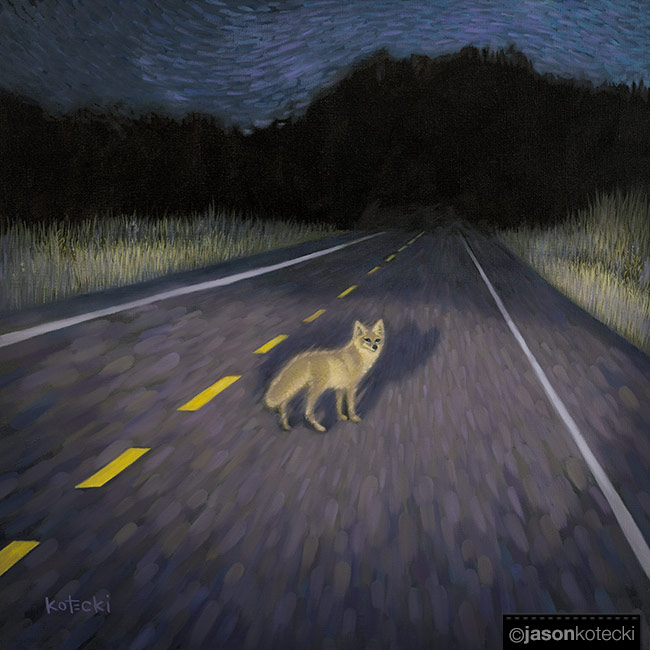
    “Ghost in the Road” by Jason Kotecki. 20 x 20. Oil on canvas.
    Original is SOLD 🔴 Shop this art!

    It was like driving through a sea of black ink.

    The trip back to our hotel from the Lamar Valley was harrowing. It being Yellowstone, the specter of animals hanging out on the road is always a possibility. We’d reveled in the wildlife of the North American Serengeti, but now the sun was gone and darkness blanketed the winding way home. My knuckles were white on the steering wheel and Kim’s clear anxiety was less than helpful.

    We snaked around curve after curve, my eyes peeled for any signs of movement. Then we saw it: a small coyote trotting down the middle of the road. As we came upon him, I slowed to a stop. He turned his head and stood frozen in the bright beam of our headlights. Time stood still. He looked at us, and we looked at him, and for a brief moment, we connected.

    Kim snuck a quick photo before he turned away and disappeared into the darkness.

    It felt like we encountered a ghost in the road.

    Sometimes we encounter people in a similar way. Their life intersects with ours and we make a brief connection. They show up to guide us through difficulty, supporting us emotionally, physically, or spiritually. When the time to move on comes, they disappear from our lives, like a ghost in the road

    Have you had encounters like that, a limited interaction with someone that greatly impacted your life?

    Years ago, I had lunch with Phil Vischer, the co-creator of Veggie Tales. I was trying to get my Kim & Jason comic strip off the ground. He gave me a lot of great advice, but one of the most notable things he said was, “Assume that your life two years from now will be nothing like you imagine it will be. Be open to where God is leading. If God calls you or Kim to a different role or a different job, be open.”

    His advice left me unsettled, but it stuck with me.

    Around that same time, Kim and I encountered a woman named Mary Jo who worked for a local Catholic Church. She told us about a growing movement within the Church to educate children and adults together and assured us that if I could create a program that held the attention and spoke to both groups, I’d definitely be in demand as a speaker. She was right, and that’s how my now twenty-year career as a professional speaker began.

    It required me to retire the comic strip, but Phil Vischer’s prophetic words helped give me an open heart and comfort when I saw God lead us in a new direction.

    It’s been said that people are in our lives for a reason, a season, or a lifetime. Phil and Mary Jo are people who came into my life for a reason. They were fellow travelers who crossed my path, and for a brief moment in time, our souls connected. In their own way, they illuminated my path, let me know that I was seen, that what I was doing mattered, and to keep going.

    We are called to do that for others.

    I’ll never forget a time I was a ghost in someone else’s road.

    Waiting for everyone else to leave, she appeared at my product table at the back of the room after my second and final presentation of the day. She seemed hesitant, engaged in an internal debate on whether to approach or retreat. I noticed from her badge that her name was Jennifer. I assumed she was trying to decide if she wanted to buy something. Instead, she hesitantly exclaimed, “I want to trade you something, but I don’t want you to think I’m crazy.”

    “I won’t think you’re crazy,” I promised, not knowing what I was in for.

    Apparently I was convincing enough, as she began digging around in her purse. She pulled out a small black velvet box and placed it on the table between us. She said not a word. Perplexed, I determined that it looked like a ring box and deduced that her silence meant that I was supposed to pick it up. I opened it. I was right there were two simple rings inside, one band was rimmed across the top with a row of tiny diamonds; the other was shiny and plain.

    They were wedding rings.

    “Ok…” I stumbled. “It looks like there is a story here…”

    She began, “Six months ago today, my husband left me while I was at work.”

    Tears welled in her eyes. She offered no further details, but it was clear that it was as surprising as it was devastating. She continued, “After he left, on a whim, I decided to apply for my dream job, the one I never went for while we were together. And I got it. And it was amazing.”

    She began sobbing, and it suddenly felt that the table between us was two miles wide. She apologized for breaking down, while I debated jumping across the table to hug her right then and there.

    She regained her composure and said, “Sitting in your two sessions today…you just said so many things that hit me. For a long time, I had given up on love. I had given up on me. I told myself that this job — my career — was my new love now and that this would be the focus of my life. But you helped me to see that I can’t give up on love.”

    She motioned to the rings, and, looking at the last Adultitis First Aid Kit I had left, said, “If you’d be willing, I’d like to trade these for a new beginning. I don’t need them anymore.”

    I gave her a Kit and a big hug and mumbled something that I don’t remember, but was probably stupid.

    I don’t remember what I said that struck a chord. I don’t know whatever came of her, although it’s possible she’s still following our stuff all these years later.

    I was a ghost in the road of her story, and she was a ghost in the road of mine.

    Something I said to her on that day helped her to see with new eyes and gave her the confidence to bravely move forward. Meanwhile, Jennifer’s courage and her gift serve as an everlasting reminder of the privilege of what I get to do. When I get discouraged that the crowd I’m speaking to is too small, or not engaged enough, or that I am too tired, I think of Jennifer, a ghost in the road who crossed my path so many years ago, and I am reminded that every single day is an opportunity to change someone’s world.

    Never underestimate your role in helping to heal our world. As it has been said many times, “Helping one person might not change the world, but it could change the world for one person.”

    I hope this reflection opens your eyes and gives you an appreciation for the ghosts in your own road.

    And I hope it will inspire you to be a fellow traveler who crosses someone else’s, taking the time to look them in the eye and say, “I see you. You matter. You’re doing great. Keep going.”

  • Love is in the Air

    “Love Is In The Air” by Jason Kotecki. 16 x 16. Oil on canvas.
    Original is SOLD 🔴 Shop this art!

    This painting is called “Love is in the Air.”

    Our eyes draw us to the billowing steam from the geyser, forming the shape of a heart.

    Indeed, it is a fitting representation of the way most of our society views love. Like the steam, it is a little mysterious, always changing, and dependent on which way the wind is blowing. Love is regarded as a fleeting feeling evident on a wedding day, but which vanishes at some point in the ensuing years when life gets hard.

    I would like to invite us to look for a different, better metaphor for true love in this painting.

    Like the bison.

    The bison is rock solid. Grounded. Immovable in winds of change.

    My friend, contrary to popular belief, true love is not a feeling that ebbs and flows with the wind. It’s not caught up with transitory qualities like looks, circumstances, and emotions. Looks fade, circumstances change, and emotions are unreliable, often clouding reality.

    I’m no relationship expert, but I have been married for well over two decades now. If you want a relationship that outlasts the average, you cannot depend on feelings to save you. On any given day, your partner may not look or act anything like the person you first fell in love with. You may find yourselves in a circumstance you didn’t anticipate or plan for when everything was going well.

    True love isn’t a feeling; it’s a choice. 

    This points to another important difference between these two metaphors: The steam cloud has no control over itself. The bison, on the other hand, can take action.

    Here’s a real-world example of the difference:

    A few years ago, I instituted a new personal policy: Always stop at the lemonade stand.

    You see, I am a bit of an over-thinker. My old pattern of behavior went like this: I’d see some kids running a lemonade stand and think about stopping, only to drive past it while overthinking it to death. Did I have cash on me? Did I have the time? Was there even a convenient place to park? I’ve already driven six blocks past it; it would be stupid to turn around now. Ultimately, I’d miss the moment and feel bad for the rest of the day.

    So I decided to take the thinking (and overthinking) out of it. I decided to establish a new rule: ALWAYS STOP AT THE LEMONADE STAND. Of course, for this personal policy to work, it has to be ironclad. The only way to avoid overthinking was that there could be no exceptions. No excuses. I permitted myself to be late wherever I was going. Even if I was late to my own father’s funeral, “I had to stop at the lemonade stand.”

    The key is that when it comes to any sort of goal, habit, or resolution you establish, it’s a lot easier if you don’t give yourself any outs. Commit 100%. If you allow yourself even one exception, then it’s always a fight from then on. You’ll always give yourself a reason why it’s ok to ignore the rule “this one time.” 

    Even though it’s sometimes inconvenient, I love this policy. I like that it allows me to be more generous, which is in line with the type of person I want to be. I always ask the kids what they’re raising money for. I always try to encourage them in some small way. And I always over-tip.

    The thought of stopping at a lemonade stand is like the steam; it comes and goes, and stopping is dependent on how I’m feeling at the time. But this personal policy is a stubborn bison, blocking the rest of my day until I act.

    Thinking about complimenting someone, writing a note of encouragement, or helping someone in a bind is not the same as actually doing any of those things.

    If you are in a relationship where the love feels like it’s fading, are you like the steam cloud, waiting for something to happen? Are you waiting for a feeling to return or for your partner to change, to do something that rekindles that loving feeling you once had?

    The better strategy is to be more like the bison and make the first move.

    As psychologists have found time and again, behavior shapes emotion. If I am angry or upset when I see a lemonade stand, I always feel 100 percent better after I stop, even if I’m only walking away with a watered-down lukewarm cup of lemonade.

    So even if you don’t feel like it, try doing something loving for the other person. Surprise them with an unexpected gift. Do one of their household chores for them. Praise them in front of someone else.

    It’s amazing how often our loving actions can transform into loving feelings.

    Before you throw in the towel on a relationship that has lost its loving feeling, act lovingly toward your partner. Decide that you’re not going anywhere, like a bison standing in the middle of the road at Yellowstone. Don’t give up.

    Change may not be immediate, but if you are persistent and continue acting in love, don’t be surprised if, before long, a new feeling of love is in the air.