Art Series: Life’s a Zoo

  • I Just Called to Say I Love You

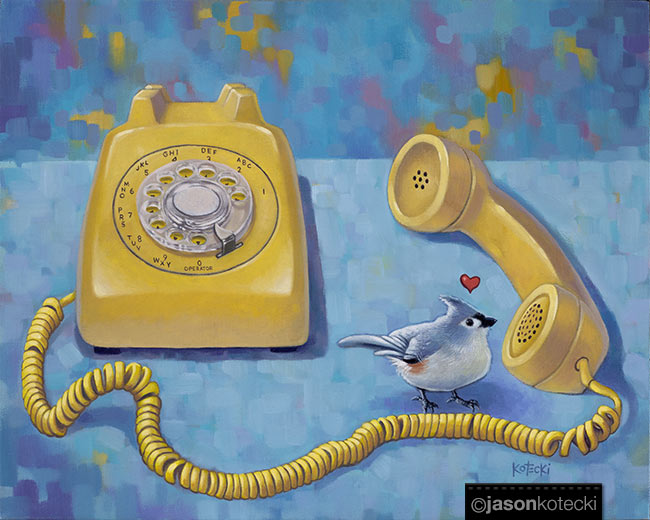
    “I Just Called to Say I Loe You” by Jason Kotecki. 20 x 16. Oil on canvas.
    Original is SOLD 🔴 Shop this art!

    “I Just Called to Say I Love You” is a famous Stevie Wonder song. It’s also the title of this painting.

    One word in that title might be more important than all the others. We’ll get to that in a sec.

    When my wife Kim and I were dating, we’d spend hours and hours on the phone, talking late into the night, racking up phone bills that if bound together, would make the longest Harry Potter book look like a pamphlet. This was in the days when phones were attached to walls and the “call waiting” feature was a source of civil war for any siblings also angling for phone rights.

    My personal phone habits with Kim were the exception, not the rule. To this day, I hate being on the phone, for reasons both justified and irrational, but too numerous to bore you with. I let almost everything go straight to voicemail. I am certain the quality of my life would increase exponentially if I never had to talk on the phone ever again. 

    Of course, the phone is a handy tool for maintaining relationships, which is another weakness of mine. Fortunately, my wife helps with that, as she does the little things that help keep relationships alive for both of us. I am an introvert, a Type 5w4 on the Enneagram (if you know, you know), and as previously mentioned, hate the phone. A generous assessment is that I spend a lot of time in my own head and it’s easy to get lost in there. Which is good for allowing me to create wonderful things, but not so good for maintaining friendships.

    Either way, it’s a perfect storm for a scenario in which if Kim dies before me, I’ll end up living alone in a home that neighborhood kids will describe as haunted and invent all sorts of urban legends about the old guy who supposedly lives there.

    Part of my problem is that I overthink relationships. In our own ways, maybe we all do.

    Friendships can stall if we make them too complicated or set expectations too high. Failing to meet them finds us buried in an ever-mounting pile of “shoulds.” The more time that passes, the more time we assume is required for catching up. And of course, life rarely drops oceans of uninterrupted time into our laps, so… the relationship slowly grows stale and eventually dies.

    A recent conversation convinced me of that being a flawed approach.

    Andy Gullahorn is a songwriter in Nashville who started an interesting routine with his friend Gabe several years ago. Every week, Andy goes for a walk. Gabe, who lives a mile and a half away, does the same thing at the same time. They walk toward each other, and when they meet, they give each other a high five. Sometimes they stop to play badminton. Oftentimes, no words are exchanged, and they simply head back home.

    Kim and I had a chance to interview Andy, and he shared another routine he has with a friend who lives in Houston. Since an in-person high-five is out of the question, every Monday for six years, they simply exchange fist bump emojis. That’s it. And yet the connection has deepened to such an extent that Andy says he trusts that friend with his life.

    Andy’s advice is to start small. And ridiculous. “It doesn’t have to be dead serious to make a deep connection,” he says. “In fact, if that’s where it starts, it’s hard to maintain that. The high five is just a stupid foundation to hold real relationship.”

    Of course, not every relationship needs to be maintained for all time. Some people come into our lives for a reason or a season. But Andy’s right. Maybe we should focus on uncomplicating the friendships we want to fertilize.

    In the interview, he challenged viewers to just commit to not having a deep conversation but to just exchange winks or honk at each other as they pass one another on the road, even without saying another word. 

    That’s why maybe the most important word in Stevie’s classic song is…”just.”

    I JUST called to say I love you. That’s it. No fanfare. No guilt trips. No phone bills weighty enough to kill a small mammal.

    We don’t always need to have an hour-long conversation for our relationships to thrive. 

    A high five or a fist bump emoji might just do the trick. 👊
  • Hallelujah Chorus

    “Hallelujah Chorus” by Jason Kotecki. 24x 24. Oil on canvas.
    Original is SOLD 🔴 Shop this art!

    What makes life worth living?

    When we look back on a given year, it’s easy to identify the massive oak trees and tall pines that stand as signposts: the weddings and the funerals, the epic vacations, and the major accomplishments. 

    But we often overlook the small blessings – the birds within the trees, if you will.

    Our minds can only hold so much information, and in my experience, our hard drive space seems to dwindle with each passing year. The brain prioritizes the stuff it determines is important, discarding the rest. Those giant oaks and majestic pines take precedence.

    I’ve been rescuing things from the discard pile through a simple practice that makes it easier to spot those aforementioned birds.

    Once a day, I write down one happy moment from the day before. That’s it. One moment. One line. No paragraph or story or context. Most aren’t even full sentences. It’s like a verbal Polaroid, a snapshot in time that describes a simple moment of happiness. 

    But in the same way that a picture is worth a thousand words, that simple snapshot composed of a handful of words contains within it a treasure trove of details, emotions, and story.

    I do this in a Bullet Journal, with each Happy Moment taking up no more than one line on a page. One could adapt it by writing each Happy Moment on a Post-It note and dropping it into a jar with the intent of reading them when you need a pick-me-up.

    The practice takes me less than thirty seconds a day. The payoff comes at the end of the month or the year, when I re-read them all. 

    Kim and I recently spent time reviewing the previous year. The publication of Wonderhunt stood out, as did our Escape Adulthood Summit in Utah and family trips to Key West and Washington, D.C. But my favorite part was reading all 365 of my Happy Moments for the year.

    Here are a few highlights:

    Playing catch with Ben amidst the kites at Leland Park.
    The scallop dish with leeks and apple risotto at the Black Pig.
    Ginny rolling a strike on frame 10 with no bumpers.
    Staff dinner at the supper club.
    Seeing the walls finally up in the studio.
    Watching Lucy ride Chester with confidence.
    Family time on the front porch, eating push-ups.

    As you can see, none of these rise to the level of “major milestone.” Frankly, they’d probably be forgotten had I not taken the time to write them down at the time.

    But these happy moments become souvenirs of a wonderful journey. Perhaps even more than the achievements and milestones, they give me a feeling of aliveness and a sense that my year was spent well. They are reminders of what makes life worth living, and that I have been blessed in myriad ways, despite the defeats and sorrows that also populated the previous year.

    It’s easy to overlook the small songbirds hidden in the forest of our lives. But when we invest a few seconds to jot down one happy moment a day, reading them at the end of the month or year is magical. It’s like experiencing a sublime symphony, with each note harmoniously contributing its voice to a melody that slowly builds to a soaring crescendo of gratitude.

    It becomes a hallelujah chorus, exulting in the glorious gift of being alive.
  • Rudolph

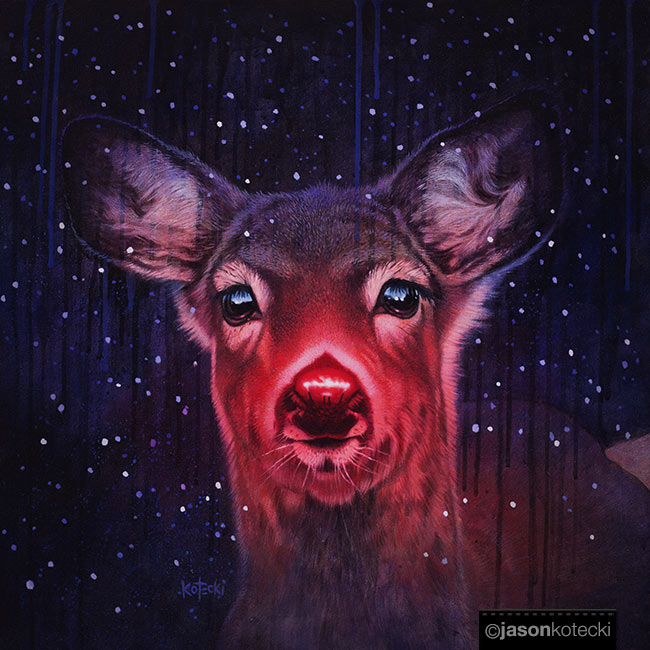
    “Rudolph” by Jason Kotecki. 20 x 20. Oil on canvas.
    Original is SOLD 🔴 Shop this art!

    I had a bully in middle school.

    His name was John B. (I’m withholding his last name because I am sure he matured into a nice man with great kids and has started a charity to feed homeless cats.)

    But he was a jerk back then.

    He looked like a swollen eggplant with hair. A year older than me, John B. never punched me or beat me up. He never separated me from my lunch money. No, John was an orator, preferring to use his words to belittle and humiliate me.

    It all began when we had to draw our shoes in art class, and the teacher hung our work in the hallway. Now my brothers and I weren’t lacking anything we needed, but our family didn’t have the money for name-brand shoes. Nikes were a pipe dream, so I had to settle for Nucleus high tops instead. (In case you’re wondering, that company no longer exists, so bullies now have to focus their attention elsewhere.) Ironically, I thought they were pretty rad, discount store origins aside.

    John B. didn’t.

    Every day between classes, he’d point me out and belittle me for my off-brand shoes. I wanted to punch him in his smug, fat face. Considering he was much larger than I, that wouldn’t have ended well. So I was left to endure the stomach-churning mockery and shame until a new art project made its way to the wall.

    It could have been worse. It’s small potatoes in the grand scheme of things. But whoever said “sticks and stones may break my bones, but words will never hurt me” is a dolt with oatmeal for brains. Of course words hurt! And sometimes they have longer-lasting effects, with the emotional scars remaining long after any broken bones have healed.

    One day in my more recent past, I  was watching the deer in my backyard, and I thought about Rudolph the Red-Nosed Reindeer, another victim of bullying. I wondered what he might look like in real life, if his nose really did light up and wasn’t just some silly illuminated cartoon clown nose. My brain is a weird place, but it’s the question that inspired this painting. 

    It also led to a very powerful experience.

    As the piece progressed, it took on a life of its own. The deer’s piercing eyes grabbed me and wouldn’t let go. They were vulnerable, revealing someone who was sad, hurt, and alone. Someone who maybe wondered why he was made broken. And someone totally unaware that the source of ridicule, the very thing he wished he could be rid of, was actually a gift.

    I thought back to my run-in with John B. I remembered the anxiety I felt each day, hoping not to cross paths with him in the hall, resentful that my parents weren’t well-to-do enough to afford Nikes. 

    Looking back now, find it notable that John B.’s criticism was about the brand of shoes, and not the effectiveness of the drawing. The drawing was really good. His taunting certainly didn’t cause me to feel pride in my talent, but perhaps he was jealous. After all, a poorly drawn nondescript shoe hardly would have garnered as much attention. 

    I get that now. 

    But not then. Back then, I wanted to blend into the shadows and disappear. 

    Sometimes the darkness is inviting because it promises to keep you hidden from the scorn, the sticks, the stones, and the fists. But embracing the darkness isn’t the answer. 

    It turns out that the one thing you can’t escape in the shadows is yourself.

    And can I be honest with you?

    John B. was a jerk. But he’s not the biggest, meanest, most terrible bully I’ve ever faced. Not by a long shot. 

    That title goes to me.

    I’ve said worse things about myself than John B. ever did. I’ve been told that I am the worst husband, son, father, and friend…by myself. I’ve been reliably informed that I’m not smart enough, brave enough, or talented enough by someone who should probably know: me. 

    Why are we so willing to treat ourselves more horribly than we’d ever treat another person? Our inner bully criticizes our every move, never giving the benefit of the doubt. It showers us with the most vile, hurtful, poisonous self-talk. It accompanies our days with a drumbeat of doom, a never-ending echo that we have nothing to offer and we’ll never be enough.  It counters every morsel of virtue with a mountain of evidence proving that we suck.

    Then someone like John B. comes along and merely confirms what you already believed about yourself all along.

    As I was working on this painting, I could almost feel my heart breaking for little Rudolph, as if I wanted to assure him that he is awesome. I wanted to beg him to pay those bullies no mind. I wanted to remind him that the thing that makes him stand out – the very thing others mock him for – is his gift to share with the world.

    Eventually, I realized Rudolph in this painting was me. 

    And he is you.

    Like Rudolph, there is a light within you. It might be hidden in your pain, your brokenness, or the thing that makes you weird. It pulses when you share it for the good of another and brightens someone’s day. 

    Like Rudolph, you are different. That’s exactly what makes you a wonderfully made, extraordinary work of art.

    You see, darkness doesn’t hide the truth. It uses just enough of it to get you to believe the lies.

    Yes, it IS true that you aren’t enough. 

    The lie is that you need to be.

    Like Rudolph, we just need you to share your light with the rest of us. 
  • Nope

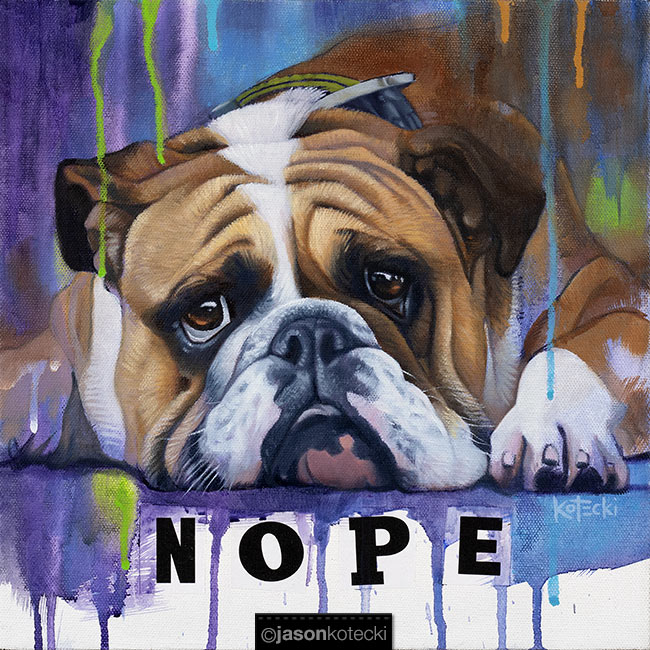
    “Nope” by Jason Kotecki. 12 x 12. Oil on canvas.
    Original is SOLD 🔴 Shop this art!

    Mama said there’d be days like this.

    Sometimes when we’re feeling overwhelmed, exhausted, or sad, we simply need a time out. 

    Or pizza. 

    That was the prescription our midwife gave us after Lucy was born. Kim and I had come into the delivery day mentally depleted, our first child already a few weeks overdue. Then the labor itself was a marathon. After the birth, Kim almost fainted because of a drop in blood pressure. As she recovered, it was on me to put on Lucy’s first diaper and figure out out to dress a four-hour-old (it’s like trying to gift-wrap Jell-O) before clearing an inch of ice from our car so we could drive home from the birth center. 

    The prospect of going home to attend to the 24/7 needs of a newborn was overwhelming, to say the least.  Aware of our exhaustion and sensing our uncertainty, our midwife said, “You know what I want you to do? When you get home, I want you to order in the biggest, cheesiest, gooiest deep-dish pizza ever, and savor it.”

    And we did. It was glorious.

    It was just the little treat we needed to keep going. We still rely on the magical properties of pizza from time to time. 

    Sometimes we require something stronger, like a “sick of it” day. In most workplaces, if you have the flu, a persistent cough, or you’re going through more Kleenex than me watching the opening scenes of “Up,” you get to take a sick day and stay home from work. But what if you have a case of the Mondays (or a case of November)? 

    Kim and I recommend taking a “sick of it” day. (You can still tell your boss it’s a “sick day.”) It’s kind of like playing hooky, but it’s really a chance to shift momentum and throw life a curveball for a change. You can do anything you want, but no work and no chores. Treat yo self. 

    But what happens when those days mama warned us about turn into weeks, or months, or years?

    Our body will tell us if we’re paying attention. I like to think of our negative emotions as a check engine light for our body and soul. You know, the light that illuminates our vehicle’s dashboard to tell us that something’s off. Most people handle it like my father-in-law handled the check engine light on his old Chevrolet Celebrity – with a thick black piece of electrical tape, hiding the light from view. 

    Problem solved!

    Or not. Ignoring a problem rarely works. If you’re in a funk right now or enduring a hard season, it might be time to call a time-out and see what the inner check engine light is trying to tell you.

    I preach the power of optimism. But it’s unrealistic to expect we can go through life on a positive high all the time (and I’m leery about people who seem to do so). 

    Maybe you’re experiencing caregiver fatigue. Maybe it feels like everything you touch turns to shitake. Or maybe you’re burned out from the last three years of pandemic, politics, and pivoting. 

    It’s ok. Welcome to the Human Club. You’re normal!

    We don’t have to be afraid of feeling the feels and examining what they have to teach us.

    Uncomfortability can be useful. We need to pay attention to our inner check engine light, not ignore it with a never-ending Netflix marathon, a bottle of wine, or any of the countless ways we self-medicate to numb ourselves to escape our pain.

    It’s giving us a heads-up that something may need to be addressed. For me, it’s usually a warning that I need to ease up on adding new commitments to my calendar, a reminder to spend more time in my secret hideout, or an invitation to get a little more rest. (Often it’s a combo of all three.)

    This approach from Steve Jobs is a good guide. He said, “For the past 33 years, I have looked in the mirror every morning and asked myself: ‘If today were the last day of my life, would I want to do what I am about to do today?’ And whenever the answer has been no for too many days in a row, I know I need to change something.”

    Are you in need of a change? It might be time to talk to someone, like a counselor, pastor, or medical professional. Maybe you need to take that difficult first step toward healing a relationship. Or maybe it’s time to finally embark on that new career path.

    Remember, for now doesn’t mean forever. It may feel like there’s no end in sight to the malaise you’re experiencing, but it only seems that way.

    Don’t be afraid to peel back the tape on your check engine light and see what it has to tell you.

    Maybe a gooey, cheesy pizza and a night on the couch is exactly what you need. Maybe a “sick of it” day will do the trick. Or maybe it’s time for a baby step toward a bigger change.

    Let your inner check engine light lead the way.

  • Shocked Chicken

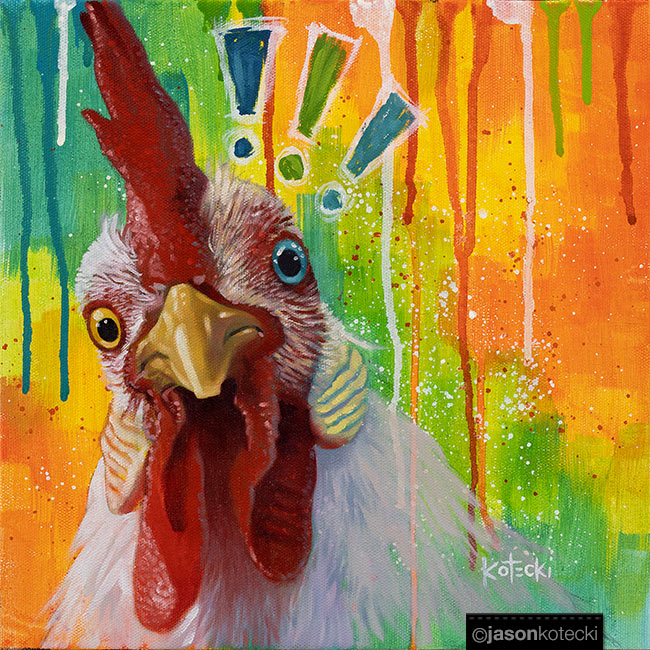
    “Shocked Chicken” by Jason Kotecki. 12 x 12. Oil on canvas.
    Original is SOLD 🔴 Shop this art!

    Thomas Edison has been attributed with saying, “If we did all the things we are capable of, we would literally astound ourselves.” 

    This is true. The potential within each one of us is enormous. 

    But I’ll go one step further. I say that we’d be astounded if we knew how good we already are. Maybe the marketing messages we’ve been bombarded with over the years have convinced us that we really aren’t good enough. Maybe we haven’t received enough positive compliments. Maybe we think the people who do compliment us are just being nice, or don’t know the real us. 

    Please…stop.

    My confidence does not rest in your resume, your highlight reel, or your dashing good looks. It rests in the divine Spirit of your Creator, which dwells within you. 

    You matter. 

    This may come as a shock to you, but you have a special brand of awesome that no one else has. 

    And this world needs it!

  • Balancing Act

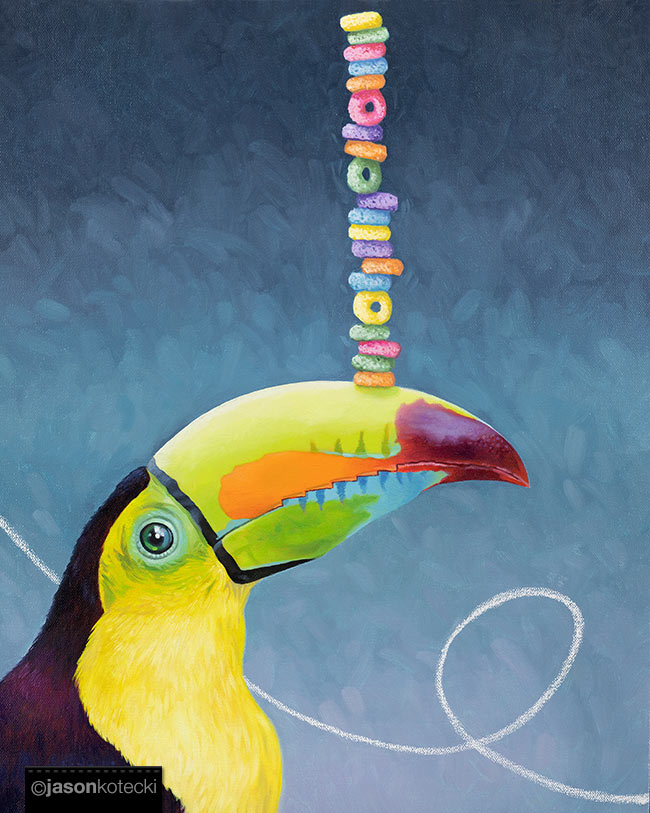
    “Balancing Act” by Jason Kotecki. 16 x 20. Oil on canvas.
    Original is SOLD 🔴 Shop this art!

    How many Froot Loops can you stack on top of one another before they topple over?

    How tall would someone’s tower have to be for you to find yourself impressed?

    We often relish the opportunity to declare how many activities we’re balancing. Like a status symbol, our busyness signals our importance. We could pretend the pink ones are work responsibilities, the yellow ones are family and household chores, maybe the orange ones are volunteer commitments, and the green ones are hobbies…All hail the one with the highest stack of Froot Loops! 

    I am always in awe of people who seem to be able to operate smoothly amidst a schedule bursting at the seams. My personality type is such that I easily get overwhelmed when I’m trying to stack more than a handful of Froot Loops at a time.

    I recently added something new to my morning prayer routine. After looking back on the previous day and reflecting on what went well and what I could have done better, I try to identify the most important thing to accomplish in the day ahead. 

    And let me tell you, it’s bloody hard.

    I mean, it’s a simple question. And sometimes it’s easy because there’s a specific, obvious task that needs to be completed: Deliver this speech. Finish the manuscript for editing. Paint the ceiling

    But most days, it’s not so obvious. 

    Answering this question goes against my inherent desire to cram my day like a Volkswagon Beetle stuffed with seventy-six circus clowns. When I survey the day before me, I usually see a smorgasbord of Very Important Things, all seemingly equal in significance. If I happen to settle on something like “spend time in the studio,” I have to fight the urge to also write “andfinishthisandworkonthatanddontforgettotakeoutthegarbage.”

    I’m not alone, am I?

    The science is clear. We get a tiny yet thrilling dopamine hit every time we check something off our almighty to-do list – regardless of how essential the chore actually was – which encourages us to rush headlong into the abyss of productivity.

    I have to remind myself that the question “What is today’s most important thing?” is not asking for the ONLY thing I need to do that day. Or asking me to only do ONE good or worthwhile thing all day. 

    It’s merely asking me to declare the most important one.

    Because, unfortunately, despite my desire to bend reality and make my home in the multiverse, there can only be one most important thing. (See this reflection on how we magically changed the meaning of the word “priority.”)

    I have found that oftentimes in this process, my most important thing is to “be open,” because the most important thing hasn’t yet revealed itself at six-thirty in the morning. But that awareness is vital because it makes me more likely to notice it when it comes. 

    I encourage you to try this, especially if you’re having a hard time balancing all the Froot Loops. Its power comes in forcing you to pause, nudging you to slow down, reflect, and be intentional.

    Why does this matter? 

    This matters because when I don’t identify the most important thing for the day, I’m liable to rush off and accomplish a whole hell of a lot of things. Which seems good and feels great. But if the sheer volume of activity crowds out what was actually the most important thing I needed to do, my life slowly veers off track.

    It doesn’t matter how many Froot Loops you can balance if you were supposed to be paying attention to the Cheerio.
  • The Monarch

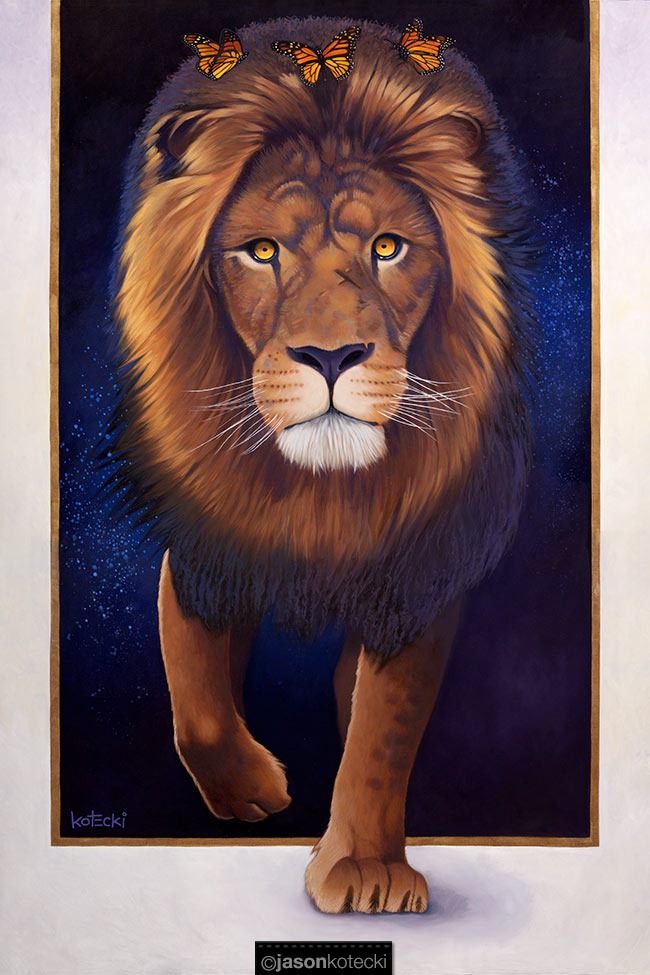
    “The Monarch” by Jason Kotecki. 40 x 60. Oil on canvas.
    Original is SOLD 🔴 Shop this art!

    His name was Joel, but I called him Mr. Dawson. He was one of the best leaders I’ve ever known.

    On the surface, Mr. Dawson was just a regular guy who coached youth baseball. But he was kind, humble, and strong, albeit not in the “benchpress dump trucks” sort of way. A rare autoimmune disease took several fingers on one hand. But he was able to balance a baseball with it while holding a bat with his other hand. During practice, he’d carefully toss the ball upwards and whack it with the bat in the direction of a fielder.

    When I played Little League, he managed an opposing team, but his vote helped me land on the all-star team. He became my coach after drafting me when I turned thirteen and moved up to Junior League. I was an occasional pitcher. My fastball wasn’t very fast, and I didn’t have a curveball, but I kept the ball over the plate. The good news is I rarely walked anyone, but the bad news is batters usually salivate at the prospect of facing someone who throws slow and straight. 

    The back of my baseball card was not impressive.

    Perhaps not surprisingly, I’d never been the winning pitcher of a game. I could claim it was because the teams I pitched for were never that good, but then again, neither was I. For some unknown reason, Mr. Dawson decided to make it his mission that season to get me a win. It took a while, but somehow, his persistent belief in me sank in. I actually started believing it was possible. I don’t even remember the score of the game when it finally happened, but I do remember the feeling. I remember his proud smile. 
    And I remember being happier for him than I was for myself.

    That’s what the best leaders do: believe in people. 

    Oftentimes, those people don’t believe in themselves. Sometimes it’s for a good reason, and sometimes it’s the natural result of not having anyone in your life who does. But the good leaders see a spark. Heck, maybe the spark doesn’t even exist, but their belief that it does is so convincing, it’s as if they are somehow able to will it into existence. 

    This painting was inspired by C.S. Lewis’s character, Aslan, the Christ-like figure in The Chronicles of Narnia. It’s a great image of the best kind of leader: brave but vulnerable. He’s confident in knowing what he’s about, but kind enough to welcome the lowliest creatures into his friendship and protection. Malcolm Forbes said, “You can easily judge the character of a man by how he treats those who can do nothing for him.” 

    People are fragile beings, like the butterflies in this painting. I sure was when I was thirteen, a shy, skinny kid with oversized glasses playing on a team stocked with much better athletes, trying to figure out who he was and what he had to offer. 

    The best leaders walk with us out of our past and into our future, accompanying us from who we’ve been to who we can be. We all need people like that in our lives. If someone believes in you, consider yourself lucky. And take them at their word, even if you can’t yet see what they see.

    Mr. Dawson died too soon from cancer shortly after I moved on to high school, more complications of his condition. By then a close friend of the family, I saw him face his final battle and the unknown of the next life with bravery and good humor. 

    Sometimes in life, we are the butterflies. We are fragile and need to believe the people who care about us are right when they tell us they see greatness within us.

    Sometimes in life, we are the lion.

    We are called to be leaders who seek out the lost, the young, the weak, and the forgotten. Our job is to look for the good in them, believing in them as long as it takes until they can see it for themselves. 

    Thanks, Mr. Dawson.

  • The Sherpa

    “The Sherpa” by Jason Kotecki. 24 x 30. Oil on canvas.
    Original is SOLD 🔴 Shop this art!

    Do you ever feel lost?

    It seems like an absurd question when we all have smartphones offering turn-by-turn directions to anywhere we want to go.

    But having access to all the paths isn’t the same as knowing which one to take.

    What happens when none of the paths you’ve tried have led to where you want to go? What do you do when you know where you are now isn’t where you want to be, but none of the roads before you seem quite right? What then?

    Perhaps the best place to begin is with those little bits of colored whimsy people sprinkle on ice cream sundaes. Indeed, it’s as good a starting place as any.

    According to an Internet search, the ball-shaped versions of hardened sugar are called “sprinkles,” while the rod-shaped variety is known as “jimmies.” My family isn’t particular; we just call them awesome. My youngest daughter drew a picture of a “Jimmy Machine,” illustrating how they are made. 

    According to her, “Jimmy goes into a machine and it prints out Jimmys onto a conveyor belt. When it goes upside down, they fall, drop onto a series of four trampolines, and then into a butt cheek pit where they emerge as butterflies. Finally, they go in lava and then turn into jimmies.”

    I like to think of myself as creative, but this is PhD-level stuff.

    Some might say it’s merely the absurd ramblings of an eight-year-old with an overactive imagination.

    Yet, is it that much different than Walt Disney’s preposterous vision of Disneyland, a vision that investors, his brother, and even his own wife considered a disastrous waste of time and money? The success of Walt’s idea seems obvious in retrospect, but at the time, it was anything but. The same goes for “Snow White,” history’s first feature-length animated film, which was derisively dubbed “Disney’s Folly.” To those who didn’t get the vision, Walt’s ideas probably looked a lot like the blueprint of my daughter’s “Jimmy Machine.”

    Overactive imagination, indeed. 

    If you look closely, most of the best advancements of humankind started out looking like delusions of ridiculousness. Walt Disney knew that sometimes the best path forward isn’t on the map at all, and the only way to see it is through childlike eyes.

    Reminding people of the power of the childlike spirit is my mission in life. In a world overwhelmed by Adultitis, it’s been an uphill battle. 

    You see, the danger in branding your company “Escape Adulthood” is that it’s easy for people to discount you as irresponsible, immature, cotton-headed ninny noggins who are avoiding the responsibilities of adulthood and trying to escape the pressures of the “real world.”

    As a pragmatist, I’d be tempted to think the same way if I didn’t know any better. 

    It gives me solace to know we are not alone. J. R. R. Tolkien, the author of those little-known books The Hobbit and The Lord of the Rings, was often accused of writing fairy tales that were nothing more than the escapist’s way out of this so-called real world. His reply was simple and brilliant. He proposed that everything was dependent on that from which one is escaping. “We view the flight of the deserter and the escape of a prisoner very differently. Why should a man be scorned if, finding himself in prison, he tries to get out and go home?”

    Exactly. 

    Paying bills, upholding responsibility, and making hard decisions are important and necessary hallmarks of adult life. But the deep-down person we were when we were kids is much closer to the real us than the stilted, joyless version we often present to the world around us. Cynicism, common knowledge, and the rules that don’t exist have imprisoned us from being our true selves: passionate, playful, and curious creatures who dream big dreams and are filled with faith, hope, and love.

    So no, we’re not about shirking responsibilities or ignoring reality.

    We’re just trying to get back home.

    That’s why Kim and I often refer to children as sherpas. Like those experienced, wise guides who escort climbers up the face of a mountain, children have a pure wisdom that can help us traverse this adventure called life. 

    A GPS will not get us where we want to go. 

    Like any good adventure, life is difficult. We need all the tools we can carry, including the ones we tossed away so carelessly in our hurry to grow up. So yes, bring your logic, your experience, and self-control. (Walt needed all of them to make Disneyland real.) But don’t forget to pack your curiosity, playfulness, and passion, for they, too, have their usefulness. 

    They help us to identify hidden paths missing from our map. They open our eyes to help us see what can be, which is the first step required in making it so.

    And leave room in your pack for one more important but overlooked tool: whimsy.

    Although Whimsy is often viewed as superfluous, it is a spark of delight with the supernatural power to uplift the human spirit. Whimsy can fill a heart with happiness and a head with new ideas. Whimsy brings a playful unpredictability to our days. It puts the heavy things we carry in perspective. The delicious ridiculousness of whimsy helps lighten our loads and brings joy to others.

    Sometimes in life, we get stuck circling the same path, repeating our mistakes because we keep trying to use the wrong tools for the job, expecting a different result. The tried and true tools of adulthood are useful, but like using a screwdriver to shovel your driveway, insufficient for the task at hand. 

    If you are sad, stuck, discouraged, or overwhelmed…try whimsy.

    It’s a small thing that can have outsized results, the same way a sprinkling of jimmies can transform an ice cream sundae.

    A good sherpa knows the power of whimsy. Don’t bother looking for it on a map, but it might be the best path to take right now to get where you want to go. 

    In a dark world where the terrible stuff weighs so heavily upon us, we need whimsy more than ever. Whimsy lifts the soul, loosens up the mind, gladdens the heart, and opens the eyes to what can be. 

    This is the way.
  • Celebrate Life

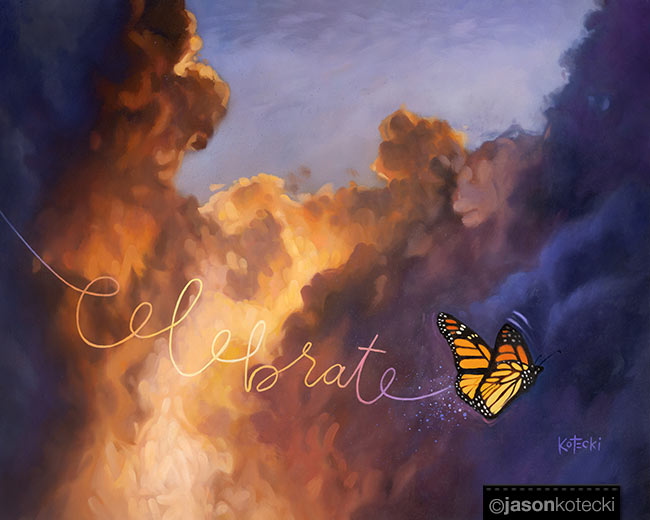
    “Celebrate Life” by Jason Kotecki. 24 x 30. Oil on canvas.
    Original is SOLD 🔴 Shop this art!

    My daughter has raised monarch butterflies for the past few years. They undertake a migratory journey from southern Canada to Mexico (up to 3,000 miles!), making them beacons of strength, hope, and resilience as well as symbols of change and transformation. 

    Take a good, hard look at any caterpillar. If we’re honest, they’re kind of ugly. There’s nothing about a caterpillar to convince an unbeliever that it would ever be able to fly, let alone transform into something so stunningly beautiful. 

    Is it an ugly worm that crawls on the ground or a majestic creature that flies on the wind?

    Both.

    Storms are a part of life. Sometimes they come in the form of a diagnosis we don’t want to hear. Sometimes they come in the form of a global pandemic. They are out of our control. The only thing we can control is how we react to them. 

    The truth is, there is more to any situation than meets the eye.

    Life is neither perfect nor pretty. But if you look close enough, you will find blessings in disguise and reasons to celebrate.

  • Greatest Of All Time

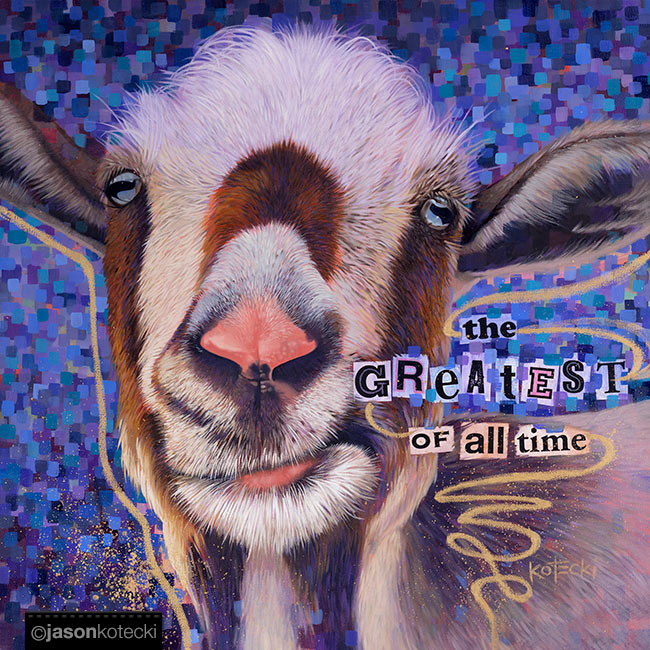
    “Greatest Of All Time” by Jason Kotecki. 24 x 24. Oil on canvas.
    Original is SOLD. 🔴 Shop this art!

    How many Super Bowl rings does it take to become a goat?

    I am not referring to those four-legged cheese-making mammals with a taste for tin cans.

    I’m talking about the label of “GOAT” – the Greatest Of All Time.

    As I write this, Tom Brady recently retired after twenty-two seasons in the NFL. He was the 199th pick in the draft, yet ended up with seven Super Bowl rings and threw more touchdown passes than anyone in history. He never played on a losing team. He is widely regarded as the GOAT, at least when it comes to quarterbacks.

    Frankly, I’m still getting used to being labeled a “goat” as a good thing. In 1986, Bill Buckner was called a goat for letting an easy ground ball roll past him in a World Series game, and it definitely wasn’t meant as a compliment. (Ah, the ever-present thin line between hero and villain.)

    Debating the greatest of all time is a juicy topic for sports talk radio, but what makes the discussion so compelling? Why such an obsession with greatness?

    Besides the fact that we like comparing things (and arguing!), greatness stirs something within us. We are inspired when we see it manifested, be it in the long and decorated career of Tom Brady or in the gold medal performance of figure skater Nathan Chen.

    But greatness stretches far beyond the sports world:

    🥘We see it in a delicious dish prepared with ease by Gordon Ramsay. 
    ✈️We saw it in the remarkable daring and bravery of Amelia Earhart. 
    🐯We saw it in the spellbinding gentleness and kindness of Fred Rogers. 
    🙏We saw it in the compelling selflessness and compassion of Mother Teresa. 

    The greatness of these individuals is so profound and self-evident, it’s easy to assume they are rare geniuses who possess mystical talents. Their level of excellence appears unattainable for us mere mortals. Their talent is unmistakable, but the individuals we place on the pedestal of greatness are merely human beings whose extraordinary results came from the consistent practice of ordinary things.

    Our preoccupation with debating the greatest of all time is a trap that prevents us from striving for greatness ourselves.

    It’s easier to argue about the top five saints of all time than to aim to become one. 

    Am I suggesting you are GOAT material?

    Actually, yes. 

    Hear me out. Usually, the title of GOAT is bestowed on someone famous, known for their professional accomplishments, and often in a domain conducive to measurable outcomes…

    But what about people who aren’t famous?  Isn’t it possible that some Incan woman possessed unmatched skill as a potter, with her only flaw being born at a time when she couldn’t have her own YouTube channel?

    And what if your skill is not as esteemed or public as that of a professional athlete or celebrity chef? Could an unknown Amish grandmother technically be the greatest bread maker of all time? And tell me, who is the greatest school custodian of all time? The greatest dental hygienist of all time? The greatest administrative assistant of all time?

    What about domains lacking metrics that are easy to quantify? When it comes to football, we can compare wins, passing yards, touchdowns, longevity, playoff appearances, awards, and Super Bowl rings, all while debating the relative importance of each. But how would one go about naming the Greatest Mother of All Time? The Greatest Father of All Time? The Greatest Wife or Husband or Friend or Next Door Neighbor of All Time? 

    Most of us don’t have trading cards with our pictures on them, and if we did, they wouldn’t have stats on the back totaling Boo-Boos Kissed, Lunches Prepared, Loads of Laundry Completed, Encouraging Words Spoken, or Hugs Delivered. 

    Without these metrics a Google search away, what would it take for you to become the GOAT?

    If you’re normal, you might be thinking, slow your roll, buddy. I already feel like I’m falling short, day after day. I barely qualify as a good parent, let alone the greatest of all time. 

    I hear you. Sometimes I feel like I’m leading the league in dropped balls.

    The good news is that the seeds of greatness are in our DNA because we each have a spark of the divine within us. 

    Simply put, you were born for greatness. 

    Don’t let my famous examples fool you. The dictionary defines great as “remarkable in magnitude, quality, skill, or effectiveness.” The steps to achieve greatness are accessible to everyone. Including me. And you. The steps are simple, but not easy.

    🔎 Identify Your Gifts. What talents have you been given? If they don’t immediately come to mind, settle into a quiet place. Take stock of the things you do well. Where do you shine? What comes easily to you? What do you love doing? What do people compliment you for? These are your gifts. Remember, “better than everyone else in the world” at anything is not a requirement for greatness.

    🎁 Honor Your Gifts. If you treasure a gift, you don’t take it for granted or throw it in a corner. To give your gifts the respect they deserve, use them, share them, and work to improve them. Shoring up weaknesses can be helpful, but keep in mind that Mister Rogers wasn’t as bold and gregarious as Gordon Ramsay, who was not as gentle or vulnerable as Mister Rogers. Greatness lies in maximizing your strengths. 

    🔒 Be Committed. Greatness requires the willingness to do what no one else will. Not many are willing to stick to the diet and workout routine that helped Tom Brady stay so productive for so long. Even fewer are clamoring to comfort the sick and clean the sores of people living in the slums of Calcutta, as Mother Teresa did. Amelia Earhart was willing to attempt things no one else had ever done, consequences be damned. Greatness requires immense courage and bravery. You have to be willing to challenge conventional wisdom, buck the status quo, and take a stand without any guarantee that anyone will follow you. 

    🧗 Keep Going. Nathan Chen’s debut Olympic performance was a disaster, riddled with falls. Gordon Ramsay didn’t make a perfect omelet on his first try. Tom Brady didn’t win every playoff game he was in. The great ones aren’t people who never get knocked down. They’re the ones who keep getting up when they do. Anybody can have a good day, a good week, or even a good year. The greats show up year after year. They are persistent, consistent, and stand the test of time. 

    🚀 Empower Others. Through his example alone, Fred Rogers inspired millions of people, most of whom never met him, to treat others with more respect and kindness than they might have otherwise. Tom Brady’s drive, high standards, and work ethic empowered his teammates to be better. Mother Teresa built a community of sisters who followed her lead and carried on her work after she was gone. Your own humble journey toward greatness may be your most enduring legacy.

    We can’t count on being considered the greatest. But that doesn’t mean we shouldn’t strive to be great.

    It’s unlikely that you or I will ever be publicly regarded as the “GOAT” of anything. Unless you’re Muhammad Ali – “I am the greatest!” – the title is bestowed on you by others. We can’t control it. Who cares?

    When it comes to greatness, everyone else is irrelevant. I agree with Hemingway, who said, “There is nothing noble to being superior to your fellow man; true nobility is being superior to your former self.”

    There is one category you can be assured of being the GOAT, and that’s the category of YOU.

    Your job is to be the Greatest You of All Time.

    If you learned a new thing today or did something to improve your craft or make yourself better than you were yesterday, congrats. You are officially the greatest YOU of all time.

    If you got up today after being knocked down yesterday, your legend just gained a new comeback story, and you’re officially the greatest YOU of all time.

    If you used one of your gifts to make someone’s day or lessen the burden of another soul, your scoreboard of contributions to the world just increased by one, officially making you the greatest YOU of all time.

    Instead of wasting our time arguing over who is the GOAT, may we use their example as inspiration to cultivate our own greatness within us.

    Identify your gifts. Honor them by honing them and sharing them with others. Be committed. Keep going. And empower others along the way. 

    Regardless of whether or not you play in the NFL or make soufflés on TV, those principles are controllable. If you practice them, I can’t guarantee you’ll ever be deemed the GOAT by pundits, historians, or late-night callers on talk radio. 

    But I will guarantee that people will be inspired by the greatness they see within you. 

    No Super Bowl rings required.