My son Ben turned five recently. One of our favorite things about homeschooling is the freedom of schedule, which allows us to give our kids total control over the agenda on their birthday.
And Ben was crystal clear on what he wanted.
It started with cinnamon rolls and bacon for breakfast, followed by the opening of one present. Then a trip to the Lego store and lunch at Pizza Ranch (he loves the blueberry dessert pizza). When we got home, he requested that everyone change into their pajamas (which, I’ll be honest, wasn’t a tough sell.)
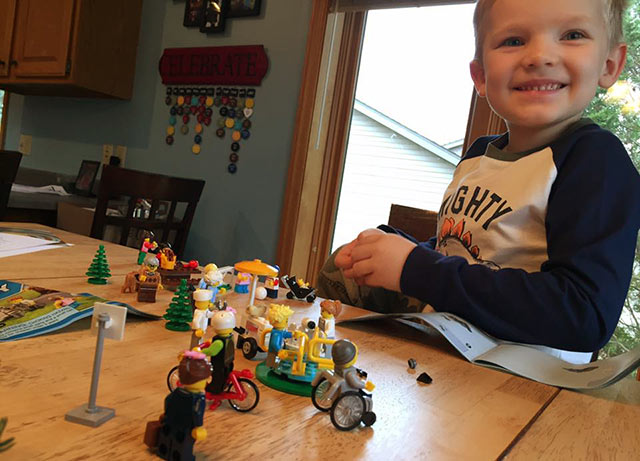
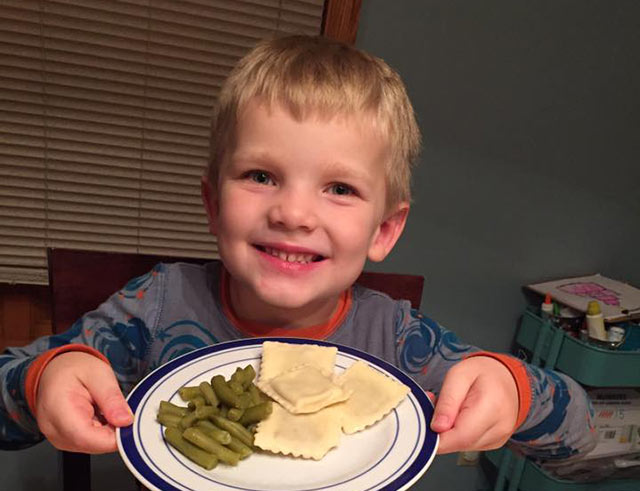
The afternoon was spent putting the new Lego set together and playing nicely with his sisters. He requested “noodle pillows” (aka beef ravioli) — with no sauce — for dinner.
The birthday dessert was peanut butter cookies, and after opening some presents his siblings bought with their own money, he finally got to watch the only Star Wars movie he hadn’t yet seen. (Episode lll).
As the evening wound down and I tucked him into bed, he proclaimed it to be the “best day ever!”
Granted, it was a slightly weird “best day ever,” but that’s ok. (In our house, “weird” is a compliment of the highest order.) Everyone has his or her own ideas of what a perfect day is, and I believe we should spend more time owning it than apologizing for it.
How clear are you on what your best day ever would look like?
How often do you make them happen?
If this were a Visa commercial, and I were calculating the value of the day, the total cost of everything — the Legos, the lunch out, and the ingredients from the grocery store — would be around a hundred bucks.
The value of making him feel like a millionaire? Priceless.
The thing is, a kid would have no idea how to spend a million dollars. By the time we’re adults, we have some pretty good ideas.
However.
Once we’ve burned through all that cash, are we really any happier than we were when we were five years old, having our best day ever?
It rarely requires a million dollars for us to feel like a millionaire.
Maybe instead of chasing more money, we should look for more perspective.
The Cubs, after 108 years, had finally won the World Series, and they won it in spectacular fashion. (I can’t believe I just wrote that!) THE CUBS HAVE WON THE WORLD SERIES. For reals. I am still filled with joy and brimming with happiness. But the thought of driving to Chicago for the victory parade never crossed my mind.
Kim floated the idea after reminding me that I had a speaking engagement in Chicago a few days later. “Why not go down earlier and make it a long weekend?” she teased.
Thoughts of snarling traffic and being trampled to death by a raucous mob sprang forth. “Are you serious? That’s insane!” I replied.
When she got online to look for hotel rooms, I knew she was both.
She found an unbelievable deal on a hotel room steps away from Grant Park, where the rally was to be held. The confident sparkle in her eye and the call for adventure were too strong. We packed up the kids and drove to Chicago a few hours later.
Oh, there were plenty of excuses to stay home. There are always reasons why something might not work. Life is never shy about providing opportunities for adventure, but we miss most of them because we’re too busy letting our excuses run the show.
Kim and I are not gluttons for doing things that are destined to fail. But attempting something that might not work is a different matter entirely. Many people mistake them for being the same. They are not.
Pretty much everything in life might not work. They say the only certainties in life are death and taxes, and in my experience, neither is Adultitis-free endeavors.
But this. This worked perfectly. Traffic into the city was a breeze. The location of our hotel, as I mentioned, was ideal. The weather was spectacular; not a cloud in the sky and more reminiscent of a September day than the November one that it was. The spot we secured on a small hill to the right of the stage was perfect: near a big screen but close enough to see the stage. We were only a hundred feet from the porta-potties, and the incline kept us out of the mud, just outside the current of human traffic, and provided an opportunity to sit while we waited.
There were a LOT of people. The crowd size, between the parade and the rally, was reportedly 5 million people. That’s good enough for #7 on the all-time list of largest groups of humans ever assembled (the biggest ever in America). It was also reported that there were only five arrests. The mass of humanity we encountered was joy-filled, kind, and patient. A lady next to us gave her blanket for our kids to sit on, and she offered them some pizza too. The kids cheered for their favorite players, and joining the chorus of “Go Cubs Go” at the end was pure magic.
I was so thankful for the opportunity to be there for the celebration. It helped make the victory even more real, as it’s still hard to believe the Cubs actually won the World Series. It truly was the experience of a lifetime.
As good as this team is, there is no guarantee that they’ll win another World Series any time soon. Even if they did, it wouldn’t be nearly as historic as this one was.
Heck, there is no guarantee that I’ll even be alive a year from now.
I know that may be morbid, but Kim and I think about these types of things all the time. I might not be here a year from now. Kim might not, either. It terrifies me to consider that the same is true for each of my children. At the very least, I will never again have a seven-year-old Lucy, a four-year-old Ben, and a two-year-old Ginny. All the more reason to jump on any adventure that presents itself.
After all, one of the reasons we lived in a crappy apartment for nine years while eating ramen noodles and accumulating debt while building this business was so we could eventually have the freedom to do things like this. That freedom is also one of the reasons we homeschool our kids.
We prepare for rainy days, but we also know that sometimes, rainy days don’t come. We‘ve done too much work with the Make-A-Wish Foundation and have known too many friends who died way too young to lose sight of this fact:
Every single day is a precious gift. Waiting for the conditions to be just right before you make the most of it is as tragic as it gets.
One of the reasons I do what I do as an artist, author, and speaker is to help people have as few “I wish I woulda’s” as possible. And selfishly, that starts with me. I spent most of the first 21 years of my life too afraid to do anything. I missed opportunity after opportunity because I was too focused on all the things that could go wrong, all the ways I might feel uncomfortable, fail miserably, or experience embarrassment.
I succeeded in staying safe and, for the most part, avoiding disaster. If there were a merit badge for maintaining a tidy comfort zone, I earned it. But at what cost? How many amazing memories never materialized? How many adventures floated by, unclaimed?
When I look back at my life, all of the greatest things that have ever happened to me happened when I was pushed or, more recently, intentionally stepped out of my comfort zone. Every. Single. One.
I’m happy to say that after years of tinkering and taking tiny steps into the unknown, the call to adventure has become stronger than my fear of failure.
When faced with an exciting opportunity that also scares the bejeezus out of us — and believe me, bringing three kids under eight into a throng of partygoers did that — there are three questions we ask ourselves:
1) Will this mortgage our future? We are willing to stretch the budget and borrow a bit from the rainy day fund to invest in an adventure, but we don’t do anything that puts an undue risk on our family’s future.
2) What if it doesn’t work? We are not Pollyannas, setting out to climb a mountain in flip-flops, hoping that everything will work out. Being honest about what could go wrong helps us to prepare contingency plans that minimize disaster and increase our odds of success.
3) What if it does? This is the one that most people don’t put enough emphasis on. They assemble the list of cons and use that as evidence for standing pat. It doesn’t take a creative genius to come up with reasons why taking your kids into the heart of five million people could turn into a hot pile of bad. But we’ve come to see how right Mark Twain was when he said, “Twenty years from now you will be more disappointed by the things you didn’t do than by the ones you did do.” After the adventure is over, any negative incidents either fade away or end up making the story even better, while the positive memories strengthen.
After the rally was over and the crowd had largely dispersed, we bought a deep-dish pizza from a vendor and found a sunny spot to sit in the grass. Somewhere within the fifty-seven seconds it took for our family to devour that helpless circle of cheese and dough, Kim and I looked at each other and said, “We did it.”
We conquered our fears, were part of history, and added another thrilling adventure to our life’s portfolio.
P.S. I started this oil painting after the Cubbies won the pennant, but could not get myself to finish it when they fell behind in the World Series. The path to the top of the mountain is paved with baseballs, which represent the 108 years of futility. The ball in the mouth of the cub has the year 2016 written on it, a year I will never forget. As a lifelong Cubs fan, there are no words to describe the satisfaction of finishing this painting with the strike through the word “someday.” Finally, after so many years of ups and downs, the Cubs are the World Series Champions. #FlyTheW
“We’d like Jason to give the same 90-minute presentation three times in a row with a 29-second break between each. Oh, and can he do it wearing a chicken costume?”
A veteran speaker friend taught Kim and I a great line to use whenever a client begins demanding things we are not able to or interested in accommodating. In these situations, he’d politely redirect the conversation by saying, “This is how I work…” and then outline the personal policies he’d established. It was his business, after all, and he had the right to run it as he saw fit.
Of course, the client had the right to look elsewhere, which was fine by him because he didn’t want to spend his time doing things he didn’t want to do.
As adults, we spend so much time following someone else’s rules — especially the ones that don’t exist — that we forget that we have the power to make our own. You may not be a business, but this is your life, and you have the right to run it as you see fit. A perfect example is this auto-responder that Kim received from someone who was on vacation:
On Friday September 16 to Sunday September 25th, I will be following some very strict rules. “Wake up smiling, soak up the sun, eat & drink plenty, nap often, go boating, sit by the fire, enjoy the sunsets, make memories and be grateful for this time.”
On Monday September 26th I will return refreshed and hit the ground running!
Now who’s gonna argue with those rules?
Want to set one day a week as an untouchable family day? Go for it.
Don’t want to check email on the weekend? Then don’t.
Want to spend the first half-hour of your day in quiet solitude? Make it a rule.
Don’t want to spend any more time than necessary with people who bring you down? That’s your call.
Not interested in working for clients who are rude and unreasonable? You don’t have to.
Want to live a life that is more stressful and less fun? Spend it endlessly caving to the demands and wishes of others. A better alternative might be to set up a few of your own rules about how you’d like your life to work.
No, not everyone will be thrilled about your rules. That’s ok. Life is too short to spend it jumping through someone else’s hoops.
If you’re going to live by the rules, might as well be your own.
At the risk of sounding like a crotchety old man a few decades early, the summers of my youth were not packed wall-to-wall with extracurricular affairs. Yes, there was Little League, but the days were long enough to accommodate no small number of other “aimless” pursuits. Playing home run derby in the tennis court with my friends. Exploring the ravine near my house as a pint-sized Indiana Jones. Sorting and displaying my baseball cards, and then drawing my own.
It was the opportunity to freely explore the things that fascinated me, without the prospect of a bell ringing in my ear telling me when to stop. I could follow my own curiosity, tugging on the proverbial thread that leads from one thing to another and then another, in a way that strict 50-minute periods don’t look kindly upon.
This ability to “wonder aimlessly” is a valuable thing. It is the heart and soul of tinkering and the key to a happy, fulfilling life.
It’s also something we need to fight to protect for our children and ourselves. One of the reasons Kim and I homeschool is to keep the “old school” spirit of summer alive, all year ’round.
According to the dictionary, to “wonder” is to “desire or be curious to know something.” It’s also to “feel admiration and amazement; marvel.” Meanwhile, to be “aimless” is to be “without goal, purpose, or direction.”
Wonder is a state we tend to view favorably. To be aimless, on the other hand, is an American sin. Someone without a goal or direction is seen in a negative light. A slacker, destined for an unproductive, ungratifying life.
The current system in America is anything but aimless. From the earliest ages, the goal is to get kids reading as quickly as possible, even if that means limiting the amount of time they have for “aimless” free play, which interestingly enough, science has confirmed is crucial to the development of resiliency and conflict resolution, while helping them discover their own areas of interest and engage fully in the passions they wish to pursue.
Once they are reading, the race is to get them to excel in a handful of subjects deemed worthwhile (science and math for sure, art and music and building things, not so much) so that their test scores match up favorably with other children in different cultures around the world.
Even extracurricular activities are highly structured and systematized, and have grown so demanding that they completely crowd out any time for those “aimless” pursuits, like the ones from the summers of my quickly retreating youth.
Of course, all of this academic and extracurricular excessiveness is necessary in order to get an esteemed university to look favorably upon our children, so that they will grant them admission to their hallowed halls, only to graduate burdened with suffocating financial debt and haunted by the uncertainty of not knowing if this is really what they want to do with the rest of their life…
…because they never had the chance to wonder aimlessly.
Direction and structure and purpose are good things. But they are empty skeletons if we have not been given the slow stretches of time to spend figuring out for ourselves what we like and don’t like, what we’re good at, what fascinates us and matters to us, and what lights us up inside so much that Friday is simply Friday, not some reason to thank God for the sweet relief from another week spent in drudgery.
One can never experience too much wonder. Unfortunately, we have less of it now than ever because we have filled our lives with too many distractions. In order to get it, we need to put our phones down, opt-out of some of the structured activities that eat our calendar, and carve out time for a little aimlessness.
Is there something your heart is trying to convince you to do, but you’re just not sure if you have it in you to take the leap?
Maybe you just need to borrow courage from someone else.
When Kim and I began homeschooling, we were like every other parent that starts homeschooling: scared out of our minds that we’d ruin our kids forever and tank their resale value. There were so many reasons to go for it, but what finally gave us peace of mind was hearing from parents who had been through it, and seeing the evidence of success in the form of their grown children who had become doctors, engineers, and airline pilots.
A woman at a homeschool conference we attended put it like this: “In the beginning, I wasn’t sure if it would work. But seeing the families who’d come before me and how well their kids turned out made all the difference. I was able to borrow courage from them until I got to the point where I saw the same results in my own children and developed my own self-confidence.”
Sometimes you just have to look for someone who’s already done what you want to do – it only takes one – and borrow courage from them. You don’t even have to know them. You just have to know their story is true. If they did it, so can you.
When we found out that Kim was pregnant with Lucy, we had been traveling together to all of my speaking engagements. Most people were happy to share their assumptions that our traveling days were over, but we didn’t want them to end just because our family was expanding. Fortunately, there was one family who gave us hope. Jim and Marilyn told us about their travels all over the country with their two young sons, including a trip to the Grand Canyon when the youngest was two.
We were able to borrow courage from them to move forward.
Lucy ended up on 34 flights in her first year of life. Since then, we added two more kids to the mix, but our adventures didn’t stop. We are a family of confident international travelers now, but we had to borrow some courage to get started.
You can homeschool your kids. You can travel with young children. You can write that novel. You can start your own business. You can lose those fifty pounds. You can run that marathon. You can get that degree while working two jobs. You can make it on one income. You can transform your community from the inside out. You can beat cancer. You can emerge from a divorce stronger than before. You can find out how many licks it takes to get to the center of a Tootsie Pop.
Things are only impossible until they aren’t.
After Roger Bannister proved that a mile could be run in less than four minutes, it didn’t take long for many to follow. Today, it’s fairly common. If someone else has done it, chances are, so can you. Does it guarantee you’ll succeed? Of course not. But the biggest hurdle we face is believing that success is possible.
Some dreams require you to borrow the money you need to get started.
Need some courage? You can borrow that too.
The good news is it’s free. You just have to look around.
We are inundated with rules that don’t exist. Not speed limits and tax laws, but the seemingly invisible norms, assumptions, and superstitions that we follow (often subconsciously) and which drive our lives. The more I write and talk about them, the more I uncover. And there is no shortage in the realm of education.
My wife Kim and I homeschool. In the grand scheme of things, we’re in the shallow end of the pool; the oldest of our three children is only seven. But these past several years may have been the most important of all, because we’ve had to unlearn pretty much everything we knew about education. It was especially challenging for Kim, who is a former kindergarten teacher. After a five-year career, it’s taken at least that long to slowly purge all of the things she kept from her classroom because, frankly, we don’t need them.
We have a really good foundation beneath us, because we’ve taken the time to identify, and consequently ignore, several rules that don’t exist. Here are a few we’ve had to break so far.
1) Thy children need a teacher to learn.
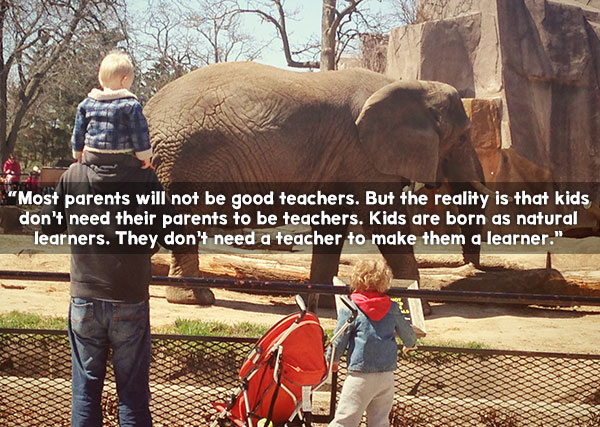
Kids are natural learners. They don’t need to be taught anything, except maybe how to find answers. But their passions and natural curiosity will drive them, if you are willing to get out of the way. Which, of course, schools are not set up to do. Although Kim was “trained” as a teacher, most days it’s more of a hindrance than a help.
We have tried to see ourselves more as “coaches,” rather than “teachers.” Perhaps it’s semantics, but we think of a good coach as someone who observes, asks questions, and helps facilitate progress by creating situations and environments specifically tailored to the individual. That includes paying attention to a child’s interests and watching closely for the things they show a proclivity for. And then strewing things about that might take them to a new level. Or taking them on a field trip. Checking out some books from the library. Connecting them with a mentor. Or suggesting a few tips to help them solve a problem. It takes a lot of faith and trust to take on this role, but if you do, it won’t be long before you’re learning amazing things from them.
2) Thy children need a curriculum to learn.
Curriculum companies make a lot of money, which does not necessarily make them bad, but it doesn’t make them necessary either. When we were first exploring the idea of homeschooling, Kim and I expected that we’d have to buy some sort of curriculum in order to shore up the areas where we were weak. (We had not fully discarded rule #1 yet.)
We’ve been to a number of homeschooling conferences, and I have noticed a trend in many families that has also played out in ours. At first, a curriculum is a security blanket. It gives you the peace of mind to homeschool because it feels like a set of instructions. Follow them, and you don’t have to worry as much about messing your kids up. But eventually, the curriculum gets in the way. It takes away freedom (which I think is the best part of homeschooling) by introducing rigidity, setting arbitrary milestones that stress you out if your kids don’t meet them in time, and inducing guilt if you don’t keep pace with the prescribed timeline.
Most families I see who have been homeschooling for a while often start with a curriculum of some sort. Then, after experiencing various degrees of frustration, they use it less and less, until oftentimes, it is disregarded altogether.
Although a somewhat clumsy phrase, it would be fairly accurate to describe what Kim and I do as “unschooling,” which is a method of homeschooling that is largely self-directed. Which, as Clark Aldrich points out in his book, Unschooling Rules, is exactly what everyone does most of the time throughout their life:
“When a doctor finds a rarely seen condition in a patient, she does not sign up for a class that covers the material, but will run for 6 weeks and start the following semester.”
Indeed, adults don’t need a prescribed curriculum to learn new things. Kids don’t either.
3) Thy children shalt know certain things by certain ages, or there is something wrong with them.
As good, cute, new homeschooling parents, Kim and I bought the classic book, “What Your Kindergartner Needs to Know.” It felt important to have a yardstick to measure our progress. My first concern was discovering things in the book that I didn’t even know. It wasn’t long before the book took a one-way trip to the recycling bin.
Babies don’t learn to crawl, walk, and talk at the exact same time. According to Parents.com, “most kids start taking their first steps between 11 and 15 months, but this milestone is hugely variable, and anywhere from 9 to 18 months is really considered normal.” Most people understand that there is a range here. What perplexes me is that as soon as we put them in school, we suddenly expect children to develop at the same rate. Heaven help the child who is not reading by the end of kindergarten. Even if he is uncommonly advanced in math, there will be much wringing of hands, and he’s likely to be labeled as learning disabled before he enters first grade.
I find it fascinating that we put so much emphasis on what our kindergartner, third grader, or sixth grader “needs” to know, and yet you will not find any books called, “What Your Thirty-Nine-Year-Old Needs to Know.” Do I really care if my dentist has read and understands “Taming of the Shrew?” If, after a certain point (usually high school), we don’t really care what a person knows, why do we ever?
Yes, I know there are certain developmental red flags that are important to pay attention to. But let’s chill out on the artificial timeline. There is a rule of thumb I have instituted for myself, which, although it borders on ridiculous, actually keeps me from acting as such. If my daughter is having a hard time letting go of her pacifier, or my son seems to be too old to be carefully backing off of a curb on his hands and knees, I ask myself, “Is it likely that they will still be having this issue when they go off to college?” The answer, of course, is always “no.” It helps paint a ridiculous picture in my imagination, which in turn reminds me how ridiculous it is to force our children to develop according to arbitrary schedules.
4) Politicians know what’s best for thy children.
Of course, the controversy du jour is Common Core. But this is only the latest in a long line of legislation made up by politicians about what is best for our children. There are usually many reasons these legislations come to be, but sadly, “what’s best for our children” is not often at the top of the list. As a case in point, any early childhood education professional worth his or her salt will tell you that the most important thing for the development of young children is play. In 1895, Friedrich Fröbel, the father of kindergarten, said, “Children must master the language of things before they master the language of words.” He said it 120 years ago, but it’s still true today. The way to learn about things is through experiential play, and it is a time-consuming process that cannot be hurried. And yet recess and free play are the very things that are being eliminated from kindergarten classrooms across the country, in favor of more structured activities in a race for higher test scores.
If politicians really cared what’s best for our kids, they might be a little more interested in making sure they’re not saddled with such astronomical debt. Politicians are notorious for making short-sighted, politically expedient decisions in all kinds of matters. It hardly makes sense to assume they’d make an exception when it comes to education.
5) Thy will kill thine offspring if forced to spend every single day with them.
I was a little nervous about this one myself. You see posts on Facebook from parents who are cheering the end of spring break or lamenting an unexpected snow day because their kids are diving them up a snowdrift. Then I read a post by Penelope that made perfect sense and which I found to be completely true. She talked about how the most difficult time to deal with kids is when they are clingy and fighting for your attention. But when you take them out of school, they see you all the time, so they don’t need to be clingy, and “don’t have to do insane tricks to get the small moments of attention they can get after school.” Now this is not to say you don’t need breaks from each other now and again, especially if you are an introvert, as Kim and I both are. But, as ludicrous as it may sound, your kids actually become more enjoyable to be around the more time you spend with them.
6) Thou shalt care what other people think.
This may be the most important rule one needs to break before embarking on the adventure of homeschooling. Although it is more popular than it’s ever been, homeschooling is not mainstream. It requires no small amount of courage to go against the grain, doing things differently than your friends, neighbors, and likely, even your own parents. There is a measure of safety in going with the flow and following rules that don’t exist. Because if things go awry, at least you can say you did what you were “supposed” to do. If you deviate from the path, and your kid doesn’t “turn out,” the only one to blame is you. But alas, our children don’t need us to transfer our accountability to someone else. They need us to lead, to look at the facts, and be mindful of (and honest about) the decisions we make.
Being a great parent who turns out amazing kids is hard because there is no easy-to-follow recipe. But if you ever even hope to have a shot, you’ve got to be willing to break a few rules.
I studied illustration at Northern Illinois University. (Go Huskies!) I had some amazing teachers, but in that world, it really didn’t matter where I went to school or who I studied under.
What mattered was the portfolio.
In the art world, a portfolio is the curated collection of your absolute best work. The year after I graduated, I bought my first suit and drove up to the big city of Chicago to show my portfolio to art directors at various advertising agencies, with the hope of getting freelance work.
In less than a minute, these busy art directors would flip through my portfolio and pass judgment on what represented years of training and toil (and sometimes tears). The fantasy was that he’d be absolutely destroyed by the depth of my daring and weep tears of joy and jealousy at the level of my talent. He’d immediately call his art director friends and brag, “I’ve found him. I found…the one.”
Yeah…so that never happened. Instead, I heard things like, “Not bad, kid. We’ll call you if something comes up.”
Our lives our filled with days, and those days are filled with mostly ordinary moments. But you’re also creating a portfolio. Your greatest hits. The summary of why you were here.
What’s in your portfolio?
If someone took a few moments to flip through it, would they be blown away by your courage and curiosity and collection of unforgettable memories? Or would they say things like, “Meh,” or “It’s fine,” or “It kind of looks like everybody else.”
It’s easy to make safe work that looks like everybody else’s.
It’s easy to keep busy with things that make us feel productive but don’t really matter.
It’s easy to settle for making stuff we’re “supposed to” instead of creating the life we were made for.
An artist is someone busy building a legendary portfolio filled with laughter and adventures and extraordinary moments.
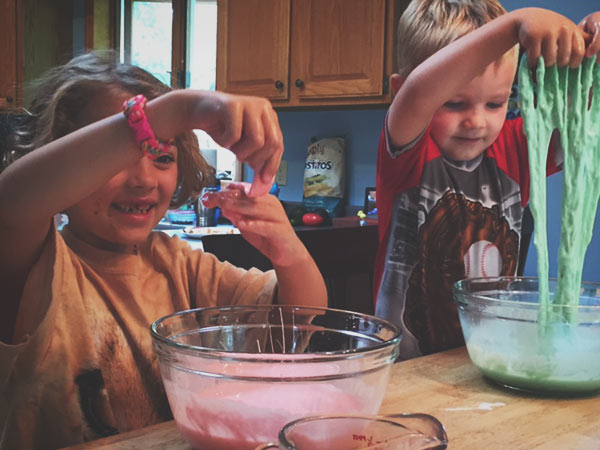
Yesterday morning, despite the fact that I had a full to-do list after having been out of the office for the first three days of the week, I decided to make slime with the kids.
Yep, slime.
They had been watching episodes of DIY Dad on YouTube, and the one on slime seemed especially fun and not particularly hard. Out of the blue, I alerted my pajama-clad son that we were going on a secret mission: to get the supplies we needed to make slime!
He jumped off the couch and scurried into his car seat — still in his pajamas — and off we went to the grocery store. We picked up two bottles of Elmer’s glue, Borax, and some donuts for good measure. When we got home, my oldest was up, and after our sprinkle-covered sweet treats, we went about making some slime.
It was a blast.
I do not submit this story to enter myself as a candidate for Dad of the Year. I share it as an example of how difficult it is to do things like this. I make a living encouraging people to toss aside the never-ending to-do list once in a while and spend time with the people they love, in the hope of helping people have as few “I wish I woulda’s” as possible.
People nod their heads, knowing how important it is. But it’s still hard.
I had a full slate of things to do, and only two days to do them before I was out of the office again. It was tempting to tell myself that we could make slime another day when I had more time. It would have been a lot easier (and less messy) to just stick with the plan.
But then I thought of the dear friend who saw one of her twin daughters through neuroblastoma when she was three. Now, twelve years later, this mother’s worst nightmare has come true as the sister has been diagnosed with the stage four version. The prognosis is not good.
And then I thought, “What the hell am I waiting for? A wake-up call like that?”
I wanted to make slime with my kids.
If not now, when?
I’m glad I did it. I don’t do stuff like this as often as I’d like to. It’s easy to want to be the parent who ditches some work for some spontaneous play with their kids, or the person who surprises her friend with tickets to an afternoon matinee at the movies. But it’s hard to actually ditch the guilt, ignore the shoulds, get off your butt, and just freaking DO it.
It’s easy to lie about doing it later. The danger is that eventually, later disappears.
Since 94% of the population suffers from at least a mild form of Adultitis, odds are that anyone with a job has to work with someone infected with this vile disease. Maybe it’s a co-worker, or a client, or – gulp! – the boss. Sometimes, the people I chat with after my speaking programs will confess to being married to someone with a full-blown case of Adultitis.
So the question, of course, is how do I fix someone who has it?
Unfortunately, the truth is…you don’t.
I am a professional speaker. Most speakers I know started their careers with the hope of making a difference and changing lives. I certainly did. If you do it long enough, you’ll likely come across the uplifting statistic that informs you that your audience will probably forget almost everything you said the minute they walk out the door. Eventually, you will realize that you do not have any ability whatsoever to change someone’s life. Entertain, sure. Inspire, maybe. But change? That’s up to them, not you. (Newsflash: this little rule also applies to any husbands, wives, parents, and teachers who may be reading.)
It’s hard not to feel like you’re a professional exerciser of futility.
The thing is, the more quickly you accept this reality, the better speaker you become.
When you are not worried about the guy in the front row crossing his arms, or the lady who ducked out the back, or whether or not you will get a standing ovation, the more you will be able to focus on being your authentic, true self and allow your message to land where it will.
And THEN you might make some sort of difference for someone.
You may not make a living from being on stage, but the principle is the same. When dealing with people who have Adultitis, there is only so much you can do. This is it:
1) Do your best to be a good example. Take yourself lightly. Live your life cheerfully, with humor and joyful anticipation. In the best-case scenario, these people will see and be inspired by your approach to life, and a little will rub off. Maybe they’ll even ask for your secret, and then you can help them on the road to recovery.
2) If your example alone doesn’t make a dent, you should incorporate their office supplies or car keys into Jell-O molds. (Just kidding.) (Not really.) Maybe you could try sending them flowers or a box of cookies. Maybe they just need someone to notice them and be kind to them.
3) If you’re still running into a brick wall of Adultitis, your only other option is to ignore them and do your best to limit your exposure to them. You don’t have to be mean about it; you just have to be intentional. Depending on your relationship, you might consider deleting them from your life. Harsh, I know, but life is too short to have the joy sucked out of you by someone with a full-blown case of Adultitis.
“Whoa, buddy,” you may be thinking. “That’s a little extreme. And it’s not exactly gonna work. This is my spouse you’re talking about,” or “I can’t exactly fire my idiot co-worker.” If extracting yourself from the situation is not an option, you should make it a priority to surround yourself with people who are relatively Adultitis-free. These relationships will help bolster your energy levels and serve as a force field from the Adultitis-ridden zombies in your life.
Is it an ideal solution? No, but it’s reality.
You are only the ringmaster of your circus and your monkeys. Focus on the things you can control: your attitude, your actions, and the people you choose to spend most of your time with. Let go of the things you can’t.
Simple, although certainly not easy.
Striving for an Adultitis-free life will not always yield the results you’d like. You may not be able to make someone change, but it’s always possible to make a difference.
I was sitting on the beach reading, and I looked up from my book to a most wonderful sight. It was of my daughter Lucy, clutching a boogie board, being escorted to the shore by a strong wave of saltwater. The entire ride lasted barely five yards, but the transformation in her was light-years from a few hours earlier. The initial introduction to this unfamiliar ocean vessel was marked with trepidation and more than a few tears.
Her triumphant, tooth-deprived grin was one of my favorite moments from our recent 11-day, 7-state, 2,300-mile road trip with three kids under seven.
Another special moment was seeing the pride and joy in Ben’s blue eyes as he began to master his “muscles,” the green camouflaged floatation vest that enabled him to independently venture beyond the pool’s steps. Like Lucy, he wasn’t sure about this new thing, but once he got the hang of it, there was no stopping him.
For both of them, like many things in life, the hard part was finding the courage to go for it.
Frankly, my favorite part of the trip might just be the fact that we did it. (Although the soul food at Mrs. B’s in Montgomery was right up there.) We planned our trip thoughtfully, and I hoped for the best, but it turned out even better than I imagined.
It certainly wasn’t easy. We posted the highlights on Facebook and Instagram because most people don’t stop to capture the bad times. Besides, I doubt anyone wants to see an hour-long video of an exhausted 20-month-old too stubborn to sleep. Trust me, I was there for the live performance.
Twice.
But we did it. We made it to the other side closer as a family and with neat new memories we wouldn’t have otherwise had.
The whole thing started with me getting an invitation to speak for an association of Medical Group Managers in Destin, Florida, a place I’d never been. People who heard about it said, “Oh, you should really take the family.” One thing led to another, and it turned into this 11-day road trip that was part business trip, part book tour, part family vacation, part crazy.
It was harder to pull off than just flying down alone. It would have been easier to wait till Ginny was older and more “travel-ready.” But who among us is guaranteed tomorrow?
The minute we saw the emerald Gulf waters from our hotel room in Destin, I was so glad we did it. Had I gone the easy way and traveled solo, I know I would have spent the whole time wishing I’d have figured out a way to bring the family.
My goal with this post is not to convince you to travel with kids, spend time in Florida, or wear camouflaged life vests. (Although I recommend all three.)
It’s about being aware of those opportunities to dance with adventure that quietly float into our lives, and the practice of not dismissing them simply because they are hard.
Most of the time, the reason we didn’t do the things we wish we had is because they were too hard.
Too scary. Too risky. Too uncomfortable. Too uncertain. Too…something.
And yet the hardness is what makes the end result so worthwhile.
Mark Twain was right: “Twenty years from now you will be more disappointed by the things that you didn’t do than by the ones you did do.”
Playing it safe, doing what you’ve always done, and sitting on the couch binge-watching MacGyver is easy.
Living a great story is hard.
But don’t let Adultitis fool you into thinking it’s not worth it.