Once upon a time, there was a friendly, kind, and generous woman named Joan. She attended an Escape Adulthood Summit in Madison and wanted to bring back some of the magic she experienced to a group of her friends. So she hosted the first-ever Escape Adulthood Party. And a great time was had by all.
Joan didn’t ask for permission. She didn’t have an advanced degree in party planning. She just did it.
And Kim and I were just tickled pink about it. We have always thought this fight against Adultitis was bigger than us, and we are delighted whenever our suspicions are proven right.
The three Escape Adulthood Summits we’ve put on have been magical experiences, but the spirit that brings them to life is bigger than any one person, place, or parcel of time. Joan created a spark, and we set out to help fan the flame.
And so, two years ago, we went to work putting together a guide to inspire and encourage others to put on Escape Adulthood Parties of their own. After all, who couldn’t benefit from a little less Adultitis in their lives? And an excuse to have a party with no obligation other than to have a ton of fun? Sign us up!
We’ve taken the concept of Joan’s original party, combined it with standard elements and best practices of an Escape Adulthood Summit, and sprinkled in tons of ideas provided by people like you. This guide is the result of that magical combination.
It’s been a labor of love, and it turned out to be quite a little gem. There are ideas on what kind of food to serve, what things to do, and what to talk about, along with a sample agenda and more inspiring decorating tips than you can shake a stick at. Oh, and if you’ve read Penguins Can’t Fly and had the idea that it would make a great book club book (bless your heart!), we’ve included a complete discussion guide for it as well. (Warning: adding elements of an Escape Adulthood Party to a standard book club has the potential to put all other book clubs to shame!)
By all means, make Adultitis twitchy by spreading it far and wide.
Keep in mind that it is just a guide. We’ve given you an outline, but feel free to put your own spin on it to make it your own. Your party can be as casual or elaborate as you like. Our dream is to see people all over the world hosting Escape Adulthood Parties, reporting back with pictures and stories, and tips on how to make them even better. We plan on updating it regularly with everyone’s good ideas.
The war against Adultitis is epic in scale. The good news is that the fight is fun.
One of the best ways to defeat Adultitis is to set booby traps for it.
An Adultitis Booby Trap is a simple item or routine you incorporate into your life to serendipitously remind yourself to smile, laugh, or take yourself lightly, particularly when Adultitis levels are at their highest.
Our favorite Adultitis Booby Trap involves a tiny penguin eraser called Marty. For many years, we used Gumby’s friend Pokey until we stumbled upon Marty, who reminded us of the hero on the cover of my book. He has since become a champion of dreaming big, ignoring common knowledge, and not waiting for permission. Almost anything can work, but the best candidates are small and waterproof.
The game is a bit like Hide & Seek, except instead of hiding and finding each other, you hide Marty. One person starts with the task of hiding Marty in a place where someone else will eventually find him. The person who finds Marty is then in charge of hiding him again, as the game continues indefinitely. The fun comes when you’re pouring yourself a bowl of cereal, taking a shower, or making copies, and Marty shows up unexpectedly, bringing with him a smile to brighten your day.
See? An Adultitis Booby Trap.
This game rocks because it’s a super simple way to add a bit of playfulness at home or work. Kim and I started this game when we were dating, after getting the idea from some college friends.
Our friend Eliz plays this game with her mom, hiding a ceramic hen in each other’s houses. We were sitting at her dining room table one night for dinner, and she started laughing hysterically. She had not noticed until just then that the hen was in her china cabinet. Her sneaky mom had put it there over a week before. So fun!
It’s all about adding more fun to your daily routine, easily and inexpensively. And don’t let the simplicity of this game cause you to underestimate its effectiveness. We have received countless reports in the last decade from people all over the world who have been stressing less and having more fun…all because of a “silly” game.
If you decide to adopt Marty yourself, you can pick one up here. Happy hiding!
Superman has his Fortress of Solitude. Batman has the Batcave. For my wife, it’s the bathtub. My dad’s is his workshop. Mine is my studio. Or Barnes & Noble. Yours might look like a nature preserve, a scrapbooking nook, or a fishing boat.
I’m talking about secret hideouts.
A secret hideout is a place you go to recharge, reflect, or just disappear for a little bit. It’s where you can refill your Kool-Aid. Wonder. Dream. Decompress.
Everyone needs a secret hideout. Especially if you want to do super things. Like be a great parent, spouse, friend, or you know, change the world.
So, where is YOUR secret hideout? What is the place for you where time flies AND stands still at the same time? Where you feel a little bit more YOU after spending any amount of time there?
Maintaining any semblance of life balance is a challenging, never-ending pursuit. But one very straightforward way to keep Adultitis at bay is to spend a little time in your secret hideout each week (if not each day.)
Consider yourself warned, however: Adultitis would love for you to believe that spending time in your secret hideout is an indulgence, making you feel selfish or guilty.
It’s not. It’s a necessity.
Superman is literally freaking Superman, and even he can’t fight crime every second of the day. Even Superman needs time to recharge. Forgive my bluntness, but you’re no Superman. (Neither am I.)
Where’s YOUR secret hideout? When was the last time you spent some quality time there?
The white dog bounded down the skinny green runway, chasing a stuffed animal attached to a steel cable. In just ten seconds, the race was over, and Yeti had her prize. Meanwhile, her best friend was looking on. After the steel cable was reset, this time with a small stuffed zebra, a trainer readied herself in front of the big box where Shiley stood poised. The trainer raised her hand while unlatching the door on the cage, and then dropped her arm to indicate it was time for the wench operator at the other end of the track to get that zebra moving. The door flung open, and a flash of fur and speed exploded from the box. Shiley, a South African cheetah, pursued his prey with abandon. The big cat traversed the 330-foot track in just three seconds. It spent half of that time with all four feet off the ground.
This is what we had come to see, the world’s fastest land animal doing what it does best. If you blinked, you’d probably miss it. But we were too excited to even breathe, let alone blink. It was one of the highlights of the four days I spent in San Diego last week with my daughter Lucy. I had a speaking engagement at the front end, so it was our first Daddy-Daughter business trip.
It was a trip we will both remember for the rest of our lives, and I hope it’s just the first of many. Here are a few thoughts from my experience.
Spend Money on Experiences Over Stuff. Always.
I had a friend in high school who hated going out to eat. He preferred spending money on things like fancy baseball hats or the latest rap CDs. (This was the late 90s.) His rationalization was that the meal was too quickly over and done with, while at least with a hat or CD, he had something to show for it long term. Makes sense intuitively, but it turns out that it’s not the route to happiness. A recent article in The Atlantic underscores that a decade of psychology research has confirmed that experiences bring us more happiness than do possessions. Author James Hamblin writes:
Most of us have a pretty intense capacity for tolerance, or hedonic adaptation, where we stop appreciating things to which we’re constantly exposed. iPhones, clothes, couches, et cetera, just become background. They deteriorate or become obsolete. It’s the fleetingness of experiential purchases that endears us to them. Either they’re not around long enough to become imperfect, or they are imperfect, but our memories and stories of them get sweet with time. Even a bad experience becomes a good story.
It’s true, isn’t it? As exciting as it is to buy a new gadget, car, or even a home, it doesn’t take long for it to become old hat, keeping us on the never-ending treadmill chasing the next big thing. Meanwhile, with our experiences, the biggest disasters often turn into the best stories. Before feeding a rhino at the San Diego Zoo, the trainer told us to remove any loose rings or jewelry from our hands. She assured us that we’d eventually get any lost items back, but we’d have to wait three days, if you know what I mean. I’m not sure I’d want a rhinoceros to swallow my wedding ring, but it sure would make for a pretty good story when I got it back.
It’s Not About Money, It’s About Intention.
Granted, we really splurged on a few things for this trip. Frankly, none of it would have happened were it not for the speaking engagement, which subsidized part of the travel. The big highlights were the cheetah run, a backstage experience at the San Diego Zoo (which also involved a cheetah!), and having lunch with Shamu at Sea World. But we had just as much fun swimming at the hotel pool, eating pepperoni pizza in bed, and playing in the waves at Pacific Beach. Some of my fondest memories from childhood were of the modest three-day road trips my family took just a few hours away from our home.
That being said, if you’re going to break the bank for something, an experience will give you more bang for your buck.
Anticipation Is Where The Magic Is.
The Atlantic article talks about how the mere act of waiting for an experience elicits more happiness that waiting for a material good. It compares the giddy anticipation of a delicious meal at a nice restaurant versus the impatience that comes with waiting for your pre-ordered iPhone to arrive.
I can certainly relate to that. This trip has been months in the making, and every day leading up to it was tantalizingly delightful for both of us. Anticipation is the electricity of childhood. Waiting for this trip reminded me of waiting to see what goodies Santa left under our tree on Christmas morning.
Kim and I kept the cheetah experiences a secret for a long time because we knew that when you’re dealing with animals, there are no guarantees. But as soon as I knew it was safe, I let Lucy in on the surprise, because I knew that anticipation is an important part of the overall experience.
Here’s Hamblin again:
“Savoring future consumption for days, weeks, years only makes the experience more valuable. It definitely trumps impulse buying, where that anticipation is completely squandered. (Never impulse-buy anything ever.)”
Want a Memory? Make a List.
Most people take photos of their vacations. (Sometimes it’s to the detriment of actually experiencing the thing we’re trying to capture. I will admit that I missed out on a few things because I was too busy futzing with the F-stop.) Photos are great, but another thing I highly recommend is making a memory list. It’s not a journal, it’s a short list of details you jot down shortly after your experience. Here are a few examples from the course of our trip:
Lucy even signed a few autographs after my keynote.
Lucy got to pick the rental car: red!
She signed about a half dozen autographs at the end of my presentation.
Went to Pacific Beach. Enjoyed watching surfers from the pier. Stumbled upon a Bears bar and watched the last few minutes of a win over Atlanta. Sang “Bear Down” with the crowd.
Had Lucy take a quick shower to wash the sand out. She was cashed out in bed 10 minutes later.
Lucy got a stuffed cheetah and named it “Minny” because it reminds her of skinny, which cheetahs are.
Nightcap included swimming, a dip in the hot tub, some wrestling, and a chapter in BFG.
Memory lists are an excellent way to record the things that might not have been captured on camera. (It’s not like I was taking selfies of us wrestling.) And it’s always amazing how years later, even a simple sentence fragment can introduce a flood of specific memories that might have otherwise been lost.
Traveling with Kids is a Drag.
Literally. Kids tend to slow you down when you travel, which is a big reason why many people don’t enjoy it.
As if it’s a problem.
Yep. Lucy definitely slowed us down. It took longer to do almost everything. But instead of nagging her to keep up all the time, I slowed down to her pace. And I noticed things I might not have otherwise noticed. Like a flamingo feather I found on the ground that I swear was more valuable to her than any souvenir we bought. The only reason I noticed it was because she collected about three thousand bird feathers on the trip.
Too often, in our rush to the next thing, we miss out on the treasure right in front of us. Slowing down is almost always a good thing.
I plan to keep using my time, energy, and money to create as many memories with my kids as possible. They’re growing up faster than a speeding cheetah.
The last thing I want to do is rush things along, let alone blink.
What’s the best experience you’ve ever spent money on, even if you were a little nervous about the expense at the time?
The school buses are ready to roll. Students have their new shoes laced good and tight. New backpacks are filled with shiny new supplies. Butterflies are busy in the tummies of newbie teachers and students. The start of school in Wisconsin is here!
This fall, Lucy is five years old. Since she will not be attending a “school” in the next few days, I guess that means one thing…we are “officially” homeschoolers. Of course, our fellow homeschoolers (who in 2013 made up 3.4% of the U.S. student population) would agree that we’ve been homeschooling since she was a baby. Tru dat!
What will Lucy be doing on the first day of school in Wisconsin?
She’ll be in East St. Louis with her family, at an in-service where her Daddy is speaking, to help a bunch of Head Start teachers fight Adultitis this school year. The day before, we’ll be at the St. Louis Zoo, where she’ll get to see her favorite animal (cheetah!) up close and personal.
It’s pretty neat. I’m feeling blessed that she can join us on this journey to rid the world of Adultitis. At the innocent age of five, she “gets” this mission. When asked recently what Adultitis is, Lucy said confidently, “It is where you lose your happiness!” Yessiree!
For all of you fellow homeschoolers, or just curious folks out there, a common question we receive is, “What’s your homeschooling philosophy?” After years of reading, researching, and LOTS of discussion, we’re thrilled to have our philosophy in our heart and head as we start/continue this journey of home educating Lucy, Ben, and Virginia.
Our-schooling: Self-directed, adult-facilitated life learning in the context of their own unique interests.
BOOM.
We adopted this exact wording from a very neat article we read recently about homeschooling by Ben Hewitt. Granted, it’s a mouthful, but every word is intentional and makes me excited and proud to be on this adventure.
I’m the type of person who’s going to ugly cry on the day of my kids’ weddings. I’ve known since the day my first child was born. But even then, I knew I’d rather cry in gratitude over all the cool memories we created than in regret over the things I missed out on.
Which is why I’m so glad Kim and I made it a priority early on to become hoarders.
It seems that everyone hoards something. Some people hoard stuff. Some people hoard money.
We are memory hoarders.
Rather than fill our home with stuff, we’d rather fill our lives with adventures.
Which one are you? When an unexpected $100 appears in your life, what’s your first impulse about where it should go?
When we have extra money after living expenses, some of it goes into savings, but the rest goes into experiences. I think back fondly to one summer when the kids were little, when we…
Went to a bubble-blowing flash mob.
Took the kids fishing with Grandpa.
Hosted a summer cookout for our family.
Went to a Madison Mallards baseball game and a month later, watched a fireworks show from the outfield.
Saw a flick at the drive-in movie theater.
Toured the Milwaukee Public Museum and learned about butterflies and dinosaurs and Native Americans.
Played at Bay Beach amusement park in Green Bay.
Spent a week in Galena, Illinois, with my family, where we swam, played pool, and rolled down a huge hill overlooking the river.
Helped Lucy run her first Lemonade Stand to raise money for Kindermusik.
Ate 18-inch corn dogs and sat awestruck at acrobats from Africa at the Wisconsin State Fair.
Enjoyed an exciting performance by the Mad City Water Ski Team.
Many of them were completely free. Others cost money. But here’s the thing: At the time, we didn’t have cable. We only had one car. We rarely bought new clothes or appliances or DVDs or any other thing that could be labeled as “stuff.” In fact, we were often selling old stuff so we could have more money for experiences.
To this day, as soon as we finish one adventure, we’re already plotting our next one.
Will Dean, co-founder of the Tough Mudder endurance event series, sums up our attitude perfectly: “Experience is the new luxury. Unlike an iPhone, which depreciates over time, memories and experiences actually appreciate over time.”
Nowhere is this more evident than with the screensaver on our TV. It pulls our photos from the cloud and places them into a slideshow. Our most recent adventures, displayed in hi-def. It makes us feel incredibly rich.
On Lucy’s wedding day, I have no doubt that I will be proud and grateful to have been a memory hoarder.
When you’re a kid, dressing up all fancy for dinner is exciting. Although it can be fun for grown-ups too, it doesn’t take long for Adultitis to creep in when one begins to worry about which fork to use or whether or not you have spinach in your teeth. The premise of an Olde Timey Dinner — one of the highlights from the 2014 Escape Adulthood Summit — is to keep the fun and ditch the pretense.
You don’t need to attend an Escape Adulthood Summit to experience the fun of Ye Olde Timey Dinner. Here are some tips for hosting your own:
what to eat
You can serve whatever you want, but the most important thing is to use the good china. If you need some convincing, read this. Even Kraft Macaroni & Cheese takes on a gourmet status when served on fancy plates. (If you don’t have any fancy plates, just put the lights down low and light a few candles — instant fancy!)
If you need some inspiration, we had fun putting a childlike spin on the traditional seven-course format with the following menu:
Appetizer: PB&J Sushi Rolls Soup: ABC Vegetable Soup Salad: Fruit Shish-kabob with Drizzled Yogurt Sauce Sorbet: Dreamsicle Fish Entree: Fruity Pebbles Encrusted Tilapia with Strawberry-Mango-Jalapeño Salsa and green beans Meat Entree: Bacon Cheeseburger Slider with house-made Potato Chips Dessert: Key Lime Tart
what to wear
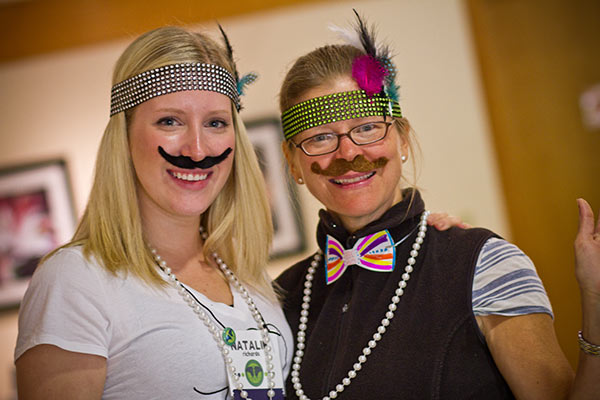
Get gussied up! We provided pearl necklaces, top hats, DIY bow ties, feather-adorned flapper girl headbands, and fake mustaches for attendees to complement their jeans and t-shirts. Feather boas and long gloves are naturals as well. Nothing wrong with requiring guests to wear real dress-up clothes, if that floats your boat. You could challenge people to come outfitted with the fanciest clothes they can find at a second-hand store, with the requirement of bringing the receipt as proof.
what to listen to
Music is an important element of Ye Olde Timey Dinner. We found a collection of hits from the 1920s, which was a perfect soundtrack. You could also dig out some jazz or classical music, depending on what kind of mood you’re looking for.
what to talk about
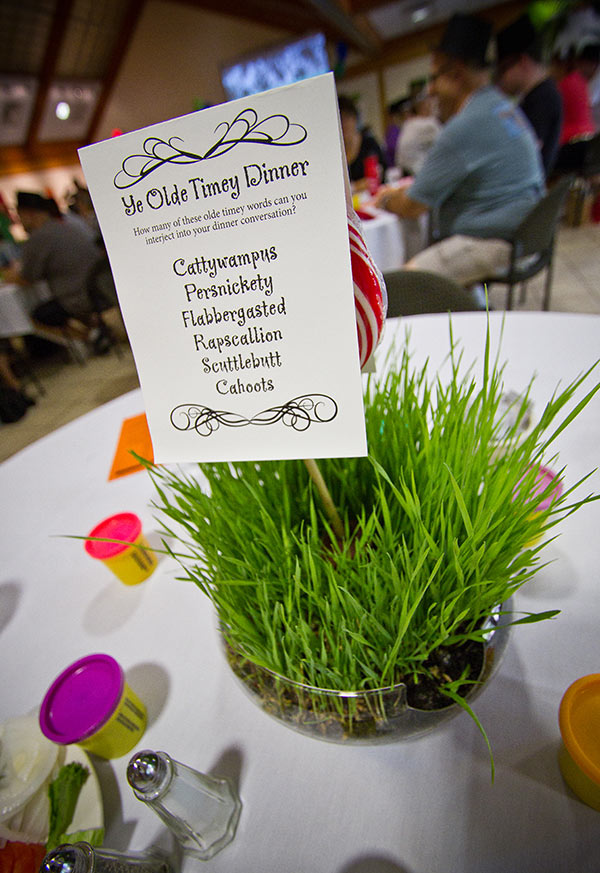
We put tent cards at each table that encouraged diners to pepper their conversations with old-fashioned words and phrases. (See top photo.) Frankly, it was one of the best parts of the whole affair. Keep in mind that a thorough understanding of each word is not required. Bonus laughter came when someone blurted out the word nonsensically. You can download the tent cards we used right here. (Just print them on card stock, cut them down the middle, fold ’em in half, and you’re good to go.)
So that’s the gist of an Olde Timey Dinner. The goal of this article is to get you started, but we also hope that you put your own spin on the concept and share your ideas in the comments below!
Don’t dilly dally on this opportunity to starve Adultitis. May your shenanigans raise a ruckus to remember!
How can you tell if the story you’re living is any good?
Before a speech I gave recently, the executive director of the organization that hired me was sharing the results of a survey they had commissioned to evaluate their effectiveness. By all accounts, this organization had met or exceeded all of their performance metrics. But as the leader admitted, “most performance metrics don’t tell a really good story.”
She’s right, you know. Things like income, expenses, and profit margins can give us a handy snapshot of the health and growth of an organization. But they do not tell the whole story. In fact, they can be a rather poor reflection of happiness delivered or lives changed.
After all, who can accurately measure how profoundly a soul has been moved? Or the precise generational impact of a tool that empowers an individual to lift themselves out of poverty? It’s much easier to calculate the things that are easily measured — like last quarter’s profits — and assume everything else takes care of itself. At best, this technique only provides part of the story. At worst, it can lead us down some bad roads.
Even more dangerous is when we measure our lives in the same way. Just like in business, our personal lives have a set of standard metrics that make for easy guideposts, not just to chart our own progress, but to compare ourselves with others.
Here are a few:
How much money do you make? How many Facebook friends do you have? How many square feet make up your home? What is it worth? What titles do you have or awards have you won? How many degrees have you earned? How many letters are after your name? How many hours do you work? How big is your office? How expensive is your car? What is your kids’ GPA? How many extracurricular activities are they involved in? How much money does that cost you? What about their tuition? How many boards do you serve on?
The answers to each of those questions are easily calculated. Many of us spend the majority of our time monitoring those stats while assuming that our efforts spent to increase them will result in a corresponding uptick in the quality of our story.
Not so fast. Just because something can be measured doesn’t make it important.
Try these questions on for size:
How interesting is your life? How adventurous is it? How fulfilled are you? How much of a difference are you making? How loved do you feel? How excited are you to start each day? How happy are you? How content?
That last group of questions is awfully hard to quantify. But they have a lot more to do with the awesomeness of your story than the size of your paycheck, your home, or your kids tuition bill.
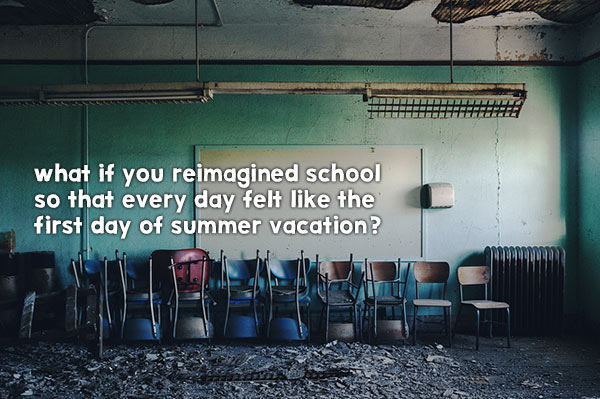
What’s a sadder reflection on our modern educational system: the fact that “School’s Out” by Alice Cooper is the de facto theme for students everywhere this time of year, or the fact that almost no one stops to consider that maybe it’s a problem that so many people feel this way about school?
For me, it’s weird to think of taking a break from learning. The truth is that kids are learning every day, whether they are in school or not. So am I. So are you. But I get it. For kids, school is associated with learning. That’s why we’re sent, to learn stuff. So naturally, if school stinks, so must learning.
Maybe I’m alone, but I think it’s sad that the surge of freedom associated with the first day of summer vacation is such a common feeling in our society.
One of the things that excites me most about our homeschooling adventure — especially with the interest-based approach we are taking — is the chance to make Mr. Cooper’s rock standard sound like a song from another planet to my kids.
I approached the bandana-wearing barista and bared my soul.
“I have a confession to make,” I started. “I am a coffee virgin. I’ve never had more than a sip my whole life.”
“Uh oh,” she said. “And you came here, of all places?”
The “here” she was speaking of was Anodyne Coffee. I was in Milwaukee working on the first draft for my next book. I’d heard good things about the place and figured it would be a good spot to work. I love coffee shops, from the exotic smells to the hipster vibe. The only thing is, I don’t drink coffee.
Well, I didn’t.
On the twenty-minute walk from my hotel, the thought crossed my mind that maybe my trip to the coffee shop should include me drinking, you know, actual coffee. Even though I’d only ever had sips, I was pretty sure I wouldn’t like it, and it seemed like a pretty good way to waste $4.
Then I remembered Stanley. It was clear that, regardless of my opinion of the coffee, ordering it would make for a better story than not. And at that, my decision was made.
“Normally I’d order a hot chocolate or something,” I explained to the barista, “But I figured today is the day. What would you recommend for a first-time coffee drinker? What’s a good gateway drink?”
“Well,” she began, “If you like hot chocolate, you might want to try a mocha. It’s kind of like a hot chocolate with coffee in it.”
“Sounds good!”
“Do you want whipped cream?” she asked.
“Sure, let’s get crazy!”
After receiving my drink, I found a spot to sit and took a sip. Instant deliciousness. Suddenly, a surefire way to waste $3.54 became a contender for the best $3.54 I’d ever spent. In an instant, a new world opened up before me. A delightful buzz coursed through my veins as I pounded out a few chapters of the book. I decided to order another one.
I was a little concerned when the barista asked me if I wanted to “make it decaf this time, just in case?”
Just in case what? I thought to myself. I declined, deciding to cast my cares to the wind. I had a book to write after all!
I will say that I felt a lot like Jim Carrey in the movie Dumb & Dumber, when he was in the van, furiously pumping his arms back and forth, and said, “It’s like I’m running at an unbelievable rate, Harry!”
One thing’s for sure. It may have been my first coffee, but it won’t be my last. I am certainly glad I took the plunge.
Now, to the billions of coffee drinkers worldwide, me trying coffee for the first time is as trivial as it gets. (Although being the last person on a bandwagon may be somewhat notable.) But that doesn’t matter. What does matter is that I ignored Adultitis and said yes to something that had the potential to make my story better. Even if I had not liked coffee, at least I wouldn’t have the regret of wondering if I would have and wishing I’d tried it.
This is an excellent example of what I call tinkering: Little experiments of little consequence that have the potential to move your story in exciting new directions. For me, trying coffee was a case of tinkering. If I liked it, awesome! If not, no big deal. Either way, my propensity for adventure got a little bigger, and my story got a little better.
Don’t discount the small steps you could take today to make your story more awesome.
You never know where something as small as a sip could lead.
What’s something small you’ve done in the last week that made your story more awesome?