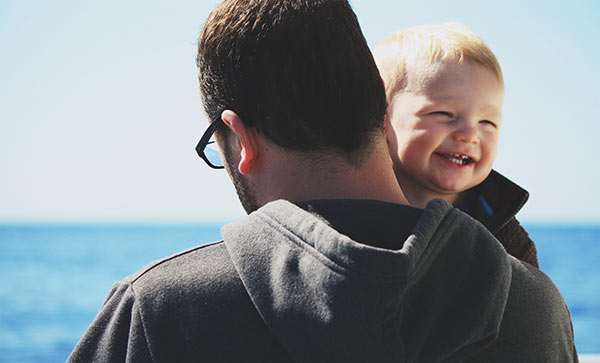
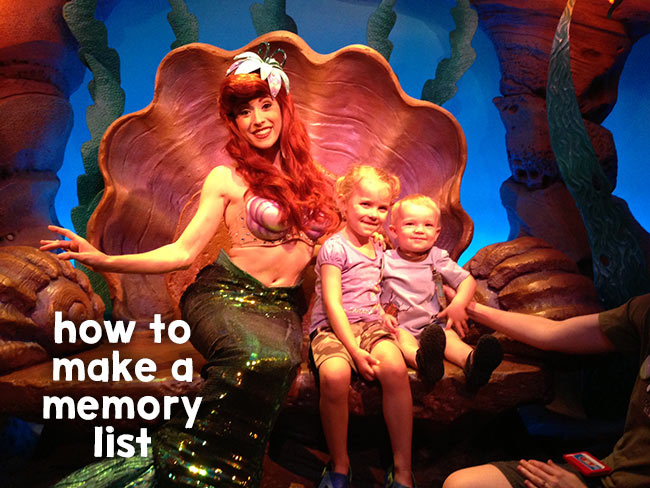
My son Benjamin is only 15 months old, and he is a natural-born flirt.
On a recent family vacation to Santa Barbara, Ben made friends with approximately 7,235 people. He doesn’t say much, but then again, he doesn’t need to. His bright eyes and broad smile do all the work for him. Whether it’s sitting on airplanes, waiting in lines, or dining at a restaurant, Ben is constantly scanning for someone to smile at. And if you catch his gaze, watch out. Women are stopped dead in their tracks, and grown men are immediately drawn into silly games of peekaboo. When Ben smiles at you, no matter what kind of mood you’re in, you can’t help but smile back.
He’s viral.
According to Wikipedia, something is viral if it can induce some agents to replicate it, resulting in many copies being produced and spread around.
I can guarantee this: there were more smiles in Santa Barbara last week than there would have been if Ben had stayed home.
But here’s the thing: you’re like Ben. You’re viral, too.
Your attitude is contagious. It spreads to people around you. If you want, you can spread smiles, enthusiasm, and optimism wherever you go. Of course, you can also be a harbinger of Adultitis. None of us lives in a bubble; we are each impacted by the people around us.
It’s often said that we should be the change we wish to see in the world. Sometimes a big change can begin with a simple smile.
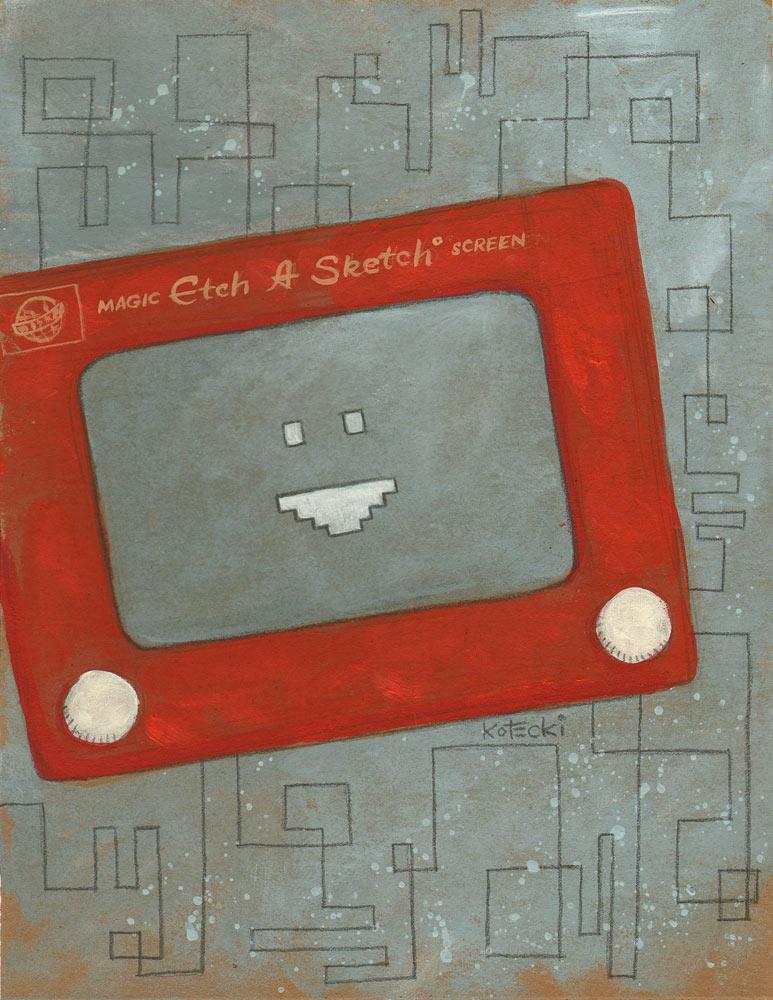
Andre Cassagnes, the dude who invented the Etch-a-Sketch, was an electrical technician. Cassagnes came up with the idea in his garage when he peeled a translucent decal from a light switch plate and found pencil mark images transferred to the opposite face. Initially dubbed the Telecran, the toy was renamed L’Ecran Magique, or ‘The Magic Screen,’ and made its debut at a toy fair in Nuremberg, Germany, in 1959.
Funny thing about Etch-a-Sketches.
Using one is ridiculously easy. (Especially if you want to draw, you know, stairs.)
But making anything worthwhile with it is really, really hard.
Even though some people make it look easy:
The cool thing about the Etch-a-Sketch is how easy it makes it to start over. You shake it up a few times, and you’re rewarded with a blank slate.
Which makes the Etch-a-Sketch a lot like life.
Living is pretty easy, thanks to the fact that your brain, heart, and lungs put much of it on autopilot. Making your life into anything worthwhile, however, is hard. Harder than spending an hour on Facebook or watching a Golden Girls marathon.
But God, the dude who invented life, also made it pretty easy to start over.
Each new day is an opportunity to start again. With a clean slate and a new optimism.
Of course, there are exceptions, but few things in life are unfixable. Sure, you may have messed up yesterday in grand, spectacular fashion.
Your project, meeting, or soufflé may not have turned out the way you would have liked. Maybe you got lazy, lashed out, fell down, or said something you regret.
That’s ok. Today is a new day, a chance to try again.
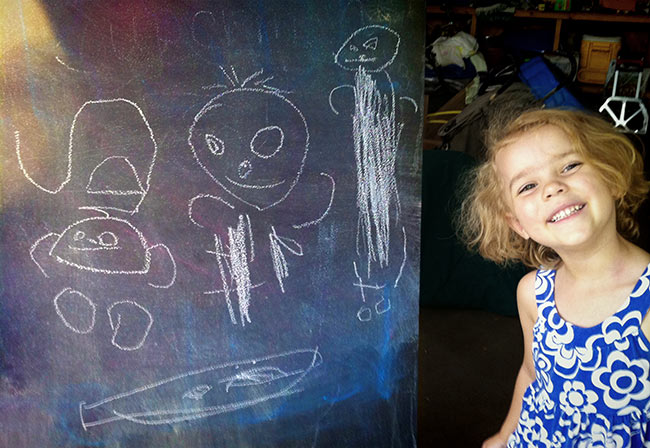
Have you ever noticed that you can always tell whether a child’s drawing was actually drawn by a child or an adult? Advertisements, signage, or product packaging will sometimes convey a childlike quality by including some elements supposedly drawn by a child. Much of the time, the drawing is done by a grown-up mimicking a child’s drawing. And you can tell it’s a fake.
Why is that?
It’s because the grown-up is trying to be something he or she is not. A real child’s drawing contains the bold, uninhibited, and unconventional expressiveness of that child. An adult can try to copy that spirit, but it is a fool’s game. The adult is burdened with too many pre-conceived notions: what color something is supposed to be, what shape something is, and how big it should be in relation to the other objects. Even though a grown-up may try to ignore those learned observations — by making the sun green or the house a triangle — she might not even consider the idea of making the trees float, which may be an obvious choice for a particular child. Usually, the grown-up ends up with an image that looks kind of like something a child would draw, but it’s always just a bit off, making it glaringly inauthentic.
Nothing beats an original.
We run into the same problem when we imitate someone else instead of just being ourselves. When we try to fit into a career that doesn’t suit us, mirror the journey of a personal hero, or follow in our father’s footsteps, no matter how well we do it, something will always be just a bit off. People can tell, and more importantly, we can feel it. Ironically, the reason we can’t pull it off is that too much of “us” gets in the way.
Like a child with a blackboard and a fat piece of chalk, what we need to do is open the floodgates and let the “us” run free. It is only when we boldly go in our own direction, tap into our own mix of unique talents, and embrace our own wonderful idiosyncrasies that we can fashion a life that is a truly authentic and inspiring work of art. It’s always better to be a first-rate you than a second-rate somebody else.
As my friend Scott says, “Cover bands never make it into the Rock & Roll Hall of Fame.”
There is magic in your originality. That’s what we want to see. And it’s exactly what the world needs.
Pajama Runs are great because they fit into busy schedules, allow you to break a few “rules,” and for the price of a few simple ice cream cones, you get to create a memory you will never forget.
The Mission: Put simply, a Pajama Run is when you surprise someone by taking them out for a late-night ice cream treat in their pajamas. In fact, EVERYONE involved needs to be wearing pajamas. Anyone can play — you can “kidnap” your kids, grandkids, parents, or friends — and you can include as many people as you want. Bonus points if the people you surprise are already in bed (feel free to wake them up with pots and pans and wooden spoons or some appropriate music). For best results, maintain the mystery by keeping the destination a secret for as long as possible. If you have kids and you’re feeling extremely rebellious, do it on a school night.
When you buy something online, during the checkout process, there is almost always a checkbox with an invitation to receive promotional emails of some sort. Sometimes you have to check the box to get the emails. Other sites have pre-checked the box for you, automatically assuming that you want their stuff. If you don’t, you physically have to uncheck the box — or opt-out — yourself.
If you’re not paying attention, you could end up getting a bunch of stuff you didn’t really want.
Too many people live life with their checkboxes pre-checked.
Every society has certain norms about how one is supposed to navigate through life. Here are a few that are pretty standard in America these days:
You work a job you only kinda like — if you’re lucky — and then get to do what you really want when you retire.
You always take the promotion.
You should live together before you get married.
A household needs two incomes to survive.
A family must have two cars.
Your family room should be centered around a television.
You carry a monthly balance on your credit card.
You have your babies in a hospital.
When they are four or five, you send them off to school.
Your kids should be involved in as many extracurricular activities as possible, as early as possible. (If you want them to be well-adjusted and get into good colleges, that is.)
You need to decide what you want to do with your life in high school, so you can decide what degree you want to pursue, to decide what colleges to apply to.
Once you get that degree, find someone to hire you to work that job you only kinda like…
Interestingly, most of the norms above only became norms within the past 50-100 years. Which makes it all the more peculiar that we are so quick to follow them. “The way we do things” hasn’t always been the way we’ve done things. And yet, many people go through life with these “checkboxes” pre-selected.
It’s time to opt out.
Opt out of all the preconceived notions, assumptions, and stereotypes. Then mindfully choose what’s best for you.
Just because everyone around you is running around like chickens with their heads cut off, overcommitted, overwhelmed, and financially overextended doesn’t mean you have to be, too. Just like online, if you don’t pay attention to what you’re signing up for (and why), you could end up with a life flooded with things you don’t want. Things like stress, debt, and regret.
Of course, opting out requires a fair measure of thought. You have to think: is this what I really want? Where did this norm come from? What are the pros and cons of sticking with it or ignoring it? Are there any alternatives?
On top of the heavy thinking, opting out requires faith and courage as well.
It’s not my job or my aim to tell you WHAT to choose. I just want you to be intentional about your choices. Your life doesn’t have to stick to the same standard plot as everyone else. In the end, you may end up choosing to keep many of the things the same. But at least the decisions are yours, and not anyone else’s.
In the end, that’s what leads to a rewarding life filled with meaning and adventure. And keeps you from getting a flood of stuff you never signed up for.
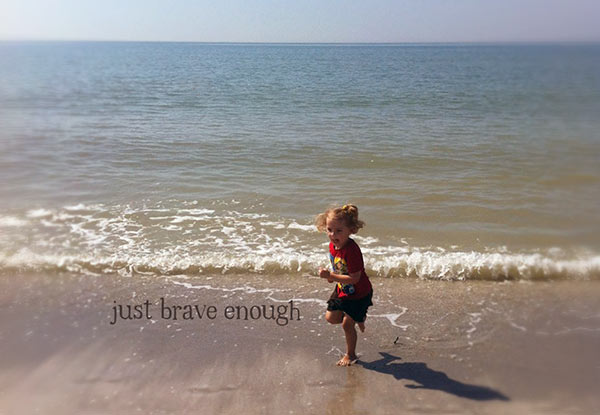
After a speaking gig in Houston years ago, we drove down to Galveston to spend a little time near the Gulf. Our daughter Lucy, almost four years old at the time, waded in the water, immersed in a game she liked to call “tricking the waves.” Kim commented on how much deeper she was willing to go compared to just a few months earlier, when we were in Florida.
Now, Lucy didn’t go diving headfirst into the surf or anything, but she didn’t need to. She was being, as I like to say, “just brave enough.”
I spent a lot of my childhood being afraid. I was afraid of new experiences. Of meeting new people. Of the unknown. Of drowning. Of looking stupid. Of the future. Of being a colossal failure in life. I was afraid of “the thunder, the lightning, and the firetrucks.”
Over the years, my faith has helped me deal with much of that fear, but it’s still a part of my life. It is for all of us.
There have been many moments in my life when I have been afraid and, like Susan Jeffers advises, “felt the fear and did it anyway.” Those brief moments of bravery have increased my resistance to fear. Like Lucy, after I went a little deeper, my new position didn’t seem all that deep anymore.
I’ve always been drawn to quotes about fear, courage, and bravery. The following quote comes from the movie “We Bought a Zoo,” and I had to jot it down as soon as I heard it:
“You know, sometimes all you need is twenty seconds of insane courage. Just literally twenty seconds of just embarrassing bravery. And I promise you, something great will come of it.”
–Matt Damon in We Bought a Zoo
I don’t know about you, but to me, there is great comfort in remembering that I don’t have to be brave and courageous every minute of my life.
Kim and I are all about collecting experiences over stuff. The challenge with experiences is that they are fleeting. Which is why we normally try to make them tangible in some way, to relive them again and again.
Some common methods for “tangibilizing” memories are taking photos, shooting video, scrapbooking, and journaling. These are each excellent in their own way, but they also have downsides. With photos and video, you can easily spend more time looking through a camera’s viewfinder than actually enjoying the experience firsthand. And others require a lot of post-event work that doesn’t always get done, as is the case with video editing, scrapbooking, and journaling.
I am not discounting any of the above methods for capturing experiences for future enjoyment. I have done and will continue to utilize each of them. I just want to call attention to an often-unheard-of but perhaps the easiest and most effective method.
Memory lists.
Memory lists are very simple and only require a few minutes to make. Using a notebook, jot down the “memory snapshots” that you experienced that day. Keep them simple; one sentence snippets will suffice. Don’t worry if you’re not a “writer.” You probably are experienced at making to-do lists, and you don’t worry about those winning Pulitzer prizes, right? Well, consider this an I-did list.
You can easily bust out a list of 10 things in less than five minutes. But here’s the magic: when you review the list in five years, you’ll be amazed at how those memories spring to life while your brain fills in the details you didn’t even write down.
For example, I just stumbled across a list that I made right after a trip to Florida years ago. Here’s a sampling of some of my notes from a visit to Disney World:
Abu kissed Lucy during the Main Street parade.
Genie gave Dad a high five.
We told Cinderella’s evil stepsisters to “Keep it movin’.”
Lucy: “It looked like Beast was nice.”
Treats: Rice Krispies Mickey with M&Ms, Red Velvet Mickey Cake Pop.
Lucy started bawling when Maleficent came out during the live show at Cinderella’s castle, requiring Dad to hold her.
Ben’s first ride: It’s a Small World.
Mommy and Lucy on the Astro Orbiter ride during the fireworks. Lucy: “It’s so pretty!”
At night, the castle played “tricks” (light show). Lucy: “Good job, castle!” (with a thumbs up.)
Dole whips!!!
Notice how rough and seemingly mundane a few of them are. Some are simply milestones (Ben’s first ride), a record of what we ate (Mickey cake pops), cute things Lucy said (“Good job, castle!”), or moments that were fleeting and could have easily been forgotten (Abu stopping to kiss Lucy).
We do have pictures and video of some of these moments, but let’s face it, some of the best memories happen when the cameras are turned off (or aren’t allowed). And upon our return from Florida, I didn’t have the time or energy to make a scrapbook, edit a video, or write more in-depth about our trip in a journal.
But I had fifteen minutes to write a list of 38 things that stood out about it.
Years later, it only took five minutes to read it and relive some wonderful memories that would have otherwise been forgotten.
I’ve never appreciated Dr. Seuss more than since having kids. He made books as enjoyable for adults as they are for children. Hands down, I would rather read ANY Dr. Seuss book over the Disney Princess Golden Books that have been the focus of Lucy’s recent attention. The former is fun to read, the latter comes off like a lifeless book report of an otherwise entertaining movie. (Just the facts, ma’am.) After reading Cinderella for the seven hundredth time, there are only two possible forms of relief: either a cannonball to the face or a reading of Hop on Pop.
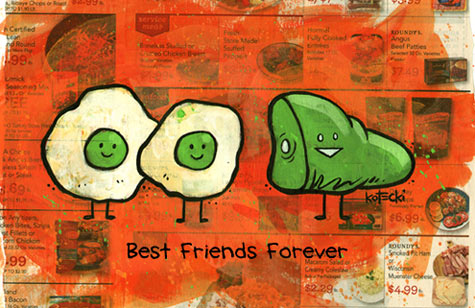
Have you heard the legend that Green Eggs and Ham was written on a bet? It’s no legend, it’s true. After writing The Cat in the Hat using only 233 words, Seuss’ editor bet him that he could not write a book using no more than 50 words. Seuss won the bet when he wrote the now classic tale about some oddly-colored proteins.
Which brings me to an important lesson. And no, it’s not that you should try new things in a box or with a fox. You see, Green Eggs and Ham is Dr. Seuss’s best-selling book of all time. And it contained fewer words than any of the others.
Although it goes against what we learned in kindergarten, sometimes less is more.
During the Civil War, Edward Everett, who was considered one of the great orators of the day, gave a speech that lasted two hours. But no one remembers it, because it was overshadowed by Abraham Lincoln, who used just ten sentences to deliver his Gettysburg Address.
But this lesson applies to more than words.
Less clutter is more space. Keeping your house, bedroom, or office desk free from clutter leads to more clarity and more space in your head.
Less activity is more freedom. Not saying yes to every invitation, working fewer hours, and limiting how many extracurriculars your kids are involved in leads to more family time and the freedom to do more things that feed you.
Less disruption is more productivity. Close your office door and turn off email alerts, and you’ll get more done. Turn off the TV at dinner, and your conversations will be more fruitful.
Less stuff is more experience. Spending less on the newest fashions, furnishings, and gadgets gives you more money to make memories and create scenes.
We here have made a mission out of believing that less stress is more fun.
And apparently, less Disney Princess Golden Books is more sanity.
Are you looking for more of something in your life? Space? Money? Productivity? Freedom? Family Time? Fun?
Maybe the answer lies in doing less of something else.
I met Kevin and his family when I was in college. They were very involved in the church I attended. Such cool people; kind, warm, and welcoming. The parents modeled a marriage worth emulating. Kevin reminded me of me when I was his age: brown curly hair, smart and thoughtful, a little bit shy.
I’d lost touch, but was saddened when I heard that Kevin, just twenty-three years old, was battling leukemia. He had been in Texas getting treatment and fighting hard, but with the cancer on the verge of winning the war, he returned in September to spend his final months at home. Kevin’s favorite holiday is Christmas, but it wasn’t assured that he’d live to see the next one. So his family did a cool thing.
They broke a rule and moved Christmas up a few months.
Upon his return — in September, remember — he was greeted by a street strewn with signs welcoming him home. Beautiful red bows adorned the maple trees, fence, and porch. Even the neighbor’s house had Christmas lights, too. Friends and family decked out Kevin’s home with Christmas cheer, cookies, and a fully-decorated tree.
Awesome.
What if your doctor told you that you had a 50/50 shot of making it to the end of the year? What would change in your life? Anything? Everything?
Here’s a sobering thought: there’s a pretty good chance that at least a few people reading this won’t be here this Christmas. That number could include you. Or me. The only 100% certainty is that for every one of us, our Christmases are numbered.
Don’t wait for a doctor’s diagnosis to wake you out of your slumber. It’s a luxury that rarely comes.
Is there something you’re yearning to do but are waiting for the “proper” time to do it? Maybe this is the week to go for it. (Or at least start planning for it.) No time like the present, after all.
What advice would you give to someone to make sure they’re living every day to the fullest? (Especially if that someone was you?) Here are some of mine:
Quit worrying about what other people think.
Examine your life for rules you’re living by that don’t actually exist. (Hint: there are way more of these than you can possibly imagine.) Start ruthlessly ignoring them.
Watch less TV. Create more adventures.
Pull out the good china and have a fancy dinner (even if you’re only having macaroni and cheese). To those waiting for some sort of special occasion, I’d say that having dinner together with the people you love is always a special occasion.
Start dreaming a little bit bigger than seems reasonable. That’s how you know you’re doing it right.
Do more of what excites you to the core. Do less of what doesn’t.
Remember that EVERY day is a holiday. It’s just that most days, what to celebrate is up to you.
Every day is a holiday; celebrating them is optional.
Kevin made it to the “real” Christmas, but he passed away less than a month later. He and his family were a powerful and humbling example to me of what faith and love really look like during difficult times.
And as for the specific dates on which we’re supposed to celebrate things like Halloween or Thanksgiving or Christmas?
When I was in third grade, my teacher asked me to draw a picture of Santa Claus for the school newsletter. I distinctly remember Mrs. Smith saying that I was the perfect man for the job because I could draw him better than she.
I don’t remember a lot of things about third grade, but I remember how that compliment made me feel.
I tell that story from time to time, mostly with the aim of stressing to teachers the importance of encouraging their students when they see them doing something great. I readily admit that Mrs. Smith very well could have been feeding me a line of B.S. when it came to comparing our artistic skills, but the point is that she was sincere, and she made me believe it. That moment stands out as the first time I was really made to believe had a gift when it came to art. I owned it, and I never looked back.
She always told me that I’d be a “famous” artist someday Luckily, I didn’t know then that most artists don’t become famous until they die.
Well, I was cleaning out a closet the other day and came across a box of mementos from my childhood. Among the finds was a stack of school newsletters, including Peru Catholic School newsletter, circa 1984. Inside was the most horrifying, God-awful illustration of Santa ever put to paper. I refuse to believe it’s the work of my hands, even though I happened to be in third grade in 1984. Yes, the initials “JK” are lightly drawn in the bottom right corner of the artwork (not lightly enough!), but I still can’t bring myself to claim the work as my own. Granted, all the other names around the drawing are fellow classmates and there wasn’t another “JK” in third grade that year, but I’ll stick to the theory that in this case, “JK” stands for just kidding.
Santa Claus by “JK” circa 1984
Ok, ok, I’ll admit this: the suspicion that Mrs. Smith was giving me a line of B.S is very VERY likely.
Looking back, I’m not sure what she saw in me. Perhaps, compared to the other third graders, the drawing isn’t half-bad. Or maybe our class had unusually low artistic aptitude, causing me to really stand out. In the end, none of that matters.
What matters is that Mrs. Smith saw something in me, and told me about it in such a way that I believed it was true. Which led me to keep drawing. And drawing. And drawing. And eventually I got better. Pretty darn good, actually.
Mall Santa by Jason Kotecki, circa 2000. You’ve come a long way, baby!
The talent was there all along. But without hard work, talent just becomes unfulfilled potential. And without some encouragement from time to time, it’s awfully hard to buy in to doing the work required to hone that talent into something remarkable.
Mrs. Smith passed away from cancer before I ever had a chance to thank her for what he did that day. It’s likely she wouldn’t have even remembered it.
But a small gesture to you might be a big honking deal to someone else.
Whether you’re a teacher, a manager or a parent, if you catch somebody’s light shining, tell them you see it and that you appreciate it. When you encourage others — and really mean it — you have no idea what kind of impact you just might make.
In the case of Mrs. Smith, she provided the fuel to ensure that someone wouldn’t be drawing bad Santas forever.