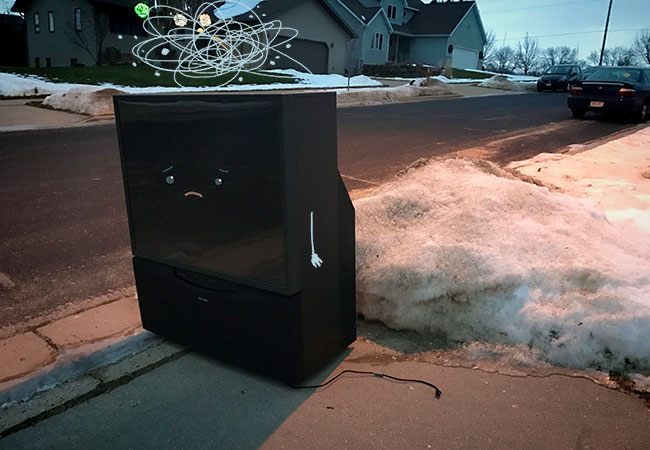
Many Januarys ago, as the ho ho hos of the holiday season abruptly transitioned to the ho ho hums of winter, I came across this abandoned television on a walk around the neighborhood. (Sad face added by me.) I’m sure this one-time technological marvel was the highlight of some Christmas past, but there it sat on the side of the road, abandoned, amidst dirty piles of old snow, valueless. I had no doubt a new TV was in its place; better, flatter, higher def…and also destined to be discarded in a few years.
It was an oversized reminder of our obsession with stuff and our never-ending chase of the latest and greatest. We so easily forget that while we prioritize the tangible — physical things we can see, touch, and that take up space — their most consistent attribute is how they distract us from the things that matter.
Indeed, it’s our experiences — the intangible, fleeting moments of our lives — and the memories they leave behind, that become our most highly valued treasures.
It’s the beauty of the light from a hundred candles in a darkened church on Christmas Eve, the afternoon spent together covered in flour while baking snicker doodles, tucking some deliriously excited but exhausted kids into bed after a late night at Grandma’s; these are the moments that rush by too fast (rudely neglecting to warn us of their importance as they go), and are more valuable than a million big screen TVs.
When we spend money on stuff, it usually depreciates in value over time. This year’s must-have Christmas gift is next year’s Goodwill contribution.
However, the money we invest in experiences is different. The memories we make appreciate in value as we get older and loved ones move on. The money we spend on experiences is always a bargain and leaves us with longer-lasting feelings of happiness. We usually wish we had savored them more when we had the chance.
Instead of buying a “thing” for someone you care about, you might consider gifting them an experience of some kind. It could be a simple weekend trip, concert tickets, a nice dinner out, an offer to babysit for a whole day, a scholarship for an art class, an evening of bowling, or a visit to a spa for a massage. The possibilities are endless.
Now, I seem to be always adding to my Funko Pop collection, and I’d like to upgrade my grill, but just as no one on their deathbed ever said they wished they spent more time at the office, no one ever said, “I wish I had accumulated more stuff!”
But certainly more than a few people have wished they’d taken more family vacations, thrown more parties, undertaken more adventures, or created more memories with the people they loved.
This is not as much a rant against stuff as it is a rally for mindfulness.
In many ways, this year will be the same as the last: filled with temptations to chase the tangible, as well as thousands of opportunities to seek out, embrace, and savor that which is not.
May our goal be to look for ways to invest in memories that get more valuable each passing year.
It sure beats accumulating a future ornament for the end of our driveway.
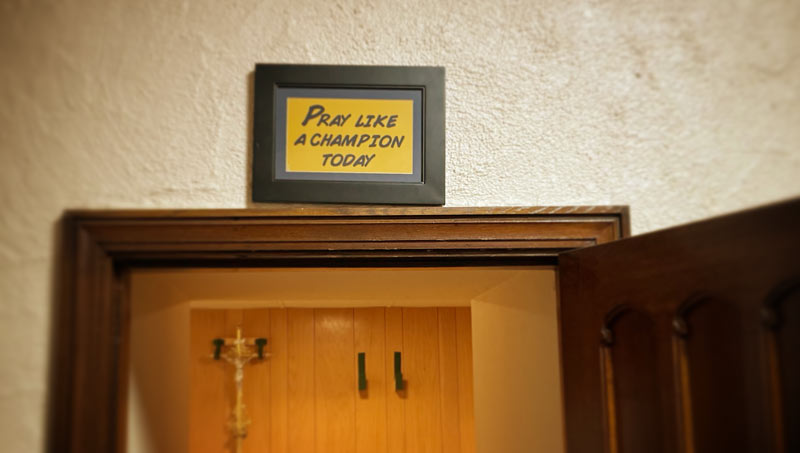
This sign is above the door in the sacristy at Holy Name of Jesus in Sheboygan, where I serve as a lector. In a Catholic church, the sacristy is a room, usually near the altar, where vestments, supplies, and sacred vessels are kept, and the priest and attendants prepare for Mass.
It’s kind of like the locker room where the players prepare for the big game.
The sign is a play off the famous one in the stairwell between the locker room and the field at Notre Dame University. (That one says, “Play like a champion today.”) It actually originated at the University of Oklahoma, on a sign installed by coach Bud Wilkinson in the 1940s for the Sooners football team. In 1986, Notre Dame coach Lou Holtz had one made for his team. Since then, it has become a tradition for Notre Dame players to touch the sign, often with a tap, a swipe, or a kiss, as a way to honor the history, remember the sacrifices of those who came before, and mentally prepare for the game.
One of my favorite routines implemented by our pastor, Fr. Nick, is when he gathers the cantor, lectors, and altar servers in prayer before Mass begins. He asks for the ability to treat it as if it were our first Mass, our last Mass, and our only Mass.
Each of these scenarios calls to mind a unique emotional flavor…
There’s a nervous excitement you get when doing something for the first time.
There’s a feeling of reverence and appreciation that arises when you know you only get to do it once.
And there’s a somber sort of gravity when you know you’re doing something for the last time.
They are different experiences, but in each case, we usually make a special effort to savor the moment, giving it our undivided attention, allowing ourselves to be fully present.
There is great value in adopting this mindset anytime you’re doing something important, especially if it’s become routine. It might feel like a bit of mental trickery, because even if it’s not actually the first or only time you’re doing it, it may very well be your last.
I like this prayer so much that I now say it before every speech I give. I put myself in the headspace of it being my first, last, and only speech. I pray that God will be with me, that I will say what needs to be said, and that my audience will hear what they need to hear. (Which, believe it or not, is sometimes different than what I actually say!)
To consider that it could legitimately be the last speech I’ll ever give rekindles a certain electricity and helps me give it the respect it deserves, regardless of how “impressive” the stage or size of the audience.
It helps me give it my all, like a champion.
Now, you may not be a priest, a lector, a professional speaker, or a football player.
You don’t need to be any of these things to take this ritual to heart.
What is on your to-do list today?
Is there something on it that’s important, but you do it so regularly that it feels rote, and sometimes even like a burden?
Like caring for an ailing parent or a sick patient, perhaps?
Maybe serving a customer or helping a student.
Nursing a child.
Teaching a class.
Running a meeting.
Repairing a vehicle.
Fixing a leaky pipe.
Making dinner.
Preparing to host a family gathering this holiday season.
No matter what the task, what if you acted like you were doing it for the first time?
Would you do anything differently if it were your only time doing it?
What if, today, is the last time you’ll ever get to do it?
How might you approach it then?
Like a champion, I hope.
P.S. This article was originally published at SheboyganCatholic.com, a site I created to share more of my thoughts on faith. If you’re interested in that sort of thing, you can subscribe to the weekly newsletter here.
🤔 I wonder…what’s something on your to-do list today that’s become a routine, or is something you’re not looking forward to? How would you approach it if it were your first, last, or only time?
Sometimes living a better story requires making a big, hairy, scary change. Like moving across the country or taking a pay cut to do what you love. But most of the time, we just need to be open to the art of tinkering.
The dictionary says that to tinker is “to repair, adjust, or work with something in an unskilled or experimental manner.”
Take special note of those words “unskilled” and “experimental.” For some reason, we grown-ups think we have to master something on our first attempt. And know exactly how something will turn out before we take a first step. Naturally, that’s impossible, so we don’t even try.
Kids are under no such illusions. They tinker all day long.
And when you were a kid, so did you.
If you’re serious about improving your story, just try small things and see what happens. If your inner child whispers something that sounds fun but feels a bit outrageous, commit to trying it just once. Or for a few days.
Order something off the menu that you normally wouldn’t. Maybe it’ll open up a whole new culinary adventure. Or maybe not. No big deal.
Get rid of a small box of things. Maybe you’ll appreciate the freedom so much that you’ll give away half your things to Goodwill. Maybe not. No big deal.
Submit your resumé for that dream job. Maybe they’ll call you for an interview. Maybe not. No big deal.
Invite that guy out for coffee. Maybe he’ll say yes, and it will lead to dinner. Or maybe he doesn’t, and it won’t. No big deal.
Run around the block today. Maybe you’ll be so invigorated that you’ll set the goal of running a marathon in six months. Maybe not. No big deal.
Don’t worry about doing everything perfectly, and don’t bite off more than you can chew. Just do a little of this, a little of that. Cut a little here, a little there. You might even want to start a Tinker Project.
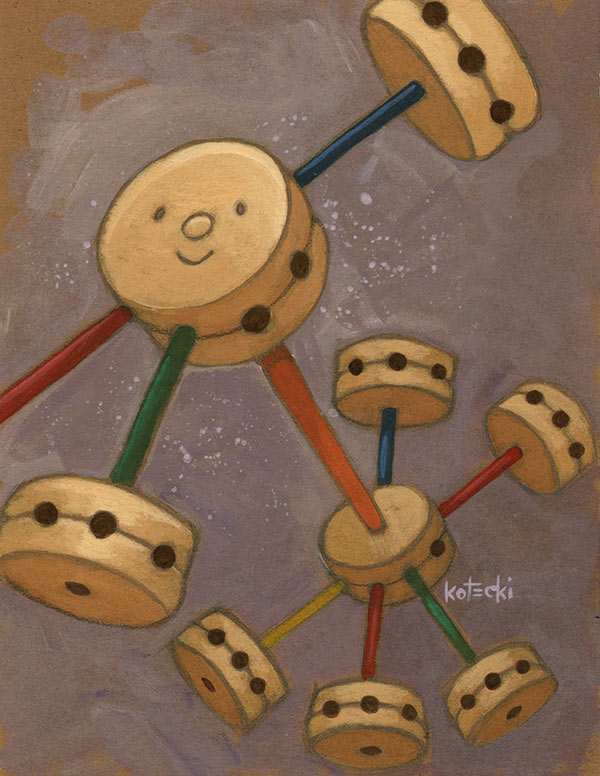
A Tinker Project is a playful endeavor of any size or scope that gives you permission to experiment with something that’s been tugging at your soul, without regard to any particular outcome. It’s a chance to chase your curiosity and try something new. It’s about venturing into the unknown, just because, where the act of exploration is reward enough.
A few years ago, I launched a Tinker Project to create 100 new pieces in a year. (I made 29 original pieces the year before.) I was regretful of having gone too many years in a row wishing I’d spent more time in the studio. I gave myself permission to experiment; none of the pieces needed to be great or serve any bigger purpose. In the end, I grew leaps and bounds as an artist and made some significant breakthroughs.
The best part was that I could stop wondering what would happen if I actually committed myself to making more art.
Your Tinker Project might be to take a picture every day on a morning walk, not to become a National Geographic photographer, but just to release a creative side of yourself that has been dormant for too long.
Your Tinker Project might be writing a dozen short stories about an abandoned robot, not to become a bestselling author, but because the stories can’t stay locked within you for one more minute.
Your Tinker Project might be to visit 24 new restaurants this year, not to start a career as a successful food blogger, but simply to stretch your culinary comfort zone a bit.
Your Tinker Project might be to pen one handwritten letter a week, not to increase your business, but to connect more deeply with people you care about.
Your Tinker Project might be to take a six-week ballroom dancing class, not to avoid embarrassing yourself at your wedding reception, but just because it might be fun.
A Tinker Project may produce some productive, practical, and perhaps even profitable benefits, but that’s not its purpose. In adulthood, our heart often takes a back seat to our head, with its incessant need for reason and fear of failure or looking stupid.
A Tinker Project is about trusting that sometimes, your heart has reasons for doing things that take a while for your head to understand.
I really hope you’ll be inspired to start a Tinker Project of your own. If so, I’d love to hear how it goes. Use the hashtag #TinkerProject to share it with the rest of us.
These small actions may lead to big things, sure, but don’t be paralyzed by the belief that to make your life better, you have to do something elaborate, groundbreaking, and meticulously planned.
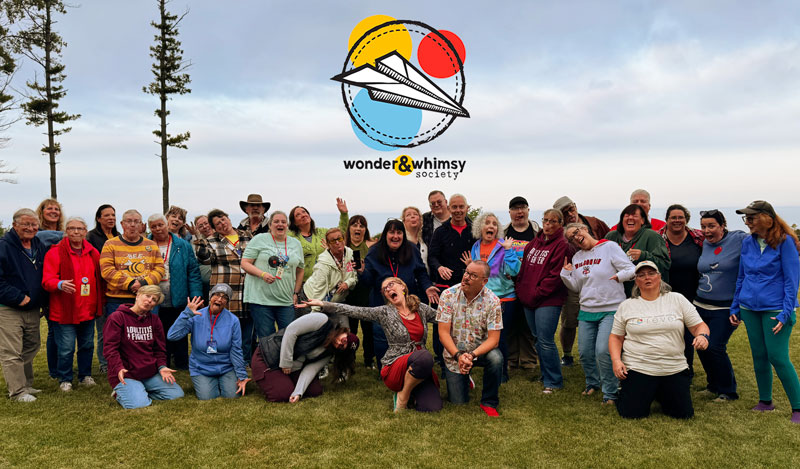
Yesterday, we held what may be the last Wonder & Whimsy Society Family Reunion in our backyard. I’ve learned to never say never, but for now, Kim and I have decided to tie a bow around the W&WS, feeling called to move on to other things.
A project born of the pandemic that lasted five years, it was a labor of love that changed lives for the better, most notably our own. It was a difficult decision that took a good part of a year to come to. It was reminiscent of the time I resolved to retire my comic strip, “Kim & Jason,” after investing six-plus years into it.
Both decisions came after a lot of prayer. I wanted to be sure that we weren’t abandoning ship just because persisting was hard. The issue of pride also makes it difficult to move on. Was I wrong to pursue it? Does stepping away make it a failure (and a public one at that)? Did I waste years on something not meant to be?
Our lives are made up of seasons. Entering a new one doesn’t automatically make the last one bad, or wrong, or a failure.
When we left Madison for Sheboygan in 2021, there were many signs that it was time to move on from a place that had been our home for twenty years. It was tempting to regard it as an evil ex-girlfriend who wronged me. But I never could. Yes, there were reasons for leaving, but that place and community served us well for two decades. I just couldn’t get myself to paint over the positive with a broad brush of negativity, as if we were fooled or mistreated.
Just because something ends doesn’t mean it was bad. Neither should we cling to a season that has ended.
Each season has a reason.
Each one is its own gift.
Each season brings forth something good, even the particularly trying or unhappy ones.
What can trip us up, however, are misaligned expectations. I talked about this in my presentation at Wondernite Friday night, and will share more later. The short version is that expectations are merely predictions of how we think or hope something might go. Sometimes we are right, and sometimes we are wrong. In either case, they were still predictions.
We lose our sense of peace when we refuse to let go of something because “this wasn’t the way it’s supposed to go.”
Seasons are a natural part of life, and we experience different ones in our relationships, careers, and health.
A change from one season to the next is not necessarily an indicator that you’re doing something wrong.
It’s ok to feel sadness when a particular season ends. I did when I said goodbye to my comic strip, and I do now, saying goodbye to the Wonder & Whimsy Society. As much of a relief as it is when your kids can sleep through the night, there’s also a sadness that your days of rocking them to sleep are also numbered. It’s ok to be sad when a sweet season comes to an end; that means it mattered.
We can and should learn from every season we experience. We should look for and be grateful for the blessings that came from them. And we can look forward to new seasons with hopeful anticipation.
But we shouldn’t beat ourselves up because summer turned into fall.
🤔 I wonder…what season were you most sad to move on from? What new season are you looking forward to with anticipation?
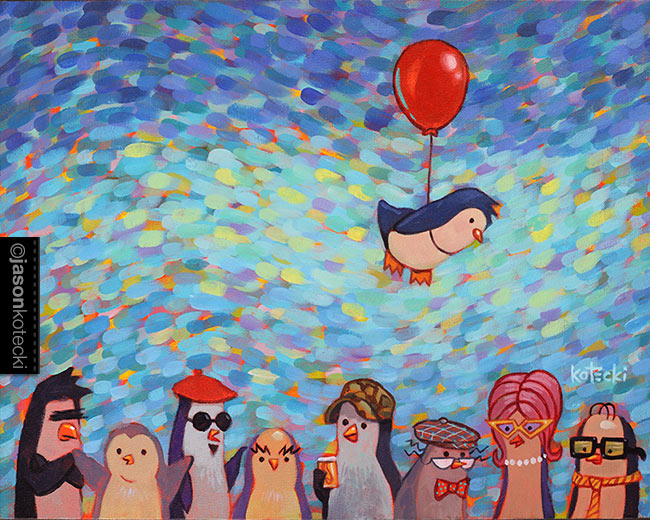
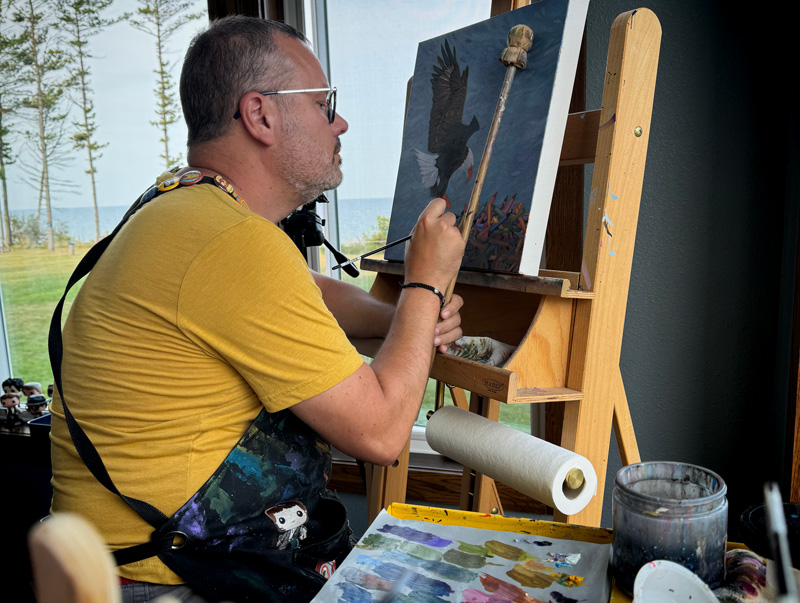
The upcoming Wondernite auction will be filled with unique items. (The one-day auction is open to everyone, but you can also buy a virtual ticket to watch the livestream of my presentation.) Among the items available are two original paintings I did while exhibiting at the Midsummer Art Fair in Sheboygan.
I like painting live for a few reasons. First, and most selfishly, it gives me something to keep me busy during the long days.
Secondly, it attracts people to our booth. I’m one of the only ones at the show doing a live demo, so it really stands out.
Another cool benefit that I didn’t see coming is that I become almost invisible. People can be standing nearby, flipping through prints, and forget that I’m there. It’s a blessing to hear their enthusiastic, unvarnished comments to one another and the delight they get from my work. (Fortunately, most reactions are all good. If they weren’t, I’m sure I’d feel differently!)
But perhaps my favorite thing about live painting is something I started last year, on a whim. When a child comes up and stops to watch me working, I stop painting and ask if they’d like to help, handing them my paintbrush before they can answer.
Now, I know a few secrets. In this environment, I create paintings that are more impressionistic than my usual style. They don’t require technical precision, like many of my others. This enables me to get the painting finished in one day while giving me the flexibility to stop and have conversations with passersby. This style also allows for more “diversity” of brushstrokes from my special collaborators. The other thing I know is that acrylic dries fast, so if something goes really wrong, I can easily paint over it later.
To be honest, though, I’ve now done four of these and have only painted over one errant brushstroke.
And it was left there by a grown-up.
Yes, I do invite an adult to have at it from time to time. Mostly old ladies who I can tell really want to contribute, but often have many years of built-up Adultitis I need to help them clear away first.
Still, it’s mostly kids who contribute to these pieces. What I find most fascinating are the reactions from their parents. Many correctly determine that if the artist didn’t want his painting “ruined,” he wouldn’t hand over his paintbrush to a three-year-old. They encourage their children to give it a try and snap photos of the moment.
But it’s striking how many of the others tell on themselves, revealing the Adultitis bottled up within. I can sense them clenching up, worrying they’ll be responsible for their kid ruining the painting.
“Do it like this…”
“No, don’t do it that way…”
“Don’t mess it up…”
Then, after their child lays down a single stroke deemed to be satisfactory, they quickly interject, “Ok, that’s enough…” trying to shut it down before all hell breaks loose.
I mostly just ignore the grown-ups, preferring instead to focus on the best part: seeing the kid’s face after they hand the brush back to me. Their eyes widen, they stand a little straighter, and they exude a sense of awe over having played a part in something so “important.”
I’d like to give the parents a little pep talk, but it never seems like the right time. I just hope that the “you did great!” I direct at the child is loud enough to pierce the soul of their parent.
Although they are simple paintings, there’s something beautiful about knowing they’re created by a complex tapestry of marks made by others. Even the wonky, shaky, less-than-perfect ones.
And so maybe now is the right time to speak to the parent. For in many ways, we are all those parents, whether we have kids or not.
We all have a little voice inside our heads – maybe with origins in real events that happened years ago – that continually tells us, “You’re not good enough. You’re gonna screw it up. You’ll look like a fool.”
The truth is this: No, you’re not good enough. You will screw things up. And there will be times you’ll look like a fool.
But also, that’s ok.
It really is ok.
That doesn’t make you bad or broken or stupid; it makes you human.
Just like the rest of us.
But the other true thing is this: the only way to grow, the only way to get better, the only way to get the most out of this very short life, is to do it anyway. Say yes to the invitation to participate, to contribute, to experience something new.
It’s hard to put a price tag on the feeling that comes from outgrowing our comfort zone and contributing to something bigger than ourselves.
The story we inhabit is bigger than us. It’s a masterpiece, in fact.
But it won’t be as beautiful without your wonky, shaky, less-than-perfect contribution.
🤔 I wonder…where in your life right now do you need to let go of perfectionism, sidestep fear, and stretch your comfort zone?
It was a very calm lake, and I’d been kayaking a few times before. Spending an afternoon with my family on glacier-fed Eklutna Lake in Alaska seemed like a great entry into our vacation portfolio.
Then the guide started giving her super casual safety presentation, and I suddenly wondered if I was down to my last hour of life.
To be fair, I’ve never used a sea kayak before. The pros make it look easy. To me, it seems poorly designed. (Unless you were designing something intended to drown someone, in that case, it’s perfect.) If you don’t know what it’s like to use a sea kayak, imagine an eight-foot-long wooden 2×4 floating in the water. Now imagine sitting on top of it and trying not to tip over. Maybe it’s just me, but if I’m looking for something to help me traverse the sea, I’d rather have something closer to a pontoon boat than a pine needle to float on.
Despite the barely existent waves on this lake, and even they felt like a tsunami threatening to flip me over. Kim and the kids got to use tandem kayaks, which the employee described as very stable and almost impossible to tip. The way she described mine made me feel like it was a foregone conclusion that I was going to drown or, best case scenario, have to be rescued by my children and towed back to shore with a raging case of hypothermia.
Now, I was the one who suggested this activity, so I couldn’t exactly be the one who put the kibosh on the excursion due to cowardice. So I put on a brave face and got in the boat. The guide pushed me out into the water, and I immediately felt like death was imminent. I like to think of myself as a fairly athletic individual, but I felt as awkward and unstable as an elephant trying to balance on a basketball.
Thankfully, she gave me a few tips: Don’t make any sudden movements. Try not to look behind you. Sit up straight and stay balanced.
In retrospect — spoiler alert: I didn’t die! — I realized that those tips are just as useful for life as they are for sea kayaking.
1. Don’t make any sudden movements. It’s not usually advisable to make sudden changes in life. Spontaneity is good, but best reserved for things of little consequence. Getting married, quitting a job, dropping out of school, or making an all-in investment with your life savings are not scenarios conducive to sudden movements. But we can be very tempted to make them when we’re in periods of desolation, like when we’re stressed out, weary, lonely, afraid, or depressed. Those are uncomfortable seasons, and we’d do anything to get relief, so it’s tempting to go for a quick fix. This can lead to our life being tipped upside down and disastrous long-term consequences.
2. Try not to look behind you. Sure enough, there were some moments when I tried turning around to see what the kids were up to, and I got pretty wobbly. It’s good to learn from the past, but there is a danger in spending too much time looking backward. Otherwise, our life can drift off course, and we can end up in a place we don’t want to be. It’s always better and more stable to look in the direction you want to go.
3. Sit up straight and stay balanced. Let’s be real: life balance is an impossible goal. Variables change too fast on any given day to maintain perfect equilibrium. But we’ve all experienced times when we’ve been leaning too far in one direction for too long. Like the season when Kim began to Wonderhunt, after feeling overwhelmed from being in constant caregiver mode. Of course, there are seasons of life in which certain responsibilities require an outsized amount of time and attention from us — like putting in overtime to finish a project at work or caring for a sick family member — but we must be on guard from staying in that mode for too long. Sleep in once in a while. Take a day off. Go for a long walk or spend an extra hour in prayer. Do whatever you can to restore some semblance of balance, or you’re facing a surefire recipe for an overturned life.
In the end, we spent a little over an hour out on the lake. I followed the guide’s tips as best as I could, and gradually felt my confidence grow (or at least my panic subside). We all returned to shore safe and dry.
Once I got the hang of things, I spent time on the water just floating, trying to soak in the beautiful scenery around me and savor the time with my family, taking mental snapshots of them as they glided into view. And this, too, is good advice for living.
Sometimes we get stuck focusing on staying alive, and we forget to savor the gift of life.
Kim and I are well-known for encouraging people to be more childlike and act more like kids. A few brave souls have asked (although I suspect countless others have wondered): How does this philosophy impact our role as parents?
In other words, how does a parent walk the line between teaching kids to break rules that don’t exist, without descending into total anarchy?
Great question.
While it’s true that our kids regularly say “#Notarule” in its proper context during normal conversations, any speculation that our kids are living in Willy Wonka’s Chocolate Factory is grossly exaggerated.
Here are some thoughts on the matter. Your mileage may vary, but I believe there are some useful nuggets here, whether you’re a parent or not.
A Parent’s First Job is Parenting.
First and foremost, we are our kids’ parents, not their friends or playmates or butlers. No one else has this job, so if we don’t do it, our kids will be screwed, destined to live life as soft, spoiled, entitled, selfish little scoundrels. I think they deserve better.
And so it falls on us to teach them manners and accountability and forgiveness and generally how to not be dirtbags. The challenge is that this takes a lot of work, which is why many people prefer to delegate it to someone else. It requires the willingness to be the “bad guy,” to say no, and to enforce the law. This, in turn, requires patience, perseverance, self-confidence, and at least a little stubbornness (with the latter being our strongest trait).
We are very proud when someone at a restaurant compliments us on how well-behaved our kids are, because we know how much work and consistency go into it. We are also certain they might have a different opinion if they lived with these minions every single day, like we do.
Kids Need Rules.
With a degree in early childhood education, Kim is well-versed in the research that shows kids need structure and routine in order to feel safe, grow, and thrive. As such, although our schedule is flexible, we run a pretty orderly household, complete with consistent bedtimes, cleanup routines, and behavioral expectations (right now we’re working on not interrupting someone while they are talking, which, at this rate, they should master by the time they leave for college).
In our home, there are plenty of rules that DO exist, and there are consequences for breaking them, just like in the real world. We merely advocate the overthrow of rules that DON’T exist. Fortunately, there are plenty of them within the realm of parenthood.
Parents Need Backbones.
If he had his druthers, my son Ben would wear pajamas all day long, every single day, for the rest of his life. Once in a while, we let him roll with his own wardrobe choices because, if I’m being really honest about it, the only reason I wouldn’t let him wear his pajamas to the grocery store is because I was concerned about what other people would think of my parenting.
And frankly, that’s why more parents don’t let their kids break rules that don’t exist. They care too much about what other people would think of them if they did.
Kids deserve parents with enough self-confidence to allow them to be themselves and not conform to an expectation that only exists because it’s always existed.
Once in a While is Not the Same as Always.
My friend Eliz sets aside one day a year as the “Day of Yes.” On this particular day, this mother of twins says yes to any and all reasonable requests, particularly the things she normally says no to. My sister-in-law once took her daughter to the midnight screening of the first Twilight movie. On a school night.
Now, the key to these examples is that both of these moms run a pretty tight ship. Rules are enforced, and the kids are well-behaved. The only reason it’s special is that it doesn’t happen all the time. Parents who always let their kids eat dessert first are doormats. Parents who never let their kids eat dessert first have a stick up their butt. The magic is in the middle.
Don’t Fear the Why.
One thing Kim and I try to practice is an openness to our kids’ “Why?” questions. Practice is the key word here, as “Because I said so” slips out from time to time. The truth is, whether you are a parent, a manager, or a CEO, forcing yourself to answer why you do things a certain way is a great way to ferret out rules that don’t exist. If you have a clear answer, you find yourself smack dab in the middle of a teachable moment. If not, you very well may have stumbled upon a rule that’s begging to be broken.
Tinker.
Empowering your kids to break rules that don’t exist is not a one-size-fits-all proposition. Some parents are naturally more lenient, while others tend to be more strict. A lenient parent might jump at the idea of Barbarian Spaghetti(which is a spaghetti dinner with no plates), while a stricter one might recoil in horror.
The secret is to start where you are. Just tinker. Step out of your comfort zone in a premeditated way. If Barbarian Spaghetti seems a bit intimidating, then just have breakfast for dinner. Or eat dessert first. Decorate ugly cookies. Push back bedtime to celebrate a special occasion. You don’t have to blow your comfort zone away with a nuclear-powered bazooka. Go at it with a pea shooter, and work your way up from there.
How to Make a Hard Job Easier.
Being a bad parent is easy. Being a good parent is incredibly hard. Being a great parent is damn near impossible. As for perfect parents? They’re like unicorns and easy-to-open Barbie packaging; they don’t exist.
We believe that you can’t be truly great at anything if you’re not injecting some measure of fun. Although we take our job as parents very seriously, we try not to take ourselves too seriously, and that seems to make the hard parts go more smoothly.
Case in point:
The Most Important Thing.
The rallying cry of “Escape Adulthood” is not about forgoing all responsibility so we can engage in silly, trivial pursuits all day long. Rather, it’s about breaking free from the safe, boring, and predictable version of adulthood that traps most people, and bringing those childlike sensibilities into our daily lives so that we can stress less and have more fun.
Kim and I want our kids to be curious, dream big, enjoy life, and value experiences over stuff. The best way to do that is to model those qualities ourselves. Because the adage “Do what I say and not what I do” is (and always has been) a myth.
“Your actions are speaking so loudly, I can’t hear a word you’re saying.”
-Ralph Waldo Emerson
Telling an amazing story with our lives — one filled with magic and meaning and wonder and love — makes it more likely our kids will do the same with theirs.
Alas, that’s the hard part. You get that down, and parenting is a piece of cake.
The confirmation came from the woman at the nursery after seeing the photos Kim shared of two of our cherry trees. It wasn’t a surprise, but it also cemented the fact that we’d lost even more time.
A few years earlier, after our majestic wooded backyard was reduced to a violent pile of splintered trees, we processed the grief by imagining possibilities. What might this apocalyptic landscape someday become?
A vision of pulling fresh-baked pies from the oven, made with the fruit from trees planted in the aftermath of the storm, was one of the first to emerge. The image was so real, I swear I could smell it. And yet I knew it would require patience. It takes years, I was reliably told, for fruit trees to establish themselves and become mature enough to share their apples and pears and cherries. It was for this reason that I became a squeaky wheel, pestering Kim that we should move quickly to get trees picked out and planted.
As I near my fiftieth birthday, I have a heightened sense of urgency. Mortality is more in focus than ever. I hope I still have several decades of life left, but I also know that tomorrow is never guaranteed. Best case scenario, I’ve got fewer years ahead of me than I do behind me.
And so I’ve spent a lot of time thinking about time and how I should be spending it. Am I using my talents as well as I could? Am I wasting too much time on stuff that doesn’t matter? Do I cling too tightly to things I need to release?
Planting a tree, even if not completely from a seed, still feels like a revolutionary act in an age obsessed with instant gratification. Despite all our technical advances, they have still not yet figured out how to make a fruit tree planted yesterday yield ingredients for today’s Flaming Cherries Jubilee.
Whether it’s to produce ingredients for a pie, provide shade for a backyard, or serve as support for a treehouse, planting a tree with a particular outcome in mind is a declaration of hope. You hope the outcome will come to pass, and you hope you’ll still be around when it does.
And when a harsh winter claims your fragile cherry trees as its victim, your hope takes a hit. You feel your odds lengthen as you sense time slipping through your fingers.
Another date that went nowhere.
Another month without conception.
Another year with more steps backward than forward.
Two of our four cherry trees were pronounced dead by the coroner at the nursery. How many years would it take — if ever — before we’d partake of any fruit of this mini orchard we planted?
It’s always tempting — rational, even — to give up.
Instead, we opted to respond with another declaration of hope.
Kim and I headed to the nursery. We picked out two new cherry trees, the sturdiest ones we could find. Although I was discouraged about starting over, the truth remained that planting new trees today was still better than doing it a week from now. Another life lesson here, if you’re paying attention.
I wondered if this delay would prove to be the death knell to my cherry pie dreams. Or would I and my grandkids have dozens and dozens of pies in our future?
We returned home, and I settled into my easy chair to watch a baseball game with my son. Somewhere during the third inning, my wife emerged from outdoors with a gift in her hand.
A cherry.
While doing some yard work, Kim discovered a small cluster of about ten cherries on one of the two trees that had survived. She handed one to me.
I popped it into my mouth and savored it like a prisoner eating his last meal. It was a time machine. Memories flooded back from my childhood, of eating cherries stolen from my grandma’s tree, and of the homemade pies she made from it. It may have been forty-five years later, but it tasted exactly the same.
Every morning, I have a practice of writing down my happiest moment from the day before. “Ate the very first cherry off our own tree” made the cut. It currently headlines this year’s list.
That cherry represented something to me, even if I’m not sure what. Something spiritual, eternal, and true. Not necessarily a guarantee that I’ll make it to the day when that tree produces enough cherries for a whole pie.
More of a reminder that hope is always worth holding on to.
Hope never tasted so sweet.
🤔 I wonder…what’s some hope you need to hold on to for a little longer?
Are you sabotaging your own success and happiness?
We recently exhibited at the Midsummer Festival of the Arts in Sheboygan. I’m no stranger to this sort of thing, between participating in art fairs and the gift shows we did in the early days, selling prints and greeting cards to retail and gift shops.
I’ve noticed that exhibitors fall into one of two buckets.
The first consists of people like the two gents next to us. A father and son team were selling metalwork to be displayed outdoors. It’s clear they are there to do a job. They’re pros who are purposeful, efficient, and positive. Not chatty, but friendly.
The second type is like another neighbor we had. Always quick to comment about the weather (which is somehow always too hot or too wet or too windy) and complain about the attendance (which is somehow always too low). This one is regularly straying from their booth to find someone to commiserate with, and makes declarations like, “They love my art, but they don’t have any money to buy.” And if you seem to be doing better than them, they’ll gladly share their opinion of why that is in a way that doesn’t feel much like a compliment.
I both cases, the work itself was very good. But the attitude was miles apart.
Without fail, it’s the first type that consistently enjoys more success.
Coincidence?
Look, we’ve had some rough shows over the years. It was tempting to blame the promoter, the weather, the low attendance, or the buying power of the attendees. It’s comforting to commiserate with others experiencing slow sales, and hurl “must be nice” at the ones doing gangbusters.
It feels good — in the moment — but it’s not very productive.
I eventually found it’s a better use of time and energy to use those occasions to revisit my approach. Is my work as good as it could be? Are we presenting it in the best possible way? Could we improve the clarity of our message? Come up with a more appealing offer? Adjust our sales technique?
In case you haven’t figured it out, the message here is bigger than exhibiting at art fairs.
It’s a valuable lesson for all of life.
One option is to play the victim and complain about all the outside factors that are conspiring to keep you down. You can mutter “must be nice” about the people doing well. Direct it at their natural talent, their good connections, their Ivy League education, or their dumb luck of being in the right place at the right time. You can also blame the weather, the economy, or politicians.
Unfortunately, this is the equivalent of spraying success repellent all over yourself. It creates an invisible aura of negativity that is palpable to the people you encounter. Meanwhile, you’re too busy blaming all the things outside of your control that you don’t have time to improve the things you can.
Or.
You can accept the fact that there are disadvantages you can’t control, and decide to focus on the things you can, choosing to make the best out of whatever comes your way.
That’s really what it is: a decision.
When you make a decision over and over and over again, it becomes a habit, a way of life, and that’s what makes it feel like it’s not a decision.
The good news is that bad habits can be replaced with better ones.
Which starts with a decision.
You can decide to focus on what you can control: working hard, being kind, and maintaining a positive attitude.
You can practice noticing when you’re playing the “must be nice” game, and pivot to a spirit of curiosity about how to better leverage your own strengths.
You can decide that you’re not going to get sucked into conversations with people who want you to share in their negativity.
Oftentimes, the reason we find ourselves afflicted with Adultitis is because we opened the door and invited it in.
🤔 I wonder…what is a technique you use to get yourself back on track when you find yourself swerving into comparison and complaining?
Kim and I were on our way to San Diego. For reasons known only to Delta, our seats got reassigned, and we were split up. Considering that part of the reason for our trip was to celebrate our 25th wedding anniversary, and because we still actually like each other, we looked for an opportunity to switch seats with another passenger.
I was in the middle seat, and a lady sat in the aisle seat next to me. Kim, herself in an aisle seat one row behind, asked the woman if she wouldn’t mind swapping spots so we could sit together.
None of us was in any kind of preferred seating. No First Class, Comfort Plus, or exit rows involved. And yet the woman hesitated, immediately exhibiting a perturbed attitude, as if Kim had requested both kidneys and another vital organ to be named later.
Picking up on her prickly vibe, Kim calmly but firmly responded to the woman with four words: “You can say no.”
After a short pause, which perhaps provided the time to realize she wasn’t losing anything in this exchange, the woman willingly switched places without any further incident or passive aggression.
Now, I don’t know this lady.
Maybe she was feeling settled and didn’t want the hassle of moving.
Maybe she really has a thing for seat 21D.
Maybe she was disappointed that she wasn’t going to get a chance to hit on me.
All I know is that Kim’s short reply felt like such a baller move.
And it was. Not in some sort of “I’m going to bully you into this” or “I’ll share this on social media to shame you in front of the world” sort of way. Rather than an attempt by Kim to exert some kind of power, it was an act of generosity in which she gave power away.
It’s easy to go from one choice to the next, feeling like we are a tiny vessel whipped to and fro by the waves of life, forever at the mercy of our boss, our kids’ school, the government, the airline, or the passenger one row behind us.
Maybe for this woman, it felt like one more example of having to bend to the whims and wishes of someone else. Another moment of feeling powerless.
And with one simple statement, Kim gave her a gift.
“You can say no.”
Four words that gave her permission to pause and be reminded that she has agency over her choices and life. In this case, I’m grateful for her yes. But I’m glad she allowed me to reflect on how difficult it is for us to say no.
We forget how much power we have. Sure, sometimes there are dire consequences for ignoring certain directives. But they are far fewer than we presume.
You really don’t have to say yes to every invitation, opportunity, or request for help.
You really don’t have to say yes to the offer to join the board, accept the position, or sign your kid up for one more thing.
You really don’t have to say yes to that social event when you were looking forward to a quiet weekend you so desperately need.
And you know what? You don’t even have to give a reason. You can simply thank them for thinking of you and tell them it’s not going to work out this time.
We can say no. We can change our minds. We can choose to reverse course and abandon this path we started down, but no longer want to follow.