Category: Uncategorized

  • Far From Regular: A Secret Recipe for a Rich Life

    Have you ever made your own frozen custard with milk you got from your own cows?

    Have you ever made cider from apples you picked from the orchard in your backyard?

    Have you ever been so self-sustaining that you only need to go to the grocery store once a month?

    Have you ever built your home from scratch with your own hands?

    I haven’t.

    But I have friends who do all this and more. They are not Amish, and they are not “preppers,” but the life they live is more reminiscent of Little House on the Prairie than Modern Family.

    They fascinate me. And the more I hear about their life, the more my heart sings. And this confounds me. Because normally feelings like these lead to one of two things: Either a desire to have what they have or the realization that I have identified a kindred spirit. We are the same!

    Except in this case, I don’t have cows. I have no interest in waking up at the butt crack of dawn every morning to milk them. We might plant a few fruit trees this year, but nothing resembling an orchard. I enjoy getting my groceries delivered every week. I am not capable of building a shed, let alone a whole house. (I swell with pride when I install a shelf.)

    Although I respect the heck out of their life, I have no desire for it to be mine. And it doesn’t appear that we have anything in common because my life is nothing like theirs…

    Oh wait, yes, it is.

    There is one big thing we share: We are living life by our own rules. We are not abiding by the paint-by-numbers approach.

    We have burned the paint-by-number to ashes.

    Being a witness to a family that has such a blatant disregard for almost every single regular way of doing things is what makes my heart sing. That level of mindfulness—and disregard for the status quo—is rare.

    I resonate with people who live life on their terms. Even if it looks completely different than mine. It energizes me, and it fires me up because it gives me a sense of what’s possible when someone is mindful of the life they want to have. It expands my own horizons of what I see as possible, and I can’t help but wonder how much better the world would be, how much happier, less depressed, and angry and lost people would be if more of us refused to settle for the “regular” way.

    There is a regular way of doing everything. Having babies. Schooling your children. Making money. Finding a job. Taking vacations. Planning a wedding. Worshipping God. Learning. Teaching. Retiring.

    Interestingly, the regular way is different in different cultures. And the regular way is often a perfectly fine way for most people in most situations.

    Heck, you can get pretty far in life without having to make any real decisions on your own. The regular path is there for you, starting with how you should think about what you should do after high school, to what to have them read at your funeral.

    The problem is that Adultitis sets in when we settle for the regular way more often than not.

    Because we’re not all the same.

    And the regular way is terrible as a one-size-fits-all solution.

    If your soul feels stifled, if you feel the sad, heavy cloud of Adultitis reigning over you, maybe it’s because you’re settling in one or more areas of your life, having made choices that are perfectly fine for the majority of people…just not you.

    Consider this a permission slip to skip the regular way and try a different road. You can always come back to the one you’re on later. (The well-trodden path is easy to find.)

    Others have already made the decision you are considering but are hesitant to commit to. Find them. Borrow courage from them. Learn from them.

    That’s why I love spending time with my cow-milking, custard-making friends.
    They remind me that a life far from regular is the best kind there is.

    (And the cider is delicious, too.)


    🤔 I wonder…who is someone you’re inspired by who skipped the regular way of doing something?

  • How to Turn the Tide Against Adultitis

    Your team is in bad shape. Here you are in the playoffs, and you’re losing. Even though you’re somehow only down by six points, nothing is going right. You were flying high earlier in the game, leading by two scores. Everything was clicking.

    And then…

    A turnover and two huge penalties gave your opponent some easy scores. None of the plays you’re calling are working. Your best running back got injured and is out for the game. Your players are growing more discouraged as each second melts off the clock. Now the other team has the ball and they’re driving down the field. If they score a touchdown—and your team is showing no sign of preventing it—this game is over.

    Stay with me on this metaphor; we’re going somewhere. You might not be a football coach—or even care about football—but perhaps this sounds eerily similar to life right now.

    Everything was going well. Finances were in good shape. Things at work were looking up. You and your spouse were on the same page. The kids were getting along.

    And then…

    Your spouse got sick and has been out of commission for over a week now. All of a sudden, your kids’ teachers decided to team up and go for the world record for most homework assignments. The dishes in the sink are a food-encrusted skyscraper. Your children are expertly pushing one another’s buttons, and tempers are flaring.

    Adultitis is winning hard.

    But let’s go back to our imaginary football game…

    Your opponent is only twenty yards from the end zone. A field goal could ice the game; a touchdown will undoubtedly send your team home for the offseason.

    And then…

    Their quarterback drops back to pass. He’s got a receiver wide open at the goal line and lets the ball go. Out of nowhere, your safety cuts in front and intercepts the pass! He’s got ninety-five yards of open grass ahead of him…as he streaks down the sideline, the crowd erupts into delirium. You’re jumping up and down, and your arm is like a windmill, waving him toward the end zone. He crosses the goal line, scores a touchdown, and ties the game! The stadium is shaking as your players sprint on the field to celebrate.

    You still need to kick the extra point to take the lead, but one thing is certain.

    Momentum has shifted.

    There’s not much more exciting for a team on the brink than a game-altering “pick six” like I just described. For the sportsball ambivalent, a “pick” is slang for “interception” and the “six” denotes how many points a team scores on a touchdown.

    Wouldn’t it be nice to be able to summon one of those up in real life, when Adultitis has a stranglehold on you and your family?

    Well, you can.

    That’s exactly how we use “Pajama Runs” in our household. When Adultitis is having its way with us and everything seems to be going wrong, Kim and I pull out pots and wooden spoons and start banging on them. Our kids know the sound. The mood in the house immediately changes as everyone hurries to the car—even if they are in their pajamas—and we head out for ice cream.

    We typically only do this a few times a year, but it always does the trick. Momentum shifts. Perspective is gained. Fun is had.

    It’s like a pick six, and Adultitis loses big time. The only difference is that in football, you can’t call a play that will guarantee a pick six. It’s true: you actually have more power in real life.

    Pajama Run is our go-to play, but you can draw up your own. It just has to be some kind of activity guaranteed to be fun that immediately and physically shifts you to a dramatically different place than your current environment. For maximum results, it should feel a little like a rule that doesn’t exist. (See: wearing pajamas in public and going out after bedtime, or having ice cream right before dinner, as we often do.)

    When you’re in the middle of an Adultitis attack, it’s common to feel pretty helpless, and it’s tempting to throw in the towel. Don’t give up! You are the head coach of your life. You have the power to shift momentum.

    The war will rage on your whole life, but you can win today’s game.

    Now, blow that metaphorical whistle around your neck, call a timeout, and draw up a play that sends Adultitis to the showers.

  • Be Open to Something Better

    I recently came across this in my photo stream. Part photo, part iPad drawing, it’s my original vision of the art studio I wanted to build as an addition to our home. This was exactly what I wanted: a little extra light-filled space added on to the home office already there. If I could have snapped my fingers and made it instantly materialize exactly like this, I would have been thrilled.

    What I ended up with looks almost nothing like this. So…does that make it a disappointment?

    Heck no!

    Here’s how my studio addition turned out:

    Yes, this will work.

    It’s a reminder to me that, as the poet Elizabeth Barrett Browning wrote, “God’s gifts put man’s best dreams to shame.” 

    Looking at my drawing now, years later, I see how small I was dreaming. All that glass was good in theory, but it was way too much. It would have let in too much light, too much cold in the winter, too much heat in the summer, and offered too little privacy. The original plan didn’t even consider adding to our basement below, which we did, giving us much-needed storage space for inventory.

    The spirit of the vision is the same: more space, lots of light, stunning lake views…but the result is far and away better than I envisioned. Thanks be to God.

    I often feel like my capacity for dreaming has diminished over the years. Perhaps it’s easier to dream when we’re young, before life experience introduces cynicism and makes failure and disappointment a common occurrence. We grow weary of dreaming too big, for fear of getting our hopes up, only to be disappointed. (Or maybe that’s just me?) Make your dreams just big enough to be impressive, but not grandiose enough to slip past the edge of the impossible.

    That younger version of me often feels like a missing person, and I wonder what became of him.

    Looking back at the origins of dreams that came true helps.

    So does a reframe on the dreams that didn’t.

    Early in my career, I dreamed of becoming a syndicated cartoonist with my comic strip appearing in every newspaper in the country. Even though I landed in a few for a brief time, that dream never materialized, and I made the difficult decision to retire the strip after six-plus years of giving it my all.

    Sometimes dreams are just starting points, a place to begin when we don’t know any better. It’s a flag in the ground, a destination to start moving toward. But then, on our journey, we learn more about ourselves and more about the dream, including what sacrifices it requires, and the pros and cons of what success truly looks like.

    After some soul-searching, I realized that what I really wanted was to use my art to inspire, entertain, and encourage people to renew their childlike spirit. A comic strip was the way I thought would get me there. Whether it was a weak idea, a lack of talent, or the slow death of newspapers, that path was not meant to be. My problem was that I thought it was the only way, and I spent a lot of time grieving what I considered a failed dream.

    In retrospect, it wasn’t. The career I currently have is far superior to the one I thought I wanted. I am still using my art to inspire, entertain, and encourage people to renew their childlike spirit. Back then, I simply didn’t have the imagination big enough to envision my current life. Had I known that what I currently do was an option when I was twenty-two, I would have chosen this.

    Another example of God’s gifts putting man’s best dreams to shame.

    It’s important to understand that I may not be here had I not started where I did. And so I can thank that original dream for giving me the start. That part of the journey built my work ethic, taught me lessons in perseverance, and helped me sort out the “why” behind my dream.

    It’s ok to let a dream go once more data has been collected and we realize it’s not something we want after all. That doesn’t make it a bad dream, or a failed dream, or make us foolish for once having wanted it. We can thank it for the enthusiasm it provided us, giving us the fuel we needed to launch.

    For over twenty years, Kim and I dreamed of living on a lake. It seemed impossible while we were toiling away in an apartment for eight years in the not-so-great side of town. Not until about six months before it happened did I ever even consider the lake would be one of the Great ones. But I’m currently writing this from my dream studio overlooking my backyard, also known as Lake Michigan.

    God’s gifts put man’s best dreams to shame.

    Looking back like this gives that long-lost dreamer within me permission to rise again. Maybe he’s not lost after all.

    Kim and I have a helpful little thing we add to our prayers, especially the “big dream” kind. The addendum is this: “or something better.” Sometimes we say it out loud, and sometimes just in our heads. It’s sort of an understanding we have with God that we are open to his suggestions, because time and again, we have found that his ideas are usually better than ours.

    Maybe your dream appears to be heading in an unexpected direction. Maybe it feels like it’s in the midst of a crash and burn. Maybe it’s time to be open to something better.

    God’s gifts put man’s best dreams to shame.

    🤔 I wonder…what’s a dream in your life that turned out way better than you ever imagined?

  • The Missing Piece in your Problem-Solving Toolkit

    Imagine sitting at your kitchen table with a thousand puzzle pieces scattered before you.

    A small island of interconnected pieces has taken shape. They were easy—the only face in the whole scene. You reach for a piece that looks like it could be part of the person’s hair. After rotating it and testing the fit a few times, you confirm it’s not the right one.

    Then, angered that it didn’t work, you toss the entire table over in a furious rage. With pieces flying in every direction, you swear off jigsaw puzzles forever, convince yourself you stink at them, and remind yourself that you always knew this was how it would go. Then you slide into depression and inhale an entire can of Pringles, beating yourself up for not choosing the right piece.

    Whoa, you’re probably thinking, That’s not me, but whoever it is sounds like they have some serious anger management issues.

    I know, it’s silly to think about getting so worked up over a simple jigsaw puzzle. Most people don’t descend into a shame spiral and immediately quit if one piece doesn’t fit. Most people just put it down and look for another one to try.

    But what if the endeavor felt a little more…important?

    In real life, how often do we beat ourselves up for making a wrong move? How often do we quit after the first setback? How often do we even hesitate to begin something new because we’re convinced it is beyond our capabilities, worried the journey is too arduous, or that we’ll look foolish to others if we struggle?

    Maybe you’re engaged with a different kind of puzzle right now…

    • Perhaps you’re trying to get a business idea off the ground
    • Helping a child deal with a newly diagnosed health issue.
    • Struggling to keep morale up amongst your team.
    • Or maybe you’re adjusting to an overwhelmingly different work routine or environment.

    Like a sea of puzzle pieces laid across your kitchen table, it probably feels pretty overwhelming. But what if you reframed your current challenge to be more like the approach you’d take in putting it together?

    You know in advance what the end picture (aka “success”) is supposed to look like. 

    You know that every piece you pick up isn’t going to fit perfectly the first time.

    You’re not sure how long it will take, but you know that if you keep trying pieces that look like they could work, you’ll eventually complete the puzzle.

    And, most importantly, you know that you are not an idiot or a terrible person simply because one thing you tried didn’t work. Especially if it’s a puzzle you’ve never encountered before.

    Sure, the stakes for your challenge are higher than those surrounding the assembly of a silly jigsaw puzzle.

    However.

    The strategies for solving it are exactly the same.

    Anger and anxiety are not going to help one bit.

    That’s why I always praise the benefits of tinkering.

    Tinkering—and its delightfully playful connotation—helps lower the anxiety level so we can think more clearly. It reframes our mistakes so they are not so devastating, preventing anger and shame from getting a foothold.

    Tinkering is a great tool that’s a lot like putting together a jigsaw puzzle.

    You try a piece that looks like it might fit. If it doesn’t, you simply look for and try another one, and another one, until you find the one that does. Then you keep going, celebrating the little wins along the way. (There’s something gratifying about the feeling when a piece clicks into place, isn’t there?)

    Oh, and you don’t toss the table in a fit of rage when something doesn’t work.

    So, you know that dilemma you’re mired in right now? The one that’s got you filled with frustration and self-doubt?

    Yes, it’s more important than a simple jigsaw puzzle.

    But treating it more like one might be the missing piece you need to solve it.


    🤔 I wonder…what current challenge in your life might benefit from being looked at more like a jigsaw puzzle?

  • The Must Be Nice You Might Be Missing

    It’s the curse of every author. 

    The exact millisecond you finally release a book from your tight grip and allow it to run free in the world, it happens. An anecdote comes your way that would have been perfect for it, and you immediately think of seventeen other insights you should have added. 

    When I wrote Must Be Nice, I didn’t spend any time addressing the holidays, but boy, does that phrase pop up this time of year. And perhaps the bitter tone that accompanies our “must be nice” is a smidge more resentful.

    The holiday season looks different to everyone who celebrates. We have different backgrounds and circumstances and inhabit different seasons of life. In certain ways, some people have it “better” than us. But the truth we miss when we utter “must be nice” about someone else is that we also have it better than others. Maybe even the very same people we wish we could be more like. 

    Those struggling financially may be quick to say it “must be nice” to have the means to provide a bountiful harvest of presents and food for their family. And no doubt, it is.

    It also “must be nice” to not be distracted from the true meaning of the season by the trappings of consumerism, a slippery slope that leads to greed, jealousy, and unhappiness. 

    As a parent whose children are outrunning their childhood, I catch myself thinking it must be nice to have a wide-eyed five-year-old again or a newborn to snuggle this time of year.

    But I can also acknowledge that it must be nice to be at this stage, where I can talk about the deeper, more meaningful messages of Christmas with my kids, and be humbled by the selfless generosity I see growing within them.

    The person who feels alone might say, “Must be nice to have a family to spend holidays with.”

    And the person with the big family might say, “Must be nice not to be pulled by everyone else’s expectations, and to have the freedom to make the holiday your own.”

    One person missing a loved one might say, “Must be nice to have your husband with you at the dinner table.”

    And another might say, “Must be nice to have ever had a husband at all.”

    While yet another says, “Must be nice to have good memories of the holidays; my alcoholic husband made so many of mine traumatic.”

    Warning! This is not a contest to prove who has it worse. Nor is it an argument to convince you that other people aren’t better off in certain respects. 

    It is a reminder, however, that it’s a waste of time to wish for someone else’s must be nice and that a better path might be to identify and truly appreciate your own.

    Most importantly, it’s also an invitation to accept the secret, often overlooked gift of the season, beautifully wrapped and waiting just for you.

    What is it?

    It’s an opportunity.

    An opportunity squandered by stewing in jealousy and discontentment.

    An opportunity that will not present itself ever again in quite the same way.

    It’s the opportunity to create a new memory this year that becomes a must be nice to look back on with gladness for years to come. 

    And also the opportunity to be a heaven-sent must be nice for someone who desperately needs one this year.

    Hmm. An opportunity that offers two gifts in one.

    Must be nice.

    🤔 I wonder…what is a “must be nice” you are appreciating this time of year?

  • Is This Really the Most Wonderful Time of Year?

    “Are you making deviled eggs?” he asked the day before Thanksgiving.

    “I wasn’t planning on it, but I could. Want me to?” I offered.

    “Well, sure if you have time,” he said graciously.

    I did. And he appreciated them.

    And Ben and I ended up having so much fun, as I taught him how to make this family favorite for my Dad.

    I’m grateful for these memories from last year at this time.

    This was the beginning of a journal Kim wrote on Thanksgiving, reflecting on how last year was the last time she’d “get to” make her dad deviled eggs. He passed away in January. The “firsts” in our lives get a lot of fanfare, but we don’t often know the last times until they’ve passed us by.

    It’s the most wonderful time of the year.

    Except when it’s not.

    For many people, the loss of a loved one makes this a painful season. Whether this is the first holiday without them or the twenty-seventh, lots of complicated feelings bubble to the surface.

    First of all, it’s okay to be sad when everyone (and every song in every store) is urging you to be merry.

    And if you know someone who is dealing with loss, I learned a valuable lesson several years ago. Although it may feel kinder to not bring up the person for fear of stirring up painful emotions, it’s often more generous to remember and celebrate them than to pretend like they never existed.

    When Kim made deviled eggs this year, she received a tiny heart as she sprinkled on the paprika (see if you can find it in the photo above). And with that, a new tradition is born, giving Gary a permanent place around our Thanksgiving table.

    Maybe this is your year to start a new tradition that incorporates the spirit of departed loved ones into your holiday celebrations. Of course, deviled eggs are not a requirement. But did they love candy canes? Maybe add them to your tree this year.

    Or maybe you could add an ornament to your Christmas tree that symbolizes their interests, hobbies, or personality. Find or make a new one every year to keep their memory alive.

    You could also frame pictures of loved ones and bring them to the dinner table. Include them in your toast, or share a fun story about them over dessert.

    Speaking of dessert, was there a certain one they were known for making? (Or devouring?) Make it in their honor.

    What if you organized a charitable act in memory of your loved one? This could include volunteering, donating to a cause they cared about, or initiating a community project as a tribute.

    One reader shared something she and her great-aunt did after her mom died from cancer. Every month, they would go out to dinner, picking a different place her mom loved or would have loved. They’d share memories and talk about what she would have loved (or hated) about the place, and talk about how hard it was that she was gone. It provided them a chance to laugh, to cry, and keep her memory alive, growing closer to each other in the process.

    Another cool idea is to create a memory jar where family members and friends can write down their favorite memories of those who have passed. Read these notes together during the holiday season, sharing stories and anecdotes that allow everyone to reminisce and celebrate their lives.

    Or take things to the next level and create a time capsule by placing meaningful items or notes into a container each year. Open the capsule during the holidays and reminisce about the treasures inside.

    Prefer something simpler and more low-key? Hold a candlelighting ceremony where each participant lights a candle in memory of the departed loved one. This can be done on Christmas Eve or another significant day.

    If you are wrestling with complicated emotions that come from missing someone this time of year, I offer my prayers for peace and comfort. I hope one of these ideas is a catalyst to bring a bit more joy and wonder this holiday season.

    I’ll close the way I began, with Kim. Here are a few lines she wrote to her dad:

    I’m sure going to miss you at the table this evening. It won’t be the same without you here. But, knowing you’ll be there to welcome me to the heavenly banquet someday brings me a pure paprika heart of joy. I look forward to it!!

    I’ll bring the deviled eggs. 💛

  • The Day I Accidentally Murdered My Bucket List

    My Bucket List is dead, and I was the one who killed it.

    I didn’t mean to do it…it just sort of happened.

    I was reviewing what went well this year and what didn’t while on a personal retreat a few days before Thanksgiving. As usual, the inventory of highlights was way longer. It contained projects we completed, trips we took, improvements we made to the house, and accomplishments our kids achieved. Many were planned, but a significant number of the entries were unplanned opportunities and unexpected blessings.

    If you think about it, that’s how much of life is.

    Many of our biggest blessings and favorite memories are unplanned. When I decided to go Christmas caroling thirty years ago, even though I am a terrible singer, it was because I had a plan to win over a girl I had been chasing. Instead, I met a different one who eventually became my wife.

    I met my two best friends in college. A college I went to primarily because in high school, I went to an art camp there that my art teacher suggested I apply for.

    And we certainly weren’t planning to move to Sheboygan and buy our dream home when the pandemic was ramping up in early 2020.

    Anyway, later on in my retreat, I was inspired to take a look at my Bucket List. I checked things off, reworded a few entries, and added some new ones, finishing with an unoriginal sum of 101 items. Settling into bed, I thumbed through “Stillness Is The Key” by Ryan Holiday and reviewed a few chapters that caught my eye. I came across a verse by English poet and theologian Thomas Traherne, who said, “To prize blessings and not have them is to be in hell.”

    It struck me as an apt description of a Bucket List: a list of blessings I prize but do not have.

    Holiday even called it out by name: “The creep of more, more, more is like a hydra. Satisfy one — lop it off the bucket list — and two more grow in its place.”

    It was true. I am happy to have accomplished many things on my list, but I’m regularly adding new ones to it.

    Then I took a critical look at the list I’d just spent an hour updating. Honestly, all of the items are cool, but if I get hit by a bus next week, I’m not going to be devastated that I never got a chance to see Paris from the top of the Eiffel Tower.

    And yet, it IS on the list, the very existence of which creates a subconscious and not-so-subtle message that my life is still somewhat lacking. Blessings I prize but do not have.

    Traherne also said, “To have blessings and to prize them is to be in Heaven.”

    I realized that among my collection of blessings from the previous year, no less than twenty-five could have been exciting Bucket List entries. For example, “Catch a foul ball at Wrigley Field” was not on mine, but it did happen last year, and it is exactly the kind of thing that would make a great Bucket List entry—if it were something I could somehow orchestrate.

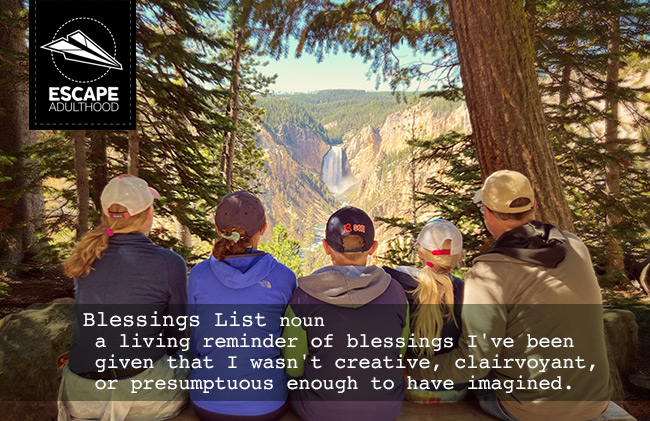
    “Murder” might be too strong a word to describe what I did to my Bucket List. But I definitely retired it, replacing it with a Blessings List. It still has the classic “bucket list” verbiage, except it’s written in the past tense. “Visit Yellowstone National Park with my family” is instead “Visited Yellowstone National Park with my family.” “See Paul McCartney in concert” is now “Saw Paul McCartney in concert.”

    It’s populated by many of the things Kim and I have recorded in our annual review over the past two-plus decades; an awesome collection of milestones, trips, experiences, and once-in-a-lifetime moments.

    Some of which were actually planned ahead of time.

    It’s already ten times bigger than my Bucket List, and I look forward to adding to it every year until I kick that proverbial pail. I love that it’s a living reminder of blessings I’ve been given that I wasn’t creative, clairvoyant, or presumptuous enough to have imagined.

    Please know this: If you have a Bucket List, I wish you well and don’t want to discourage you in the least. It is a wonderful tool that can help you strive for greatness and make the most of this precious gift of life. Mine definitely served me well.

    Maybe just keep this reminder handy: 

    To have blessings and to prize them is to be in Heaven.

  • How to Fix the Whole World

    The current state of the world is…not great.  

    So many of our problems are global, governmental, and systemic, stemming from conflicts spanning thousands of years. Perhaps, like me, you wonder, “What the heck can one person do?”

    When I am overwhelmed by an avalanche of things I can’t control, I find it helpful to focus on what I can. And then I came across this quote from St. Teresa of Calcutta:

    “If you want to bring happiness to the whole world, go home and love your family.”

    Ah, good ol’ Mother Teresa. What a pleasant thought from a sweet old lady beloved the world over. It’s a nice sentiment for a greeting card, but a naive prescription for solving what ails our world.

    Well, that’s how it seems, if you didn’t know what a tenacious, uncompromising spark plug she really was.

    Of course we love our family, we think. Check. Done. Got it. After patting ourselves on the back for acing a homework assignment from perhaps the greatest saint of the twentieth century, we think, ok, what else?

    Buckle up, buttercup. 

    We all say we love our family, but do our actions match our words?

    • Are you spending real time with your family, or are you spending money to make up for all the times you’re not there?
    • Is it quantity time, or just scraps of time here and there you call “quality” time?
      When you are together, how much time do you do what THEY want to do, on their terms?
    • How much time do you spend criticizing your spouse or trying to “change” them?
      Do you ever take on some of their household responsibilities to give them a break?
    • Do you take out the garbage before your wife has to remind you four times?
    • Do you ever give your husband back rubs, or are you too busy pointing out that he forgot to take out the garbage again?
    • How protective are you of family dinner time? How many times a week do you eat dinner together?
    • If you have children, do you allow them to struggle with hard things, or are you quick to swoop in to help them out of every jam?
    • Do they have chores they don’t get paid for?
    • How often do you put healthy limits on your kids, and how good are you at holding to them?
    • Are you paying attention to who your kids hang out with and what they’re watching?
    • How often are you labeled the “mean” parent?
    • How often do you sacrifice what you want for the good of your family?

    Oof. Suddenly, that sweet old lady’s Hallmark card just got real. I don’t know about you, but if I really want to follow Mother Teresa’s advice, I’ve got some work to do.

    Please know I’m not being accusatory here, only trying to provide a full picture of what true love looks like. Loving your family well is hard. It goes far beyond providing room and board, buying gifts, and shuttling them to and from myriad obligations.

    Heck, I expect that if you are a regular reader here, you probably can check off many of these things with confidence. That’s great! If so, let this serve as a reminder that you’re doing good.

    Because the world—and Adultitis—will bombard you with reasons you’re not.

    It will try to get you to place your attention on your career. Your income. The size of your home. All while convincing you to embrace the mantle of “providing a better life for your family.” It’s not bad to want a better life for your family, as long as it doesn’t come at the expense of loving them well. We do a lot of things “for our family” that, if we’re honest, are really more about making us look good.

    I got an email from a woman who had a great job at a bank. Then she gave birth to a daughter with health challenges. She made it work for a while, but eventually quit the bank and started an in-home daycare to be with her kids. It came with a pay cut and a plummet in status. Even though she took countless classes and became certified as an early childhood educator, she was often referred to as a “babysitter” by friends and peers. She admitted that she went down the negative road of “what ifs” from time to time. Now that she’s retired, she is grateful for the decision she made and the impact she was able to have in the lives of so many, including her daughter.

    Loving your family well isn’t easy. It’s hard and uncomfortable, often bringing feelings of doubt, uncertainty, and fear.

    It’s true that you may not be able to make a dent in the policy of global governments.

    But it’s also true that no one on Earth can fulfill your mission to love your family.

    I suppose it takes a fool to believe that loving your family really can bring happiness to the whole world.

    But it would be more foolish not to try.


    🤔 I wonder…what hard thing would you add to the list of ways to love your family well?

  • When to Be a Houseplant

    Sometimes you just need to be a houseplant.

    This statement was shared by Shannon, a friend who had finally emerged from a hard season filled with challenging health issues. They often left her feeling depleted, without the energy to do much of anything.

    And so she gave herself permission to be a houseplant.

    I laughed at the metaphor, calling to mind the times I’ve sunk deep into the couch and slipped into a vegetative state.

    But she went on to note that although houseplants are stationary and require help from others to stay alive, they aren’t doing nothing. They are very much alive, producing oxygen for us to breathe while providing joy, peace, and beauty to others.

    That’s certainly not nothing.

    It’s a good reminder for all of us, especially in a culture that fetishizes busyness, action, and so-called productivity. Sometimes productivity isn’t flashy.

    Or even visible.

    In agriculture, a field needs to lie fallow every seven years, or it will not maintain its fruitfulness. But that fallow period is not nothing. Even while resting, the field has activity and growth, giving the land time to bring forth new fertility. During that period where the field seems to be doing nothing, it is vitally productive.

    I have learned as a creative person that I have to let my life go fallow sometimes, too, especially after a period of intense activity. While my life is slowed down, my body can rest, my spirit can heal, and my mind can become a more fertile place for new ideas to take root.

    A good way to look at it is the way James Taylor looked at creating his first album after twelve years of touring. After explaining that he needed time and space to compose new music because he’d been so busy on the road, a reporter asked, “So you took time off to write?” James replied, “I didn’t take time off work; I did a different kind of work.”

    Whether our creative juices are depleted or we’re exhausted from a hard season of life, sometimes in life we need to do a different type of work.

    Sometimes the best course of action is to stop pushing and stay still. Rest. Breathe. Look for small ways to bring joy, peace, and comfort to others.

    Sometimes you just need to be a houseplant.


    🤔 I wonder…have you ever been forced (or given yourself permission) to “be a houseplant?” What did that look like?

  • All Masterpieces Begin with Chunky Crayons

    This won me first prize in a city-wide Halloween poster contest when I was in 5th grade. I’ve come a long way.

    Imagine a young child proudly showing you a drawing she made. Using a handful of stubby crayons, you can make out what appear to be some trees, although they look more like wobbly circles sitting on top of crooked brown rectangles. There are some figures in the scene, too, but it’s hard to tell exactly who they are supposed to be.

    Now imagine yourself rolling your eyes as you criticize the drawing, pointing out the clichéd subject matter, the sloppy scribbles, and the unrealistic use of color. You matter-of-factly declare that it’s just terrible—probably the worst drawing you’ve ever seen—and boast that you could easily draw something so much better.

    The little one says nothing, but a single tear rolls down her cheek as she turns away, dejected.

    Who knew you could be such a jerk?

    Oh, but you are.

    Every time you criticize something your past self made.

    I was watching an interview with Jerry Seinfeld, who was promoting the release of his book, Is This Anything? It’s an exhaustive collection of all of his comedy bits from his illustrious career, including his earliest stuff from the seventies. The interviewer asked him if he ever looks back on his old stuff and thinks about how he could make it so much better now.

    “Yes,” said Seinfeld. “But anybody can look at their early work and go, oh my gosh, this is not as good as I got later on. And I started doing that, but then I thought, that’s not really fair to your young self. Because that stuff—whatever it is—got you to the next step, which got to the next step, and the next step. So I thought I’m going to be nicer to this early stuff, instead of going, this is so basic, so infantile, so hacky.”

    I can relate to this. A few of my childhood drawings still exist, and of course, they are very rudimentary. (See the example above.) But I even turn up my nose at most of my high school and college work—which is much better than my fifth-grade drawings—immediately noticing every flaw and rolling my eyes at the obvious mistakes.

    I can be a real a-hole to my younger self, who was doing the best he could at the time, and whose effort helped lay the groundwork for where I am now.

    I say things to myself I’d never utter to another human being, let alone a small child.

    Perhaps you do the same with your earlier creations, whether they’re drawings or songs or photos or quilts or woodworking projects or lesson plans. Indeed, the same is true of the greatest thing you and I are in the process of creating: our very lives. We all have a few decisions we made when we were younger that we wish we had made differently. Choices that, in retrospect, seem like nothing more than a waste of time or money.

    It’s probably the reason we are so hesitant to start new things now, as adults: We are all too aware of the a-hole inner critic peering over our shoulders.

    But just like the child with a few chunky crayons, we did the best we could with the skills, experience, and information we had at the time.

    We need to be kinder to our younger self.

    Do not despise these small beginnings from your past.

    When you see your old stuff, instead of criticizing the flaws, revel in how far you’ve come, and applaud the effort and bravery it took to begin. 

💌 Get next month’s exclusive Mini*Print! Join the Collector Club
00 days
00 hr
00 min
00 sec