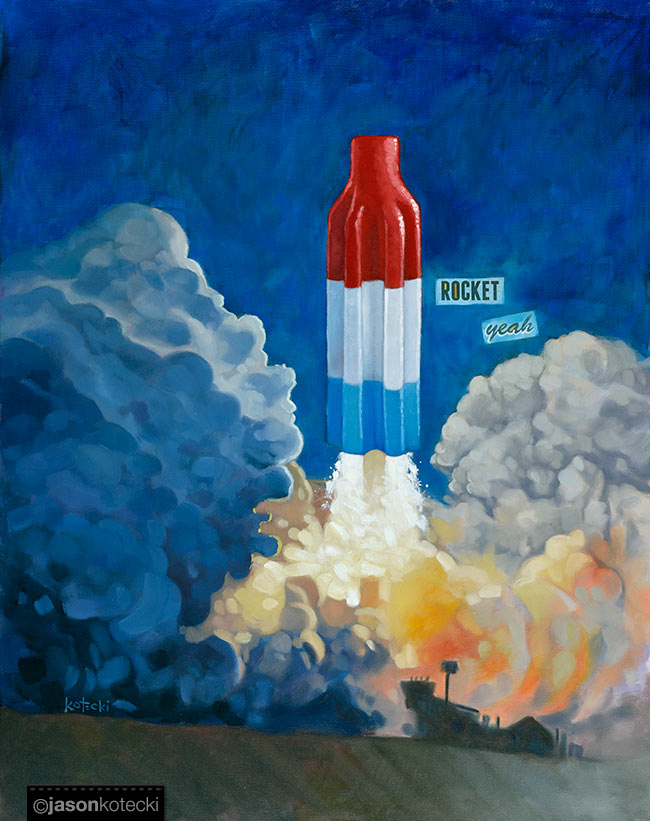
Keyword: dessert

  • Stonehenge

    “Stonehenge” by Jason Kotecki. 30 x 24. Oil on canvas.
    Original is SOLD 🔴 Shop this art!

    I remember the painting critiques back in art school. After spending several weeks working on our masterpieces, we’d all sit in a circle and explain what our paintings were about. Someone would inevitably say their piece was a postmodern reaction to the psychological impact of the industrial revolution that caused existential dread. To me, it looked like a canvas with some paint sloppily applied. It did seem like the students who were better at making “serious” art got better grades. (Or perhaps they were just better at explaining why their art was serious.)

    Perhaps this is why, after making this painting of Stonehenge, constructed with ice cream sandwiches, I feel obliged to explain why.

    There are many theories about what Stonehenge is, who built it, when it was built, and what purpose it served. Many theories, but nobody knows for sure.

    Of course, someone put them there. Someone had a reason for it.

    Most theories assume it served some sort of “serious” purpose concerning astrological events or burial rituals. But maybe it was simply a good challenge that helped pass the time because nobody had invented cable yet. Maybe it was a primitive tourist attraction. Maybe it was just for fun.

    People flock to Stonehenge not because they know what purpose it served, but because of the mystery. And mystery is fun. Plus, it looks cool. Which is also fun.

    Whimsy and fun are often seen as extra, nonessential. But fun is its own reason for being.

    Imagine having the opportunity to jump into a pool of noodles. No child would ever wait until they could answer the question, “But what purpose does this serve?”

    People with Adultitis need data and statistics before they justify why having fun is important. They can be found, but if you ask me, most of them are common sense.

    Employees who are having fun are happier and do better work.

    Customers who are having fun spend more money.

    Leaders who are having fun attract more followers.

    These are theories that explain why we should take having fun seriously. Why not have fun simply because… it’s fun?

    We are constantly in the pursuit of happiness. I don’t know about you, but I’ve never seen someone having fun who is unhappy. Do we really need data to prove that a life filled with fun is better than one that isn’t?

    Why did those ancient people build Stonehenge? I don’t know.

    Why did I paint Stonehenge made out of ice cream sandwiches? Because I thought it would be fun.

    Sometimes, that’s the only reason you need.
  • Enjoy the Climb

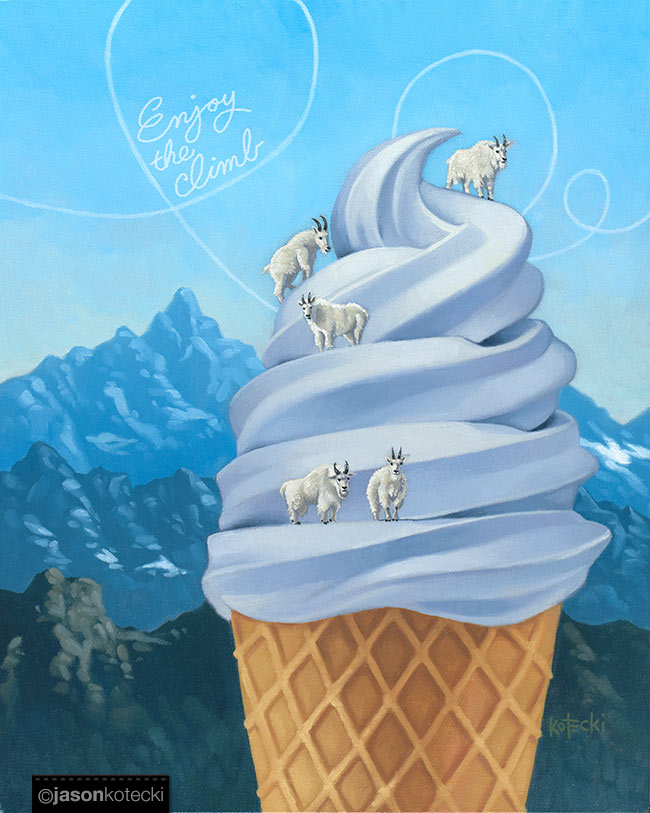
    “Enjoy the Climb” by Jason Kotecki. 16 x 20. Oil on canvas.
    Original is SOLD 🔴 Shop this art!

    If you were to place your nose really close to this canvas and focus only on one of the goats, what would you see? A mountain goat on a snowy mountain. The environment around them is boring, plain, cold, and possibly treacherous.

    I was reading some old journals the other day. I was struck by how concerned I was about details of projects and initiatives that are no longer relevant to our current business model. Problems that needed to be solved, or else! Pitfalls that seemed like backbreakers. At first, I felt disappointment that I had wasted so much time on things that, in the end, didn’t matter at all. But then I realized that’s how life works. You struggle through, doing the best you can with the information you have. Hopefully, you learn from your mistakes, grow, and move forward. I realized that in ten years, a review of the journal I wrote this morning will probably feel the same way; only the details will have changed.

    Back to the painting now. Look at the big picture.

    Holy cow, those goats are surrounded by ice cream! 

    Sometimes we miss the cool things happening in our lives, because we’re too focused on the struggles right in front of us.

    A few years ago, I was enjoying a wonderful dinner with some speaker friends. We started a table discussion about the best place you’ve ever been that you’d like to go back to. While others shared amazing stories of Tuscany, Brazil, and Ireland, I felt silly because all I could think of was the Quality Inn in Clearwater, Florida.

    I’m pretty sure the year was 2007. Kim and I didn’t have kids yet, and we were in the early stages of my speaking career. We’d recently been to a speakers’ convention where a guy named Randy Gage talked about these exotic bungalows in Tahiti. He noted that some are perched over the water, featuring cool glass-bottomed floors, and wondered why anyone would invest the considerable expense to vacation in Tahiti and then settle for the slightly cheaper but extremely less exotic wood-bottomed accommodations a few hundred feet inland.

    So as we checked into the Quality Inn, the host offered us the option of upgrading from our “Garden View” room (which savvy travelers know as code for “Ugly Roof and Air Conditioning Unit View”) to an “Ocean View” room.

    “How much extra would that cost?” we asked.

    “$20 a night,” was the reply.

    We huddled to talk it over. Twenty bucks was a big deal for us, which should not come as a surprise because, as I mentioned, we were checking into a QUALITY INN.

    With Randy’s rallying cry still ringing in our ears, we threw caution to the wind and said YES.

    Isn’t it funny how often it takes far less than a million dollars to feel like a millionaire? That’s definitely how we felt as we triumphantly surveyed our ocean view.

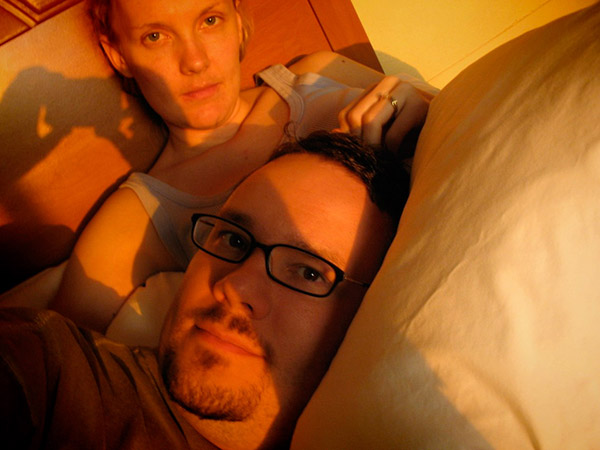
    Photographers often refer to the hour before sunset as “magic hour,” because the light from the sun casts a beautiful golden hue on everything it touches. I remember lying on our bed, watching the sun sink into the Gulf. And I still remember how beautiful Kim looked. I’m so glad we snapped this selfie before selfies were a thing.

    I also remember that back then, we spent a lot of our time dreaming of “making it” and looking forward to the days when we’d be checking into much fancier hotels, you know, like Quality Inns in Tuscany.

    I spent a lot of time striving, worrying, and wishing I were somewhere else. Somewhere better. But I look back now and realize what an exciting, fun time that really was.

    Sometimes we get so caught up chasing the next moment that we forget to savor the one we’re in.

    Wherever you are on the mountain right now, enjoy the climb.
  • Leap

    “Leap” by Jason Kotecki. 20×16. Oil on canvas.
    Original is SOLD 🔴 Shop this art!

    Why is it that so many of the people who have found success in America are first-generation immigrants? One big reason is that many of them came from a place that is not so great. They saw America as the Land of Opportunity, and they pursued it with a definitive focus and relentless persistence. They were willing to leap from the known to the unknown.

    A big reason people don’t chase their dream is that where they are now isn’t half bad.

    They give up the dream and settle for the dreamsicle.

    A dreamsicle is sweet and alluring and very tempting. It’s the option most people go for, with its safety, comfort, and surface-level perks. Because of that, you wonder if you’re crazy to even consider abandoning it.

    The dreamsicle is the lifestyle that ensures you need to keep your current job for as long as possible.

    It’s the boyfriend who checks all the boxes except for the one that matters most.

    It’s the job that impresses your parents but gives you Sunday Night Dread.

    But eventually, it leaves an unsatisfying feeling in your stomach. Like maybe you shouldn’t have settled for something so easy.

    When I first started my business, the prospect of dealing with taxes, paying for my own health insurance, and being solely responsible for the revenue (or lack thereof) felt daunting. Turning down a steady job with killer benefits and staying in a crappy apartment for eight years seemed ill-advised at the time. Now it’s clear that it was one of the best decisions I ever made.

    Any time you break away from the crowd and do something different is scary. The leap into the unknown requires us to be the leaders of our own destiny.

    But nothing is ever as rewarding or satisfying as chasing the dream in our hearts.

    The dreamsicle is not the same as the dream.

    Is it time for you to leap?

  • Half Full

    “Half Full” by Jason Kotecki. 12 x 12. Oil on canvas.
    Original is SOLD 🔴 Shop this art!

    I like to think of myself as an optimistic person. After all, I am a lifelong Cubs fan who always believed in the hope-filled power of next year. Then again, when they lose three games in a row these days, feeling certain that they’ll never win another game again seems pretty pessimistic.

    The truth is, I’m probably a little bit of both. 

    The optimistic side of me believed that Penguins Can’t Fly would be a New York Times bestseller. It wasn’t.

    This defeat, along with a number of other epic failures in my career, bolsters the popular argument that I should minimize the risk of pain and defeat by keeping my expectations low. 

    This strategy of operating with low expectations is employed by many. The thinking goes that if you don’t get your hopes up about something, then you won’t be as disappointed if it doesn’t work out. And if it turns out well, you’ll get the enjoyment of being pleasantly surprised.

    As it turns out, it’s a flawed strategy.

    According to neuroscientist Tali Sharot, people with high expectations always feel better because how we feel depends on how we interpret the event. 

    When a person with high expectations succeeds, they attribute it to their own traits. When they fail, it wasn’t because they were dumb; it was because the exam was unfair, and next time they’ll do better. When a person with low expectations fails, it was because they were dumb, and if they succeed, it’s because the exam happened to be really easy, and next time reality will catch up with them.

    Secondly, regardless of the outcome, anticipation makes us happy. It’s why people prefer Friday to Sunday: it brings the anticipation of the weekend ahead.

    Finally, optimism acts as a self-fulfilling prophecy. Believing we will be successful makes us more likely to be so, and optimism reduces stress and anxiety, leading to better health.

    When a container is at 50% capacity, it is half full.

    But technically, it’s also half empty.

    Both are absolutely correct assessments of the container in question.

    If the label you give it is completely subjective, go with the one that gives you the best chance of going somewhere beyond what you thought was possible.

    So many of our life experiences could be seen in the same light. We lose a job. We break a leg. We get dumped by the one we thought was The One. Is that unexpected, unwelcome thing that just happened in your life an obstacle or an opportunity?

    Yes.

    Both are absolutely correct assessments of the event in question.

    Deciding what you call it can make all the difference.

    Was Penguins Can’t Fly a failure?

    Upon further review, believing that it had a chance of becoming a bestseller led me to put in a lot of effort. It pushed me to think of new and creative ways to promote it, and it got me out of my comfort zone by asking for help. All of these things made a difference. No, it wasn’t a NYT bestseller, but three printings later, and after having outsold my advance (something most published authors never do), it was a success.

    It turns out that optimism is attributed to that success. Without it, I would have always wondered what might have been.

    I don’t know if I’m naturally optimistic or not. These days, even though I still feel fearful about getting my hopes up only to have them dashed, I’m realizing it’s more of a choice than a disposition. 

    We all get to make that choice every single day. To me, there’s really no contest.

    I choose half full.
  • Rocket Yeah

    “Rocket Yeah” by Jason Kotecki. 24 x 30. Oil on canvas.
    Original is SOLD 🔴 Shop this art!

    We’ve been launching ourselves into space for decades now, and there’s still an element of risk every time we do it. Although very smart people do their best to minimize it, there is always the prospect of danger, disaster, and the possibility that it might not work. With all that humankind has gained from these amazing missions, I’m thankful we’ve had so many brave people willing to go for the ride.

    It’s good to remember that every worthwhile endeavor comes with an element of risk and requires at least some small measure of bravery. It comes with the territory and is a necessary consideration as we make our plans.

    However, I made this painting to also remind us not to focus too much on the danger. I know I can get sucked into spending too much time thinking about the risk, what I might lose, and what people will think of me if I fail (especially if in some spectacular fashion).

    Determining that an endeavor carries some risk shouldn’t automatically keep us from moving forward.

    The whimsy incorporated into this piece in the form of a bomb pop blasting off into space is a reminder to focus at least as much on the excitement of what’s possible and the potential gains to be made in the process of trying. This recalibration can give us the fuel we need to launch off into an adventure in which the outcome is unknown.

    Do you have an opportunity in front of you that’s freaking you out a little bit?

    Instead of worrying so much about what might happen if it doesn’t work, get excited by asking yourself the question, “What if it does?!”

    * * *

    [ Below is a video with a behind-the-scenes look at the making of this painting – enjoy! ]

  • Pie in the Sky

    “Pie in the Sky” by Jason Kotecki. 20 x 20. Oil on canvas.
    Original is SOLD 🔴 Shop this art!

    In December of 2016, I wrote the biggest check of my life. Not in size, but in importance. It was the final check to close out a business debt that totaled $100,000 back in 2008. We paid it off seven months early, and for the first time since we launched in 2000, the business was completely debt-free.

    That felt really, really good.

    Deep down, I always knew we’d pay it off, but it seemed like it would take forever. In 2008, the year 2017 seemed a million years away. And before that, as we racked up said debt staying afloat while we tested business models, and funded small successes (and a few big defeats), surviving — let alone thriving — seemed pie in the sky.

    At least it did when we spent two whole days at a craft show in Milwaukee and only sold $7.94 in greeting cards.

    Or when my hometown newspaper, which ran my comic strip free for a whole year, decided to drop it when I asked for $10 a week.

    Or when we were down to the last $100 in our bank account more times than I care to remember.

    Pie in the sky.

    Coined in a song written in 1911 by a Swedish-born American named Joe Hill, we understand “pie in the sky” as something good and pleasant to contemplate, but very unlikely to be realized.

    I don’t know what the odds were of us actually building a real business with no experience, no proven business model, and no money. Were they as long as the Cubs rallying from a 3-1 series deficit to win the World Series? Or as unlikely as the Patriots coming back from 25 down with a little over a quarter to play to win the Super Bowl?

    The real question is this: How great does the deck have to be stacked against you before you give up, labeling your dream as pie in the sky?

    Only you can answer that, and every person has a different one. But we are often too quick to chalk something up as pie in the sky when it really isn’t. It can keep us from even starting. It lets us off the hook, thinking our dream was impossible anyway, because sacrifice and hard work and hope — yes, even hope — hurts sometimes.

    I don’t write this to place myself on a pedestal. If I have done anything well, it has been to persist. But my persistence was fueled by a belief that God placed this dream deep in my heart, and that he would see it through. Every day I woke up thinking, this could be the day — the day that we got our big break and everything would turn around. Some of the things that seemed to be big breaks turned out to be pathetic spurts and epic fails. Mostly, we got a lot of small breaks that added up to something pretty great. It certainly tested every bit of my patience and nerve and good sense, and made me question my sanity on more than thirty-seven occasions, but here we are.

    Not everything is worth seeing through till the end. As we grow, our dreams and desires, and priorities can change. But don’t be tricked into stopping just because the odds seem long. Everything is impossible until it isn’t.

    Yes, the odds may be long. Your stamina may be depleted. Your hope may be dim.

    But if the cause is great enough and your soul is on board and your motive is pure, keep going.

    You may just be able to grab that pie and eat it, too.
  • Different is Cool

    “Different Is Cool” by Jason Kotecki. Digital.
    Shop this art!

    Is it possible to be correct when all the experts think you’re nuts?

    Iggy was a doctor who lived in the 1800s and was greatly concerned about the high rate of women dying after childbirth. He knew there had to be a reason for the problem, so he experimented with different solutions. Finally, he figured out a simple practice that was easy to do, and when it was followed, it saved lives.

    His colleagues rejected and ridiculed his idea, branded him a quack, and he was eventually committed to a mental institution, where he died two weeks later. The thing is, his idea worked; he just couldn’t explain why. His solution was too out there, too unorthodox, too different from what the experts were used to.

    What’s so threatening about different?

    Can you imagine turning on your car radio only to hear the same song on every single station?

    What about going to a restaurant that only had one thing on the menu?

    Or firing up Netflix and finding just one show to watch?

    I think we can all agree that a world without options would be very boring indeed. 

    Different is cool.

    Except when it comes to things that challenge our beliefs or question our long-held assumptions.

    The human brain is engineered to be a pattern recognition machine. We are built to notice differences and changes in our environment. It helps us determine a storm is coming that requires us to seek shelter, notice an accident up ahead that suggests we should slow down, or that there is a lion in our camp we might want to avoid. We notice breaks in the pattern and make a prejudgment to feel safe or prepared.

    Lately, we have been struggling with this often helpful but sometimes not-so-helpful feature of noticing differences and making snap judgments. We are taught in after-school specials that prejudice is bad, and if we catch ourselves doing it, we experience feelings of guilt or shame.

    My friend Jessica, a speaker, comedian, and diversity trainer, reminded me that we shouldn’t feel guilty about these judgments and assumptions; after all, they happen automatically and can be useful. What really matters is what we do with them.

    Jessica’s suggestion was this: “When you write that first story, print it as a draft, triple-spaced with extra-wide margins. You do this because you’re anticipating edits.”

    So back to Iggy, formally known as Ignaz Semmelweis. What was his crazeballs idea? Only that doctors should wash their hands before working with patients.

    After his tragic demise, a small group of curious scientists experimented with the procedures he proposed. Eventually, his theories finally gained widespread acceptance years after his death, partly thanks to Louis Pasteur’s scientific confirmation of germ theory.

    He also inspired what is now known as the Semmelweis reflex: a metaphor for a certain type of human behavior characterized by the reflex-like rejection of new knowledge because it contradicts entrenched norms, beliefs, or paradigms.

    Was it a terrible thing for the first reaction from the experts of the day to dismiss Iggy’s idea? No, not necessarily. After all, it went against the pattern of everything they knew to be true at the time. The scientists who originally branded Iggy a crackpot weren’t jerks for thinking that his ideas were weird. They were jerks because they didn’t leave enough room for edits to their original story about him. They should have been open to examining more facts, even if it might lead them away from what they believed to be true. But they weren’t, which is a shame when you think about how many lives could have been saved.

    It’s always a useful exercise to spend time exploring a point of view that is the opposite of what we’re used to. It could be watching a documentary, reading a book, or having a real conversation – not a Facebook fight – with a human being.

    Our brains are pretty great at noticing differences and making assumptions.
    A more constructive alternative to wishing they weren’t so effective at that task might be to figure out whether our assumptions and prejudices are actually serving us, and act accordingly.

    Anticipate edits.