“Horse & Hummingbird” by Jason Kotecki. 30 x 30. Oil on canvas. Original is SOLD 🔴 Shop this art!
I compare myself to other people all the time. Friends, colleagues, neighbors, and the people I went to high school with.
According to the Bible, God made hummingbirds on the 5th day. He made horses on the 6th. It seems obvious that He made a horse because He wanted something different than a hummingbird. I don’t expect he chastises horses for not being able to fly or expects hummingbirds to hang their tiny heads in shame for all the times they don’t win the Kentucky Derby.
Quite frankly it’s kind of ridiculous to compare the two. So why do we do it with one another? It’s no less ridiculous.
But it’s a great way to waste time we could be spending to improve our lives and make the world better by embracing and sharing our own unique gifts.
Later on in the Bible, we learn that “God has given us different gifts for doing certain things well.” (Rom 12:6) You are not like anyone else. You are supposed to do what you’re made for. And no one else has the same mission as you do.
We don’t need you to be a horse. We don’t need you to be a hummingbird. We don’t need you to be a better version of that girl you went to high school with.
“Teenage Mutant Ninja Sea Turtle” by Jason Kotecki. 40 x 40. Oil on canvas. Original is SOLD 🔴 Shop this art!
If the movies taught me anything, it’s that superheroes wear spandex.
We’ve been led to believe that superheroes are special. They come from another planet. They are blessed with superhuman abilities. They are super smart, or rich, or got involved in some sort of dangerous science experiment that turned out ok. They typically wear cool outfits while traveling in cool vehicles and wielding cool accessories.
Also, their muscles have muscles.
This painting is an homage to the Teenage Mutant Ninja Turtles, who, when they first emerged from the sewer in 1984, clearly challenged the notion of what heroes are supposed to look like.
The truth is, real heroes hardly ever look like they do in the movies.
Oftentimes, they look a lot like you.
The turtle in this painting has emerged from its comfortable ocean surroundings and is wearing a mask that symbolizes two important concepts.
The first is that it’s not all about us.
Superheroes often hide their identity, giving them a sense of anonymity. Real heroes don’t do it for the glory, and they don’t demand credit. They serve a cause greater than themselves, and their chief motivation is doing the right thing and helping others. The mask can serve as a physical reminder that it’s not about us.
Secondly, the mask gives us permission to act “as if.”
Part of the reason children and adults alike enjoy wearing Halloween costumes is that it gives us permission to be someone different. The mask can be an opportunity to wander outside our comfort zone and try on a new way of acting, to be someone better than perhaps we believe we are. I like the advice from Joe Rogan, who suggested that if you’re unsure about what action to take in a particular situation, ask what the hero in the movie would do. In the beginning, it might feel a lot like acting, but that way of acting might just stick, and before you know it, you’ll end up doing something that once seemed superheroic.
Ultimately, being a hero is not about how you look, what you wear, or where you come from.
This painting challenges the notion of what superheroes look like and reminds us that in order to become one, we might need to leave our comfort zone in order to take action.
It might be serving a cause greater than ourselves, standing up for what’s right, regardless of how unpopular it makes us.
It might be standing up to the bully at work (or the one in our head).
It’s often as simple as staying under the radar and just helping someone who needs help, whether it’s a child, an elderly neighbor, or a random guy struggling to load something into his car.
We are all called to be heroes.
This calling may require sacrifice, a bit of discomfort, and a new way of acting, but it doesn’t require spandex.
“Leap” by Jason Kotecki. 20×16. Oil on canvas. Original is SOLD 🔴 Shop this art!
Why is it that so many of the people who have found success in America are first-generation immigrants? One big reason is that many of them came from a place that is not so great. They saw America as the Land of Opportunity, and they pursued it with a definitive focus and relentless persistence. They were willing to leap from the known to the unknown.
A big reason people don’t chase their dream is that where they are now isn’t half bad.
They give up the dream and settle for the dreamsicle.
A dreamsicle is sweet and alluring and very tempting. It’s the option most people go for, with its safety, comfort, and surface-level perks. Because of that, you wonder if you’re crazy to even consider abandoning it.
The dreamsicle is the lifestyle that ensures you need to keep your current job for as long as possible.
It’s the boyfriend who checks all the boxes except for the one that matters most.
It’s the job that impresses your parents but gives you Sunday Night Dread.
But eventually, it leaves an unsatisfying feeling in your stomach. Like maybe you shouldn’t have settled for something so easy.
When I first started my business, the prospect of dealing with taxes, paying for my own health insurance, and being solely responsible for the revenue (or lack thereof) felt daunting. Turning down a steady job with killer benefits and staying in a crappy apartment for eight years seemed ill-advised at the time. Now it’s clear that it was one of the best decisions I ever made.
Any time you break away from the crowd and do something different is scary. The leap into the unknown requires us to be the leaders of our own destiny.
But nothing is ever as rewarding or satisfying as chasing the dream in our hearts.
“ Imagination Can Take You Anywhere” by Jason Kotecki. 30 x 24. Oil on canvas. Original is SOLD 🔴 Shop this art!
In my family growing up, I was always the art guy. Today, I make a living painting pictures, telling stories, and writing books.
My younger brother Dan was the science guy. He now works for a cancer hospital analyzing and improving “systems,” or something structured and boring like that.
I always saw us as complete opposites, which is how I think most people see art and science.
Yes, my brother and I are different, but I was also decent at math and enjoyed doing experiments in chemistry class. Meanwhile, he had a pretty good drawing talent that went under the radar. Today, he collects Pearl Jam posters because he appreciates the art.
I was so locked in to looking at the difference between us that I never noticed the connections.
Artists are thought of as free-spirited, open-ended, and subjective. Scientists are often viewed as analytical, precise, and objective.
But Science is not cold, rigid, and unfeeling. Art is not some frivolous, fluffy extra. Believe it or not, they are connected.
Curiosity and Imagination are the parents of both art and science.
The same curiosity and imagination that is present when an artist creates a new play, sculpture, or piece of music is present in the best scientists as well. We imagine space travel, and curiosity asks, “How can we make that happen?” We imagine a world without cancer, and curiosity asks, “What hasn’t been tried on this particular strain?” Curiosity asks, “How can we become more energy independent?” and our imagination gets to work on thinking up a whole bunch of possible solutions, ranging from the far-fetched to the less so. Sometimes solutions are hidden within an idea that seems completely preposterous.
This painting was inspired by my first trip to Vancouver, and by a quote often attributed to Albert Einstein: “Logic will get you from A to B. Imagination will take you everywhere.”
Imagination is often seen as a peculiar skill set of children and the pastime of daydreamers. Mildly amusing, but hardly practical for a self-respecting adult. Too often, our imaginations fade as we grow older. We stop asking questions and dreaming big. We reward the rule-followers. We search for and obediently follow the best practices.
But in a changing world, what worked before will not get us to where we need to go. There is no roadmap. No formula. No step-by-step manual to help us succeed tomorrow.
The well-worn paths we’re used to treading now only lead us astray, to a world that no longer exists.
So what now?
We must stop looking at science and art as opposing forces.
We need to realize that we are all artists. Working in paint, charcoal, or clay is not required.
And likewise, we are all scientists. Even if we don’t wear lab coats.
If you are stuck, or have a sneaking suspicion that things could be better in your life, your relationships, or your organization…you are right.
The way forward is to imagine a better reality, the future we wish to create. And then we tinker our way there, by trying things that might not work and using what we learn to guide our next steps — even small steps — forward.
Imagination. It’s not just a plaything for children.
Dust yours off. It can take you to some pretty amazing places.
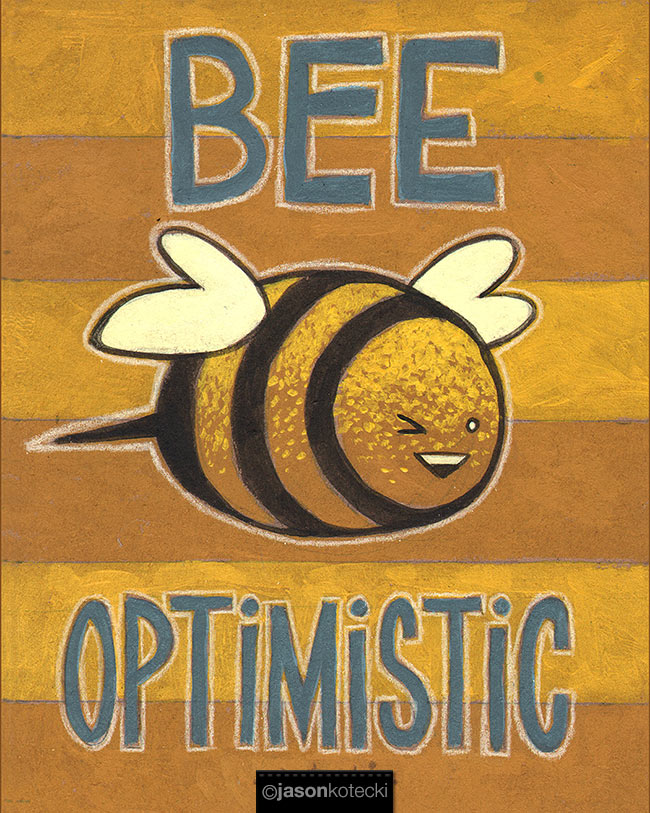
“Bee Optimistic” by Jason Kotecki. 8 x 10. Acrylic on paper. Original is SOLD 🔴 Shop this art!
The phone call came minutes after I walked off stage after a speaking program. It was my wife Kim, alerting me that my dad wanted to arrange an urgent family meeting for the next day. As he has a bit of a history of overhyping things, I couldn’t help but wonder about the true importance of this meeting, especially since the following day was the only day I’d be home in the span of a week.
A call back to Dad confirmed that the situation was serious, and he was adamant that he didn’t want to tell us the news by phone.
* Gulp *
And so began a 24-hour waiting period in which the only thing to do was entertain worst-case scenarios and pray that somehow, things would work out. I spent the rest of the evening trying to get my mind off it, suddenly empathizing with everyone who has ever had to wait for a diagnosis. No matter how dire the news, there is a certain peace in at least knowing what you’re dealing with. But the waiting (and the not knowing) is torture.
The next day, my brothers and our wives convened at the home of my youngest sibling. While waiting for my parents to arrive, we ate some pumpkin desserts my sister-in-law had whipped up, as if the sweetness would somehow counteract the sour news we all anticipated.
A million years later, my parent’s car pulled into the driveway. My mom looked like she was wearing a white sweatshirt with the hood pulled over her head. This did not look good, and seemed to confirm our suspicions that this terrible news was centered around her.
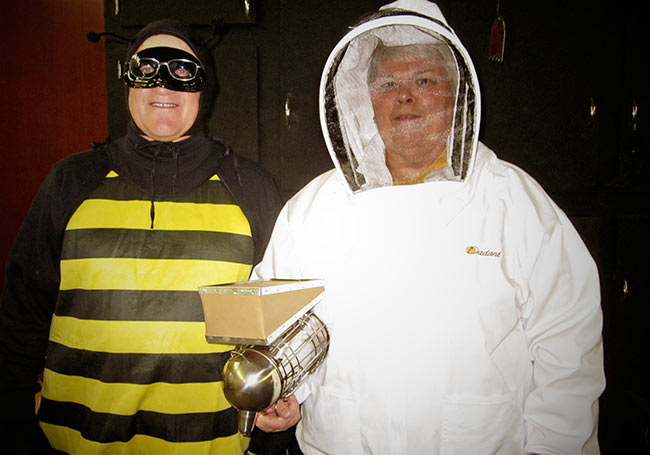
As they got out of the car, we could see that Mom was in fact wearing a beekeeping costume, and my dad was dressed as a bee!
What the?!
We were all confused as could be, but still secretly wished that this ridiculousness was a sign that the news was not as bad as we feared. Maybe this was just “Dad being Dad.”
Hugs we exchanged and it seemed like my parents were in good spirits. I wanted to exhale, assured that my worst fears were just the by-product of an overactive imagination. I glanced at the uncertain smiles on the faces of my family members and hoped that we’d soon be pleasantly surprised with positive news that we never saw coming.
Then my dad set up a makeshift cardboard podium in the living room and pulled out a homemade sign made on loose-leaf paper that he taped to the front. It read “Stuff Happens.” Below that was a smiley face next to a frowny face. The frowny face had an “x” through it. Hope quickly evaporated from the room. It felt hard to breathe. We braced for the worst.
All eyes were fixed on my Dad, who started things off by reminding us of how many tough challenges we’d gotten through as a family over the years. On and on he went, testing the patience of his children and his wife, who was sitting in a chair on the opposite side of the room.
Finally, this man, my father, the one dressed up like a bee, bravely told us that he had cancer.
At first, my heart plummeted into my stomach. But as he explained the kind of cancer he had (prostate), shared that they had caught it so early, and told us how high the survival rate was, hope slowly returned. He said that he and Mom had resolved to be positive and optimistic, which is why they decided to lighten the mood by coming dressed in the Halloween costumes they had worn at a party the night before.
He said, “We hoped it would take a little of the sting out of the news we had to share.”
I am not even kidding.
We eventually learned that my parents had worn the costumes for the entire two-hour drive up to Wisconsin, a trip that included a stop to pump gas, as well as a run through the Burger King drive-thru.
As the mood lightened and we followed my parents’ optimistic lead, all I could think about was, I bet no one in the history of ever has told his family that he had cancer while wearing a bee costume.
But that’s exactly what my dad did.
He also served as a shining example of how even though we can’t control what life throws at us, we can control whether or not we’ll go down looking or swing for the fences.
My dad came though the other side, prostate-free but filled with perspective and gratitude. Since then, my Mom has overcome her own battle with uterine cancer. And both tell me they feel like they won the lottery. In their regular visits to the Cancer Treatment Center of America, they encountered people who were in a much tougher fight, many of whom weren’t likely to make it through. Meanwhile, Kim and I have met a lot of beautiful families through our work with the Make-A-Wish Foundation, all of whom have been dealt hands I wouldn’t wish on my worst enemy. It’s impossible not to want to help.
But how do you help fight cancer? It’s so big and scary and ugly, and we are so small.
One of the things my dad does is hand out Bee pins.
Shortly after the big meeting with the bee and his keeper, I made a painting for my dad featuring his favorite insect and the message, “Bee Optimistic.” It was equal parts encouragement and tribute to his positivity. He asked if I could make him a “Bee Optimistic” pin that he could wear every day. I did, and he does.
He’s purchased hundreds of pins, handing them out to anyone he meets who has been touched by the shadow of cancer, like he’s a volunteer at a marathon handing out water to the the runners.
Because he is.
Fighting cancer is a hard race. Faith and hope is the water you need to keep going. When my Dad hands out the Bee pins, he is handing out hope. Although the action is small, the impact is huge.
We can’t control what happens to us in life, but we can control how we react to it. No matter who you are, people are watching, be it your kids, your employees, or your biggest fans.