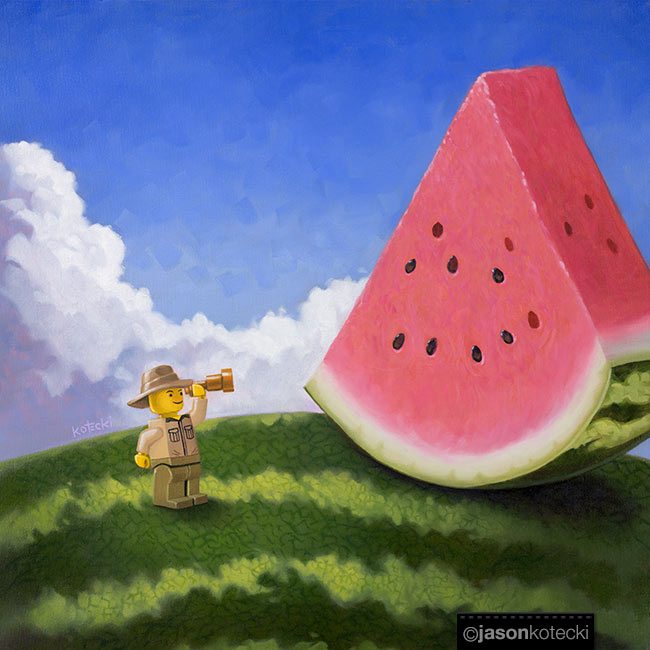
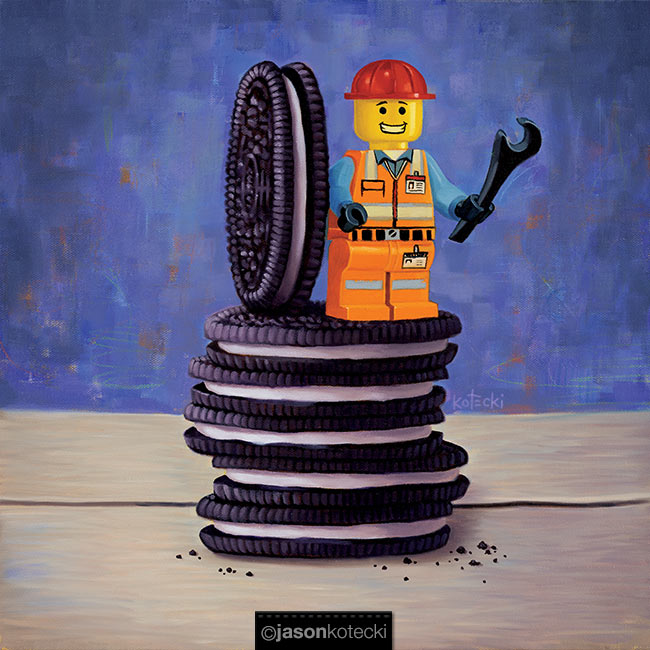
“Sunshine In My Soul” by Jason Kotecki. 12 x 12. Oil on canvas. Original is SOLD 🔴 Shop this art!
I do not know how people survive without faith in this dark world.
Perhaps it’s why our rates of depression, anxiety, and suicide are at all-time highs. My faith is like having sunshine in my soul. No matter how heavy the storm or dark the night, there is a joy that never dissipates, giving me hope.
I did not always have this faith. Like many, my perception of God came from the reflection of Him I saw in others. Often, it was a pretty distorted version.
But there were people I encountered who were in alignment with the merciful, mighty, and loving Father I have come to know and love.
This is the God whose light I pray shines forth from my work, so that others may see, believe, and experience this sunshine in their soul.
“How Many Watermelons?” by Jason Kotecki. 20 x 20. Oil on canvas. Original is available. 🔴 Shop this art!
What do motivational posters, charismatic preachers, and embroidered pillows have in common?
They regularly tell us to count our blessings.
If we’re in the midst of a good day, we’d probably admit it would take a long time to count all our blessings. Maybe even longer than it would take to count all the seeds in a watermelon. But theoretically, both could be done.
This painting was inspired by the saying “Anyone can count the number of seeds in a watermelon, but only God can count the number of watermelons in a seed.”
Today is the second anniversary of the day I needed a chainsaw-wielding neighbor to help me clear trees from my driveway so I could drive to the airport for a speaking engagement. The night before, a storm descended upon our home with a terrible straight-line wind that damaged our home and devastated our property. I had to leave my wife behind in a home with no power to push aside the grief to begin the clean-up and call insurance companies.
I can assure you, it did not feel like a blessing.
That storm turned our trees into kindling and destroyed our finances. It wrought great debt and fear, and uncertainty. It brought trauma to our family and nightmares to my kids.
But it was also a seed.
A seed that has since produced many blessings…
It connected us to some amazing people.
It taught us how to receive generosity from others with humility.
It provided us with the insurance money to buy a new roof which needed to be replaced.
It opened the door to a new space to play ball and badminton and frisbee together.
It inspired us to be even more hospitable, ushering in Moonrise Movie Nights and the Wonder & Whimsy Society Family Reunion.
It gave us a new view, one that many agree is even more breathtaking than the one we had before.
It strengthened our family and bolstered our faith, bringing us even closer to God.
I suspect that dark forces were pretty happy about the storm, hoping it would destroy us. But I believe God allowed it because even though it brought a great deal of pain, he also knew just how many blessings would spring forth.
I share this not to minimize the pain any of us has experienced, but to offer a reminder that in life, pain and joy can co-exist.
Today is also Father’s Day. My experiences have led me to believe that God is a good father. He wants to hold you in his arms and give you a big, all-encompassing hug, especially if you are struggling with some great trauma of your own. I want to let you know that he is bringing forth fruit from the ashes, perhaps some of which you may already be able to perceive.
I can assure you, the full bounty goes beyond what you can ever imagine.
I’ve just shared many blessings we’ve identified from the storm we experienced. But the thing is, we’re only two years removed from it. How many more blessings have yet to be revealed?
Only God knows how many games of catch I’ll have with my son.
Only God knows all the conversations that will be had around our new fire pit.
Only God knows how many pies will be baked from the fruit trees we just planted.
Only God knows how many photos Kim will take of the wonder that will bloom there.
Only God knows how many family dinners will be shared from our deck overlooking the lake.
Only God knows how many people will be blessed and healed in some way by their time there.
Only God knows what opportunities and relationships will arise from this new space.
The storm was a seed that produced a multitude of watermelons.
And those watermelons are filled with seeds that will usher forth even more.
Only God knows all the things that will be made possible because of a brief moment in time when a hurricane-force wind whooshed through our lives one summer day.
Only God knows the number of watermelons in a seed.
“Talent Stack” by Jason Kotecki. 16 x 16. Oil on canvas. Original is SOLD 🔴 Shop this art!
Sometimes people look at successes I’ve had and say, “Must be nice,” as if they happened by magic.
What they don’t often see is the framework that helped enable that success. Fortunately, it’s a framework anyone can develop.
We often assume that in order to be successful, we need to be great at one thing. That can work—see LeBron James, for example—but that path is extremely difficult and unlikely. The truth is, you only need to be pretty good at a handful of ordinary skills.
You just need to build a talent stack.
Scott Adams, the creator of the comic strip Dilbert, popularized this concept which states that you can ensure success by assembling a “stack” of two or more complementary skills and be in the top 25 percent or so in each. Do that and you’ll be unstoppable.
In his case, he readily admits he’s not the best artist, the most skilled writer, or the savviest business expert. But his unique combination of those skill sets has contributed to his success as a cartoonist.
My own talent stack began with a few crayons. “Artist” was my first and is my longest-lasting identity. I’ve always enjoyed it, and I got praised for it, so I’m sure that made me want to keep doing it.
In high school, I had a chance to take a creative writing class, which I enjoyed exponentially more than my math classes. I kept honing that skill, which eventually became an indispensable part of my talent stack.
In college, I gave a talk as a leader on a retreat and received great reviews. Even though I am naturally shy, I enjoyed the process of crafting stories in spoken form. It was like creative writing but delivered out loud.
To the surprise of me, my parents, and the high school speech teacher who gave me a “C,” public speaking emerged as the primary driver of our business. I went from giving cartooning workshops in schools to speaking at churches to keynoting conferences for associations and corporations all over the place.
Now it took me a few years to realize that these three talents—art, writing, and speaking—were not separate skills that operated independently, but part of a talent stack, that when used in harmony became even more powerful. I am not the best artist in the world, or the best writer or speaker. But I’m pretty good at all three, and that combination has been the secret sauce of my success. Once I was introduced to talent stacking, I eagerly looked for complementary skills to add. By devouring hundreds of marketing books and through the school of trial and error, I’ve achieved the equivalent of an MBA in marketing. Am I the best marketer in the world? No, but I easily fall into the top 25 percent.
Kim and I went on several organized retreats in college. That background gave us a foundation to build on when we started hosting our own events. After putting on numerous meetups, workshops, book tours, fundraising galas, and Escape Adulthood Summits over the past two decades, we’ve gotten pretty good at managing logistics and creating experiences that move people.
Most recently, we used the pandemic as an opportunity to get good at livestreaming, which added a whole new dimension to our business.
Drip by drip, these new skills made the other skills even more valuable and ushered in greater success.
Of course, your talent stack will look different from mine, but the premise is the same. Start with natural strengths and abilities and work to make them better. Think about how they can work together in unexpected ways, even if they seem unrelated.
Everyone in your industry probably competes on many of the same skills. What do you have that’s different? Oftentimes the magic lies in a skill or interest that seems to come out of left field. For instance, many professional speakers are also writers. But my artistic gifts and whimsical, childlike perspective allow me to offer something extraordinary.
This isn’t just about what you were born with. Look for other skills you can attain that complement and enrich the others. That might involve a traditional degree or certification, but it can also be done by reading books, listening to podcasts, taking courses online or at your local community college, or practicing, in public, every day, as we did with our pandemic project of livestreaming.
If you’re stuck, here are some evergreen choices that will help:
Presentation skills
Technology skills
Foreign language skills
Sales or marketing skills
Writing skills
Business management skills
Nunchuck skills
Remember, you don’t have to turn yourself into the foremost expert on any of these skills. Just be in the top 25 percent. Said another way, in a world of around eight billion people, you only need to be among the top two billion. If one hundred thousand people live in your city, you just have to be in the top twenty-five thousand.
In other words, pretty good is good enough.
Keep in mind that this is a lifelong project. If you’re doing it right—meaning you stay curious and keep growing—your talent stack will continue to evolve and strengthen throughout your career and life. One last word of warning, however…
When you have a decent stack of three to five skills going, you can bank on someone, somewhere observing what you’ve been able to accomplish and saying, “Must be nice.”
“Gummy Bear Doing Sit-Ups” by Jason Kotecki. 12 x 12. Oil on canvas. Original is SOLD 🔴 Shop this art!
When I was a teenager, my mom called me a dreamer.
She didn’t mean it as a compliment, but she wasn’t wrong.
I’ve always been idealistic, my head regularly inhabiting the clouds. I’d sing along with John Lennon’s Imagine and revel in the fact that we were soul mates. You’re NOT the only one, John. We’re in this together!
I took pride in that side of myself. But when my mom labeled me a dreamer, and I knew it wasn’t a compliment, it got my attention.
Of course, my idiot teenage response was, “What does she know?”
Eventually, I would relate to Mark Twain, who said, “When I was a boy of fourteen, my father was so ignorant I could hardly stand to have the old man around. But when I got to be twenty-one, I was astonished at how much he had learned in seven years.”
When I graduated from college, I had big dreams. I was going to marry the love of my life. I was going to become a successful artist. And I may or may not have imagined the small town I came from erecting a statue in my honor one day.
But in order for my dream to work, I needed my parents to let me live with them in the year between graduation and the wedding. That would give me the financial runway to knock on doors, get my name out there, and start making things happen.
I knew I needed a plan. I put together a multi-page document outlining my detailed strategy and financial projections. I don’t know if my parents let me stay with them for that year rent-free because of the brilliance of my plan, or because that’s what parents do, and there really wasn’t another option. And as most business plans go, big chunks of it fell apart when it got punched in the mouth by reality.
But it did give me focus, direction, and accountability to do the work that propelled me forward on my journey. It exposed me to an important truth I’ve seen at work again and again in the last twenty-five years:
The most successful people balance hopes and dreams with practicality and hard work.
If you spend all your time with your head in the clouds, you may come up with a world-changing idea or two. But if you don’t have the initiative and work ethic to put toward them, they’ll never materialize.
World-changing ideas are worthless without execution.
On the other hand, a relentless work ethic that lacks vision is wasteful. People in this camp default to letting someone else tell them what to do – which is unlikely to lead to happiness – or they toil without purpose, methodically plodding along in no particular direction.
When you keep your head down all the time, you’re blind to the road signs pointing to exciting possibilities.
A rocket ship requires practical thought, precise calculations, and productive persistence to achieve orbit. But it requires a dreamer to imagine they can reach the stars in the first place.
It’s a tricky balance, and my experience leads me to believe people are usually stronger in one area than the other. As I shared, I am a dreamer at heart. But getting where I am today required a lot of hustle, sacrifice, experimentation, and experience gained from failure.
Henry David Thoreau gave us the blueprint when he said, “If you have built castles in the air, your work need not be lost; that is where they should be. Now put foundations under them.”
My mother’s candid observation was meant to be helpful. And it was. It inspired me to buckle down. Maybe at first just to prove her wrong, but eventually simply because she was right.
What camp are you in?
If you are more of a dreamer, maybe you need to spend time putting your ideas into action with a little elbow grease. It’s more comfortable to live in Dreamland, where reality doesn’t rudely poke holes in your grand visions. Don’t be discouraged by the failures you encounter, for they are not arrows piercing the heart of your dream, but merely guideposts pointing you in the direction to go.
If you are more of a “nose to the grindstone” type of person, perhaps you need to give yourself permission to wonder aimlessly and dream of something better. Sure, it’s more comfortable to stay in work mode than get your hopes up for a future that may never happen. But that only leads to a future you never wanted. Don’t worry about figuring it all out before you begin. Plant your flag on a future summit and use your work ethic and practicality to plot your path there one step at a time.
Both ways are hard. But great things don’t come easy.
This gummy bear knows what’s up.
Dreaming of six-pack abs is a good start, but it amounts to nothing without any sit-ups.
But the sit-ups are a waste of time if we never ponder why we wanted the six-pack abs in the first place.
“Stonehenge” by Jason Kotecki. 30 x 24. Oil on canvas. Original is SOLD 🔴 Shop this art!
I remember the painting critiques back in art school. After spending several weeks working on our masterpieces, we’d all sit in a circle and explain what our paintings were about. Someone would inevitably say their piece was a postmodern reaction to the psychological impact of the industrial revolution that caused existential dread. To me, it looked like a canvas with some paint sloppily applied. It did seem like the students who were better at making “serious” art got better grades. (Or perhaps they were just better at explaining why their art was serious.)
Perhaps this is why, after making this painting of Stonehenge, constructed with ice cream sandwiches, I feel obliged to explain why.
There are many theories about what Stonehenge is, who built it, when it was built, and what purpose it served. Many theories, but nobody knows for sure.
Of course, someone put them there. Someone had a reason for it.
Most theories assume it served some sort of “serious” purpose concerning astrological events or burial rituals. But maybe it was simply a good challenge that helped pass the time because nobody had invented cable yet. Maybe it was a primitive tourist attraction. Maybe it was just for fun.
People flock to Stonehenge not because they know what purpose it served, but because of the mystery. And mystery is fun. Plus, it looks cool. Which is also fun.
Whimsy and fun are often seen as extra, nonessential. But fun is its own reason for being.
Imagine having the opportunity to jump into a pool of noodles. No child would ever wait until they could answer the question, “But what purpose does this serve?”
People with Adultitis need data and statistics before they justify why having fun is important. They can be found, but if you ask me, most of them are common sense.
Employees who are having fun are happier and do better work.
Customers who are having fun spend more money.
Leaders who are having fun attract more followers.
These are theories that explain why we should take having fun seriously. Why not have fun simply because… it’s fun?
We are constantly in the pursuit of happiness. I don’t know about you, but I’ve never seen someone having fun who is unhappy. Do we really need data to prove that a life filled with fun is better than one that isn’t?
Why did those ancient people build Stonehenge? I don’t know.
Why did I paint Stonehenge made out of ice cream sandwiches? Because I thought it would be fun.
“Home Fries” by Jason Kotecki. 12 x 12. Oil on canvas. Original is SOLD 🔴 Shop this art!
One good thing about the COVID-19 pandemic keeping us closer to home is that it brought back family dinner for many people. If this is one of the things that remains as part of what people refer to as a “new normal,” then I am all for it.
This painting, titled “Home Fries,” is a reminder that home is where the heart is. And the place our heart gets nourished most is around the dinner table.
In the last hundred years or so, we’ve seen technology bring about more advancements than the rest of human history combined. We’ve come a long way, baby.
For the most part, these advancements have served us well. We’re able to produce more food, travel longer distances in less time, eradicate once-deadly diseases, and improve the length and quality of our lives.
Unfortunately, we are so eager to reach for the new and improved that we often throw the wisdom of the ages right out the window. It’s dangerous to be too quick to discard the traditions of the past as old-fashioned and out of touch.
One such tradition that seems to be going the way of the dodo bird is the family dinner. Our busy, packed schedules have pushed this old-timey tradition to the brink of extinction. After all, with so many things going on these days, who has time to gather together all at once? With such full plates, family dinner is the first to go. The rise of fast food joints and microwave ovens makes it seem an easy sacrifice.
Unfortunately, the very thing we’re sacrificing is the health, intimacy, and future of our family.
As Miriam Weinstein wrote in her book, The Surprising Power of Family Meals, “We’ve perfected the segmentation of the family. Nobody has to eat the same food, watch the same show, listen to the same song, let alone sing it. We love to imagine the French with their lush tables, or the Italians with their big families, but we prefer to gobble our take-out, our home delivery, our single-serve microwave, on the run, in front of the TV, in the food court, or in the car, while we dream of quality time, of family vacations, of someplace far away.”
If you care about your family at all, you may want to reconsider the importance of family dinners in your life. The National Center on Addiction and Substance Abuse at Columbia University did a study that divided teenagers into two groups. The first group had dinner with their family five times a week or more. The second group had dinner together with their family two times a week or less. The results were astounding.
They discovered that the kids who ate dinner more often with their families were up to 45% less likely to smoke, drink, use drugs, be suspended from school, or have sex at a young age. They are twice as likely to receive A’s in school. Kids who frequently eat dinner with their families are more likely to confide in their parents and are at a lower risk for thoughts of suicide. Other studies from a wide variety of divergent fields have found equally surprising results. Regular family dinners discourage obesity and eating disorders and make kindergartners better equipped to read (even more so than getting read to!)
Isn’t it amazing to think how much depends on dinner?
Please note, we’re not talking gourmet dinners here. The study didn’t mention anything about preparing meals that would make Bobby Flay jealous. And the conversation? That doesn’t have to be all that engaging, either.
Heck, in my house growing up, a typical dinner conversation often included my Dad farting and blaming it on a duck under the table. Which resulted in giggles from me and my two brothers and an icy glare from my Mom (which usually was concealing a nearly undetectable smirk.)
Oh, and my Dad also had a penchant for asking the same, stupid, boring question every single night: “How was school today?”
Naturally, we’d respond with the same stupid answer: “Fine.”
But the thing is, if by some freak occurrence, something actually DID happen at school that I wanted to talk about, I knew my Dad (and Mom) would be there to ask the question. That shared time together, that calm amidst the storm that we call life, is so vitally important. In a world that often seems like it has gone crazy, the best thing you can do for the health and sanity of your family is to step off the hamster wheel once a day and share a simple meal together. The conversations that do occur help parents to learn more about their children’s lives and help them to better understand the day-to-day challenges their kids face.
Maybe a regular family dinnertime really is tough to swing. Well, who says you can’t make breakfast your regular meal time? If all parents knew how important eating dinner together as a family was to their children — something that used to be an unquestioned element of family life in this country — I think we’d see a lot more people doing it. If you struggle finding time to corral the troops for mealtime on a regular basis, I encourage you — no, I beg you — to try harder. Not only is it a pretty good way to escape the hustle and bustle of the outside world for a few moments each day, but the benefits it provides your children are priceless.
And if family dinners are already part of your routine, why not give it even more attention, intention, and fun?
Life is fast, and technology is making it even faster. Don’t get so sucked into the promise of the future that you abandon a time-tested ritual that our ancestors knew to be vital.
Bring the tradition of eating dinner together back into the fabric of your life.
The health and happiness of your family depend on it.
“Ring of Fire” by Jason Kotecki. 20 x 20. Oil on canvas. Original is SOLD 🔴 Shop this art!
Everyone thinks the excitement that accompanies the start of a relationship is the best.
Granted, it IS intoxicating. Everything is new and mysterious. You’re wondering if the other person just likes you or actually “likes you” likes you. A simple touch ignites an inferno of passion. There’s so much to talk about as you’re constantly learning new things about one another. That way he chews, and that way she steals your jacket when she’s cold, is still cute and endearing.
There’s no doubt about it: The beginning of a new relationship is pretty great.
But then again, in the beginning, you’re just two separate entities. Like bread and cheese. Cheese is good. Bread is good. Put them together and you have a cheese sandwich. Also good.
But Johnny Cash was right when he sang that love is a burning thing. It doesn’t get really good until you’ve gone through some fires together. That’s when you really get to know what you’re made of, as you melt together and you become one. That melty, gooey goodness is where the magic’s at. And have you ever tried to separate a grilled cheese sandwich? It’s not easy. Which is how it should be.
Combined, my parents and Kim’s parents have been married for over 90 years. They have struggled and endured many, many fires. But through it all, they’ve stuck together. In today’s day and age, that’s no small feat. Is there a secret? I don’t know. I’m sure there’s luck involved, but I know that it’s not all luck. I know communication is really important. And mutual respect. And a willingness to give more than you get.
But I think the real secret is that it comes down to a choice to stick together, no matter what. Infatuation is a feeling, but love? Love is a choice. When my parents exchanged vows on their wedding day, promising they’d be there for each other no matter what, in sickness and in health, through the good times and the fires…they meant it. For reals.
And when I married Kim, that’s how I looked at it too. Death will have to break us apart; it’s the only option. We have not left an escape hatch for ourselves. The ships back to a world where we go our separate ways are smoldering sticks of charcoal. When disagreements emerge, a fight erupts, and feelings are hurt, Plan A is to work it out.
There is no Plan B.
When you don’t burn the ships, there’s a very high probability that someday, you’ll use them to sail away from one another.
Of course, you can throw all of this out the window if both people aren’t on board. If one flakes out or doesn’t live up to the promise, it all falls apart. And that is nothing short of heartbreaking.
I write this to give hope to the newlyweds, to the people thinking about giving this love thing another go, and to those who are in the middle of one of those scary fires right now.
As James Blunt sang, “Everybody wants a flame, they don’t want to get burnt.”
It’s true: once you get past the lovey-dovey stage of a relationship, and experience the fires that flare up when things get real, you will come out a little charred.
But that char – the battle scars from a life lived together – add a richness, depth, and magic that a regular old cheese sandwich can only dream about.
“Leap” by Jason Kotecki. 20×16. Oil on canvas. Original is SOLD 🔴 Shop this art!
Why is it that so many of the people who have found success in America are first-generation immigrants? One big reason is that many of them came from a place that is not so great. They saw America as the Land of Opportunity, and they pursued it with a definitive focus and relentless persistence. They were willing to leap from the known to the unknown.
A big reason people don’t chase their dream is that where they are now isn’t half bad.
They give up the dream and settle for the dreamsicle.
A dreamsicle is sweet and alluring and very tempting. It’s the option most people go for, with its safety, comfort, and surface-level perks. Because of that, you wonder if you’re crazy to even consider abandoning it.
The dreamsicle is the lifestyle that ensures you need to keep your current job for as long as possible.
It’s the boyfriend who checks all the boxes except for the one that matters most.
It’s the job that impresses your parents but gives you Sunday Night Dread.
But eventually, it leaves an unsatisfying feeling in your stomach. Like maybe you shouldn’t have settled for something so easy.
When I first started my business, the prospect of dealing with taxes, paying for my own health insurance, and being solely responsible for the revenue (or lack thereof) felt daunting. Turning down a steady job with killer benefits and staying in a crappy apartment for eight years seemed ill-advised at the time. Now it’s clear that it was one of the best decisions I ever made.
Any time you break away from the crowd and do something different is scary. The leap into the unknown requires us to be the leaders of our own destiny.
But nothing is ever as rewarding or satisfying as chasing the dream in our hearts.
“This Ain’t Kansas” by Jason Kotecki. 20 x 20. Oil on canvas. Original is SOLD 🔴 Shop this art!
As dissimilar as they may appear on the surface, rural Midwestern farmers and rural Asian farmers have some things in common. One is a deep respect for tradition. This is an important value that can provide a sense of stability and help pass on hard-earned wisdom to future generations.
But I believe we must also have an openness to new things. Not so that we will abandon our ideals, but so that we can experience a much richer life.
It’s like the difference between experiencing life in black and white versus full color, like in the 1939 version of The Wizard of Oz.
Indeed, doing things the way you’ve always done them, and surrounding yourself with the same people, places, and opinions, is a pretty good way to live life in grayscale.
I made this piece as a reminder that sometimes we need to break free from what’s expected. Mashups of east and west, urban and rural, liberal and conservative, old and new, are what make life more interesting.
How does one opt for a more technicolor life? Simple: Take a break from your traditions.
Read a magazine or watch a documentary on something you know nothing about. Order food you’ve never tasted before. Take a new form of transportation to work for a week. Have a conversation with someone who holds an opposite point of view (without trying to convince them they’re wrong).
This openness to new ideas, perspectives, and ways of doing things is a key to unlocking opportunities that can change your life.
I have struggled the past few years trying to find my place. I have been a member of the National Speakers Association for over a decade now, and it has served me well. I have made wonderful friends and have learned a lot about growing a successful speaking business.
But in recent years, I’ve had a hard time finding relevant examples to model my business after. You see, I have this art thing that I do, which is very unique among the speakers I’ve encountered. Even the ones that incorporate art somehow into their offerings do so in a way that’s totally different than the direction I want to head.
And so I have spent the better part of the last two years seeking out art-centered business models. I have tried to learn as much as I can from other successful artists. And I’ve learned a lot, but it turns out, most of them aren’t so keen on the whole “speaking in front of large crowds” thing.
I was frustrated by my failure to find someone who has already done what I am trying to do. Someone who has a roadmap I can follow.
Until I finally figured out there is magic in the mashup.
It’s the combination of two seemingly unrelated things –public speaking and making art –that gives me my edge and helps make me stand out. Borrowing the best of what I’ve learned from great speakers as well as successful artists, while mixing in my own unique quirks and talents, has been a game-changer for me.
If you’ve been feeling paralyzed by the belief that things have to go a certain way, or if you’ve felt like a square peg trying to force yourself into a round hole, or if life just feels a little too gray…it might be time to mix in some new ideas, experiences, and assumptions.
“Pie in the Sky” by Jason Kotecki. 20 x 20. Oil on canvas. Original is SOLD 🔴 Shop this art!
In December of 2016, I wrote the biggest check of my life. Not in size, but in importance. It was the final check to close out a business debt that totaled $100,000 back in 2008. We paid it off seven months early, and for the first time since we launched in 2000, the business was completely debt-free.
That felt really, really good.
Deep down, I always knew we’d pay it off, but it seemed like it would take forever. In 2008, the year 2017 seemed a million years away. And before that, as we racked up said debt staying afloat while we tested business models, and funded small successes (and a few big defeats), surviving — let alone thriving — seemed pie in the sky.
At least it did when we spent two whole days at a craft show in Milwaukee and only sold $7.94 in greeting cards.
Or when my hometown newspaper, which ran my comic strip free for a whole year, decided to drop it when I asked for $10 a week.
Or when we were down to the last $100 in our bank account more times than I care to remember.
Pie in the sky.
Coined in a song written in 1911 by a Swedish-born American named Joe Hill, we understand “pie in the sky” as something good and pleasant to contemplate, but very unlikely to be realized.
I don’t know what the odds were of us actually building a real business with no experience, no proven business model, and no money. Were they as long as the Cubs rallying from a 3-1 series deficit to win the World Series? Or as unlikely as the Patriots coming back from 25 down with a little over a quarter to play to win the Super Bowl?
The real question is this: How great does the deck have to be stacked against you before you give up, labeling your dream as pie in the sky?
Only you can answer that, and every person has a different one. But we are often too quick to chalk something up as pie in the sky when it really isn’t. It can keep us from even starting. It lets us off the hook, thinking our dream was impossible anyway, because sacrifice and hard work and hope — yes, even hope — hurts sometimes.
I don’t write this to place myself on a pedestal. If I have done anything well, it has been to persist. But my persistence was fueled by a belief that God placed this dream deep in my heart, and that he would see it through. Every day I woke up thinking, this could be the day — the day that we got our big break and everything would turn around. Some of the things that seemed to be big breaks turned out to be pathetic spurts and epic fails. Mostly, we got a lot of small breaks that added up to something pretty great. It certainly tested every bit of my patience and nerve and good sense, and made me question my sanity on more than thirty-seven occasions, but here we are.
Not everything is worth seeing through till the end. As we grow, our dreams and desires, and priorities can change. But don’t be tricked into stopping just because the odds seem long. Everything is impossible until it isn’t.
Yes, the odds may be long. Your stamina may be depleted. Your hope may be dim.
But if the cause is great enough and your soul is on board and your motive is pure, keep going.
You may just be able to grab that pie and eat it, too.