Keyword: orange

  • What Does The Fox Say?

    “What Does The Fox Say?” by Jason Kotecki. 24 x 30. Oil on canvas.
    Original is SOLD 🔴 Shop this art!

    Have you ever texted someone a question and then those three little dots pop up as they formulate their reply? 

    You know the three dots.

    Depending on how consequential their response is, that delay can feel like an eternity, right?

    We want answers now, but sometimes they take a while to come.

    From the very beginning of our relationship, Kim and I talked about living in a lake home one day, surrounded by tall pine trees. It took over twenty years to come true, which was approximately nineteen more than I expected.

    Over that prolongated waiting period, I asked God what was taking so long many times. I never got a concrete answer. (At least not one that kept me from asking it again, three months later.)

    When we grow impatient waiting for an answer, we are prone to make up our own.

    I figured maybe God didn’t hear me. Maybe He was hard of hearing. Maybe He was waiting for me to pray harder. Maybe I wasn’t good enough. Maybe He didn’t think I deserved it.

    The thing is, I never got the sense that God was saying no. Sometimes I wished he would, because the waiting was so difficult, as He wasn’t exactly responding with an obvious yes. Just twenty years of three dots.

    After the dream home materialized, in the middle of a global pandemic, when we thought we might lose everything, so did the answer. It became clear that He was doing important work in me that mattered more to Him than the dream home, and that kind of work takes time.

    Eighteen months after moving in, a storm rolled into Sheboygan, and a terrible straight-line wind ripped through our backyard. It destroyed 150 trees, uprooting our forest oasis and plunging us into debilitating debt.

    Again, I came to God with a question: Why?

    This time, my faith was stronger than the roots of the pine trees that couldn’t stand up to the storm. I knew something good would come from the nightmare, but the three dots lingered for longer than I would have liked. I leaned on a question that got us through the pandemic, and one I share almost every time I’m on stage: 

    “Now that this has happened, what does this make possible?”

    A week after the storm, I took my family to breakfast. After we ordered, I turned to a blank page in a journal and asked my wife and kids to dream with me. What was possible now that the storm had taken all our trees? One by one, we built our list as we envisioned a bright future.

    It took a few months for the professional lumberjacks to clear the trees, level our property, and for the new grass to take root. But now we have a stunning, unobstructed view of Lake Michigan and a vast stretch of green to play baseball and bocce, and frisbee. We’ve hosted several Moonrise Movie Nights with friends and family. We installed a fire pit, a bird bath, and other whimsical touches that make our hearts sing. We recently planted fruit trees that we hope will yield ingredients for homemade pies, and we hope to add some legacy trees that will look gorgeous in the fall.

    When people who knew our old backyard see our new one, they often lower their voices to a whisper and say, “I hate to say it, but I think it’s even better now!”

    And you know what? They are right. We do miss the trees, but we like this version of our backyard even better. And never in a million years would we have had the gall to cut down 150 perfectly good trees to get it.

    Meanwhile, even though insurance didn’t pay for any of the backyard cleanup or restoration, it did give us a new roof, which was due to be replaced. And the debt, which is steadily being paid down, has drawn me even closer to God, which is right where He wants me.

    So what about you?

    Are you in a spot where you are waiting for answers, and all you’ve received so far are the three dots? 

    I can’t tell you when the answers will come, but they will. Maybe not till the next life, but maybe sooner than you think.

    As you wait for answers, don’t be so quick to make up your own.
  • Talent Stack

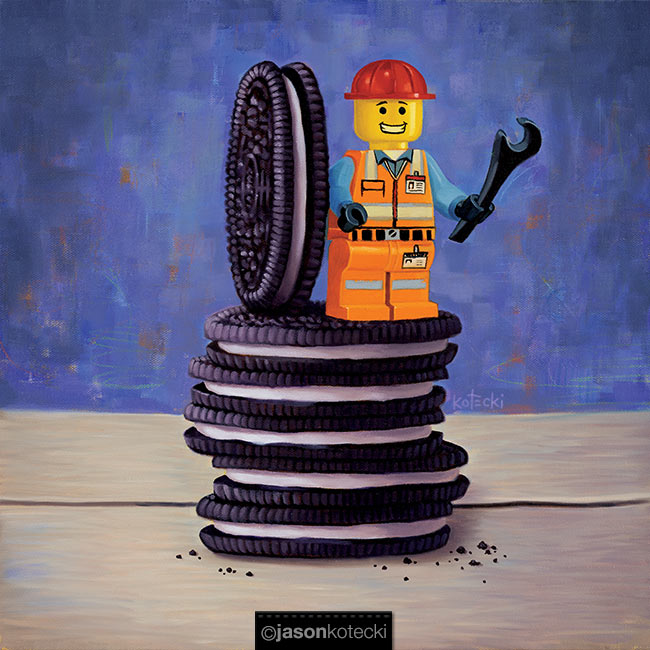
    “Talent Stack” by Jason Kotecki. 16 x 16. Oil on canvas.
    Original is SOLD 🔴 Shop this art!

    Sometimes people look at successes I’ve had and say, “Must be nice,” as if they happened by magic.

    What they don’t often see is the framework that helped enable that success. Fortunately, it’s a framework anyone can develop.

    We often assume that in order to be successful, we need to be great at one thing. That can work—see LeBron James, for example—but that path is extremely difficult and unlikely. The truth is, you only need to be pretty good at a handful of ordinary skills.

    You just need to build a talent stack.

    Scott Adams, the creator of the comic strip Dilbert, popularized this concept which states that you can ensure success by assembling a “stack” of two or more complementary skills and be in the top 25 percent or so in each. Do that and you’ll be unstoppable. 

    In his case, he readily admits he’s not the best artist, the most skilled writer, or the savviest business expert. But his unique combination of those skill sets has contributed to his success as a cartoonist.

    My own talent stack began with a few crayons. “Artist” was my first and is my longest-lasting identity. I’ve always enjoyed it, and I got praised for it, so I’m sure that made me want to keep doing it.

    In high school, I had a chance to take a creative writing class, which I enjoyed exponentially more than my math classes. I kept honing that skill, which eventually became an indispensable part of my talent stack.

    In college, I gave a talk as a leader on a retreat and received great reviews. Even though I am naturally shy, I enjoyed the process of crafting stories in spoken form. It was like creative writing but delivered out loud. 

    To the surprise of me, my parents, and the high school speech teacher who gave me a “C,” public speaking emerged as the primary driver of our business. I went from giving cartooning workshops in schools to speaking at churches to keynoting conferences for associations and corporations all over the place. 

    Now it took me a few years to realize that these three talents—art, writing, and speaking—were not separate skills that operated independently, but part of a talent stack, that when used in harmony became even more powerful. I am not the best artist in the world, or the best writer or speaker. But I’m pretty good at all three, and that combination has been the secret sauce of my success. Once I was introduced to talent stacking, I eagerly looked for complementary skills to add. By devouring hundreds of marketing books and through the school of trial and error, I’ve achieved the equivalent of an MBA in marketing. Am I the best marketer in the world? No, but I easily fall into the top 25 percent.

    Kim and I went on several organized retreats in college. That background gave us a foundation to build on when we started hosting our own events. After putting on numerous meetups, workshops, book tours, fundraising galas, and Escape Adulthood Summits over the past two decades, we’ve gotten pretty good at managing logistics and creating experiences that move people.

    Most recently, we used the pandemic as an opportunity to get good at livestreaming, which added a whole new dimension to our business.

    Drip by drip, these new skills made the other skills even more valuable and ushered in greater success.

    Of course, your talent stack will look different from mine, but the premise is the same. Start with natural strengths and abilities and work to make them better. Think about how they can work together in unexpected ways, even if they seem unrelated. 

    Everyone in your industry probably competes on many of the same skills. What do you have that’s different? Oftentimes the magic lies in a skill or interest that seems to come out of left field. For instance, many professional speakers are also writers. But my artistic gifts and whimsical, childlike perspective allow me to offer something extraordinary.

    This isn’t just about what you were born with. Look for other skills you can attain that complement and enrich the others. That might involve a traditional degree or certification, but it can also be done by reading books, listening to podcasts, taking courses online or at your local community college, or practicing, in public, every day, as we did with our pandemic project of livestreaming.

    If you’re stuck, here are some evergreen choices that will help:

    • Presentation skills
    • Technology skills
    • Foreign language skills
    • Sales or marketing skills
    • Writing skills
    • Business management skills
    • Nunchuck skills

    Remember, you don’t have to turn yourself into the foremost expert on any of these skills. Just be in the top 25 percent. Said another way, in a world of around eight billion people, you only need to be among the top two billion. If one hundred thousand people live in your city, you just have to be in the top twenty-five thousand. 

    In other words, pretty good is good enough.

    Keep in mind that this is a lifelong project. If you’re doing it right—meaning you stay curious and keep growing—your talent stack will continue to evolve and strengthen throughout your career and life. One last word of warning, however…

    When you have a decent stack of three to five skills going, you can bank on someone, somewhere observing what you’ve been able to accomplish and saying, “Must be nice.”

  • Shocked Chicken

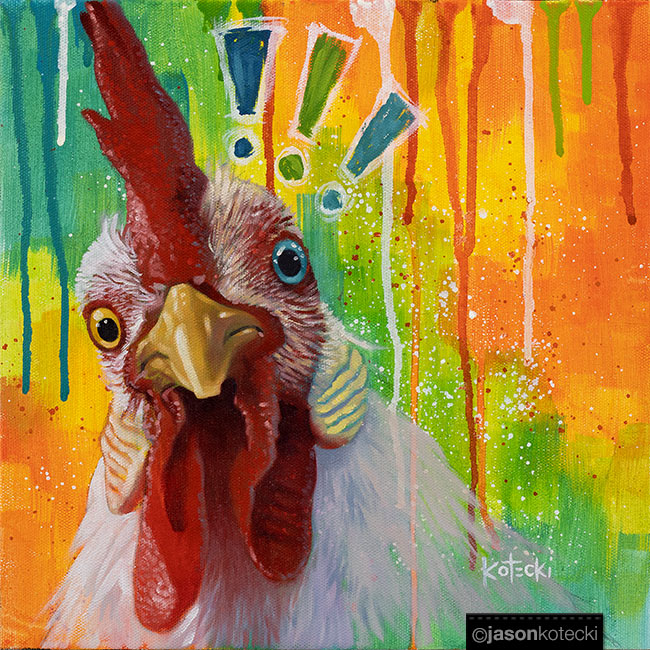
    “Shocked Chicken” by Jason Kotecki. 12 x 12. Oil on canvas.
    Original is SOLD 🔴 Shop this art!

    Thomas Edison has been attributed with saying, “If we did all the things we are capable of, we would literally astound ourselves.” 

    This is true. The potential within each one of us is enormous. 

    But I’ll go one step further. I say that we’d be astounded if we knew how good we already are. Maybe the marketing messages we’ve been bombarded with over the years have convinced us that we really aren’t good enough. Maybe we haven’t received enough positive compliments. Maybe we think the people who do compliment us are just being nice, or don’t know the real us. 

    Please…stop.

    My confidence does not rest in your resume, your highlight reel, or your dashing good looks. It rests in the divine Spirit of your Creator, which dwells within you. 

    You matter. 

    This may come as a shock to you, but you have a special brand of awesome that no one else has. 

    And this world needs it!

  • The Monarch

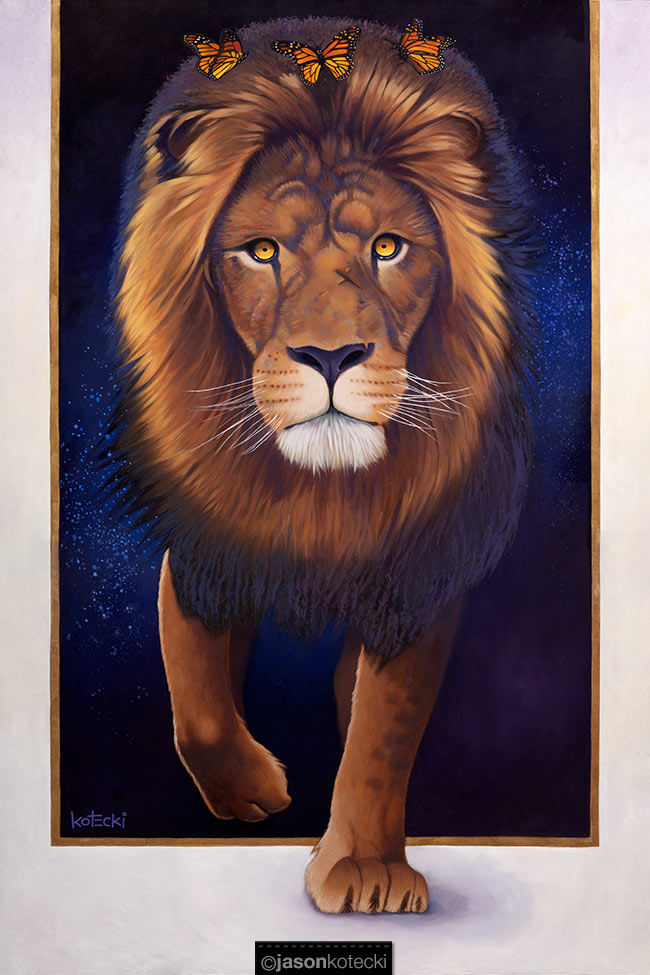
    “The Monarch” by Jason Kotecki. 40 x 60. Oil on canvas.
    Original is SOLD 🔴 Shop this art!

    His name was Joel, but I called him Mr. Dawson. He was one of the best leaders I’ve ever known.

    On the surface, Mr. Dawson was just a regular guy who coached youth baseball. But he was kind, humble, and strong, albeit not in the “benchpress dump trucks” sort of way. A rare autoimmune disease took several fingers on one hand. But he was able to balance a baseball with it while holding a bat with his other hand. During practice, he’d carefully toss the ball upwards and whack it with the bat in the direction of a fielder.

    When I played Little League, he managed an opposing team, but his vote helped me land on the all-star team. He became my coach after drafting me when I turned thirteen and moved up to Junior League. I was an occasional pitcher. My fastball wasn’t very fast, and I didn’t have a curveball, but I kept the ball over the plate. The good news is I rarely walked anyone, but the bad news is batters usually salivate at the prospect of facing someone who throws slow and straight. 

    The back of my baseball card was not impressive.

    Perhaps not surprisingly, I’d never been the winning pitcher of a game. I could claim it was because the teams I pitched for were never that good, but then again, neither was I. For some unknown reason, Mr. Dawson decided to make it his mission that season to get me a win. It took a while, but somehow, his persistent belief in me sank in. I actually started believing it was possible. I don’t even remember the score of the game when it finally happened, but I do remember the feeling. I remember his proud smile. 
    And I remember being happier for him than I was for myself.

    That’s what the best leaders do: believe in people. 

    Oftentimes, those people don’t believe in themselves. Sometimes it’s for a good reason, and sometimes it’s the natural result of not having anyone in your life who does. But the good leaders see a spark. Heck, maybe the spark doesn’t even exist, but their belief that it does is so convincing, it’s as if they are somehow able to will it into existence. 

    This painting was inspired by C.S. Lewis’s character, Aslan, the Christ-like figure in The Chronicles of Narnia. It’s a great image of the best kind of leader: brave but vulnerable. He’s confident in knowing what he’s about, but kind enough to welcome the lowliest creatures into his friendship and protection. Malcolm Forbes said, “You can easily judge the character of a man by how he treats those who can do nothing for him.” 

    People are fragile beings, like the butterflies in this painting. I sure was when I was thirteen, a shy, skinny kid with oversized glasses playing on a team stocked with much better athletes, trying to figure out who he was and what he had to offer. 

    The best leaders walk with us out of our past and into our future, accompanying us from who we’ve been to who we can be. We all need people like that in our lives. If someone believes in you, consider yourself lucky. And take them at their word, even if you can’t yet see what they see.

    Mr. Dawson died too soon from cancer shortly after I moved on to high school, more complications of his condition. By then a close friend of the family, I saw him face his final battle and the unknown of the next life with bravery and good humor. 

    Sometimes in life, we are the butterflies. We are fragile and need to believe the people who care about us are right when they tell us they see greatness within us.

    Sometimes in life, we are the lion.

    We are called to be leaders who seek out the lost, the young, the weak, and the forgotten. Our job is to look for the good in them, believing in them as long as it takes until they can see it for themselves. 

    Thanks, Mr. Dawson.

  • Teenage Mutant Ninja Sea Turtle

    “Teenage Mutant Ninja Sea Turtle” by Jason Kotecki. 40 x 40. Oil on canvas.
    Original is SOLD 🔴 Shop this art!

    If the movies taught me anything, it’s that superheroes wear spandex.

    We’ve been led to believe that superheroes are special. They come from another planet. They are blessed with superhuman abilities. They are super smart, or rich, or got involved in some sort of dangerous science experiment that turned out ok. They typically wear cool outfits while traveling in cool vehicles and wielding cool accessories.
     
    Also, their muscles have muscles.

    This painting is an homage to the Teenage Mutant Ninja Turtles, who, when they first emerged from the sewer in 1984, clearly challenged the notion of what heroes are supposed to look like.

    The truth is, real heroes hardly ever look like they do in the movies.

    Oftentimes, they look a lot like you.

    The turtle in this painting has emerged from its comfortable ocean surroundings and is wearing a mask that symbolizes two important concepts.

    The first is that it’s not all about us.

    Superheroes often hide their identity, giving them a sense of anonymity. Real heroes don’t do it for the glory, and they don’t demand credit. They serve a cause greater than themselves, and their chief motivation is doing the right thing and helping others. The mask can serve as a physical reminder that it’s not about us.

    Secondly, the mask gives us permission to act “as if.”

    Part of the reason children and adults alike enjoy wearing Halloween costumes is that it gives us permission to be someone different. The mask can be an opportunity to wander outside our comfort zone and try on a new way of acting, to be someone better than perhaps we believe we are. I like the advice from Joe Rogan, who suggested that if you’re unsure about what action to take in a particular situation, ask what the hero in the movie would do. In the beginning, it might feel a lot like acting,  but that way of acting might just stick, and before you know it, you’ll end up doing something that once seemed superheroic.

    Ultimately, being a hero is not about how you look, what you wear, or where you come from. 

    This painting challenges the notion of what superheroes look like and reminds us that in order to become one, we might need to leave our comfort zone in order to take action.

    It might be serving a cause greater than ourselves, standing up for what’s right, regardless of how unpopular it makes us.

    It might be standing up to the bully at work (or the one in our head).

    It’s often as simple as staying under the radar and just helping someone who needs help, whether it’s a child, an elderly neighbor, or a random guy struggling to load something into his car.

    We are all called to be heroes.

    This calling may require sacrifice, a bit of discomfort, and a new way of acting, but it doesn’t require spandex.

  • The Peach

    “The Peach” by Jason Kotecki. 12 x 12. Oil on canvas.
    Original is SOLD 🔴 Shop this art!

    Eating a peach, in season, perfectly ripe, is pure magic. But also messy.

    Oh, sure, you can eat peaches before they’re ripe, and they might drip less, but they’re not nearly as good. The best peaches are always messy.

    Now I’ll admit it: I prefer tidy. I like the structure of a good plan. I feel good when the dishes are done and the counter is cleared. I’m easily disturbed when piles stay piles for too long.

    Is that an Adultitis-fueled trait? Perhaps. But I do find that I am more present, relaxed, and creative when clutter and chaos are minimised. In general, I don’t think it’s a terrible trait to have. And I don’t believe that an Adultitis-free life disregards any sense of order.

    That said, I think we can all agree that 2020 has been less than tidy. I recently reviewed a list of all the goals I’d set for the year, and I had to cross out about 80% of them because they’d become either irrelevant or impossible. This year has been a real mess of confusion, conflict, and anxiety. In many ways, it has been a bona fide dumpster fire.

    But can I let you in on a secret? We’re only halfway through, but I suspect I will look back on this year as one of the best years of my life. It might take me a few years to fully own that, but I can already see hints of its truthfulness.

    At the very beginning of the pandemic, Kim and I started doing daily live-streams from our kitchen table. We didn’t know what the future had in store for us, but the message we hammered on over and over was this: look for the opportunity. We encouraged you to ask yourself, “Now that this has happened, what does this make possible?”

    It was the advice we shared, but also followed. 

    This pandemic has strengthened my relationship with God in untold ways. It brought my family closer together. It has pushed me and Kim into making changes in our business that we’ve talked about for years, but never had the time for. It forced us into trying new things and learning new skills that will yield new fruit in the years to come. It birthed a brand new initiative – the biggest one we’ve ever undertaken – that seems destined for a time like this, but twenty years in the making. (More on that VERY soon!)

    I share this because I don’t think this can be chalked up to luck or talent. I share it because it’s a technique available to anyone and because it’s possible for 2020 to be your best year ever, too. 

    Preposterous?

    Look, we all have things outside of our control that work against us, obstacles that rise up to thwart us. But the bigger the obstacle, the bigger the opportunity. Our attitude, our mindset, the frame we choose to operate within, is entirely within our control. 

    You can feel under attack and choose not to play the role of victim.

    You can feel anxious and choose not to cower in a corner and give in to despair.

    You can feel like everything is a mess and still choose to look for beauty. 

    I remember the day we let our oldest daughter take control of her own ice cream cone for the first time. It was a beautiful Madison summer afternoon, and we were hanging out at the Memorial Union, overlooking picturesque Lake Mendota. We braved the super-duper-long line for ice cream and figured that rather than micromanage each lick, we’d give Lucy full reign over her Zanzibar Chocolate ice cream cone.

    Kim handed it to her, and she gave a look of surprise and wonderment that appeared to say, “Are you serious?”


    After getting assurance that she was on her own, Lucy dove right in, her hazel eyes shining with joy. She licked. She smiled. She concentrated. She beamed.

    And she ended up with the cutest brown goatee I ever did see.

    Meanwhile, the chocolate mess invaded everywhere from her nose to her toes. Her shirt and shorts were stained. The real breakthrough came when Kim, seeing the mammoth mess unfold before her very eyes, resisted every ounce of motherly urge to wrestle the cone back from our daughter. She let go of the dirty shirt, the sticky fingers, and the crazy sugar buzz that would be left behind.

    She let it all go.

    Later, she coined a great saying: “Never let making a mess get in the way of making a memory.”

    Please note, I’m not ignoring the mess and the less-than-ideal outcomes that come from it. I’d like to offer a moment of silence for Lucy’s tank top. Several washes and stain-stick treatments later, it was unable to be revived and ended up in the trash bin of history. That’s okay, though; we’ve decided that we’d much rather have the memories of that moment than the shirt. 

    That “deciding” part is the key.

    Seeing with new eyes isn’t about ignoring the mess. It’s about choosing to sort through it to find something good.

    You may find a lifelong memory, stumble upon a new business model, or uncover the opportunity of a lifetime.

    You know how, when people are asked if they would like to change a negative thing that happened in their past, they often say they’d leave things as is, because of the good things that came from it? That’s how I feel about 2020:

    I may not want to RELIVE it, but I don’t think I’ll want to UNDO it, either.

    Sometimes life doesn’t go the way we planned, expected, or even hoped. 2020 will probably go down as one of the messiest years we’ve ever experienced. The question is: Are you improving the odds that this year will go down as one of your best?

    Adventures are rarely tidy.

    Sometimes the greatest blessings spring forth from the biggest messes.

  • Ring of Fire

    “Ring of Fire” by Jason Kotecki. 20 x 20. Oil on canvas.
    Original is SOLD 🔴 Shop this art!

    Everyone thinks the excitement that accompanies the start of a relationship is the best. 

    Granted, it IS intoxicating. Everything is new and mysterious. You’re wondering if the other person just likes you or actually “likes you” likes you. A simple touch ignites an inferno of passion. There’s so much to talk about as you’re constantly learning new things about one another. That way he chews, and that way she steals your jacket when she’s cold, is still cute and endearing.

    There’s no doubt about it: The beginning of a new relationship is pretty great.

    But then again, in the beginning, you’re just two separate entities. Like bread and cheese. Cheese is good. Bread is good. Put them together and you have a cheese sandwich. Also good.

    But Johnny Cash was right when he sang that love is a burning thing. It doesn’t get really good until you’ve gone through some fires together. That’s when you really get to know what you’re made of, as you melt together and you become one. That melty, gooey goodness is where the magic’s at. And have you ever tried to separate a grilled cheese sandwich? It’s not easy. Which is how it should be. 

    Combined, my parents and Kim’s parents have been married for over 90 years. They have struggled and endured many, many fires. But through it all, they’ve stuck together. In today’s day and age, that’s no small feat. Is there a secret? I don’t know. I’m sure there’s luck involved, but I know that it’s not all luck. I know communication is really important. And mutual respect. And a willingness to give more than you get.

    But I think the real secret is that it comes down to a choice to stick together, no matter what. Infatuation is a feeling, but love? Love is a choice. When my parents exchanged vows on their wedding day, promising they’d be there for each other no matter what, in sickness and in health, through the good times and the fires…they meant it. For reals. 

    And when I married Kim, that’s how I looked at it too. Death will have to break us apart; it’s the only option. We have not left an escape hatch for ourselves. The ships back to a world where we go our separate ways are smoldering sticks of charcoal. When disagreements emerge, a fight erupts, and feelings are hurt, Plan A is to work it out.

    There is no Plan B. 

    When you don’t burn the ships, there’s a very high probability that someday, you’ll use them to sail away from one another. 

    Of course, you can throw all of this out the window if both people aren’t on board. If one flakes out or doesn’t live up to the promise, it all falls apart. And that is nothing short of heartbreaking.

    I write this to give hope to the newlyweds, to the people thinking about giving this love thing another go, and to those who are in the middle of one of those scary fires right now. 

    As James Blunt sang, “Everybody wants a flame, they don’t want to get burnt.”

    It’s true: once you get past the lovey-dovey stage of a relationship, and experience the fires that flare up when things get real, you will come out a little charred. 

    But that char – the battle scars from a life lived together – add a richness, depth, and magic that a regular old cheese sandwich can only dream about. 

  • The Greatest Showman

    “The Greatest Showman” by Jason Kotecki. 16 x 20. Oil on canvas.
    Original is SOLD 🔴 Shop this art!

    The absence of fear is not bravery.

    The absence of fear is a terrible life.

    If you stay exactly where you are and never try anything new, you may be able to avoid fear. Maybe.

    If you want your life to matter, however, fear comes with the territory. You’re going to have to figure out how to tame it.

    The good news is that our fear is never as ferocious as we make it out to be.

    Most adults don’t consider themselves to have a robust imagination; that’s the realm of children and fairy tales. However, there is one aspect where most adults actually have an overactive imagination, and that’s when it comes to our fears. It doesn’t require any effort at all to picture our portfolio going belly up, our project crashing and burning, or ending up penniless, homeless, and living in a van down by the river while eating Spam out of a can. We can picture all of these things easily, in vibrant, living color, just as easily as a child imagining a personal tour through Willy Wonka’s chocolate factory.

    We easily dismiss any vision of an ideal (but as of yet unrealized) future, but give total credence to even the most far-fetched worst-case scenario. 

    A better strategy is to stop pretending that our imagination has gone missing, realize how powerful it is, and start using it to help us. Whenever I am freaked out about something, I like to do a little activity that only requires three steps, but requires full use of my imagination.

    The first step is to imagine the worst-case scenario in your situation. This is the easy part, because we probably already have a head start. It’s helpful to write it down or say it out loud, because the mere act of shining some light on it helps us to see how ridiculous it is.

    The second step is to imagine the best-case scenario. This might be a little harder, but it’s a lot of fun. Enter Mr. Roger’s Land of Make Believe and visualize the most preposterously positive scenario that you can possibly imagine. The sort of thing that would make you say, “If you wrote this into a movie, no one would believe it.” You will notice that you begin to turn the tables on fear and plant a vision in your head that can have an eerie way of coming to pass.

    The final step is to imagine a likely scenario. This will likely land somewhere in the middle of the first two. Your job is to pretend that you are a Las Vegas oddsmaker and draw up a picture of how things will most likely go down. It’s not ideal, and might be uncomfortable, but it’s surely nowhere near as bad as the worst-case scenario. Meanwhile, ideas will start to surface about some practical things you can do to help your cause.

    This activity helps you use your imagination for good, and also reminds you how it can trick you into seeing your situation as more terrifying than it really is.

    When I was a teenager, I worked at a car dealership. I was a good worker, but I had never received a raise. And I was trying to save up for a car. I decided to ask my boss for a raise. He was the owner, a smart, no-nonsense, sometimes gruff kind of guy. I put it off for weeks. I carefully planned the argument that made my case. I rehearsed my speech, prepared to list my accomplishments and call in lead witnesses if needed. I debated the proper time of day to ask: first thing in the morning? At the end of the workday? On a Saturday when the service department was closed? It went without saying that the beginning of the conversation was crucial. I needed to float a trial balloon to gauge his mood. Any sense of irritability, and the mission would have to be aborted at once. More than once, I considered what to do if he fired me on the spot for being an ingrateful little peon. 

    Eventually, I decided that the day had come. I screwed up my courage and walked up to his office, prepared to handle any possible rebuttal and ready to deliver an impassioned speech about justice and landing on the right side of history. 

    “Excuse me, Ron…can I talk to you for a second?”

    “Yeah, what is it?”

    That must have been when I blacked out. I probably mumbled the word “raise” at some point, but there was nothing close to the memorized inspirational speech I had practiced. 

    He let me flounder for about seventeen seconds before putting me out of my misery and saying, “Yeah, that sounds fine.”

    I walked back to my wash station on cloud nine. I had no idea that conquering the world would be so easy. 

    Sometimes the tiger we’re fighting is nothing more than a house cat.
  • Leap

    “Leap” by Jason Kotecki. 20×16. Oil on canvas.
    Original is SOLD 🔴 Shop this art!

    Why is it that so many of the people who have found success in America are first-generation immigrants? One big reason is that many of them came from a place that is not so great. They saw America as the Land of Opportunity, and they pursued it with a definitive focus and relentless persistence. They were willing to leap from the known to the unknown.

    A big reason people don’t chase their dream is that where they are now isn’t half bad.

    They give up the dream and settle for the dreamsicle.

    A dreamsicle is sweet and alluring and very tempting. It’s the option most people go for, with its safety, comfort, and surface-level perks. Because of that, you wonder if you’re crazy to even consider abandoning it.

    The dreamsicle is the lifestyle that ensures you need to keep your current job for as long as possible.

    It’s the boyfriend who checks all the boxes except for the one that matters most.

    It’s the job that impresses your parents but gives you Sunday Night Dread.

    But eventually, it leaves an unsatisfying feeling in your stomach. Like maybe you shouldn’t have settled for something so easy.

    When I first started my business, the prospect of dealing with taxes, paying for my own health insurance, and being solely responsible for the revenue (or lack thereof) felt daunting. Turning down a steady job with killer benefits and staying in a crappy apartment for eight years seemed ill-advised at the time. Now it’s clear that it was one of the best decisions I ever made.

    Any time you break away from the crowd and do something different is scary. The leap into the unknown requires us to be the leaders of our own destiny.

    But nothing is ever as rewarding or satisfying as chasing the dream in our hearts.

    The dreamsicle is not the same as the dream.

    Is it time for you to leap?

  • Wind In Our Sails

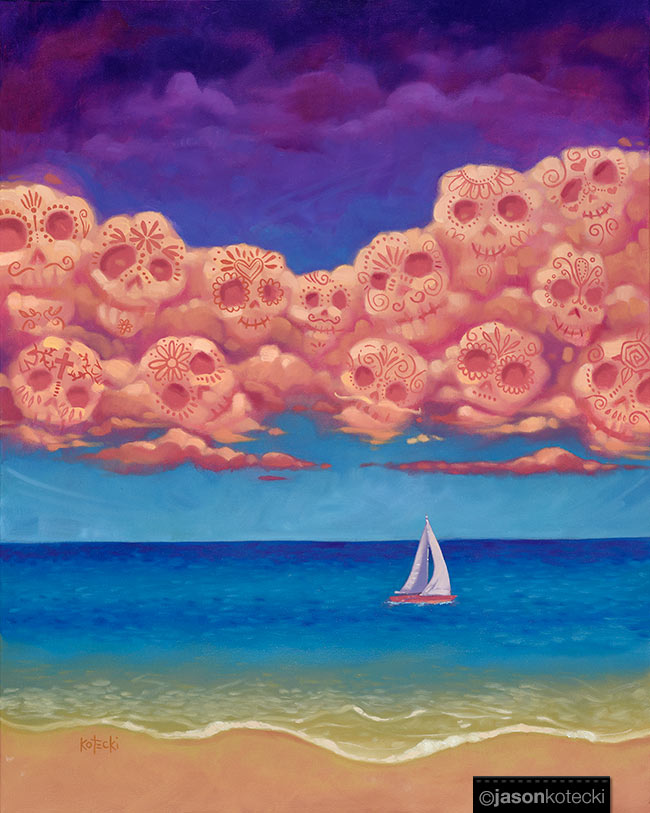
    “Wind In Our Sails” by Jason Kotecki. 20 x 20. Oil on canvas.
    Original is SOLD 🔴 Shop this art!

    This painting was inspired by a family vacation to Mexico. One thing that was abundantly clear in the week we were there is that the Mexican people love their color. When you’re accustomed to everything being Pottery Barn beige and gray, it really stands out. 

    I wanted to incorporate that vibrant, whimsical color, along with one of the culture’s great traditions, Dia de Muertos, or Day of the Dead. I think it is a beautiful way to look at the afterlife and the ancestors who went before us. I appreciated the idea of seeing death as a part of the life process, rather than an end in itself.

    I also liked the focus on how much we owe to the people who came before us. In American culture, the independent spirit of the individual is celebrated. That’s fine, as far as it goes. Except that there is no such thing as a self-made man or woman. No one becomes successful by themselves. Yes, your unique talents and a fiery self-determination are key ingredients for success. 

    But life is a group effort. 

    I was thinking about the people in my own life who have passed away. Not just family members, but teachers and coaches who served as mentors, too. Every one of them taught me something that I carry with me to this day. 

    My Grandma K. made me feel like I was special, just as I was.

    My third-grade teacher, Mrs. Smith, encouraged me to take my artistic talent seriously.

    My Little League coach, Mr. Dawson, helped me believe that I was a winner.

    When I was an uncertain teenager, Deacon Vince saw me as a grown-up with valuable contributions to make.

    Each of us is like that tiny sailboat. At times, it can feel like we are drifting, alone, on a vast and overwhelming sea. 

    But we are not alone. 

    We have the wisdom, given to us by the people in our lives who have gone before us, charting our course. They have touched our lives, and their examples live on, showing us the way.

    And their words live on as the wind in our sails, guiding us into a bright and colorful future.