Topic: Balance & Burnout

  • We Can’t Let Winter Win

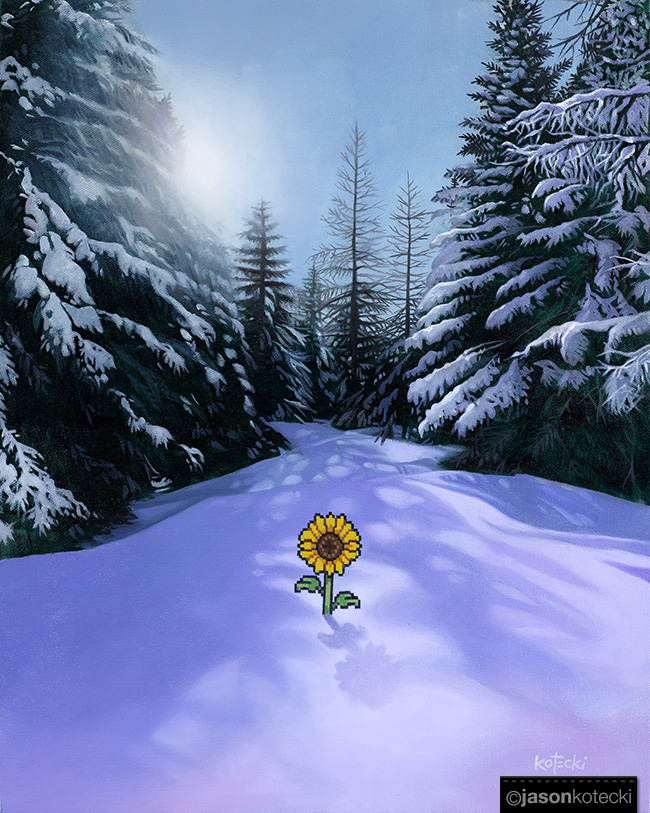
    “We Can’t Let Winter Win” by Jason Kotecki. 16 x 20. Oil on canvas.
    Original is available 🟢 Shop this art!

    One thing I love about the Midwest is the seasons. Real ones. Not like those they claim to have elsewhere, so-called “winters” with an occasional snow flurry and temperatures that sometimes flirt below forty.

    In Wisconsin, our seasons are pure, not pretenders. 

    I like that, because it allows me to fully embrace the beauty and lessons of each one. It’s a reflection of life, which has distinct seasons, no matter where we live.  

    If we’re honest, we’d prefer life to be one long, glorious summer, filled with sunshine and popsicles. But no. There are seasons of autumn, times for slowing down and saying goodbyes. And there are long winters of loneliness, where life feels frozen solid, and hope gets buried under a blanket of snow. 

    Of course, spring always follows, but sometimes it seems to have overslept.

    In Wisconsin, there is always a point when you’re pretty sure winter is over. 

    Live here long enough, and you realize it’s not. 

    There’s always one last gasp. One final snowstorm. One more cold snap that steals spring away, just as you were about to elope together on your way to summer.

    That might be the most deflating, difficult part of winter: The moment when it appears it will never end, and you don’t know how much more you can take.

    Life feels like that sometimes, when it seems like winter’s gonna win. 

    Winter wins when it convinces us that nothing will ever change.

    Winter wins when we let disappointment over unmet expectations turn into resentment.

    Winter wins when we allow ourselves to be buried under a blanket of apathy.

    Winter wins when we decide to give up and let the hope within us flicker out.

    But it doesn’t have to get the final say.

    This painting is a reminder that we can’t let winter win.

    The 8-bit sunflower is reminiscent of a video game, because I think that’s a good way to think of it. When you’re in the middle of one of life’s winters, everything is heavy. Summer looks so far away. We see all the things that need to change for us to go from where we are to where we want to be, and it feels insurmountable. 

    Sometimes the answer to the darkness that weighs down on us is a little levity. Making a game out of it is a way to rise above the life-and-death seriousness of our situation. It takes us ever-so-slightly outside ourselves to give us perspective that is a little wider than the restricted, optionless way winter can feel sometimes.

    Part of what makes a game engaging and fun is that there is a challenge to it. But the key is for it to be a doable challenge. So instead of focusing on all the ways we are frozen in place and how many more days of winter are ahead, make a game out of finding even one tiny clue that spring is on its way. You don’t need to defeat the Final Boss and save the Princess; you just need to make it past this level. 

    Today.

    The game is this: Figure out how to win today.

    It doesn’t have to be big.

    It could be one five-minute prayer.

    It could be getting dinner on the table.

    It could be dumping the bottle of vodka down the drain.

    It might just be getting out of bed.

    Sometimes the win is just giving it one more day.

    I’ve experienced many winters, especially in the early days of building our business. I once got some advice from a business colleague I’ve never forgotten. He, too, was an entrepreneur and knew how discouraging it was to feel like you made one step forward only to take three steps back. He shared a simple policy he lived by. On those really hard days, the days when he didn’t think he could go any further, he promised himself he’d give it one more day. He gave himself permission to abandon ship after that, but not before he gave it one more day.

    Sure enough, the next day always brought some glint of hope, a new reason to believe. There was rarely any huge breakthrough that magically happened. Maybe it was a small sale. Maybe it was an encouraging word from a friend. Maybe it was just a good night’s sleep.  

    Just a baby step forward.

    We win when we find evidence that spring is on its way.

    We win when hope bursts through a blanket of apathy.

    We win when our resentment melts into acceptance.

    We win when our panic gives way to patience.

    We win when we bring light to someone else.

    We win when we give it one more day.

    Don’t let winter win.

    Keep holding on for spring.
  • Doing Nothing

    “Doing Nothing” by Jason Kotecki. 20 x 20. Oil on canvas.
    Original is available. 🔴 Shop this art!

    Doing nothing isn’t really doing nothing.

    New parents (and parents-to-be) get lots of advice. Among the wellspring of wisdom are tips on getting your kids to eat or sleep, and keeping them alive while maintaining your sanity. 

    Perhaps the truest and most common exhortation is: Cherish every moment; it all goes so fast.

    We don’t need anyone to tell us this, of course. It’s so obvious that we discard it out of hand with a smile, a nod, and a quip like, “I know; the days are long, but the years are short, amiright?”

    The problem is that the entire world seems to conspire against us. 

    It doesn’t want us cherishing anything. That would require us to slow down for a hot minute. Cherishing, pondering, reflecting…these don’t feel very productive. In fact, they feel a lot like doing nothing.

    I remember when my oldest daughter was a newborn. One afternoon, after completing the important work-related items on my to-do list, I relieved Kim by assuming caregiving duties. Lucy and I nestled into the rocking chair, where she promptly downed several ounces and drifted off to sleep. I sat for a few moments, soaking in the silence before the siren song of productivity resurfaced. Now that she had fallen asleep so quickly, I could tackle my email! As I was about to set her on the couch and grab my laptop, it hit me:

    Oh my gosh. I’m doing it. I’m missing out on the best stuff.

    Sometimes, a sleeping baby is a gift God gives us to help us manage other responsibilities. But I’d already accomplished my important tasks for the day. In that moment, I received a gift: the realization that there will always be e-mail to check, but my opportunities to hold that little sleeping angel were numbered. I became acutely aware that years from now, when I’m walking Lucy down the aisle on her wedding day, I will not remember any of the “productive” things I did that day. But the memory of her button nose, bald head, and peaceful slumber will remain with me forever.

    On that rapidly approaching day, I don’t want to find myself wishing I’d spent more time doing “nothing.”

    We live in a culture that worships at the altar of productivity. Adultitis is a sinister foe after all of us. It has tricked us into believing that we should always be busy, always “doing” something. If it’s not shared on social media, it didn’t happen. If it can’t be measured, it doesn’t matter. 

    A book called How Will You Measure Your Life? by Clayton Christensen sheds light on this. He points out that it is our nature to unconsciously choose the things that give us an immediate, tangible accomplishment over something for which we aren’t likely to see a return for decades. 

    We can cut the grass, close a sale, finish a week’s worth of lesson plans, deliver a presentation, publish a paper, or redesign our website in less time than it takes to raise great kids or build an awesome marriage.

    So we default to efforts that provide an immediate payoff and a satisfying feeling of accomplishment.

    In chasing this dopamine hit of achievement — even one that isn’t all that consequential — we confuse the urgent with the important. We unwittingly turn irrelevant tasks into priorities simply because they can be checked off some list. And checking off five things is better than one, even if the undone item was the most important. 

    Like a junkie craving another high, we feel anxious spending too much time doing nothing.

    But doing nothing isn’t really doing nothing. Sure, holding my sleeping baby and soaking in a quiet moment didn’t decrease the messages in my inbox. But it certainly wasn’t “nothing.” Quite the contrary. 

    Taking the time to do nothing once in a while – especially with the people we love – might be the single most important thing we do all day.

    When you carve out time to be with someone you care about, “What are we going to do?” becomes a question that demands an answer. The longer it goes without one, the higher the anxiety levels rise.

    Unfortunately, without a specific activity on which to focus our attention, we turn to those little dopamine-delivering slot machines always by our side. Time and again, I see friends or couples together, at the beach, on the train, out to dinner, and their attention is on their phones. 

    Their bodies are near each other, but their hearts and minds are miles apart.

    Together, but not really.

    All because we can’t escape the lure to do…something.

    Let’s refuse to let the almighty algorithm dictate how we spend our time. What if the answer to “What are we going to do?” was simply, “Nothing. Doesn’t matter. Let’s just be together.” There doesn’t need to be a mission accomplished, a box to be checked, or an objective to be measured.

    This painting is inspired by a favorite quote from Winnie the Pooh, who said, “People say nothing is impossible, but I do nothing every day.” 

    Doing nothing, it seems, takes more effort than doing something.

    When Lucy was a baby, and I was savoring a quiet moment alone with her doing nothing, the pull of productivity tried to poison it. Even if I left my laptop closed, I wondered if I should be engaging her more, teaching her more, or coming up with something more “Instagram worthy” to do with her. Was I a bad dad for not wanting to do more than just sit with her? 

    But the doing nothing was actually…nice.

    And it filled me with peace that is oh so hard to come by these days.

    Having a little honey, wishing on a dandelion, and enjoying a fine day together might feel a lot like nothing.

    Sometimes doing nothing is the very best something you can do.
  • Sunshine In My Soul

    “Sunshine In My Soul” by Jason Kotecki. 12 x 12. Oil on canvas.
    Original is SOLD 🔴 Shop this art!

    I do not know how people survive without faith in this dark world. 

    Perhaps it’s why our rates of depression, anxiety, and suicide are at all-time highs. My faith is like having sunshine in my soul. No matter how heavy the storm or dark the night, there is a joy that never dissipates, giving me hope. 

    I did not always have this faith. Like many, my perception of God came from the reflection of Him I saw in others. Often, it was a pretty distorted version. 

    But there were people I encountered who were in alignment with the merciful, mighty, and loving Father I have come to know and love. 

    This is the God whose light I pray shines forth from my work, so that others may see, believe, and experience this sunshine in their soul. 

  • LOLigator

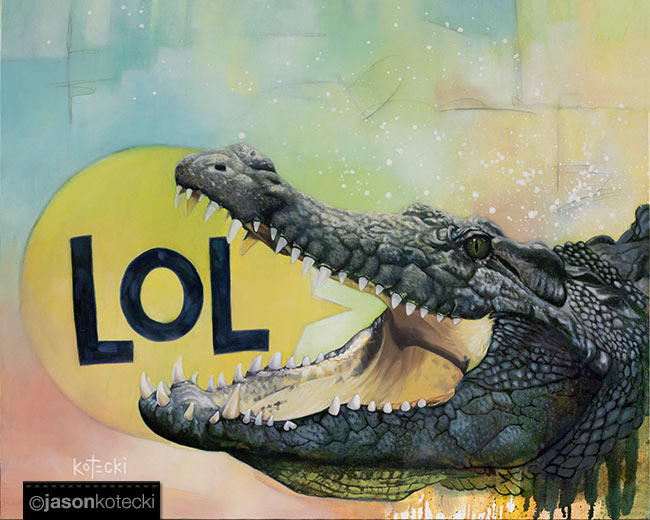
    “LOLigator” by Jason Kotecki. 30 x 24. Oil on canvas.
    Original is SOLD 🔴 Shop this art!

    An alligator can live up to 100 years…

    which is why there’s an increased chance they will see you later.

    One of the midwives who helped Kim on her journey into motherhood had experience working with the Navajo people. She told us about a custom of theirs in which the first person to make a newborn laugh is obligated to throw the family a huge party to celebrate the occasion. According to their tradition, it’s considered the moment in which the baby is fully present and “in the world.”

    I think that’s pretty cool.

    You often see people rejoicing over a baby’s first words, first steps, and first day of school, but never have I heard a big deal made out of a baby’s first laugh. At least not enough to warrant a party to be thrown because of it.

    It’s a striking example of how little we value laughter in our society.

    What’s weird is that laughter is a universally loved activity, and yet, adulthood often finds us treating it as a non-renewable resource, something to be reserved for when our work is done. We leave it out of serious and challenging situations, and grow suspicious of people who do too much of it.

    Which brings me to alligators.

    I don’t know about you, but when I see an alligator, I don’t think, “Here’s a guy who must be the life of every party.” He’s not on my Top 10 list of Animals Who Don’t Take Themselves Too Seriously.

    And yet, when he opens his mouth, it looks like he just heard a good joke.

    Which gives me hope, because I encounter a lot of people walking around with the sunny disposition of an alligator these days. 

    We can all agree that laughter is beneficial. It boosts the immune system (why they say laughter is the best medicine), brings you more energy, lowers levels of pain, and protects you from the dreaded Adultitis. Of course, as we get older and are inundated with Adultitis, laughs can be hard to come by. 

    The good news is that you can literally fake it till you make it. 

    Believe it or not, fake laughter offers the same benefits as real the kind. Certified life coach Katie West says, “Pretending to laugh (or practicing laughter) can alter our body chemistry since our brains can not tell the difference between real and fake laughter.”

    I have experienced a group of people fake laughing, and I can tell you, the vibe shift is real. And when people are practicing fake laughs, real ones bubble up like clockwork.

    Likewise, we can generate more laughter by being intentional about injecting some fun into our routine:

    • Read the funny pages over breakfast.
    • Listen to comedy podcasts on your commute.
    • Get a joke-a-day calendar for your desk.
    • Turn your inanimate objects into Adultitis Booby Traps.
    • Hang out with funny people.
    • Attend an improv show.
    • Read or watch something funny before bed. (At the very least, stop watching the Crisis News Network!)

    Stress continues to be a contributing factor to every single thing that kills us, from heart disease to suicide. Yet the standard operating procedure these days is to trudge through life with furrowed brows and steely determination. But now, more than ever, we should take a cue from the Navajo people and celebrate laughter.

    Every single laugh is a dollar in the economy of the human spirit.

    I get that we live in serious and challenging times, but that doesn’t require us to take ourselves seriously.

    St. Teresa of Ávila, a Spanish mystic and great reformer, once said, “May God protect me from gloomy saints.” 

    One of the greatest things ever is hearing my kids laugh. Whether it’s a silly little giggle or an unbridled belly laugh, there’s no better sound in the world.

    I imagine that God probably feels the same way about his children.

    When we laugh, we are happy and free. During that moment of laughter, we are not worried, anxious, or stressed. And so it must give God great joy to see his children buckled over in laughter, just as it does me with my kids.

    And reminds me just how much Adultitis must hate it.

    All the more reason to make laughter a priority.

    As Charlie Chaplin, one of the world’s greatest Adultitis fighters and a patron saint of comedy, once said, “A day without laughter is a day wasted.”

  • The Wingman

    “The Wingman” by Jason Kotecki. 60 x 40. Oil on canvas.
    Original is SOLD 🔴 Shop this art!

    Life is amazing. It is also hard.

    The war against Adultitis is a grueling one that will last your lifetime. But that shouldn’t keep you from trying to soak it with water balloons.

    Your happiness depends on it.

    Now, you’ll need two things in the fight against Adultitis: water balloons and a wingman.

    A Water Balloon is anything joyful that induces playfulness, laughter, merriment, or wonder. The most powerful ones appear frivolous, done for no particular reason other than fun.

    My late father-in-law Gary had a long fight with chronic pain. His faith sustained him, along with a diverse array of water balloons to help him fight, such as Chuck Norris jokes, air shows, Ernest movies, and April Fools pranks.

    My water balloons include: Dad jokes. My Funko Pop collection. Pajama runs. Dance parties. Photobombing my family’s photos. Watching Parks and Rec reruns.

    A Wingman is someone who encourages you to throw water balloons at Adultitis, and when you do, is at the ready with another one. It’s someone you can be goofy with and have fun with, who doesn’t roll their eyes at your silliness or denigrate the things that light you up.

    My wingman is my wife. And my kids. And the members of the Wonder & Whimsy Society.

    Sometimes a wingman is hard to come by. One of my favorite things about our tribe of Adultitis Fighters is that it provides a place for people on an island, without a wingman in their immediate vicinity. The Escape Adulthood League is an army of wingmen (and women) with water balloons at the ready.

    Not only do we each need a wingman, but we are also called to be a wingman for others. That’s what this movement we’re building together is about. Every single one of us can encourage others to embrace their inner child. To embrace their guilty pleasures and to celebrate the things that make them weird.

    So collect as many water balloons as you can. Summon your wingman.

    This is war.

    And Adultitis is about to get wet.

  • Not a Morning Person

    “Not a Morning Person” by Jason Kotecki. 24 x 24. Oil on canvas.
    Original is SOLD 🔴 Shop this art!

    Do elk have the choice of being a morning person?

    Are there some elk, hidden away in the woods, “sleeping in?” Some who stayed up late contemplating the universe, or were up all night partying with other woodland creatures?

    Alas, I assume that elk are wired the way they are wired, and they don’t have the choice of whether they are a night elk or a morning elk.

    No, but we do.

    I used to be a night person. I rolled my eyes at the people who annoyingly championed the virtue of early rising. I loved staying up to work on art when the world was quiet. I’d go to bed way past midnight and somehow only need a few hours to tackle the next day with a full supply of energy.

    That, of course, was before kids. Nowadays, when nine o’clock rolls around I am dragging like a wet, rolled-up area rug. If I do summon the energy to stay up a smidge past midnight, my next few days are completely wrecked.

    A few years back, I read the book “Miracle Morning” and developed a new habit. Nowadays, I am up before 6 am (unthinkable back in my youth).

    I guess that makes me a morning person.

    The war rages on between the pious morning people and the obstinate night owls. Although typically vehemently opposed to one another, both sides seem to talk about liking the quiet, which is, of course, present both very early in the morning and very late at night.

    Our souls crave solitude from the noise that dominates our daily lives.

    We all need to carve out some quiet time. The when probably isn’t as important as what we do with it.

    My life transformed when I became a morning person, and not because I decided to get up early in the morning, but because of what I did with that time.

    Back in the day, I used the silence to work, read, or endlessly scurry down internet rabbit holes.

    These days, my routine looks different.

    I pour a fresh cup of coffee, light a candle, and plant myself in my prayer chair, which once served as the place where I rocked all three of my kids. I read the Bible. I journal. I pray. Sometimes I listen to music or read from a devotional. Other times, I just sit there, in the quiet, before the kids are up and the world turns on for the day, listening for the still, small voice of God. It is bliss. I never thought I’d ever actually enjoy getting up this early, but now I wouldn’t miss it.

    It’s a little oasis in a desert filled with an endless parade of noisy marching bands and riled-up slot machines blinking and begging us to pull their lever. The marching bands are all the outside forces trying to distract us. The slot machines are the illuminated rectangles in our purses and pockets that we constantly refresh, lured in by the promise of that oh-so-gratifying hit of dopamine when we see something that surprises us, delights us, entertains us, or enrages us.

    This is a challenge to examine our habits.

    Do we get up early merely to have a longer treadmill on which to sprint, attacking a to-do list that never ends?

    Do we stay up late bingeing content that temporarily satisfies but does nothing to uplift our souls or make us better humans?

    Do we subconsciously avoid silence because it makes us feel anxious in the immediate gratification era in which we live?

    Silence feels weird.

    Silence feels unproductive.

    Silence feels boring.

    And yet, maybe the elk are up early to bask in silence.

    I’ve always been a believer. I’ve not always been a morning person.

    But spending an hour a day in silence with God changed everything.

  • Nope

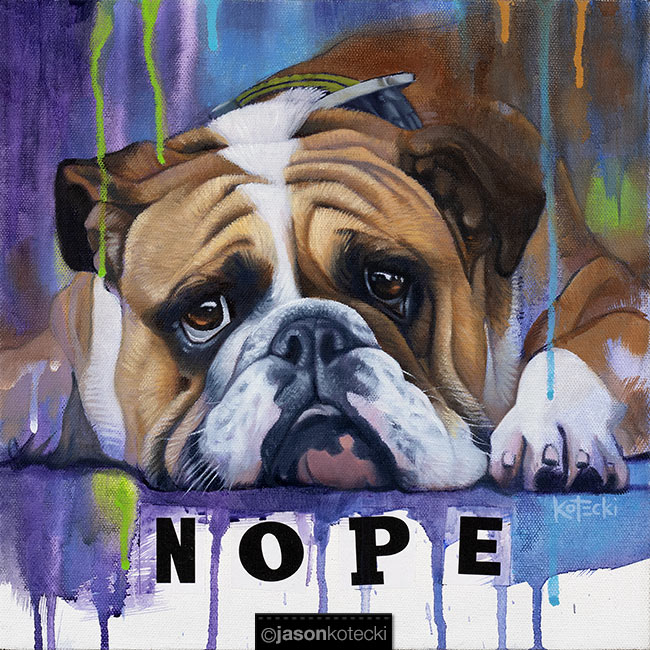
    “Nope” by Jason Kotecki. 12 x 12. Oil on canvas.
    Original is SOLD 🔴 Shop this art!

    Mama said there’d be days like this.

    Sometimes when we’re feeling overwhelmed, exhausted, or sad, we simply need a time out. 

    Or pizza. 

    That was the prescription our midwife gave us after Lucy was born. Kim and I had come into the delivery day mentally depleted, our first child already a few weeks overdue. Then the labor itself was a marathon. After the birth, Kim almost fainted because of a drop in blood pressure. As she recovered, it was on me to put on Lucy’s first diaper and figure out out to dress a four-hour-old (it’s like trying to gift-wrap Jell-O) before clearing an inch of ice from our car so we could drive home from the birth center. 

    The prospect of going home to attend to the 24/7 needs of a newborn was overwhelming, to say the least.  Aware of our exhaustion and sensing our uncertainty, our midwife said, “You know what I want you to do? When you get home, I want you to order in the biggest, cheesiest, gooiest deep-dish pizza ever, and savor it.”

    And we did. It was glorious.

    It was just the little treat we needed to keep going. We still rely on the magical properties of pizza from time to time. 

    Sometimes we require something stronger, like a “sick of it” day. In most workplaces, if you have the flu, a persistent cough, or you’re going through more Kleenex than me watching the opening scenes of “Up,” you get to take a sick day and stay home from work. But what if you have a case of the Mondays (or a case of November)? 

    Kim and I recommend taking a “sick of it” day. (You can still tell your boss it’s a “sick day.”) It’s kind of like playing hooky, but it’s really a chance to shift momentum and throw life a curveball for a change. You can do anything you want, but no work and no chores. Treat yo self. 

    But what happens when those days mama warned us about turn into weeks, or months, or years?

    Our body will tell us if we’re paying attention. I like to think of our negative emotions as a check engine light for our body and soul. You know, the light that illuminates our vehicle’s dashboard to tell us that something’s off. Most people handle it like my father-in-law handled the check engine light on his old Chevrolet Celebrity – with a thick black piece of electrical tape, hiding the light from view. 

    Problem solved!

    Or not. Ignoring a problem rarely works. If you’re in a funk right now or enduring a hard season, it might be time to call a time-out and see what the inner check engine light is trying to tell you.

    I preach the power of optimism. But it’s unrealistic to expect we can go through life on a positive high all the time (and I’m leery about people who seem to do so). 

    Maybe you’re experiencing caregiver fatigue. Maybe it feels like everything you touch turns to shitake. Or maybe you’re burned out from the last three years of pandemic, politics, and pivoting. 

    It’s ok. Welcome to the Human Club. You’re normal!

    We don’t have to be afraid of feeling the feels and examining what they have to teach us.

    Uncomfortability can be useful. We need to pay attention to our inner check engine light, not ignore it with a never-ending Netflix marathon, a bottle of wine, or any of the countless ways we self-medicate to numb ourselves to escape our pain.

    It’s giving us a heads-up that something may need to be addressed. For me, it’s usually a warning that I need to ease up on adding new commitments to my calendar, a reminder to spend more time in my secret hideout, or an invitation to get a little more rest. (Often it’s a combo of all three.)

    This approach from Steve Jobs is a good guide. He said, “For the past 33 years, I have looked in the mirror every morning and asked myself: ‘If today were the last day of my life, would I want to do what I am about to do today?’ And whenever the answer has been no for too many days in a row, I know I need to change something.”

    Are you in need of a change? It might be time to talk to someone, like a counselor, pastor, or medical professional. Maybe you need to take that difficult first step toward healing a relationship. Or maybe it’s time to finally embark on that new career path.

    Remember, for now doesn’t mean forever. It may feel like there’s no end in sight to the malaise you’re experiencing, but it only seems that way.

    Don’t be afraid to peel back the tape on your check engine light and see what it has to tell you.

    Maybe a gooey, cheesy pizza and a night on the couch is exactly what you need. Maybe a “sick of it” day will do the trick. Or maybe it’s time for a baby step toward a bigger change.

    Let your inner check engine light lead the way.

  • Balancing Act

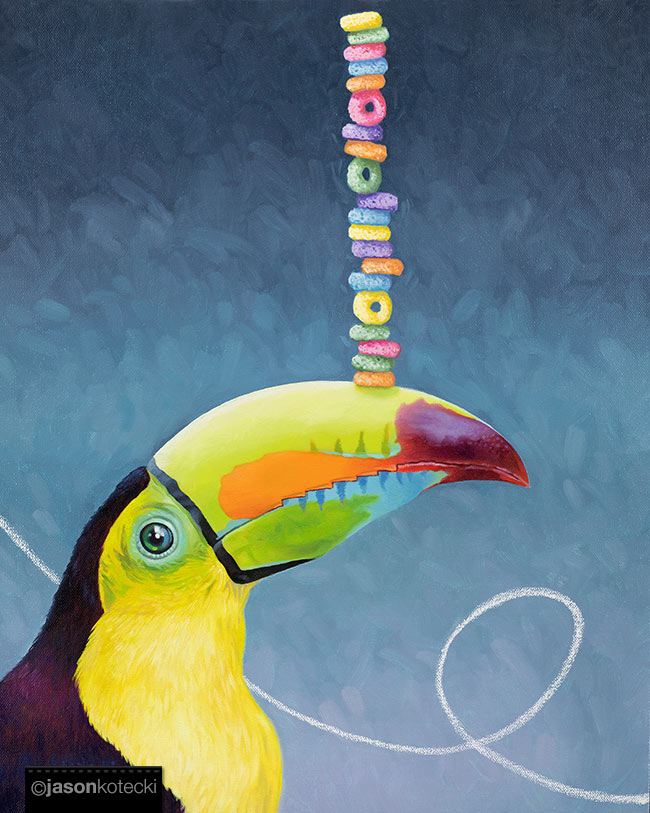
    “Balancing Act” by Jason Kotecki. 16 x 20. Oil on canvas.
    Original is SOLD 🔴 Shop this art!

    How many Froot Loops can you stack on top of one another before they topple over?

    How tall would someone’s tower have to be for you to find yourself impressed?

    We often relish the opportunity to declare how many activities we’re balancing. Like a status symbol, our busyness signals our importance. We could pretend the pink ones are work responsibilities, the yellow ones are family and household chores, maybe the orange ones are volunteer commitments, and the green ones are hobbies…All hail the one with the highest stack of Froot Loops! 

    I am always in awe of people who seem to be able to operate smoothly amidst a schedule bursting at the seams. My personality type is such that I easily get overwhelmed when I’m trying to stack more than a handful of Froot Loops at a time.

    I recently added something new to my morning prayer routine. After looking back on the previous day and reflecting on what went well and what I could have done better, I try to identify the most important thing to accomplish in the day ahead. 

    And let me tell you, it’s bloody hard.

    I mean, it’s a simple question. And sometimes it’s easy because there’s a specific, obvious task that needs to be completed: Deliver this speech. Finish the manuscript for editing. Paint the ceiling. 

    But most days, it’s not so obvious. 

    Answering this question goes against my inherent desire to cram my day like a Volkswagon Beetle stuffed with seventy-six circus clowns. When I survey the day before me, I usually see a smorgasbord of Very Important Things, all seemingly equal in significance. If I happen to settle on something like “spend time in the studio,” I have to fight the urge to also write “andfinishthisandworkonthatanddontforgettotakeoutthegarbage.”

    I’m not alone, am I?

    The science is clear. We get a tiny yet thrilling dopamine hit every time we check something off our almighty to-do list – regardless of how essential the chore actually was – which encourages us to rush headlong into the abyss of productivity.

    I have to remind myself that the question “What is today’s most important thing?” is not asking for the ONLY thing I need to do that day. Or asking me to only do ONE good or worthwhile thing all day. 

    It’s merely asking me to declare the most important one.

    Because, unfortunately, despite my desire to bend reality and make my home in the multiverse, there can only be one most important thing. (See this reflection on how we magically changed the meaning of the word “priority.”)

    I have found that oftentimes in this process, my most important thing is to “be open,” because the most important thing hasn’t yet revealed itself at six-thirty in the morning. But that awareness is vital because it makes me more likely to notice it when it comes. 

    I encourage you to try this, especially if you’re having a hard time balancing all the Froot Loops. Its power comes in forcing you to pause, nudging you to slow down, reflect, and be intentional.

    Why does this matter? 

    This matters because when I don’t identify the most important thing for the day, I’m liable to rush off and accomplish a whole hell of a lot of things. Which seems good and feels great. But if the sheer volume of activity crowds out what was actually the most important thing I needed to do, my life slowly veers off track.

    It doesn’t matter how many Froot Loops you can balance if you were supposed to be paying attention to the Cheerio.
  • Home Fries

    “Home Fries” by Jason Kotecki. 12 x 12. Oil on canvas.
    Original is SOLD 🔴 Shop this art!

    One good thing about the COVID-19 pandemic keeping us closer to home is that it brought back family dinner for many people. If this is one of the things that remains as part of what people refer to as a “new normal,” then I am all for it.

    This painting, titled “Home Fries,” is a reminder that home is where the heart is. And the place our heart gets nourished most is around the dinner table.

    In the last hundred years or so, we’ve seen technology bring about more advancements than the rest of human history combined. We’ve come a long way, baby.

    For the most part, these advancements have served us well. We’re able to produce more food, travel longer distances in less time, eradicate once-deadly diseases, and improve the length and quality of our lives. 

    Unfortunately, we are so eager to reach for the new and improved that we often throw the wisdom of the ages right out the window. It’s dangerous to be too quick to discard the traditions of the past as old-fashioned and out of touch.

    One such tradition that seems to be going the way of the dodo bird is the family dinner. Our busy, packed schedules have pushed this old-timey tradition to the brink of extinction. After all, with so many things going on these days, who has time to gather together all at once? With such full plates, family dinner is the first to go. The rise of fast food joints and microwave ovens makes it seem an easy sacrifice.

    Unfortunately, the very thing we’re sacrificing is the health, intimacy, and future of our family.

    As Miriam Weinstein wrote in her book, The Surprising Power of Family Meals, “We’ve perfected the segmentation of the family. Nobody has to eat the same food, watch the same show, listen to the same song, let alone sing it. We love to imagine the French with their lush tables, or the Italians with their big families, but we prefer to gobble our take-out, our home delivery, our single-serve microwave, on the run, in front of the TV, in the food court, or in the car, while we dream of quality time, of family vacations, of someplace far away.”

    If you care about your family at all, you may want to reconsider the importance of family dinners in your life. The National Center on Addiction and Substance Abuse at Columbia University did a study that divided teenagers into two groups. The first group had dinner with their family five times a week or more. The second group had dinner together with their family two times a week or less. The results were astounding.

    They discovered that the kids who ate dinner more often with their families were up to 45% less likely to smoke, drink, use drugs, be suspended from school, or have sex at a young age. They are twice as likely to receive A’s in school. Kids who frequently eat dinner with their families are more likely to confide in their parents and are at a lower risk for thoughts of suicide. Other studies from a wide variety of divergent fields have found equally surprising results. Regular family dinners discourage obesity and eating disorders and make kindergartners better equipped to read (even more so than getting read to!)

    Isn’t it amazing to think how much depends on dinner?

    Please note, we’re not talking gourmet dinners here. The study didn’t mention anything about preparing meals that would make Bobby Flay jealous. And the conversation? That doesn’t have to be all that engaging, either.

    Heck, in my house growing up, a typical dinner conversation often included my Dad farting and blaming it on a duck under the table. Which resulted in giggles from me and my two brothers and an icy glare from my Mom (which usually was concealing a nearly undetectable smirk.)

    Oh, and my Dad also had a penchant for asking the same, stupid, boring question every single night: “How was school today?”

    Naturally, we’d respond with the same stupid answer: “Fine.”

    But the thing is, if by some freak occurrence, something actually DID happen at school that I wanted to talk about, I knew my Dad (and Mom) would be there to ask the question. That shared time together, that calm amidst the storm that we call life, is so vitally important. In a world that often seems like it has gone crazy, the best thing you can do for the health and sanity of your family is to step off the hamster wheel once a day and share a simple meal together. The conversations that do occur help parents to learn more about their children’s lives and help them to better understand the day-to-day challenges their kids face.

    Maybe a regular family dinnertime really is tough to swing. Well, who says you can’t make breakfast your regular meal time? If all parents knew how important eating dinner together as a family was to their children — something that used to be an unquestioned element of family life in this country — I think we’d see a lot more people doing it. If you struggle finding time to corral the troops for mealtime on a regular basis, I encourage you — no, I beg you — to try harder. Not only is it a pretty good way to escape the hustle and bustle of the outside world for a few moments each day, but the benefits it provides your children are priceless. 

    And if family dinners are already part of your routine, why not give it even more attention, intention, and fun?

    Life is fast, and technology is making it even faster. Don’t get so sucked into the promise of the future that you abandon a time-tested ritual that our ancestors knew to be vital.

    Bring the tradition of eating dinner together back into the fabric of your life. 

    The health and happiness of your family depend on it.
  • Time For S’mores

    “Time For S’mores” by Jason Kotecki. 24 x 30. Oil on canvas.
    Original is SOLD 🔴 Shop this art!

    The background of this painting comes from a photograph I took during a family trip to the Pacific Northwest. It captured a holy moment.

    You see, in our family, when the sun has taken its final bow for the day, and the moon is set to take the stage, it’s time for s’mores. 

    I suppose you could have s’mores during afternoon tea, and of course, there’s no rule against having them for breakfast, but it just doesn’t seem right.

    You may disagree with me on the proper time for s’mores, but one thing is certain: making s’mores demands that you make time for s’mores. 

    It’s not something you just throw together. You have to gather the chocolate, graham crackers, and marshmallows, which aren’t as conveniently handy as eggs and milk. You have to build a fire, which requires wood and kindling and matches, and the patience required to nurse a spark into a full-blown fire, especially if the wind is conspiring against you. You have to get the sticks for roasting said marshmallows. And most importantly, you have to set aside the space to make all of this happen, because it won’t schedule itself, and there’s no rushing it if you want it done right. I’m first in line for a burnt marshmallow, but a perfectly toasted one takes no small amount of time and patience. 

    Time and patience.

    Two rare and very limited resources in our fast-food, drive-thru society, where we pack our vacations so full that upon our return home, we exclaim our need for another vacation.

    To make time for s’mores, you must be willing to put down your mobile devices. You have to turn down invitations to partake in other, more thrilling activities. You must set aside time for what seems like nothing. 

    And once you do all that, the real magic happens. Your heartbeat slows. You notice just how many stars are in the sky (have they been there this whole time?!). The smoke from the fire seeps into your clothes and your bones, making you feel like you lived this day well. Stories begin to emerge from the past, followed by laughter, and content smiles savoring good memories. New legends are born, while old legends grow mighty in stature. Talking about the olden days often leads to dreams for the future, and those stars suddenly become pretty handy for wish-making. 

    This, to say nothing of the s’mores themselves, which are deliciously gooey and sticky sweet, but nothing compared to the benefits they brought forth, in the form of conversation, contemplation, and connection.

    In a world that feels like it’s bursting at the seams, too rushed, too noisy, and too demanding, it’s always time for s’mores.