Topic: Comparison

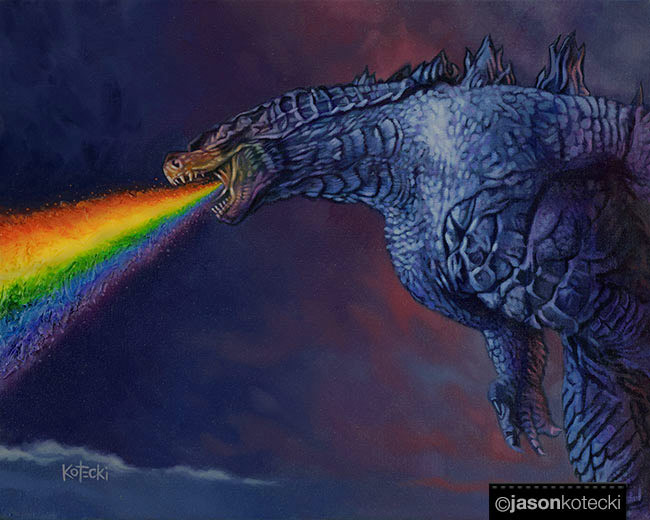
  • One of One

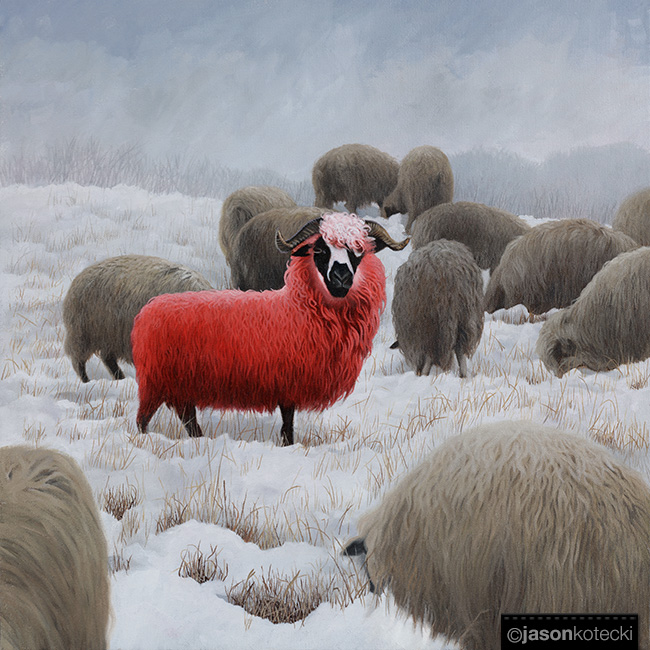
    “One of One” by Jason Kotecki. 20 x 20. Oil on canvas.
    Original is available 🟢 Shop this art!

    When I was in art school in the late nineties, the goth look was in. A significant segment of art kids wore all-black clothing, Doc Martens boots, and fingernails painted with dark colors. I found it fascinating to observe that the ones intent on bucking the system, sticking it to the man, and expressing their individuality all looked…exactly the same.

    It’s scary to stand out.

    We learn this at a young age, when simply being our weird, unique selves can lead to us being shamed and ostracised at recess, on the school bus, or even across the dinner table by a sibling or parent.

    And so, much of life is a careful effort to blend in.

    Just look at the cars we drive, most of which are either black, white, or some combination of the two.

    Or how we take fashion cues from tastemakers and trendsetters because getting caught wearing something out of style is akin to death.

    We must be careful to curate what we say in public for fear of being cancelled.

    In the case of my art school companions, we even blend together in our rebellion.

    Now, some would explain this as an evolutionary feature, not a bug. There’s safety in numbers, after all. We’ve learned to blend in because there’s danger in straying too far from the herd.

    The thing is, we’re not here to sink to our base animal instincts. We were created for a higher purpose. We were made for greatness.

    We are born originals. The problem, as St. Carlo Acutis observed, is that most of us die as photocopies.

    As an artist, I sell prints of my work. Some of them are timed releases, some are limited editions, and some are open editions (available all the time). 

    I sell a lot of them, but they’re all really just fancy photocopies. 

    And none are worth as much as the original. A print sells for less than a hundred dollars. The original can sell for thousands.

    Ask anyone who has purchased one of my original paintings, where you can see the texture of the canvas, feel the brushstrokes with your fingers, and observe the luminosity that emanates from dozens of thin layers of oil paint, and they’ll confirm: Nothing beats an original.

    Sadly, too often we settle for being photocopies.

    It’s been said that imitation is the sincerest form of flattery.

    Maybe if someone else is imitating us. 

    But if it is we who are doing the imitating, then imitation is the sincerest form of boring.

    It is good to learn from those who came before us. It’s possible to find a measure of success by imitating someone else. 

    But the best you’ll ever be is a second-rate version of them.

    This is not a call to stand out for the sake of standing out, or to pretend to be something you’re not. It’s about having the courage to be more of who you are. It’s a reminder that safety should not be our highest virtue. 

    You are free to opt for the safe path. Most people do.

    But you will not be able to escape the gnawing sense of dissatisfaction, the quiet desperation, the ever-present sense in your soul that there’s more to life, and this ain’t it.

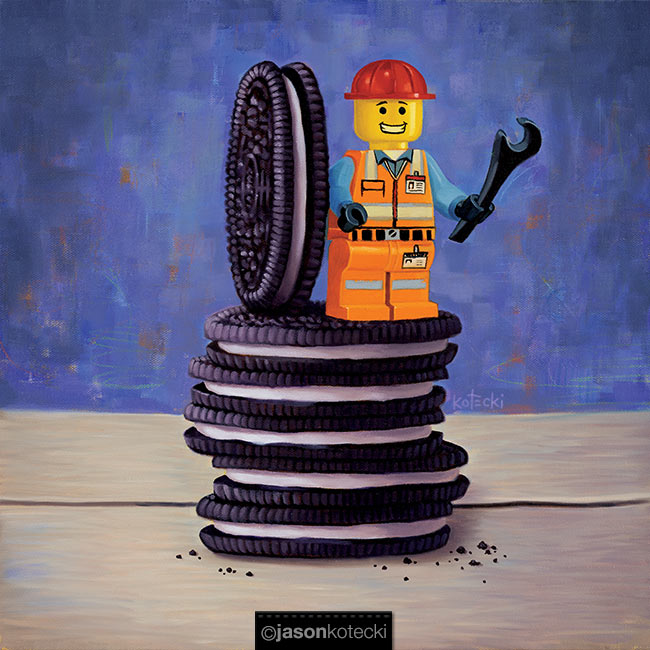
    The reason I made the hero in this painting red was because of the lesson I learned from red shoes. After years of wearing safe, plain, predictable shoes, I started pining for red ones. The people I saw wearing red shoes always seemed to be so brave and adventurous, somehow getting more out of life. I wanted that, but I was afraid. I was afraid of standing out too much, but mostly I was afraid that I’d be found out as a fraud.

    Adultitis tried convincing me that I wasn’t one of those “red shoe people.” I wasn’t fun enough, brave enough, or free enough. 

    Eventually, I stood up to Adultitis and got the red shoes. The fears ended up being empty threats. I’ve worn red shoes on stage for every speaking engagement for about two decades now. I love ’em. They make me feel more fun, confident, and free, like a guy who decided it didn’t matter what other people think. 

    Of course, red shoes are not the secret to defeating Adultitis.

    Being brave is.

    What are your red shoes? There is probably something in your life you’ve always (but probably secretly) wanted to own, do, or be, that you’ve talked yourself out of. Maybe Adultitis sold you on the idea that you’re just not “that type of person” and it would be safer to blend in.

    But maybe you actually are that type of person.

    Maybe the fear is a smokescreen keeping you from becoming all God created you to be.

    Maybe twenty seconds of embarrassing bravery will open the door to a new level of confidence and unimaginable opportunities.

    Maybe your example of standing out from the herd will be the spark that lights the way forward for someone else, giving them courage to be brave, too.

    “To be nobody-but-yourself—in a world which is doing its best, night and day, to make you everybody else—means to fight the hardest battle which any human being can fight; and never stop fighting.”

    —E.E. Cummings

    Is any of this safe? Hell no. Of course not.

    But it’s the only way to feel alive.
  • Jailbreak

    “Jailbreak” by Jason Kotecki. 16 x16. Oil on canvas.
    Original is available 🔴 Shop this art!

    Remember paint-by-numbers? 

    You know, the beloved craft project in which an image is broken down into sections, each labeled with a number. Fill in each section with the color that corresponds to the ascribed number, and you achieve something that sort of resembles a work of art.

    Kinda, but not really. 

    It might look pretty, but it’s not art.

    It’s a plan. It’s a system. It’s one way of doing things.

    But it’s definitely not art.

    There’s no risk involved. No creativity. There’s none of YOU in the work.

    When you finish building a desk from IKEA, do you stand back and proclaim that you have just created a work of art? 

    No. You were merely following instructions.

    A paint-by-number can be a fun, relaxing way to spend an afternoon.

    Unfortunately, too many of us settle for a paint-by-number life.

    We believe that if we follow the rules, do what we’re told, and stay within the lines, we’ll end up with something that sort of resembles a successful life.

    Kinda, but not really. 

    Oh, it may get you a nice job with a nice benefits package and a nice house in a nice neighborhood with a nice car and 2.5 very nice kids, but I’m not sure that I’d call that a masterpiece.

    Just as a paint-by-number gives you the illusion of having made art, this path gives you the illusion of a well-lived life.

    We didn’t come up with this on our own, of course. Society and governments would very much prefer us to adopt the paint-by-number route. We’ve been conditioned this way, beginning in school.

    The prospect of a paint-by-number life is not all that different from those standardized tests we were given, the kind that can be graded by a machine, where the objective is to fill in each section correctly.  The only difference is that instead of using a number 2 pencil, you get to use color.

    Just not all of them.

    We’re not unwilling participants, however. Part of us craves the comfort and security that comes from embracing a paint-by-number method: “Just tell me what to do to have a safe, comfortable, successful life.” 

    Unfortunately, our best life is not achieved via the safe, predictable, step-by-step path.  

    Safety is an illusion, and doing things the way everyone else is doing them is not the path to happiness. Too many people figure this out in midlife, when the paint-by-number method fails to satisfy.

    We’re not here to live paint-by-number lives.

    Earlier in my career, I searched for a paint-by-number approach. I joined the National Speakers’ Association and got to know many successful people. I tried to copy them, but while they had specific talents and interests and values that contributed to their success, I discovered I had different ones. I searched for a speaker who was also an artist to show me the way. But the few artists I did find weren’t artists in the same way I was an artist, so it didn’t translate. 

    I thought maybe I was looking in the wrong place. I looked to other artists I admired for a roadmap. That also proved fruitless; it turns out that not many artists are all that eager to stand on a stage and speak to a thousand people.

    Lots of experts were happy to sell me their program: “Paint this red and this blue and this green, and you’ll be as happy and successful as I am!”

    That fell short, too. It was as if I had red and blue crayons, but lacked a green one that seemed important. Meanwhile, I also had purple and periwinkle, but I couldn’t find a paint-by-number that also included them.

    I spent many years frustrated and discouraged, unable to find a prescribed path to success that fit my unique talents, interests, and values.

    Finally, I had an epiphany. I didn’t need to wish for or wait until I had the colors someone else had before I could be successful. And those extra colors that didn’t seem to fit were actually an advantage.

    I resonated with this realization from Fred Rogers: “I’ll never forget the sense of wholeness I felt when I finally realized what in fact I really was: not just a writer or a language buff or a student of human development or a telecommunicator, but I was someone who could use every talent that had ever been given to me in the service of children and their families.” 

    I, too, realized that the magic was in combining my seemingly disparate talents. If I took all the crayons I had — even the ones that seemed extra or out of place — I’d be able to create something wholly original. 

    That’s when everything changed, and my career exploded.

    “Escape competition through authenticity.”

    –Naval Ravikant

    I have original paintings for sale. I also sell prints, which are copies of the original. 

    They look similar.

    But one is worth exponentially more.

    “All people are born originals, but many die a photocopy.”

    –St. Carlo Acutis

    It’s easier and feels safer to copy what other people are doing by living a paint-by-number life. Fit in. Follow the rules. Keep on doing what you’ve always done. Keep telling yourself you’re not creative.

    Adultitis would like nothing more for you.

    But here’s the thing: they don’t hang paint by numbers in the Louvre. 

    This doesn’t mean we shouldn’t listen to advice, learn from others, or ever follow best practices. I’m not saying you should strive to be original for the sake of originality. 

    I’m saying you already are an original.

    Or, as Dr. Seuss said, “There is no one alive that is youer than you.”

    You were made to be a masterpiece.

    You are in the process of building a portfolio. Fill it with adventures. Take chances. Try new things. Do things that don’t make sense once in a while.

    Use all the colors you’ve got.

    When you get to the end of your life, and you’re looking back at what you’ve created, please don’t let it be filled with paint-by-numbers.

    Don’t limit your potential by trying to squeeze yourself into someone else’s tame, safe, predictable prescription for success. 

    Confidently be your awesome, wild, original self.

    And make Adultitis go running for the hills.
  • Don’t Fight Fire With Fire

    “Don’t Fight Fight with Fire” by Jason Kotecki. 20 x 16. Oil on canvas.
    Original is SOLD 🔴 Shop this art!

    If you try to do anything worthwhile, you’ll likely suffer skeptics and critics.

    When you encounter naysayers, you have a few options. You can allow them to stop you. This is generally not advised, especially if they are little more than bullies. Or you can use their doubts as fuel. 

    This is what I recommend, but with caution.

    You see, that fuel burns hot. If you rely too much on it, you can end up consumed with anger and rage. If it becomes all about proving someone else wrong, rather than pursuing something worthwhile that brings you joy, you will be the loser in the end.

    When I was younger, I idolized Michael Jordan. Besides his athletic prowess, I also admired his work ethic, determination, and persistence. But I also remember the speech he gave when he was inducted into the NBA Hall of Fame. Despite having accomplished everything a player could possibly achieve and being widely regarded as the greatest of all time, he was still holding on to grudges from decades gone by. Perceived slights from his high school basketball coach, teammates, reporters, and fellow competitors. He was still trying to torch them all to prove his dominance, spitting out petty barbs to people he perceived as having wronged him. He came across as bitter, shallow, and small.

    Those slights he used to fuel his competitive drive seemed to have consumed him, leaving him charred.

    It’s natural to want to right perceived wrongs. But as many wise people have said, “Withholding forgiveness is like drinking poison and expecting the other person to die.”

    Our culture today seems more combative than ever. Trash-talking is considered an art form. We are urged to use the haters to fuel our rise, and then, when our success is undeniable, use it to torch them. When we win, it’s open season on our opponent. We must reign fiery retorts and comebacks down upon them, shaming them into submission. The more clever the comeback, the more street cred we receive.

    But there’s a better way, and the Wright Brothers are a great example.

    As you might imagine, the race to be the first to fly was heated. The two were fiercely competitive, but they never badmouthed their competitors, choosing instead to compliment their good qualities.

    One of their biggest rivals was a man by the name of Samuel Langley. He was the head of the Smithsonian, one of the most respected scientists of the day, and by far the most well-funded individual pursuing the problem of flight. He portrayed a haughty pride over his self-perceived inevitability of success. Ultimately, he experienced a very public, very humiliating failure.

    One that opened the door for the Wright Brothers to gloat.

    As I read David McCullough’s book about them, I found myself rooting for Orville and Wilbur to do some sort of well-deserved verbal victory dance.

    They never did.

    McCullough writes:

    “Neither brother was ever to make critical or belittling comments about Langley. Rather, they expressed respect and gratitude for the part he had played in their efforts. Just knowing that the head of the Smithsonian, the most prominent scientific institution in America, believed in the possibility of human flight was one of the influences that led them to proceed with their work.

    Wilbur told Octave Chanute in a letter written some years later: ‘He possessed mental and moral qualities of the kind that influence history. When scientists in general considered it discreditable to work in the field of aeronautics, he possessed both the discernment to discover possibilities there and the moral courage to subject himself to the ridicule of the public and the apologies of his friends. He deserves more credit for this than he has yet received.’”

    How kind. How gracious. And frankly, how epically badass.

    Taking the high road and responding with kindness possesses an underrated level of effectiveness. For the Bible tells us that when you treat your enemies with kindness, “you heap burning coals upon their head.”

    Don’t let the naysayers stop you. You can turn them into motivation, but be careful about using them for fuel.

    Fighting fire with fire leaves both of you as a pile of ash.

  • Great Expectations

    “Great Expectations” by Jason Kotecki. 30 x 24. Oil on canvas.
    Original is SOLD. 🔴 Shop this art!

    I have a confession to make.

    I fully expected to marry a brunette. I was pretty vocal about it, even. No blondes for me!

    In retrospect, the women who caught my eye when I was young — Princess Leia, Lois Lane, Wonder Woman — were all brunette. Most of the girls I dated in high school were brunettes.

    But after I met Kim, who was most definitely not a brunette, I didn’t waste any time wondering if I was making the right choice in spending time with her. I didn’t delay my decision to propose because I was holding out for a brunette to come along. I didn’t miss the opportunity of a lifetime because “this wasn’t the way it was supposed to go.”

    I wish I could say I was that flexible with all my expectations.

    When I graduated from college with a degree in illustration, I expected I’d make my living as a freelance illustrator. A year into that pursuit led me to realize that I really hated taking orders drawing what other people wanted me to draw.

    So I shifted all my attention to a comic strip I had been developing called Kim & Jason. I expected that I’d make my mark in the world by following in the footsteps of Charles Schulz and Bill Watterson.

    I put everything into it for six years. Along the way, I fell into speaking, and it started to bring in money. Way more than the comic strip. I eventually made the difficult decision to retire Kim & Jason so I could double down on what was working.

    With that decision, it felt that the naysayers were proven right: I really couldn’t make it as an artist. But the only reason they seemed right is that my expectations were wrong.

    I once heard a talk by Fr. Mike Schmitz in which he said, “Expectations are a thief of peace.”

    I recoiled at the idea at first, because I associate expectations with hope, and hope is good. If expectations are the thief of peace, is the antidote to become a pessimist? Lower the bar? Settle for mediocrity? Slack off? That seemed less than ideal.

    Then it occurred to me: An expectation is a prediction.

    It’s a prediction about what you think — and maybe even hope — will happen. Sometimes it’s little more than wishful thinking, but it could be a legitimate educated guess with actual data to back it up. And sometimes your prediction is correct and your expectations are met. 

    But it’s still a prediction. 

    One you might be making with a wildly insufficient lack of information.

    Before I actually started freelancing, I didn’t know how I’d feel creating things that didn’t light me up. When I began my comic strip, I didn’t realize how quickly the internet would decimate newspapers and change the landscape. And back then, I didn’t know anything about the business of professional speaking.

    Take a quick review of your life right now. How much current frustration, pain, or sadness is the result of circumstances turning out differently from what you expected?

    Is holding on to what didn’t happen keeping you from appreciating all the great things that did and are happening now?

    Maybe you can relate to this simple example. Recently, I had a wonderful, tremendously productive day that felt like a failure. One project took waaaay longer than I expected, blowing my to-do list to smithereens. Although some tasks got pushed to another day, I accomplished a few other things I hadn’t planned and took advantage of the unseasonably warm day to enjoy an invigorating walk in the sunshine. It ended with a delicious dinner with my beautiful bride.

    By all objective measures, it was a very good day. But it didn’t feel like it.

    The thing that soured it? 

    My expectations. 

    The day simply didn’t line up according to the timing and order of my expectations. Because some to-dos were left unchecked — even though other great elements were added — somehow it felt like I failed. 

    This is not a cautionary tale against planning or a list of pro tips to bulletproof your plans. It’s a reminder that it’s hard to appreciate accomplishments when they are in the same room as even one unmet expectation, one missed goal, or one unforeseen event that was out of your control. 

    In the battle between reality and expectations, reality is undefeated. 

    Expectations really are a thief of peace. They can ruin a day or derail our dream if we’re not careful.

    I believe that God plants dreams in our hearts. The details we imagine in the early stages create enthusiasm that serves as fuel to get moving. But oftentimes, those details reflect immaturity, a lack of imagination, or are limited by the fact that we don’t yet have the relationships, technology, or knowledge that will eventually help us to get there.

    Art was my first love; the first talent I discovered, and the one that was most nurtured early in my life. It’s easy to see why I would have the expectation of making it as an artist.

    But that was before I took a creative writing class in high school.

    It was before I discovered a gift for public speaking in college.

    It was before I realized “professional speaker” was an actual job.

    And it was before I figured out that my art, writing, and speaking could be combined to create something unique and bigger than the sum of their parts.

    Like many people, when I was a young adult, I expected my career to go a certain way. It went a different direction, filled with opportunities and experiences I didn’t even know were possible when I was an 18-year-old kid.

    But thirty years ago, if I had been given the choice between my original expectations and a full picture of how my life turned out, I’d choose my current reality. 

    Every. Single. Time.

    And yet, here’s the crazy part: because it doesn’t match up with my original expectation — you know, the one I had when I was a naive, inexperienced teenager — I am sometimes tempted to wonder where I went wrong.

    Expectations are a thief of peace.

    Holding on to expectations that don’t match reality is a terrific way to go through life frustrated and disappointed.

    When we become resentful of missed expectations, we are in danger of also missing other opportunities and blessings we didn’t see coming.  

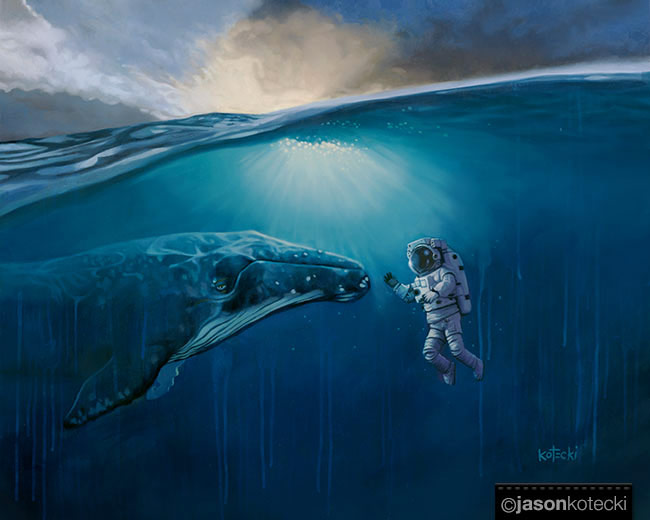
    The astronaut in this painting represents a dreamer.

    This dreamer has always possessed a spirit of adventure and imagined a life spent exploring the unknown, pushing past the boundaries of human understanding, and experiencing the supernatural enchantment. The dreamer expected this would happen as an astronaut in the context of space.

    Instead, the dreamer’s story ended up in the ocean after a visit to Sea World, and now days are spent adventurously exploring the unknown and experiencing enchantment in encounters with sea creatures.

    So…did this dreamer’s dream go unfulfilled?

    My friend Jessica has some good advice about how we should handle our expectations: “When you write that first story, print it as a draft, triple-spaced with extra wide margins. You do this because you’re anticipating edits.”

    Letting go of expectations is not about being pessimistic. One can be optimistic without becoming a slave to expectations. My optimism is grounded in the fact that God has ALL the data, loves me more than I deserve, and tells the best stories. We can make plans and hope for things to go a certain way, while still holding loosely to them, trusting that God may have different (and better!) ones. 

    If you want more peace in your life, don’t abandon hope. 

    Don’t stop striving for greatness. 

    Just stop putting faith in your predictions.
  • The Armada

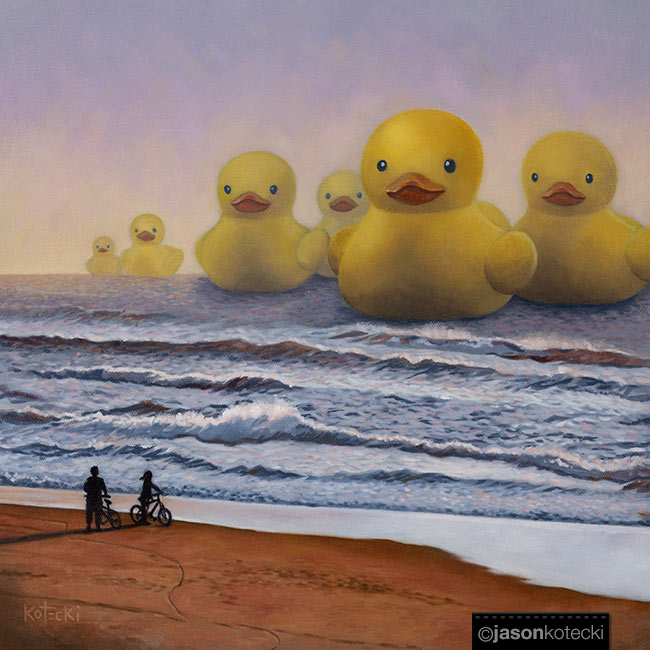
    “The Armada” by Jason Kotecki. 16 x 16. Oil on canvas.
    Original is SOLD 🔴 Shop this art!

    Quick! You’re on the beach with a friend and you spot something approaching on the horizon. To your amazement, you make out an armada of giant rubber ducks coming to shore. What is your reaction?

    Are you excited? Overjoyed? Concerned? Skeptical? Worried? Afraid?

    Are they visitors or invaders?

    Do they bring good tidings or dark intentions?

    Sometimes a painting can just be a fun picture that makes you smile. And sometimes it contains a deeper meaning. I asked people on social media to share their perceptions of this painting, and it may or may not surprise you that their responses varied greatly:

    • “Pure joy. I have a jacket printed with rubber ducks. They always make me smile, as does the ocean, and riding my bike!”
    • “Here comes whimsy!”
    • “Hope is on the horizon.”
    • “I’m a little worried.”
    • “Terrified.”
    • “Invasion from a Trojan Horse.”
    • “Plastic pollution and impending doom from climate change.”

    It turns out that the meaning of this painting, as well as the meaning of almost everything in life, is largely determined by you. 

    Our perceptions impact our actions. For example, whether you’d run for cover or organize a welcoming party would depend on whether you see these rubber ducks as friends or foes. One side sees the other as hopelessly naive. The other side sees the other as paranoid. Both sides have a point.

    If we respond too enthusiastically, we might fall into a trap.

    If we respond with animosity, we may sabotage any chance of something good happening.

    We can assume the best, assume the worst, or…perhaps the best, wisest, most productive thing we can do is keep an open mind and wait and see.

    Now, let’s put the shoe on the other flipper. Imagine if you’re one of those ducks. You’re fun. Lots of people like you. You want to be helpful and bring joy to others. You’re new in town, but you have good intentions. But what are those locals on the shore thinking?

    Do they see you as a visitor or an invader?

    Do they think you bring good tidings or dark intentions?

    We’ve all been the new guy. The new kid in class. The newest employee. Or, most recently for us, the new family in town. I like to think of this painting as a metaphor for our mission to bring wonder and whimsy to distant shores. I unveiled it at the first Wondernite we hosted in Sheboygan, having moved from Madison two years earlier. As relative unknowns, we wondered if anyone would come.

    It turned out to be our biggest and best one yet.

    It’s scary to consider what the natives might think of you. You feel like you stick out like a sore thumb because it seems obvious that everyone can tell you’re not familiar with the local culture, the shorthand, the inside information that everyone else takes for granted. 

    It’s tempting to want to appear big and important. Maybe pretend to be something you’re not. After all, you’ve got a clean slate. None of these new people know all your history and baggage. You never get a second chance to make a first impression, so it’s a chance to put forth something impressive.

    I’ve found it’s easier, more effective, and frankly, less exhausting to just be yourself. People are drawn to authenticity, and we are very good at spotting a fake. Your weird flag may not inspire everyone, but it will attract your people.

    It’s more beneficial to check your expectations.

    If you expect the natives to be hostile, you’re likely to protect yourself by being hesitant and withdrawn, which may make you appear cold and aloof to others. But be warned: if you assume the locals will be hostile and unwelcoming, guess what you’re likely to get.

    You see, there is this thing called confirmation bias. (Perhaps you’ve heard of it.) It’s applicable whether or not you see yourself as the kids on the beach or the newcomers floating to shore. How it works is that we make an initial judgment or tell ourselves a story about a person, group, or situation. Then we reflexively look for evidence that supports our case and confirms our bias. 

    Meanwhile, we subconsciously filter out any information that runs contrary to our story. We interpret new information as being supportive of the opinions we already hold, and it doesn’t matter how poorly it fits. Our dutifully protective brain finds a way without us having much of a say.

    If you think your spouse is ignoring you, you’ll be on the lookout for all the evidence to make your case.

    If you expect to have an awesome day, your antenna will be up and scanning for proof all day long.

    If you think Republicans are the worst, you will notice and remember every example that proves your point.

    If you think Democrats are the enemy, well, you get the point.

    So…what if we paused at the very beginning to realize we don’t yet know the truth and take a wait-and-see approach? Thanks to confirmation bias, if you expect the best in others, the odds are better you’ll find it.

    This might just be a fun, whimsical painting that makes you smile.

    Perhaps something light-hearted to hang in your bathroom.

    It might also be a reminder to always be yourself while giving other people a chance to do the same.

  • Horse & Hummingbird

    “Horse & Hummingbird” by Jason Kotecki. 30 x 30. Oil on canvas.
    Original is SOLD 🔴 Shop this art!

    I compare myself to other people all the time. Friends, colleagues, neighbors, and the people I went to high school with.

    According to the Bible, God made hummingbirds on the 5th day. He made horses on the 6th. It seems obvious that He made a horse because He wanted something different than a hummingbird. I don’t expect he chastises horses for not being able to fly or expects hummingbirds to hang their tiny heads in shame for all the times they don’t win the Kentucky Derby.

    Quite frankly it’s kind of ridiculous to compare the two. So why do we do it with one another? It’s no less ridiculous.

    But it’s a great way to waste time we could be spending to improve our lives and make the world better by embracing and sharing our own unique gifts.

    Later on in the Bible, we learn that “God has given us different gifts for doing certain things well.” (Rom 12:6) You are not like anyone else. You are supposed to do what you’re made for. And no one else has the same mission as you do.

    We don’t need you to be a horse. We don’t need you to be a hummingbird. We don’t need you to be a better version of that girl you went to high school with.

    We just need you to be you.

    process

  • Talent Stack

    “Talent Stack” by Jason Kotecki. 16 x 16. Oil on canvas.
    Original is SOLD 🔴 Shop this art!

    Sometimes people look at successes I’ve had and say, “Must be nice,” as if they happened by magic.

    What they don’t often see is the framework that helped enable that success. Fortunately, it’s a framework anyone can develop.

    We often assume that in order to be successful, we need to be great at one thing. That can work—see LeBron James, for example—but that path is extremely difficult and unlikely. The truth is, you only need to be pretty good at a handful of ordinary skills.

    You just need to build a talent stack.

    Scott Adams, the creator of the comic strip Dilbert, popularized this concept which states that you can ensure success by assembling a “stack” of two or more complementary skills and be in the top 25 percent or so in each. Do that and you’ll be unstoppable. 

    In his case, he readily admits he’s not the best artist, the most skilled writer, or the savviest business expert. But his unique combination of those skill sets has contributed to his success as a cartoonist.

    My own talent stack began with a few crayons. “Artist” was my first and is my longest-lasting identity. I’ve always enjoyed it, and I got praised for it, so I’m sure that made me want to keep doing it.

    In high school, I had a chance to take a creative writing class, which I enjoyed exponentially more than my math classes. I kept honing that skill, which eventually became an indispensable part of my talent stack.

    In college, I gave a talk as a leader on a retreat and received great reviews. Even though I am naturally shy, I enjoyed the process of crafting stories in spoken form. It was like creative writing but delivered out loud. 

    To the surprise of me, my parents, and the high school speech teacher who gave me a “C,” public speaking emerged as the primary driver of our business. I went from giving cartooning workshops in schools to speaking at churches to keynoting conferences for associations and corporations all over the place. 

    Now it took me a few years to realize that these three talents—art, writing, and speaking—were not separate skills that operated independently, but part of a talent stack, that when used in harmony became even more powerful. I am not the best artist in the world, or the best writer or speaker. But I’m pretty good at all three, and that combination has been the secret sauce of my success. Once I was introduced to talent stacking, I eagerly looked for complementary skills to add. By devouring hundreds of marketing books and through the school of trial and error, I’ve achieved the equivalent of an MBA in marketing. Am I the best marketer in the world? No, but I easily fall into the top 25 percent.

    Kim and I went on several organized retreats in college. That background gave us a foundation to build on when we started hosting our own events. After putting on numerous meetups, workshops, book tours, fundraising galas, and Escape Adulthood Summits over the past two decades, we’ve gotten pretty good at managing logistics and creating experiences that move people.

    Most recently, we used the pandemic as an opportunity to get good at livestreaming, which added a whole new dimension to our business.

    Drip by drip, these new skills made the other skills even more valuable and ushered in greater success.

    Of course, your talent stack will look different from mine, but the premise is the same. Start with natural strengths and abilities and work to make them better. Think about how they can work together in unexpected ways, even if they seem unrelated. 

    Everyone in your industry probably competes on many of the same skills. What do you have that’s different? Oftentimes the magic lies in a skill or interest that seems to come out of left field. For instance, many professional speakers are also writers. But my artistic gifts and whimsical, childlike perspective allow me to offer something extraordinary.

    This isn’t just about what you were born with. Look for other skills you can attain that complement and enrich the others. That might involve a traditional degree or certification, but it can also be done by reading books, listening to podcasts, taking courses online or at your local community college, or practicing, in public, every day, as we did with our pandemic project of livestreaming.

    If you’re stuck, here are some evergreen choices that will help:

    • Presentation skills
    • Technology skills
    • Foreign language skills
    • Sales or marketing skills
    • Writing skills
    • Business management skills
    • Nunchuck skills

    Remember, you don’t have to turn yourself into the foremost expert on any of these skills. Just be in the top 25 percent. Said another way, in a world of around eight billion people, you only need to be among the top two billion. If one hundred thousand people live in your city, you just have to be in the top twenty-five thousand. 

    In other words, pretty good is good enough.

    Keep in mind that this is a lifelong project. If you’re doing it right—meaning you stay curious and keep growing—your talent stack will continue to evolve and strengthen throughout your career and life. One last word of warning, however…

    When you have a decent stack of three to five skills going, you can bank on someone, somewhere observing what you’ve been able to accomplish and saying, “Must be nice.”

  • Hallelujah Chorus

    “Hallelujah Chorus” by Jason Kotecki. 24x 24. Oil on canvas.
    Original is SOLD 🔴 Shop this art!

    What makes life worth living?

    When we look back on a given year, it’s easy to identify the massive oak trees and tall pines that stand as signposts: the weddings and the funerals, the epic vacations, and the major accomplishments. 

    But we often overlook the small blessings – the birds within the trees, if you will.

    Our minds can only hold so much information, and in my experience, our hard drive space seems to dwindle with each passing year. The brain prioritizes the stuff it determines is important, discarding the rest. Those giant oaks and majestic pines take precedence.

    I’ve been rescuing things from the discard pile through a simple practice that makes it easier to spot those aforementioned birds.

    Once a day, I write down one happy moment from the day before. That’s it. One moment. One line. No paragraph or story or context. Most aren’t even full sentences. It’s like a verbal Polaroid, a snapshot in time that describes a simple moment of happiness. 

    But in the same way that a picture is worth a thousand words, that simple snapshot composed of a handful of words contains within it a treasure trove of details, emotions, and story.

    I do this in a Bullet Journal, with each Happy Moment taking up no more than one line on a page. One could adapt it by writing each Happy Moment on a Post-It note and dropping it into a jar with the intent of reading them when you need a pick-me-up.

    The practice takes me less than thirty seconds a day. The payoff comes at the end of the month or the year, when I re-read them all. 

    Kim and I recently spent time reviewing the previous year. The publication of Wonderhunt stood out, as did our Escape Adulthood Summit in Utah and family trips to Key West and Washington, D.C. But my favorite part was reading all 365 of my Happy Moments for the year.

    Here are a few highlights:

    Playing catch with Ben amidst the kites at Leland Park.
    The scallop dish with leeks and apple risotto at the Black Pig.
    Ginny rolling a strike on frame 10 with no bumpers.
    Staff dinner at the supper club.
    Seeing the walls finally up in the studio.
    Watching Lucy ride Chester with confidence.
    Family time on the front porch, eating push-ups.

    As you can see, none of these rise to the level of “major milestone.” Frankly, they’d probably be forgotten had I not taken the time to write them down at the time.

    But these happy moments become souvenirs of a wonderful journey. Perhaps even more than the achievements and milestones, they give me a feeling of aliveness and a sense that my year was spent well. They are reminders of what makes life worth living, and that I have been blessed in myriad ways, despite the defeats and sorrows that also populated the previous year.

    It’s easy to overlook the small songbirds hidden in the forest of our lives. But when we invest a few seconds to jot down one happy moment a day, reading them at the end of the month or year is magical. It’s like experiencing a sublime symphony, with each note harmoniously contributing its voice to a melody that slowly builds to a soaring crescendo of gratitude.

    It becomes a hallelujah chorus, exulting in the glorious gift of being alive.
  • Shocked Chicken

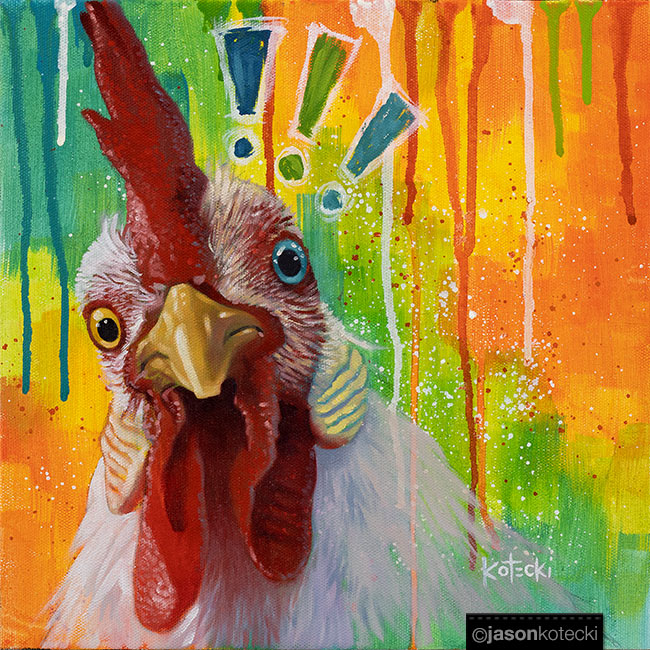
    “Shocked Chicken” by Jason Kotecki. 12 x 12. Oil on canvas.
    Original is SOLD 🔴 Shop this art!

    Thomas Edison has been attributed with saying, “If we did all the things we are capable of, we would literally astound ourselves.” 

    This is true. The potential within each one of us is enormous. 

    But I’ll go one step further. I say that we’d be astounded if we knew how good we already are. Maybe the marketing messages we’ve been bombarded with over the years have convinced us that we really aren’t good enough. Maybe we haven’t received enough positive compliments. Maybe we think the people who do compliment us are just being nice, or don’t know the real us. 

    Please…stop.

    My confidence does not rest in your resume, your highlight reel, or your dashing good looks. It rests in the divine Spirit of your Creator, which dwells within you. 

    You matter. 

    This may come as a shock to you, but you have a special brand of awesome that no one else has. 

    And this world needs it!

  • Greatest Of All Time

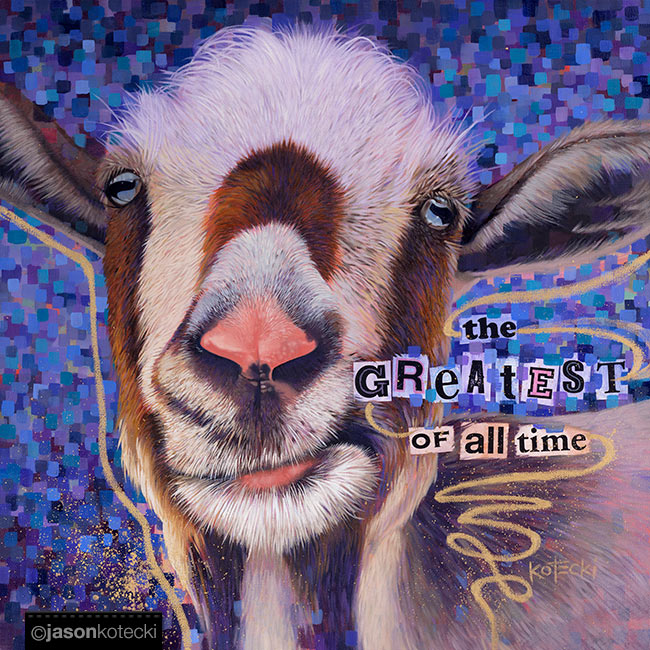
    “Greatest Of All Time” by Jason Kotecki. 24 x 24. Oil on canvas.
    Original is SOLD. 🔴 Shop this art!

    How many Super Bowl rings does it take to become a goat?

    I am not referring to those four-legged cheese-making mammals with a taste for tin cans.

    I’m talking about the label of “GOAT” – the Greatest Of All Time.

    As I write this, Tom Brady recently retired after twenty-two seasons in the NFL. He was the 199th pick in the draft, yet ended up with seven Super Bowl rings and threw more touchdown passes than anyone in history. He never played on a losing team. He is widely regarded as the GOAT, at least when it comes to quarterbacks.

    Frankly, I’m still getting used to being labeled a “goat” as a good thing. In 1986, Bill Buckner was called a goat for letting an easy ground ball roll past him in a World Series game, and it definitely wasn’t meant as a compliment. (Ah, the ever-present thin line between hero and villain.)

    Debating the greatest of all time is a juicy topic for sports talk radio, but what makes the discussion so compelling? Why such an obsession with greatness?

    Besides the fact that we like comparing things (and arguing!), greatness stirs something within us. We are inspired when we see it manifested, be it in the long and decorated career of Tom Brady or in the gold medal performance of figure skater Nathan Chen.

    But greatness stretches far beyond the sports world:

    🥘We see it in a delicious dish prepared with ease by Gordon Ramsay. 
    ✈️We saw it in the remarkable daring and bravery of Amelia Earhart. 
    🐯We saw it in the spellbinding gentleness and kindness of Fred Rogers. 
    🙏We saw it in the compelling selflessness and compassion of Mother Teresa. 

    The greatness of these individuals is so profound and self-evident, it’s easy to assume they are rare geniuses who possess mystical talents. Their level of excellence appears unattainable for us mere mortals. Their talent is unmistakable, but the individuals we place on the pedestal of greatness are merely human beings whose extraordinary results came from the consistent practice of ordinary things.

    Our preoccupation with debating the greatest of all time is a trap that prevents us from striving for greatness ourselves.

    It’s easier to argue about the top five saints of all time than to aim to become one. 

    Am I suggesting you are GOAT material?

    Actually, yes. 

    Hear me out. Usually, the title of GOAT is bestowed on someone famous, known for their professional accomplishments, and often in a domain conducive to measurable outcomes…

    But what about people who aren’t famous?  Isn’t it possible that some Incan woman possessed unmatched skill as a potter, with her only flaw being born at a time when she couldn’t have her own YouTube channel?

    And what if your skill is not as esteemed or public as that of a professional athlete or celebrity chef? Could an unknown Amish grandmother technically be the greatest bread maker of all time? And tell me, who is the greatest school custodian of all time? The greatest dental hygienist of all time? The greatest administrative assistant of all time?

    What about domains lacking metrics that are easy to quantify? When it comes to football, we can compare wins, passing yards, touchdowns, longevity, playoff appearances, awards, and Super Bowl rings, all while debating the relative importance of each. But how would one go about naming the Greatest Mother of All Time? The Greatest Father of All Time? The Greatest Wife or Husband or Friend or Next Door Neighbor of All Time? 

    Most of us don’t have trading cards with our pictures on them, and if we did, they wouldn’t have stats on the back totaling Boo-Boos Kissed, Lunches Prepared, Loads of Laundry Completed, Encouraging Words Spoken, or Hugs Delivered. 

    Without these metrics a Google search away, what would it take for you to become the GOAT?

    If you’re normal, you might be thinking, slow your roll, buddy. I already feel like I’m falling short, day after day. I barely qualify as a good parent, let alone the greatest of all time. 

    I hear you. Sometimes I feel like I’m leading the league in dropped balls.

    The good news is that the seeds of greatness are in our DNA because we each have a spark of the divine within us. 

    Simply put, you were born for greatness. 

    Don’t let my famous examples fool you. The dictionary defines great as “remarkable in magnitude, quality, skill, or effectiveness.” The steps to achieve greatness are accessible to everyone. Including me. And you. The steps are simple, but not easy.

    🔎 Identify Your Gifts. What talents have you been given? If they don’t immediately come to mind, settle into a quiet place. Take stock of the things you do well. Where do you shine? What comes easily to you? What do you love doing? What do people compliment you for? These are your gifts. Remember, “better than everyone else in the world” at anything is not a requirement for greatness.

    🎁 Honor Your Gifts. If you treasure a gift, you don’t take it for granted or throw it in a corner. To give your gifts the respect they deserve, use them, share them, and work to improve them. Shoring up weaknesses can be helpful, but keep in mind that Mister Rogers wasn’t as bold and gregarious as Gordon Ramsay, who was not as gentle or vulnerable as Mister Rogers. Greatness lies in maximizing your strengths. 

    🔒 Be Committed. Greatness requires the willingness to do what no one else will. Not many are willing to stick to the diet and workout routine that helped Tom Brady stay so productive for so long. Even fewer are clamoring to comfort the sick and clean the sores of people living in the slums of Calcutta, as Mother Teresa did. Amelia Earhart was willing to attempt things no one else had ever done, consequences be damned. Greatness requires immense courage and bravery. You have to be willing to challenge conventional wisdom, buck the status quo, and take a stand without any guarantee that anyone will follow you. 

    🧗 Keep Going. Nathan Chen’s debut Olympic performance was a disaster, riddled with falls. Gordon Ramsay didn’t make a perfect omelet on his first try. Tom Brady didn’t win every playoff game he was in. The great ones aren’t people who never get knocked down. They’re the ones who keep getting up when they do. Anybody can have a good day, a good week, or even a good year. The greats show up year after year. They are persistent, consistent, and stand the test of time. 

    🚀 Empower Others. Through his example alone, Fred Rogers inspired millions of people, most of whom never met him, to treat others with more respect and kindness than they might have otherwise. Tom Brady’s drive, high standards, and work ethic empowered his teammates to be better. Mother Teresa built a community of sisters who followed her lead and carried on her work after she was gone. Your own humble journey toward greatness may be your most enduring legacy.

    We can’t count on being considered the greatest. But that doesn’t mean we shouldn’t strive to be great.

    It’s unlikely that you or I will ever be publicly regarded as the “GOAT” of anything. Unless you’re Muhammad Ali – “I am the greatest!” – the title is bestowed on you by others. We can’t control it. Who cares?

    When it comes to greatness, everyone else is irrelevant. I agree with Hemingway, who said, “There is nothing noble to being superior to your fellow man; true nobility is being superior to your former self.”

    There is one category you can be assured of being the GOAT, and that’s the category of YOU.

    Your job is to be the Greatest You of All Time.

    If you learned a new thing today or did something to improve your craft or make yourself better than you were yesterday, congrats. You are officially the greatest YOU of all time.

    If you got up today after being knocked down yesterday, your legend just gained a new comeback story, and you’re officially the greatest YOU of all time.

    If you used one of your gifts to make someone’s day or lessen the burden of another soul, your scoreboard of contributions to the world just increased by one, officially making you the greatest YOU of all time.

    Instead of wasting our time arguing over who is the GOAT, may we use their example as inspiration to cultivate our own greatness within us.

    Identify your gifts. Honor them by honing them and sharing them with others. Be committed. Keep going. And empower others along the way. 

    Regardless of whether or not you play in the NFL or make soufflés on TV, those principles are controllable. If you practice them, I can’t guarantee you’ll ever be deemed the GOAT by pundits, historians, or late-night callers on talk radio. 

    But I will guarantee that people will be inspired by the greatness they see within you. 

    No Super Bowl rings required.