Topic: Comparison

  • Smack Daddy

    “Smack Daddy” by Jason Kotecki. 12 x 12. Oil on canvas.
    Original in Private Collection. 🔴 Shop this art!

    Have you kissed a frog lately?

    This painting was inspired by Dig ‘Em, the cartoon mascot of Honey Smacks. But it represents something deeper than a favorite Saturday morning breakfast cereal from my youth. Whether it’s a beautiful princess or a handsome prince disguised as a slimy wart-ridden amphibian, frogs often find themselves in fairy tales as hidden forms of something else.

    Fairy tales aren’t real, but sometimes real life does mimic them.

    For example, do you know someone in your life you weren’t very fond of when you first met? When I was in Little League, Scott D. was the best player on the best team (which sadly, wasn’t mine). I was certain he was part-cyborg – no human was that good – who drank plutonium for breakfast. I pitched against him a few times.

    It never went well.

    I tried hitting against him, too (with “tried” being the operative word). He was the only kid in the league who threw a real curveball, and you couldn’t actually see his fastball, only hear it zip by you as you stood Jello-legged in the batter’s box. He fielded every ground ball that came his way and hit home runs over buildings, always with an air of ease and an ever-present smile plastered on his face.

    I hated him and that stupid, smug smile.

    Fast forward a few years, and we ended up on the same high school baseball team together. He was still a great player, but I discovered that he wasn’t part-cyborg. He was actually a super nice guy, and we became friends. Scott was the kind of person who made you feel better than you actually were. He was ten times the ballplayer I was, but he made me feel like we were equals. I was a second baseman, and we developed a sneaky pickoff maneuver when he was pitching. With nothing more than a knowing glance, we claimed many a baserunner with our clever trap. After the umpire called the out and our opponent slinked shamefully off the field, we always shared a smile.

    Some may have even considered it smug.

    Like a frog in a fable, we regularly encounter situations in which things aren’t as they appear and surprise us when their true identities are revealed. Enemies transform into friends. Setbacks turn into steps forward. Challenges become unexpected gifts.

    Over the course of the pandemic, stories of pain, loss, and anger have been plentiful. We know those stories well; they’re the ones trumpeted by the media and passed along on social media like a dirty crack pipe. But I love asking people to share good reports from the ordeal. In my virtual and in-person speaking programs, I can always count on receiving a stream of replies from attendees; stories of happy moments, unanticipated opportunities, and surprising blessings.

    Sometimes life feels more like a horror movie than a fairy tale, with our happy ending having gone missing.

    But pay attention; it might be hiding right around the corner.
     
    It can be hard to find hope in present circumstances. That’s why it’s helpful to look back on the surprise twists we’ve already encountered, to remind us of their presence and give us hope.
     
    The interesting twist in my story about Scott is that he didn’t change; only my perception of him did. And that’s the big difference between fairy tales and real life. In real life, it’s usually not the frog that transforms, it’s us.

    Might be worth keeping that in mind the next time you find yourself in a swamp, face-to-face with a frog.

  • Pretty Darn Great

    “Pretty Darn Great” by Jason Kotecki. 40 x 60. Oil on canvas.
    Original is SOLD 🔴 Shop this art!

    This shark is awesome. You can tell how awesome he is by his gold teeth. Obviously, the male sharks want to be him, and all the ladies want to be with him. The fact that he is a success is a foregone conclusion to everyone.

    The joke is on the shark, though, because these teeth are not long for this world. You see, sharks continually shed their teeth (some shedding approximately 35,000 teeth in a lifetime!) That’s a lot of lost bling. What a shame!

    The tragedy is that gold grill or no, he already was great. He just didn’t believe it.

    I don’t know about you, but I make this mistake all the time.

    I chase after shiny objects that don’t last to prove my worth, even though deep down I don’t always feel so worthy.

    When I was in seventh grade, I would have given anything for a pair of Air Jordans. I didn’t feel cool, but I was certain these shoes would make up for it. I never got them. It’s just as well, I guess, because they wouldn’t have fit me a year later. 

    Back at the turn of the century, Apple came out with the iBook. The lime green one was awesome. I printed out a picture and put it on my vision board, imagining that my possession of it would make me hip and trendy. Never got it. Of course, if I still had it today, it would be little more than a decorative doorstep. 

    I have dreams of owning a Porsche 911 convertible someday. I think they are beautiful cars, and I love driving convertibles (my dad used to have one). But can I be honest? Sometimes I wonder if the real reason I want it is to have something to show everyone how great and successful I am.

    Now, my faith teaches me that I am wonderfully made in the image of my creator. Frankly, it’s a little hard to believe, most days. After all, I wear bifocals now. My hair is thinning. I eat lots of gluten. 

    Interestingly, my perspective changes when I think about my own kids. Are they perfect? Hells no. (They take after their old man after all). But they are great. It’s not hard at all for me to see their amazing qualities. And the kind of shoes they’re wearing has nothing to do with it. 

    Why is it so easy to see the positive traits of others and so hard to see them in ourselves?

    There are people out there who are a little too big for their britches. But even in those cases, once you collect a certain amount of wisdom, you realize that all the bombast and overconfidence are merely masking their own unworthiness.

    Indeed, most of us are overwhelmed by our flaws and sell ourselves short. We believe the TV and magazine ads that tell us we need to fix this, tuck that, and acquire the new gizmo to feel complete. I don’t know if you can relate, but I often feel suffocated by thoughts that I’m not enough. Not smart enough. Not talented enough. Not brave enough. Each one is like a weed, crowding out the truth. 

    The good thing about this feeling of “not enough” is that it helps us make room for God. His power is made perfect in our weakness. He picks up the slack and nullifies our deficiencies. We are truly in danger when we think we can do this thing called life alone. 

    You and I, we are already great. And not in some lame, everybody-gets-a-participation-trophy way.

    First, some perspective. Do you know the odds of you even being here? Dr. Ali Binazir crunched the numbers, and when you factor in the probability of your dad meeting your mom…

    …and that they stayed together long enough to have kids…

    …and the fact that one of the 100,000 eggs your mom produces in her lifetime…

    …met the one of the 4 trillion sperm your dad made during the years you could have been born…

    …there is a 1 in 400,000,000,000,000,000 (1 in 400 quadrillion chance) of you being alive.

    The chance of you being attacked and killed by a shark is about 1 in 4,000,000.

    Statistically speaking, you are a miracle. Having beaten odds like that suggests there is a reason you are here. And indeed, there is. You have something to offer that the world needs.

    You see, the real reason for your greatness is that you were purposefully and wonderfully made by a loving God. Within you – amidst any so-called flaws you dwell on – is a spark of something divine. That, my friend, makes you priceless.

    “When I was a child my parents loved me not because I was good but because I was Madeleine, their child. I loved them, and I wanted to please them, but their love of me did not have to be earned. Neither does the love of God. We are loved because we are his children, because we are.”

    – Madeleine L’Engle

    You don’t have to keep trying to prove yourself. You can just be. 

    You may not be perfect, but you are already great.

    Gold teeth or no.

  • All-American

    “All-American” by Jason Kotecki. 40 x 40. Oil on canvas.
    Original is SOLD 🔴 Shop this art!

    This bison is terrible at golf. But that’s okay because he’s playing a different game.

    In a fitting reflection of the diversity we enjoy in this county, the American Dream has splintered into a hundred different versions. I like to think of these options as games. Rather than tracking three-pointers, we might measure things like money, body weight, square footage, degrees, status, accolades, connections, sales, prestige, and fame. In the old version, the white picket fence served as the trophy to prove that you won.

    This is your life. You decide what game you want to play. But you can’t play and hope to win them all. If you’re not careful, you can get duped into playing a game you don’t even care about and end up making choices that distract you from the game you do.

    The cool thing is that once you identify the game that matters to you, you can let go of all the burdensome envy and guilt you feel when you compare yourself to people playing different games. I’ll admit it: I’m getting blown out in the games that are being played by some of my friends, family, and peers. You might be, too. But the game that matters to me? I’m leading the league.

    Two lessons here: Get really clear on what game you’re playing. And don’t beat yourself up for being in last place in the games you’re not.

  • 93% Weird

    “93% Weird” by Jason Kotecki. 24 x 40. Oil on canvas.
    Original is SOLD 🔴  Shop this art!

    Many fruits have a similar vibe. You get some variations in color and texture, but “round” is pretty much the regular shape.

    Even the tomato, which I grew up being taught was a vegetable, wants to get in with the fruit group. And upon a quick glance, we say, “Sure, whatever, you seem to fit the description.”

    And then there’s the pineapple.

    Compared to most fruits, pineapples are weird. Unfortunately, weird isn’t usually a compliment.

    Before I take the stage for a speech, at the very end of my introduction, there is a passage that talks about me “spending time with my beautiful wife and three weird kids.”

    It’s always fun – and telling – to see how the introducer handles this bit. Sometimes they read it as is, but other times they are quick to uncomfortably interject, “I didn’t write that!” I’ve even had some who eliminate it altogether. 

    Ultimately I exclaim to them that, in our household, being called “weird” is a badge of honor. For example, one day, my wife was telling my oldest daughter that it’s OK to be weird. It makes life more interesting, she said, and like Rudolph the red-nosed reindeer, the things that make us weird are often our greatest superpowers. She informed Lucy that being weird makes life better.

    The next day, we heard Lucy asking her little brother, “Ben, are you weird?”

    “No,” he replied, innocently.

    “Then you’re going to have a horrible life.”

    Now don’t get me wrong. It is possible to be too weird. “Licking-the-salt-from-almonds-and-putting-them-back-in-the-bowl” kind of weird. Or “owning-thirty-seven-cats-and-dressing-them-all-to-look-like-Taylor-Swift” weird.

    So the rule of thumb in our family is that you should shoot for 93% weird; anything after that is just too much. 

    The cold hard truth is that most of us aren’t anywhere near that level of weird. 

    When we were kids, at the very beginning, we were all weird. We made up weird games, had weird bedtime routines, enjoyed weird hobbies, and dressed up in weird clothes in weird combinations. But eventually, someone sees us living our bliss, decides it’s weird and shames us. We get made fun of in the schoolyard, on the bus, or across the dinner table. For the first time, it occurs to us that some of the things we do might be looked upon with contempt by another person.

    From then on, we start paying attention. We start noticing what’s “in” and what’s not. We take heed of the things that could get us ridiculed, singled out, and shamed. And we stop doing them. We smooth out the rough edges and start hiding our weirdness. And one by one, little parts of us die.

    Possibly the greatest tragedy of our lives is that we spend so much time conforming to the world around us, just to avoid that feeling of shame ever again.

    And the world is worse off for it.

    “Ridicule is the terrible witherer of the flower of the imagination. It binds us where we should be free.”–Madeleine L’Engle

    People only have the power to shame us if we give it to them. When we surrender our weird, we are imprisoning ourselves and handing over the key. It’s too expensive to pay attention to what everyone else thinks.

    Because when we do, and as Adultitis settles in…

    Our choices become limited.
    Our possibilities shrink.
    Our life becomes boring.

    We need to embrace our weird. About 93% worth.

    Do that, and you’ll realize that you’re not weird, you’re free.

  • Enjoy the Ride

    “Enjoy the Ride” by Jason Kotecki. 30 x 24. Oil on canvas.
    Original is SOLD. 🔴 Shop this art!

    This painting was inspired by my family’s trip to Mexico, the beautiful tradition of Dia de Muertos, and thoughts of loved ones who have come before.

    Life can seem like such a slog sometimes. A constant struggle of trying to get ahead, putting out fires, and overcoming one obstacle after another. 

    It can feel like we’re in survival mode, and it takes everything we’ve got just to make it through the day.

    It’s easy to grow tired and become discouraged, maybe even bitter and a little angry.

    This is because we don’t have perspective.

    Our ancestors, who have already traversed this lifespan and have seen what’s beyond, have a different perspective than we do.

    They are now able to see the big picture. They went through the valleys, but their purpose was ultimately revealed. They have the full understanding that the journey is shorter than we realize. Like us, they experienced darkness, but they have received the gift of perspective that allows them to see the beauty in it all. 

    If the loved ones who have gone before us could give us advice, it might just be this: enjoy the ride.
  • How Many Licks?

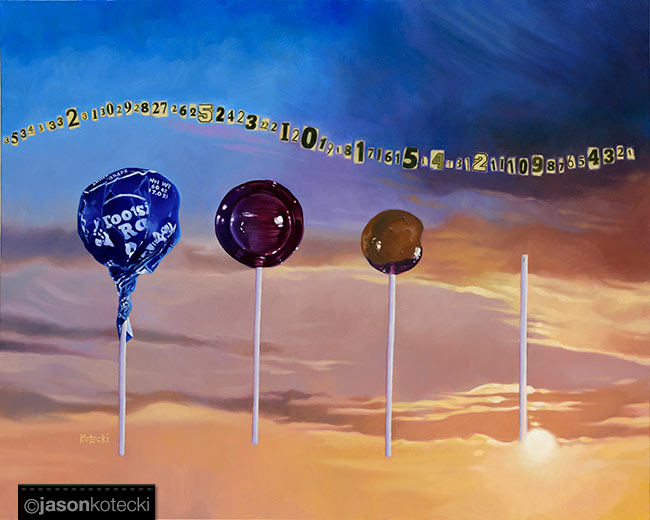
    “How Many Licks?” by Jason Kotecki. 30 x 24. Oil on canvas.
    Original is SOLD 🔴 Shop this art!

    How many licks does it take to get to the Tootsie Roll center of a Tootsie Pop?

    A commercial that appeared on TV when I was a child asked that very question. It turns out that a number of folks have tried to get to the bottom of this.

    A group of engineering students from Purdue University built a licking machine, modeled after a human tongue, and determined that it took an average of 364 licks to get to the center of a Tootsie Pop.

    A chemical engineering student from the University of Michigan built his own licking machine and recorded that it required 411 licks.

    And a group of junior high school students ditched machines in favor of human lickers, and reported an average of 144 licks.

    Apparently, the world really may never know how many licks it takes to get to the Tootsie Roll center of a Tootsie Pop.

    I remember the first time I took my kids to Wrigley Field. It was the year after the Cubs won the World Series, and the kids were excited to see their favorite players in person. It was a beautiful day, the Cubbies won, and we relished singing “Go, Cubs, Go” with 40,000 fellow Cub fans.

    We looked forward to that game for months. As we do for many of the firsts in our lives. Your first baseball game. Your first kiss. The first time you get to drive by yourself. The first place of your own. Your first child.

    We anticipate the first times and do our best to savor them.

    But the last times are different. They have a habit of sneaking up on us. Undoubtedly, there was a last time that I held my youngest daughter in the middle of the night, in a grouchy sleep-deprived state, comforting her – begging her — back to sleep. But I don’t remember it, because I didn’t realize it was the last time when it happened.

    The first times come with a lot of fanfare. But the last times come and go without a whisper.

    How many dinners do you have left with your parents?

    How many anniversaries do you have left with your spouse?

    How many bedtime stories do you have left to read to your kids?

    How many fishing trips do you have left with your grandchildren?

    How many licks?

    There is no machine we can build that will tell us. Not exactly.

    We can guess, we can estimate, we can hope for the best.

    But I bet that number is a lot smaller than we think it is.

    Live accordingly.
  • This Ain’t Kansas

    “This Ain’t Kansas” by Jason Kotecki. 20 x 20. Oil on canvas.
    Original is SOLD 🔴 Shop this art!

    As dissimilar as they may appear on the surface, rural Midwestern farmers and rural Asian farmers have some things in common. One is a deep respect for tradition. This is an important value that can provide a sense of stability and help pass on hard-earned wisdom to future generations. 

    But I believe we must also have an openness to new things. Not so that we will abandon our ideals, but so that we can experience a much richer life. 

    It’s like the difference between experiencing life in black and white versus full color, like in the 1939 version of The Wizard of Oz.

    Indeed, doing things the way you’ve always done them, and surrounding yourself with the same people, places, and opinions, is a pretty good way to live life in grayscale. 

    I made this piece as a reminder that sometimes we need to break free from what’s expected. Mashups of east and west, urban and rural, liberal and conservative, old and new, are what make life more interesting. 

    How does one opt for a more technicolor life? Simple: Take a break from your traditions.

    Read a magazine or watch a documentary on something you know nothing about. Order food you’ve never tasted before. Take a new form of transportation to work for a week. Have a conversation with someone who holds an opposite point of view (without trying to convince them they’re wrong). 

    This openness to new ideas, perspectives, and ways of doing things is a key to unlocking opportunities that can change your life.

    I have struggled the past few years trying to find my place. I have been a member of the National Speakers Association for over a decade now, and it has served me well. I have made wonderful friends and have learned a lot about growing a successful speaking business.

    But in recent years, I’ve had a hard time finding relevant examples to model my business after. You see, I have this art thing that I do, which is very unique among the speakers I’ve encountered. Even the ones that incorporate art somehow into their offerings do so in a way that’s totally different than the direction I want to head.

    And so I have spent the better part of the last two years seeking out art-centered business models. I have tried to learn as much as I can from other successful artists. And I’ve learned a lot, but it turns out, most of them aren’t so keen on the whole “speaking in front of large crowds” thing.

    I was frustrated by my failure to find someone who has already done what I am trying to do. Someone who has a roadmap I can follow.

    Until I finally figured out there is magic in the mashup.

    It’s the combination of two seemingly unrelated things –public speaking and making art –that gives me my edge and helps make me stand out. Borrowing the best of what I’ve learned from great speakers as well as successful artists, while mixing in my own unique quirks and talents, has been a game-changer for me. 

    If you’ve been feeling paralyzed by the belief that things have to go a certain way, or if you’ve felt like a square peg trying to force yourself into a round hole, or if life just feels a little too gray…it might be time to mix in some new ideas, experiences, and assumptions. 

    And watch your world change.

  • Like a Boss

    “Like a Boss” by Jason Kotecki. 16 x 20. Oil on canvas.
    Original is SOLD 🔴 Shop this art!

    Life can feel like a high-wire act. You’re doing your best to juggle everything on your plate: your job, your family, your finances, and just when you think everything is going pretty well, you glance down and see someone whose yard looks way better than yours. How do they get those flowers to flourish like that?

    Or someone’s kids who are in way more activities than yours. Will my kids be less attractive to colleges? 

    Or someone who just drove up in their new car. Should I be thinking about getting a better job?

    For instance, my neighbor cuts his grass every six minutes. Okay, maybe it only seems like that. It’s probably more like sixteen. The point is, a perfect lawn is apparently important to him. I’m not here to judge, except I often do judge…myself. 

    Our lawn usually looks pretty shaggy compared to his, especially if it’s been more than a week since we cut our grass. And the fact that we hire that out makes me self-conscious. Does he think I’m less of a man because I don’t cut my own grass? Does he think we think we’re better than him because we hire someone to do it for us? Do the neighbors see our weak landscaping game and think our house is bringing down the home values in the neighborhood? It’s kind of embarrassing to say all this out loud, because I have no reason at all to think anyone is thinking any of this, but it does pop into my head when I lose focus on what matters to me.

    I appreciate a nice lawn, but I value the extra time to spend with my family. One of the reasons I work so hard on my business is so I can spend more time doing what I love and pay someone else to do the things I hate.

    Please understand that I’m not saying my way is the best one. After all, my neighbor friend is retired with kids who are grown. He has a lot more time to spend on keeping up his lawn. For all I know, it might be a therapeutic escape for him. It’s like comparing apples and mangosteens. Which is completely my point.

    Television and magazines are filled with examples of people who seem to have it all together. They gracefully glide through life as the perfect mom, perfect wife, and perfect employee.

    It’s all a facade. We don’t ever know the whole story, whether it’s the celebrity with the flawless teeth or the neighbor right next door. We all have different priorities and are fighting different battles (which often stay hidden from the camera’s lens or our surface-level observations).

    I’m not here to tell you what’s important to you. I’m just here to remind you that it can’t ALL be. 

    The people who are running around like chickens with their heads cut off, trying to keep up with an impossible standard of balancing everything perfectly, are making a huge mistake. Not only is such a standard impossible to attain, but they’re also allowing the busyness to distract them from what’s most important. 

    The people who are doing life right are the ones who are mindful of what kind of life they want to live and are focused on that.

    How do you tackle life like a boss? 

    Stay focused on what’s most important to you. Ignore the rest.

  • Different is Cool

    “Different Is Cool” by Jason Kotecki. Digital.
    Shop this art!

    Is it possible to be correct when all the experts think you’re nuts?

    Iggy was a doctor who lived in the 1800s and was greatly concerned about the high rate of women dying after childbirth. He knew there had to be a reason for the problem, so he experimented with different solutions. Finally, he figured out a simple practice that was easy to do, and when it was followed, it saved lives.

    His colleagues rejected and ridiculed his idea, branded him a quack, and he was eventually committed to a mental institution, where he died two weeks later. The thing is, his idea worked; he just couldn’t explain why. His solution was too out there, too unorthodox, too different from what the experts were used to.

    What’s so threatening about different?

    Can you imagine turning on your car radio only to hear the same song on every single station?

    What about going to a restaurant that only had one thing on the menu?

    Or firing up Netflix and finding just one show to watch?

    I think we can all agree that a world without options would be very boring indeed. 

    Different is cool.

    Except when it comes to things that challenge our beliefs or question our long-held assumptions.

    The human brain is engineered to be a pattern recognition machine. We are built to notice differences and changes in our environment. It helps us determine a storm is coming that requires us to seek shelter, notice an accident up ahead that suggests we should slow down, or that there is a lion in our camp we might want to avoid. We notice breaks in the pattern and make a prejudgment to feel safe or prepared.

    Lately, we have been struggling with this often helpful but sometimes not-so-helpful feature of noticing differences and making snap judgments. We are taught in after-school specials that prejudice is bad, and if we catch ourselves doing it, we experience feelings of guilt or shame.

    My friend Jessica, a speaker, comedian, and diversity trainer, reminded me that we shouldn’t feel guilty about these judgments and assumptions; after all, they happen automatically and can be useful. What really matters is what we do with them.

    Jessica’s suggestion was this: “When you write that first story, print it as a draft, triple-spaced with extra-wide margins. You do this because you’re anticipating edits.”

    So back to Iggy, formally known as Ignaz Semmelweis. What was his crazeballs idea? Only that doctors should wash their hands before working with patients.

    After his tragic demise, a small group of curious scientists experimented with the procedures he proposed. Eventually, his theories finally gained widespread acceptance years after his death, partly thanks to Louis Pasteur’s scientific confirmation of germ theory.

    He also inspired what is now known as the Semmelweis reflex: a metaphor for a certain type of human behavior characterized by the reflex-like rejection of new knowledge because it contradicts entrenched norms, beliefs, or paradigms.

    Was it a terrible thing for the first reaction from the experts of the day to dismiss Iggy’s idea? No, not necessarily. After all, it went against the pattern of everything they knew to be true at the time. The scientists who originally branded Iggy a crackpot weren’t jerks for thinking that his ideas were weird. They were jerks because they didn’t leave enough room for edits to their original story about him. They should have been open to examining more facts, even if it might lead them away from what they believed to be true. But they weren’t, which is a shame when you think about how many lives could have been saved.

    It’s always a useful exercise to spend time exploring a point of view that is the opposite of what we’re used to. It could be watching a documentary, reading a book, or having a real conversation – not a Facebook fight – with a human being.

    Our brains are pretty great at noticing differences and making assumptions.
    A more constructive alternative to wishing they weren’t so effective at that task might be to figure out whether our assumptions and prejudices are actually serving us, and act accordingly.

    Anticipate edits.

  • Cherry On Top

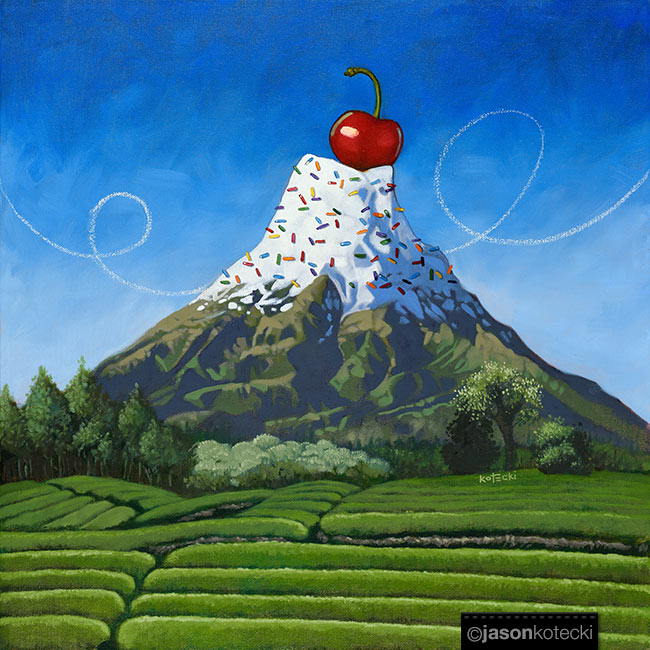
    “Cherry On Top” by Jason Kotecki. 20 x 20. Oil on canvas.
    Original is SOLD 🔴  Shop this art!

    I’m really not a fan of how often I base my happiness on what I haven’t accomplished, or what inconvenience just popped up.

    The truth is, life really is amazing. 

    Unfortunately, Adultitis would have us think differently. 

    Your washing machine goes kaput. You’re in the middle of dinner and realize you don’t have a crucial ingredient. You don’t get the promotion. That nagging cold won’t go away. Your goals are taking longer to achieve than expected.

    It’s easy to get lost in the weeds, focused on what we’re missing or what’s going wrong.

    Sometimes we just need a bit of perspective. The average world income is five thousand dollars. If you make more than that, then you’re in the top 50%. If you make more than $50,000, you’re in the top 0.5%. 

    We live in a time where Oregon Trail is a fun computer game, not a harrowing months-long journey replete with danger and dysentery.

    Are you alive? Do you have a job? Do you have a roof over your head? Do you have something to eat today? Does someone love you? Do you have a dream in your heart? Is today a chance to let go of yesterday and start fresh? Although you may not have said yes to every single one of those questions, I’m betting you can say yes to most. 

    And if that’s true, regardless of what goals remain unattained, or what inconveniences are currently plaguing us, I think we can agree that our lives are pretty dang good. 

    Anything else is a cherry on top.