Topic: Leadership

  • One of One

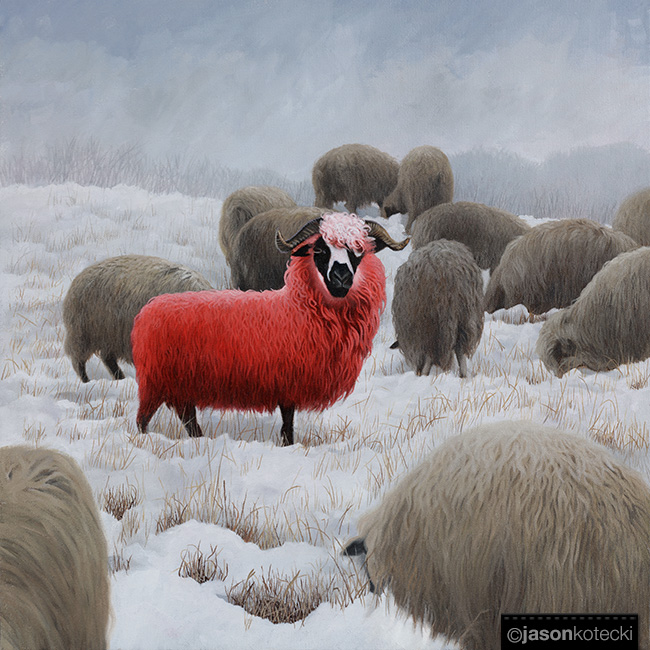
    “One of One” by Jason Kotecki. 20 x 20. Oil on canvas.
    Original is available 🟢 Shop this art!

    When I was in art school in the late nineties, the goth look was in. A significant segment of art kids wore all-black clothing, Doc Martens boots, and fingernails painted with dark colors. I found it fascinating to observe that the ones intent on bucking the system, sticking it to the man, and expressing their individuality all looked…exactly the same.

    It’s scary to stand out.

    We learn this at a young age, when simply being our weird, unique selves can lead to us being shamed and ostracised at recess, on the school bus, or even across the dinner table by a sibling or parent.

    And so, much of life is a careful effort to blend in.

    Just look at the cars we drive, most of which are either black, white, or some combination of the two.

    Or how we take fashion cues from tastemakers and trendsetters because getting caught wearing something out of style is akin to death.

    We must be careful to curate what we say in public for fear of being cancelled.

    In the case of my art school companions, we even blend together in our rebellion.

    Now, some would explain this as an evolutionary feature, not a bug. There’s safety in numbers, after all. We’ve learned to blend in because there’s danger in straying too far from the herd.

    The thing is, we’re not here to sink to our base animal instincts. We were created for a higher purpose. We were made for greatness.

    We are born originals. The problem, as St. Carlo Acutis observed, is that most of us die as photocopies.

    As an artist, I sell prints of my work. Some of them are timed releases, some are limited editions, and some are open editions (available all the time). 

    I sell a lot of them, but they’re all really just fancy photocopies. 

    And none are worth as much as the original. A print sells for less than a hundred dollars. The original can sell for thousands.

    Ask anyone who has purchased one of my original paintings, where you can see the texture of the canvas, feel the brushstrokes with your fingers, and observe the luminosity that emanates from dozens of thin layers of oil paint, and they’ll confirm: Nothing beats an original.

    Sadly, too often we settle for being photocopies.

    It’s been said that imitation is the sincerest form of flattery.

    Maybe if someone else is imitating us. 

    But if it is we who are doing the imitating, then imitation is the sincerest form of boring.

    It is good to learn from those who came before us. It’s possible to find a measure of success by imitating someone else. 

    But the best you’ll ever be is a second-rate version of them.

    This is not a call to stand out for the sake of standing out, or to pretend to be something you’re not. It’s about having the courage to be more of who you are. It’s a reminder that safety should not be our highest virtue. 

    You are free to opt for the safe path. Most people do.

    But you will not be able to escape the gnawing sense of dissatisfaction, the quiet desperation, the ever-present sense in your soul that there’s more to life, and this ain’t it.

    The reason I made the hero in this painting red was because of the lesson I learned from red shoes. After years of wearing safe, plain, predictable shoes, I started pining for red ones. The people I saw wearing red shoes always seemed to be so brave and adventurous, somehow getting more out of life. I wanted that, but I was afraid. I was afraid of standing out too much, but mostly I was afraid that I’d be found out as a fraud.

    Adultitis tried convincing me that I wasn’t one of those “red shoe people.” I wasn’t fun enough, brave enough, or free enough. 

    Eventually, I stood up to Adultitis and got the red shoes. The fears ended up being empty threats. I’ve worn red shoes on stage for every speaking engagement for about two decades now. I love ’em. They make me feel more fun, confident, and free, like a guy who decided it didn’t matter what other people think. 

    Of course, red shoes are not the secret to defeating Adultitis.

    Being brave is.

    What are your red shoes? There is probably something in your life you’ve always (but probably secretly) wanted to own, do, or be, that you’ve talked yourself out of. Maybe Adultitis sold you on the idea that you’re just not “that type of person” and it would be safer to blend in.

    But maybe you actually are that type of person.

    Maybe the fear is a smokescreen keeping you from becoming all God created you to be.

    Maybe twenty seconds of embarrassing bravery will open the door to a new level of confidence and unimaginable opportunities.

    Maybe your example of standing out from the herd will be the spark that lights the way forward for someone else, giving them courage to be brave, too.

    “To be nobody-but-yourself—in a world which is doing its best, night and day, to make you everybody else—means to fight the hardest battle which any human being can fight; and never stop fighting.”

    —E.E. Cummings

    Is any of this safe? Hell no. Of course not.
    But it’s the only way to feel alive.
  • Born For This

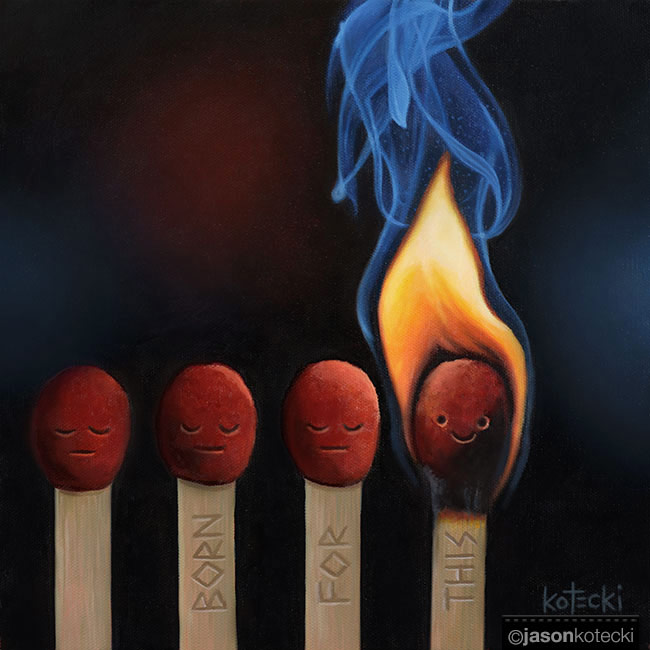
    “Born For This” by Jason Kotecki. 12 x 12. Oil on canvas.
    Original is SOLD 🔴 Shop this art!

    The Wright Brothers were the first to fly, but they weren’t the first to try.

    Not by a long shot.

    For more than fifty years, humans had been actively working on the problem (after thousands of years of dreaming about it). Many brave people tried for years in vain, often at the cost of their very lives. Most considered it impossible.

    But when the Wright Brothers succeeded, they became a match that lit the way forward.

    They shared the joy of flying with others. In his first public demonstrations in Europe, Wilbur would take a passenger into the air with him. The brothers also eagerly trained new pilots. Soon after their success, countless others followed, and in short order, aviation boomed across the world.

    After fifty years of collective failure, the work and the example of the brothers opened the floodgates. Orville himself lived to see aviation transformed by jet propulsion, the introduction of the rocket, and the breaking of the sound barrier in 1947. On July 20, 1969, when Neil Armstrong, another American born and raised in western Ohio, stepped onto the moon, he carried with him, in tribute to the Wright brothers, a small swatch of the muslin from a wing of their 1903 Flyer.

    It reminds me of another pioneer named Roger Bannister, who was the first to run a mile in less than four minutes. People said it couldn’t be done. Doctors suggested you could die in the process of even attempting it. And yet after Bannister proved it was possible, Australian John Landy did it himself just six weeks later.

    You can just do things.

    But sometimes we need someone to show us a something can be done for us to believe we can do it ourselves.

    One family Kim and I knew before having children was a match that sparked our own belief that we could travel with kids. Our daughter Lucy ended up on 34 flights before her first birthday.

    And all the homeschooling parents we encountered who had raised successful children doing amazing things in the world were matches that gave us the confidence that maybe would could, too.

    What if someone is waiting for you to be the example they need?

    You and me, we’re like matches.

    A match is not made to sit in a box, unlit, forever. It was designed to create a fire, but not one kept to itself.

    You were made with specific talents to achieve a specific purpose. Part of that purpose in life is to make a difference in the lives of others. And just like a match, you get one shot. You have to give it your all.

    Of course, it’s scary!

    You have the option to embrace the status quo, like the other matches in this painting, preferring comfort and protecting themselves. But they are not fulfilling their potential.

    That is not why they were made.

    If God planted a dream in your heart, you have the moral imperative to chase it. Because your example might be exactly what someone else needs to achieve theirs.

    Your spark can enflame and bring life to others.

    As St. Catherine of Siena said, “Be who God meant you to be and you will set the world on fire.”

    You were born for this.
  • You Can Just Do Things

    “You Can Just Do Things” by Jason Kotecki. 30 x 24. Oil on canvas.
    Original is available. 🔴 Shop this art!

    I don’t know who needs to hear this, but you can just do things.

    It’s true.

    Yet it seems we’re always waiting for something before we can begin.

    We are waiting until we get the degree.

    We are waiting until the kids leave the nest or until we retire.

    We are waiting until we know all the steps.

    We are waiting until we finalize the plan.

    We are waiting until we feel ready.

    We are waiting until we feel courageous.

    We are waiting for inspiration.

    We are waiting for permission.

    We are waiting for the stars to align, the sun to come out, and conditions to be perfect.

    We are waiting for just one last thing before the rest of our lives can begin.

    Meanwhile, sand slips through the hourglass, turning into minutes, days, and years.

    Patience is a virtue, and there are times in life when only patience will do. But more often than not, our waiting is just a form of hiding. Adultitis sabotages us before we even begin.

    You can just do things.

    Unfortunately, it’s easier to complain. To blame someone else. To wait for instructions, permission, or for the timing to be just right.

    But the timing will never seem right.

    You don’t have to wait for permission.

    You don’t need a hall pass.

    You don’t need a note from your parents.

    You don’t need a document signed by a notary public.

    You can just do things.

    As I was working on the manuscript for The Penguin Who Flew, I had the serendipitous opportunity to take a writing retreat to the Outer Banks in North Carolina. It’s the very site where Orville and Wilbur Wright achieved flight for the first time. While I was there, I dove deep into their story. I read “The Wright Brothers” by David McCullough, watched a documentary about their life, and visited the National Monument in Kitty Hawk, standing at the place where they made history.

    The Wright Brothers did not wait for permission.

    Other people working on achieving sustained flight of an engine-powered, heavier-than-air aircraft were highly educated experts. The Wrights only had high school diplomas. But they didn’t put their dream on pause to get a degree. Instead, they read books on math and physics, studied and observed birds in flight, and collected data from their own experiments. They needed knowledge and experience, not a piece of paper.

    They also didn’t wait for funding from investors. Big money went to the more well-known, more highly educated experts in the race. Orville and Wilbur were nobodies, unknown and irrelevant. They didn’t have financial backers, an inheritance from a wealthy father, or a winning lottery ticket in their pocket. They had a mildly successful business that provided just enough profit to self-fund their experiments, bit by bit.

    Nor did they wait until they had a full plan in place before taking their first steps. The brothers tinkered, learning as they went. Although the whole point was to figure out how to make a self-powered plane, they didn’t even bother with a motor until they could figure out how to master lift, balance, and control. Their competitors floundered trying to accomplish everything all at once.

    Even after the brothers had cracked the nut of manned flight, they were met with doubt and disinterest in their initial attempt to sell their invention to the U.S. government. Instead of giving up, they went to Europe. It was only upon becoming celebrities after successful, public demonstrations in France that the United States finally offered a contract.

    You can just do things.

    “Whoa, hold up, pal,” you might be saying. “You can’t just be a surgeon without a medical degree.” Well, obviously. Of course. It’s easy to come up with exceptions, but they only prove the rule.

    You don’t need permission to change the direction your life is heading, and you don’t need a piece of paper on the wall to start improving your life today.

    Real life is not a schoolyard version of kickball, where you wait anxiously for someone to pick you, hoping it’s sooner rather than later.

    Adultitis is the king of convincing you that you absolutely need just one more thing before you begin. It’s really just trying to kill time and run out the clock on you.

    Yes, you will need some patience, but you don’t need permission to start chasing your dream.

    You don’t need to wait for a pink slip to start looking for a better job.

    You don’t need to wait until you’re a millionaire before you start being generous.

    You don’t need to wait to feel courageous before you can act bravely. 

    You can just ask for help.

    You can just start a side hustle.

    You can just ask her on a date.

    You can just homeschool your kids.

    You can just apply for better jobs, even if you already have one.

    You can just stop spending money on stupid things.

    You can just end that toxic relationship.

    You can just cancel your subscription to Netflix.

    You can just offer forgiveness before receiving your apology.

    You can just talk to God and ask Him to show you He’s real.

    You can just stop waiting for permission.

    And you know what else?

    You can be afraid and still do all of these things.

    Don’t waste your life waiting for the fear to magically disappear.

    There will not be a time when you will have all the assurances you need.

    You will not earn everyone’s unconditional approval.

    You will not be able to eliminate every risk.

    You will not receive a guarantee of success.

    And yet, one truth remains.

    You can just do things.
  • The Fly Girl

    “The Fly Girl” by Jason Kotecki. 20 x 20. Oil on canvas.
    Original is SOLD 🔴 Shop this art!

    This is part of “Adultitis Fighters,” a series of paintings by Jason Kotecki featuring real and fictional characters who serve as role models in the fight against Adultitis.

    At a time when women were expected to stay firmly on the ground, Amelia Earhart set her sights on the sky and refused to let fear or convention clip her wings. With her daring flights and record-breaking adventures, she proved that many of the limits people accept are nothing more than “rules that don’t exist.” More than just a pilot, Amelia embodied the spirit of wonder and rebellion. Her courage, playfulness, and curiosity turned the world into a playground of possibility, inspiring generations to follow their own dreams. In choosing to live boldly, she showed us all how to rise above the ordinary and reminds us that life is meant to be an adventure.

    “Never interrupt someone doing what you said  couldn’t be done.”

    “Never do things others can do and will do, if there are things others cannot do or will not do.”

    “The most difficult thing is the decision to act, the rest  is merely tenacity.”

    “Adventure is worthwhile in itself.”

  • Ghost in the Road

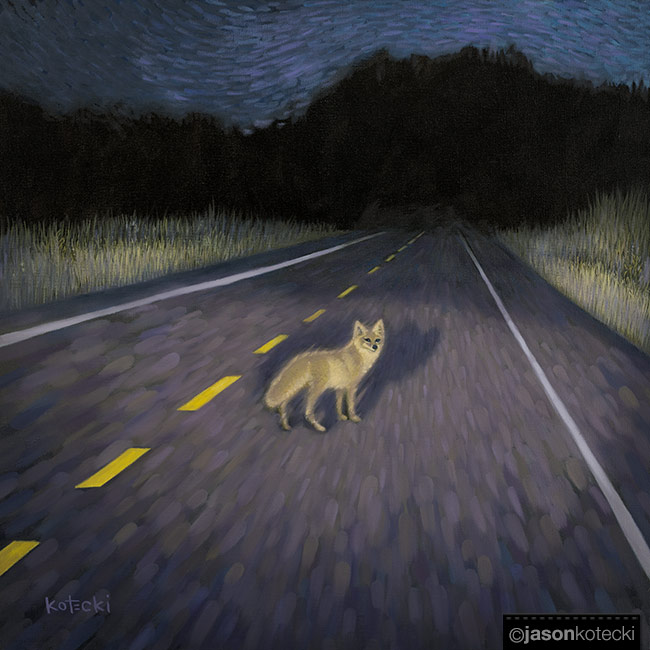
    “Ghost in the Road” by Jason Kotecki. 20 x 20. Oil on canvas.
    Original is SOLD 🔴 Shop this art!

    It was like driving through a sea of black ink.

    The trip back to our hotel from the Lamar Valley was harrowing. It being Yellowstone, the specter of animals hanging out on the road is always a possibility. We’d reveled in the wildlife of the North American Serengeti, but now the sun was gone and darkness blanketed the winding way home. My knuckles were white on the steering wheel and Kim’s clear anxiety was less than helpful.

    We snaked around curve after curve, my eyes peeled for any signs of movement. Then we saw it: a small coyote trotting down the middle of the road. As we came upon him, I slowed to a stop. He turned his head and stood frozen in the bright beam of our headlights. Time stood still. He looked at us, and we looked at him, and for a brief moment, we connected.

    Kim snuck a quick photo before he turned away and disappeared into the darkness.

    It felt like we encountered a ghost in the road.

    Sometimes we encounter people in a similar way. Their life intersects with ours and we make a brief connection. They show up to guide us through difficulty, supporting us emotionally, physically, or spiritually. When the time to move on comes, they disappear from our lives, like a ghost in the road

    Have you had encounters like that, a limited interaction with someone that greatly impacted your life?

    Years ago, I had lunch with Phil Vischer, the co-creator of Veggie Tales. I was trying to get my Kim & Jason comic strip off the ground. He gave me a lot of great advice, but one of the most notable things he said was, “Assume that your life two years from now will be nothing like you imagine it will be. Be open to where God is leading. If God calls you or Kim to a different role or a different job, be open.”

    His advice left me unsettled, but it stuck with me.

    Around that same time, Kim and I encountered a woman named Mary Jo who worked for a local Catholic Church. She told us about a growing movement within the Church to educate children and adults together and assured us that if I could create a program that held the attention and spoke to both groups, I’d definitely be in demand as a speaker. She was right, and that’s how my now twenty-year career as a professional speaker began.

    It required me to retire the comic strip, but Phil Vischer’s prophetic words helped give me an open heart and comfort when I saw God lead us in a new direction.

    It’s been said that people are in our lives for a reason, a season, or a lifetime. Phil and Mary Jo are people who came into my life for a reason. They were fellow travelers who crossed my path, and for a brief moment in time, our souls connected. In their own way, they illuminated my path, let me know that I was seen, that what I was doing mattered, and to keep going.

    We are called to do that for others.

    I’ll never forget a time I was a ghost in someone else’s road.

    Waiting for everyone else to leave, she appeared at my product table at the back of the room after my second and final presentation of the day. She seemed hesitant, engaged in an internal debate on whether to approach or retreat. I noticed from her badge that her name was Jennifer. I assumed she was trying to decide if she wanted to buy something. Instead, she hesitantly exclaimed, “I want to trade you something, but I don’t want you to think I’m crazy.”

    “I won’t think you’re crazy,” I promised, not knowing what I was in for.

    Apparently I was convincing enough, as she began digging around in her purse. She pulled out a small black velvet box and placed it on the table between us. She said not a word. Perplexed, I determined that it looked like a ring box and deduced that her silence meant that I was supposed to pick it up. I opened it. I was right there were two simple rings inside, one band was rimmed across the top with a row of tiny diamonds; the other was shiny and plain.

    They were wedding rings.

    “Ok…” I stumbled. “It looks like there is a story here…”

    She began, “Six months ago today, my husband left me while I was at work.”

    Tears welled in her eyes. She offered no further details, but it was clear that it was as surprising as it was devastating. She continued, “After he left, on a whim, I decided to apply for my dream job, the one I never went for while we were together. And I got it. And it was amazing.”

    She began sobbing, and it suddenly felt that the table between us was two miles wide. She apologized for breaking down, while I debated jumping across the table to hug her right then and there.

    She regained her composure and said, “Sitting in your two sessions today…you just said so many things that hit me. For a long time, I had given up on love. I had given up on me. I told myself that this job — my career — was my new love now and that this would be the focus of my life. But you helped me to see that I can’t give up on love.”

    She motioned to the rings, and, looking at the last Adultitis First Aid Kit I had left, said, “If you’d be willing, I’d like to trade these for a new beginning. I don’t need them anymore.”

    I gave her a Kit and a big hug and mumbled something that I don’t remember, but was probably stupid.

    I don’t remember what I said that struck a chord. I don’t know whatever came of her, although it’s possible she’s still following our stuff all these years later.

    I was a ghost in the road of her story, and she was a ghost in the road of mine.

    Something I said to her on that day helped her to see with new eyes and gave her the confidence to bravely move forward. Meanwhile, Jennifer’s courage and her gift serve as an everlasting reminder of the privilege of what I get to do. When I get discouraged that the crowd I’m speaking to is too small, or not engaged enough, or that I am too tired, I think of Jennifer, a ghost in the road who crossed my path so many years ago, and I am reminded that every single day is an opportunity to change someone’s world.

    Never underestimate your role in helping to heal our world. As it has been said many times, “Helping one person might not change the world, but it could change the world for one person.”

    I hope this reflection opens your eyes and gives you an appreciation for the ghosts in your own road.

    And I hope it will inspire you to be a fellow traveler who crosses someone else’s, taking the time to look them in the eye and say, “I see you. You matter. You’re doing great. Keep going.”

  • Love is in the Air

    “Love Is In The Air” by Jason Kotecki. 16 x 16. Oil on canvas.
    Original is SOLD 🔴 Shop this art!

    This painting is called “Love is in the Air.”

    Our eyes draw us to the billowing steam from the geyser, forming the shape of a heart.

    Indeed, it is a fitting representation of the way most of our society views love. Like the steam, it is a little mysterious, always changing, and dependent on which way the wind is blowing. Love is regarded as a fleeting feeling evident on a wedding day, but which vanishes at some point in the ensuing years when life gets hard.

    I would like to invite us to look for a different, better metaphor for true love in this painting.

    Like the bison.

    The bison is rock solid. Grounded. Immovable in winds of change.

    My friend, contrary to popular belief, true love is not a feeling that ebbs and flows with the wind. It’s not caught up with transitory qualities like looks, circumstances, and emotions. Looks fade, circumstances change, and emotions are unreliable, often clouding reality.

    I’m no relationship expert, but I have been married for well over two decades now. If you want a relationship that outlasts the average, you cannot depend on feelings to save you. On any given day, your partner may not look or act anything like the person you first fell in love with. You may find yourselves in a circumstance you didn’t anticipate or plan for when everything was going well.

    True love isn’t a feeling; it’s a choice. 

    This points to another important difference between these two metaphors: The steam cloud has no control over itself. The bison, on the other hand, can take action.

    Here’s a real-world example of the difference:

    A few years ago, I instituted a new personal policy: Always stop at the lemonade stand.

    You see, I am a bit of an over-thinker. My old pattern of behavior went like this: I’d see some kids running a lemonade stand and think about stopping, only to drive past it while overthinking it to death. Did I have cash on me? Did I have the time? Was there even a convenient place to park? I’ve already driven six blocks past it; it would be stupid to turn around now. Ultimately, I’d miss the moment and feel bad for the rest of the day.

    So I decided to take the thinking (and overthinking) out of it. I decided to establish a new rule: ALWAYS STOP AT THE LEMONADE STAND. Of course, for this personal policy to work, it has to be ironclad. The only way to avoid overthinking was that there could be no exceptions. No excuses. I permitted myself to be late wherever I was going. Even if I was late to my own father’s funeral, “I had to stop at the lemonade stand.”

    The key is that when it comes to any sort of goal, habit, or resolution you establish, it’s a lot easier if you don’t give yourself any outs. Commit 100%. If you allow yourself even one exception, then it’s always a fight from then on. You’ll always give yourself a reason why it’s ok to ignore the rule “this one time.” 

    Even though it’s sometimes inconvenient, I love this policy. I like that it allows me to be more generous, which is in line with the type of person I want to be. I always ask the kids what they’re raising money for. I always try to encourage them in some small way. And I always over-tip.

    The thought of stopping at a lemonade stand is like the steam; it comes and goes, and stopping is dependent on how I’m feeling at the time. But this personal policy is a stubborn bison, blocking the rest of my day until I act.

    Thinking about complimenting someone, writing a note of encouragement, or helping someone in a bind is not the same as actually doing any of those things.

    If you are in a relationship where the love feels like it’s fading, are you like the steam cloud, waiting for something to happen? Are you waiting for a feeling to return or for your partner to change, to do something that rekindles that loving feeling you once had?

    The better strategy is to be more like the bison and make the first move.

    As psychologists have found time and again, behavior shapes emotion. If I am angry or upset when I see a lemonade stand, I always feel 100 percent better after I stop, even if I’m only walking away with a watered-down lukewarm cup of lemonade.

    So even if you don’t feel like it, try doing something loving for the other person. Surprise them with an unexpected gift. Do one of their household chores for them. Praise them in front of someone else.

    It’s amazing how often our loving actions can transform into loving feelings.

    Before you throw in the towel on a relationship that has lost its loving feeling, act lovingly toward your partner. Decide that you’re not going anywhere, like a bison standing in the middle of the road at Yellowstone. Don’t give up.

    Change may not be immediate, but if you are persistent and continue acting in love, don’t be surprised if, before long, a new feeling of love is in the air.

  • The Redheaded Pioneer

    “The Redheaded Pioneer” by Jason Kotecki. 20 x 20. Oil on canvas.
    Original is SOLD 🔴 Shop this art!

    This is part of “Adultitis Fighters,” a series of paintings by Jason Kotecki featuring real and fictional characters who serve as role models in the fight against Adultitis.

    Actor and comedian Lucille Ball was a great breaker of rules that don’t exist, becoming one of the first women to own a major television production company and addressed issues like marriage, pregnancy, and women in the workforce at a time when such topics were rarely discussed on television. Through her iconic character Lucy Ricardo on the television show “I Love Lucy,” she was a comedic trailblazer, portraying a strong, independent woman who wasn’t afraid to be funny, clumsy, or ambitious.

    “The secret of staying young is to live honestly, eat slowly, and lie about your age.” 

    “In life, all good things come hard, but wisdom is the hardest to come by.”

    “One of the things I learned the hard way was that it doesn’t pay to get discouraged. Keeping busy and making optimism a way of life can restore faith in yourself.”

    “I’m not funny. What I am is brave.”

  • The Rebel Princess

    “The Rebel Princess” by Jason Kotecki. 20 x 20. Oil on canvas.
    Original is SOLD 🔴 Shop this art!

    This is part of “Adultitis Fighters,” a series of paintings by Jason Kotecki featuring real and fictional characters who serve as role models in the fight against Adultitis.

    Princess Leia, from the “Star Wars” franchise, is a role model because fighting Adultitis is a fight. (And Darth Vader is a pretty good example of someone with a full-blown case.) Far from a traditional “damsel in distress,” Leia showed great strength as a leader, rising up in rebellion against oppression and tyranny, facing the battle with courage and resilience while preserving a compassionate and empathetic heart. Her example encourages us to embrace our own strength, stand up for what is right, and never lose hope in the face of adversity.

    “I don’t know who you are or where you came from, but from now on you’ll do as I tell you, okay?”

    “Someone has to save our skins. Into the garbage chute, flyboy.”

    “Never be afraid of who you are.”

    “Hope is like the sun. If you only believe it when you see it you’ll never make it through the night.”

    “May the Force be with you.”

  • The Armada

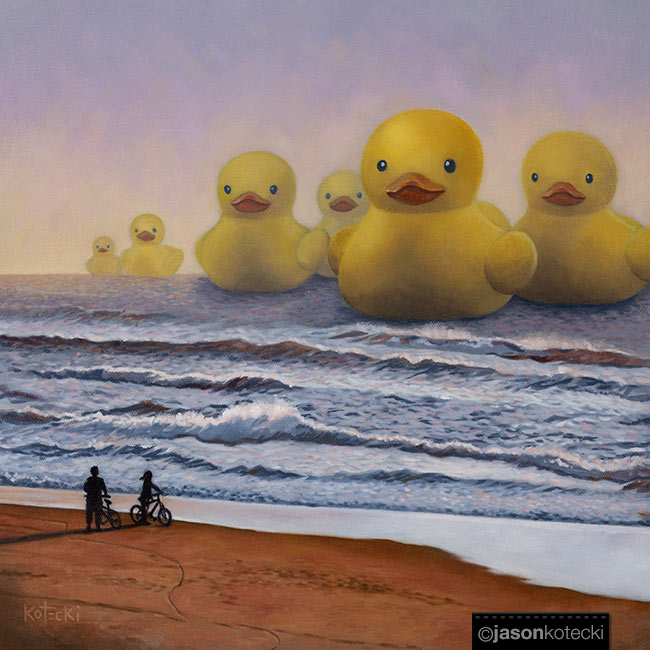
    “The Armada” by Jason Kotecki. 16 x 16. Oil on canvas.
    Original is SOLD 🔴 Shop this art!

    Quick! You’re on the beach with a friend and you spot something approaching on the horizon. To your amazement, you make out an armada of giant rubber ducks coming to shore. What is your reaction?

    Are you excited? Overjoyed? Concerned? Skeptical? Worried? Afraid?

    Are they visitors or invaders?

    Do they bring good tidings or dark intentions?

    Sometimes a painting can just be a fun picture that makes you smile. And sometimes it contains a deeper meaning. I asked people on social media to share their perceptions of this painting, and it may or may not surprise you that their responses varied greatly:

    • “Pure joy. I have a jacket printed with rubber ducks. They always make me smile, as does the ocean, and riding my bike!”
    • “Here comes whimsy!”
    • “Hope is on the horizon.”
    • “I’m a little worried.”
    • “Terrified.”
    • “Invasion from a Trojan Horse.”
    • “Plastic pollution and impending doom from climate change.”

    It turns out that the meaning of this painting, as well as the meaning of almost everything in life, is largely determined by you. 

    Our perceptions impact our actions. For example, whether you’d run for cover or organize a welcoming party would depend on whether you see these rubber ducks as friends or foes. One side sees the other as hopelessly naive. The other side sees the other as paranoid. Both sides have a point.

    If we respond too enthusiastically, we might fall into a trap.

    If we respond with animosity, we may sabotage any chance of something good happening.

    We can assume the best, assume the worst, or…perhaps the best, wisest, most productive thing we can do is keep an open mind and wait and see.

    Now, let’s put the shoe on the other flipper. Imagine if you’re one of those ducks. You’re fun. Lots of people like you. You want to be helpful and bring joy to others. You’re new in town, but you have good intentions. But what are those locals on the shore thinking?

    Do they see you as a visitor or an invader?

    Do they think you bring good tidings or dark intentions?

    We’ve all been the new guy. The new kid in class. The newest employee. Or, most recently for us, the new family in town. I like to think of this painting as a metaphor for our mission to bring wonder and whimsy to distant shores. I unveiled it at the first Wondernite we hosted in Sheboygan, having moved from Madison two years earlier. As relative unknowns, we wondered if anyone would come.

    It turned out to be our biggest and best one yet.

    It’s scary to consider what the natives might think of you. You feel like you stick out like a sore thumb because it seems obvious that everyone can tell you’re not familiar with the local culture, the shorthand, the inside information that everyone else takes for granted. 

    It’s tempting to want to appear big and important. Maybe pretend to be something you’re not. After all, you’ve got a clean slate. None of these new people know all your history and baggage. You never get a second chance to make a first impression, so it’s a chance to put forth something impressive.

    I’ve found it’s easier, more effective, and frankly, less exhausting to just be yourself. People are drawn to authenticity, and we are very good at spotting a fake. Your weird flag may not inspire everyone, but it will attract your people.

    It’s more beneficial to check your expectations.

    If you expect the natives to be hostile, you’re likely to protect yourself by being hesitant and withdrawn, which may make you appear cold and aloof to others. But be warned: if you assume the locals will be hostile and unwelcoming, guess what you’re likely to get.

    You see, there is this thing called confirmation bias. (Perhaps you’ve heard of it.) It’s applicable whether or not you see yourself as the kids on the beach or the newcomers floating to shore. How it works is that we make an initial judgment or tell ourselves a story about a person, group, or situation. Then we reflexively look for evidence that supports our case and confirms our bias. 

    Meanwhile, we subconsciously filter out any information that runs contrary to our story. We interpret new information as being supportive of the opinions we already hold, and it doesn’t matter how poorly it fits. Our dutifully protective brain finds a way without us having much of a say.

    If you think your spouse is ignoring you, you’ll be on the lookout for all the evidence to make your case.

    If you expect to have an awesome day, your antenna will be up and scanning for proof all day long.

    If you think Republicans are the worst, you will notice and remember every example that proves your point.

    If you think Democrats are the enemy, well, you get the point.

    So…what if we paused at the very beginning to realize we don’t yet know the truth and take a wait-and-see approach? Thanks to confirmation bias, if you expect the best in others, the odds are better you’ll find it.

    This might just be a fun, whimsical painting that makes you smile.

    Perhaps something light-hearted to hang in your bathroom.

    It might also be a reminder to always be yourself while giving other people a chance to do the same.

  • The Coach

    “The Coach” by Jason Kotecki. 20 x 20. Oil on canvas.
    Original is SOLD 🔴 Shop this art!

    This is part of “Adultitis Fighters,” a series of paintings by Jason Kotecki featuring real and fictional characters who serve as role models in the fight against Adultitis.

    Ted Lasso, the titular character of the TV series “Ted Lasso,” is a model of blue sky optimism and positivity. His humor and lightheartedness diffuse tension and bring joy, but he’s far from a naive pollyanna. Even though he had plenty of reasons to despair, from his failing marriage to his losing team, he didn’t succumb to pessimism and remained filled with hope. His sunny disposition and can-do attitude inspire us to maintain a positive outlook and approach challenges with resilience and determination.

    “Taking on a challenge is a lot like riding a horse, isn’t it? If you’re comfortable while you’re doing it, you’re probably doing it wrong.”

    “You say impossible, but all I hear is ‘I’m possible.’”

    “You beating yourself up is like Woody Allen playing the clarinet. I don’t wanna hear it.”

    “So I’ve been hearing this phrase y’all got over here that I ain’t too crazy about. ‘It’s the hope that kills you.’ Y’all know that? I disagree, you know? I think it’s the lack of hope that comes and gets you.”