Topic: Leadership

  • Gummy Bear Doing Sit-Ups

    “Gummy Bear Doing Sit-Ups” by Jason Kotecki. 12 x 12. Oil on canvas.
    Original is SOLD 🔴 Shop this art!

    When I was a teenager, my mom called me a dreamer.

    She didn’t mean it as a compliment, but she wasn’t wrong.

    I’ve always been idealistic, my head regularly inhabiting the clouds. I’d sing along with John Lennon’s Imagine and revel in the fact that we were soul mates. You’re NOT the only one, John. We’re in this together!

    I took pride in that side of myself. But when my mom labeled me a dreamer, and I knew it wasn’t a compliment, it got my attention.

    Of course, my idiot teenage response was, “What does she know?”

    Eventually, I would relate to Mark Twain, who said, “When I was a boy of fourteen, my father was so ignorant I could hardly stand to have the old man around. But when I got to be twenty-one, I was astonished at how much he had learned in seven years.”

    When I graduated from college, I had big dreams. I was going to marry the love of my life. I was going to become a successful artist. And I may or may not have imagined the small town I came from erecting a statue in my honor one day.

    But in order for my dream to work, I needed my parents to let me live with them in the year between graduation and the wedding. That would give me the financial runway to knock on doors, get my name out there, and start making things happen.

    I knew I needed a plan. I put together a multi-page document outlining my detailed strategy and financial projections. I don’t know if my parents let me stay with them for that year rent-free because of the brilliance of my plan, or because that’s what parents do, and there really wasn’t another option. And as most business plans go, big chunks of it fell apart when it got punched in the mouth by reality.

    But it did give me focus, direction, and accountability to do the work that propelled me forward on my journey. It exposed me to an important truth I’ve seen at work again and again in the last twenty-five years:

    The most successful people balance hopes and dreams with practicality and hard work.

    If you spend all your time with your head in the clouds, you may come up with a world-changing idea or two. But if you don’t have the initiative and work ethic to put toward them, they’ll never materialize. 

    World-changing ideas are worthless without execution. 

    On the other hand, a relentless work ethic that lacks vision is wasteful. People in this camp default to letting someone else tell them what to do – which is unlikely to lead to happiness – or they toil without purpose, methodically plodding along in no particular direction. 

    When you keep your head down all the time, you’re blind to the road signs pointing to exciting possibilities.

    A rocket ship requires practical thought, precise calculations, and productive persistence to achieve orbit. But it requires a dreamer to imagine they can reach the stars in the first place.

    It’s a tricky balance, and my experience leads me to believe people are usually stronger in one area than the other. As I shared, I am a dreamer at heart. But getting where I am today required a lot of hustle, sacrifice, experimentation, and experience gained from failure.

    Henry David Thoreau gave us the blueprint when he said, “If you have built castles in the air, your work need not be lost; that is where they should be. Now put foundations under them.”

    My mother’s candid observation was meant to be helpful. And it was. It inspired me to buckle down. Maybe at first just to prove her wrong, but eventually simply because she was right.

    What camp are you in?

    If you are more of a dreamer, maybe you need to spend time putting your ideas into action with a little elbow grease. It’s more comfortable to live in Dreamland, where reality doesn’t rudely poke holes in your grand visions. Don’t be discouraged by the failures you encounter, for they are not arrows piercing the heart of your dream, but merely guideposts pointing you in the direction to go.

    If you are more of a “nose to the grindstone” type of person, perhaps you need to give yourself permission to wonder aimlessly and dream of something better. Sure, it’s more comfortable to stay in work mode than get your hopes up for a future that may never happen. But that only leads to a future you never wanted. Don’t worry about figuring it all out before you begin. Plant your flag on a future summit and use your work ethic and practicality to plot your path there one step at a time.

    Both ways are hard. But great things don’t come easy. 

    This gummy bear knows what’s up.

    Dreaming of six-pack abs is a good start, but it amounts to nothing without any sit-ups.

    But the sit-ups are a waste of time if we never ponder why we wanted the six-pack abs in the first place.

  • Bear Attack

    “Bear Attack” by Jason Kotecki. 20 x 20. Oil on canvas.
    Original is SOLD 🔴  Shop this art!

    Make love, not war.

    Those hippies were on to something.

    No one likes war.

    Although “free love” turns out to not have been the best option, we do have to replace it with something.

    If I tell you to stop thinking about a pink elephant on roller skates, what are you thinking about? No matter what you do, DO NOT think about a pink elephant on roller skates. Just stop.

    But what if I told you to imagine a blue horse with spots of silver glitter galloping on top of a rainbow?

    It’s not enough to eliminate war, we need to replace it with something else. It’s not enough to eliminate a bad habit, we need to replace it with a good one. It’s not enough to eliminate negative thoughts, we need to replace them with positive ones.

    Our family enjoys watching Masterchef, the cooking competition reality show hosted by chef Gordon Ramsay. One of the home cooks who qualified was a former heroin addict named Ryan who admitted to spending ten years slowly killing himself. His dad stayed by his side, never giving up hope. Finally, a breakthrough came, and Ryan became obsessed with cooking, learning and perfecting various techniques. He shared how crucial it was to give his addictive personality something else to focus on.

    You can try to stop being afraid. Or you can start being grateful. Because it’s impossible to feel fear when you are being grateful.

    So what if instead of dropping fear into your mind, you dropped gratitude instead?

    Instead of dropping political rants on social media, what if you dropped encouraging words or funny photos onto your timeline instead?

    Instead of dropping judgement on one another, what if we dropped compliments instead?

    This painting is a reminder that if we truly want to get rid of something bad, we need to replace it with something good.

    Drop gummy bears, not bombs.

  • Balancing Act

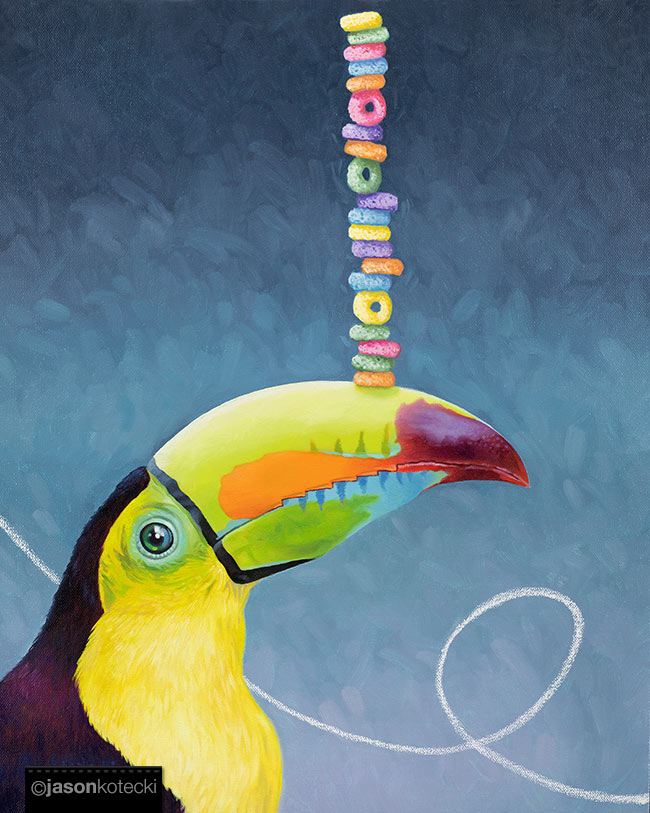
    “Balancing Act” by Jason Kotecki. 16 x 20. Oil on canvas.
    Original is SOLD 🔴 Shop this art!

    How many Froot Loops can you stack on top of one another before they topple over?

    How tall would someone’s tower have to be for you to find yourself impressed?

    We often relish the opportunity to declare how many activities we’re balancing. Like a status symbol, our busyness signals our importance. We could pretend the pink ones are work responsibilities, the yellow ones are family and household chores, maybe the orange ones are volunteer commitments, and the green ones are hobbies…All hail the one with the highest stack of Froot Loops! 

    I am always in awe of people who seem to be able to operate smoothly amidst a schedule bursting at the seams. My personality type is such that I easily get overwhelmed when I’m trying to stack more than a handful of Froot Loops at a time.

    I recently added something new to my morning prayer routine. After looking back on the previous day and reflecting on what went well and what I could have done better, I try to identify the most important thing to accomplish in the day ahead. 

    And let me tell you, it’s bloody hard.

    I mean, it’s a simple question. And sometimes it’s easy because there’s a specific, obvious task that needs to be completed: Deliver this speech. Finish the manuscript for editing. Paint the ceiling. 

    But most days, it’s not so obvious. 

    Answering this question goes against my inherent desire to cram my day like a Volkswagon Beetle stuffed with seventy-six circus clowns. When I survey the day before me, I usually see a smorgasbord of Very Important Things, all seemingly equal in significance. If I happen to settle on something like “spend time in the studio,” I have to fight the urge to also write “andfinishthisandworkonthatanddontforgettotakeoutthegarbage.”

    I’m not alone, am I?

    The science is clear. We get a tiny yet thrilling dopamine hit every time we check something off our almighty to-do list – regardless of how essential the chore actually was – which encourages us to rush headlong into the abyss of productivity.

    I have to remind myself that the question “What is today’s most important thing?” is not asking for the ONLY thing I need to do that day. Or asking me to only do ONE good or worthwhile thing all day. 

    It’s merely asking me to declare the most important one.

    Because, unfortunately, despite my desire to bend reality and make my home in the multiverse, there can only be one most important thing. (See this reflection on how we magically changed the meaning of the word “priority.”)

    I have found that oftentimes in this process, my most important thing is to “be open,” because the most important thing hasn’t yet revealed itself at six-thirty in the morning. But that awareness is vital because it makes me more likely to notice it when it comes. 

    I encourage you to try this, especially if you’re having a hard time balancing all the Froot Loops. Its power comes in forcing you to pause, nudging you to slow down, reflect, and be intentional.

    Why does this matter? 

    This matters because when I don’t identify the most important thing for the day, I’m liable to rush off and accomplish a whole hell of a lot of things. Which seems good and feels great. But if the sheer volume of activity crowds out what was actually the most important thing I needed to do, my life slowly veers off track.

    It doesn’t matter how many Froot Loops you can balance if you were supposed to be paying attention to the Cheerio.
  • The Monarch

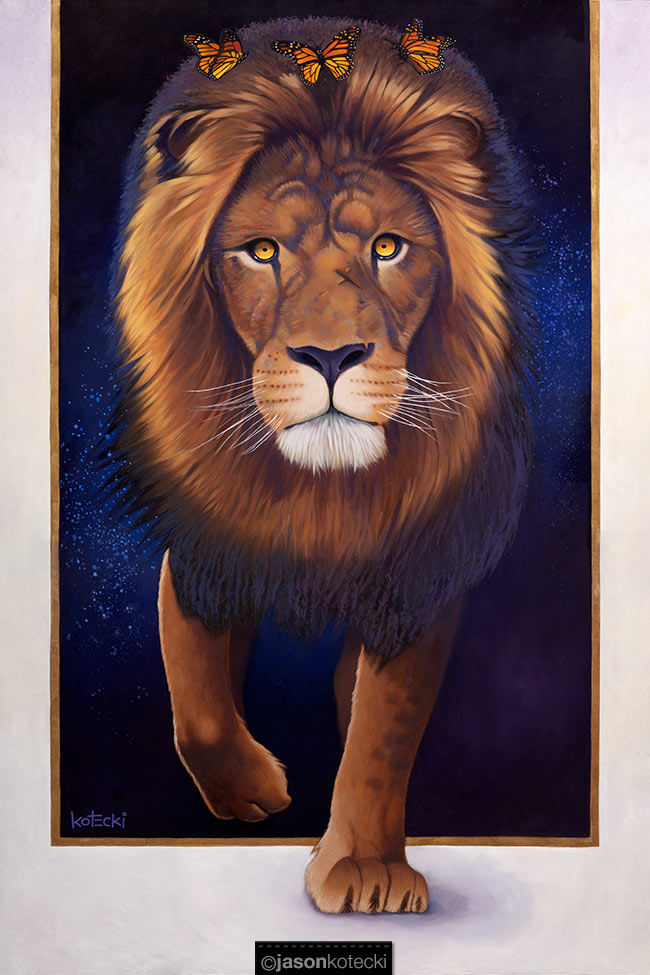
    “The Monarch” by Jason Kotecki. 40 x 60. Oil on canvas.
    Original is SOLD 🔴 Shop this art!

    His name was Joel, but I called him Mr. Dawson. He was one of the best leaders I’ve ever known.

    On the surface, Mr. Dawson was just a regular guy who coached youth baseball. But he was kind, humble, and strong, albeit not in the “benchpress dump trucks” sort of way. A rare autoimmune disease took several fingers on one hand. But he was able to balance a baseball with it while holding a bat with his other hand. During practice, he’d carefully toss the ball upwards and whack it with the bat in the direction of a fielder.

    When I played Little League, he managed an opposing team, but his vote helped me land on the all-star team. He became my coach after drafting me when I turned thirteen and moved up to Junior League. I was an occasional pitcher. My fastball wasn’t very fast, and I didn’t have a curveball, but I kept the ball over the plate. The good news is I rarely walked anyone, but the bad news is batters usually salivate at the prospect of facing someone who throws slow and straight. 

    The back of my baseball card was not impressive.

    Perhaps not surprisingly, I’d never been the winning pitcher of a game. I could claim it was because the teams I pitched for were never that good, but then again, neither was I. For some unknown reason, Mr. Dawson decided to make it his mission that season to get me a win. It took a while, but somehow, his persistent belief in me sank in. I actually started believing it was possible. I don’t even remember the score of the game when it finally happened, but I do remember the feeling. I remember his proud smile. 
    And I remember being happier for him than I was for myself.

    That’s what the best leaders do: believe in people. 

    Oftentimes, those people don’t believe in themselves. Sometimes it’s for a good reason, and sometimes it’s the natural result of not having anyone in your life who does. But the good leaders see a spark. Heck, maybe the spark doesn’t even exist, but their belief that it does is so convincing, it’s as if they are somehow able to will it into existence. 

    This painting was inspired by C.S. Lewis’s character, Aslan, the Christ-like figure in The Chronicles of Narnia. It’s a great image of the best kind of leader: brave but vulnerable. He’s confident in knowing what he’s about, but kind enough to welcome the lowliest creatures into his friendship and protection. Malcolm Forbes said, “You can easily judge the character of a man by how he treats those who can do nothing for him.” 

    People are fragile beings, like the butterflies in this painting. I sure was when I was thirteen, a shy, skinny kid with oversized glasses playing on a team stocked with much better athletes, trying to figure out who he was and what he had to offer. 

    The best leaders walk with us out of our past and into our future, accompanying us from who we’ve been to who we can be. We all need people like that in our lives. If someone believes in you, consider yourself lucky. And take them at their word, even if you can’t yet see what they see.

    Mr. Dawson died too soon from cancer shortly after I moved on to high school, more complications of his condition. By then a close friend of the family, I saw him face his final battle and the unknown of the next life with bravery and good humor. 

    Sometimes in life, we are the butterflies. We are fragile and need to believe the people who care about us are right when they tell us they see greatness within us.

    Sometimes in life, we are the lion.

    We are called to be leaders who seek out the lost, the young, the weak, and the forgotten. Our job is to look for the good in them, believing in them as long as it takes until they can see it for themselves. 

    Thanks, Mr. Dawson.

  • The Candymaker

    “The Candymaker” by Jason Kotecki. 20 x 20. Oil on canvas.
    Original is SOLD 🔴 Shop this art!

    This is part of “Adultitis Fighters,” a series of paintings by Jason Kotecki featuring real and fictional characters who serve as role models in the fight against Adultitis.

    Willy Wonka, the enigmatic chocolatier from Roald Dahl’s “Charlie and the Chocolate Factory,” is an iconic symbol of the wonder and magic of childhood. His eccentric behavior, refusal to conform, and unexpected twists challenge conventional expectations, encouraging us find delight in surprises. Willy’s whimsical inventions and fantastical creations teach everyone that anything is possible with a little imagination and ingenuity. His witty remarks and mischievous antics remind us not to take life too seriously.

    “You should never, never doubt what nobody is sure about.”

    “We are the music makers, and we are the dreamers of dreams.”

    “If the good lord intended us to walk, he never would’ve invented roller skates.”

    “The suspense is terrible! I hope it’ll last.”

    “A little nonsense now and then is relished by the wisest of men.”

  • The Good Neighbor

    “The Good Neighbor” by Jason Kotecki. 20 x 20. Oil on canvas.
    Original is SOLD 🔴 Shop this art!

    This print is part of “Adultitis Fighters,” a series of paintings by Jason Kotecki featuring real and fictional characters who serve as role models in the fight against Adultitis.

    Mister Rogers, known for his iconic television show “Mister Rogers’ Neighborhood, was able to connect with people on a deeply human level and was an unwavering example of kindness and empathy. He respected children as individuals and validated their emotions and thoughts. Mister Rogers understood the importance of play, creativity, and imagination in both children and adults’ lives and reminded viewers of the joy and laughter that can be found in everyday activities.

    “Often when you think you’re at the end of something you’re at the beginning of something else.”

    “It’s good to be curious about many things.”

    “Everyone longs to be loved. And the greatest thing we can do is let people know that they are loved and capable of loving.”

    “I like you just the way you are.”

  • Greatest Of All Time

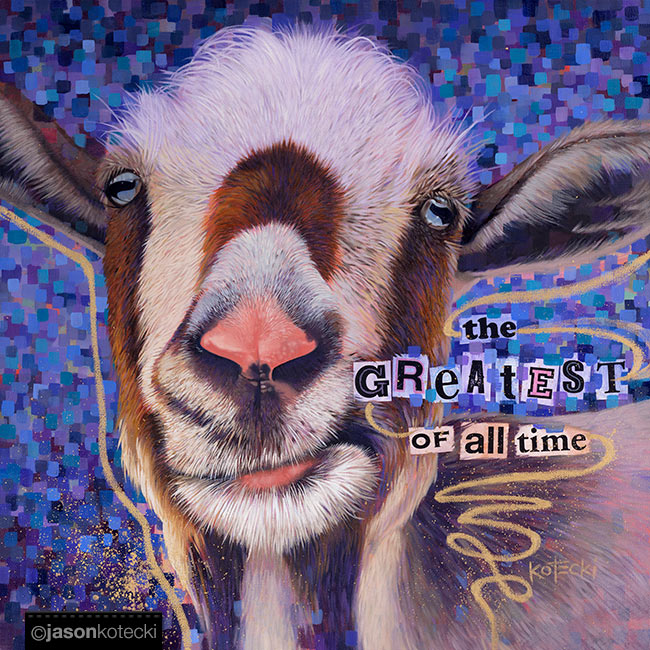
    “Greatest Of All Time” by Jason Kotecki. 24 x 24. Oil on canvas.
    Original is SOLD. 🔴 Shop this art!

    How many Super Bowl rings does it take to become a goat?

    I am not referring to those four-legged cheese-making mammals with a taste for tin cans.

    I’m talking about the label of “GOAT” – the Greatest Of All Time.

    As I write this, Tom Brady recently retired after twenty-two seasons in the NFL. He was the 199th pick in the draft, yet ended up with seven Super Bowl rings and threw more touchdown passes than anyone in history. He never played on a losing team. He is widely regarded as the GOAT, at least when it comes to quarterbacks.

    Frankly, I’m still getting used to being labeled a “goat” as a good thing. In 1986, Bill Buckner was called a goat for letting an easy ground ball roll past him in a World Series game, and it definitely wasn’t meant as a compliment. (Ah, the ever-present thin line between hero and villain.)

    Debating the greatest of all time is a juicy topic for sports talk radio, but what makes the discussion so compelling? Why such an obsession with greatness?

    Besides the fact that we like comparing things (and arguing!), greatness stirs something within us. We are inspired when we see it manifested, be it in the long and decorated career of Tom Brady or in the gold medal performance of figure skater Nathan Chen.

    But greatness stretches far beyond the sports world:

    🥘We see it in a delicious dish prepared with ease by Gordon Ramsay. 
    ✈️We saw it in the remarkable daring and bravery of Amelia Earhart. 
    🐯We saw it in the spellbinding gentleness and kindness of Fred Rogers. 
    🙏We saw it in the compelling selflessness and compassion of Mother Teresa. 

    The greatness of these individuals is so profound and self-evident, it’s easy to assume they are rare geniuses who possess mystical talents. Their level of excellence appears unattainable for us mere mortals. Their talent is unmistakable, but the individuals we place on the pedestal of greatness are merely human beings whose extraordinary results came from the consistent practice of ordinary things.

    Our preoccupation with debating the greatest of all time is a trap that prevents us from striving for greatness ourselves.

    It’s easier to argue about the top five saints of all time than to aim to become one. 

    Am I suggesting you are GOAT material?

    Actually, yes. 

    Hear me out. Usually, the title of GOAT is bestowed on someone famous, known for their professional accomplishments, and often in a domain conducive to measurable outcomes…

    But what about people who aren’t famous?  Isn’t it possible that some Incan woman possessed unmatched skill as a potter, with her only flaw being born at a time when she couldn’t have her own YouTube channel?

    And what if your skill is not as esteemed or public as that of a professional athlete or celebrity chef? Could an unknown Amish grandmother technically be the greatest bread maker of all time? And tell me, who is the greatest school custodian of all time? The greatest dental hygienist of all time? The greatest administrative assistant of all time?

    What about domains lacking metrics that are easy to quantify? When it comes to football, we can compare wins, passing yards, touchdowns, longevity, playoff appearances, awards, and Super Bowl rings, all while debating the relative importance of each. But how would one go about naming the Greatest Mother of All Time? The Greatest Father of All Time? The Greatest Wife or Husband or Friend or Next Door Neighbor of All Time? 

    Most of us don’t have trading cards with our pictures on them, and if we did, they wouldn’t have stats on the back totaling Boo-Boos Kissed, Lunches Prepared, Loads of Laundry Completed, Encouraging Words Spoken, or Hugs Delivered. 

    Without these metrics a Google search away, what would it take for you to become the GOAT?

    If you’re normal, you might be thinking, slow your roll, buddy. I already feel like I’m falling short, day after day. I barely qualify as a good parent, let alone the greatest of all time. 

    I hear you. Sometimes I feel like I’m leading the league in dropped balls.

    The good news is that the seeds of greatness are in our DNA because we each have a spark of the divine within us. 

    Simply put, you were born for greatness. 

    Don’t let my famous examples fool you. The dictionary defines great as “remarkable in magnitude, quality, skill, or effectiveness.” The steps to achieve greatness are accessible to everyone. Including me. And you. The steps are simple, but not easy.

    🔎 Identify Your Gifts. What talents have you been given? If they don’t immediately come to mind, settle into a quiet place. Take stock of the things you do well. Where do you shine? What comes easily to you? What do you love doing? What do people compliment you for? These are your gifts. Remember, “better than everyone else in the world” at anything is not a requirement for greatness.

    🎁 Honor Your Gifts. If you treasure a gift, you don’t take it for granted or throw it in a corner. To give your gifts the respect they deserve, use them, share them, and work to improve them. Shoring up weaknesses can be helpful, but keep in mind that Mister Rogers wasn’t as bold and gregarious as Gordon Ramsay, who was not as gentle or vulnerable as Mister Rogers. Greatness lies in maximizing your strengths. 

    🔒 Be Committed. Greatness requires the willingness to do what no one else will. Not many are willing to stick to the diet and workout routine that helped Tom Brady stay so productive for so long. Even fewer are clamoring to comfort the sick and clean the sores of people living in the slums of Calcutta, as Mother Teresa did. Amelia Earhart was willing to attempt things no one else had ever done, consequences be damned. Greatness requires immense courage and bravery. You have to be willing to challenge conventional wisdom, buck the status quo, and take a stand without any guarantee that anyone will follow you. 

    🧗 Keep Going. Nathan Chen’s debut Olympic performance was a disaster, riddled with falls. Gordon Ramsay didn’t make a perfect omelet on his first try. Tom Brady didn’t win every playoff game he was in. The great ones aren’t people who never get knocked down. They’re the ones who keep getting up when they do. Anybody can have a good day, a good week, or even a good year. The greats show up year after year. They are persistent, consistent, and stand the test of time. 

    🚀 Empower Others. Through his example alone, Fred Rogers inspired millions of people, most of whom never met him, to treat others with more respect and kindness than they might have otherwise. Tom Brady’s drive, high standards, and work ethic empowered his teammates to be better. Mother Teresa built a community of sisters who followed her lead and carried on her work after she was gone. Your own humble journey toward greatness may be your most enduring legacy.

    We can’t count on being considered the greatest. But that doesn’t mean we shouldn’t strive to be great.

    It’s unlikely that you or I will ever be publicly regarded as the “GOAT” of anything. Unless you’re Muhammad Ali – “I am the greatest!” – the title is bestowed on you by others. We can’t control it. Who cares?

    When it comes to greatness, everyone else is irrelevant. I agree with Hemingway, who said, “There is nothing noble to being superior to your fellow man; true nobility is being superior to your former self.”

    There is one category you can be assured of being the GOAT, and that’s the category of YOU.

    Your job is to be the Greatest You of All Time.

    If you learned a new thing today or did something to improve your craft or make yourself better than you were yesterday, congrats. You are officially the greatest YOU of all time.

    If you got up today after being knocked down yesterday, your legend just gained a new comeback story, and you’re officially the greatest YOU of all time.

    If you used one of your gifts to make someone’s day or lessen the burden of another soul, your scoreboard of contributions to the world just increased by one, officially making you the greatest YOU of all time.

    Instead of wasting our time arguing over who is the GOAT, may we use their example as inspiration to cultivate our own greatness within us.

    Identify your gifts. Honor them by honing them and sharing them with others. Be committed. Keep going. And empower others along the way. 

    Regardless of whether or not you play in the NFL or make soufflés on TV, those principles are controllable. If you practice them, I can’t guarantee you’ll ever be deemed the GOAT by pundits, historians, or late-night callers on talk radio. 

    But I will guarantee that people will be inspired by the greatness they see within you. 

    No Super Bowl rings required.
  • Smack Daddy

    “Smack Daddy” by Jason Kotecki. 12 x 12. Oil on canvas.
    Original in Private Collection. 🔴 Shop this art!

    Have you kissed a frog lately?

    This painting was inspired by Dig ‘Em, the cartoon mascot of Honey Smacks. But it represents something deeper than a favorite Saturday morning breakfast cereal from my youth. Whether it’s a beautiful princess or a handsome prince disguised as a slimy wart-ridden amphibian, frogs often find themselves in fairy tales as hidden forms of something else.

    Fairy tales aren’t real, but sometimes real life does mimic them.

    For example, do you know someone in your life you weren’t very fond of when you first met? When I was in Little League, Scott D. was the best player on the best team (which sadly, wasn’t mine). I was certain he was part-cyborg – no human was that good – who drank plutonium for breakfast. I pitched against him a few times.

    It never went well.

    I tried hitting against him, too (with “tried” being the operative word). He was the only kid in the league who threw a real curveball, and you couldn’t actually see his fastball, only hear it zip by you as you stood Jello-legged in the batter’s box. He fielded every ground ball that came his way and hit home runs over buildings, always with an air of ease and an ever-present smile plastered on his face.

    I hated him and that stupid, smug smile.

    Fast forward a few years, and we ended up on the same high school baseball team together. He was still a great player, but I discovered that he wasn’t part-cyborg. He was actually a super nice guy, and we became friends. Scott was the kind of person who made you feel better than you actually were. He was ten times the ballplayer I was, but he made me feel like we were equals. I was a second baseman, and we developed a sneaky pickoff maneuver when he was pitching. With nothing more than a knowing glance, we claimed many a baserunner with our clever trap. After the umpire called the out and our opponent slinked shamefully off the field, we always shared a smile.

    Some may have even considered it smug.

    Like a frog in a fable, we regularly encounter situations in which things aren’t as they appear and surprise us when their true identities are revealed. Enemies transform into friends. Setbacks turn into steps forward. Challenges become unexpected gifts.

    Over the course of the pandemic, stories of pain, loss, and anger have been plentiful. We know those stories well; they’re the ones trumpeted by the media and passed along on social media like a dirty crack pipe. But I love asking people to share good reports from the ordeal. In my virtual and in-person speaking programs, I can always count on receiving a stream of replies from attendees; stories of happy moments, unanticipated opportunities, and surprising blessings.

    Sometimes life feels more like a horror movie than a fairy tale, with our happy ending having gone missing.

    But pay attention; it might be hiding right around the corner.
     
    It can be hard to find hope in present circumstances. That’s why it’s helpful to look back on the surprise twists we’ve already encountered, to remind us of their presence and give us hope.
     
    The interesting twist in my story about Scott is that he didn’t change; only my perception of him did. And that’s the big difference between fairy tales and real life. In real life, it’s usually not the frog that transforms, it’s us.

    Might be worth keeping that in mind the next time you find yourself in a swamp, face-to-face with a frog.

  • If There Was a Problem

    “If There Was A Problem” by Jason Kotecki. 16 x 20. Oil on canvas.
    Original is SOLD 🔴 Shop this art!

    What if your biggest problem isn’t a problem at all?

    I love watching otters do meal prep.

    They float on their back as they work to open an oyster for lunch. They put off a nonchalant vibe, like they’re nursing a margarita on an inflatable raft in a pool at an all-inclusive resort. They have the cool confidence of Vanilla Ice, who famously rapped, “If there was a problem yo, I’ll solve it.”

    The situation is actually a matter of life and death because if they don’t eat, they don’t last long. But of course, they are well-suited for the task, so their body language gives away the fact that there’s not much drama involved.

    I wonder how our lives would look if we went about our challenges the same way, looking at our problems more like…brain teasers. What if we saw them as fun puzzles to solve, like oysters that just take a bit of patience and persistence to crack open? Too often, we (and when I say we, I mean me, but perhaps you can relate), run around in a frenzied state, lamenting the sorry state of our affairs and worried that we’ve already eaten our last meal. 

    I, for one, have perfected the craft of rejoicing over all the times God has blessed me and provided for me, while feeling absolutely certain that He’s forgotten about me this time. Sure, there was that time I never thought I’d be brave enough to make it through freshman year. That time we had less than $100 in the checking account. That time, the mechanic left a rag in the engine that prevented us from decelerating on the highway. And the time we came home from vacation to find bullet holes and glass in our living room. 

    Sure, those all worked out ok. But this time…?

    Sometimes I look back at old journal entries and come across my account of a five-alarm dumpster fire written as if it were the sign of the pending apocalypse. With a few years of hindsight, I often have to work to even remember the event.

    Like just today, I stumbled across an old photo of a car that had been in an accident. The hood was crumpled like a Shar-Pei, and it reminded me a lot of a silver Grand Am we used to have. Upon further inspection, it was our Grand Am, and memories flooded back of a fender-bender that happened after a family outing at the zoo. That, too, seemed like a disaster at the time. It was apparently so disruptive to my life that I’d forgotten all about it until I saw the photo in my photostream.

    We encountered a problem, we solved it, and life went on.

    Most problems in life are like that.

    I’m not suggesting we ignore our problems or pretend they don’t exist, but merely to reframe them as cosmic crossword puzzles to decipher, a Rubik’s cube to solve.

    It’s realizing that problems are a part of life, and the only people without them are taking up residence in those extended stay resorts called cemeteries.
    It’s about acknowledging that most problems are not as catastrophic as they feel.
    It’s about maintaining an attitude that problems are solvable while refusing to underestimate our ability to solve them.

    And it’s about accepting that even if you don’t solve the problem right away, even if you’re still trying to crack that baby open, that’s ok, too.

    What if we adopted the frame that these problems are not sent to destroy us, but to keep our minds sharp? Novelist and poet Wendell Berry reminds us that, “The mind that is not baffled is not employed. The impeded stream is the one that sings.”

    Perhaps the next time we encounter a problem – especially the kind that leaves us hysterical – we can try a little harder to adopt the posture of an otter with an oyster. Yes, it’s important. But it’s figureoutable and nothing to panic over. Maybe the calm would give us the clarity we need. Maybe an air of nonchalance would invite the playful spirit we need to crack the case.

    We are more creative than we give ourselves credit for. We are stronger than we feel. And we are loved by a God who is stronger still.

    Like the otter, we are well-suited to overcome any problem we encounter.

    Yo, we got this.


  • Stonehenge

    “Stonehenge” by Jason Kotecki. 30 x 24. Oil on canvas.
    Original is SOLD 🔴 Shop this art!

    I remember the painting critiques back in art school. After spending several weeks working on our masterpieces, we’d all sit in a circle and explain what our paintings were about. Someone would inevitably say their piece was a postmodern reaction to the psychological impact of the industrial revolution that caused existential dread. To me, it looked like a canvas with some paint sloppily applied. It did seem like the students who were better at making “serious” art got better grades. (Or perhaps they were just better at explaining why their art was serious.)

    Perhaps this is why, after making this painting of Stonehenge, constructed with ice cream sandwiches, I feel obliged to explain why.

    There are many theories about what Stonehenge is, who built it, when it was built, and what purpose it served. Many theories, but nobody knows for sure.

    Of course, someone put them there. Someone had a reason for it.

    Most theories assume it served some sort of “serious” purpose concerning astrological events or burial rituals. But maybe it was simply a good challenge that helped pass the time because nobody had invented cable yet. Maybe it was a primitive tourist attraction. Maybe it was just for fun.

    People flock to Stonehenge not because they know what purpose it served, but because of the mystery. And mystery is fun. Plus, it looks cool. Which is also fun.

    Whimsy and fun are often seen as extra, nonessential. But fun is its own reason for being.

    Imagine having the opportunity to jump into a pool of noodles. No child would ever wait until they could answer the question, “But what purpose does this serve?”

    People with Adultitis need data and statistics before they justify why having fun is important. They can be found, but if you ask me, most of them are common sense.

    Employees who are having fun are happier and do better work.

    Customers who are having fun spend more money.

    Leaders who are having fun attract more followers.

    These are theories that explain why we should take having fun seriously. Why not have fun simply because… it’s fun?

    We are constantly in the pursuit of happiness. I don’t know about you, but I’ve never seen someone having fun who is unhappy. Do we really need data to prove that a life filled with fun is better than one that isn’t?

    Why did those ancient people build Stonehenge? I don’t know.

    Why did I paint Stonehenge made out of ice cream sandwiches? Because I thought it would be fun.

    Sometimes, that’s the only reason you need.