
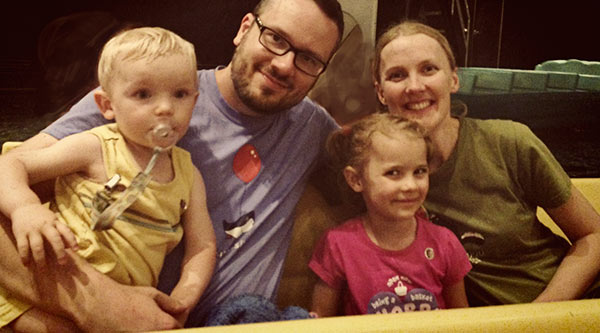
Kim and I attended our first homeschooling conference this past weekend. With a December birthday, Lucy wouldn’t be entering kindergarten for another year and a half, but we wanted to get more information about this life-changing decision we’d been considering. To be honest, we each felt a little uncertain and overwhelmed at the prospect of going all-in.
Although homeschooling is quickly growing in popularity (about 2 million kids aged 5-17 are homeschooled in the U.S., twice as many as in 1999), it’s still not the norm. There’s a lot of misinformation out here, and many people still think that homeschooled kids are socially awkward recluses, and unable to compete academically with their public school counterparts. The truth is that most homeschooled kids are extremely self-confident, well-adjusted, and academically bright, often scoring better on standardized tests than their public-schooled peers. In fact, many colleges are creating special scholarships just for homeschooled kids because they are such an asset to the school.
And yet, homeschooling still raises eyebrows.
Meanwhile, I do a lot of speaking in the education market, and it feels sort of strange to speak to public school teachers and then reveal that I actually homeschool my kids. But the truth is, it’s never been the teachers Kim and I have had a problem with (she was one herself for half a decade). They are some of the biggest-hearted, hardest-working people on the planet, in my opinion. Rather, it’s the system, the bureaucracy, and the one-size-fits-all approach that has caused us to consider homeschooling.
Now, we’re used to doing things differently from others. We call it opting out. It’s part of the whole escape adulthood thing, and we champion breaking rules that don’t exist. But still, everything we do is with mindful intention, not for shock value or for being different for different’s sake. Homeschooling is a viable option for the education of our children, an option that wasn’t as commonplace a generation ago. And so even though it’s nowhere near mainstream, we felt it was well worth considering.
Interestingly, I arrived early for a session about incorporating the kitchen into your curriculum, and I ended up chatting with the woman giving the workshop. I told her that since my daughter was not even five, we hadn’t yet started homeschooling, and she gently reminded me, “You’ve actually been homeschooling this whole time.”
So true.
One of the highlights was attending the graduation ceremony on Saturday. Six high school seniors were honored as they officially ended their homeschool education. Each gave a short speech, followed by an opportunity for the parents to say a few words. It was a moving occasion. As I sat there, I marveled at the poise and confidence these six young men and women displayed as they shared their experience and appreciation for having been homeschooled. I was awed at the respect and love they had for their parents. I was impressed by the things they’d been able to accomplish and the dreams they outlined for their future. Then I thought back to my own high school graduating class of 300 kids. I figured there would be fewer than 10 that could have been put in a similar situation and responded with as much grace and wit and wisdom. A vast majority of them would have been in Metallica t-shirts shouting something barely intelligible, like, “School sucks, I’m outta here!”
Time and again, I was blown away by the accomplishments proud parents shared about their homeschooled adult children. Master’s degrees from prestigious universities. Great jobs in the field of engineering, physics, and business. Volunteer and ministry experiences that made me feel like Ebeneezer Scrooge. Not only have they become successful, but they are among the best our society has to offer.
Kim and I gained a lot of perspective and ideas, but no one there ever pushed the “right way” to homeschool. We discovered that there really are as many ways to homeschool as there are homeschooling families. Everyone has a different personality, which is cool. I think the lack of judgment comes from having to constantly answer critics and fight for their rights as parents. The prevailing sentiment seems to be, “I don’t want anyone telling me what’s best for my family, so I won’t tell you what’s best for yours.” As someone who lives in a pretty politically charged state, it was cool to see a mix of families — conservative and liberal, Christian and non-religious, big families and one-child families — unified as one voice, eager to give support and share tips with one another. Just amazing.
Going into the weekend, my prayer was that if homeschooling wasn’t for us, we’d be willing to walk away. But if it was, I prayed for confidence and enthusiasm.
I come away with both in spades.
We now see that although homeschooling is not right for everyone, it is for us. We are excited about the freedom and possibilities before us. Yes, there is more responsibility that comes with this choice, but we have come to see that it is a choice that offers more fun, and, believe it or not, less stress.
In no particular order, here are some of our favorite things about homeschooling:
The Hope for a Brighter Future for Our Kids
We believe that for our children’s futures, success will require the ability to think creatively, easily adapt to change, and find answers on one’s own. Homeschooling excels at this. Regular school is broken, based on an outdated model born out of the Industrial Revolution. It’s also bogged down in bureaucracy and slow to change. Kim and I see homeschooling as our chance to BE the much-needed change for our kids, rather than hope and wait for things to get better.
Creativity and Control
We’ll have more control over what our kids learn than some politician, administrator, or school board. We can customize our kids’ education based on their specific needs and interests. Contrary to the way a normal school day flows, learning does not happen in clearly delineated blocks of time and topic areas (i.e., science THEN math THEN history). In reality, everything is connected! An interest in horses may involve science AND math AND history AND literature AND art AND music — all at once! Kim and I get to guide our children’s learning in a way that is relevant and meaningful to their lives.
Freedom to Grow
I love the idea of being able to give my kids freedom to follow their passions and pursue their interests fearlessly and confidently. Learning will happen at their own pace, not at the one-size-fits-all standard. They’ll be neither bored waiting for everyone else to catch up, nor left behind and at risk of being labeled slow or stupid. And there is no sound of a bell telling them that they have to be done with an activity they’re really into.
Freedom of Schedule
We are stoked at the prospect of being free from the standard school schedule, which will give us a more flexible daily and weekly schedule. It also means no painfully early mornings, no parent-teacher conferences, no homework at night, and no restrictions on when we take a vacation! In traditional schooling, there is a lot of wasted time on busywork and adminstrivia, so I appreciate the more efficient use of time in general.
Freedom of Place
Homeschooling can happen anywhere. You can do school inside at the kitchen table, outside in the grass, or in a fort made of couch cushions and blankets. And we can continue to be heavy travelers, learning on the road wherever we go.
More Family Time
This is huge: I get to see more of my kids as they grow up. The years go fast enough; I can’t imagine how much faster they’d go if they were somewhere else being taught by someone else. Plus, they get to spend more time with their siblings, creating closer relationships. Although it seems unthinkable for more time together to be a GOOD thing, the homeschooled siblings I’ve encountered all get along really well and actually enjoy being together. Who knew?
Socialization
Socialization is usually looked at the the main disadvantage of homeschooling. But we see it as one of the biggest advantages. First, in terms of time spent together, Kim and I are the primary role models, not their peers. It is OUR faith and values that will be the dominant force in their life. Secondly, my kids will be less peer dependent, making them less susceptible to negative peer pressure. But, contrary to popular belief, homeschoolers are not locked inside all day long, away from the outside world. Instead, they have the freedom to go on more field trips, do more volunteering, and gain more experience working with people of all ages, which is better training for the real world. And with a large homeschooling network in our community, our kids will be able to connect with good friends their own age, who aren’t concerned with what’s currently popular at school.
Lifelong Learning
The most exciting thing of all is the chance to cultivate curiosity and foster a lifelong love for learning in our children. Too many schools churn out unengaged, rule-following robots who think learning is boring. Consider these sad facts:
- 58% of the US adult population never reads another book after high school.
- 42% of college graduates never read another book.
- 80% of US families did not buy or read a book last year.
- 70% of US adults have not been in a bookstore in the last five years.
One workshop leader, when asked about whether or not his family takes summers off, replied, “Why would we take summers off from learning? We just keep on reading books and learning about stuff that excites us. When you make learning enjoyable, schooling IS the vacation.”
Wow.
I was also struck by another woman who said, “Our kids are all grown now, so now we get to homeschool ourselves.”
Double wow.
No doubt, homeschooling will be a challenge. But then again, all worthwhile things are. Kim and I are looking forward to sharing in the learning and doing new things WITH our kids, while taking advantage of the opportunity to turn everyday events into adventures!
You can be sure that we will share many of our adventures here. 🙂
* [ Update: The Downsides of Homeschooling? ] *
I was asked to share some of the downsides of homeschooling to help those who might be considering it themselves. While we’re still in the rookie stage of this whole thing, I am happy to share some of those that we are aware of and have even considered ourselves. I also apparently felt that this post wasn’t long enough as it was, so here goes:
Time. It would appear that one of the downsides of homeschooling is the extra time involved. Interestingly, it is not necessarily the amount of instruction time required, however. In fact, I heard one veteran assure a working mother that nights and weekends are sufficient for covering what’s necessary, because the education is so customized and you don’t have all the administrivia that comes when you’re managing 25 bodies. But make no mistake, there is a lot of thinking (and effort) involved, which takes a lot of time. There are many different curricula and approaches to consider, and every stage of your child’s life will bring new challenges to sort out. It’s interesting to keep in mind that no one else is going to put anywhere near this amount of time and consideration into my child’s educational journey. Kim and I think our kids are worth it, and we figure that if our kids went to a traditional school, we’d be spending a lot of time helping them with homework and getting them to and from school every day.
Money. Public school is free. Private school is not. Homeschooling seems to be somewhere in the middle. It’s true that some of the curricula can be expensive, but the best resource is the free public library, and there are many books and websites devoted to homeschooling on a shoestring budget.
Keeping Records and Jumping Through Hoops. Every state has different legislation and requirements regarding homeschooling, and some have some pretty stringent reporting policies, which can be a real pain. I can’t speak to all of them, but we discovered this weekend that Wisconsin is one of the most homeschool-friendly states around. For that, we are extremely grateful.
Missing Out on High School Sports and Things Like Prom. Many states require school attendance to participate in high school sports. That kind of stinks, especially since Kim played volleyball in high school and I played varsity baseball. However, some homeschool networks have their own leagues, and of course, there are public summer leagues available as well. We also heard that a lot of homeschoolers participate in sports that can be enjoyed throughout their entire lives, including activities like golf, karate, skiing, and rowing. On the topic of prom and other similar large social activities, yes, these are things that are hard to replicate in a homeschool setting. I think the loss of these experiences takes on more significance because most people don’t have a reference for the types of things homeschoolers get to experience that traditionally-schooled things don’t. Yes, our kids may miss out on some things that their peers enjoy, but we feel like the benefits they’ll receive will be far more valuable.
Having To Teach Things You’re Not That Good At. I scored well on my ACT, but these days, I barely remember algebra, let alone trigonometry! And how can I possibly teach chemistry as well as Mr. Navin, who has spent his whole life in the field? That was probably my biggest fear going into this weekend. Sure, I can get my kids up to speed through middle school, but after that, there could be some rough seas ahead. The thing I was relieved to discover is that Kim and I don’t have to be experts on all things to give them an outstanding education. Our job is to be more like a guidance counselor rather than a teacher. There are scores of resources out there, from textbooks to tutors to video series that will help them learn what they need to. Our job is to help our kids uncover their interests and point them in the direction of knowledge. I was assured that in high school (and even in middle school), homeschoolers know how to find their own information. You don’t teach them, you just guide them. And I was encouraged by stories like the one of a boy who went on to excel in physics, even though his parents both hated math. It would seem that we too often underestimate the insatiable desire of human beings to learn, particularly the things that interest them.
Less Interaction with People Their Own Age. As I mentioned above, I think this is actually a GOOD thing. But it is a false view of homeschooling to think that my kids won’t have any friends who aren’t siblings. The cry for socialization is the one thing that gets a homeschooling parent’s eyes to roll more than anything else. If public school is the supposed foolproof method for developing well-adjusted, properly “socialized” citizens, why does it churn out so many misaligned, anti-social individuals who contribute little to society and become a drain on the system? At the very least, it does not appear to be the cure-all it’s claimed to be.
Accountability. The results of your child’s education are all on you, for better or for worse. It’s obviously easier to put the blame on someone else if things go wrong, but with homeschooling, the buck stops here. I’d argue that most problems in our society point back to parenting, but these days, the bad parents have too many excuses at their disposal, and things only get worse. I, for one, relish the opportunity to call a spade a spade and value the freedom to do my job.
Fear. Of course, all this accountability often comes with a side dish of fear. Kim went to a workshop on handling doubts and was surprised to see experienced veterans in the session as well. Apparently, it’s pretty normal to frequently second-guess yourself, questioning whether you’re really doing the right thing or screwing your kids up beyond repair, especially in the face of outside opposition. I take it as a sign that you care, and I see it as a pretty normal feeling for parenthood in general, whether you homeschool or not. I was able to take a lot of solace in the stories from people who’ve turned out some pretty great kids amidst periodic doubt and uncertainty.
Dealing with Critics. Speaking of outside opposition, many people don’t understand homeschooling and some who work to undermine it. Sometimes, friends and family and complete strangers can be very rude and hurtful in their lack of support or outright hostility towards the very idea of it. By all accounts, much progress has been made in the last 20 years, but it can be tiring to always be defending your decision (and right) to do what you feel is best for your family.
Standing Out. Sort of a corollary to the last one. Homeschooling is not mainstream, although it’s becoming more popular every year. Some people will find that it’s more comfortable just blending in. But that’s not how we roll, especially when the stakes are this high.
In closing (I think), here is a fun little video by a homeschooler humorously debunking Seven Lies About Homeschoolers. Enjoy!
Leave a Reply