For me, the start of baseball season is one of the most wonderful times of the year. It means winter is over, and hope springs eternal for each team. Even long-suffering fans know that every season brings with it favorites who falter and long shots who shock the world.
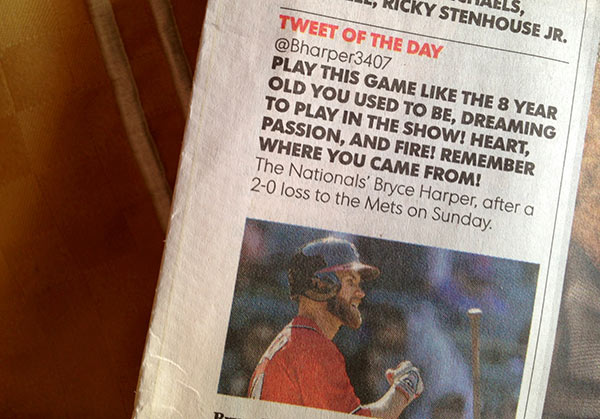
I saw a tweet in a newspaper years ago (when X was still Twitter) from Bryce Harper (when he was still playing for the Nationals, not the Phillies) that still resonates:
“Play this game like the 8 year old you used to be, dreaming to play in the show! Heart, passion, and fire! Remember where you came from!”
–Bryce Harper
He tweeted this rallying cry after his team lost 2-0 to the Mets.
You might not be a Major League baseball player, but you are a former eight-year-old.
Remember when you were eight?
Remember how amazing being a grown-up sounded?
No one telling you to make your bed! No school bells or book reports or homework! Happy Meals every day! You’d trade in your bike for a car (hopefully the flying kind) and could go anywhere you wanted!
When you were a kid, you spent a lot of time imagining the day when you would finally be grown up, with all the amazing powers that came with it, like independence and height and a drivers license. You had dreams and visions of great adventures, once you finally had the chance to call your own shots and live your own story.
If you’re reading this, and you’re an adult, how’s it going?
I know, it’s not all it was cracked up to be.
But.
Are you taking advantage of your powers and the opportunities now before you?
Kim and I like to joke that as adults, we have the ability to make the best living room forts because we are taller, have a better handle on physics, and have access to all the sheets and blankets in the whole house.
And yet, when was the last time you made an epic fort and spent an entire Saturday in it?
It appears that adulthood is wasted on adults.
Yes, I know well the unanticipated downsides of adulthood: the bills, the filing of taxes, the thankless and exhausting task of raising children of our own.
But can you imagine how excited your 8-year-old self would be with the power you now possess?
You don’t have to dream about publishing a book, learning how to sail, opening a bakery, starting a community garden, putting on a concert, building a go-kart, or flying somewhere you’ve always wanted to visit. You can actually do them! You finally have the power, resources, and freedom to change the world. (At least your small part.)
Magic that has nothing to do with how the pretty pictures are made.
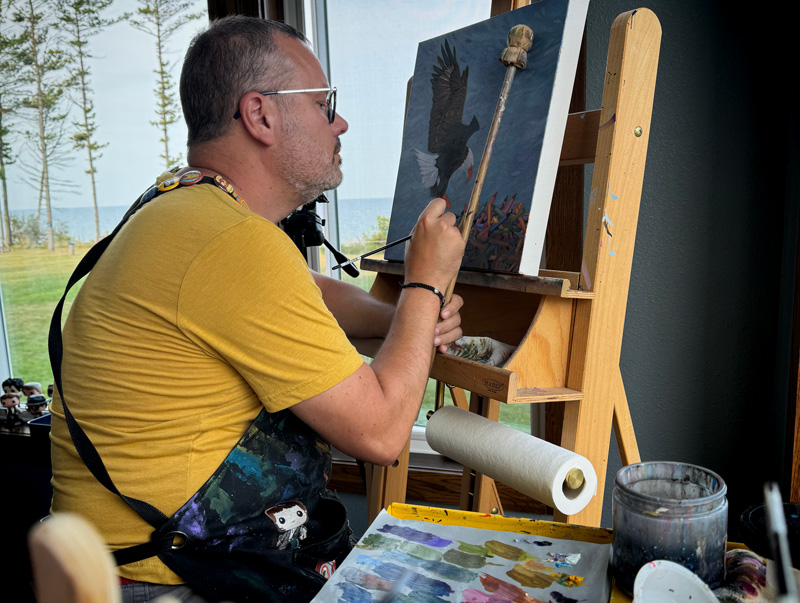
My studio serves many purposes – it’s my favorite place to sketch, brainstorm, write, paint, and design cool things – but basically, it’s where I go to slow down, get silent, and listen to God. It’s my creative base of operations where I receive light that I reflect into a dark world.
That’s why I call it Echo Base.
(And also because I am a Star Wars nerd.)
When I am there, in my happy place, a strange phenomenon occurs: Time simultaneously slows down and speeds up.
It slows down in that all the distractions and frenzied noise from the outside world fade away. I am present, and everything feels calmer, slower.
Meanwhile, time flies. I am so engrossed in the act of creation that hours pass in a way that feels like minutes.
As wonderful as it feels to be in that zone, even that’s not the magical part.
“Doubt your doubts and believe your beliefs.”
I first heard that line in a Switchfoot song many years ago. I was probably barely into my twenties, but it sure resonated, and still does today.
As we journey through life, it’s easy to get duped into doubting our beliefs. When we put too much stock in our doubts, the grip on our beliefs loosens. This leads to uncertainty and anxiety, which causes even more doubt. We are more susceptible to this cycle when we are operating at a hurried pace, inundated by noise and distractions.
When we are in a place of peace and calm, it’s easier to feel a sense of conviction and certainty about what we know to be true.
My studio is where I doubt my doubts and believe my beliefs. I do this by painting what I believe: That God is good, the world is beautiful, and light always defeats darkness. (If you look closely at my portfolio, that’s the theme you’ll see over and over again.)
If you look at the world, it doesn’t take long to doubt those beliefs. It looks like darkness is winning. The world can be violently ugly. And God doesn’t always seem so good.
When I am discouraged and filled with doubt, I retreat to my studio to create things that are good, true, and beautiful. This act of creation helps remind me of my beliefs, causing the doubts to shrivel and fade away.
In the midst of this process is where the true magic — bordering on miraculous — occurs. As the act of painting reinforces my belief, it also transforms it into a physical embodiment of that belief. This arrangement of paint on canvas turns it into a totem, something tangible that can be passed along, in the form of a social media post, a greeting card, or a framed print that can be shared with someone else. At that point, it becomes more than just a painting. It becomes a gift that reinforces the belief within them, perhaps in a desperately-needed moment, when doubts were starting to pile up in their own life.
It’s like a message in a bottle that can float on through the years, impacting people far away and even after I’m gone.
If that’s not magic, I don’t know what is.
In these days when darkness seems to have the upper hand and anxiety is at an all-time high, retreat to your secret hideout. You might not have an art studio, but I bet you do have a place where time simultaneously stands still and speeds up. A place where that little flame inside you gets reignited.
Turns out that any time you light a candle, even if just for yourself, it can illuminate the path for someone else, too.
I am not a natural-born rule breaker. This may come as a surprise, coming from someone who wrote a book about breaking rules.
The obvious question for anyone who knew me as a child is, “How did you go from being a shy boy who was afraid of new situations and spent an eternity in swimming lessons to a guy who makes a living speaking in public about breaking rules?”
For years, I’ve tried to come up with a compelling answer. After all, it seems like some sort of magic was involved.
I’d often point to a moment, sometime around college, when I imagined myself as an 80-year-old guy looking back on my life and wondering, “What if?” And yes, that was when I started to experience the fear of regret as more powerful than the fear of trying something new.
Other times, I’d give credit to a retreat I attended after high school that had a profound impact on me and changed the course of my life. But as monumental as that experience was, it doesn’t fully explain the shy-kid-to-speaker transformation.
The truth is, there wasn’t one magic moment that instantly turned me from a timid rule follower into an artist who speaks to strangers for a living and wrote a book about breaking rules.
Earlier in my career, I was always frustrated that I didn’t have a better, flashier story to tell than the boring one that included hard work, persistence, and a lot of help from others.
But then one day, my friend Kelly reminded me that Damascus moments are rare. The Biblical story of Saul experiencing a divine intervention on his road trip to Damascus that included being blinded, getting knocked off his horse, hearing the voice of Jesus, and having scales fall from his eyes before totally turning his life and changing his name to Paul around sure is dramatic.
Stories like that make great theater, but aren’t very common.
Most of the time, change happens one small choice at a time.
Yes, critical “aha!” moments can alter our course (like the retreat did for me), but most of the transformation from who we are to who we want to be can be accomplished through tinkering: little experiments where we try new things, push our limits, and spend time breathing the air just outside our comfort zone.
Looking back, I can see that every time I took a tiny step beyond my comfort zone, it grew. And I noticed that it would stay that new size, forever, or until I nudged it slightly larger again.
Little steps — even the seemingly backwards and sideways ones — add up to make a difference.
Where do you want to go? Who do you want to become? What do you want your life to look like five years from now?
Stop looking for a magic wand. Take a little step, and then another little step, and another.
You may not get knocked off your horse by a blinding light and hear the voice of God. But trust me. After enough little steps in the right direction, the difference between who you’ve become compared to who you used to be will seem a lot like magic.
Even if the story about how you got there is downright boring.
☕ What’s a boring thing you could do today that might make your life better a year from now?
This is a new video series from my studio overlooking Lake Michigan. It’s where I slow down, listen, and make art that brings light into the world. This is Echo Base Dispatch—a brief transmission from here to wherever you are—where I share what I’m working on, what I’m wrestling with, and the lessons I’m learning along the way.
–Jason
I recently taught a drawing class at my kids’ homeschooling co-op. Pondering some of the biggest mistakes I see beginners make helped me formulate the first lesson:
Start your sketch light and loose. Resist the urge to add details too soon.
I’ve seen it time and time again: In a rush of enthusiasm and naiveté, beginners focus on details too early, before the overall form of their subject is fleshed out.
Perhaps they got all excited working on the head, painstakingly capturing each wisp of hair, only to realize they didn’t leave enough room on the paper for the rest of the body. What’s more, they are heavy-handed, laying down marks that are too dark for these early stages, which becomes a problem when a mistake reveals itself. When it’s discovered that the head is a bit big or the nose needs to move a little to the left, it’s very difficult to erase those early lines.
Because they’ve already invested so much effort — and graphite! — and those dark, heavy details are hard to remove, the beginner is tempted to adjust the rest of the drawing to accommodate the mistake. This only compounds the problem and makes the drawing even more inaccurate.
When the disaster that develops can no longer be denied, the eraser finally comes out to tackle a job that’s now too insurmountable for its capabilities. What’s left behind is a smudgy, wrinkled piece of paper bearing the ghosts of a cavalcade of missteps and missed expectations.
Even worse is when he or she gives up altogether, proclaiming themselves “not an artist.”
All of which could have been prevented with a light and loose touch at the beginning.
There are a few lessons here for all of us.
Just because something doesn’t turn out the way we’d hoped doesn’t mean we are ill-suited for the job, we’re wrong to pursue it, or that we should abandon it altogether.
But it’s probably worth considering how we started.
Did we rush in before we had all the information we needed? Did we pour too many resources into one area before fully considering the big picture? Did we make assumptions that proved to be incorrect?
When starting something new, our enthusiasm often drives us to press hard on details before we can confirm if we’re even heading in the right direction.
Sometimes we drive a lot of miles in one direction before realizing that we took a wrong turn at Albuquerque.
Discouragement bubbles up when we become aware of a problem and realize things aren’t working out the way we imagined. It’s difficult to erase those expectations that have been impressed so deeply within us. Rather than adjust our course, we hold tightly to our initial assumptions, trying in vain to force reality to accommodate them. We plow forward, hoping for the best, but ultimately waste time and resources in the process.
But hope is not lost!
Maybe we can try starting again, from the beginning, with a new sheet of paper. Even if we can’t fully erase all the actions we’ve already taken, let’s avoid labeling the project as a mistake or ourselves as a failure.
You are merely human.
And on your next undertaking, start lightly, holding loosely to the results. Consider the big picture. How does this new endeavor fit within the context of the rest of your life? What are the main things you’ll need in place for this project to succeed?
Then, take baby steps that are easier to erase if you suddenly find yourself going down the wrong road.
Mind you, this is not a call to overplan. It’s a reminder to hold your initial enthusiasm in check, just for a beat, to get your ducks in a row. It’s encouragement to maintain a playful spirit of tinkering and a willingness to adjust course as you discover what God is up to.
Don’t delay in starting, dear artist.
Just start lightly, loosely, with a heart open to the big picture before getting lost in the details.
🤔 Is there something going on in your life right now you’re discouraged about and has you tempted to give up? Could there be a way to “begin” again, with baby steps and an open heart?
My family has been looking forward to them. We love the pageantry, the drama, and the vignettes about the athletes’ backgrounds. I just wish they’d implement one idea I believe would enhance the experience for everyone.
Before each event, they should hold an exhibition match or heat with regular people demonstrating the sport we’re about to see. And when I say “regular people,” I don’t mean an amateur who missed the cut, or even a teenager familiar with the sport who can hold their own.
I mean a regular Joe who has literally never done the thing before. Ever.
Look, we all think a Triple sow cow Salchow (Really? It’s not “sow cow?”) is impressive, but it would take on a whole new level of wow when compared to a guy attempting it who can barely stay upright in skates for three seconds.
Be honest: How many of us have sat smugly on our sofa with our half-empty bag of Cool Ranch Doritos, scoffing at the bobsledders who don’t appear to be doing anything other than going for a ride?
It’s a fast ride, but still.
Something tells me we’d all be singing a different tune if we swapped the four athletes out with four random dudes from the neighborhood bar.
Am I the only one who’d like to see how a career politician fares on her first-ever ski jump?
And I have a whole list of people I’d love to volunteer for a luge run.
All I’m saying is that these athletes who are competing in sports most of us only encounter once every four years have put in incredible levels of work and sacrifice. This little addition to the programming would help us appreciate it all the more.
But there’s another fringe benefit, too.
These world-class athletes are so good, they make what they do look easy. Seeing the schlubs struggle would remind us that it’s actually not. And then, perhaps it would dawn on us that when they were just starting, those world-class athletes probably looked more like the schlubs than Olympians.
And then maybe, just maybe, we’d let go of the foolishness we carry around and give ourselves some grace. Maybe we’d finally let go of the pressure of scoring a perfect 10 the first time we try something new. Maybe we’d finally realize that when we feel like the schlub slipping around, making a fool of himself that first time, it’s…normal.
Don’t let the fear of failure or looking foolish keep you from starting.
It takes a long time and lots of practice to make something look easy.
Until then, embrace your inner schlub and start putting in reps.
☕ What is something you’ve been putting off because of a fear of looking foolish or not feeling ready? What would a first step look like?
This is a new video series from my studio overlooking Lake Michigan. It’s where I slow down, listen, and make art that brings light into the world. This is Echo Base Dispatch—a brief transmission from here to wherever you are—where I share what I’m working on, what I’m wrestling with, and the lessons I’m learning along the way.
–Jason
The best part of living on the edge of Lake Michigan is witnessing the incredible, infinite creativity of God every day. Upon the simple canvas of sky and water, He paints an endless stream of masterpieces.
His work effortlessly transitions from calm to mysterious to turbulent, and his use of color, form, and texture is breathtaking. One day, the sky is a watercolor painting, with subtle pastel hues bleeding into one another like a melting scoop of rainbow sherbet. Other days are oil paintings, with an impasto of thick, angry clouds scraped across the sky. Some days, He pulls out all the crayons, some days his palette is quite limited, and some days, I swear, He’s inventing new colors.
Since I’ve been living here, I’ve harbored a desire to capture what I see. I know my version can’t hold a candle to His, doomed to look like a dime store copy of a copy of a copy. A proverbial exercise in futility.
But alas, I can wait no longer. On the occasion of turning fifty soon, I have decided to undertake a quest in which I sit on the edge of the Master’s studio and create fifty copies of some of His best work. Fifty paintings of the same sky and water that somehow never look the same.
I’m calling the series of paintings “50 Shades of Great.”
As if this tinker project wasn’t challenging enough, I am adding an extra wrinkle: I can only use four colors on each painting.
[The four colors I’ve chosen for this one are Ultramarine Blue, Cadmium Yellow, Quinacridone Magenta, and White.]
There’s a reason I’m limiting myself like this.
Let’s start by hopping in a time machine, back to a time when a box of 64 Crayola crayons — complete with a sharpener in the back — was as valuable as anything on Earth. I recall it containing every color known to mankind, exotic hues not found in the pedestrian collections of 8 or 24: Periwinkle. Brick Red. Cornflower. Thistle. Goldenrod. And of course, Gold and Silver, which I was convinced were made with real bits of the precious metals.
The box of 64 crayons turned anyone into an artist. Everything was possible; there was nothing you couldn’t draw.
Nowadays, we’re still artists. No longer working in crayon, turning out drawings to decorate the fridge, we are now tasked with creating better communities, businesses, and teams. In this work, we often yearn for a bigger budget, less red tape, or more cooperation from colleagues, upper management, and politicians. We could use more training, more structure, more resources.
If only I had brick red! Can you imagine what I’d do with periwinkle? We could make a real difference with silver and gold in our crayon box!
How we long for the unlimited possibilities that box of 64 crayons represented!
If I had double the budget, I could really make some strides with these students.
If I had a few extra hours a week, I could make some real progress on this plan.
If I had another acre, an extra room, or a few hundred more square feet, I could be so more productive and efficient.
If I had a bigger team, we could get so much more accomplished.
Money. Time. Space. Manpower.
Silver. Cornflower. Brick Red. Periwinkle.
You may want the big box of 64 crayons, but there is never a time when you’ll have everything you wish you had.
Most of the time, it feels like you’re a few crayons short of filling the humble box of 8.
Short of the resources that would make your work significantly easier or more effective, it’s easy to feel paralyzed and tempted to throw your hands up in resignation. We let the disappointment over what we don’t have keep us from making the most of what we do.
But here’s an important truth to keep in mind. The best painters in the world can create a masterpiece with only four colors: red, yellow, blue, and white. That’s all you need to paint a rainbow.
Even though art supply stores feature walls of paint tubes in a dizzying array of pigments, the wise teachers implore their students to proactively limit their palette to a handful of hues to ensure a harmonious, pleasing result.
True creativity thrives when constrained by limitations. Ultramarine was the finest and most expensive blue used by Renaissance painters. It was made from lapis lazuli, a rare and expensive stone, often costing more than gold. But when you are using a lot of warm earth tones, as those master painters did, a neutral gray made from black and white can take on a blue tone by comparison.
Having access to all the colors does not make one an artist.
It’s about knowing how to use the ones you have.
Whether you are an educator, a healthcare professional, an entrepreneur, or a parent trying to raise great kids, I understand you wish you had more time, more resources, and more freedom to do the important work that needs to be done.
Unfortunately, that may never be the case. It rarely is in the real world.
But that’s ok.
You are simply called to do the best you can with what you have.
Don’t let your limitations hold you back, dear artist.
You may not have the whole box of 64, but you have everything you need to make a masterpiece.
🤔 Where do you feel stuck because you’re waiting for something you don’t currently have? Is there something you can do to move forward using resources you do have?
I don’t care how prestigious the publisher, how persnickety the author, or how many editors looked it over; there will always be at least one typo.
It’s a law of nature, like gravity, and how whatever line you choose to stand in always becomes the slowest.
Ok, maybe it’s not that ironclad. But it does happen more than you might expect. I even noticed one in my Bible the other day (although it wasn’t the Author’s fault).
Obviously, a professional works to minimize typos as much as possible. A book riddled with errors is the mark of an amateur. It looks careless and detracts from the message or story the author is trying to convey.
I’ve talked about this law with my friend Scott, who writes books like most people change socks. Since then, I’ve seen typos pop up again and again. Instead of raining down condescension upon the world-renowned author and their fancy New York publisher, I just nod and think, “And there it is.”
It happens to the best of us.
But not me.
No, I’ve written seven books (plus all the Kim & Jason comic strips), and have thus far been able to avoid this fate.
Ahem.
Well, I spotted one recently, during a public reading of my new children’s book. It tripped a wire in my mind. Something felt wrong, but I kept going. Afterwards, I looked back at the text, trying to find the problem. I couldn’t, so I figured my brain must have misfired while my mouth was busy saying the words out loud.
Except then it happened again. During another public reading.
Yep.
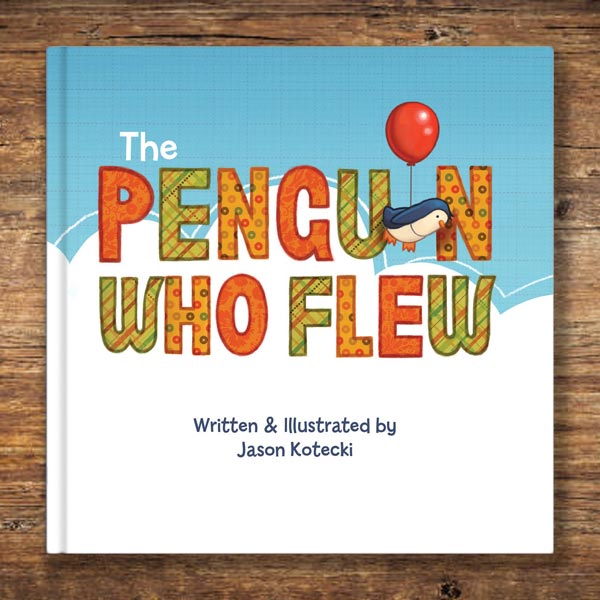
There is a typo in The Penguin Who Flew, a picture book for children that only has 32 pages and just 527 words.
This article is longer than that.
I published a book with 527 words, but only 526 of them are typed correctly.
(As far as I know.)
I can confirm that the professional editor I hired isn’t to blame, as the final manuscript does not have the error. It must have happened as I typed the copy into the final layout (why didn’t I just copy and paste?!), so the blame falls squarely on my shoulders.
To be fair, 99.8% of the words in the book are totally fine.
Somehow, that doesn’t make the 0.2% burn any less.
And let me tell you, it really bummed me out.
Still does.
But as the person who has stood on stage after stage, declaring into darn near every microphone I’ve been given that every storm cloud contains a silver lining, I had to ask the question:
Now that this has happened, what does this make possible?
Let’s see…
It unleashed an avalanche of embarrassment upon me, that’s for sure. It provided an opportunity to lose face in the eyes of readers, who will conclude that I am a hack who clearly didn’t care enough to proofread his own book. It will confirm to the world once and for all that I am a fraud…
(Wait, this is not helping…)
Then I had this thought: It’s an opportunity to grow in humility. Which, believe it or not, is something I’ve been praying for. In an attempt to become more like some of my spiritual heroes, and more specifically, Jesus, I realized that I have a long way to go in this department.
(If you don’t think God answers prayers…)
So yes, this disaster did make it possible to grow in humility. Strangely, that actually made me feel better about the whole thing.
Then I realized I could grow even more if I told everyone about the typo, publicly, like I’m doing right NOW. I assume most people will have missed it, as I did, the hundred times I read it BEFORE signing off on thousands of dollars of printing to commence.
But now everyone will be alerted. It’s no longer just my little secret.
(Yes, this sounds like a really smart move…)
That said, I have decided not to share where the typo is. Perhaps you can make it a game, or a fun scavenger hunt for your kids that you can use to teach them at least seven valuable lessons.
(See? Another good thing made possible by my blunder!)
When we do the next printing, I will correct it, which will give those who ordered early a collector’s item. It might even be worth more if it’s anything like the “error cards” from the baseball card-collecting days of my youth.
(That’s me doing you a solid, giving you an investment tip, and rewarding my early investors. Order now, while supplies last!)
But please, just do me one favor. When you do find it, don’t email me to tell me. I already know where it is, and I have no gold stars for you. It might seem like it’s helpful to let an author know you found a mistake in their book, but there’s usually not much they can do about it. Plus, no author I’ve ever met is under the illusion that they’ve written the perfect book. Let them reside in the bubble that maybe, just this once, the stars aligned, and they did.
On the other hand, after sharing my embarrassing debacle opportunity to grow in virtue with Scott, he reminded me that when people point out a typo, it means they actually read your book. Which, in today’s attention-deprived world, is just about the best compliment an author can receive.
So, to all the many folks who have sent me anecdotes and pictures of kids (and former kids) who have read and LOVED it and, in a few cases, declared it their new favorite book(!), thank you. It’s gratifying to know that this story about a persistent penguin with an impossible dream has landed the way I’d hoped.
And you know what? Feel free to spread the word about the typo.
Especially to the kids.
Maybe the fact that even the big-shot professional author of their new favorite book makes mistakes will remind them that he is human, just like them. And then maybe it’ll dawn on them that they don’t have to be perfect to achieve their dream, either.
Like Marty the penguin, they only have to give it everything they’ve got.
So remember, friend: every book has a typo.
Every life has them, too.
Just don’t let them stop you from making something great.
Hurry! Only a limited number of typo-enhanced copies are still available!
🤔 Anybody else want to grow in humility by sharing one of their colossal screw ups?
Kim and I spent the first few days of this new year together, alone. The kids were with grandparents while we enjoyed our annual respite to reflect on the year that was and dream about what might be next.
After breakfast one day, we strolled along a pier that juts into Lake Michigan. The air was cold but invigorating because the wind was elsewhere, as were most people. We had the pier to ourselves. Upon reaching the end, we paused in silence, surrounded by thin, cracked sheets of ice. It was quiet, except for the crackling and crunching of the stiff blanket covering the surface of the water.
Peace.
We lingered for a bit, then walked back toward land, resuming our conversation. As our stroll concluded, Kim declared her desire to return for a Wonderhunt, casually mentioning that she’d seen fifteen hearts in the snow and ice over the course of our short walk.
How many had I seen?
Exactly none.
What a talent! I marveled to myself.
But is there such a thing as talent for something like this? For seeing hearts in nature? I’m not so sure. It’s not the same as having been blessed with a beautiful singing voice, exceptional sprinting speeds, or a penchant for math.
I do know this: The biggest reason Kim has a knack for spotting hearts seemingly at will is that she spends a lot of time looking for them.
What looks like magic to someone else is often the result of lots and lots of practice.
I once wrote a book about seeing. In it, I talked about storms, the metaphorical kind that blow through our lives. I also wrote about one of our most underrated superpowers: the ability to choose what we look for in the midst of those storms.
Yes, the storms will come. Scary, devastating, faith-shaking storms. They are a given, right up there with death and taxes.
But the people who see the silver linings are usually the ones looking for them.
It’s not a talent. It’s a practice.
And the more you practice, the better you get.
This, my friend, is as true with finding hearts in nature as it is with anything.
So…will this year be even worse than last year? Or could it be that this will be your best year ever?
Want to know a secret? You don’t have to wait to find out.
The trap that’s so easy to fall into is letting external circumstances dictate our answers: The news headlines, the outrage du jour on social media, the ups and downs of our personal lives.
It’s hard to see a year in which you hit rock bottom as anything other than bad. But a decade later might bring a new perspective that recasts it as a gift of great value.
Please know I’m not suggesting you pretend that the tough or terrible moments don’t suck. I know I had plenty of those last year. Being sad, mad, or angry is part of the human experience. We don’t have to bury those emotions under some false blanket of positivity.
Just remember that the best year ever is not one devoid of failure, conflict, tragedy, or loss. The storms are part of life.
But.
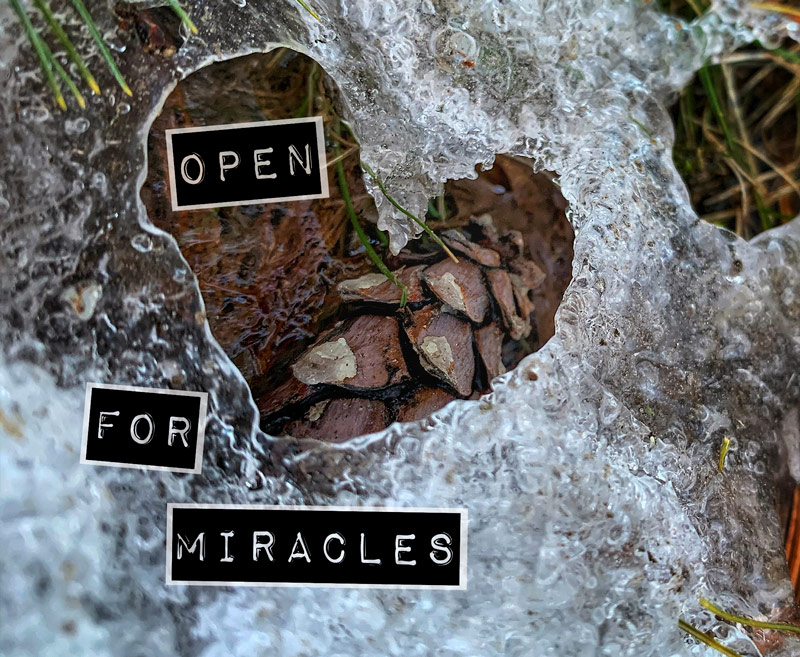
If you spend a lot of time looking for miracles, you’ll start finding them everywhere.
No talent is required.
You just need to practice.
☕ How would you assess your ability to spot the “hearts” in your life? What’s one way you could practice getting better?
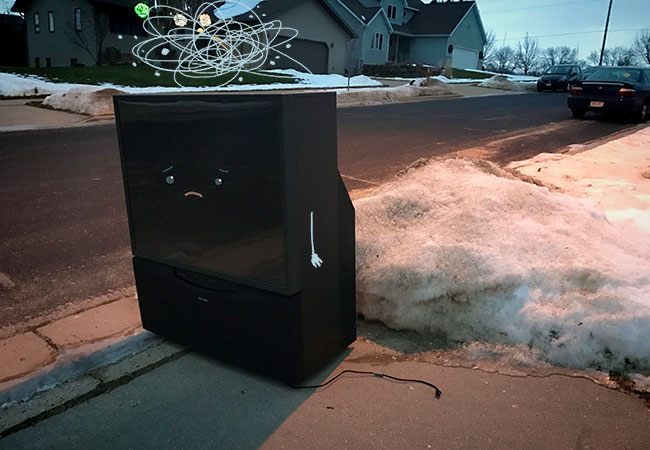
Many Januarys ago, as the ho ho hos of the holiday season abruptly transitioned to the ho ho hums of winter, I came across this abandoned television on a walk around the neighborhood. (Sad face added by me.) I’m sure this one-time technological marvel was the highlight of some Christmas past, but there it sat on the side of the road, abandoned, amidst dirty piles of old snow, valueless. I had no doubt a new TV was in its place; better, flatter, higher def…and also destined to be discarded in a few years.
It was an oversized reminder of our obsession with stuff and our never-ending chase of the latest and greatest. We so easily forget that while we prioritize the tangible — physical things we can see, touch, and that take up space — their most consistent attribute is how they distract us from the things that matter.
Indeed, it’s our experiences — the intangible, fleeting moments of our lives — and the memories they leave behind, that become our most highly valued treasures.
It’s the beauty of the light from a hundred candles in a darkened church on Christmas Eve, the afternoon spent together covered in flour while baking snicker doodles, tucking some deliriously excited but exhausted kids into bed after a late night at Grandma’s; these are the moments that rush by too fast (rudely neglecting to warn us of their importance as they go), and are more valuable than a million big screen TVs.
When we spend money on stuff, it usually depreciates in value over time. This year’s must-have Christmas gift is next year’s Goodwill contribution.
However, the money we invest in experiences is different. The memories we make appreciate in value as we get older and loved ones move on. The money we spend on experiences is always a bargain and leaves us with longer-lasting feelings of happiness. We usually wish we had savored them more when we had the chance.
Instead of buying a “thing” for someone you care about, you might consider gifting them an experience of some kind. It could be a simple weekend trip, concert tickets, a nice dinner out, an offer to babysit for a whole day, a scholarship for an art class, an evening of bowling, or a visit to a spa for a massage. The possibilities are endless.
Now, I seem to be always adding to my Funko Pop collection, and I’d like to upgrade my grill, but just as no one on their deathbed ever said they wished they spent more time at the office, no one ever said, “I wish I had accumulated more stuff!”
But certainly more than a few people have wished they’d taken more family vacations, thrown more parties, undertaken more adventures, or created more memories with the people they loved.
This is not as much a rant against stuff as it is a rally for mindfulness.
In many ways, this year will be the same as the last: filled with temptations to chase the tangible, as well as thousands of opportunities to seek out, embrace, and savor that which is not.
May our goal be to look for ways to invest in memories that get more valuable each passing year.
It sure beats accumulating a future ornament for the end of our driveway.
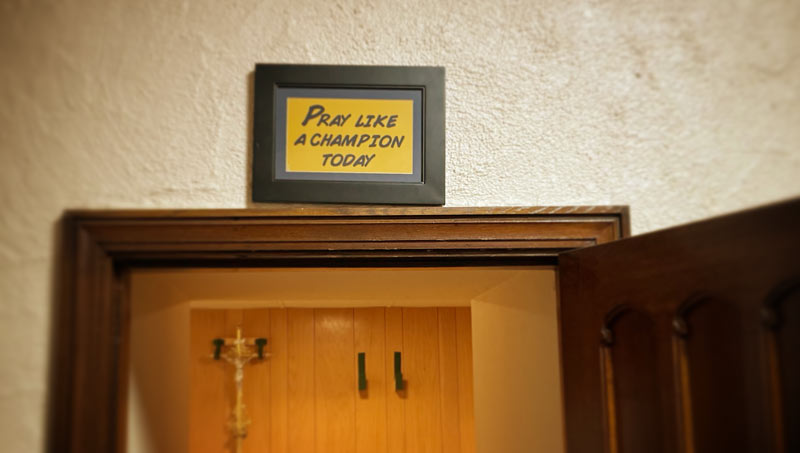
This sign is above the door in the sacristy at Holy Name of Jesus in Sheboygan, where I serve as a lector. In a Catholic church, the sacristy is a room, usually near the altar, where vestments, supplies, and sacred vessels are kept, and the priest and attendants prepare for Mass.
It’s kind of like the locker room where the players prepare for the big game.
The sign is a play off the famous one in the stairwell between the locker room and the field at Notre Dame University. (That one says, “Play like a champion today.”) It actually originated at the University of Oklahoma, on a sign installed by coach Bud Wilkinson in the 1940s for the Sooners football team. In 1986, Notre Dame coach Lou Holtz had one made for his team. Since then, it has become a tradition for Notre Dame players to touch the sign, often with a tap, a swipe, or a kiss, as a way to honor the history, remember the sacrifices of those who came before, and mentally prepare for the game.
One of my favorite routines implemented by our pastor, Fr. Nick, is when he gathers the cantor, lectors, and altar servers in prayer before Mass begins. He asks for the ability to treat it as if it were our first Mass, our last Mass, and our only Mass.
Each of these scenarios calls to mind a unique emotional flavor…
There’s a nervous excitement you get when doing something for the first time.
There’s a feeling of reverence and appreciation that arises when you know you only get to do it once.
And there’s a somber sort of gravity when you know you’re doing something for the last time.
They are different experiences, but in each case, we usually make a special effort to savor the moment, giving it our undivided attention, allowing ourselves to be fully present.
There is great value in adopting this mindset anytime you’re doing something important, especially if it’s become routine. It might feel like a bit of mental trickery, because even if it’s not actually the first or only time you’re doing it, it may very well be your last.
I like this prayer so much that I now say it before every speech I give. I put myself in the headspace of it being my first, last, and only speech. I pray that God will be with me, that I will say what needs to be said, and that my audience will hear what they need to hear. (Which, believe it or not, is sometimes different than what I actually say!)
To consider that it could legitimately be the last speech I’ll ever give rekindles a certain electricity and helps me give it the respect it deserves, regardless of how “impressive” the stage or size of the audience.
It helps me give it my all, like a champion.
Now, you may not be a priest, a lector, a professional speaker, or a football player.
You don’t need to be any of these things to take this ritual to heart.
What is on your to-do list today?
Is there something on it that’s important, but you do it so regularly that it feels rote, and sometimes even like a burden?
Like caring for an ailing parent or a sick patient, perhaps?
Maybe serving a customer or helping a student.
Nursing a child.
Teaching a class.
Running a meeting.
Repairing a vehicle.
Fixing a leaky pipe.
Making dinner.
Preparing to host a family gathering this holiday season.
No matter what the task, what if you acted like you were doing it for the first time?
Would you do anything differently if it were your only time doing it?
What if, today, is the last time you’ll ever get to do it?
How might you approach it then?
Like a champion, I hope.
P.S. This article was originally published at SheboyganCatholic.com, a site I created to share more of my thoughts on faith. If you’re interested in that sort of thing, you can subscribe to the weekly newsletter here.
🤔 I wonder…what’s something on your to-do list today that’s become a routine, or is something you’re not looking forward to? How would you approach it if it were your first, last, or only time?