Author: Jason

  • Surviving the Raging Seas (and Gentle Lakes) of Life

    Photo by ​Katja Anokhina​ on ​Unsplash​

    How hard could it be?

    It was a very calm lake, and I’d been kayaking a few times before. Spending an afternoon with my family on glacier-fed Eklutna Lake in Alaska seemed like a great entry into our vacation portfolio.

    Then the guide started giving her super casual safety presentation, and I suddenly wondered if I was down to my last hour of life.

    To be fair, I’ve never used a sea kayak before. The pros make it look easy. To me, it seems poorly designed. (Unless you were designing something intended to drown someone, in that case, it’s perfect.) If you don’t know what it’s like to use a sea kayak, imagine an eight-foot-long wooden 2×4 floating in the water. Now imagine sitting on top of it and trying not to tip over. Maybe it’s just me, but if I’m looking for something to help me traverse the sea, I’d rather have something closer to a pontoon boat than a pine needle to float on.

    Despite the barely existent waves on this lake, and even they felt like a tsunami threatening to flip me over. Kim and the kids got to use tandem kayaks, which the employee described as very stable and almost impossible to tip. The way she described mine made me feel like it was a foregone conclusion that I was going to drown or, best case scenario, have to be rescued by my children and towed back to shore with a raging case of hypothermia.

    Now, I was the one who suggested this activity, so I couldn’t exactly be the one who put the kibosh on the excursion due to cowardice. So I put on a brave face and got in the boat. The guide pushed me out into the water, and I immediately felt like death was imminent. I like to think of myself as a fairly athletic individual, but I felt as awkward and unstable as an elephant trying to balance on a basketball.

    Thankfully, she gave me a few tips: Don’t make any sudden movements. Try not to look behind you. Sit up straight and stay balanced.

    In retrospect — spoiler alert: I didn’t die! — I realized that those tips are just as useful for life as they are for sea kayaking.

    1. Don’t make any sudden movements. It’s not usually advisable to make sudden changes in life. Spontaneity is good, but best reserved for things of little consequence. Getting married, quitting a job, dropping out of school, or making an all-in investment with your life savings are not scenarios conducive to sudden movements.  But we can be very tempted to make them when we’re in periods of desolation, like when we’re stressed out, weary, lonely, afraid, or depressed. Those are uncomfortable seasons, and we’d do anything to get relief, so it’s tempting to go for a quick fix. This can lead to our life being tipped upside down and disastrous long-term consequences. 

    2. Try not to look behind you. Sure enough, there were some moments when I tried turning around to see what the kids were up to, and I got pretty wobbly. It’s good to learn from the past, but there is a danger in spending too much time looking backward. Otherwise, our life can drift off course, and we can end up in a place we don’t want to be. It’s always better and more stable to look in the direction you want to go.

    3. Sit up straight and stay balanced. Let’s be real: life balance is an impossible goal. Variables change too fast on any given day to maintain perfect equilibrium. But we’ve all experienced times when we’ve been leaning too far in one direction for too long. Like the season when Kim began to Wonderhunt, after feeling overwhelmed from being in constant caregiver mode. Of course, there are seasons of life in which certain responsibilities require an outsized amount of time and attention from us — like putting in overtime to finish a project at work or caring for a sick family member — but we must be on guard from staying in that mode for too long. Sleep in once in a while. Take a day off. Go for a long walk or spend an extra hour in prayer. Do whatever you can to restore some semblance of balance, or you’re facing a surefire recipe for an overturned life.

    In the end, we spent a little over an hour out on the lake. I followed the guide’s tips as best as I could, and gradually felt my confidence grow (or at least my panic subside). We all returned to shore safe and dry.

    Once I got the hang of things, I spent time on the water just floating, trying to soak in the beautiful scenery around me and savor the time with my family, taking mental snapshots of them as they glided into view. And this, too, is good advice for living.

    Sometimes we get stuck focusing on staying alive, and we forget to savor the gift of life.

  • The Complete Guide to Raising Your Kids To Be Rulebreakers Without Ruining Their Lives (or Yours)

    Kim and I are well-known for encouraging people to be more childlike and act more like kids. A few brave souls have asked (although I suspect countless others have wondered): How does this philosophy impact our role as parents?

    In other words, how does a parent walk the line between teaching kids to break rules that don’t exist, without descending into total anarchy?

    Great question.

    While it’s true that our kids regularly say “#Notarule” in its proper context during normal conversations, any speculation that our kids are living in Willy Wonka’s Chocolate Factory is grossly exaggerated.

    Here are some thoughts on the matter. Your mileage may vary, but I believe there are some useful nuggets here, whether you’re a parent or not.

    A Parent’s First Job is Parenting.

    First and foremost, we are our kids’ parents, not their friends or playmates or butlers. No one else has this job, so if we don’t do it, our kids will be screwed, destined to live life as soft, spoiled, entitled, selfish little scoundrels. I think they deserve better.

    And so it falls on us to teach them manners and accountability and forgiveness and generally how to not be dirtbags. The challenge is that this takes a lot of work, which is why many people prefer to delegate it to someone else. It requires the willingness to be the “bad guy,” to say no, and to enforce the law. This, in turn, requires patience, perseverance, self-confidence, and at least a little stubbornness (with the latter being our strongest trait). 

    We are very proud when someone at a restaurant compliments us on how well-behaved our kids are, because we know how much work and consistency go into it. We are also certain they might have a different opinion if they lived with these minions every single day, like we do.

    Kids Need Rules.

    With a degree in early childhood education, Kim is well-versed in the research that shows kids need structure and routine in order to feel safe, grow, and thrive. As such, although our schedule is flexible, we run a pretty orderly household, complete with consistent bedtimes, cleanup routines, and behavioral expectations (right now we’re working on not interrupting someone while they are talking, which, at this rate, they should master by the time they leave for college).

    In our home, there are plenty of rules that DO exist, and there are consequences for breaking them, just like in the real world. We merely advocate the overthrow of rules that DON’T exist. Fortunately, there are plenty of them within the realm of parenthood.

    Parents Need Backbones.

    If he had his druthers, my son Ben would wear pajamas all day long, every single day, for the rest of his life. Once in a while, we let him roll with his own wardrobe choices because, if I’m being really honest about it, the only reason I wouldn’t let him wear his pajamas to the grocery store is because I was concerned about what other people would think of my parenting.

    And frankly, that’s why more parents don’t let their kids break rules that don’t exist. They care too much about what other people would think of them if they did. 

    Kids deserve parents with enough self-confidence to allow them to be themselves and not conform to an expectation that only exists because it’s always existed. 

    Once in a While is Not the Same as Always.

    My friend Eliz sets aside one day a year as the “Day of Yes.” On this particular day, this mother of twins says yes to any and all reasonable requests, particularly the things she normally says no to. My sister-in-law once took her daughter to the midnight screening of the first Twilight movie. On a school night.

    Now, the key to these examples is that both of these moms run a pretty tight ship. Rules are enforced, and the kids are well-behaved. The only reason it’s special is that it doesn’t happen all the time. Parents who always let their kids eat dessert first are doormats. Parents who never let their kids eat dessert first have a stick up their butt. The magic is in the middle. 

    Don’t Fear the Why.

    One thing Kim and I try to practice is an openness to our kids’ “Why?” questions. Practice is the key word here, as “Because I said so” slips out from time to time. The truth is, whether you are a parent, a manager, or a CEO, forcing yourself to answer why you do things a certain way is a great way to ferret out rules that don’t exist. If you have a clear answer, you find yourself smack dab in the middle of a teachable moment. If not, you very well may have stumbled upon a rule that’s begging to be broken.

    Tinker.

    Empowering your kids to break rules that don’t exist is not a one-size-fits-all proposition. Some parents are naturally more lenient, while others tend to be more strict. A lenient parent might jump at the idea of Barbarian Spaghetti(which is a spaghetti dinner with no plates), while a stricter one might recoil in horror. 

    The secret is to start where you are. Just tinker. Step out of your comfort zone in a premeditated way. If Barbarian Spaghetti seems a bit intimidating, then just have breakfast for dinner. Or eat dessert first. Decorate ugly cookies. Push back bedtime to celebrate a special occasion. You don’t have to blow your comfort zone away with a nuclear-powered bazooka. Go at it with a pea shooter, and work your way up from there.

    How to Make a Hard Job Easier.

    Being a bad parent is easy. Being a good parent is incredibly hard. Being a great parent is damn near impossible. As for perfect parents? They’re like unicorns and easy-to-open Barbie packaging; they don’t exist. 

    We believe that you can’t be truly great at anything if you’re not injecting some measure of fun. Although we take our job as parents very seriously, we try not to take ourselves too seriously, and that seems to make the hard parts go more smoothly.

    Case in point:

    The Most Important Thing.

    The rallying cry of “Escape Adulthood” is not about forgoing all responsibility so we can engage in silly, trivial pursuits all day long. Rather, it’s about breaking free from the safe, boring, and predictable version of adulthood that traps most people, and bringing those childlike sensibilities into our daily lives so that we can stress less and have more fun.

    Kim and I want our kids to be curious, dream big, enjoy life, and value experiences over stuff. The best way to do that is to model those qualities ourselves. Because the adage “Do what I say and not what I do” is (and always has been) a myth. 

    “Your actions are speaking so loudly, I can’t hear a word you’re saying.”

    -Ralph Waldo Emerson

    Telling an amazing story with our lives — one filled with magic and meaning and wonder and love — makes it more likely our kids will do the same with theirs. 

    Alas, that’s the hard part. You get that down, and parenting is a piece of cake.

  • The Taste of Hope

    “Yep, they’re dead.”

    The confirmation came from the woman at the nursery after seeing the photos Kim shared of two of our cherry trees. It wasn’t a surprise, but it also cemented the fact that we’d lost even more time.

    A few years earlier, after our majestic wooded backyard was reduced to a violent pile of splintered trees, we processed the grief by imagining possibilities. What might this apocalyptic landscape someday become?

    A vision of pulling fresh-baked pies from the oven, made with the fruit from trees planted in the aftermath of the storm, was one of the first to emerge. The image was so real, I swear I could smell it. And yet I knew it would require patience. It takes years, I was reliably told, for fruit trees to establish themselves and become mature enough to share their apples and pears and cherries. It was for this reason that I became a squeaky wheel, pestering Kim that we should move quickly to get trees picked out and planted. 

    As I near my fiftieth birthday, I have a heightened sense of urgency. Mortality is more in focus than ever. I hope I still have several decades of life left, but I also know that tomorrow is never guaranteed. Best case scenario, I’ve got fewer years ahead of me than I do behind me.

    And so I’ve spent a lot of time thinking about time and how I should be spending it. Am I using my talents as well as I could? Am I wasting too much time on stuff that doesn’t matter? Do I cling too tightly to things I need to release?

    Planting a tree, even if not completely from a seed, still feels like a revolutionary act in an age obsessed with instant gratification. Despite all our technical advances, they have still not yet figured out how to make a fruit tree planted yesterday yield ingredients for today’s Flaming Cherries Jubilee.

    Whether it’s to produce ingredients for a pie, provide shade for a backyard, or serve as support for a treehouse, planting a tree with a particular outcome in mind is a declaration of hope. You hope the outcome will come to pass, and you hope you’ll still be around when it does.

    And when a harsh winter claims your fragile cherry trees as its victim, your hope takes a hit. You feel your odds lengthen as you sense time slipping through your fingers.

    Another date that went nowhere.

    Another month without conception.

    Another year with more steps backward than forward.

    Two of our four cherry trees were pronounced dead by the coroner at the nursery. How many years would it take — if ever — before we’d partake of any fruit of this mini orchard we planted?

    It’s always tempting — rational, even — to give up.

    Instead, we opted to respond with another declaration of hope.

    Kim and I headed to the nursery. We picked out two new cherry trees, the sturdiest ones we could find. Although I was discouraged about starting over, the truth remained that planting new trees today was still better than doing it a week from now. Another life lesson here, if you’re paying attention.

    I wondered if this delay would prove to be the death knell to my cherry pie dreams. Or would I and my grandkids have dozens and dozens of pies in our future?

    We returned home, and I settled into my easy chair to watch a baseball game with my son. Somewhere during the third inning, my wife emerged from outdoors with a gift in her hand.

    A cherry.

    While doing some yard work, Kim discovered a small cluster of about ten cherries on one of the two trees that had survived. She handed one to me.

    I popped it into my mouth and savored it like a prisoner eating his last meal. It was a time machine. Memories flooded back from my childhood, of eating cherries stolen from my grandma’s tree, and of the homemade pies she made from it.  It may have been forty-five years later, but it tasted exactly the same.

    Every morning, I have a practice of writing down my happiest moment from the day before. “Ate the very first cherry off our own tree” made the cut. It currently headlines this year’s list.

    That cherry represented something to me, even if I’m not sure what. Something spiritual, eternal, and true. Not necessarily a guarantee that I’ll make it to the day when that tree produces enough cherries for a whole pie.

    More of a reminder that hope is always worth holding on to.

    Hope never tasted so sweet.


    🤔 I wonder…what’s some hope you need to hold on to for a little longer?

  • Don’t Spray Yourself with Success Repellant

    Are you sabotaging your own success and happiness?

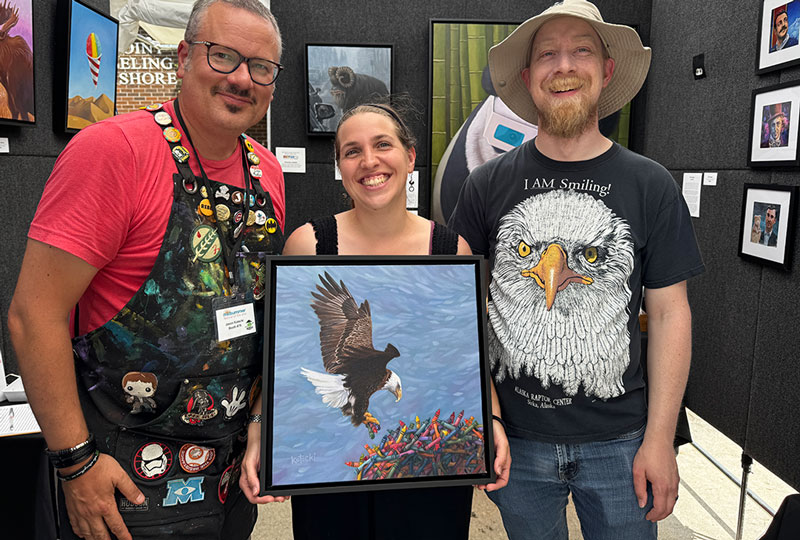
    We recently exhibited at the Midsummer Festival of the Arts in Sheboygan. I’m no stranger to this sort of thing, between participating in art fairs and the gift shows we did in the early days, selling prints and greeting cards to retail and gift shops.

    I’ve noticed that exhibitors fall into one of two buckets. 

    The first consists of people like the two gents next to us. A father and son team were selling metalwork to be displayed outdoors. It’s clear they are there to do a job. They’re pros who are purposeful, efficient, and positive. Not chatty, but friendly. 

    The second type is like another neighbor we had. Always quick to comment about the weather (which is somehow always too hot or too wet or too windy) and complain about the attendance (which is somehow always too low). This one is regularly straying from their booth to find someone to commiserate with, and makes declarations like, “They love my art, but they don’t have any money to buy.” And if you seem to be doing better than them, they’ll gladly share their opinion of why that is in a way that doesn’t feel much like a compliment.

    I both cases, the work itself was very good. But the attitude was miles apart.

    Without fail, it’s the first type that consistently enjoys more success.

    Coincidence?

    Look, we’ve had some rough shows over the years. It was tempting to blame the promoter, the weather, the low attendance, or the buying power of the attendees. It’s comforting to commiserate with others experiencing slow sales, and hurl “must be nice” at the ones doing gangbusters. 

    It feels good — in the moment — but it’s not very productive. 

    I eventually found it’s a better use of time and energy to use those occasions to revisit my approach. Is my work as good as it could be? Are we presenting it in the best possible way? Could we improve the clarity of our message? Come up with a more appealing offer? Adjust our sales technique?

    In case you haven’t figured it out, the message here is bigger than exhibiting at art fairs. 

    It’s a valuable lesson for all of life.

    One option is to play the victim and complain about all the outside factors that are conspiring to keep you down. You can mutter “must be nice” about the people doing well. Direct it at their natural talent, their good connections, their Ivy League education, or their dumb luck of being in the right place at the right time. You can also blame the weather, the economy, or politicians.

    Unfortunately, this is the equivalent of spraying success repellent all over yourself. It creates an invisible aura of negativity that is palpable to the people you encounter. Meanwhile, you’re too busy blaming all the things outside of your control that you don’t have time to improve the things you can.

    Or.

    You can accept the fact that there are disadvantages you can’t control, and decide to focus on the things you can, choosing to make the best out of whatever comes your way. 

    That’s really what it is: a decision.

    When you make a decision over and over and over again, it becomes a habit, a way of life, and that’s what makes it feel like it’s not a decision.

    The good news is that bad habits can be replaced with better ones.

    Which starts with a decision.

    You can decide to focus on what you can control: working hard, being kind, and maintaining a positive attitude. 

    You can practice noticing when you’re playing the “must be nice” game, and pivot to a spirit of curiosity about how to better leverage your own strengths.

    You can decide that you’re not going to get sucked into conversations with people who want you to share in their negativity.

    Oftentimes, the reason we find ourselves afflicted with Adultitis is because we opened the door and invited it in.


    🤔 I wonder…what is a technique you use to get yourself back on track when you find yourself swerving into comparison and complaining?

  • You Can Say No

    Kim and I were on our way to San Diego. For reasons known only to Delta, our seats got reassigned, and we were split up. Considering that part of the reason for our trip was to celebrate our 25th wedding anniversary, and because we still actually like each other, we looked for an opportunity to switch seats with another passenger.

    I was in the middle seat, and a lady sat in the aisle seat next to me. Kim, herself in an aisle seat one row behind, asked the woman if she wouldn’t mind swapping spots so we could sit together.

    None of us was in any kind of preferred seating. No First Class, Comfort Plus, or exit rows involved. And yet the woman hesitated, immediately exhibiting a perturbed attitude, as if Kim had requested both kidneys and another vital organ to be named later.

    Picking up on her prickly vibe, Kim calmly but firmly responded to the woman with four words: “You can say no.”

    After a short pause, which perhaps provided the time to realize she wasn’t losing anything in this exchange, the woman willingly switched places without any further incident or passive aggression.

    Now, I don’t know this lady.

    Maybe she was feeling settled and didn’t want the hassle of moving.

    Maybe she really has a thing for seat 21D.

    Maybe she was disappointed that she wasn’t going to get a chance to hit on me.

    All I know is that Kim’s short reply felt like such a baller move.

    And it was. Not in some sort of “I’m going to bully you into this” or “I’ll share this on social media to shame you in front of the world” sort of way. Rather than an attempt by Kim to exert some kind of power, it was an act of generosity in which she gave power away.

    It’s easy to go from one choice to the next, feeling like we are a tiny vessel whipped to and fro by the waves of life, forever at the mercy of our boss, our kids’ school, the government, the airline, or the passenger one row behind us.

    Maybe for this woman, it felt like one more example of having to bend to the whims and wishes of someone else. Another moment of feeling powerless.

    And with one simple statement, Kim gave her a gift.

    “You can say no.”

    Four words that gave her permission to pause and be reminded that she has agency over her choices and life. In this case, I’m grateful for her yes. But I’m glad she allowed me to reflect on how difficult it is for us to say no.

    We forget how much power we have. Sure, sometimes there are dire consequences for ignoring certain directives. But they are far fewer than we presume.

    You really don’t have to say yes to every invitation, opportunity, or request for help.

    You really don’t have to say yes to the offer to join the board, accept the position, or sign your kid up for one more thing.

    You really don’t have to say yes to that social event when you were looking forward to a quiet weekend you so desperately need.

    And you know what? You don’t even have to give a reason. You can simply thank them for thinking of you and tell them it’s not going to work out this time.

    We can say no. We can change our minds. We can choose to reverse course and abandon this path we started down, but no longer want to follow.

    It’s ok.

    You can say no.

  • How Many Crayons?

    I am an art nerd.

    Many guys in Wisconsin count Bass Pro Shops as their happy place. Me? I’ll take a good art supply store any day of the week. Oh, I have a few tackle boxes, they’re just packed with paint tubes, pen nibs, and drawing pencils of varying lead grades.

    When I was in high school, I loved getting the latest Dick Blick publication in the mail. More than just an art supply catalog, it was filled with pages and pages of creative possibilities. 

    As I perused materials and mediums I’d never seen before, much less worked with, my eye was always drawn to the top-of-the-line sets. It didn’t matter if it was professional markers, colored pencils, or paints; I dreamed of having the set that featured every color the manufacturer made. In those days, they were way beyond my means, and perhaps that’s what gave them part of their appeal. I dreamed of one day getting to a point where sets like those would be in my reach. Why, there’d be no limit to the art I’d be able to make!

    This reminds me of even earlier in life, back to the days of pining for the Rolls-Royce set of crayons: Crayola’s box of 64, complete with a sharpener in the back!

    It featured exotic colors not to be found in the pedestrian collections of 8 or 24: Periwinkle. Brick Red. Cornflower. Thistle. Goldenrod. And of course, gold and silver. (Which I was convinced were made of real bits of the precious metals.)

    There’s no doubt about it: if you possessed the box of 64 crayons, there was nothing you couldn’t draw. You were a true artiste. (My mind would simply not have been able to comprehend that one day they’d make a box of 120!)

    Even though we are no longer turning out drawings to be hung on the fridge, we still assume the role of artist, so to speak. We are now tasked with creating better communities, businesses, and teams. And we often yearn for a bigger budget, less red tape, or more cooperation from colleagues, upper management, and politicians. We could use more training, more structure, more resources.

    How we long for the unlimited possibilities that box of 64 crayons represented! If only I had brick red! Can you imagine what I’d do with periwinkle? We could make a real difference with silver and gold in our crayon box!

    If I had double the budget, I could really make some strides with these students.

    If I had a few extra hours a week, I could make some real progress on this plan.

    If I had another acre, an extra room, or a few hundred more square feet, I could be so more productive and efficient.

    If I had a bigger team, we could get so much more accomplished.

    Money. Time. Space. Manpower.

    Silver. Cornflower. Brick Red. Periwinkle.

    You may want the big box of 64 crayons, but there is never a time when you’ll have everything you wish you had. Most of the time, it feels like you’re a few crayons short of filling the humble box of 8.

    Short of the resources that would make our work significantly easier or more effective, we often let the disappointment over what we don’t have paralyze us from making the most of what we do.

    There was a time when I could only afford a set of 24 colored pencils. I pined for the complete set of 150 I saw in the Dick Blick catalog and fell asleep dreaming of the possibilities they would provide and the art I’d be able to make.

    In the meantime, I didn’t stop drawing. I made do with what I had, mixing colors by layering them over one another to make new ones. In the process, little by little, my skills improved. My high school art teacher, impressed by my potential and passion, gifted me with a bigger set. I kept drawing. Eventually, all that drawing led to my art becoming the foundation of my career, and now I can afford to get whatever colors I want.

    No, you might not have the box of 64. Not yet.

    Don’t let that keep you from making art.

    I know how painful it can be to exist in a place where you don’t have access to all the colors you wish you did.

    But thanks to my art training, I also know this: just about any famous painting you can think of can be recreated with just four colors: red, yellow, blue, and white.

    Almost any color can be created with these humble hues.

    Even though art supply stores feature walls of paint tubes in a dizzying array of colors, the master teachers implore their students to proactively limit their palette to a handful of colors to ensure a harmonious, pleasing result.

    True creativity thrives when constrained by limitations. During the Renaissance period, blue was a very expensive pigment. But when you are using a lot of warm earth tones, as those painters did, a neutral made from black and white can take on a blue tone by comparison.

    Having access to all the colors does not make one an artist. It’s about knowing how to use the ones you have.

    Whether you are an educator, a healthcare professional, an entrepreneur, or a parent trying to raise great kids, I understand that you wish you had more time, more resources, and more freedom to do the important work that needs to be done.

    Unfortunately, that may never be the case. It rarely is in the real world.

    But that’s ok.

    You are simply called to do the best you can with what you have.

    It’s ok to want and wish for ALL the colors.

    But you can still make a masterpiece with just four.

    🤔 I wonder…what masterpiece is being left undone while you’re waiting for more colors?

  • Independence Day

    Here in America, amidst the parades and fireworks and meat on the grill, it’s easy to overlook an important fact: July 4th used to be a blank square on the calendar.

    On many calendars throughout the world, it still is.

    But almost 250 years ago, a ragtag bunch of rebels stood up to the world’s power and the premier fighting force of its time. It started a pretty big fight that eventually, they won.

    No one gave them permission. It’s not like there was a day on the calendar that said, “Today’s the day, guys!”

    They got together and just…decided.

    A lot of blood, sweat, and tears followed, but it couldn’t have started without a decision. Because of that fateful declaration of independence, a nation was born, and the world changed.

    And so did our calendar.

    I am grateful for those brave men and women. I love the fireworks and the parades and the meat on the grill. But perhaps it’s time to take a cue from the calendar and make a new declaration of independence.

    Against Adultitis.

    It’s strategically hidden and doesn’t get much press, but I’d argue it’s the premier fighting force of our time. It’s definitely a bully that keeps you under its thumb.

    You don’t need permission to declare independence from the ruts and comfort zones that rob you of a feeling of adventure and aliveness.

    You can declare independence from the melancholy that deprives you of joy and wonder.

    You can declare independence from pessimism and the cynical belief that the world is beyond saving and that hope is old-fashioned.

    You can declare independence from a calendar that strangles you with too many obligations and extracurricular activities.

    You can declare independence from the stress that comes from trying to do it all, measure up, and keep up with a culture of busyness that continues to accelerate.

    You can declare independence from past regrets that keep you from creating something better here in the present.

    You can declare independence from the discouragement that life is meaningless and from fear of the future.

    Of course, then the real work begins, just like it did for the revolutionaries two-and-a-half centuries ago. But the work is doable when tackled bit by bit, one step at a time. (Don’t forget about this free community of fellow Adultitis Fighters you can plug into and gain strength from every day.)

    And the work is worth it because the other side of standing up to the bully brings freedom.

    The freedom to slow down and delight in the little things.

    The freedom to stress less and play more.

    The freedom to spend more time with people you love. 

    The freedom to become who you were uniquely created to be.

    The freedom to initiate adventures and reawaken your biggest dreams.

    The freedom to live the life you want to live, not the one you feel like you should. 

    The freedom to do work that matters. 

    The freedom to make your life a masterpiece. 

    Parades are not guaranteed, but there will be fireworks — at least the metaphorical kind. (The grilled meat is up to you.)

    This is a callout to the brave men and women of our time.

    It all starts with a declaration of independence.

    Is today the day?


    🤔 I wonder…what aspect of adultitis do you need to declare independence from?

  • Thou Shalt Always Be Positive

    Be positive! Be optimistic! Everything is unicorns and rainbows and sunshine and lollipops, yadda, yadda, yadda. 🦄🌈☀️🍭

    I am very suspicious of people who are always positive.

    I know this may sound weird coming from me, Mr. Anti-Adultitis, whose own father wears a “Bee Optimistic” pin every single day.

    Yes, I believe in the power of positive thinking. And optimism is way more attractive than pessimism. But a deep dive into the Wright Brothers reminded me about how the real world works.

    Changing the world (or even just our week) requires a little more nuance than the ill-fated advice to always be optimistic.

    First of all, there are positives about being negative.

    Wilbur and Orville were known to have great arguments and disagreements, with heated words flying between them at the tops of their voices. Their friend Charlie Taylor insisted they were never really mad. Their discussions were rooted in a great mutual admiration of each other and carried out only in pursuit of the truth. The brothers were not afraid to consider the negative, especially when it came to their theories and plans. 

    It was characteristic of all his family, Wilbur said, to be able to see the weak points of anything. This was not always a “desirable quality,“ he added, “as it makes us too conservative for successful businessmen, and limits our friendships to a very limited circle.“

    The Wright Brothers actively looked for problems. After they were identified, the brothers could begin figuring out how to solve them helped the duo minimize risk, avoid disaster, and increase their odds of success.

    There’s no doubt that the pair’s optimism fueled their achievement by helping them to persist despite the onslaught of skeptics and critics. But they were also human. They experienced failure and were prone to doubts.

    Before their big breakthrough, Wilbur got invited to speak to the Western Society of Engineers in Chicago on the subject of gliding experiments. It was his first request to speak in public, and it came after some failed experiments. He wanted to turn it down, but his sister Katharine urged him to do it. As he was making preparations, she asked him, “Will it be witty or scientific?”

    “Pathetic, by the time I’m done with it,” said Wilbur.

    In the end, reviewing his notes and records while preparing for the talk helped him to crystallize his thoughts, and the reaction he received from the audience emboldened him, serving as a wind in his sails.

    One of their biggest lows came during their trials at Kitty Hawk. After experiencing a series of failures, the brothers realized that the data from their predecessors that they had taken as gospel was incorrect and could no longer be trusted.

    The brothers experienced many such moments of discouragement. But they didn’t stay that way. In his book, The Wright Brothers, David McCullough recounts:

    What they talked about on the train heading back to Ohio was neither recorded at the time nor discussed in any detail afterward. Yet it is clear from a few of their later comments that they were as down in spirit about their work as they had ever been, and especially Wilbur.

    According to what Orville was to write years later, Wilbur was at such a low point he declared that “not in a thousand years would man ever fly.” Wilbur’s gloom on the train was only momentary. As Orville said, “He was at work the following day and it seemed to me was more hopeful and determined than ever.”

    Later on, Orville was part of the first fatality in the history of powered flight, when his passenger, Lieutenant Selfridge, died of a fractured skull during a crash. Orville himself was laid up in a hospital for months. Wilbur was in Europe when he heard the news. McCollough writes:

    Wilbur looked up, his eyes full of tears, and said if anything could make him abandon further work in solving the problem of flight, it would be an accident like this. Then, springing to his feet, he declared, “No, we have solved this problem. With us flying is not an experiment; it is a demonstration.”

    The Wright Brothers changed the world; where does this leave us?

    We can remember that although Wilbur and Orville were positive thinkers, they wisely used negativity to their advantage. However, had they dwelled in negativity too often, they never would have gotten off the ground.

    I think the real goal is to practice focusing on where you fall on the spectrum between optimism and pessimism. What’s your default mode?

    It’s impossible to be optimistic every second of every day. Life’s too hard for that.

    It’s ok to be discouraged.

    Just don’t stay that way.

    Practice keeping optimism as your default mode.

    That way, when the winds of life blow you down, your optimism can help dust you off so you can rise again.

    And soar.


    🤔 I wonder…when in your life did a healthy dollop of negativity turn out to be just what you needed?

  • 31 Things to Do with Extra Copies of The Penguin Who Flew

    The Penguin Who Flew is an inspiring book about a persistent little penguin. It’s the kind of book that brings light to a world that seems darker than ever. And it offers up encouragement that we all need to hear, no matter how many birthdays we’ve celebrated.

    Maybe you have an extra copy (or four) on hand. Or maybe you’re a Dream Maker like Marty’s grandma and want to encourage as many people as possible. Either way, here’s a list of 31 things you can do with extra copies of “The Penguin Who Flew.”

    1. Give them to your favorite kids in your life.
    2. Send them to all of your grown children or grandchildren.
    3. Celebrate your own or someone else’s birthday by giving books to all the guests.
    4. Gift a bundle of books to preschool & daycare classrooms or send one home with each child.
    5. Stock the Little Free Library in your town or start a new one with a kid-friendly design.
    6. Offer books as part of a lesson or during a special children’s service at church.
    7. Add a “Book Table” at food pantries or clothing drives where families can pick up books along with essentials.
    8. Donate books to domestic violence shelters, homeless shelters, or foster care agencies.
    9. Host a “shopping” experience at a school, community center, or church where each child picks a few books.
    10. Leave a small bin in pediatric offices: “Take a book, keep a book.”
    11. Include books in backpacks during back-to-school supply drives.
    12. Set up a mini reading area at parks, farmers markets, or community events with a “Take a Book” sign.
    13. Leave a book and a cheerful note at neighborhood doorsteps like a reverse trick-or-treat.
    14. Hide books in public places (with weather protection) and give clues on social media or flyers.
    15. Use them as client gifts.
    16. Give them to people you’d like to become clients.
    17. Reward employees for being awesome.
    18. Give one to your boss for extra brownie points.
    19. Use them as end-of-the-year gifts for your kids’ teachers or coaches.
    20. Gift them to the people who make your life better, such as your postman, pastor, chiropractor, hairdresser, yoga instructor, barista, or butler.
    21. Help fight Adultitis by randomly giving one to the person sitting next to you on the bus, train, or plane.
    22. Finish your Christmas shopping in one fell swoop.
    23. Put them in Easter baskets.
    24. Instead of candy at Halloween, hand out books to trick-or-treaters.
    25. Include them in care packages you send to long-distance friends or relatives.
    26. Give them to recent grads to encourage them to chase their dream!
    27. Raffle prizes!
    28. Housewarming gifts!
    29. Silent auction items!
    30. Host or hostess gifts!
    31. Share it with your super famous celebrity friend and ask him or her to tell their followers about it.

  • The Terrible, Horrible, No Good, Very Bad Week

    This past week was…not great.

    It was already slated to be a busy week during a very busy month. Then, in 72 hours, we went from a simple wellness visit to the emergency room to a training session at Milwaukee Children’s Hospital to learn how to check blood sugar and inject insulin into our kid.

    We interrupt your regularly scheduled life to bring you this important message: your son has Type 1 Diabetes.

    Just like that, speaking gigs were postponed, daily planners were whitewashed with white-out, and Ben’s life changed forever.

    He’s handling it well with a great attitude. I’m so proud of him and his sisters, who have stepped up to shower him with love and support. As parents, Kim and I have been living under a weighted blanket of fears and worries, sadness and overwhelm. Weirdly, we rotate between grief over having been dealt this hand, and guilt for feeling sad because we know how much worse it could be. Visiting a children’s hospital has a way of making that abundantly clear.

    It’s early, but I feel called to share some thoughts publicly, to offer a live look as we ask the very question I’ve shared on hundreds of stages to thousands of people: “Now that this has happened, what does this make possible?”

    It’s not an empty platitude. It’s a way of seeing that helps one find rainbows amidst life’s tumultuous thunderstorms. So we’ve been asking the question, and we’ve already found some answers…

    This diagnosis has brought us even closer together as a family. Team Kotecki is stronger than ever.

    As Ben rises to the challenge, I can already see him becoming more responsible and gaining confidence.

    The necessity of counting carbs to know how much insulin to administer has the potential to make our entire family healthier as we become more aware of our choices.

    That’s only the beginning. My faith compels me to think even bigger…

    The nurse who trained us has Type 1 diabetes herself. I can’t help but wonder if this will impact Ben’s career someday, with the empathy he gains impacting hundreds or thousands of people.

    Maybe this will put him on the road that will lead him to meeting his future wife someday.

    Maybe he’ll have some part to play in helping to find a cure.

    Of course, I don’t know if any versions of these rudimentary visions will come to pass. But I do know this: the good that will ultimately come from this diagnosis, the number of people it will impact, and the multitude of graces that will abound are no match for my meager imagination.

    I can’t predict what it will look like, but I can plan on it being better than I can imagine.

    And it’s not wishful thinking, either. 

    I have seen it in my own life.

    When I look back, there are so many instances where the connected dots go back so far that it’s hard to see them all. “If this hadn’t happened, then this wouldn’t have happened, and this would never have been possible.” On and on it goes, an endless tapestry of threads, expertly woven and interconnected with the lives of others. I can’t think of a single instance where I’d remove any horrible thing that I’ve gone through in my life, because then I’d have to sacrifice the abundance of good that came with it.

    Of course, sometimes, not enough time has passed to see anything good or any glimmer of hope. Asking the question, “What does this make possible?” helps prime us to see the silver linings when they eventually appear.

    Like most people, I prefer comfort, and I spend a lot of time and effort chasing it. Suffering, however, is unavoidable. Sooner or later, the storm finds us. We eventually receive news we didn’t want to hear.

    One benefit of being this close to fifty is that I have enough experience to know that time after time, failures, disappointments, tragedies, and traumas have yielded blessings beyond my wildest imagination.

    God writes the best stories.

    He does his best work when we surrender.

    After we returned home from our first of three big training sessions at the hospital, I was feeling overwhelmed by all the things that instantly changed about our lives, and the new responsibilities and financial burdens added to our plates. As we finished dinner, a small rain shower passed by, and the largest, brightest rainbow I’ve ever seen appeared on the horizon over Lake Michigan.

    We rushed out to behold its majesty, which brought forth our neighbors from their homes, too.

    It was an emphatic reminder that everything was going to be ok and that the Master Storyteller was already at work. Not necessarily easy, but OK. That’s what gives me every confidence that this diagnosis will prove to be a gift that will help Ben become the best version of himself.

    So yeah, the past week was not great.

    But we will continue to ask, “What does this make possible?”

    I know that the answer will be something good.

💌 Get next month’s exclusive Mini*Print! Join the Collector Club
00 days
00 hr
00 min
00 sec