Category: Uncategorized

  • Don’t Let Your Kids Grow Up to Be Dillholes

    I know a guy who claims that his family is the most important thing in his life. 

    He also brags about spending 300 days a year on the road as a speaker.

    I don’t know how many hours one needs to spend with one’s loved ones to register as “enough,” but by my calculations, the math here doesn’t add up.

    Why is the person who works 60-hour weeks, spends 200 days on the road, and sits on three charitable boards applauded when they say that family is the most important thing, but another person who quits the rat race to stay home and spend more time with their family is seen as an underachiever not living up to potential?

    These are questions I wrestle with often. I want to make a gigantic impact on the world. I literally want to make a positive difference in the lives of one billion people. It is what has driven me since the first day I started this company. I want it more than anything.

    Well, almost more than anything, it turns out.

    A few years back, Kim and I were set to scale our business to the next level. We discussed plans for adding more people and initiating new projects, all with the goal of broadening our reach. Business was good, but we were set on making it bigger. 

    And then.

    After an exceptionally busy stretch when I was away from home, we nearly hit a breaking point. The combined effort of running a household, managing a business, taking care of three young kids, homeschooling, AND trying to take on new initiatives designed to grow our business proved to be just. Too. Much.

    We were hit with the reality that we were not superhuman, after all.

    And so we had to make some tough choices. It became clear that our kids were not getting our best. They were getting sloppy seconds…or even thirds. In the end, we decided that quality time with our family was actually more important to us than changing the world. We reminded ourselves that we are in a unique season of life, and although it seems like it when the days are long, our kids will in fact NOT be this young and dependent forever.

    We ultimately decided that even if we made an impact in the lives of one billion people, but our kids turned out to be dillholes, we will have failed.

    We didn’t abandon the business. We scaled back how much time we gave it, by working smarter, postponing some projects, and ditching the parts that took too much time for too little return. Interestingly, since we made that decision, our business has exploded, as has the time we spend together as a family. 

    This isn’t always easy. Like I said, the inner drive to reach more people is strong in me. I am in constant fear that I am not living up to my potential. That I should be doing more. That the work we do is great, and that more people should know about it. Some days, putting my hours where my mouth is in order to spend more time with my family feels a lot like giving up on a dream.

    But I only have 24 hours a day, just like you. Contrary to popular belief, you can’t do it all. Not well, at least. 

    And saying that family is my number one priority is not the same as proving it with my actions.

    In our society, this choice is not as commonplace, sexy, exciting, lucrative, or socially acceptable as sticking to our original plan of pushing, striving, and growing, while maintaining the facade that we’re balancing it all.

    Kids don’t give us standing ovations, raises, or fancy gold-plated plaques.

    I spent last Friday – a day I could have been working on the next big thing – with my kids at the library, reading Chronicles of Narnia, and learning how to make bowtie pasta.

    When all is said and done, maybe I’ll regret prioritizing time with my kids over striving for a bigger impact with my work.

    I have come to the conclusion that I will regret it more if I don’t.

    The world is all stocked up on dillholes.


  • Rest at the Lookouts and Savor the Victories

    As the final in a series of reflections on the lessons learned from my family’s hike up the Lanikai Pillbox trail, this might be the one I needed the most. 

    When we began the hike, the summit was the agreed-upon destination. Anything less would have been a disappointment. We wanted to see the best view.

    But it’s been said that life is the journey, not the destination, and for good reason. There are a lot of cool things to see on the way, and if you keep your head down, you’re liable to miss them. 

    Take the pandemic as an example. We haven’t yet reached the destination, but perhaps you can use this moment as a lookout. I think it’s worth appreciating how far we’ve come. Starting with the fact that we know a lot more about the virus and how to treat it than we did a year ago. Also, vaccinations are readily available for all who want them.

    And we somehow made it through the great toilet paper shortage of 2020.

    I’ll admit that when striving for a goal, I tend to keep my head down until it’s accomplished. No sense looking up until the job is finished, I figure; otherwise, you’re just giving in to distraction and wasting time.

    At the risk of stating the obvious – but with a desire to remind myself – there are plenty of reasons to stop along the way to appreciate how far you’ve come.

    For one, it helps avoid burnout. Whether it’s a two-hour task or a two-year adventure, little breaks actually improve efficiency and help maintain your energy levels.

    Secondly, moments of reflection allow for much-needed perspective. You can consider what’s been working well, what might need to be adjusted, and consider if this is still the path you want to be on. 

    Finally, stopping along the way keeps you from missing your life and the beauty hidden in each moment. John Lennon was right when he said, “Life is what happens to you while you’re busy making other plans.”

    We all want this pandemic to be over. The temptation is to keep our heads down until things get back to “normal.” We are always eager for trials to pass, just like parents who yearn for the day their child finally sleeps through the night. But each season has blessings that accompany the trials. I might be happy that I no longer have to change diapers, but boy, do I miss holding a sleeping baby in my arms. With each new season we enter, the old one fades away, never to return again.

    Don’t ever wish away time. Don’t rush past the lookouts.

    Don’t be so eager to reach the finish line that you miss the scenery along the way.

    Of course, when you do reach a summit, celebrate it! 🎉

    It may seem obvious, but to a driven person like myself, I need the reminder. When I’ve completed a goal, I rarely savor the accomplishment. I’m more likely to think, well, this was the goal, this is what I set out to do. No sense celebrating like I won the lottery; this was the expected outcome. What’s next?

    To make matters worse, sometimes when things are going well, I can’t help myself. I’m tempted to wonder when things will take a turn for the worse. I look around for the other shoe to drop. Which is dumb, because any second I spend on that robs me of the joy of the present moment.

    Call it pessimism, realism, or a huge sense of unworthiness, but it’s not great, Bob.

    The midwife who helped us out with the birth of all three of our children had a saying she usually aimed at Kim: “Don’t go looking for trouble.” It was meant to be a caution against needless worry, a reminder to stay at peace in the present, not entertain the anxious thoughts of an uncertain future.

    So yes, we finally made it to the top. I was able to slow down and put the return trip planning on hold for a hot minute. The view was as good as advertised. We lingered there for a good long while, savoring our triumph. 

    Please take a few moments to do the same with your life. Enjoy the season you are in, and look for the blessings amidst the trials.

    When you have a good day, accomplish a goal, or achieve a small victory, appreciate and savor the gift that it is. 

    And don’t be so quick to worry about the time when things will start moving downhill. Life is long. There are sunny days and rainy days. 

    Don’t waste a sunny day scrolling through the weather app on your phone searching for a rainy one.


  • Baby Steps Count

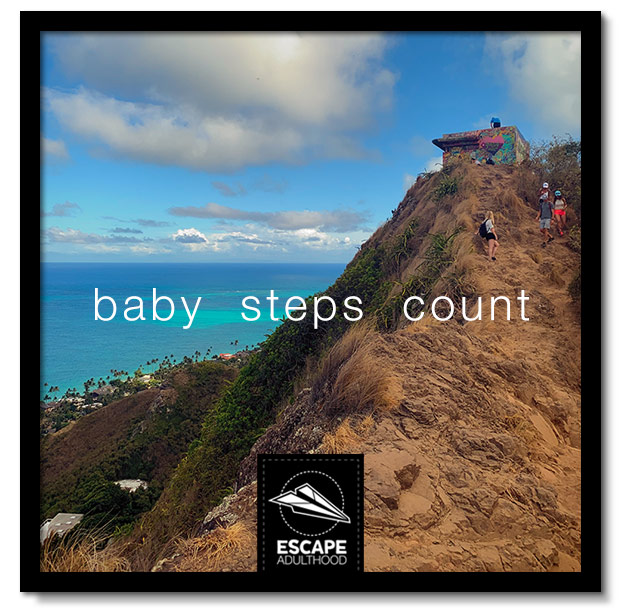
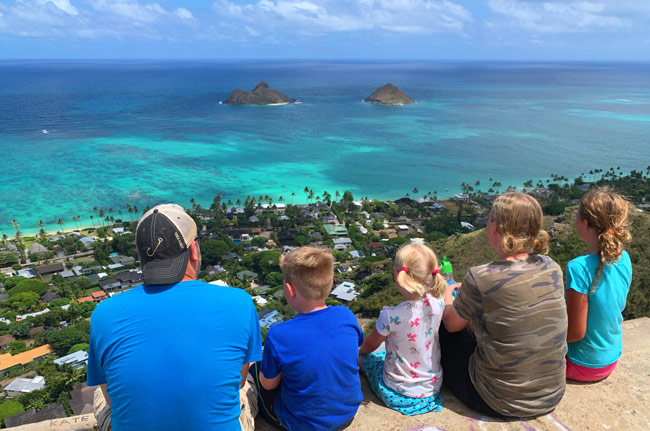
    Over the last few weeks, I’ve been reflecting on a family trip to Hawaii and the lessons we learned on our Lanikai Pillbox hike. The journey up the ridge overlooking “The Mokes” was not a reckless one, but some of the stretches were somewhat treacherous for the five-  and seven-year-olds. During those times, each step was meticulously planned out. I’d help the kids look for, plan, and take the obvious next step.

    “Grab my hand and step over there.”

    “Put your hand there and step onto that rock.”

    “Get down on your butt and scooch to that one.”

    Of course, my layman climbing terms aside, legitimate rock climbers know this routine well. Lots of thought and effort go into one move that may net only one inch of progress. And sometimes we have to go the long way around to move forward.

    I think that’s worth remembering when we’re stuck in the long part of a great slog. Like a pandemic. Or in the midst of any great struggle in life.

    Back in the early days of our business, when it felt as though one step forward resulted in three steps back, I was often discouraged. Like when a promotion email went out and the response was crickets. Or when a big marketing investment turned up bupkis. Or the moments when there was too much month at the end of our money. 

    I felt like throwing in the towel more times than I can count.

    Fortunately, I got some advice from a business colleague that I’ve never forgotten. Colin was also an entrepreneur and knew about discouragement. He shared a simple policy he had adopted for himself. On those really hard days, the days when you think you can’t go any further, he promised himself he’d give it one more day. He gave himself full permission to abandon ship after that, but not before he gave it One. More. Day.

    I adopted that approach and found that, sure enough, the next day always brought some measure of hope, a new reason to believe. It could have been a small sale. Maybe it was just a good night’s sleep. It was rarely any huge breakthrough that magically happened; just a baby step forward.

    But the thing is, baby steps count.

    Movement is progress, no matter how small. 

    Inches add up.

    Feel like throwing in the towel today? Give it one more day. 

    Sometimes you just have to look for the next baby step.

    And take it.


  • You Can Do Hard Things

    In September of 2019, I was booked to speak at a nurses’ conference in Hawaii, and we decided to make it a family trip. The gig was in Honolulu, but we spent the first week on the windward side of Oahu, in the shadow of the ridge overlooking Lanikai and Enchanted Lakes, suburbs of Kailua. 

    On that ridge snakes the Lanikai Pillbox trail, boasting one of the best views in Hawaii. There are pillboxes throughout the Hawaiian islands, typically built to be military observation stations. Although this particular one was built after the attack on Pearl Harbor in World War II, it is from this vantage point that you would’ve seen the Japanese bombers approaching. Island residents reported seeing the aircraft appearing on the horizon and invading the island like a swarm of locusts.

    Tutu Man, the larger-than-life ukulele player who owned the rental property where we were staying, suggested we make the hike as a family. I’d heard it was fairly challenging, but he was confident we could all handle it. He was a big, bold, brash dude, and prone to hyperbole, so I was somewhat skeptical.

    I decided to conduct a scouting mission and take the journey alone. I scurried up the trail, analyzing the terrain through the eyes of a dad with a ten, seven, and five-year-old. I concluded it would be hard, but doable. The view was spectacular, and I wanted them to experience it firsthand.

    The next morning at breakfast, prior to our family trek, I delivered a pep talk. I told my children that there were three things they needed to know:

    “It will be hard.”
    “You will skin your knee.”
    “You can do this.”

    “It will be hard.”

    Optimism is essential to the success of any important undertaking, but it’s vital to be honest with ourselves with a realistic appraisal of our situation. What are our weaknesses? Where are the blind spots? What are the potential roadblocks we’ll encounter? This frank assessment allows us to improve our chances by planning accordingly.

    Our culture conditions us to expect easy. We look for quick fixes and instant gratification. We enjoy cruise control, fast food, and on-demand entertainment. Because of this, it’s helpful to know that something will be hard before you begin. You may not fully grasp how hard it will actually be, but at least you won’t be surprised when you encounter adversity and be tempted to quit before you’ve barely begun. 

    My kids needed to know this wasn’t a walk on the beach. 

    Now, I am no mountain climber, marathon runner, or survivalist. But I have done hard things. One of them was sticking to a twenty-year dream that had no guarantee of success and often showed little to no progress.

    I knew creating a business from scratch that allowed me to make a living doing what I loved – when doing what I loved was art and not something like, say, accounting – was a tall order. To be honest, it was about ten times harder and took about ten years longer than I expected. But a thorough understanding that nothing worthwhile comes easy kept me from being blindsided when things got hard. Instead, I was prepared to dig deeper, learn more, and try new things.

    “You will skin your knee.”

    Yes, there will be blood. My kids are not fans. A dot of blood from a picked scab from a mosquito bite usually incites panic and requires a Band-Aid, stat. 

    I figured it would be wise to give them a heads-up about the potential bodily harm.

    When it comes to your hard thing, you may not shed physical blood, but there is a painful price to be paid for anything of real value. You may lose friends. You may end up in debt. Your pride might take a pounding. You may have to live in a crappy apartment with no cable and no air conditioning for six years longer than you expected, while friends and family members are having kids, building nice homes, and going on nice vacations. (Hypothetically.) 

    The point is, doing a hard thing hurts. You’ll likely question your ability, your faith, and your sanity. But the most important thing to know is this:

    “You can do this.”

    I knew my kids were up to the task, as long as they didn’t quit when the going got tough (or at the first sign of blood). I knew they would be stretched, but I also knew the reward would be worth it. Not just the view at the top, but the feeling they’d experience back at the bottom: the exhilarating sense of fulfillment that comes after doing something hard. 

    When my own dream was still in doubt and my faith in myself wavered, I clung to the belief that I could do all things through God’s strength. I can testify that there is no better feeling than to have been challenged to see what you’re made of and come away impressed by what you discovered.

    And I wanted that for my kids, even if it was just a small taste. 

    I am happy to report that we made it to the top, and back down again, relatively unscathed. It was hard. We did collect a few scrapes. There were tears. But we did it, and the view was tremendous.

    You, too, can do hard things.

    Maybe someone in your life has told you you’re not good enough. Smart enough. Strong enough. 

    They are wrong.

    Thomas Edison was closer to the truth when he said, “If we did all the things we are capable of, we would literally astound ourselves.”

    You can do hard things. You can climb that mountain. Overcome that loss. Make it through that divorce. Achieve that childhood dream. You have a supernatural strength at your disposal, making you capable of more than you can imagine.

    Don’t fall into the trap of easy. Easy is overrated.

    It will be hard, and you will skin your knee, but you can do this.
  • The Best Way to Deal with Your Worst-Case Scenario

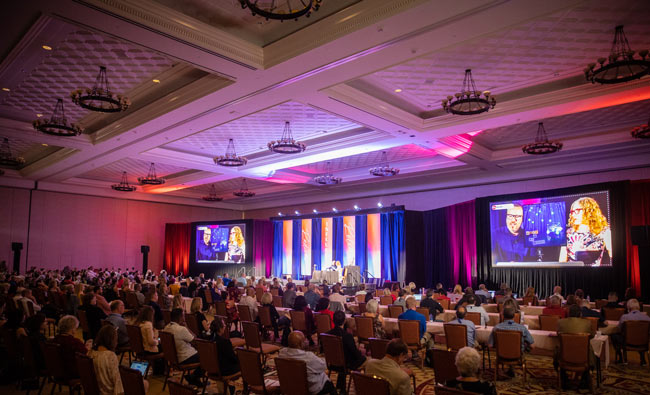
    I recently gave the most nerve-wracking talk of my life. It was in front of my peers, at the national conference for professional speakers. It’s sort of like performing open-heart surgery on another heart surgeon while hundreds and hundreds of other heart surgeons watch.

    In other words, tough crowd.

    At my first convention fifteen years earlier, I was awestruck by the speakers on the main stage. They were polished, poised, and really, really good. I decided then and there I wanted to be on that stage someday.

    This past July, I had my chance.

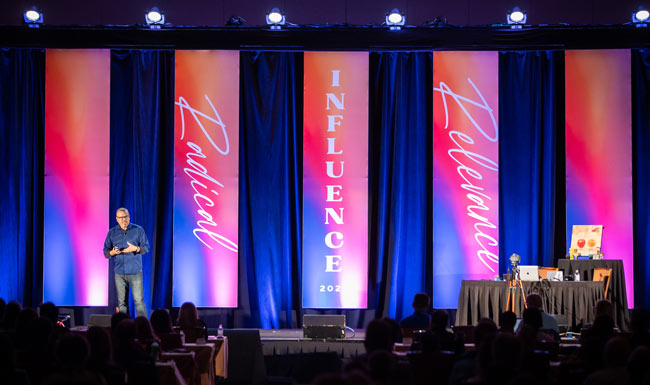
    The theme was Radical Relevance, and Kim and I were selected to kick off the conference partially because of the pivots we made while navigating the pandemic. 

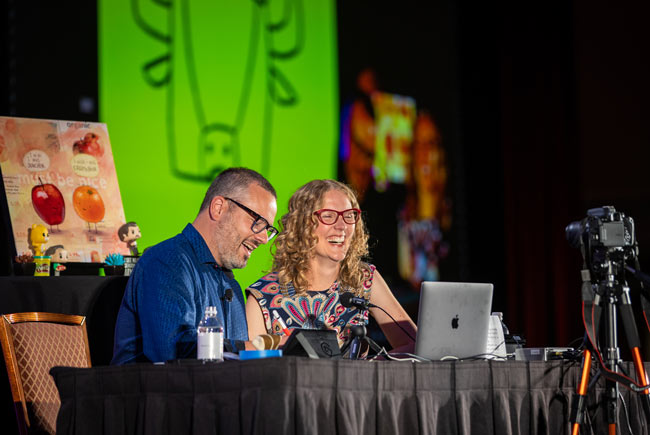
    My goal was to craft a revolutionary talk, one that would be talked about for decades. I envisioned the speech starting with just me on stage, demonstrating what I did pre-pandemic. And then in dramatic fashion, the spotlight would shift to a set that was modeled after our virtual in-home studio. I’d walk over as Kim joined me on stage to exhibit our professional pivot in front of a live studio audience, simultaneously broadcasting to the virtual attendees at home.

    Creative. Different. Daring. 

    And great in theory, but at rehearsal, things began falling apart fast.

    I was already concerned that our presentation had too many things that could go wrong. Well, the day before the biggest speech of my life, they were all going wrong.

    I always prefer to rely less on technology, not more, but we’d decided to replicate our in-house set on stage. It involved a fancy DSLR camera on a tripod, my iPad, and more dongles than a herd of milking cows. I was hopeful that since we were the first speakers on the program, we’d be able to get everything set up and perfectly arranged beforehand, allowing us to have some time to collect ourselves and concentrate on giving a great presentation.

    Nope.

    First, we learned we’d only have about four minutes to move everything on stage, set up the technology, and position the camera perfectly, because a gaggle of fake Elvises needed the whole stage to perform an opening number. (Hey, it was Vegas, after all.)

    Then we learned that the lighting was set and unchangeable, so no dramatic spotlight moments.
    No worries. We’re professionals; we can let that go.

    Then came the soundcheck from hell.

    You know how sometimes, when you’re on a phone call, the sound gets wonky and you hear everything you just said a second or two after you say it? Annoying, right?

    That’s what was happening during our soundcheck.
     
    Not only is it impossible to string together anything longer than a sentence when that’s going on, but it’s also what our sound technician told us we could expect for the entirety of our joint presentation. “Yeah,” he said matter-of-factly. “Because we’re using Zoom to broadcast to the virtual audience and then piping that feed to the live audience, you’re going to hear that delay. There’s nothing we can do about it.”

    Oh cool…Wait, what?!

    I was running contingency plans through my head as Kim and I rehearsed part of our talk, but I was numb. It’s hard to imagine more of a nightmare scenario, short of having to perform naked. Rehearsal ended with me being extremely less confident than when I began, which is usually the opposite of what you’re hoping for.

    As we walked back to our hotel room, I scrambled to add a few lifeboats to the Titanic. I seriously considered ditching the whole thing and just going out on stage with a microphone. No Kim. No set. No technological moving pieces. 

    One hundred percent dongle-free.

    I said as much to Kim, but then added, “And I’d end up regretting not trying for the rest of my life.” She agreed. 

    The rest of the day was spent controlling what I could. I strategized ways to move things on stage more quickly. I even started writing an alternative keynote in my head, in case it all erupted into a dumpster fire of bad audio and failed technology.
     
    The backup speech was actually pretty good, too. If everything went up in flames, I pictured myself abruptly standing up from the set and addressing the audience with some real talk. I’d launch into a stirring speech about how it is our duty to push the envelope of our craft. But even if our efforts fail, we soldier on and make the best of it. 

    Because. We. Are. Professional. Speakers. 

    This dream scenario may or may not have included my colleagues erupting into thunderous applause, rushing the stage to carry me on their shoulders and parade me onto the Las Vegas strip, and ending with me receiving the key to the city. It felt so real, I started to wonder ifit might not be an even better speech than the one I’d spent three months crafting. 

    But the pit in my stomach kept suggesting the very real possibility that this speech would be talked about for a generation, but for altogether different reasons than I’d hoped. I was pretty sure that I was on the verge of giving the biggest train wreck of a speech that the National Speakers Association had ever witnessed. 

    In reality, the hopeful nature of my alternative ending made me feel more comfortable, because it helped me believe that everything would be ok no matter what. 

    But the thing that squelched my doubts completely was a single, simple thought:
     
    No matter what happens, at the end of today, you’ll still be married to your best friend, you’ll still have three amazing kids, and you’ll still be living in your dream house on Lake Michigan.

    It was a truth bomb of perspective.

    Suddenly, the pressure was off. My nerves were calmed. And I rested easy knowing that if worse came to worst, I could flee Las Vegas in shame, revoke my membership in NSA, and never have to see these people again.

    As it turned out, the talk was a massive hit. We got set up in record time. Kim and I managed through the audio challenges without a hitch. The delay was tough, but it made us be more intentional about what we did say, making the speech more powerful. Plus, it garnered the respect of our peers, who knew how difficult it was to pull off.  The end of our speech was greeted with a rousing standing ovation. Many people told us it was the perfect way to start the conference as we emerged from the pandemic, and a catchphrase from our speech was echoed by almost every speaker after us.

    I’m grateful for how things went and the kind response we received. My biggest takeaway? The reminder that most of the worst-case scenarios we face aren’t really worst-case scenarios at all.
     
    Gratitude gives us the perspective to see things as they are. Taking stock of the blessings in my life and focusing on what really mattered helped me see that the only thing truly being threatened was my pride and ego. And that made all the difference.

     When we dare to stare down the monster under the bed, we discover that it shrinks.

     When you hold your fears up to the light of gratitude, you can watch them melt away in the truth that you are more than your failures and stronger than you think.

    And for Adultitis, that’s the ultimate worst-case scenario.

    Curious to see the speech? Here it is, in its entirety:

    And here’s a video version of this post:

  • Combatting the Pandemic of Loneliness

    Long before COVID-19 emerged on the scene like poop in a punchbowl, there was another pandemic that had taken hold of our society.

    The pandemic of loneliness.

    We are supposedly more connected than ever, with the little internet-enabled devices we carry with us everywhere. And yet loneliness, depression, and suicide are at all-time highs. Kim and I noticed this phenomenon well before COVID, but the pandemic has exacerbated the problem bigly.

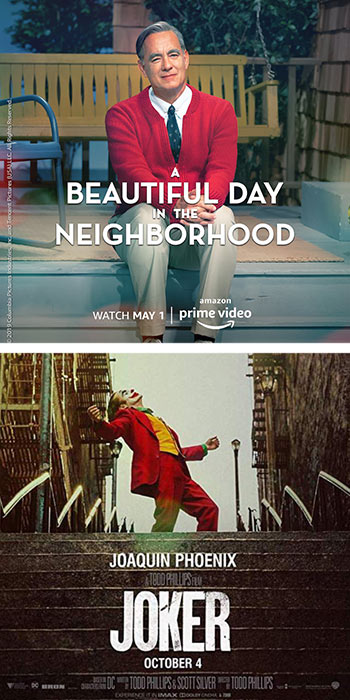
    This leads me to think about the connection between two seemingly unrelated movies that came out the same year: the wonderfully uplifting A Beautiful Day in the Neighborhood, starring Tom Hanks as Mister Rogers, and the disturbingly violent, award-winning film, The Joker, with Joaquin Phoenix in the title role. 

    The greatest talent Fred Rogers had – and there were many – was his extraordinary ability to make everyone around him feel seen. It seems as though he had an otherworldly ability to make every person he encountered feel like the most important person in the world.

    If you pay close attention to The Joker, a big reason Arthur Fleck transformed into a diabolical murderer was that he felt unseen. He was constantly ignored, passed by, and walked over.

    Which led to disastrous results.

    In this pandemic of loneliness, many people are yearning to feel seen. The good news is that we can all follow the lead of Mister Rogers and be part of the solution. There is no special talent involved, no barrier to entry. In fact, Fred’s wife said she hated it when people called him a living saint, because it made it seem like what he did was unattainable. The truth is, he really worked at it. 

    He practiced the intention of attention.

    Try closely observing the people you encounter today. Look for something they do well or a trait you appreciate about them. Then – and this is the important part – tell them. You could point out something positive you notice about a young person in your life. Thank a team member for a job well done, highlighting something tangible they contributed. Or give the lady in the supermarket checkout lane a simple but specific compliment.

    Don’t worry if you feel like you’re pointing out the obvious. I can assure you that most people underestimate their good qualities and will benefit from the reminder.

    The intention of attention will make you look like a superhero in that person’s eyes. Your small act can be a game-changer in their life.

    Now, the flip side of the coin is when you are feeling lonely or unseen. What then?

    It’s natural to want to be noticed; to feel seen. But sometimes you have to be willing to allow yourself to be seen first.

    I grew up painfully shy, with a preference to stay sequestered away from uncertainty. But that is not what life is for. Eventually, my faith saved me in that regard. It gave me the courage to step out, speak up, and be vulnerable. My faith continues to remind me that even though I may feel lonely, I am never alone.

    I think about the people who have attended an Escape Adulthood Summit by themselves. That takes an incredible amount of bravery, especially for those who are introverts. I know how hard it can be to put yourself out there, but in my experience, good things usually come when I do.

    It’s hard to be seen when you keep yourself hidden away.

    Seek out a like-minded community. Plug into a local church or get involved with a civic club. If you resonate with our work, you’ll probably dig the Wonder & Whimsy Society. And there’s also the Escape Adulthood League, our free social network of Adultitis Fighters.

    The important thing is to show up. Contribute. Volunteer. Maybe even seek out someone who seems even more lonely than you.

    The pandemic of loneliness is beatable, but it does require action.

    Practice the intention of attention.


  • Why You Should Definitely Give Your Home a Name

    Does your home have a name?

    There are so many things to love about Mexico, from the culture to the bright colors and the delicious food. We’ve twice been there as a family (Tulum and Cabo) and were delighted to discover that many of the homes had signs denoting their name.

    It’s a charming little detail we like very much, and so when we bought our new home, we decided it needed a name, too.

    We settled on Casa de Whimsy.

    And just as when you give a mouse a cookie, he’s going to ask for a glass of milk, if you give your house a name, you’re going to need a sign to go with it.

    Ours hangs proudly near our front door, lovingly assembled with knick-knacks foraged from a secondhand art supply store in town. It gives visitors a pretty good idea of what they’ll encounter inside. 

    The word “whimsy” represents our family well. We don’t take ourselves seriously. We love color. We regularly partake in kitchen dance parties, embark on epic Pajama Runs, and hold Barbarian Spaghetti dinners. And as far as decor goes, it is basically an art gallery specializing in whimsy.

    Clearly, our home is appropriately named. But why is whimsy so important to us?

    Although often viewed as superfluous, whimsy is a spark of delight with the supernatural power to uplift the human spirit. Whimsy can fill a heart with happiness and a head with new ideas. It brings a playful unpredictability to our days. It puts the heavy things we carry in perspective. The delicious ridiculousness of whimsy helps lighten our loads and brings joy to others. 

    Casa de Whimsy is not just a description of our home, it’s an aspiration, too. Every time we walk through the front door,  we are reminded to have fun, take ourselves lightly, and celebrate the gift of life. It gives us permission to live playfully.

    Now more than ever, the world feels dark and cumbersome. We need more wonder and more whimsy, not because we are in danger of forgetting the terrible stuff, but because the terrible stuff weighs so heavily on us.

    There’s a lot of value in naming your home.

    What would yours be named?


  • The Most Important Step to Achieving a Dream

    …is the next one.

    How do you eat an elephant?

    I’m not sure what elephants taste like, or why you’d ever want to eat one, but the answer, of course, is one bite at a time. (Mustard is optional, but a little enthusiasm never hurts.)

    The same instructions apply when it comes to accomplishing a big dream: One bite at a time.

    Tinkering embodies this spirit perfectly. Tinkering implies baby steps, not grand gestures: a little of this, a little of that.

    I’ve accomplished some of my biggest dreams in the past few years. They were all accomplished with a healthy dose of tinkering, taking one baby step at a time.

    The first step was just deciding to go for it.
    The next step was to draw one comic strip.
    The next step was to share it online.
    The next step was to draw another one.

    Like I said, baby steps. I ended up drawing thousands of comic strips, but not all at once. And even though the comic strip has been retired for well over a decade, the audience I grew and the lessons I learned were instrumental in getting me to where I am now.

    People nod when I tell them to start with the first step because it makes sense. They laugh when I tell them the first step might be something drop-dead simple, like just deciding. Or reading a book. Or asking someone for advice. Or drawing one comic strip.

    But then they can’t help themselves. They mentally forecast the second step, then the third, and maybe make it all the way to step seventeen before they get stuck, or encounter a fake no. In their head, step seventeen is extremely difficult, or impossible, or even more terrifying, completely unknown.

    And that’s when the dream hits a roadblock and, more often than not, dies.

    Do you have a dream in your heart? Don’t murder it just because you don’t know how you’ll ever overcome step seventeen.

    Right now, step seventeen may seem hazy. Not to worry. It will become abundantly clear right after you take step sixteen.

    Step seventeen may seem insurmountable. Cool. You might be surprised how the growth you experience in the first sixteen steps magically transforms it into a molehill.

    And don’t be surprised if step seventeen looks quite a bit different from what you imagine right now – or is rendered altogether irrelevant – after step twelve prompts you to take an unexpected turn. (Like the day I felt called to retire my comic strip.)

    Repeat after me: I don’t have to know step seventeen before I take Step #1.

    Start with Step #1. (And for the love of penguins, don’t combine six steps into one step!) Just start with lowly, insignificant Step #1. Yes, it might be obvious. So simple a child could do it. Too small to make any noticeable difference. Step #1 will most definitely be ALL of these things.

    But only one question matters: Have. You. Done. It?

    No? Then quit worrying about step seventeen and f@¢king do Step #1.

    My apologies for the candor, but your dream matters to me, and this really fires me up.

    These elephants don’t eat themselves.


  • Now for the Fun Part: An Open Letter to Grads

    Hello, graduate. Congratulations on your accomplishments and a job well done!

    Now for the fun part.

    You’ve made it this far by following directions, filling in little circles, asking for permission, standing in line, and raising your hand before speaking up. The instructions have been clear: do this (take these classes, write this paper, complete this assignment) and get this (pass the course, earn a recommendation, receive a degree).

    You got to this point by following the rules. Now that you’ve graduated, it’s time to start breaking some.

    Make no mistake, the work is not over. In fact, it’s only just beginning. If you continue looking for rules to follow — old habits die hard, after all — you will find them. You will be expected to be “realistic,” urged to find a job with good benefits, and encouraged to keep your inbox at zero. You’ll be handed a definition of success that puts an inordinate amount of emphasis on things that can be measured.

    Follow these rules and you will most certainly succeed.

    At being ordinary.

    But, dear graduate, you were made for more than that. We desperately need you to be extraordinary. I know it doesn’t seem like it, because the examples of people doing it are few and far between. That’s mostly because it’s hard.

    Paint-by-numbers are easy. But they don’t hang paint-by-numbers in the Louvre.

    The rules you followed to this point will no longer serve you. If you want to make a difference in the world and be truly happy in life, you must follow your own way, and that includes leaving a few rules in your wake, broken and abandoned.

    I’m not speaking of speed limits and tax laws, a few of the rules that DO exist and carry real consequences for breaking them. You’ll need to identify the ones that DON’T exist and disregard them like it’s your job.

    Because it is.

    It will help if you can keep close the five-year-old that still lives within you. It will not take long to realize that being an adult is not all it was cracked up to be. But Adulthood does have its perks, not the least of which is that now, finally, YOU are the boss of you. Life is a choose-your-own-adventure. That’s right: the choices are finally yours. Don’t abdicate this power to anyone else.

    So listen to your inner child reminding you that it’s ok to eat dessert first once in a while, jump in puddles, and flaunt your weirdness.

    It may be hard to believe, but you don’t have to hate Mondays.
     
    You don’t have to rely on your calendar to decide what days are worth celebrating.

    And for the love of penguins, please don’t fall into the trap of being realistic.

    My wish for you, dear friend, is the same one I have for my own children: a life filled with magic, meaning, love, and wonder.

    Blessed are the rulebreakers. They shalt inherit the Future.

    You’ve got this.

    P.S. Penguins Can’t Fly is an excellent primer on the most prevalent rules that don’t exist. It’s designed to foster the curiosity needed to get better at spotting them in your own life, and provide the courage to break them with style and grace. (It also makes a perfect gift for graduates and anyone else interested in taking their story to new heights.)

  • I Got a Rock

    In the immortal words of a trick-or-treating Charlie Brown…I got a rock.

    It wasn’t just any rock, mind you; it was a kindness rock. If you are unfamiliar with the concept, people hand-paint ordinary rocks with inspirational or encouraging messages and leave them in a public place for someone to find. 

    This particular one was shaped a bit like a heart, painted red, and included the words, “Love you.” I found it on a walk, near the lakeside bench where I like to sit. I immediately recognized what it was, but completely resisted the idea that it could actually be intended for me. After all, the placement seemed strange, hardly a location I’d consider a proper hiding spot. 

    They probably accidentally dropped it and would soon return looking for it. 
    Someone else probably needs it more than I do.
    I don’t need to hear this message…do I?

    Finally, I realized: these are made to be left behind for someone to find, and whoever finds it is who it’s for. 

    I believe that. Usually, I am the person doing things like this. Whether it’s an Art Drop, where I hide a piece of art in a public location, or when I hide Marty the penguin under someone’s chair at a speaking engagement, I love doing anonymous things. I trust completely that whoever ends up being the recipient is exactly the person it was meant for.

    And yet apparently, I don’t believe it works the same way when it pertains to me.

    Eventually, I did take the rock, examined it, and accepted it as a gift. I sat on the bench and thought about how tired I was from getting our home and business settled in the months since our move to Sheboygan. Overwhelmed with home improvement projects and business obligations, I was processing a curveball I’d received that morning concerning the renovation of my studio. I was discouraged and exhausted.

    As I watched the waves rhythmically roll in and felt them wash away the wall of anxieties that had built up, I smiled. Maybe this rock really was meant for me. Maybe God, through the actions of another person, really wanted me to know He loved me, right at that exact moment. 

    Is it all a bit much to attach any spiritual meaning to the timing of a random rock being placed in my path by a random stranger on a random day?

    Perhaps.

    I don’t have any proof to offer, that’s for sure. It’s nice to fancy such thoughts of God using his creation to send random love notes to us. But it’s harder when you also take into account the dark times in your life when he didn’t feel present at all. Those times, it appeared that he just sat back and allowed terrible things to happen. What then? Was he too busy to notice, too incompetent to help?

    Those are hard questions. I believe God loves us and wants us to love one another. I also know that love isn’t love if you’re forced into it. And so the gift of free will seems to take an awful lot of control out of his hands. By giving us the power to love, we’ve also been given the power to hurt one another deeply. 

    Thankfully, God can turn pain into plot twists. 

    Sometimes his response to the bad guy blowing up our bridge is to send a speedboat to catch us and whisk us off to someplace better. 

    Is it possible that instead of being too busy or too weak, God is attentive and powerful enough to transform our disaster into something triumphant? Maybe this great artist is creative enough to weave seemingly random events — both the heartbreaking and the banal — into a tapestry that is more detailed and delightful than we could ever imagine.

    I, for one, have had experiences in which very good things came from very bad circumstances. But this is important: until the exact moment the blessing came into focus — sometimes years later — the situation seemed hopeless and impossible. I was convinced of it. I surveyed the scene of the crime, examined the facts at hand, and it was clear: an open and shut case.

    Except that sometimes we don’t have all the facts. Sometimes we interpret them incorrectly. And sometimes a new piece of evidence emerges that recasts all the previous facts in a new light, resulting in a completely different story.

    Like the end of a good mystery, it’s gratifying when the pieces of understanding fall into place. The hard part is living in the tension before the puzzle is resolved, wrestling with the Whys and the How could you’s.

    I prefer having the script. I want to see how it ends. I’d like approval rights too, thank you very much. Maybe it takes a few hundred pages for this plot twist to resolve, but as long as it does, I’m fine with it. I’ll even settle for an idea of how it might resolve. Gimme a possibility, no matter how narrow, and I can rest, secure in my faith. But too often, I don’t see any positive outcome or a satisfactory explanation for why terrible things happen to good people.

    Alas, this is a limitation of being human and living on the foggy side of eternity. Like a toddler lacking in understanding and impatient for answers, we cry out in frustration, exhaustion, and anger. Life is beautiful, but it is not easy. Sometimes it just wears us out, physically and emotionally.

    But I believe that God knows this and empathizes with us. And I suspect that’s why sometimes, he uses random rocks made by random strangers to remind you that he sees you, he’s with you, and he loves you very much.

    Who knows? Maybe he inspired me to write this little post to serve as a similar reminder, to be delivered today, just for you.

💌 Get next month’s exclusive Mini*Print! Join the Collector Club
00 days
00 hr
00 min
00 sec