Topic: Innovation & Creativity

  • One of One

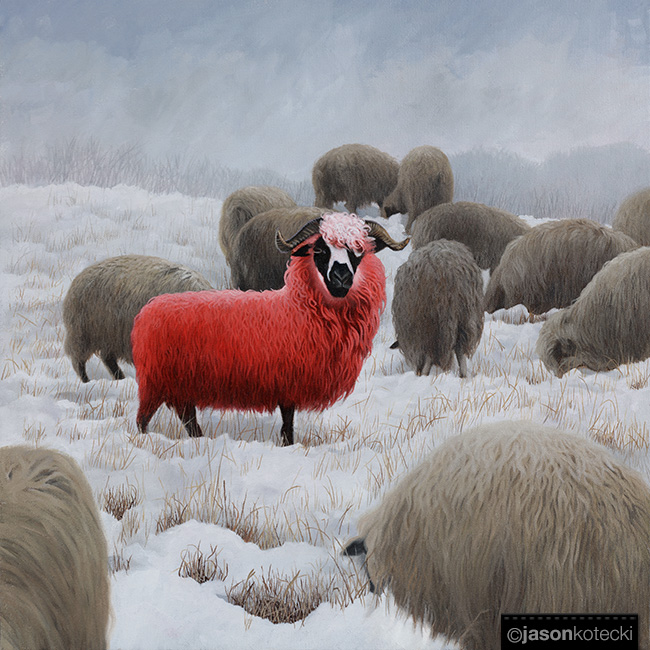
    “One of One” by Jason Kotecki. 20 x 20. Oil on canvas.
    Original is available 🟢 Shop this art!

    When I was in art school in the late nineties, the goth look was in. A significant segment of art kids wore all-black clothing, Doc Martens boots, and fingernails painted with dark colors. I found it fascinating to observe that the ones intent on bucking the system, sticking it to the man, and expressing their individuality all looked…exactly the same.

    It’s scary to stand out.

    We learn this at a young age, when simply being our weird, unique selves can lead to us being shamed and ostracised at recess, on the school bus, or even across the dinner table by a sibling or parent.

    And so, much of life is a careful effort to blend in.

    Just look at the cars we drive, most of which are either black, white, or some combination of the two.

    Or how we take fashion cues from tastemakers and trendsetters because getting caught wearing something out of style is akin to death.

    We must be careful to curate what we say in public for fear of being cancelled.

    In the case of my art school companions, we even blend together in our rebellion.

    Now, some would explain this as an evolutionary feature, not a bug. There’s safety in numbers, after all. We’ve learned to blend in because there’s danger in straying too far from the herd.

    The thing is, we’re not here to sink to our base animal instincts. We were created for a higher purpose. We were made for greatness.

    We are born originals. The problem, as St. Carlo Acutis observed, is that most of us die as photocopies.

    As an artist, I sell prints of my work. Some of them are timed releases, some are limited editions, and some are open editions (available all the time). 

    I sell a lot of them, but they’re all really just fancy photocopies. 

    And none are worth as much as the original. A print sells for less than a hundred dollars. The original can sell for thousands.

    Ask anyone who has purchased one of my original paintings, where you can see the texture of the canvas, feel the brushstrokes with your fingers, and observe the luminosity that emanates from dozens of thin layers of oil paint, and they’ll confirm: Nothing beats an original.

    Sadly, too often we settle for being photocopies.

    It’s been said that imitation is the sincerest form of flattery.

    Maybe if someone else is imitating us. 

    But if it is we who are doing the imitating, then imitation is the sincerest form of boring.

    It is good to learn from those who came before us. It’s possible to find a measure of success by imitating someone else. 

    But the best you’ll ever be is a second-rate version of them.

    This is not a call to stand out for the sake of standing out, or to pretend to be something you’re not. It’s about having the courage to be more of who you are. It’s a reminder that safety should not be our highest virtue. 

    You are free to opt for the safe path. Most people do.

    But you will not be able to escape the gnawing sense of dissatisfaction, the quiet desperation, the ever-present sense in your soul that there’s more to life, and this ain’t it.

    The reason I made the hero in this painting red was because of the lesson I learned from red shoes. After years of wearing safe, plain, predictable shoes, I started pining for red ones. The people I saw wearing red shoes always seemed to be so brave and adventurous, somehow getting more out of life. I wanted that, but I was afraid. I was afraid of standing out too much, but mostly I was afraid that I’d be found out as a fraud.

    Adultitis tried convincing me that I wasn’t one of those “red shoe people.” I wasn’t fun enough, brave enough, or free enough. 

    Eventually, I stood up to Adultitis and got the red shoes. The fears ended up being empty threats. I’ve worn red shoes on stage for every speaking engagement for about two decades now. I love ’em. They make me feel more fun, confident, and free, like a guy who decided it didn’t matter what other people think. 

    Of course, red shoes are not the secret to defeating Adultitis.

    Being brave is.

    What are your red shoes? There is probably something in your life you’ve always (but probably secretly) wanted to own, do, or be, that you’ve talked yourself out of. Maybe Adultitis sold you on the idea that you’re just not “that type of person” and it would be safer to blend in.

    But maybe you actually are that type of person.

    Maybe the fear is a smokescreen keeping you from becoming all God created you to be.

    Maybe twenty seconds of embarrassing bravery will open the door to a new level of confidence and unimaginable opportunities.

    Maybe your example of standing out from the herd will be the spark that lights the way forward for someone else, giving them courage to be brave, too.

    “To be nobody-but-yourself—in a world which is doing its best, night and day, to make you everybody else—means to fight the hardest battle which any human being can fight; and never stop fighting.”

    —E.E. Cummings

    Is any of this safe? Hell no. Of course not.

    But it’s the only way to feel alive.
  • Jailbreak

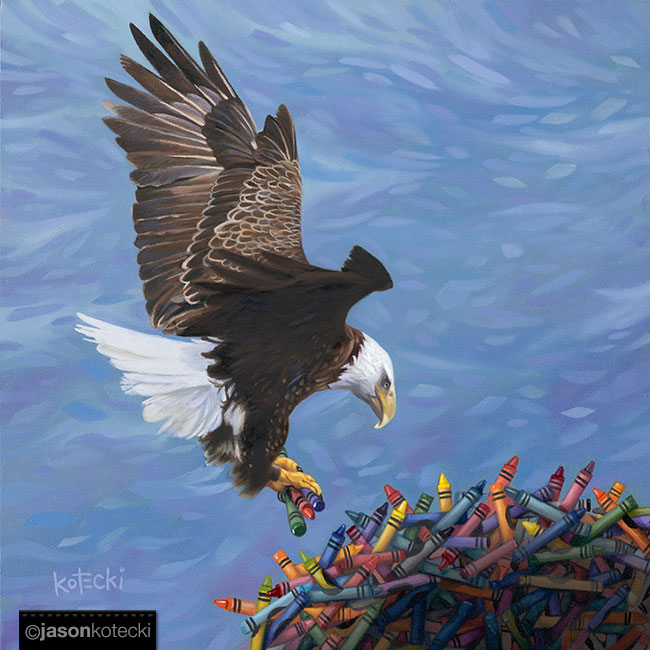
    “Jailbreak” by Jason Kotecki. 16 x16. Oil on canvas.
    Original is available 🔴 Shop this art!

    Remember paint-by-numbers? 

    You know, the beloved craft project in which an image is broken down into sections, each labeled with a number. Fill in each section with the color that corresponds to the ascribed number, and you achieve something that sort of resembles a work of art.

    Kinda, but not really. 

    It might look pretty, but it’s not art.

    It’s a plan. It’s a system. It’s one way of doing things.

    But it’s definitely not art.

    There’s no risk involved. No creativity. There’s none of YOU in the work.

    When you finish building a desk from IKEA, do you stand back and proclaim that you have just created a work of art? 

    No. You were merely following instructions.

    A paint-by-number can be a fun, relaxing way to spend an afternoon.

    Unfortunately, too many of us settle for a paint-by-number life.

    We believe that if we follow the rules, do what we’re told, and stay within the lines, we’ll end up with something that sort of resembles a successful life.

    Kinda, but not really. 

    Oh, it may get you a nice job with a nice benefits package and a nice house in a nice neighborhood with a nice car and 2.5 very nice kids, but I’m not sure that I’d call that a masterpiece.

    Just as a paint-by-number gives you the illusion of having made art, this path gives you the illusion of a well-lived life.

    We didn’t come up with this on our own, of course. Society and governments would very much prefer us to adopt the paint-by-number route. We’ve been conditioned this way, beginning in school.

    The prospect of a paint-by-number life is not all that different from those standardized tests we were given, the kind that can be graded by a machine, where the objective is to fill in each section correctly.  The only difference is that instead of using a number 2 pencil, you get to use color.

    Just not all of them.

    We’re not unwilling participants, however. Part of us craves the comfort and security that comes from embracing a paint-by-number method: “Just tell me what to do to have a safe, comfortable, successful life.” 

    Unfortunately, our best life is not achieved via the safe, predictable, step-by-step path.  

    Safety is an illusion, and doing things the way everyone else is doing them is not the path to happiness. Too many people figure this out in midlife, when the paint-by-number method fails to satisfy.

    We’re not here to live paint-by-number lives.

    Earlier in my career, I searched for a paint-by-number approach. I joined the National Speakers’ Association and got to know many successful people. I tried to copy them, but while they had specific talents and interests and values that contributed to their success, I discovered I had different ones. I searched for a speaker who was also an artist to show me the way. But the few artists I did find weren’t artists in the same way I was an artist, so it didn’t translate. 

    I thought maybe I was looking in the wrong place. I looked to other artists I admired for a roadmap. That also proved fruitless; it turns out that not many artists are all that eager to stand on a stage and speak to a thousand people.

    Lots of experts were happy to sell me their program: “Paint this red and this blue and this green, and you’ll be as happy and successful as I am!”

    That fell short, too. It was as if I had red and blue crayons, but lacked a green one that seemed important. Meanwhile, I also had purple and periwinkle, but I couldn’t find a paint-by-number that also included them.

    I spent many years frustrated and discouraged, unable to find a prescribed path to success that fit my unique talents, interests, and values.

    Finally, I had an epiphany. I didn’t need to wish for or wait until I had the colors someone else had before I could be successful. And those extra colors that didn’t seem to fit were actually an advantage.

    I resonated with this realization from Fred Rogers: “I’ll never forget the sense of wholeness I felt when I finally realized what in fact I really was: not just a writer or a language buff or a student of human development or a telecommunicator, but I was someone who could use every talent that had ever been given to me in the service of children and their families.” 

    I, too, realized that the magic was in combining my seemingly disparate talents. If I took all the crayons I had — even the ones that seemed extra or out of place — I’d be able to create something wholly original. 

    That’s when everything changed, and my career exploded.

    “Escape competition through authenticity.”

    –Naval Ravikant

    I have original paintings for sale. I also sell prints, which are copies of the original. 

    They look similar.

    But one is worth exponentially more.

    “All people are born originals, but many die a photocopy.”

    –St. Carlo Acutis

    It’s easier and feels safer to copy what other people are doing by living a paint-by-number life. Fit in. Follow the rules. Keep on doing what you’ve always done. Keep telling yourself you’re not creative.

    Adultitis would like nothing more for you.

    But here’s the thing: they don’t hang paint by numbers in the Louvre. 

    This doesn’t mean we shouldn’t listen to advice, learn from others, or ever follow best practices. I’m not saying you should strive to be original for the sake of originality. 

    I’m saying you already are an original.

    Or, as Dr. Seuss said, “There is no one alive that is youer than you.”

    You were made to be a masterpiece.

    You are in the process of building a portfolio. Fill it with adventures. Take chances. Try new things. Do things that don’t make sense once in a while.

    Use all the colors you’ve got.

    When you get to the end of your life, and you’re looking back at what you’ve created, please don’t let it be filled with paint-by-numbers.

    Don’t limit your potential by trying to squeeze yourself into someone else’s tame, safe, predictable prescription for success. 

    Confidently be your awesome, wild, original self.

    And make Adultitis go running for the hills.
  • Rodeo Dolphin

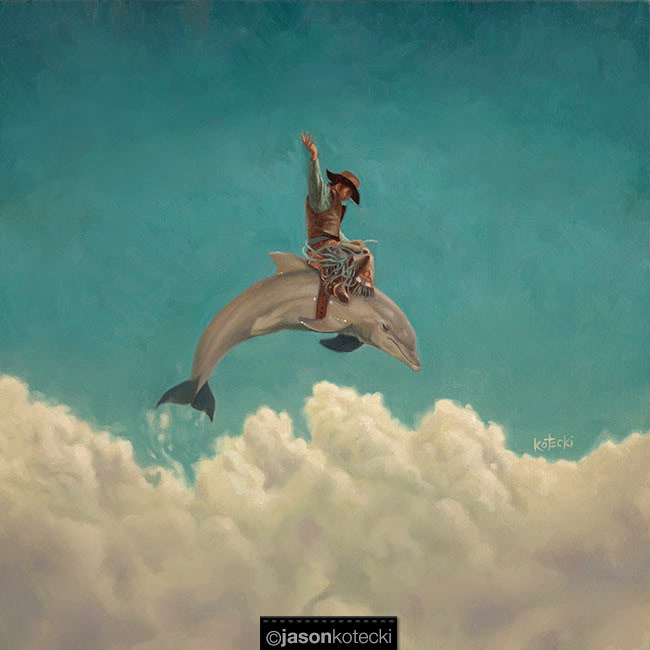
    “Rodeo Dolphin” by Jason Kotecki. 20 x 20. Oil on canvas.
    Original is available. 🔴 Shop this art!

    This painting is a little bit crazy.

    Some people will be quick to point out that cowboys don’t ride dolphins. They’ll scoff that dolphins don’t belong in the sky. They’ll demand an explanation about the meaning of it all.

    Those were the same kind of people who scoffed at the Wright Brothers for having the audacity of thinking they could build a flying machine. Humans can’t fly, they said. They don’t belong in the sky, they scoffed. They demanded an explanation for why these two, with no college education, no formal technical training, no experience working with anyone other than themselves, no friends in high places, no financial backers, no government subsidies, and little money of their own, would ever think they could achieve such an absurdity?

    To be fair, for more than fifty years, many others before them served as a source of comic relief, mocked and ridiculed in the press for their delusions of grandeur and “childish” flying machines.

    Somehow, and to our benefit, this did not deter Wilbur and Orville Wright.

    History is filled with people criticized for being crazy.

    But, as it’s been said, monuments are not built for critics and statues are not dedicated to fault-finders.

    Very often, our dreams appear absurd, especially to others. And especially the big ones.

    A horseless carriage?

    A self-powered flying machine?

    A pocket-sized device you can use to communicate with anyone in the world?

    What will they think of next? A flying car? A colony on Mars? A cure for cancer?

    This reminder is not reserved for the select few who change world history and have statues erected in their honor. I make a living doing what I love from my studio on the shores of Lake Michigan. Trust me, in the early days of our business, when Kim and I were living on a diet largely dependent on Hamburger Helper and couldn’t afford to run our air conditioning during the hot summer, every bit of my current life seemed far-fetched, to say the least.

    Of course, you can’t count on every dream coming true.

    But you can count on somebody calling you crazy for dreaming it.

    That’s ok.

    Keep dreaming anyway.

    The best dreams start out a little crazy.
  • You Can Just Do Things

    “You Can Just Do Things” by Jason Kotecki. 30 x 24. Oil on canvas.
    Original is available. 🔴 Shop this art!

    I don’t know who needs to hear this, but you can just do things.

    It’s true.

    Yet it seems we’re always waiting for something before we can begin.

    We are waiting until we get the degree.

    We are waiting until the kids leave the nest or until we retire.

    We are waiting until we know all the steps.

    We are waiting until we finalize the plan.

    We are waiting until we feel ready.

    We are waiting until we feel courageous.

    We are waiting for inspiration.

    We are waiting for permission.

    We are waiting for the stars to align, the sun to come out, and conditions to be perfect.

    We are waiting for just one last thing before the rest of our lives can begin.

    Meanwhile, sand slips through the hourglass, turning into minutes, days, and years.

    Patience is a virtue, and there are times in life when only patience will do. But more often than not, our waiting is just a form of hiding. Adultitis sabotages us before we even begin.

    You can just do things.

    Unfortunately, it’s easier to complain. To blame someone else. To wait for instructions, permission, or for the timing to be just right.

    But the timing will never seem right.

    You don’t have to wait for permission.

    You don’t need a hall pass.

    You don’t need a note from your parents.

    You don’t need a document signed by a notary public.

    You can just do things.

    As I was working on the manuscript for The Penguin Who Flew, I had the serendipitous opportunity to take a writing retreat to the Outer Banks in North Carolina. It’s the very site where Orville and Wilbur Wright achieved flight for the first time. While I was there, I dove deep into their story. I read “The Wright Brothers” by David McCullough, watched a documentary about their life, and visited the National Monument in Kitty Hawk, standing at the place where they made history.

    The Wright Brothers did not wait for permission.

    Other people working on achieving sustained flight of an engine-powered, heavier-than-air aircraft were highly educated experts. The Wrights only had high school diplomas. But they didn’t put their dream on pause to get a degree. Instead, they read books on math and physics, studied and observed birds in flight, and collected data from their own experiments. They needed knowledge and experience, not a piece of paper.

    They also didn’t wait for funding from investors. Big money went to the more well-known, more highly educated experts in the race. Orville and Wilbur were nobodies, unknown and irrelevant. They didn’t have financial backers, an inheritance from a wealthy father, or a winning lottery ticket in their pocket. They had a mildly successful business that provided just enough profit to self-fund their experiments, bit by bit.

    Nor did they wait until they had a full plan in place before taking their first steps. The brothers tinkered, learning as they went. Although the whole point was to figure out how to make a self-powered plane, they didn’t even bother with a motor until they could figure out how to master lift, balance, and control. Their competitors floundered trying to accomplish everything all at once.

    Even after the brothers had cracked the nut of manned flight, they were met with doubt and disinterest in their initial attempt to sell their invention to the U.S. government. Instead of giving up, they went to Europe. It was only upon becoming celebrities after successful, public demonstrations in France that the United States finally offered a contract.

    You can just do things.

    “Whoa, hold up, pal,” you might be saying. “You can’t just be a surgeon without a medical degree.” Well, obviously. Of course. It’s easy to come up with exceptions, but they only prove the rule.

    You don’t need permission to change the direction your life is heading, and you don’t need a piece of paper on the wall to start improving your life today.

    Real life is not a schoolyard version of kickball, where you wait anxiously for someone to pick you, hoping it’s sooner rather than later.

    Adultitis is the king of convincing you that you absolutely need just one more thing before you begin. It’s really just trying to kill time and run out the clock on you.

    Yes, you will need some patience, but you don’t need permission to start chasing your dream.

    You don’t need to wait for a pink slip to start looking for a better job.

    You don’t need to wait until you’re a millionaire before you start being generous.

    You don’t need to wait to feel courageous before you can act bravely. 

    You can just ask for help.

    You can just start a side hustle.

    You can just ask her on a date.

    You can just homeschool your kids.

    You can just apply for better jobs, even if you already have one.

    You can just stop spending money on stupid things.

    You can just end that toxic relationship.

    You can just cancel your subscription to Netflix.

    You can just offer forgiveness before receiving your apology.

    You can just talk to God and ask Him to show you He’s real.

    You can just stop waiting for permission.

    And you know what else?

    You can be afraid and still do all of these things.

    Don’t waste your life waiting for the fear to magically disappear.

    There will not be a time when you will have all the assurances you need.

    You will not earn everyone’s unconditional approval.

    You will not be able to eliminate every risk.

    You will not receive a guarantee of success.

    And yet, one truth remains.

    You can just do things.
  • The Prepper

    “The Prepper” by Jason Kotecki. 16 x 16. Oil on canvas.
    Original is SOLD 🔴 Shop this art!

    When my wife told me she was pregnant with our first child, my heart filled with joy.

    Two seconds later, panic arrived at the party.

    All I could think about was how profoundly our lives were about to change and I didn’t have the slightest idea of how to prepare. I immediately began searching Amazon for the latest owner’s manual for babies.

    Kim, on the other hand, seemed to calmly slide into the nesting phase that’s common to many moms in the animal kingdom. In preparation for a new life, they instinctually work to create conditions for that new life to thrive.

    In the years since I’ve seen Kim navigate this phase for all three of our kids, and I’ve realized there are parallels between mothers and artists. While not all of us get to experience motherhood, I believe that every last one of us is an artist.

    Yes, even if you can only draw stick figures.

    In essence, an artist is simply someone who brings something new and beautiful into the world with the potential to improve it in some way. It’s a one-of-a-kind gift that could not be created by anyone else.

    You could have been born at any time in any place, but you were born when and where you were born and you are alive now. You were born for a reason! As long as you’re still breathing, you have something within you the world needs.

    It might be a novel, a non-profit, a painting, or a play. Perhaps it’s a sculpture, a sonnet, or a song. It could also be that a building, a business, or a movement will be your masterpiece.

    We need to take this endeavor as seriously as a mother takes the preparations for her new baby. We need to create conditions that give our undertaking its best chance of success, and that involves three things: supplies, space, and safety.

    A serious mother collects the supplies that will be needed to help her succeed: diapers, bottles, creams, clothes, blankets, and toys. A serious artist needs supplies, too. It might be pens, pencils, paper and paint, or yarn, wood, software, or clay.

    A serious mother considers where the baby will sleep and play and she creates space for that to happen. Likewise, a serious artist also requires a dedicated space, even if it’s just a small folding table in the corner of their bedroom, or a workbench in the back of the garage.

    Finally, a serious mother makes preparations to ensure her youngster is protected and safe to grow and develop. A serious artist also needs a safe space for creativity. New ideas are especially fragile. One must not judge them too harshly at the start, for they need time to blossom into what they are to become.

    The nesting stage is fun, exciting, and imbued with the magic of anticipation, as you envision all the memories (or masterpieces) that will be made. It is a good inclination to want everything you need, and make sure it all has a place. After all, when you are in the whirlwind of caring for a newborn (or in the thick of the creative process), it’s helpful to have what you need, when you need it.

    But don’t be fooled.

    The trap that awaits both mothers and artists is the desire to have all the supplies one could corral, the most ideal space one could hope for, and the highest level of safety and comfort possible.

    All parents eventually come to discover that you are never fully prepared for a baby to arrive in your home. There will always be something you’ve forgotten, something you run out of too quickly.

    It’s ok. Eventually, you learn to make do, and from these constraints come real growth.

    One thing is certain…when it comes to parenting, Mother Nature will not be delayed. The baby is coming, ready or not.

    Alas, this is where the comparisons diverge, for the artist has no such advantage. As such, he or she may be lured into a trap that tricks them into a never-ending nesting phase of collecting all the colors and tools and tricks of the trade.

    It’s an illusion. Under the guise of being serious, the artist is now simply hiding. One must never be fooled into waiting for conditions to be perfect, because they never will be.

    If an artist is not careful, nine months of preparation can slip into nine years of procrastination, justified by not enough time, not enough space, not enough money to begin. Before you know it, nine decades of life are spent and the art your soul desired to make, the gift the world so desperately needed from you, never gets to emerge.

    Serious artists don’t let preparation turn into procrastination.

    We don’t need perfection. But we do need your art.

    That’s why we need you to take it seriously.
  • Strawberry Fields

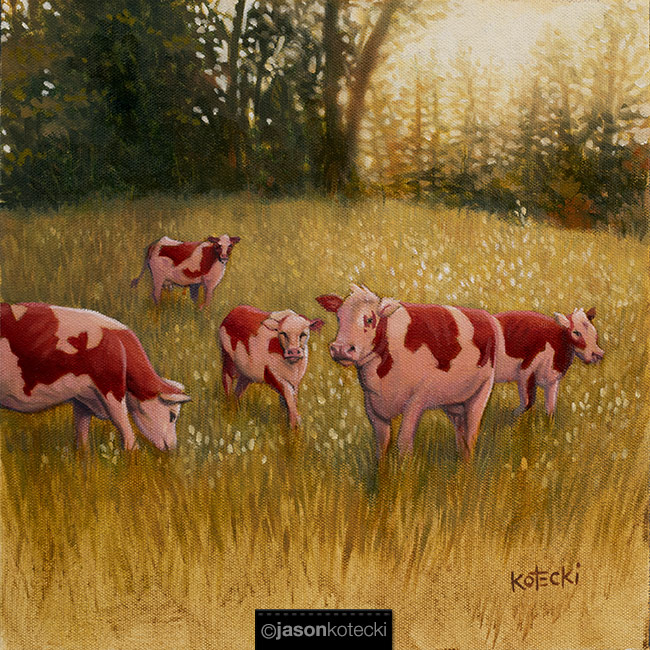
    “Strawberry Fields” by Jason Kotecki. 12 x 12. Oil on canvas.
    Original is SOLD 🔴 Shop this art!

    Where does strawberry milk come from? Pink cows, of course.

    It’s a silly thing that some children believe; something grandparents tell grandchildren when pulling their leg.

    I created this painting for an art fair we exhibited at in Sheboygan, Wisconsin, a land filled with dairy cows. I was pleased that so many people who saw it got the joke, reminiscing nostalgically about the “fact” that strawberry milk comes from pink cows.

    Part of the humor comes from considering the silly logic of children, and the outlandish things they are prone to believe.

    I, for one, used to believe I was Superman. I wore my Superman shirt under my school uniform in second grade to prove it. 

    The ridicule of my classmates inspired me to reconsider that belief.

    But kids are not alone in their misguided understanding of the world. We grown-ups believe our fair share of ridiculous things, don’t we?

    After all, some of us believe that you can’t eat breakfast for dinner and should never eat dessert first.

    Some of us believe that Diet Coke is good for us.

    Some of us believe it’s bad luck to bring bananas on a fishing boat.

    Some of us believe that the first few years of parenting are the hardest.

    Some of us believe that it’s possible to do and see everything on vacation, and we should ruin that vacation trying.

    Some of us believe the news other people watch is propaganda while the news they watch is always true.

    Some of us believe that we don’t need to prioritize spending time with loved ones, as long as the scraps of time we do spend is “quality” time.

    Some of us believe that money is the best barometer of success.

    Some of us believe that skin color says something about who we are as a person.

    Some of us believe that good times will last forever.

    Some of us believe that bad times will last forever.

    Some of us believe that love is a feeling.

    Some of us believe the devil isn’t real.

    Some of us believe that they’d finally be happy, if only…

    Oh dear. Perhaps we grown-ups are not as grounded in reality as we like to think. Maybe we are all in danger of following a few rules that don’t exist.

    I know I believe some of these things some of the time. But it’s probably silly to believe that anyone who reads this will take a moment to re-evaluate their own beliefs.

    Maybe even sillier than believing that pink cows are responsible for strawberry milk.

  • Surfer Chicken

    “Surfer Chicken” by Jason Kotecki. 16 x 16. Oil on canvas.
    Original is SOLD 🔴 Shop this art!

    I’ve watched surfers in Hawaii, San Diego, and yes, even here in Sheboygan, Wisconsin, which is also known as “The Malibu of the Midwest.”

    The majority of a surfer’s time seems to be spent paddling, floating, and waiting. From what I hear, it’s all worth it, because the feeling you experience when you’re in the middle of a great wave, having timed it just right, is a moment of euphoria.

    I feel like I have some sense of this as an artist. There are moments when I’m in the zone at my easel, when time stands still, every brush stroke feels pre-ordained, and the joy of creating fills my soul.

    But in between, there is the fishing for ideas, prepping the canvas, preparatory drawings and color studies, uncertain brushstrokes, frustration in mixing just the right color, constant distractions, and results that don’t match the vision in my head.

    The moment of euphoria — the small sliver of time in the zone — truly does make it all worth it.

    The magic doesn’t just happen, though. It requires a routine. You have to pull on your wetsuit. You have to lug your surfboard to the beach. You have to get out on the water. You have to put yourself in a position for the perfect wave. You have to wait and wait…and wait.

    I learned this as a cartoonist. When I was creating my comic strip, Kim & Jason, I spent time every morning writing. Most of the time, this so-called “writing” looked an awful lot like staring blankly into space. (Like how much of surfing looks like sitting on a surfboard floating in the water.) I realized that the key was committing to the entire time, no matter what, even if that meant I came away with zero ideas. Because a few minutes of staring blankly into space has a way of making you feel pretty foolish. You think of all the other things you have to get done, rationalize that maybe you just don’t have it today, and you’d be better served to switch to something more “productive.” 

    This is a trap! I reframed the win as sitting there for the whole thirty minutes, not coming up with a great idea. 

    Putting in the time, regardless of the result, is the key. Sometimes it involved jotting down ideas that weren’t very good (much like a surfer mistiming a wave or committing to one that peters out). More times than not, the best ideas came at the very end, after a long stretch of nothing. 

    I also discovered that ideas came more easily when I was faithful to the daily habit. Too long a break dried up the well and made staring back up even harder.

    No matter what our activity of interest, we want to experience the sexy highlights, like gliding effortlessly across a rushing wall of water, or putting the finishing touches on a masterpiece.

    But committed dedication to the practice is how you get there.

    A surfer who goes out every day is the one most likely to catch the wave when it comes. And because she is out there every day, practicing and honing the craft, when the ultimate wave does come, she’s more likely to have the skill to catch it properly and ride it as well and for as long as possible. She will possess the experience to make the most of that moment.

    The fisherman who fishes every day has the best chance of making the best catch.

    The runner who runs every day has the best chance of completing the marathon.

    The writer who writes every day has the best chance of writing something great.

    The parent who spends time with their child every day has the best chance of creating a memory that will last a lifetime or having a conversation that changes a life.

    It’s easy to desire the moment of euphoria.

    It’s even easier to give up too quickly when that moment feels too hard or too long in coming.

    The in-between parts are long, hard, and boring. They are also normal. Don’t let them take you by surprise and trick you into quitting too soon. 

    You can’t predict or summon the ultimate wave on demand, just as you can’t predict or summon a great idea. 

    But you can make yourself ready to make the most of it when it comes.

  • The Big Kid

    “The Big Kid” by Jason Kotecki. 20 x 20. Oil on canvas.
    Original is SOLD 🔴 Shop this art!

    This is part of “Adultitis Fighters,” a series of paintings by Jason Kotecki featuring real and fictional characters who serve as role models in the fight against Adultitis.

    Paul Reubens embodied Pee-wee Herman with unparalleled dedication, seamlessly merging character and performer on and off-camera. His meticulous attention to detail, from wardrobe to mannerisms, and innovative comedic techniques, including breaking the fourth wall and surreal humor, contributed to Pee-wee’s iconic persona. Reubens’ commitment to silliness addressed universal themes with humor, resonating with millions and cementing his place as a comedic icon.

    “Why don’t you take a picture, it’ll last longer.“ 

    “That’s my name, don’t wear it out!”

    “I’ve always felt like a kid, and I still feel like a kid, and I’ve never had any problem tapping into my childhood, and my kid side.”

    “Shhh! I’m listening to reason!”

    “I’m just trying to illustrate that it’s okay to be different — not that it’s good, not that it’s bad, but it’s all right. I’m trying to tell kids to have a good time and to encourage them to be creative and to question things.”

  • The Sherpa

    “The Sherpa” by Jason Kotecki. 24 x 30. Oil on canvas.
    Original is SOLD 🔴 Shop this art!

    Do you ever feel lost?

    It seems like an absurd question when we all have smartphones offering turn-by-turn directions to anywhere we want to go.

    But having access to all the paths isn’t the same as knowing which one to take.

    What happens when none of the paths you’ve tried have led to where you want to go? What do you do when you know where you are now isn’t where you want to be, but none of the roads before you seem quite right? What then?

    Perhaps the best place to begin is with those little bits of colored whimsy people sprinkle on ice cream sundaes. Indeed, it’s as good a starting place as any.

    According to an Internet search, the ball-shaped versions of hardened sugar are called “sprinkles,” while the rod-shaped variety is known as “jimmies.” My family isn’t particular; we just call them awesome. My youngest daughter drew a picture of a “Jimmy Machine,” illustrating how they are made. 

    According to her, “Jimmy goes into a machine and it prints out Jimmys onto a conveyor belt. When it goes upside down, they fall, drop onto a series of four trampolines, and then into a butt cheek pit where they emerge as butterflies. Finally, they go in lava and then turn into jimmies.”

    I like to think of myself as creative, but this is PhD-level stuff.

    Some might say it’s merely the absurd ramblings of an eight-year-old with an overactive imagination.

    Yet, is it that much different than Walt Disney’s preposterous vision of Disneyland, a vision that investors, his brother, and even his own wife considered a disastrous waste of time and money? The success of Walt’s idea seems obvious in retrospect, but at the time, it was anything but. The same goes for “Snow White,” history’s first feature-length animated film, which was derisively dubbed “Disney’s Folly.” To those who didn’t get the vision, Walt’s ideas probably looked a lot like the blueprint of my daughter’s “Jimmy Machine.”

    Overactive imagination, indeed. 

    If you look closely, most of the best advancements of humankind started out looking like delusions of ridiculousness. Walt Disney knew that sometimes the best path forward isn’t on the map at all, and the only way to see it is through childlike eyes.

    Reminding people of the power of the childlike spirit is my mission in life. In a world overwhelmed by Adultitis, it’s been an uphill battle. 

    You see, the danger in branding your company “Escape Adulthood” is that it’s easy for people to discount you as irresponsible, immature, cotton-headed ninny noggins who are avoiding the responsibilities of adulthood and trying to escape the pressures of the “real world.”

    As a pragmatist, I’d be tempted to think the same way if I didn’t know any better. 

    It gives me solace to know we are not alone. J. R. R. Tolkien, the author of those little-known books The Hobbit and The Lord of the Rings, was often accused of writing fairy tales that were nothing more than the escapist’s way out of this so-called real world. His reply was simple and brilliant. He proposed that everything was dependent on that from which one is escaping. “We view the flight of the deserter and the escape of a prisoner very differently. Why should a man be scorned if, finding himself in prison, he tries to get out and go home?”

    Exactly. 

    Paying bills, upholding responsibility, and making hard decisions are important and necessary hallmarks of adult life. But the deep-down person we were when we were kids is much closer to the real us than the stilted, joyless version we often present to the world around us. Cynicism, common knowledge, and the rules that don’t exist have imprisoned us from being our true selves: passionate, playful, and curious creatures who dream big dreams and are filled with faith, hope, and love.

    So no, we’re not about shirking responsibilities or ignoring reality.

    We’re just trying to get back home.

    That’s why Kim and I often refer to children as sherpas. Like those experienced, wise guides who escort climbers up the face of a mountain, children have a pure wisdom that can help us traverse this adventure called life. 

    A GPS will not get us where we want to go. 

    Like any good adventure, life is difficult. We need all the tools we can carry, including the ones we tossed away so carelessly in our hurry to grow up. So yes, bring your logic, your experience, and self-control. (Walt needed all of them to make Disneyland real.) But don’t forget to pack your curiosity, playfulness, and passion, for they, too, have their usefulness. 

    They help us to identify hidden paths missing from our map. They open our eyes to help us see what can be, which is the first step required in making it so.

    And leave room in your pack for one more important but overlooked tool: whimsy.

    Although Whimsy is often viewed as superfluous, it is a spark of delight with the supernatural power to uplift the human spirit. Whimsy can fill a heart with happiness and a head with new ideas. Whimsy brings a playful unpredictability to our days. It puts the heavy things we carry in perspective. The delicious ridiculousness of whimsy helps lighten our loads and brings joy to others.

    Sometimes in life, we get stuck circling the same path, repeating our mistakes because we keep trying to use the wrong tools for the job, expecting a different result. The tried and true tools of adulthood are useful, but like using a screwdriver to shovel your driveway, insufficient for the task at hand. 

    If you are sad, stuck, discouraged, or overwhelmed…try whimsy.

    It’s a small thing that can have outsized results, the same way a sprinkling of jimmies can transform an ice cream sundae.

    A good sherpa knows the power of whimsy. Don’t bother looking for it on a map, but it might be the best path to take right now to get where you want to go. 

    In a dark world where the terrible stuff weighs so heavily upon us, we need whimsy more than ever. Whimsy lifts the soul, loosens up the mind, gladdens the heart, and opens the eyes to what can be. 

    This is the way.
  • Stonehenge

    “Stonehenge” by Jason Kotecki. 30 x 24. Oil on canvas.
    Original is SOLD 🔴 Shop this art!

    I remember the painting critiques back in art school. After spending several weeks working on our masterpieces, we’d all sit in a circle and explain what our paintings were about. Someone would inevitably say their piece was a postmodern reaction to the psychological impact of the industrial revolution that caused existential dread. To me, it looked like a canvas with some paint sloppily applied. It did seem like the students who were better at making “serious” art got better grades. (Or perhaps they were just better at explaining why their art was serious.)

    Perhaps this is why, after making this painting of Stonehenge, constructed with ice cream sandwiches, I feel obliged to explain why.

    There are many theories about what Stonehenge is, who built it, when it was built, and what purpose it served. Many theories, but nobody knows for sure.

    Of course, someone put them there. Someone had a reason for it.

    Most theories assume it served some sort of “serious” purpose concerning astrological events or burial rituals. But maybe it was simply a good challenge that helped pass the time because nobody had invented cable yet. Maybe it was a primitive tourist attraction. Maybe it was just for fun.

    People flock to Stonehenge not because they know what purpose it served, but because of the mystery. And mystery is fun. Plus, it looks cool. Which is also fun.

    Whimsy and fun are often seen as extra, nonessential. But fun is its own reason for being.

    Imagine having the opportunity to jump into a pool of noodles. No child would ever wait until they could answer the question, “But what purpose does this serve?”

    People with Adultitis need data and statistics before they justify why having fun is important. They can be found, but if you ask me, most of them are common sense.

    Employees who are having fun are happier and do better work.

    Customers who are having fun spend more money.

    Leaders who are having fun attract more followers.

    These are theories that explain why we should take having fun seriously. Why not have fun simply because… it’s fun?

    We are constantly in the pursuit of happiness. I don’t know about you, but I’ve never seen someone having fun who is unhappy. Do we really need data to prove that a life filled with fun is better than one that isn’t?

    Why did those ancient people build Stonehenge? I don’t know.

    Why did I paint Stonehenge made out of ice cream sandwiches? Because I thought it would be fun.

    Sometimes, that’s the only reason you need.