Topic: Innovation & Creativity

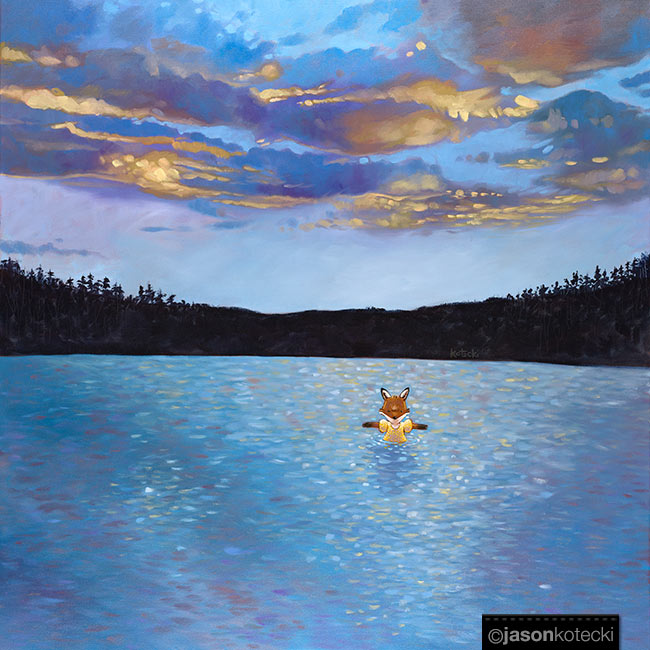
  • The Only Prescription

    “The Only Prescription” by Jason Kotecki. 12 x 12. Oil on canvas.
    Original is SOLD 🔴 Shop this art!

    Somehow, the television show Saturday Night Live took a lowly old cowbell and turned it into a pop culture phenomenon.

    The famous skit imagines a studio session with the band Blue Öyster Cult recording their hit song “(Don’t Fear) The Reaper.” Christopher Walken, as “rock legend” Bruce Dickinson (“the cock of the walk, baby!”), singles out the little-used percussion instrument, played by Will Ferrell. Hilarity ensues as Dickinson urges the band to highlight the cowbell in the song.

    Now the script was funny, and Walken and the other actors nailed their performances. But what is most interesting to me is that Ferrell and playwright Donnell Campbell, who co-wrote the sketch, first had to notice the cowbell in the original song by Blue Öyster Cult.

    They noticed something most people didn’t and saw an opportunity.

    During a family vacation in Mexico, we bought a coconut drink from a roadside vendor for about $2. We enjoyed the drink and threw out the shell. (What else would we do with it?) Then I recalled some of the restaurants we visited where frozen drinks were served in coconut shells with tiny umbrellas. Undoubtedly, those drinks sold for a higher price than the same one served in a boring old glass.

    A “useless” coconut shell was transformed into something of value. Enterprising business owners had literally turned garbage into money.

    Of course, flea markets and thrift stores do the exact same thing. And people who buy and flip fixer-uppers? Where most people see a dilapidated lost cause, they see a tidy profit and a future feature in a glossy magazine.

    The most successful people see opportunities that others miss.

    I’d argue that it’s not a talent; it’s a habit. In the middle of the Panic of 1873, a six-year recession, Thomas Edison invented the incandescent light bulb. In 1876, he established GE (General Electric Co.), which is now the third-largest company in the world.

    In the late 1970s, the United States experienced an energy crisis, and inflation ballooned out of control, causing a major recession that lasted for thirty months.

    In the midst of this economic storm, Applebee’s, Ben & Jerry’s, Olive Garden, and Fuddruckers were founded. In fact, all of the following entities were formed during a recession: Burger King, The Jim Henson Company, FedEx, CNN, Hewlett-Packard, MTV, Hyatt Hotels, Trader Joe’s, Sports Illustrated, and Wikipedia.

    The first Apple Store opened in the recession of 2001 and was declared dead on arrival. Which, of course, it wasn’t; it was so successful that in the recession of 2008, many people considered Apple Stores to be recession-proof.

    And according to Forbes, the COVID crisis was a catapult for launching over 4 million new small business ventures, the largest eruption in the history of our country.

    I remember talking to an elderly real estate tycoon during that economic nosedive of 2008. He grumbled about how all everyone seemed to do was complain about the bad economy. All he could see was an abundance of opportunities, and he lamented that he didn’t have enough years left to take advantage of them all.

    Most of the time, the difference between success and failure is determined by what we decide to see.

    Indeed, the best time to buy stock is when the market is down.

    The best time to start a business is when the economy is bad.

    The best business ideas solve real problems.

    We need you to look at the world as a child would, with big dreams, boundless optimism, and a vision of what’s possible.

    We need you to see through new eyes and find the opportunity that is right under your nose.

    We need more cowbell.
  • Insert Coin

    “Insert Coin” by Jason Kotecki. 30 x 24. Oil on canvas.
    Original is available. 🟢 Shop this art!

    My Grandpa and uncle used to own a tavern. Once in a while, they’d close it to host family parties. I remember the dimly lit atmosphere and the ghosts of spent cigarettes that hung in the air, but my favorite feature was the row of arcade games lined up against the wall. They were blinking, bright doorways to amazing worlds and grand adventures. 

    I don’t remember ever being given any money from my parents to play them. But no matter. Each game had a preview segment, showing a minute or so of the gameplay to entice you to feed it some coins. I just delighted in going from machine to machine, maneuvering the joystick and mashing buttons while pretending I was the one controlling the game.

    Eventually, the novelty wore off, as the preview always ended the same way. I could pretend for hours, living in a fantasy world, which was fun for a while. But if I wanted to experience the game for real, I had to insert some coins.

    Sometimes we live “preview” lives in our own heads. Imagining what it would be like if we made the decision to ask her out. Or put the house up for sale and embark on that quest. Or ask for that raise. Or quit that godforsaken job once and for all. Sometimes those visions in our heads have amazing endings, others have disastrous results, but either way, it’s all fake.

    No matter how certain you are of the likely result (good or bad), you don’t know what will really happen until you actually go for it. Knowing for sure? That costs something.

    You have to be willing to insert the coin.

    It might be a financial investment, of course, but that’s not usually what holds us back. Not really. More often, it’s the fear of the unknown, of not measuring up, or the risk of failure (and the embarrassment that might come from it). Sometimes we shy away from the pain and discomfort it will require. We’re just not willing to put in the work or serve the time to get where we want to be.

    A few years after my grandfather closed the tavern for good, I had a friend who was great at video games. My brothers and I would sit and watch him play Super Mario Bros., delighted to see how far he’d get, fingers crossed over whether he’d be able to defeat Bowser and win the game. It too was fun, for a while. But the joy was always fleeting because his success was not ours. It was always more fulfilling to solve a level on my own, even if I never did make it as far in the game as he did.

    This painting is inspired by that original Nintendo classic. I’m intrigued by the idea of coming across one of the game’s iconic green pipes in the middle of a wide-open field. What’s it doing there? Where does it lead? And most importantly, would I have the courage to find out?

    Life is a lot like a video game. It’s filled with challenges, obstacles, and opportunities to level up. But unlike most video games in which you have a few “lives” to get it right, real life only gives you one.

    What a pity to waste it watching someone else’s game or settling for an imaginary version of your own. 

    What a shame to let fear keep you from fully owning your story and who you are meant to become. 

    Don’t miss the adventure of a lifetime.

    Insert the coin.
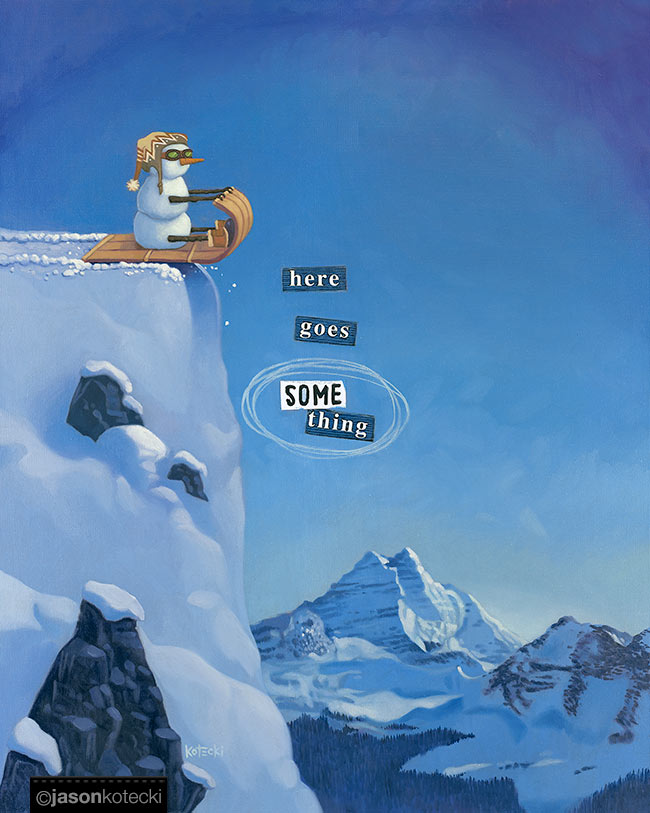
  • Here Goes Something

    “Here Goes Something” by Jason Kotecki. 24 x 30. Oil on canvas.
    Original is SOLD 🔴 Shop this art!

    “Here goes nothing.”

    It’s a phrase we often use when we’re not sure how something will turn out. In fact, since it tends to come from a sense of desperation, we use it to admit that there’s a pretty good chance of it not working. It’s our little way of softening the psychological blow of failing.

    It makes me think of the pass play in football referred to as a “Hail Mary.” The team with the ball is losing, and time has nearly expired. They need a touchdown but they’re so far from the goal line that their only hope is to launch a long pass into a sea of waiting defenders. It’s a pass with a very low chance of success, but at that point, you’re out of options. 

    Here. Goes. Nothing. 

    However.

    This isn’t a football game.

    Trying things that might not work is not nothing.

    It takes tremendous courage, vulnerability, and faith. Dare I say it’s the most important thing we can ever do?

    Doing things that we are sure will work is safe and comfortable. Chasing guarantees is one way to go about our days, but if this is all we ever do, we will have wasted our lives. This is not why we were born.

    When you try something that might not work, it’s true: it might not. But in the end, many other good things will have come of it. At the very least, you will have learned something, and your comfort zone will have inched a little larger.

    And that’s definitely not nothing.

    We recently hosted our third Wondernite. Before our first one, I had no idea if it would work. I didn’t know if anyone would come. I didn’t know if I would even sell one painting. There was a distinct possibility that my brother Doug would go through all twenty items up for auction and not receive one bid and I’d have the exciting opportunity to descend into a catastrophically humiliating shame spiral while sitting in the back of the room. Thankfully for all concerned parties, it turned out well enough that we are currently planning our fourth.

    By the same token, we’ve also invested thousands of dollars into trade shows that did not deliver a good return on investment. They drove us deeper into debt. They bordered on soul-crushing. But the lessons we learned in the process, about marketing, positioning, pricing, and branding, were invaluable, and part of the reason Wondernite turned out to be a success.

    Tinker. Play. Experiment. Try things that might not work. And when you cast off into the unknown, you can be confident in saying to yourself, “Here goes something!!!”

  • Willing To Relocate

    “Willing To Relocate” by Jason Kotecki. 24 x 24. Oil on canvas.
    Original is SOLD 🔴 Shop this art!

    When Kim and I decided to move to Madison after we got married, neither of us had jobs or job prospects for that matter. I’m sure some people thought we were crazy.

    Kim and I didn’t have to leave home. It was fine, and it offered an opportunity. But we wanted an adventure to call our own, and suspected that the life we wanted to live would require a change of scenery. 

    And so we were willing to relocate.

    We had to leave behind that which was familiar in order to grow into who we were meant to become. We picked Madison, but in our case, the need to move away from our comfort zone was more important than the actual location itself.

    Sometimes we have to be willing to relocate to make our dreams come true. Of course, that might mean moving across town or across the country.

    But it might mean moving into a different group of friends.

    It might mean moving from where our customers are today to where they will be tomorrow.

    It might mean moving into a new way of seeing ourselves, perhaps from the role of victim to that of victor.

    When I was a brand new speaker, Kim and I helped form a mastermind group with a few of our peers, talented people at a similar stage as us. We had the harebrained idea to invite Robert into our group. Robert was a true pro that we all looked up to. He’d been speaking for years and had a thriving business. We never thought he’d actually say yes. 

    He did. 

    The thing that impressed me most about Robert was his openness to new ideas. He shared hard-earned lessons, but never paraded the fact that he was further along than any of us. He looked at us as true peers. He was always curious and open to our ideas. He regularly asked us for our opinions and was eager to try out our suggestions. 

    I remember thinking that when I grew up and got really successful, I wanted to be like Robert. 

    Here’s the thing. I now see that he wasn’t patronizing us; he was smart. He knew that in order to grow his business and get better as a speaker, he couldn’t stay where he was. He had to be willing to relocate. 

    Sadly, the reason he stood out is that his attitude is rare. I’ve seen many speakers – and businesses for that matter – slowly fade into oblivion and irrelevance because pride held them back. They already knew it all. They weren’t open to a new path.

    Robert was successful. But he wasn’t about to settle.

    If you are not satisfied with your life as it is now, you have to be willing to relocate from where you are now to where you want to be.

    If you want to experience the summit, you have to say goodbye to sea level.

  • Leap

    “Leap” by Jason Kotecki. 20×16. Oil on canvas.
    Original is SOLD 🔴 Shop this art!

    Why is it that so many of the people who have found success in America are first-generation immigrants? One big reason is that many of them came from a place that is not so great. They saw America as the Land of Opportunity, and they pursued it with a definitive focus and relentless persistence. They were willing to leap from the known to the unknown.

    A big reason people don’t chase their dream is that where they are now isn’t half bad.

    They give up the dream and settle for the dreamsicle.

    A dreamsicle is sweet and alluring and very tempting. It’s the option most people go for, with its safety, comfort, and surface-level perks. Because of that, you wonder if you’re crazy to even consider abandoning it.

    The dreamsicle is the lifestyle that ensures you need to keep your current job for as long as possible.

    It’s the boyfriend who checks all the boxes except for the one that matters most.

    It’s the job that impresses your parents but gives you Sunday Night Dread.

    But eventually, it leaves an unsatisfying feeling in your stomach. Like maybe you shouldn’t have settled for something so easy.

    When I first started my business, the prospect of dealing with taxes, paying for my own health insurance, and being solely responsible for the revenue (or lack thereof) felt daunting. Turning down a steady job with killer benefits and staying in a crappy apartment for eight years seemed ill-advised at the time. Now it’s clear that it was one of the best decisions I ever made.

    Any time you break away from the crowd and do something different is scary. The leap into the unknown requires us to be the leaders of our own destiny.

    But nothing is ever as rewarding or satisfying as chasing the dream in our hearts.

    The dreamsicle is not the same as the dream.

    Is it time for you to leap?

  • Imagination Can Take You Anywhere

    “
    Imagination Can Take You Anywhere” by Jason Kotecki. 30 x 24. Oil on canvas.
    Original is SOLD 🔴 Shop this art!

    In my family growing up, I was always the art guy. Today, I make a living painting pictures, telling stories, and writing books.

    My younger brother Dan was the science guy. He now works for a cancer hospital analyzing and improving “systems,” or something structured and boring like that.

    I always saw us as complete opposites, which is how I think most people see art and science.

    Yes, my brother and I are different, but I was also decent at math and enjoyed doing experiments in chemistry class. Meanwhile, he had a pretty good drawing talent that went under the radar. Today, he collects Pearl Jam posters because he appreciates the art.

    I was so locked in to looking at the difference between us that I never noticed the connections.

    Artists are thought of as free-spirited, open-ended, and subjective. Scientists are often viewed as analytical, precise, and objective.

    But Science is not cold, rigid, and unfeeling. Art is not some frivolous, fluffy extra. Believe it or not, they are connected.

    Curiosity and Imagination are the parents of both art and science.

    The same curiosity and imagination that is present when an artist creates a new play, sculpture, or piece of music is present in the best scientists as well. We imagine space travel, and curiosity asks, “How can we make that happen?” We imagine a world without cancer, and curiosity asks, “What hasn’t been tried on this particular strain?” Curiosity asks, “How can we become more energy independent?” and our imagination gets to work on thinking up a whole bunch of possible solutions, ranging from the far-fetched to the less so. Sometimes solutions are hidden within an idea that seems completely preposterous.

    This painting was inspired by my first trip to Vancouver, and by a quote often attributed to Albert Einstein: “Logic will get you from A to B. Imagination will take you everywhere.”

    Imagination is often seen as a peculiar skill set of children and the pastime of daydreamers. Mildly amusing, but hardly practical for a self-respecting adult. Too often, our imaginations fade as we grow older. We stop asking questions and dreaming big. We reward the rule-followers. We search for and obediently follow the best practices.

    But in a changing world, what worked before will not get us to where we need to go. There is no roadmap. No formula. No step-by-step manual to help us succeed tomorrow.

    The well-worn paths we’re used to treading now only lead us astray, to a world that no longer exists.

    So what now?

    We must stop looking at science and art as opposing forces.

    We need to realize that we are all artists. Working in paint, charcoal, or clay is not required.

    And likewise, we are all scientists. Even if we don’t wear lab coats.

    If you are stuck, or have a sneaking suspicion that things could be better in your life, your relationships, or your organization…you are right.

    The way forward is to imagine a better reality, the future we wish to create. And then we tinker our way there, by trying things that might not work and using what we learn to guide our next steps — even small steps — forward.

    Imagination. It’s not just a plaything for children.

    Dust yours off. It can take you to some pretty amazing places.
  • The Princess Dress

    “The Princess Dress” by Jason Kotecki. 36 x 36. Oil on canvas.
    Original is SOLD 🔴 Shop this art!

    This painting was inspired by my daughter.

    Our family loves going on walks. A half mile from our house, there is a row of lakefront homes. A small sliver of land between two of them serves as a public access point to the lake. A few years ago, an hour before the sun tucked itself in for the night, we pushed our strollers through the skinny green passageway to enjoy the pint-sized plot of beach that was ours.

    It wasn’t long before my oldest began wading in the water, delighted by the sand squishing between her toes. Lucy was wearing last year’s Halloween costume — a sparkly pink and yellow princess dress — because, well…just because. The gentle waves kissed the bottom of her gown. I considered telling her to be careful not to ruin it, but reasoned that a little water never hurt anyone.

    Meanwhile, Ben was outfitted in his Incredible Hulk costume — you know, just because — and for some reason, was lying face-down in the sand. Motionless. He looked like a big green sea turtle who had come in with the tide to build a nest. We’d be finding sand on him days later.

    By the time I turned my attention back to Lucy, she was in lake water up to her armpits, princess dress and all! I stood there, in stunned silence, as the supercomputer in my brain whizzed through its vast database in search of some rule frowning upon the intermingling of lakes and princess dresses. (Old Halloween costume or not, that dress wasn’t cheap, and I didn’t want it ruined.) But the warm smile that beamed widely across her face suggested that perhaps this was yet another rule that doesn’t exist.

    In that moment, with the sun setting behind her, I realized that Lucy was living life as well as it could possibly be lived. Too often, we fall far short of this ideal. Why? 

    Because we’re afraid of getting our princess dress wet.

    And we all have one. Our “princess dress” is the carefully curated version of ourselves that we show off to others. It’s the way we look, speak, and act. It’s our degree and our job title, our home and hairstyle, our cars, clothes, and 401ks, all wrapped into one pretty package and tied with a bow that signifies that we are responsible, sophisticated, and successful.

    In order to keep this princess dress looking good, we must live a life of restraint. No full-out running, no sitting on the ground, no eating messy things, and certainly no swimming in lakes.

    We are given countless opportunities to dive headfirst into the experience of life, but we are too afraid to mess up our hair, our clothes, or our reputation. Because running through puddles, making a mess, or doing something silly for the sheer sake of fun sullies the dress we’ve worked so hard to preserve. And besides, people like “us” don’t do things like “that.”

    While settling for good enough, we miss the insanely great.

    Guess what? After the dip in the lake, Lucy’s princess dress went into the washing machine and came out… good as new.

    Fear does a pretty good job of keeping us from living an amazing life. But it’s a horrible predictor of the future.

    Don’t settle for dipping your toes into this adventure called life. For best results, spend more of your time up to your armpits in awesome. 

    Don’t be afraid to get your princess dress wet.
  • Roam

    “Roam” by Jason Kotecki. 30 x 24. Oil on canvas.
    Original is SOLD 🔴 Shop this art!

    Starting at younger and younger ages, kids are expected to begin thinking about what they want to do with their lives. I feel bad for them, because between increasing homework loads and more demanding extracurricular commitments, they are given less and less free time to figure out who they are and what lights them up.

    No matter how old you are, a little space to roam can make a big difference.

    After three grueling years producing his show, Sam and Friends, Jim Henson was burned out and ready to give up on puppetry. Then he left for a yearlong walkabout in Europe. He took in puppet performances throughout the continent, impressed by how appreciated the art form was outside the United States. “Until then, I hadn’t taken puppetry all that seriously,” Henson said. “It just didn’t seem to be the sort of thing a grown man works at for a living.” But Henson returned from Europe energized and inspired, and would eventually create The Muppet Show and Sesame Street.

    I like the idea of a gap year, which is typically a period of time taken between high school and college to deepen practical, professional, and personal awareness. I’ve also heard of people taking them mid-career, or married couples who take them when they become empty nesters, to re-establish their relationship as it enters a new phase.

    Every once in a while, we all need a bit of time and space to wander, wonder, and think about what’s next.

    I love this definition of roam: To go to different places without having a particular purpose or plan.

    Here’s another good one: To move about or travel aimlessly or unsystematically, especially over a wide area.

    The next step in our life journey is not always evident. Perhaps you are in a season that calls for some aimless travel, even if it’s just spending a few days outside of your normal routine. 

    Sometimes we need to break free from the day-to-day. 

    Sometimes we have to roam a bit to find ourselves.

  • This Ain’t Kansas

    “This Ain’t Kansas” by Jason Kotecki. 20 x 20. Oil on canvas.
    Original is SOLD 🔴 Shop this art!

    As dissimilar as they may appear on the surface, rural Midwestern farmers and rural Asian farmers have some things in common. One is a deep respect for tradition. This is an important value that can provide a sense of stability and help pass on hard-earned wisdom to future generations. 

    But I believe we must also have an openness to new things. Not so that we will abandon our ideals, but so that we can experience a much richer life. 

    It’s like the difference between experiencing life in black and white versus full color, like in the 1939 version of The Wizard of Oz.

    Indeed, doing things the way you’ve always done them, and surrounding yourself with the same people, places, and opinions, is a pretty good way to live life in grayscale. 

    I made this piece as a reminder that sometimes we need to break free from what’s expected. Mashups of east and west, urban and rural, liberal and conservative, old and new, are what make life more interesting. 

    How does one opt for a more technicolor life? Simple: Take a break from your traditions.

    Read a magazine or watch a documentary on something you know nothing about. Order food you’ve never tasted before. Take a new form of transportation to work for a week. Have a conversation with someone who holds an opposite point of view (without trying to convince them they’re wrong). 

    This openness to new ideas, perspectives, and ways of doing things is a key to unlocking opportunities that can change your life.

    I have struggled the past few years trying to find my place. I have been a member of the National Speakers Association for over a decade now, and it has served me well. I have made wonderful friends and have learned a lot about growing a successful speaking business.

    But in recent years, I’ve had a hard time finding relevant examples to model my business after. You see, I have this art thing that I do, which is very unique among the speakers I’ve encountered. Even the ones that incorporate art somehow into their offerings do so in a way that’s totally different than the direction I want to head.

    And so I have spent the better part of the last two years seeking out art-centered business models. I have tried to learn as much as I can from other successful artists. And I’ve learned a lot, but it turns out, most of them aren’t so keen on the whole “speaking in front of large crowds” thing.

    I was frustrated by my failure to find someone who has already done what I am trying to do. Someone who has a roadmap I can follow.

    Until I finally figured out there is magic in the mashup.

    It’s the combination of two seemingly unrelated things –public speaking and making art –that gives me my edge and helps make me stand out. Borrowing the best of what I’ve learned from great speakers as well as successful artists, while mixing in my own unique quirks and talents, has been a game-changer for me. 

    If you’ve been feeling paralyzed by the belief that things have to go a certain way, or if you’ve felt like a square peg trying to force yourself into a round hole, or if life just feels a little too gray…it might be time to mix in some new ideas, experiences, and assumptions. 

    And watch your world change.

  • Life’s a Wave

    “Life’s A Wave” by Jason Kotecki. 30 x 24. Oil on canvas.
    Original is SOLD 🔴 Shop this art!

    The familiar pit formed at the bottom of my stomach like a butterfly battle royal on pay-per-view. It developed after my mom answered the phone and told me it was for me.

    When I was younger, I was afraid of just about everything. New situations always brought an enormous level of anxiety, and phone calls delivered a special level of dread.

    It was a classmate on the other end, asking if I wanted to come over to play.

    For most people, this would be great news, not a situation worth getting nauseous over. But I was not most people. I’ve never been keen on having my plans changed at the last minute. I had a whole day planned of doing nothing ahead of me. Not to mention, I’d never been to Chris’s house before. Talk about a new situation! It was clearly a sensory overload too treacherous for a lazy Saturday.

    I quickly mumbled some excuse about how my mom wouldn’t let me today and hung up. “Whew! That was close,” I thought to myself, eager to return to my regularly scheduled day of surprise-free comfort.

    Only one problem: my mom heard.

    She ordered me to call my friend back up to tell him I could go. Gulp. That wasn’t at all embarrassing! “Hey Chris…hehe…good news…”

    The thing is, I ended up having a great time. There were many similar situations in my childhood in which my mom shoved me out of the nest, and I almost always enjoyed it. Eventually, I started to make little leaps on my own. At some point, I decided I didn’t want to be an 80-year-old guy looking back on my life, wondering, “What if?”

    The fear of regret became worse than the fear of the unknown.

    Life can be a spectator sport if you want it to be. You can watch the action standing safely on the shore. It’s the best way to minimize risk, avoid failure, and stay comfortable.

    The only problem is that it’s not much of a life.

    The real action happens out in the surf. To ride the wave of an amazing life, you have to be willing to leave the shore.

    Sometimes you have to take the plunge into parenthood even though you don’t think you’re ready.

    Sometimes you have to cash in your rainy day fund for a venture that might not work.

    Sometimes you have to book that trip today, because you never know how many tomorrows you have left.

    I cannot guarantee that you won’t wipe out now and again. But the bumps and bruises that accompany a wipeout are more tolerable than the deep ache of wondering “what if?”

    What wave is it time for you to catch?