Topic: Innovation & Creativity

  • Invasion

    “Invasion” by Jason Kotecki. 20 x 20. Oil on canvas.
    Original is SOLD 🔴 Shop this art!

    I love macarons. I only had my first one a few years ago, but it was love at first bite.

    Not only am I always on the lookout for ways to get them in my belly, but I decided it was time to get them into some paintings. They’re so cute and colorful, after all, and perhaps keeping myself busy painting them would help distract me enough to keep me from eating them.

    I like the whimsy that comes from playing with scale, making something smaller or bigger than it would be in real life. Perhaps this reflects my early fascination with dollhouses, dioramas, and Micro Machine cars.

    One day, as I was doodling in my sketchbook, it occurred to me that a macaron looked a little bit like a flying saucer, and that was all she wrote. My imagination concocted a great scene in which an army of macaron UFOs descended upon a field of grazing cows. Naturally, one would have to be taken as a specimen for further experimentation, sucked up by some powerful tractor beam.

    I like the idea that a painting like this begs the viewer to ponder some questions. What kind of planet did these strange, sweet ships come from? What will become of the cow? And where will the farmer imagine it went when he awakes in the morning to find one missing?

    Yes, it’s all nonsense. But that doesn’t make it useless.

    “I like nonsense; it wakes up the brain cells.”

    –Dr. Seuss

    Perhaps these nonsensical questions will wake up our brain cells so they will be firing on all cylinders when it comes to tackling more vexing challenges in our life. Answers tend to be found by people asking the most questions. And sometimes the answer to a problem is hiding in something that looks a lot like nonsense.

    Maybe someday soon, one or more of Earth’s most pressing problems will be solved thanks to a discovery on some faraway planet.

    After all, it wasn’t that long ago that space travel was nothing more than science fiction.


  • Rocket Yeah

    “Rocket Yeah” by Jason Kotecki. 24 x 30. Oil on canvas.
    Original is SOLD 🔴 Shop this art!

    We’ve been launching ourselves into space for decades now, and there’s still an element of risk every time we do it. Although very smart people do their best to minimize it, there is always the prospect of danger, disaster, and the possibility that it might not work. With all that humankind has gained from these amazing missions, I’m thankful we’ve had so many brave people willing to go for the ride.

    It’s good to remember that every worthwhile endeavor comes with an element of risk and requires at least some small measure of bravery. It comes with the territory and is a necessary consideration as we make our plans.

    However, I made this painting to also remind us not to focus too much on the danger. I know I can get sucked into spending too much time thinking about the risk, what I might lose, and what people will think of me if I fail (especially if in some spectacular fashion).

    Determining that an endeavor carries some risk shouldn’t automatically keep us from moving forward.

    The whimsy incorporated into this piece in the form of a bomb pop blasting off into space is a reminder to focus at least as much on the excitement of what’s possible and the potential gains to be made in the process of trying. This recalibration can give us the fuel we need to launch off into an adventure in which the outcome is unknown.

    Do you have an opportunity in front of you that’s freaking you out a little bit?

    Instead of worrying so much about what might happen if it doesn’t work, get excited by asking yourself the question, “What if it does?!”

    * * *

    [ Below is a video with a behind-the-scenes look at the making of this painting – enjoy! ]

  • Follow No Maps

    “Follow No Maps” by Jason Kotecki. Digital art.
    Shop this art!

    Best practices are for the birds.

    Remember when your mom asked you if you’d jump off a bridge if all your friends did? Nowadays, you could get away with saying “yes” if you explained that jumping off the bridge was a “best practice.”

    Look, I’m all for seeking out wisdom and learning from others who are doing things well. But I’m beginning to see “best practices” morph into a fancy way of saying, “tell me what to do so I don’t have to think.” It’s become just as much a way of hiding as it is a tool for improvement. After all, no one ever got fired for following a best practice.

    Best practices are the equivalent of paint-by-numbers: “Color these sections exactly the way we tell you and you’ll end up with a pretty picture that looks exactly like this.”

    As I’m fond of saying, they don’t hang paint-by-numbers in the Louvre.

    Innovation is a sexy buzzword these days. Everyone wants to be seen as innovative. But you can’t be innovative if you’re busy following best practices. Doing the same thing as everyone else is the opposite of innovation.

    If you really want to be innovative, you have to find better practices. And the only way to do that is to try doing something different. Of course, it might not work. But…what if it does?

    You can follow best practices or you can be innovative, but you can’t do both.

    The head fake here is that this little rant seems to be all about business, but it’s really not.

    It’s about life. The map is there for you if you want it. You can parent your kids, spend your free time, navigate your education, plan your wedding, celebrate holidays, run your campaign, decorate your home, or manage your finances according to “best practices.” If you want your life to look like everyone else’s, by all means, look around, watch what everyone else is doing, and do that. Frankly, that’s actually what most people want.

    But if you are reading this, I suspect you want something more than for your life to look like a boring old paint-by-number that looks exactly like everyone else’s. In order to do that, you have to ignore the map and head off for parts unknown. That’s what “escaping adulthood” is all about.

    The scary part is not that you don’t know where to head, because deep down, you actually do.

    Deciding to start; that’s the scary part. It’s also the beginning of a great adventure.

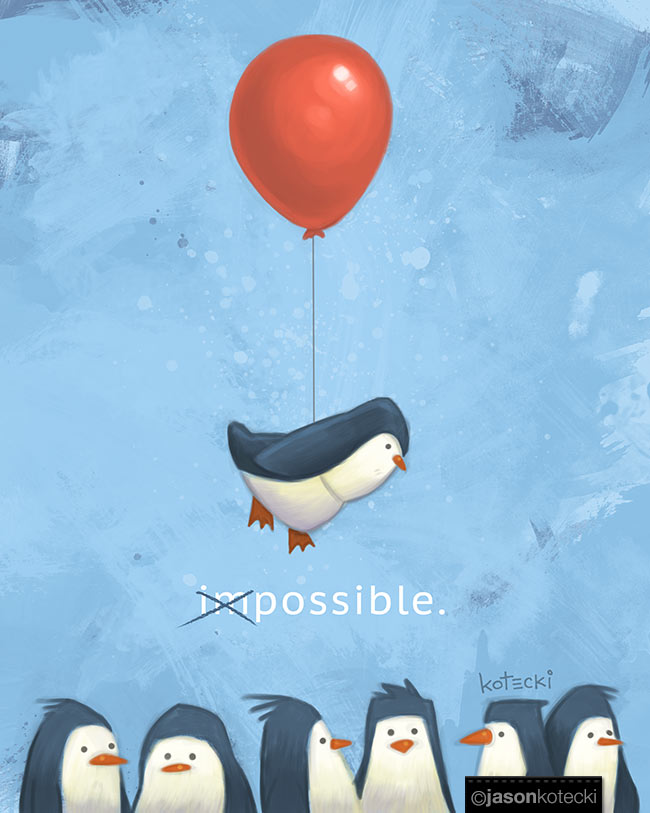
  • Penguin Possible

    “Penguin Possible” by Jason Kotecki. Digital.
    🖼️ Shop this art!

    “I do have dreams, but I try to keep them realistic.”

    No one likes to admit they don’t have dreams. But no one likes to be called a fool, either. Or worse yet, a failure. After all, the bigger you dream, the more likely you are to fail. Claiming to have realistic dreams makes you sound smart. It gives the impression that you’re going places, likely to succeed, and are not to be sidetracked chasing any childish, crackpot schemes. But one of those words is terribly problematic.

    The word “realistic.”

    Who’s to say what’s realistic or not?

    Do we really believe that Orville and Wilbur Wright were deemed “realistic” by their fellow townsfolk while they used their bicycle repair shop profits to try and build the world’s first “flying machine”?

    After all, in 1902 (just ONE year before the Wright Brothers’ great success), Lord Kelvin—the otherwise brilliant dude who determined the correct value of absolute zero as approximately –273.15 degrees Celsius—said, “No aeroplane will ever be practically successful.”

    And just fifty-eight years after the Wright Brothers’ breakthrough, was President John F. Kennedy being “realistic” in 1961 when he declared that America would send a man to the Moon by the end of the decade? (By the way, the first handheld pocket calculator would not be invented until five years after Kennedy’s speech.)

    Meanwhile, is it “realistic” today to think that we will ever find a cure for AIDS or autism, or Alzheimer’s disease?

    When it comes to dreams, this world is suffering from a bigness deficiency. I don’t think there’s anybody alive who is dreaming too big. In fact, I’m not even sure it’s possible. I don’t need studies about how much of our brain capacity goes unused to tell me about the potential of mankind. Just look at examples. Whether it’s the invention of the artificial heart, or the guy who climbed Mount Everest blind, or the inspiring examples of Holocaust survivors. We are created to do things that don’t, at first glance, seem very realistic.

    If a dream is realistic, it’s not really a dream. It’s a to-do.

    If you want to be realistic, be realistic about your fears. After all, most of the things you worry about will never happen. But when it comes to your dreams, leave realism at home. At least at the beginning.

    No matter how big you think you’re dreaming, it’s not big enough. A good dream has to be kind of crazy. And improbable.

    “Big dreams create the magic that stir men’s souls to greatness.”

    —Bill McCartney

    If you’re going to dream, you might as well dream big. And if you’re ever accused of dreaming too big, then you can rest assured that you’re on the right track. Just pretend you’re a long-lost member of the Wright clan.

    Don’t worry about being realistic. And be very, very cautious about what you label as “impossible.”

    For as John Andrew Holmes wisely said, “Never tell a young person that something cannot be done. God may have been waiting centuries for somebody ignorant enough of the impossible to do that thing.”