My parents recently hosted us for a birthday dinner. In Kim’s card, my Dad had written something about us being the most persistent people he knew. Kim smiled, because we know how close a cousin “persistent” is to “stubborn,” which is a synonym for “unreasonable,” “pig-headed,” and “cantankerous.”
But we took it for the compliment it was intended to be.
Persistence, stubbornness, an abundance of sticktoitiveness…whatever you want to call it, we definitely have it.
It’s what allowed us to keep going for twenty years before making it to our dream home on Lake Michigan. We endured years of financial loss, crushing debt, the disappointing results of failed plans, and excruciating stretches of time when momentum was harder to find than Waldo in a candy cane factory.
That persistence served us well. It may have been our superpower, but it never seemed that special to me. Maybe because I know the secret.
There were many times I wanted to wave the white flag. But whenever it felt like the jig was up and bankruptcy was looming, I just assured myself that if all this didn’t work out, Kim could always go back to teaching. I could always get a corporate job or manage a fast food place somewhere. We’d be fine.
Then I’d think about how terrible it would be if I had to do that for the next twenty or thirty years.
And then I’d get back to work on the thing that excites me. Because moving forward suddenly wasn’t as hard, or hopeless, or impossible as it seemed. In considering the alternatives, I was reminded that I had a choice.
Even now, when I’m in the middle of hosting a one-man woe-is-me pity party about how difficult I have it, how much this sucks, and how I don’t think I want to do this anymore, I call a timeout. I reflect on the summers of my teenage years, when I worked at a car dealership, enduring long days doing work that didn’t excite me. I remember how slow the clock moved as I counted down the minutes to freedom. I recall the pangs of dread that settled in on Sunday nights.
That job is where I learned that I’m employable. It’s when I made the choice that I was going after my dream, no matter how hard the road or how long it took. In that promise, persistence was born.
This is not a message about never quitting, which is sometimes the wisest course of action. It’s about reminding ourselves that quitting is only one of the options.
Adultitis prefers us playing the victim card. It very much enjoys us feeling powerless and without any choices.
But we always have choices.
We put its panties in a bunch when we play the perspective card. When we look at how far we’ve already come, or take an honest accounting of all the options at our disposal – while realizing how many of them are worse than our current situation – we can pull ourselves from the pit of hopelessness.
Laying all the choices out on the table can help remind us that we are on the right road after all. Sometimes, being faced with a less desirable scenario immediately brings to mind some new thing we can try in our present situation.
I’m sure there’s a little bit of persistence involved, and a dash of needing to be my own boss, but mostly, the thing that kept me going was simply reframing my situation.
What is the secret to being persistent? How do you keep going when you really want to throw in the towel?
You simply remind yourself of ALL the choices, and why “keep going” is the best one.
Another fun fact is that my first few kisses were instigated by the girl, not me. And that’s not because I had so many of them chasing me; it’s because I was waiting for the timing to be perfect.
Was I waiting for a red, Jamaican-accented crab holding a big neon sign blinking, “Kiss the girl!”?
No, of course not. That’s ridiculous.
I was waiting for the billboard after that to assure me that the first sign was the sign I was waiting for.
Truthfully, I was afraid. I was lost in questions: Is this the one? How can I tell if she wants me to kiss her? How am I supposed to do this, anyway? How is my breath? What if I do it wrong? Will she laugh at me? Will she tell all her friends? Will I die alone, single, and unloved? Yep, I’m totally going to die alone, single, and unloved.
While I was swimming in the fog of self-doubt and existential dread, I guess the girl got tired of me missing the neon sign, the billboard, AND the marching band and leaned in and went for it. And then, caught off guard, I may or may not have blacked out, which might explain why, although there are a few contenders, I can’t remember which one was technically my first kiss.
As you can see, I can be a bit of an over-thinker, lost in the weeds as I wait for the timing to be right. Fortunately, as I’ve gotten older, I have also gotten better at making the first move and worrying less about perfect timing.
I’ve learned that it’s a fool’s game trying to determine the right time to do anything.
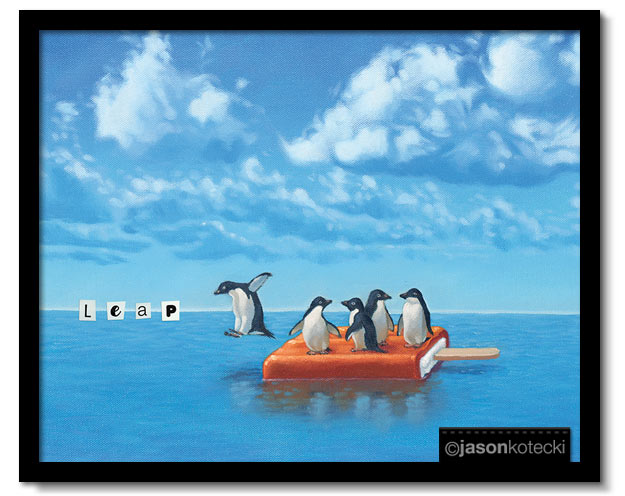
When is the right time to kiss the girl? When is the right time to start a family? When is the right time to go back to school? When is the right time to start that business? When is the right time to sell that stock? When is the right time to retire? When is the right time to take that leap your heart is begging for?
I don’t know. No one does.
Perfect timing is only obvious in retrospect.
If you’re wondering about the right time to do the thing you’ve been mulling over, I do know this: it’s probably a lot closer to NOW than later.
I am a planner. I believe wisdom is important when making decisions. These are good things. But there is a certain wisdom in the adage that advises jumping off the cliff and building the parachute on the way down.
Because that’s what happens anyway.
In life and in business, there are no perfect plans. As noted philosopher Mike Tyson once proclaimed, “Everyone has a plan until they get punched in the mouth.”
But the good news is, as Marie Forleo reminds us, “Everything is figureoutable.”
Meanwhile, as we wait for the stars to align, we miss out on opportunities right in front of us.
One of my favorite things is getting to take one of my kids with me when I travel for a speaking engagement. We’ve made a point to make the first one with each child kind of epic. At a gig in San Diego, I took Lucy to the zoo and we got to see a cheetah run. Ben joined me on a trip to Orlando, where we rented a convertible and visited Legoland.
Finally, it was my youngest’s turn. I secured tickets to the Magic Kingdom for me and Ginny after an organization booked me for their national conference in Orlando last December. The timing was perfect.
Then COVID.
The event switched to virtual, and our epic trip was put on hold. It was excruciating to tell her the trip was canceled after we’d spent so much time looking forward to it. Since the Disney tickets are transferable, I’ve been waiting for another opportunity in the area to present itself. So far, nothing has. I didn’t want to “settle” on a “lesser” first trip with Ginny, but I recently decided to move beyond this self-imposed restriction.
Our first trip together will now be, drumroll, please…
…Chattanooga, Tennessee! I know, exciting, right?! It may not be the sexiest destination, but I also know that for Ginny, it’s more about spending time with me than where we go. I also know that life offers no guarantees, and if I keep waiting, I may miss my chance to take her on a trip altogether. Or, less dramatically, we’ll end up taking far fewer of them than we could have. (Of course, the next gig anywhere near Orlando has her name on it, no questions asked.)
One of the best tricks Adultitis has at its disposal is convincing us to wait for the timing to be perfect. It’s a trap that allows us to hide, fear to win, and the clock to run out.
The clock runs out for all of us. The end is sooner than you think.
Most people wish they’d gotten started on that thing they now love earlier, not later.
Most people wish they’d had more kids, not less.
Most people on their deathbed are more regretful about the things they didn’t do than the things they did.
You’re never “ready” enough. You never have enough saved up. You’re never cool enough, strong enough, smart enough, confident enough, worthy enough, or lovable enough.
From your first kiss to your first business trip with your kid, the timing is never perfect.
Sometimes you have to quit overthinking it and just jump.
I took my kids to the art museum the other day. It had an exhibit featuring artwork by local students, from kindergarten up to high school. Afterward, we checked out the other exhibits from the more experienced, grown-up artists.
I liked the stuff from the kids better.
It got me thinking about the role a museum curator plays. A quick Google search explains that he or she acquires, cares for, and develops a collection. They also arrange displays of collected and loaned works and interpret the collection to inform, educate, and inspire the public.
I wonder how they decide what exhibits to run, what artists to feature. How do they choose what paintings to include in each show? I know enough about the job to understand that oftentimes, the curator has a certain narrative they are trying to tell with a particular exhibit, and the goal isn’t necessarily to show the “best” work, which is mostly subjective anyway. Rather, they select pieces that support the story they’re telling. And no matter how big the museum is, space is not finite, so every piece included means that others will have to be left out.
We rely on curation every single day, and I’m not just talking about art museums.
In the olden days, and even in many third-world countries, a lack of knowledge is a problem. Not for us. In an era when we’re flooded with more information in a day than a person living a few hundred years ago had to deal with in her whole lifetime, curation is more important than ever. The trick isn’t uncovering more information; it’s deciding what matters and what doesn’t. That’s the power of curation.
At the restaurant, we ask the waitress what she recommends.
We rely on bestseller lists to tell us which books are worth reading.
We let Netflix suggest movies to watch based on our past viewing preferences.
We depend on the organizers of the conference we are attending to assemble the experts worth hearing from.
We even curate our social media feeds to deliver news and updates from people we know, like, and trust. (Even though this may not result in us receiving a full or accurate picture of reality.)
Early in our lives, our parents or guardians serve as curators for our lives. That’s especially how Kim and I view our responsibility as homeschooling parents. We don’t feel pressure to “teach” our kids anything, but rather to assemble for them a tapestry of experiences and opportunities that might spark their curiosity. That curiosity takes care of the learning just fine.
In the last few weeks, we’ve watched documentaries about the International Space Station, Disney animators, and a free solo rock climber named Alex. We haunted the library and spent an hour browsing the stacks of books we collected from the shelves. We went to a rock concert and are planning a field trip to see how they tap maple trees for syrup.
On the flip side, we also make choices about what things to exclude from their young lives. We consider their level of maturity and understanding and wisely discern what’s useful and what’s rubbish; what will help them grow and what might lead them astray. We limit screen time, sweets, and movies that we don’t feel are appropriate. We realize we cannot protect them from all the darkness they will encounter in life, but we shield them from dangerous situations as best as we can during these formative years.
Good parents are the curators of their kids’ lives until they have grown in age and wisdom to be able to curate their own.
Regardless of how intentional or effective your parents were about the task, the job of curating your life is now yours alone.
Like a museum curator, you are telling a story with your life. How deliberate are you?
What movies do you watch? What books do you read? Where do you get your news? What websites do you frequent? Who do you follow on social media? What foods do you eat? Where do you travel? What people are you allowing into your life? What habits are you cultivating? What experiences and ideas are you exposing yourself to?
“The ideas you consume determine the person you’ll become.”
–Josh Spector
Every decision about how you spend every minute of your day is a choice, whether it’s conscious or not. Are the choices helping you grow and thrive? Or are they leaving you less healthy and more depressed? Are they growing flowers or sowing weeds?
The things that you allow into your life are important, but so are the things you decide to leave out, such as negative influences, time sucks, and activities that distract you from living your best life. Successful serial entrepreneur Gary Vaynerchuk reminds us of this fact: “Miraculous things happen when you cut out your most pessimistic friend. You become more optimistic.”
Regardless of how much thought or time you’ve put into it, understand this: you are the curator of your life.
How would you rate it? Is it meh…or amazing?
Is there something you could add or remove that would make your story stronger?
A lot of questions here, and I’m afraid I’m not able to provide many answers.
Your time is finite, and the decisions about this exhibition called life are entirely yours.
For just fifty-eight cents, someone will come to your house to collect a letter you’ve written and hand-deliver it to the house of someone else anywhere in the country.
Heck, back in the old days, you had to be royalty with great wealth and servants at your beck and call if you wanted a personal message delivered to someone in your kingdom.
Even now, if you lived in Miami, how much time, money, and effort would it take you to hand-deliver a birthday card to a friend in Seattle? Depending on whether you took a plane or car, and if you had any overnight stays involved, it might cost you a thousand dollars or more.
Instead, a mailman will do it for the tidy sum of fifty-eight cents, and you can stay on your couch in your pajamas polishing off a pint of Chubby Hubby.
Miraculous.
It makes me wonder why we don’t avail ourselves of this magic more often. Because perhaps the best part of the whole thing is receiving a real greeting card or a handwritten letter from someone else. You have a permanent record of someone’s inner thoughts, and a relic of them, in the form of their own handwriting, their unique signature. They had to lick the envelope. They affixed the stamp. It’s like a little craft project, made just for you.
It’s extraordinary because it’s rare. We don’t do snail mail much anymore; it takes too long. An email or a text is quicker.
In this harried world, there is something special knowing that someone had to hit pause on their day, on purpose, to complete a physical action that took longer than pounding out a few keystrokes on their laptop. That’s the coolest part: the indisputable fact that they were thinking of you. You mattered to them. And they gave someone very specific instructions to deliver that message directly to you, as quickly as possible.
All for fifty-eight cents.
This isn’t an advertisement for the postal service, although they do have some amazing people in their ranks. It’s a reminder that there are miracles all around us.
If you can’t see them, you’re not paying attention.
I hope this inspires you to send a miracle to someone today.
[ 💌 Want a printable version you can print and share with your favorite postal worker? Here you go! ]
Next time you look in the mirror, I challenge you to ask the question, “Would I want to hang out with me?”
I know a lot of people who label themselves as “un-fun,” wishing it weren’t so but resigned to a monotonous stream of grown-up responsibilities, obligations, and commitments.
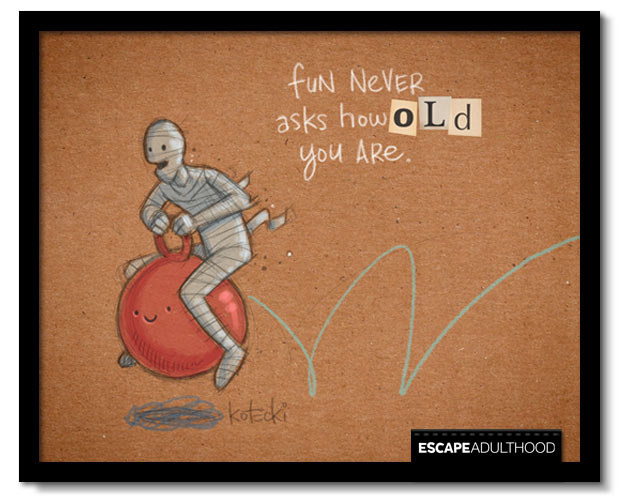
If that describes you, take heart. I refuse to believe that you’re the boring, stick-in-the-mud fuddy-duddy you (or your favorite teenager) feel like you are sometimes. That fun-having expert with a PhD in Play is still there. The problem might simply be that you don’t have any margin for fun.
Margin for fun?
Yes. You’ve probably heard of “margin of error,” so let’s start there. A margin of error can be defined as how many mistakes you can make and still be able to achieve something. If you’re an Olympic athlete, one misstep can take you out of medal contention. It’s usually stressful when your margin of error is too small. Maybe you’re not an Olympic athlete, but if you’ve ever had too much month at the end of your paycheck and the transmission went out in your car, you know what I’m talking about.
Likewise, life is harder and less enjoyable if you don’t have enough margin for fun.
What causes this? How does our margin for fun get so narrow?
It could be a result of doling out too many yeses. The more projects you’re juggling, the more activities your kids are in, the more committees you sit on, the less your margin for fun. One thing going wrong in your day becomes a grenade chucked into your fully-stocked china shop of a schedule. Not fun.
You can also limit your margin for fun by worrying too much about stuff that doesn’t matter as much as you think it does. You’re gonna have to do your own reality check on this one, but demanding anything close to perfection from, say, the cleanliness of your house, your kids’ report cards, or your own self is usually an effective way to dramatically decrease your margin for fun.
And sometimes we are afraid to indulge in fun because we think it will make us look silly. And it’s true; it might. Taking a selfie with a statue could draw some sideways glances. You will almost certainly look ridiculous ice skating for the first time. But, as comedian Amy Pohler reminds us, “There’s power in looking silly and not caring that you do.” Giving too much weight to what other people think of us is a pulverizer of fun.
This idea originated from a mom named Sara, who heard me speak at a conference in Arizona. She wrote:
“I am a full-time teacher, mom of FOUR (15, 13, 10, and 8), and my husband and I serve on the boards, manage the teams, etc. My kids are busy with school, sports, and technology. After hearing your keynote, I want to increase my margin for fun.”
When you have no margin for fun, Adultitis is primed to take over.
So, how does one increase their margin for fun?
First, try dialing back on the yeses. Limit commitments, reclaim a Sabbath, or even one night a week. A tightly-packed schedule suffocates fun. Give your calendar some room to breathe, increasing the opportunity to embrace spontaneity, linger for one more hour, or take the long way home. Fun needs room to run and likes to hide off the beaten path.
Secondly, let go of perfection and lower expectations. I’m not talking about letting everything go to hell. I’m not talking about not caring, trying hard, or doing a good job. I’m talking about getting really honest with yourself to make sure the standard you’re setting for yourself isn’t just a way of proving your worth or patching over some pain by trying to achieve some Pinterest-fueled fantasy. If something doesn’t go according to your perfect plan, what’s really the worst that will happen? Saying the answer out loud is a great way to expose the impotence of this lingering fear. Lowering your expectations a smidge gives fun permission to emerge from the shadow and make some magic.
And finally, give yourself permission to look silly. The older I get, the more I’m convinced that the inability to feel embarrassment is a superpower. I have a friend who has a personal rule to always enter swimming pools via cannonball. It’s the least invisible entry method, but it’s undeniably the most fun.
Why bother with any of this? Why work on increasing your margin of fun?
Because you only get one life, friend. This is it. Yes, it can be hard, but it can also be amazing. And it’s way too short to be so serious all the time. At the risk of stating the obvious, a fun life is a BETTER life. A HAPPIER life. A LESS STRESSFUL life.
They say the only certainty is death and taxes. That’s because the fun is up to you.
And it’s closer than you think; you just need to make some room for it on the Ferris wheel.
I encourage you, I beg you, I beseech you…increase your margin for fun.
I know a guy who claims that his family is the most important thing in his life.
He also brags about spending 300 days a year on the road as a speaker.
I don’t know how many hours one needs to spend with one’s loved ones to register as “enough,” but by my calculations, the math here doesn’t add up.
Why is the person who works 60-hour weeks, spends 200 days on the road, and sits on three charitable boards applauded when they say that family is the most important thing, but another person who quits the rat race to stay home and spend more time with their family is seen as an underachiever not living up to potential?
These are questions I wrestle with often. I want to make a gigantic impact on the world. I literally want to make a positive difference in the lives of one billion people. It is what has driven me since the first day I started this company. I want it more than anything.
Well, almost more than anything, it turns out.
A few years back, Kim and I were set to scale our business to the next level. We discussed plans for adding more people and initiating new projects, all with the goal of broadening our reach. Business was good, but we were set on making it bigger.
And then.
After an exceptionally busy stretch when I was away from home, we nearly hit a breaking point. The combined effort of running a household, managing a business, taking care of three young kids, homeschooling, AND trying to take on new initiatives designed to grow our business proved to be just. Too. Much.
We were hit with the reality that we were not superhuman, after all.
And so we had to make some tough choices. It became clear that our kids were not getting our best. They were getting sloppy seconds…or even thirds. In the end, we decided that quality time with our family was actually more important to us than changing the world. We reminded ourselves that we are in a unique season of life, and although it seems like it when the days are long, our kids will in fact NOT be this young and dependent forever.
We ultimately decided that even if we made an impact in the lives of one billion people, but our kids turned out to be dillholes, we will have failed.
We didn’t abandon the business. We scaled back how much time we gave it, by working smarter, postponing some projects, and ditching the parts that took too much time for too little return. Interestingly, since we made that decision, our business has exploded, as has the time we spend together as a family.
This isn’t always easy. Like I said, the inner drive to reach more people is strong in me. I am in constant fear that I am not living up to my potential. That I should be doing more. That the work we do is great, and that more people should know about it. Some days, putting my hours where my mouth is in order to spend more time with my family feels a lot like giving up on a dream.
But I only have 24 hours a day, just like you. Contrary to popular belief, you can’t do it all. Not well, at least.
And saying that family is my number one priority is not the same as proving it with my actions.
In our society, this choice is not as commonplace, sexy, exciting, lucrative, or socially acceptable as sticking to our original plan of pushing, striving, and growing, while maintaining the facade that we’re balancing it all.
Kids don’t give us standing ovations, raises, or fancy gold-plated plaques.
I spent last Friday – a day I could have been working on the next big thing – with my kids at the library, reading Chronicles of Narnia, and learning how to make bowtie pasta.
When all is said and done, maybe I’ll regret prioritizing time with my kids over striving for a bigger impact with my work.
I have come to the conclusion that I will regret it more if I don’t.
As the final in a series of reflections on the lessons learned from my family’s hike up the Lanikai Pillbox trail, this might be the one I needed the most.
When we began the hike, the summit was the agreed-upon destination. Anything less would have been a disappointment. We wanted to see the best view.
But it’s been said that life is the journey, not the destination, and for good reason. There are a lot of cool things to see on the way, and if you keep your head down, you’re liable to miss them.
Take the pandemic as an example. We haven’t yet reached the destination, but perhaps you can use this moment as a lookout. I think it’s worth appreciating how far we’ve come. Starting with the fact that we know a lot more about the virus and how to treat it than we did a year ago. Also, vaccinations are readily available for all who want them.
And we somehow made it through the great toilet paper shortage of 2020.
I’ll admit that when striving for a goal, I tend to keep my head down until it’s accomplished. No sense looking up until the job is finished, I figure; otherwise, you’re just giving in to distraction and wasting time.
At the risk of stating the obvious – but with a desire to remind myself – there are plenty of reasons to stop along the way to appreciate how far you’ve come.
For one, it helps avoid burnout. Whether it’s a two-hour task or a two-year adventure, little breaks actually improve efficiency and help maintain your energy levels.
Secondly, moments of reflection allow for much-needed perspective. You can consider what’s been working well, what might need to be adjusted, and consider if this is still the path you want to be on.
Finally, stopping along the way keeps you from missing your life and the beauty hidden in each moment. John Lennon was right when he said, “Life is what happens to you while you’re busy making other plans.”
We all want this pandemic to be over. The temptation is to keep our heads down until things get back to “normal.” We are always eager for trials to pass, just like parents who yearn for the day their child finally sleeps through the night. But each season has blessings that accompany the trials. I might be happy that I no longer have to change diapers, but boy, do I miss holding a sleeping baby in my arms. With each new season we enter, the old one fades away, never to return again.
Don’t ever wish away time. Don’t rush past the lookouts.
Don’t be so eager to reach the finish line that you miss the scenery along the way.
Of course, when you do reach a summit,celebrate it! 🎉
It may seem obvious, but to a driven person like myself, I need the reminder. When I’ve completed a goal, I rarely savor the accomplishment. I’m more likely to think, well, this was the goal, this is what I set out to do. No sense celebrating like I won the lottery; this was the expected outcome. What’s next?
To make matters worse, sometimes when things are going well, I can’t help myself. I’m tempted to wonder when things will take a turn for the worse. I look around for the other shoe to drop. Which is dumb, because any second I spend on that robs me of the joy of the present moment.
Call it pessimism, realism, or a huge sense of unworthiness, but it’s not great, Bob.
The midwife who helped us out with the birth of all three of our children had a saying she usually aimed at Kim: “Don’t go looking for trouble.” It was meant to be a caution against needless worry, a reminder to stay at peace in the present, not entertain the anxious thoughts of an uncertain future.
So yes, we finally made it to the top. I was able to slow down and put the return trip planning on hold for a hot minute. The view was as good as advertised. We lingered there for a good long while, savoring our triumph.
Please take a few moments to do the same with your life. Enjoy the season you are in, and look for the blessings amidst the trials.
When you have a good day, accomplish a goal, or achieve a small victory, appreciate and savor the gift that it is.
And don’t be so quick to worry about the time when things will start moving downhill. Life is long. There are sunny days and rainy days.
Don’t waste a sunny day scrolling through the weather app on your phone searching for a rainy one.
Over the last few weeks, I’ve been reflecting on a family trip to Hawaii and the lessons we learned on our Lanikai Pillbox hike. The journey up the ridge overlooking “The Mokes” was not a reckless one, but some of the stretches were somewhat treacherous for the five- and seven-year-olds. During those times, each step was meticulously planned out. I’d help the kids look for, plan, and take the obvious next step.
“Grab my hand and step over there.”
“Put your hand there and step onto that rock.”
“Get down on your butt and scooch to that one.”
Of course, my layman climbing terms aside, legitimate rock climbers know this routine well. Lots of thought and effort go into one move that may net only one inch of progress. And sometimes we have to go the long way around to move forward.
I think that’s worth remembering when we’re stuck in the long part of a great slog. Like a pandemic. Or in the midst of any great struggle in life.
Back in the early days of our business, when it felt as though one step forward resulted in three steps back, I was often discouraged. Like when a promotion email went out and the response was crickets. Or when a big marketing investment turned up bupkis. Or the moments when there was too much month at the end of our money.
I felt like throwing in the towel more times than I can count.
Fortunately, I got some advice from a business colleague that I’ve never forgotten. Colin was also an entrepreneur and knew about discouragement. He shared a simple policy he had adopted for himself. On those really hard days, the days when you think you can’t go any further, he promised himself he’d give it one more day. He gave himself full permission to abandon ship after that, but not before he gave it One. More. Day.
I adopted that approach and found that, sure enough, the next day always brought some measure of hope, a new reason to believe. It could have been a small sale. Maybe it was just a good night’s sleep. It was rarely any huge breakthrough that magically happened; just a baby step forward.
But the thing is, baby steps count.
Movement is progress, no matter how small.
Inches add up.
Feel like throwing in the towel today? Give it one more day.
Sometimes you just have to look for the next baby step.
In September of 2019, I was booked to speak at a nurses’ conference in Hawaii, and we decided to make it a family trip. The gig was in Honolulu, but we spent the first week on the windward side of Oahu, in the shadow of the ridge overlooking Lanikai and Enchanted Lakes, suburbs of Kailua.
On that ridge snakes the Lanikai Pillbox trail, boasting one of the best views in Hawaii. There are pillboxes throughout the Hawaiian islands, typically built to be military observation stations. Although this particular one was built after the attack on Pearl Harbor in World War II, it is from this vantage point that you would’ve seen the Japanese bombers approaching. Island residents reported seeing the aircraft appearing on the horizon and invading the island like a swarm of locusts.
Tutu Man, the larger-than-life ukulele player who owned the rental property where we were staying, suggested we make the hike as a family. I’d heard it was fairly challenging, but he was confident we could all handle it. He was a big, bold, brash dude, and prone to hyperbole, so I was somewhat skeptical.
I decided to conduct a scouting mission and take the journey alone. I scurried up the trail, analyzing the terrain through the eyes of a dad with a ten, seven, and five-year-old. I concluded it would be hard, but doable. The view was spectacular, and I wanted them to experience it firsthand.
The next morning at breakfast, prior to our family trek, I delivered a pep talk. I told my children that there were three things they needed to know:
“It will be hard.” “You will skin your knee.” “You can do this.”
“It will be hard.”
Optimism is essential to the success of any important undertaking, but it’s vital to be honest with ourselves with a realistic appraisal of our situation. What are our weaknesses? Where are the blind spots? What are the potential roadblocks we’ll encounter? This frank assessment allows us to improve our chances by planning accordingly.
Our culture conditions us to expect easy. We look for quick fixes and instant gratification. We enjoy cruise control, fast food, and on-demand entertainment. Because of this, it’s helpful to know that something will be hard before you begin. You may not fully grasp how hard it will actually be, but at least you won’t be surprised when you encounter adversity and be tempted to quit before you’ve barely begun.
My kids needed to know this wasn’t a walk on the beach.
Now, I am no mountain climber, marathon runner, or survivalist. But I have done hard things. One of them was sticking to a twenty-year dream that had no guarantee of success and often showed little to no progress.
I knew creating a business from scratch that allowed me to make a living doing what I loved – when doing what I loved was art and not something like, say, accounting – was a tall order. To be honest, it was about ten times harder and took about ten years longer than I expected. But a thorough understanding that nothing worthwhile comes easy kept me from being blindsided when things got hard. Instead, I was prepared to dig deeper, learn more, and try new things.
“You will skin your knee.”
Yes, there will be blood. My kids are not fans. A dot of blood from a picked scab from a mosquito bite usually incites panic and requires a Band-Aid, stat.
I figured it would be wise to give them a heads-up about the potential bodily harm.
When it comes to your hard thing, you may not shed physical blood, but there is a painful price to be paid for anything of real value. You may lose friends. You may end up in debt. Your pride might take a pounding. You may have to live in a crappy apartment with no cable and no air conditioning for six years longer than you expected, while friends and family members are having kids, building nice homes, and going on nice vacations. (Hypothetically.)
The point is, doing a hard thing hurts. You’ll likely question your ability, your faith, and your sanity. But the most important thing to know is this:
“You can do this.”
I knew my kids were up to the task, as long as they didn’t quit when the going got tough (or at the first sign of blood). I knew they would be stretched, but I also knew the reward would be worth it. Not just the view at the top, but the feeling they’d experience back at the bottom: the exhilarating sense of fulfillment that comes after doing something hard.
When my own dream was still in doubt and my faith in myself wavered, I clung to the belief that I could do all things through God’s strength. I can testify that there is no better feeling than to have been challenged to see what you’re made of and come away impressed by what you discovered.
And I wanted that for my kids, even if it was just a small taste.
I am happy to report that we made it to the top, and back down again, relatively unscathed. It was hard. We did collect a few scrapes. There were tears. But we did it, and the view was tremendous.
You, too, can do hard things.
Maybe someone in your life has told you you’re not good enough. Smart enough. Strong enough.
They are wrong.
Thomas Edison was closer to the truth when he said, “If we did all the things we are capable of, we would literally astound ourselves.”
You can do hard things. You can climb that mountain. Overcome that loss. Make it through that divorce. Achieve that childhood dream. You have a supernatural strength at your disposal, making you capable of more than you can imagine.
Don’t fall into the trap of easy. Easy is overrated.
It will be hard, and you will skin your knee, but you can do this.
I recently gave the most nerve-wracking talk of my life. It was in front of my peers, at the national conference for professional speakers. It’s sort of like performing open-heart surgery on another heart surgeon while hundreds and hundreds of other heart surgeons watch.
In other words, tough crowd.
At my first convention fifteen years earlier, I was awestruck by the speakers on the main stage. They were polished, poised, and really, really good. I decided then and there I wanted to be on that stage someday.
This past July, I had my chance.
The theme was Radical Relevance, and Kim and I were selected to kick off the conference partially because of the pivots we made while navigating the pandemic.
My goal was to craft a revolutionary talk, one that would be talked about for decades. I envisioned the speech starting with just me on stage, demonstrating what I did pre-pandemic. And then in dramatic fashion, the spotlight would shift to a set that was modeled after our virtual in-home studio. I’d walk over as Kim joined me on stage to exhibit our professional pivot in front of a live studio audience, simultaneously broadcasting to the virtual attendees at home.
Creative. Different. Daring.
And great in theory, but at rehearsal, things began falling apart fast.
I was already concerned that our presentation had too many things that could go wrong. Well, the day before the biggest speech of my life, they were all going wrong.
I always prefer to rely less on technology, not more, but we’d decided to replicate our in-house set on stage. It involved a fancy DSLR camera on a tripod, my iPad, and more dongles than a herd of milking cows. I was hopeful that since we were the first speakers on the program, we’d be able to get everything set up and perfectly arranged beforehand, allowing us to have some time to collect ourselves and concentrate on giving a great presentation.
Nope.
First, we learned we’d only have about four minutes to move everything on stage, set up the technology, and position the camera perfectly, because a gaggle of fake Elvises needed the whole stage to perform an opening number. (Hey, it was Vegas, after all.)
Then we learned that the lighting was set and unchangeable, so no dramatic spotlight moments. No worries. We’re professionals; we can let that go.
Then came the soundcheck from hell.
You know how sometimes, when you’re on a phone call, the sound gets wonky and you hear everything you just said a second or two after you say it? Annoying, right?
That’s what was happening during our soundcheck.
Not only is it impossible to string together anything longer than a sentence when that’s going on, but it’s also what our sound technician told us we could expect for the entirety of our joint presentation. “Yeah,” he said matter-of-factly. “Because we’re using Zoom to broadcast to the virtual audience and then piping that feed to the live audience, you’re going to hear that delay. There’s nothing we can do about it.”
Oh cool…Wait, what?!
I was running contingency plans through my head as Kim and I rehearsed part of our talk, but I was numb. It’s hard to imagine more of a nightmare scenario, short of having to perform naked. Rehearsal ended with me being extremely less confident than when I began, which is usually the opposite of what you’re hoping for.
As we walked back to our hotel room, I scrambled to add a few lifeboats to the Titanic. I seriously considered ditching the whole thing and just going out on stage with a microphone. No Kim. No set. No technological moving pieces.
One hundred percent dongle-free.
I said as much to Kim, but then added, “And I’d end up regretting not trying for the rest of my life.” She agreed.
The rest of the day was spent controlling what I could. I strategized ways to move things on stage more quickly. I even started writing an alternative keynote in my head, in case it all erupted into a dumpster fire of bad audio and failed technology.
The backup speech was actually pretty good, too. If everything went up in flames, I pictured myself abruptly standing up from the set and addressing the audience with some real talk. I’d launch into a stirring speech about how it is our duty to push the envelope of our craft. But even if our efforts fail, we soldier on and make the best of it.
Because. We. Are. Professional. Speakers.
This dream scenario may or may not have included my colleagues erupting into thunderous applause, rushing the stage to carry me on their shoulders and parade me onto the Las Vegas strip, and ending with me receiving the key to the city. It felt so real, I started to wonder ifit might not be an even better speech than the one I’d spent three months crafting.
But the pit in my stomach kept suggesting the very real possibility that this speech would be talked about for a generation, but for altogether different reasons than I’d hoped. I was pretty sure that I was on the verge of giving the biggest train wreck of a speech that the National Speakers Association had ever witnessed.
In reality, the hopeful nature of my alternative ending made me feel more comfortable, because it helped me believe that everything would be ok no matter what.
But the thing that squelched my doubts completely was a single, simple thought:
No matter what happens, at the end of today, you’ll still be married to your best friend, you’ll still have three amazing kids, and you’ll still be living in your dream house on Lake Michigan.
It was a truth bomb of perspective.
Suddenly, the pressure was off. My nerves were calmed. And I rested easy knowing that if worse came to worst, I could flee Las Vegas in shame, revoke my membership in NSA, and never have to see these people again.
As it turned out, the talk was a massive hit. We got set up in record time. Kim and I managed through the audio challenges without a hitch. The delay was tough, but it made us be more intentional about what we did say, making the speech more powerful. Plus, it garnered the respect of our peers, who knew how difficult it was to pull off. The end of our speech was greeted with a rousing standing ovation. Many people told us it was the perfect way to start the conference as we emerged from the pandemic, and a catchphrase from our speech was echoed by almost every speaker after us.
I’m grateful for how things went and the kind response we received. My biggest takeaway? The reminder that most of the worst-case scenarios we face aren’t really worst-case scenarios at all.
Gratitude gives us the perspective to see things as they are. Taking stock of the blessings in my life and focusing on what really mattered helped me see that the only thing truly being threatened was my pride and ego. And that made all the difference.
When we dare to stare down the monster under the bed, we discover that it shrinks.
When you hold your fears up to the light of gratitude, you can watch them melt away in the truth that you are more than your failures and stronger than you think.
And for Adultitis, that’s the ultimate worst-case scenario.
Curious to see the speech? Here it is, in its entirety: