Author: Jason

  • The Life Changing Magic of Gesso

    Recently, Kim documented some behind-the-scenes footage of me creating in my studio. She didn’t catch me in a very glamorous task; I was merely prepping some wood panels with a coat of gesso.

    Gesso (pronounced JEH-so) is a fancy artist word. It’s basically a primer used on wood, canvas, and other materials to seal the surface and provide a suitable surface for the paint to adhere to. Naturally, it’s typically utilized in the beginning.

    But it can also be used to start over.

    I subscribe to the Bob Ross philosophy that there really are no mistakes, only happy accidents. If I don’t like how a painting is going, the first course is to make some adjustments. Tinker. Ninety-nine times out of a hundred, I can turn what seemed like a mistake into a catalyst that makes my painting even better. 

    However, there are times when the piece is irredeemable. Sometimes a horse is old, in pain, and needs to be put out of its misery. I have literally thrown some paintings into a dumpster. The other, less extreme option is to gesso it over and begin again with a fresh, white slate.

    In most cases, if you don’t like something you’ve created, you have the option to RE-create something new.

    The pandemic is waning here in the United States. We have successfully flattened the curve and avoided an overrun on our healthcare system. Slowly and carefully, our nation is reopening again. As the days grow longer and summer ramps up, we are gradually emerging from the cocoons we’ve been inhabiting for the last few months.

    In some instances, we are grateful for a return to normalcy. I do declare that the first margarita and taste of bean dip Kim and I shared at our favorite Mexican restaurant after it reopened is by far the BEST margarita and bean dip I’ve ever had.

    But other things are returning to “normal” that may invite a gut reaction that isn’t as welcome. Perhaps there are certain things we’ve been given a break from that turned out to be a welcome reprieve. Maybe heightened levels of anxiety surface at the prospect of returning to a toxic workplace. A grueling commute. Or a hectic family calendar, bursting at the seams, with little time actually spent together.

    If there is anything that comes to mind like that, some sense of dread to return to normal, know this:

    This is a golden opportunity to use some gesso and begin again.

    Most of us have been given a gift. We’ve been forced to slow down, which has disrupted our routines. That disruption has given us the rare chance to re-evaluate our lives, society, and assumptions. Running our engines at a hundred miles an hour doesn’t offer us that luxury. 

    What did you learn about yourself?

    That pang of dread you may feel about the prospect of some part of your life returning to normal; that’s a sign. It’s your soul calling out in protest, begging you to wake up to the fact that what was once “normal” doesn’t have to remain so. 

    If you look at your life as a painting, maybe there’s a part that’s just not working. (Perhaps the whole thing needs a fresh new start!)

    This is your chance. You may not get one like this again.

    It might be time to pull out the gesso and re-create something new.

  • Make Way for Greatness: What Our Kids Really Need

    The ganache wasn’t very ganachey. A rose kept falling off. And it was a little lopsided. But that didn’t make the cake my kids made for my anniversary any less a work of art, or a gift of love.

    It started as their desire to do something nice for our twentieth wedding anniversary. Since we’ve been binge-watching Kids Baking Championship, we gave them a challenge. They had to design and bake a cake that represented both Mom and Dad (a worthy challenge considering Kim and I fall on opposite ends of the dessert spectrum). It also needed to be at least two layers and be made from scratch. We told them we’d get whatever ingredients they needed, but they had to find the recipe and provide us with the ingredient list.

    Despite a few minor flaws, the end result was impressive. And it tasted good, too!

    This pandemic has caused a lot of us to ponder, what is school for? It seems an obvious answer on the surface: to educate our kids, of course. But it gets a little complicated when you ask the next question: Educate them about what?

    As parents all over the world have been forced to take a more active role in the educational process of their children, I imagine many of them have wondered about this. Perhaps they felt a little out of their league because the kids were learning stuff the parents didn’t know much about (or had forgotten since they “learned” it), making it difficult to even know how to help.

    When Kim and I began our homeschool adventure, we were forced to ask (and answer) the question, What do we want our kids to learn? Obviously, we wanted them to know how to read and be proficient in basic math skills. But what else?

    We tried to think about the things that stuck from our days in school. (Not very much, sadly. I had a  pretty high ACT score, but if I had to take the math part over again, I’d be relegated back to middle school.) Then we thought about our current lives. What skills are needed to survive – and thrive – in today’s world? 

    Facts and figures were on the very bottom of the list, what with a search engine now in every purse or pocket. Ninety-five percent of the skills I’ve used to build a profitable company that’s nearly twenty years old didn’t come from the degree I earned. That’s not to say my degree was worthless; it’s just that most of the skills I rely on today were learned after I graduated. (I may be demoted to middle school math, yet I know how to figure gross margins and read a balance sheet.)

    I am not special, by the way. This is how adults learn all the time. When a doctor finds a rarely-seen condition in a patient, she doesn’t sign up for a class that runs for 6 weeks and starts next semester. When you want to learn how to do a home improvement project you’ve never tackled before, do you look into getting a degree in construction management? No. You Google it. You watch some YouTube videos. Maybe you ask an experienced friend or buy a book from Amazon. And when do you do this? When you want to actually do the project. Now, when it’s relevant, not thirteen years ago, before you even owned a home.

    Human beings – including kids! – are natural learners. You didn’t have to give your daughter step-by-step instructions about how to walk. At some point, we stop allowing them to learn in natural ways. We force information upon them that is neither relevant nor interesting. But if they are allowed to chase an interest, it’s impossible to contain the learning that takes place. 

    Kim and I came up with a list of twenty things we wanted our kids to learn, which included skills like self-confidence, resourcefulness, responsibility, creativity, persistence, good communication techniques, financial acumen, and the curiosity of a lifelong learner. We realized that some of these things are taught in the classroom, but they go far beyond the scope of four rooms in a traditional school. 

    I am actually excited about the opportunity this pandemic has brought about. Not because I hope everyone will suddenly become homeschoolers. Frankly, I suspect it will be the opposite because what most parents have been forced into is NOT homeschooling; it’s survival. When I get a peek at what life looks like, balancing the schedules of their children who have several teachers each, while still trying to do their own work from home, it reminds me a lot more like insanity. (By the way, can I get a shout-out for all the teachers who are doing their best to make a difference within a system that wasn’t designed for this!?)

    The point is, you can call it distance learning, or e-learning, or even schooling-at-home, but it doesn’t match any brand of homeschooling I’ve ever seen a homeschooling family sign up for.

    Our brand looks a lot like unleashing the kids in the kitchen to bake a cake from scratch. From that project alone, my kids got to practice cooperation, compromise, teamwork, improvisation, problem-solving, persistence, creativity, presentation skills, leadership skills, cooking skills, not to mention some math, science, and reading.

    And that, my friend, is the opportunity available to every child, parent, grandparent, aunt, and uncle, which has nothing to do with the choice to permanently “homeschool.” 

    It’s the chance to look at education with new eyes, and the opportunity to use this time to gift our kids with some new, rich experiences that aren’t possible during “normal” times.

    It’s easy to feel like you have to make sure your kids are on top of all the assignments sent over by their teachers. But here’s a little secret: no kid is going to be failed over this crisis. What if you scaled back on the “required” work and gave your kids the freedom to explore their own passions for a change? And no, this doesn’t mean you suddenly have to be expertly qualified in all things they take an interest in so you can properly “teach” them. Your job is to serve as a coach, a guide who can help them find the information, materials, and mentors they need to level themselves up.

    Back in the olden days, kids learned important life and trade skills from mom and dad and extended family members. What are your talents? What skills do you have that you can pass on to the important children in your life? Do you know how to change a tire? Bake bread from scratch? Build an end table? Design a simple website? Plant a garden? 

    Are these not skills that could serve them just as well as knowing the names of wars that happened during the ancient Roman Empire? 

    What is a project you could let your kids take a deep dive into for a few days or weeks in a way they never could during “normal” times? Could they build a treehouse? Renovate a spare bedroom? Start a small business from scratch?

    I was blown away by what my kids were able to produce in the kitchen this week. (I invite you to see the results for yourself.) I am continually reminded of how often I underestimate them. But I am not alone. I think we as a society underestimate and undervalue our young people all the time, whether they are four, fourteen, or twenty-four. Too often, we resort to the lowest common denominator of scheduling their days full, telling them what they need to know, and selling them short.

    Our kids are capable of greatness. 

    This may be the best opportunity we’ve ever had to step aside and let them show us.

  • Barbarian Spaghetti

    Did you know that spaghetti has Adultitis-fighting superpowers? As long as you keep it off of plates, that is.

    This is one of the more polarizing ideas I’ve shared in any of my speaking programs. The thought of eating a spaghetti dinner sans plates either causes people to roll their eyes in disgust or exuberantly start planning when to do it. 

    Those who are hesitant are mostly concerned about the spectacular mess they imagine will be created. Granted, this is not a Martha Stewart-approved event, but it’s not as bad as you might think. Some have their fears alleviated when I suggest using a plastic tablecloth that can be rolled up and thrown away afterwards. In many ways, this makes cleanup easier than most dinners! Doing it outdoors as part of a picnic is also a way to minimize the mess.

    As you might expect, children, who are weary from always being reprimanded to be more “civilized” at the dinner table, love Barbarian Spaghetti immensely. But it is a great gift to give grown-ups, too. We spend way too much time worrying about what other people think, and that can be pretty exhausting. It’s fun to give others the permission to have fun, be a little silly, and not take themselves so seriously.

    We’ve done this a few times. I am pleased that many audience members embrace it, and send me photographic proof. 

    I can assure you that in each case, the only one disappointed with the outcome is Adultitis.

    Have you ever participated in a Barbarian Spaghetti dinner?

  • How to Bigify Your Life

    We didn’t see them at first, because they were the same size and color as the stones. But then some of those stones started moving. First one, then seven, then hundreds.

    We were vacationing in the Pacific Northwest, renting a home on Discovery Bay, and the rocky shoreline was covered with a thousand tiny crabs.

    The kids were fascinated by the crabs, and by the fact that the shoreline itself seemed to grow and shrink throughout the day. And it was, because even though it looked like one of the lakes we are accustomed to here in Wisconsin, the bay was connected to the nearby ocean, and the tide was making itself known.

    That led to questions of where the water went when the tide was out, which led to talk of the moon’s gravitational pull, which led to discussions about the phases of the moon, and finally, which moon each of us was born under and what, if anything, that said about us.

    My wife and I were able to answer exactly NONE of these questions on our own. Either we’d never been taught, or more likely, the lessons never stuck because they weren’t relevant to us at the time. Fortunately, Google served as an able guide as we traversed the winding path of discovery.

    This is a small example of a delightful unintended consequence of homeschooling: it has bigified our lives. (All five of us, not just the uneducated common folk we call children.) This adventure of homeschooling has cured me of the belief that learning only happens in a classroom, during certain hours, and on certain days, while requiring a professional on hand who holds a certain degree. That view of learning is so small.

    I am reminded of a quote by Jodi Picoult, who said, “Kids think with their brains cracked wide open; becoming an adult, I’ve decided, is only a slow sewing shut.”

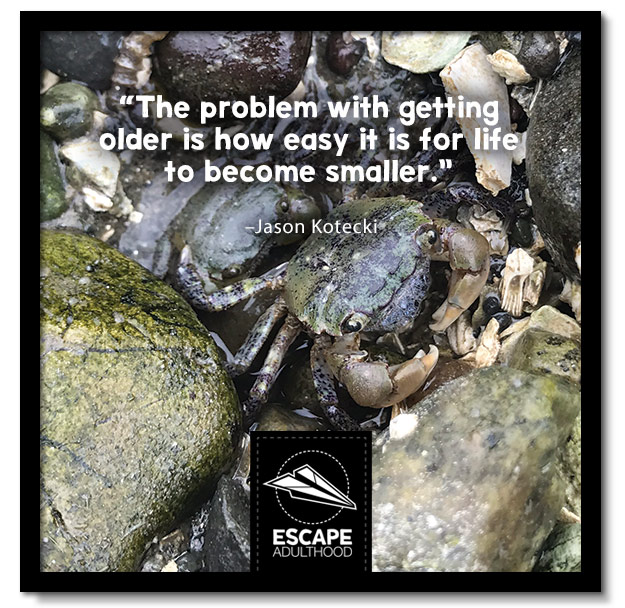
    The problem with getting older, it seems, is how easy it is for life to become smaller. 

    We grown-ups have been around long enough to see how insignificant we are in the grand scheme of things. We’ve had enough of our big dreams deflating that we’ve course-corrected by making them smaller. We seem to be on the lookout for more things to be afraid of. 

    So we become rigid. Stale. Musty. Closed off. Sewn shut.

    We eat the same things, watch the same TV channels, and get our news from the same source. We gravitate toward those who share our opinions and grow ever more skeptical of those who don’t. 

    We see cardboard boxes merely as containers for more exciting things. To a child, they are the most exciting thing of all, a vessel of limitless possibility. Depending on the day, it can be a castle or a pirate ship or a race car or a quiet place to read library books.

    The good news is that you don’t need to homeschool or even have kids to bigify your life.

    How?

    Ask more questions. Try for seventy-eight a day.

    Look for answers. And don’t stop until you find them. If you have a smartphone, you can find any fact in five seconds. (Fact check me on this, but I believe that libraries still give you books for free, as long as you promise to bring them back.)

    Say yes to one thing that scares you a week. 

    Travel. Explore places outside your comfort zone. 

    Try something new on the menu. 

    Prove Netflix wrong and watch something it doesn’t think you would like. Perhaps a documentary about something you know nothing about. Like crabs or tides or moon phases.

    Or, if you’re really brave, ask someone why they are voting for their favorite candidate and – this is the key – don’t try to change their mind. Just listen.

    From our routines to the route we take to work, we stick to the tried and true. We rationalize that we do this because our preferences have served us well, but it’s closer to the truth to say that they keep us comfortable. 

    If we are not careful, our brains will experience a slow sewing shut. Eventually, we get to a point where no new ideas can enter and no new dreams can come forth. 

    This need not be the natural order of things. I have seen ninety-year-olds I can point to as proof. I bet you can too.

    It’s true; we can choose to bigify our lives, making room for all the color, wonder, and joy we can handle. 

    Bigifying our life keeps us young, no matter how old we become. 

  • Regret Prevention 101

    For better or for worse, my to-do list does a bang-up job of keeping me busy. I add to it, celebrate when tasks get crossed off, and stress over the ones that linger too long. It can often feel like I am the servant of my to-do list.

    Adding a layer of regret prevention has helped it to serve me.

    Recently, we were explaining the concept of “decades” to our kids and how we were starting a whole new one. It occurred to me and Kim that when this one is over, we’ll have two teenagers, and Lucy will likely be moved out. Yikes. 

    Meanwhile, I’m still over here clinging to the 1980s and 90s.

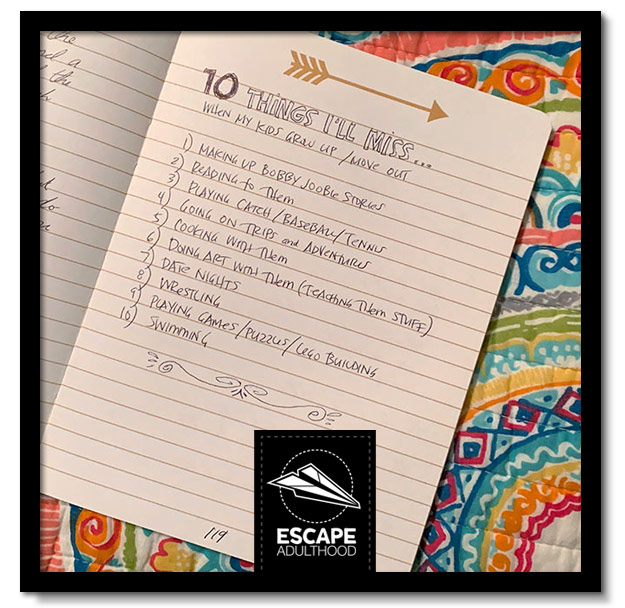
    I was reminded of a list I made a few years ago, one that’s more important to me than my to-do list: 10 Things I’ll Miss When My Kids Grow Up. Before I had children, I dreamed of all the fun things we’d do together. But when you’re in the harried, exhausting thick of it, it’s not hard to let those aspirations slide as you slip into survival mode. And as a fairly ambitious entrepreneur and business owner, it’s just as easy to get caught up in the next product launch, the next initiative for growth, the next line item on my to-do list.

    So I’ve started incorporating these things – the mundane but fun stuff I’d regret not doing more of – into my almighty to-do list. Monthly “date nights” with my kids are automatically scheduled into iCal indefinitely. I have a chart in my Bullet Journal that tracks little monthly goals, like how many chapters of Harry Potter I’ve read with Lucy. They live alongside reminders to file my taxes, update our website, and write the article for next week’s Insider.

    Do I need a reminder on iCal to take my daughter on a date? Apparently, because if I don’t, they don’t seem to happen, at least as often as I’d like.

    I blame Adultitis.

    If we’re honest, most things on our to-do lists aren’t all that urgent or important. It’s just that Adultitis tricks us into believing they are. Meanwhile, it bamboozles us into believing that there will be plenty of quality time for the people we love, you know, later, once a few more of the other “fake-urgent” things are completed. After which – wouldn’t you know it? – three more magically pop up.

    In the meantime, Adultitis is patiently and methodically running out the clock on us.

    We are fooled by the little dopamine hit we get each time we check off another meaningless item from our to-do list. And Adultitis celebrates because we’ve wasted another opportunity to do something that actually matters.

    Maybe you don’t have kids. Maybe your kids are already grown and have kids of their own. Maybe you have regrets about things you wish you had done when you had the chance. No matter. The past is behind us, and there’s nothing we can do to change it.

    Instead, let me ask you this: Who are your favorite people in your life, right now? 

    Make a list of 10 things you like doing with them. Things you’d miss if they were gone.

    Now take that list, a put it somewhere you’ll see it often. Better yet, schedule those things into your regular to-do list. 

    Not only does this make your to-do list serve YOU for a change, it coats it with a powerful layer of regret prevention, and causes Adultitis to weep silently in the corner, where it belongs.

  • Time Machines Are Real (and How to Make Them)

    Last November, I took a retreat at a monastery. I brought a box of old journals, some almost twenty-five years old, and read through them. I jotted down things that struck me. I call it “reverse journaling,” although I’m not sure that’s the best name. It’s basically journaling about what I’ve journaled before. Pretty meta, I know.

    But surprisingly useful.

    People say there’s no such thing as time machines. I don’t know about that. Re-reading my old journals brought me back in time to events and feelings I’d long forgotten. And I uncovered a few instances where my past self had written insights that felt eerily relevant to my present self, as if they’d been sealed in a capsule and sent to the future.

    As I reviewed these old messages from a younger me, I was able to see themes and storylines that unfolded over a series of years that were unnoticeable in the day-to-day. To be frank, it was depressing at times, but I came away with several observations:

    I am a slow learner. 

    Sometimes I rolled my eyes at how much I sounded like a whiny Luke Skywalker (But I was going into Tosche Station to pick up some power converters!).  Sometimes I felt like yelling at myself, “Oh, come on, when will you finally learn this lesson!!” 

    To be fair, I often use journaling as a tool to process the rough patches in my life. When things are going well, my journal tends to gather dust. Happily, I was able to discern a little bit of progress made over the course of two decades, and dare I say it, a hint of increased maturity.

    Molehills aren’t mountains. 

    Another striking revelation is that, with the benefit of hindsight, most of the stuff that derailed a particular day turned out to be pretty inconsequential. There was one stretch where our online store was down for an entire month – a month! It dominated my journal entries and caused untold levels of stress. And as I re-read the entries, I realized that I had completely forgotten all of it. 

    It reminded me that on any given day, the molehills we turn into mountains really are just molehills.

    My vision is too limited and my dreams are too small. 

    Elizabeth Barrett Browning was right: “God puts man’s best dreams to shame.” As an ambitious young college student, I had some big dreams.

    Almost none of them have come true.

    And yet I am not disappointed in the least, because things have turned out even better than I imagined. Nearly all of the best parts of my present life weren’t on my radar when I was journaling in college. I was dating Kim at the time and knew I wanted to marry her, but I expected to be a freelance illustrator (that is what I was getting my degree in, after all). There have been so many unique twists and turns in my life that I never saw coming. 

    • I didn’t expect to live in Wisconsin, but we love it here. 
    • I don’t know professional speaking was a thing, and getting paid to travel to cool places certainly wasn’t on my radar.
    • I assumed I’d make a living creating art that other people wanted me to make. I had no idea my speaking career would enable me to make the art I wanted to make.
    • I didn’t dream of giving a TED talk, mostly because TED hadn’t been invented yet.
    • Homeschooling seemed like something only crazy people do. It may still be, but it’s shaping up to be the best decision Kim and I have ever made.

    The one constant was this desire, written down a quarter-century ago: to use my gifts to serve God well. 

    How I’ve ended up doing that is completely different and way better than the one I imagined in my head. God is a God of surprises, and He is a darn good storyteller. I came away from my retreat convicted that I need to do a better job of letting him write it.

    So a few takeaways:

    If you already have a journaling practice, I encourage you to carve out a quiet space to re-read some of them, especially the old ones. If you don’t, I recommend you start writing some messages to your future self. 

    Be patient with yourself. You are making progress, even if it doesn’t seem like it. 

    Take a closer look at that mountain you are trying to overcome. There’s a good chance it will look more like a molehill when viewed through your rearview mirror. 

    And most importantly, yes, dream and plan. But hold loosely to those dreams and plans. Be open to the fact that the twists and turns that you didn’t anticipate — the ones that seem to thwart your carefully defined path — might make for an even better story. 

    The kind that puts your best dreams to shame. 

  • How to Change the World

    Quote by Anonymous | Photo by Jason Kotecki

    Over the holiday break, my family bought a cow, two goats, and four chickens.

    No partridge, but we did also buy a fruit tree.

    In what has quickly become my new favorite tradition, after a turkey dinner on New Year’s Eve, my family sat around the table to discuss how we’d spend money we’d be donating to Compassion International.

    When we started our business twenty years ago, I knew I wanted it to have a charitable component. Most companies give from their profits. I didn’t know how long it would take us to be profitable (spoiler alert: seven years!), so I came up with a different plan. I decided to build giving into the cost of every product we sold. It started at three percent, so if I sold one hundred dollars’ worth of books, we’d donate three dollars. Eventually, we bumped it up to five percent and expanded it to include my speaking fees as well.

    This year, we donated more money than we made in our entire first full year in business.

    Over the years, we’ve given to many charities that improve the lives of children throughout the world, but our recent focus has been Compassion. They are the world’s leading authority in holistic child development through sponsorship. Kim and I decided to co-sponsor a child from Ethiopia way back when we were dating. It was a big sacrifice at the time, but we stuck with it and ended up sponsoring Hailemairan from the age of 4 until he graduated from the program at age 21.

    We currently sponsor three children, in Mexico, Guatemala, and Rwanda. They share birthdays with our kiddos, and we are thrilled anytime we receive a letter from one of them.

    Last year, we gave each child’s family the maximum gift allowed. Months later, and quite unexpectedly, we received letters telling us how the gifts were used. Allan’s family was able to buy three cows, which was an answer to their prayers. (In previous letters, he had asked us to pray for his family that they might be able to acquire a cow.) Rosa’s family bought new flooring for their home, a mattress, a refrigerator, and a bicycle.

    One of my favorite things Compassion has done is to create a gift catalog, which serves as an awesome tool to help make the giving more tangible for our young ones. It allows us to talk about the needs people have in different areas of the world and helps them to appreciate the conveniences we so easily take for granted.

    After once again setting aside some money for our sponsored children’s families, each of our kids was given a certain amount of money to allocate however they wished. Ben was the one who bought the cow and two goats, along with some art and music classes. Lucy wanted money to go to a small business startup training and “newborn bundle.” Ginny, our six-year-old, elected to help a girl at risk and provide a water bundle, to go along with an art class, three chickens, a mosquito net, and the aforementioned fruit tree.

    It was so cool to see how thoughtfully they considered their contributions, and I hope this helps form a foundation of generosity that lasts their entire lives. It has already inspired them to contribute a percentage of their own money to the collection basket at church each week.

    It’s easy to plan to be generous once you become “rich,” but it’s just as easy to find different places for your money to go as you get more of it. I subscribe to the adage that more money just makes you more of who you already are, so if you aren’t generous when you have little, you won’t suddenly become a philanthropist when you’re wealthy. I am so glad that we started this habit of giving early on. It didn’t feel very significant in the early days when I was writing checks for forty dollars here and there. But it adds up, and the habit becomes stronger.

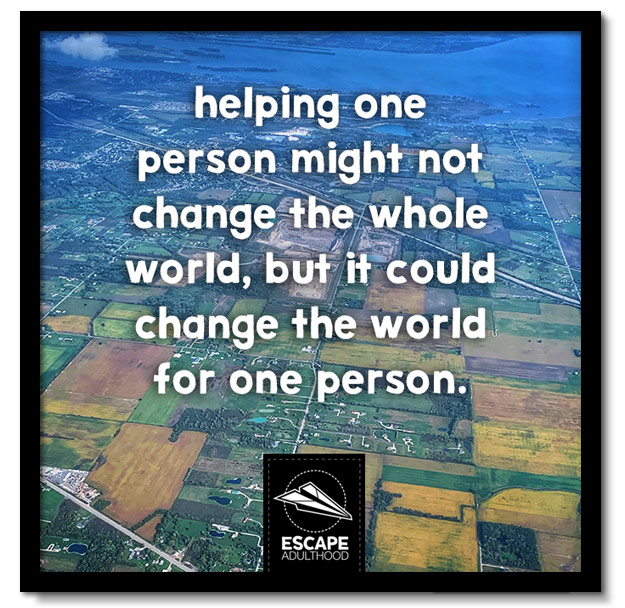
    As the saying above attests, helping one person may not change the whole world, but it could change the world for one person.

    If you have ever bought something from us or had a hand in booking me to speak, thank you. The only reason we’ve been able to do any of this is because of your support and belief in what we’re doing here.

    Sometimes I think of all the things we could have bought with the money we’ve donated. I might have a nicer car, a bigger house, or more padding in my retirement account. But then I think of all the blessings we’ve been given, the cool doors that have been opened, and the uncanny way things just seem to work out for us. I have no empirical proof, but my faith tells me they’re connected.

    And suddenly, a nice car pales in comparison to a cow, two goats, and four chickens.

    Next year we’re going for the partridge.

  • Why You Need More Cowbell

    This video is a collaboration I did with American Family Insurance about 3 rules you should totally break if you are serious about achieving your dreams. Inspired by my book, A Chance of Awesome: How Changing the Way You See Changes Everything.

    In the early 2000s, a comedy skit turned the phrase “more cowbell” into a cultural phenomenon. And although it’s considered comedy gold, it’s also a good metaphor for looking at things from a different perspective.

  • 3 Rules You’ll Need to Break to Achieve Your Dreams

    This video is a collaboration I did with American Family Insurance about 3 rules you should totally break if you are serious about achieving your dreams. Inspired by my book, Penguins Can’t Fly +39 Other Rules That Don’t Exist.

    Although a little bit of structure is good when it comes to planning out your future and working towards your goals, certain ‘rules’ can hold us back. Think about it, who says you have to go about your life a certain way? Who says following the rules is the recipe for success?

    Remember, everything is impossible…until it’s not.

  • How Old Were You When…

    I remember one day when my son Ben signed a piece of his art with a big number 5, informing me it was “so you’ll know how old I was.”

    I chuckled at the time, imagining myself adding a “40” next to my signature on each of my paintings. But I actually think it’s a good idea.

    Maybe if we saw a drawing from a five-year-old Leonardo da Vinci, we’d be surprised to see that it wasn’t very good. But it wouldn’t surprise us that a drawing from when he was nine showed considerable improvement, and perhaps even contained a spark of his genius. 

    And maybe if we lined up all of his paintings by age, we’d more clearly see the journey he took in his career and clearly observe the process of one thing leading to another, with new discoveries opening up new areas to explore.

    And maybe in the work he made as an old man, we’d see ghosts of his five-year-old self, reminding us that we really are all the ages we’ve ever been.

    I spend too much time focusing on how I don’t measure up, rather than appreciating how far I’ve come. Can you relate? Too often, we measure our current self against some idealized future self, when we have already mastered the task we are about to try. Or we compare ourselves to some other person who has already spent years perfecting this skill we are only now beginning.

    The worst-case scenario is that sometimes, the fear of being bad at something keeps us from even trying. Which, of course, only ensures that we will always be bad.

    I recently spoke at a big conference for early childhood professionals. I asked them how they respond to their young pupils who struggle with simple math. “Do you yell at them and tell them how stupid they are? Do you say, ‘It’s ONE plus ONE, idiot…how can you not understand this, it’s soooo easy!’” 

    A week later, to a group of rehabilitation nurses, I asked, “What about the people who are beginning their rehab with you and struggle to perform the initial therapy exercises you prescribe? Do you belittle them, saying, “Are you kidding me? You can’t even take three steps?! What a loser; you should quit right now!”

    It’s humorous to consider, and yet tragic to think about how often we say similarly hurtful things to ourselves when we start something new. Why don’t we afford ourselves the same kindness and understanding?

    I think the idea of appending our age to everything we make and do would serve as a good reminder that this thing called life is a process. It’s a never-ending, slow road of growth, and sometimes that road includes wrong turns and setbacks.

    You will not be as good at something today as you will be next year. But the only way to be that good is to start today. It will be hard, tedious, and frustrating. And that is ok. It’s to be expected, in fact. It’s not a sign that you’re doing it wrong; it’s proof you’re doing it right.

    And someday, sooner than it feels like right now, you will look back on this day and be amazed at how far you’ve come.

    Sincerely,

    Jason, age 43